
Understanding Your Options When You Can’t Work
How to apply for disability insurance in nj is a critical question for any New Jersey worker facing a medical condition that prevents them from earning a paycheck. The sudden loss of income, coupled with the stress of a health crisis, can feel overwhelming. This comprehensive guide is designed to be your roadmap, providing a clear, step-by-step walkthrough of the entire process to help you secure the benefits you’ve earned.
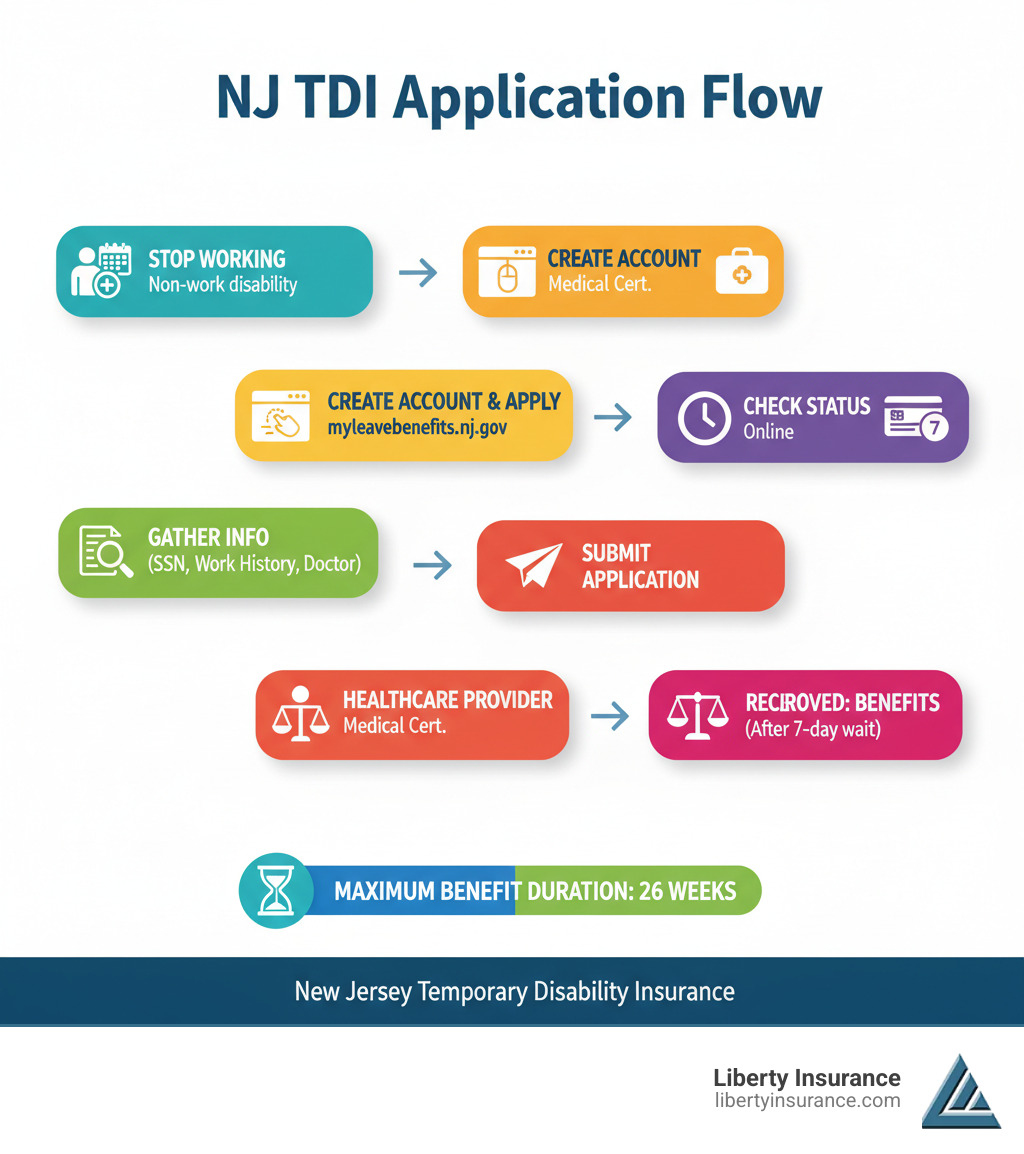
Here’s the quick answer on applying for New Jersey’s Temporary Disability Insurance (TDI):
- Create an account on the NJ Division of Temporary Disability website.
- Complete your portion of the online application (Part A).
- Have your healthcare provider complete their medical certification (Part B).
- Have your most recent employer complete their statement (Part C).
- Submit the completed application and await a decision.
- Check your claim status online through your account.
Note: If your employer has a private TDI plan, you must apply through them, not the state. Contact your HR department for instructions.
New Jersey’s Temporary Disability Insurance (TDI) program is a vital safety net, providing cash benefits when you can’t work due to a non-work-related illness or injury. It can replace a significant portion of your wages for up to 26 weeks, giving you financial stability while you recover. This program is funded by deductions from your own paycheck, meaning you’ve been paying into this system for this exact kind of emergency.
This guide will help you steer the application process, understand eligibility, and know what to expect. We’ll clarify how state TDI differs from federal Social Security Disability (SSDI) and private disability insurance, ensuring you apply for the right program. A well-prepared application is the key to a successful claim, ensuring you get the support you need without unnecessary delays.
Understanding New Jersey’s Disability Insurance Programs
When a health issue stops you from working, it’s crucial to know where to turn for help. New Jersey offers several programs, and identifying the right one is the first step. Understanding these distinctions makes how to apply for disability insurance in nj much clearer and prevents critical delays.

What is Temporary Disability Insurance (TDI) in New Jersey?
New Jersey’s Temporary Disability Insurance (TDI) provides short-term cash benefits to eligible workers who are unable to perform their job due to a non-work-related illness, injury, or other medical condition, including pregnancy and recovery from childbirth. Managed by the Division of Temporary Disability and Family Leave Insurance, the program offers income replacement for a maximum of 26 weeks. It’s designed to provide financial support so you can focus on recovery without the added stress of a total loss of income. It is important to remember that if your injury or illness is work-related, you must apply for Workers’ Compensation instead, as TDI specifically excludes work-related conditions.
State Plan vs. Private Plan for TDI
New Jersey employers are required to provide TDI coverage, and they can do so through either the NJ State Plan or an approved Private Plan. The State Plan is the default, government-administered option. However, many employers opt for private plans managed by an insurance carrier. By law, these private plans must offer benefits that meet or exceed the State Plan’s provisions, including benefit amount, duration, and eligibility requirements.
The most critical difference for you is where to file. For the State Plan, you apply directly with the state online. For a Private Plan, you must apply through your employer’s designated insurance carrier, using their specific forms and procedures.
How do you know which plan you have? The easiest and most reliable way is to contact your employer’s HR department. They can confirm your coverage and provide the correct application forms and instructions. Applying to the wrong entity is a common mistake that will cause significant delays in receiving benefits.
Employers might choose a private plan for several reasons, including potentially faster claims processing, better customer service, or the ability to integrate disability benefits with other company-provided benefits. Regardless of the reason, your HR department is your primary point of contact to begin the process correctly.
Key Differences: TDI, Family Leave Insurance (FLI), and Social Security Disability (SSDI)
It’s easy to confuse the various benefit programs. Applying to the correct one from the start is essential to avoid rejection and lost time.
- Temporary Disability Insurance (TDI): For your own short-term, non-work-related medical condition. It provides up to 26 weeks of income replacement.
- Family Leave Insurance (FLI): For time off to care for a seriously ill family member or to bond with a new child. It is not for your own disability. It provides up to 12 weeks of benefits.
- Social Security Disability Insurance (SSDI): A federal program for severe, long-term disabilities expected to last at least 12 months or result in death. The SSDI application process is much stricter, takes much longer, and is managed by the Social Security Administration, not the state of New Jersey.
This table highlights the main differences:
| Feature | Temporary Disability Insurance (TDI) | Family Leave Insurance (FLI) | Social Security Disability Insurance (SSDI) |
|---|---|---|---|
| Program Type | State | State | Federal |
| Reason for Leave | Your own non-work-related illness or injury | Caring for a sick family member or bonding with a new child | Long-term disability preventing any substantial work |
| Duration | Up to 26 weeks | Up to 12 weeks | Long-term or permanent |
| Benefit Type | Cash benefits | Cash benefits | Cash benefits and Medicare eligibility |
| Funding Source | Employee payroll deductions | Employee payroll deductions | Employee & Employer payroll (FICA) taxes |
These programs provide income but do not guarantee job protection. Job security is covered by separate laws like the federal Family and Medical Leave Act (FMLA) and the New Jersey Family Leave Act (NJFLA), which we’ll discuss in detail later.
Are You Eligible for NJ Temporary Disability Benefits?
Before you begin the application, it’s essential to confirm you meet the state’s strict eligibility criteria. Failing to meet even one requirement will result in a denial, so reviewing this section carefully is a critical first step. This section breaks down the medical and financial requirements for TDI benefits.
Who Qualifies for TDI Benefits?
To qualify for New Jersey’s TDI program, you must meet four main conditions:
- You are unable to work due to a physical or mental health condition that is not work-related. This includes illnesses, injuries, pregnancy, and childbirth recovery.
- You are under the care of a licensed medical provider who can certify your disability. This includes a licensed physician, dentist, optometrist, podiatrist, practicing psychologist, advanced practice nurse, or chiropractor.
- Your disability is not caused by your job. If your condition is a result of your work duties or an accident at the workplace, you must file a claim with the Division of Workers’ Compensation.
- You have a recent history of employment in New Jersey and have earned enough to meet the minimum financial requirements.
Minimum Earnings Requirements to Qualify
New Jersey determines your financial eligibility based on your earnings during a “base year” period. The base year is defined as the first four of the last five completed calendar quarters before the week your disability began. You only need to meet one of the following two monetary thresholds.
- For disabilities beginning in 2024, you must have worked 20 or more calendar weeks in covered New Jersey employment, earning at least $283 per week, OR you must have earned a combined total of at least $14,200 in your base year.
- For disabilities beginning in 2025, you must have worked 20 or more calendar weeks, earning at least $303 per week, OR you must have earned a combined total of at least $15,200 in your base year.
These requirements ensure that benefits are reserved for individuals who have recently and substantially contributed to the state’s workforce and the TDI fund.
How Your Weekly TDI Benefit is Calculated
If you are deemed eligible, your weekly benefit amount is calculated as 85% of your average weekly wage from your base year. However, there is a maximum amount set annually by the state.
- The maximum weekly benefit for 2024 is $1,055.
- The maximum weekly benefit for 2025 is $1,081.
Your benefit will be 85% of your average weekly wage, capped at the annual maximum. Let’s look at an example: Suppose your disability begins in 2025. To calculate your average weekly wage, the state looks at the wages you earned in the 8 weeks immediately preceding your disability. If you earned $1,000 per week during that time, your average weekly wage is $1,000. Your weekly benefit would be 85% of that, which is $850. If you earned $1,500 per week, 85% of that is $1,275. Since this is above the 2025 maximum, your benefit would be capped at $1,081 per week.
The TDI program is funded entirely by employee payroll deductions. For 2025, workers contribute 0.23% on the first $165,400 in wages, with a maximum annual contribution of $380.42. If you meet these criteria, you are ready to proceed with how to apply for disability insurance in nj.
The Step-by-Step Guide on How to Apply for Disability Insurance in NJ
Once you’ve confirmed your eligibility, the next step is submitting a complete and accurate application. This section provides a practical, detailed walkthrough of the process, from gathering your documents to coordinating with your doctor, to minimize the chance of errors and delays.

What Information Do I Need to Apply?
Being prepared is the key to a smooth application. Before you sit down to start your claim, gather the following information and documents:
- Personal Information: Your Social Security number, full name, date of birth, and current contact details (mailing address, phone number, email). If you want direct deposit, have your bank’s routing number and your account number ready.
- Employment Information: The full name, mailing address, and phone number for all employers you worked for in the last six months. You’ll also need your start and end dates of employment, your occupation, and the exact last day you physically worked before your disability began.
- Medical Information: Your healthcare provider’s full name, address, phone number, and license number. You’ll need to know your diagnosis (or a description of your illness/injury) and the date you were first treated for this specific disability.
- Disability Dates: The first day you were unable to work due to your condition. If you know it, the expected date you will be able to return to work.
- Other Benefits: Details on any other benefits you are receiving or have applied for, such as Workers’ Compensation, unemployment insurance, or a private disability insurance policy.
How to Apply: Online vs. Mail/Fax
New Jersey provides two methods for submitting your TDI application, but one is far more efficient and strongly recommended.
- Online Application: This is the fastest, most secure, and most recommended method. You get immediate confirmation that your claim was received, which starts the processing clock sooner. You can start an application online after creating a secure account. The system saves your progress, allowing you to complete it at your own pace and reducing the risk of lost paperwork. It also allows for easier status tracking.
- Mail or Fax: This traditional method is available but is significantly slower. It involves printing, manually completing, and sending paper forms (Form DS-1). This process is prone to mailing delays, processing backlogs, and potential issues with illegible handwriting. If you must choose this route, download the latest version of the form from the state’s website, write clearly in black ink, and ensure all parts are signed and complete to avoid automatic rejection.
The Role of Your Healthcare Provider
Your claim cannot be processed without medical certification from your healthcare provider. This is known as Part B of the application, the “Medical Certificate.”
Your provider must confirm your diagnosis, state the medical facts supporting it, and certify how long they expect you to be unable to work. When you complete your part of the application online, you will receive a unique Online Form ID number. You must give this number to your medical provider so they can log in to the state’s portal and submit their certification online.
Pro Tip: Do not assume your doctor’s office will handle this automatically. Call the office, explain that you have completed your part of the NJ TDI application, and provide them with your full name, date of birth, and the Online Form ID number. Ask them to confirm when they have submitted their portion. Any delay on their end will directly delay your receipt of benefits, so polite and persistent follow-up is key.
After You’ve Applied: What to Expect Next
After submitting your application, the next phase is waiting for a decision and understanding the outcome. Knowing the timeline and your rights is crucial during this period. Here’s what happens next.
Checking Your Claim Status and Awaiting a Decision
Waiting for a decision can be stressful, but the process is typically faster than many people expect. Once the Division of Temporary Disability Insurance receives your completed application—meaning your part, your doctor’s part, and your employer’s part—the state’s goal is to process the claim and mail a determination within 10-14 business days. However, this timeline can be extended if the application is incomplete, requires additional medical information, or during periods of high claim volume.
You can and should check your claim status online at any time using the account you created. This is the most efficient way to get updates and see if the state requires more information from you.
Once a decision is made, you will receive an official determination notice in the mail. If your claim is denied, the notice will explain the specific reason. Common reasons for denial include not meeting the earnings requirements, insufficient medical evidence to support the disability period, the condition not qualifying as a disability under state law, or a failure to submit all parts of the application.
If Your Application is Approved: Payments and Duration
If your claim is approved, benefits will be issued. Key things to know include:
- Waiting Week: There is a mandatory 7-day waiting period for all new claims. Benefits are not paid for the first seven consecutive days of your disability. Your eligibility for payments begins on the eighth day.
- Payment Method: Benefits are typically paid via a Money Network prepaid debit card. The card is mailed in a plain, unmarked envelope for security, so watch for it carefully. If you have an existing card from a prior NJ unemployment or disability claim within the last three years, funds will be loaded onto that same card.
- Payment Schedule: After the initial payment, benefits are generally issued bi-weekly as long as you remain disabled and under the care of a medical provider.
- Duration: You can receive TDI benefits for up to 26 weeks in a 12-month period, as long as your medical provider continues to certify your disability. If your disability extends beyond the initial period certified by your doctor, you will need them to submit updated medical information to continue your benefits.
Appealing a Denied TDI Decision
A denial is not the final word. You have the right to appeal the decision, but you must act quickly. Timing is critical: for State Plan claims, you must file your appeal in writing within 7 days of the mailing date on the denial notice. This is a very strict deadline.
For State Plan denials, you can file an appeal online or by mail. If you have a private plan, you must follow the appeal process outlined by your employer’s insurance carrier. The state’s Private Plan Compliance Section can assist if you have issues with a private plan carrier.
To build a strong appeal, you should include a copy of the denial letter, a clear written explanation of why you disagree with the decision, and any new or additional medical evidence that supports your claim. This could include more detailed doctor’s notes, results from medical tests, or a second opinion from another provider. A well-documented appeal that directly addresses the reason for denial has the best chance of success.
Job Protection, Taxes, and Other Considerations
Receiving TDI benefits is just one piece of the puzzle. It’s also critically important to understand how your leave affects your job security, your tax obligations, and how it interacts with other benefit systems.
How Job Protection Works While on Leave
A common and dangerous misconception is that TDI provides job protection. TDI provides income replacement only; it does not guarantee you will have a job to return to.
Job protection is provided by separate, distinct laws, primarily the federal Family and Medical Leave Act (FMLA) and the New Jersey Family Leave Act (NJFLA). You may be eligible for job-protected leave under these laws while receiving TDI benefits, but you must apply for them separately through your employer.
- FMLA provides up to 12 weeks of unpaid, job-protected leave for your own serious health condition. It generally applies to public agencies and private employers with 50 or more employees. To be eligible, you must have worked for your employer for at least 12 months and for at least 1,250 hours in the past 12 months.
- NJFLA primarily covers leave to care for a family member or bond with a new child. In most cases, it does not cover leave for your own disability, making FMLA the primary source of job protection for your own health condition.
Think of it this way: you apply to the State (or private carrier) for TDI to get paid. You apply to your employer for FMLA to protect your job. To see if your job is protected, use New Jersey’s Job Protection Coverage Checker. Always maintain open communication with your employer’s HR department about your leave status and expected return date.
Are NJ Temporary Disability Benefits Taxable?
Understanding the tax implications of TDI benefits can prevent surprises when you file your annual tax returns.
- Federal & State Income Tax: TDI benefits are generally considered taxable income for both federal and New Jersey state income tax purposes. You will receive a Form 1099-G from the State of New Jersey detailing the total amount of benefits you received during the calendar year. You must report this income on your tax returns.
- FICA Taxes: TDI benefits are not subject to Social Security and Medicare (FICA) taxes.
Your TDI benefits will not appear on your employer’s W-2 form. It is your responsibility to report the income from the 1099-G. If you have questions about how your benefits are reported, contact the NJ Division of Temporary Disability Insurance. For personalized advice on your tax situation, it is always best to consult a qualified tax professional.
Distinguishing TDI from Workers’ Compensation
It is critical to apply to the correct program from the outset. TDI is for non-work-related disabilities only.
If your injury or illness occurred on the job or is a direct result of your work duties, you must file a claim for Workers’ Compensation. This is a separate program handled by the Division of Workers’ Compensation. For example, if you slip on a wet floor at your office and break your arm, that is a Workers’ Compensation claim. If you break your arm while skiing on a weekend, that is a TDI claim.
In some cases, if your Workers’ Compensation claim is contested by your employer, you may be able to receive TDI benefits while you appeal the Workers’ Comp denial. However, to do so, you must file a formal claim petition for Workers’ Comp and agree to reimburse the TDI program from any settlement or award you receive. This prevents “double-dipping” or receiving payments from both programs for the same period.
Frequently Asked Questions about NJ Disability Insurance
Here are answers to some of the most common questions about how to apply for disability insurance in nj and how the system works. Understanding these nuances can help you navigate the process more effectively.
What if my employer has a private disability plan?
If your employer uses an approved private plan for TDI, you must file your claim directly with their designated insurance carrier, not with the State of New Jersey. Your first step should always be to contact your Human Resources (HR) department. They will provide you with the correct forms, contact information for the insurance carrier, and instructions on how to file. By law, private plans must provide benefits that are equal to or better than the state plan, so you are guaranteed a baseline level of coverage.
Can I work part-time while receiving TDI benefits?
Yes, in some cases. If you return to work on a part-time basis (fewer hours than your normal schedule) while still medically certified as partially disabled, you may be eligible for partial TDI benefits. Your partial benefit amount is calculated based on your part-time earnings to ensure your total income (wages plus benefits) does not exceed your regular pre-disability weekly earnings. This system is designed to support a gradual and safe return to the workforce as you recover.
How does TDI work with other types of insurance like long-term disability?
NJ TDI is a short-term benefit that provides income for a maximum of 26 weeks. It is designed for temporary periods of disability. For conditions that last longer than six months, you would need a different form of coverage to continue receiving income.
This is where long-term disability insurance becomes essential. As a separate, often private, policy, it provides income protection for extended disabilities that may last for many months, years, or even until retirement. Long-term disability coverage typically begins after a waiting period (called an elimination period), which often aligns with the 26 weeks that TDI benefits end, creating a seamless financial safety net.
What happens if my disability lasts longer than 26 weeks?
If your disability is expected to last or has already lasted beyond the 26-week maximum for TDI, you will need to look at other options. Your TDI benefits will stop. At this point, you should apply for federal Social Security Disability Insurance (SSDI) if your condition is severe and expected to last at least a year. If you have a private long-term disability (LTD) insurance policy through your employer or one you purchased yourself, you should begin the application process for those benefits, ideally before your TDI benefits run out.
Can I receive TDI benefits for a mental health condition?
Yes. Mental health conditions are treated the same as physical health conditions under the NJ TDI law. If a licensed medical provider (such as a psychiatrist or psychologist) certifies that you are unable to work due to a condition like severe depression, anxiety, or PTSD, you can be eligible for TDI benefits, provided you meet all other financial and employment requirements.
What if I have more than one job when I become disabled?
If you have multiple jobs in New Jersey, your eligibility and benefit rate are based on your combined earnings from all your covered employment. When you apply, you must list all your recent employers. The state will use the wages from all sources to determine if you meet the minimum earnings threshold and to calculate your average weekly wage. This ensures your benefit amount more accurately reflects your total loss of income.
Conclusion
Navigating the process of how to apply for disability insurance in nj is manageable when you are prepared. By understanding the eligibility rules, knowing whether you have a State or Private Plan, gathering your documents in advance, applying online, and maintaining clear communication with your healthcare provider, you can successfully secure the financial support you need during a challenging time. New Jersey’s TDI program provides a crucial safety net, replacing a portion of your income for up to 26 weeks and allowing you to focus on what matters most: your recovery.
Remember the key takeaways: TDI is for your own non-work-related health condition, it provides income but not job protection, and you must act quickly to appeal a denial. However, it’s equally important to recognize the program’s limitations.
TDI is designed for temporary situations. For disabilities that last longer than six months, this short-term coverage will not be enough. A serious illness or injury can have lasting financial consequences, and this is why a more comprehensive strategy for protecting your income is essential for long-term security.
Private long-term disability insurance offers the extended protection that state programs don’t. It can provide a steady stream of income for months or even years, ensuring that a serious medical condition doesn’t derail your financial stability or force you into hardship. Planning ahead with private coverage creates a robust safety net that goes far beyond what state-mandated programs can offer, providing true peace of mind for you and your family.
At Liberty Insurance, we help individuals and businesses in New Jersey understand their disability coverage options. We can show you how private long-term disability insurance complements state benefits to protect your most valuable asset: your ability to earn an income. We are proud to serve communities across New Jersey, including Millstone Township, Trenton, Toms River, New Brunswick, and Princeton.
If you have questions or want to explore coverage options to safeguard your financial future, contact us today. Let us help you build the protection you and your family deserve.

