
Why Understanding Key Man Insurance Tax Rules Matters for Your Business
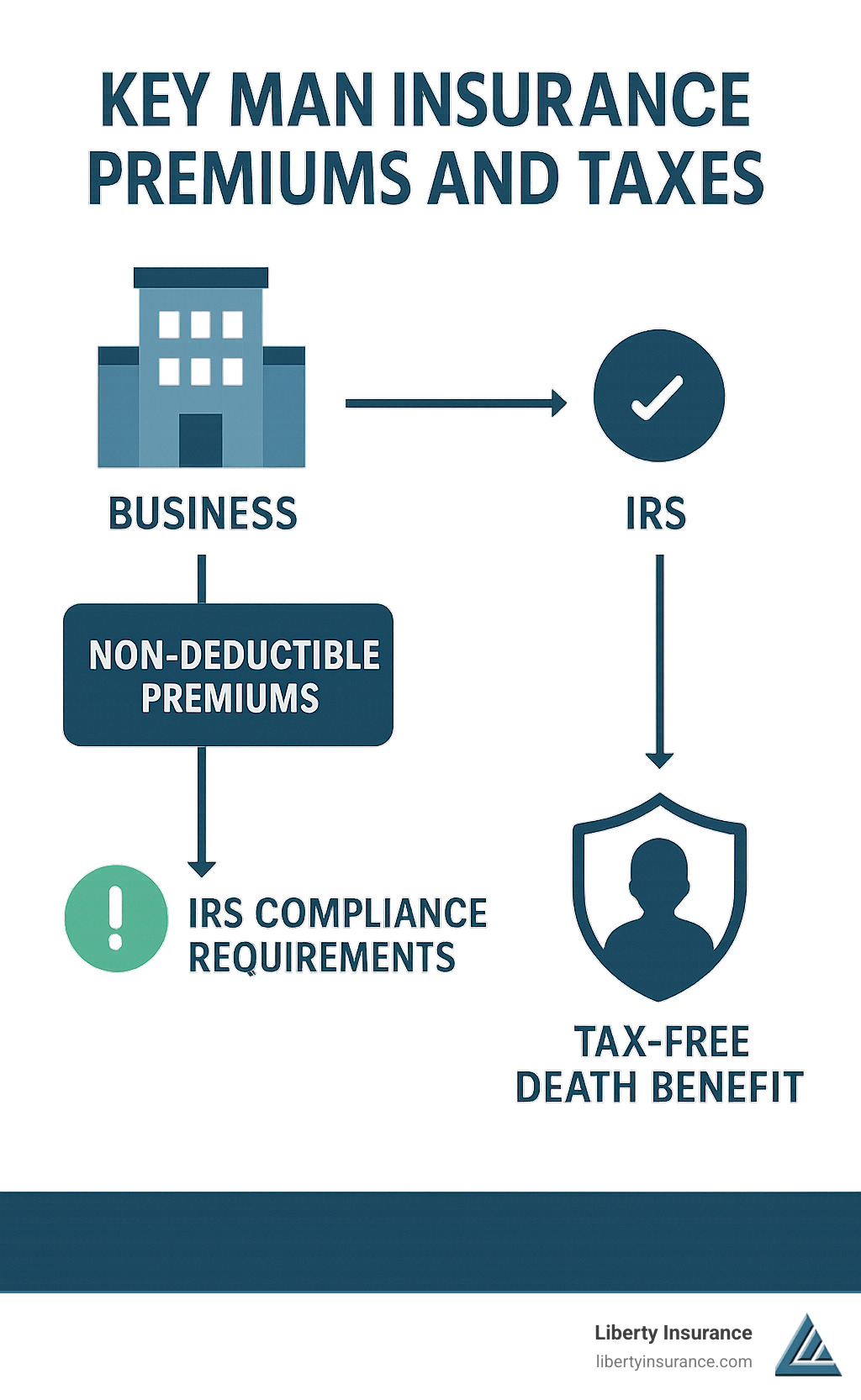
Are key man insurance premiums tax deductible? The short answer is a definitive no—key man insurance premiums are generally not tax deductible for businesses under IRS rules. However, the complete picture involves critical nuances and compliance requirements that every business owner must understand to avoid costly mistakes. While the premium isn’t deductible, the ultimate payout can be a tax-free windfall, but only if you follow the rules precisely.
Quick Answer:
- Premium Deductibility: No, premiums are NOT tax deductible as a business expense.
- Death Benefit: Generally received income tax-free by the business (but only if strict compliance rules are met).
- Key IRS Rule: Section 264(a)(1) of the Internal Revenue Code explicitly prohibits deductions for premiums when the business is a direct or indirect beneficiary.
- Important Compliance Framework: The Pension Protection Act of 2006 (PPA) introduced notice, consent, and reporting requirements that are mandatory for policies issued after August 17, 2006.
According to research from the American Management Association, a startlingly low 14% of companies report being well-prepared for the sudden loss of a key senior manager. This statistic highlights a significant vulnerability in the business world. Many business owners remain confused about the tax implications of protecting their most valuable asset—their key personnel—leaving them exposed not only to operational disruption but also to unexpected tax liabilities.
The IRS reasoning is straightforward and built on preventing what tax experts call a “double tax benefit.” The logic is simple: since your business stands to receive a substantial, tax-free death benefit, the government will not also allow you to reduce your taxable income by deducting the premiums paid to secure that benefit. Think of it this way: you can’t get a tax break on the input (premiums) and also get a tax break on the output (the benefit). This means you must pay for the policy with after-tax dollars. While this might feel like a disadvantage, it’s a small price to pay for the substantial, income-tax-free death benefit your business receives when structured properly.
Understanding these rules is absolutely critical because mistakes in compliance can turn your tax-free death benefit into fully taxable income. A simple oversight, such as failing to get written consent from the insured employee before the policy is issued, could cost your business hundreds of thousands of dollars in unexpected taxes at the worst possible time—right when it’s reeling from the loss of a key leader.
I’m Andrew Harris, a Certified Insurance Counselor with over 15 years of experience helping businesses navigate complex insurance and risk management decisions. I regularly advise clients on the specific tax deductibility of key man insurance premiums and, more importantly, the strict compliance requirements that protect the tax-free nature of their benefits. My expertise in commercial insurance gives me deep insight into these often-misunderstood tax rules, and I’ve seen firsthand how proper planning can save a business and how a lack of it can create a crisis.
In this comprehensive guide, we will explore every facet of this topic. We’ll start by defining key person insurance, then dive deep into the core IRS rules, unpack the critical requirements of the Pension Protection Act, explore unique exceptions and scenarios, and answer the most frequently asked questions to provide you with a complete understanding.
What is Key Person Insurance and Why is it Essential?
Your business runs on more than just equipment and inventory—it depends on the irreplaceable people whose knowledge, skills, and relationships drive your success. Key person insurance (also commonly called key man insurance) is a life insurance policy that a business purchases on the life of a critical employee. When you find yourself asking, “are key man insurance premiums tax deductible,” you are already on the right track, thinking strategically about how to protect your most vital human assets.
Picture this: Your star creative director, the genius behind your most successful campaigns and the mentor to your entire creative team, suddenly passes away. The immediate aftermath is chaos. Without them, high-stakes projects stall, major clients become anxious about the future of their accounts, team morale plummets, and your revenue takes a serious, immediate hit.

That’s where key person insurance becomes your financial lifeline. It provides an immediate infusion of cash to the business. This capital can be used to cover lost revenue while you regroup, fund the expensive and time-consuming process of recruiting and training a high-caliber replacement, and reassure lenders and investors that the business has a contingency plan. The benefits also extend to serving as loan collateral for business financing and demonstrating foresight and stability to potential investors or buyers. It’s not just an insurance policy; it’s a critical component of your business continuity and succession planning strategy.
Want to dive deeper into protecting your most valuable assets? Check out our comprehensive guide on essential coverage for your business’s key personnel.
Who Qualifies as a Key Person?
A key person isn’t always the one with the top title or the corner office. A key person is anyone whose sudden absence would create significant financial or operational hardship for your business. To identify these individuals, ask yourself these questions:
- Does this person possess unique skills, knowledge, or expertise that would be extremely difficult or expensive to replace? (e.g., a lead software developer who understands your proprietary code).
- Is this person responsible for a significant portion of the company’s revenue or sales? (e.g., a top salesperson who manages your largest accounts).
- Are this person’s relationships with clients, suppliers, or lenders critical to the business’s operations? (e.g., an operations manager with deep-rooted supplier connections).
- Would this person’s absence negatively impact the company’s ability to secure financing or maintain investor confidence? (e.g., a visionary founder or CEO).
- Does this person’s leadership and vision provide the strategic direction for the company? (e.g., a CEO or president).
Your CEO or founder is an obvious choice, but don’t overlook a top salesperson who brings in 40% of your revenue, the lead developer who is the only one who understands your legacy software, a master craftsperson in a manufacturing business, or even a longtime CFO whose intricate knowledge of the company’s finances is essential for stability and growth. The test is simple: if losing this person would significantly and negatively impact your bottom line, they are likely a key person worth insuring.
The Financial Impact of Losing a Key Employee
The numbers tell a sobering story. Research has shown that for small businesses, losing a founding entrepreneur can result in a devastating 60% loss in sales in the year following their death. The financial impact radiates far beyond simply replacing a salary. The costs can be broken down into several categories:
- Direct Costs: These are the immediate, out-of-pocket expenses. They include recruitment fees for executive search firms (which can be 25-35% of the new hire’s first-year salary), signing bonuses to attract top talent, and extensive training and onboarding costs.
- Indirect Costs: This is where the damage truly multiplies. Productivity plummets as remaining team members struggle to fill the void and take on unfamiliar responsibilities. Projects are delayed or canceled, leading to lost revenue and missed opportunities. Employee morale can suffer, leading to higher turnover among other staff.
- Strategic Costs: Externally, the loss can be just as damaging. Shareholder and investor confidence can waver, potentially depressing your company’s valuation. Your creditworthiness may suffer as lenders reassess the risk of your business without its key leader, making it harder to secure or maintain loans. The loss of institutional knowledge—the undocumented processes, relationships, and insights built over years—can set the company back significantly.
Key person insurance provides the financial breathing room your business needs to navigate this challenging transition. It allows you to hire interim leadership, conduct a thoughtful search for the right replacement, and manage cash flow without the added pressure of declining revenues, giving the business the best possible chance to survive and thrive.
How Much Coverage Do You Need?
Determining the right amount of coverage is a critical step. There is no one-size-fits-all answer, but common methods include:
- Multiples of Salary: A simple approach is to insure a person for a multiple of their annual salary, typically ranging from 5 to 10 times their compensation. This method is easy to calculate but may not accurately reflect the person’s true value to the business.
- Contribution to Profits: A more precise method is to calculate the key person’s direct contribution to the company’s net profits. The coverage amount would then be set to replace that contribution for a set number of years (e.g., 3-5 years) while the company recovers.
- Cost to Replace: This method involves estimating the total cost to recruit, hire, and train a suitable replacement, including search firm fees, salary, bonuses, and the cost of lost productivity during the transition. This is often considered a baseline or minimum amount of coverage.
For a deeper look at these financial impacts, review this study on the financial impact of losing a key employee.
The Core IRS Rule: Are Key Man Insurance Premiums Tax Deductible?
Here’s the direct answer to the central question: are key man insurance premiums tax deductible? The answer from the Internal Revenue Service (IRS) is a firm and unequivocal no.
This rule is codified in IRS Section 264(a)(1) of the Internal Revenue Code. This section explicitly states that no deduction shall be allowed for “Premiums on any life insurance policy, or endowment or annuity contract, if the taxpayer is directly or indirectly a beneficiary under the policy or contract.” Since the entire purpose of key man insurance is for the business (the taxpayer) to be the beneficiary and receive the death benefit, the premiums automatically fall under this rule and must be paid with after-tax dollars.
The IRS logic is straightforward: they are preventing a “double tax benefit.” Since the business can receive a substantial, tax-free death benefit (which we’ll cover in detail next), the IRS will not also allow the business to deduct the premiums paid to obtain that benefit. It’s a trade-off: you forgo the annual premium deduction in exchange for a tax-free payout when you need it most. For the technical details, you can review the IRS guidance on life insurance proceeds.

Why the IRS Disallows the Deduction
The IRS reasoning becomes crystal clear when you consider the end-to-end transaction. The death benefit your business receives is generally tax-free income. This in itself is a significant tax advantage. Allowing a business to also deduct the premiums would mean getting a tax break on both the cost and the benefit. From a tax policy perspective, key man insurance premiums are treated as a capital expense—an investment in the financial stability and continuity of the business—rather than a regular, deductible operating expense like rent or utilities. You are using after-tax dollars to purchase a capital asset (the insurance policy) that protects the business’s human capital, much like you would use after-tax dollars to purchase a physical asset like a building or machinery.
How This Differs from Other Business Insurance
This tax treatment often surprises business owners who are accustomed to deducting premiums for most other types of commercial insurance. The distinction lies in the nature of the payout. Premiums for policies like business property insurance, commercial general liability, or errors and omissions insurance are typically deductible under Section 162 as ordinary and necessary business expenses. This is because their payouts are designed to restore a loss or make the business whole again—they reimburse you for a damaged building or a legal settlement. The payout is not designed to be a net financial gain.
Key person insurance is fundamentally different. Its payout is a cash infusion intended to help the business survive, transition, and recover from the loss of a critical contributor. It’s also crucial to understand that key person insurance is not an employee benefit. This is a common point of confusion. Premiums for group term life insurance provided to employees as part of their benefits package can be deductible for the business as a form of employee compensation. But because key person insurance serves the business directly—with the business as the owner and beneficiary—it falls into a different, non-deductible tax category.
Here is a simple comparison:
| Insurance Type | Premium Deductibility for Business | Payout Taxability to Business | Primary Purpose |
|---|---|---|---|
| Key Person Insurance | No (Capital Expense per Sec. 264) | Generally Tax-Free (if compliant) | Business continuity, financial stability |
| General Liability | Yes (Operating Expense per Sec. 162) | N/A (Pays third party) | Protects against lawsuits |
| Commercial Property | Yes (Operating Expense per Sec. 162) | Taxable only if it exceeds basis | Restores property to pre-loss value |
| Group Term Life | Yes (Employee Compensation) | N/A (Benefit paid to employee’s family) | Employee benefit, part of compensation |
Navigating the Pension Protection Act of 2006
While we’ve established that the answer to are key man insurance premiums tax deductible is no, ensuring your death benefit remains tax-free requires careful navigation of rules introduced by the Pension Protection Act of 2006 (PPA). For any policy issued after August 17, 2006, compliance with the PPA is not optional—it’s essential. The act introduced IRC Section 101(j), which tightened the rules for employer-owned life insurance (EOLI), a category that includes key man policies.
These rules were created to curb perceived abuses, such as corporations buying broad-based life insurance on rank-and-file employees without their knowledge (a practice sometimes called “dead peasant insurance”). The goal of Section 101(j) is to ensure that such policies are used for their intended purpose: insuring truly key individuals with their full knowledge and consent. If you fail to follow the PPA’s requirements, your entire death benefit (minus the premiums you paid) could become taxable income. The good news is that compliance is straightforward if you are diligent.
The Critical Notice and Consent Requirement
This is the absolute golden rule of EOLI compliance: no consent, no tax-free benefit. Before the insurance policy is issued, the employer must complete two critical steps:
- Provide Written Notification: The employer must provide the employee with a clear, written notice stating that the business intends to insure their life. This notice must also specify the maximum face amount for which the employee could be insured and inform the employee that the business will be the beneficiary of any death benefit.
- Obtain Written Consent: The employee must provide their written consent to be insured and acknowledge that the business is the designated beneficiary. This consent must be obtained before the policy is issued. Attempting to get retroactive consent after the fact is not compliant with IRS rules and will jeopardize the tax-free status of the proceeds.
While initiating this conversation might feel awkward, framing it correctly is key. Explain that this is a standard business protection measure, similar to insuring physical assets, designed to ensure the company’s stability and protect the jobs of all employees. Most key employees understand and will consent without issue.
Exceptions That Keep Your Death Benefit Tax-Free
Even with the PPA’s strict rules, IRC Section 101(j)(2) provides several safe harbors that allow the death benefit to remain tax-free, provided that the initial notice and consent requirements were met. The death benefit is generally tax-free if, at the time the policy was issued, the insured individual was:
- An employee at any time during the 12-month period before their death (the 12-month rule).
- A director of the company.
- A highly compensated employee (HCE) as defined by the Internal Revenue Code. For 2024, this is generally an employee who was a 5% owner at any time during the current or preceding year, or for the preceding year, received compensation from the business of more than $155,000 (this amount is indexed for inflation).
There is also an exception where the death benefit is paid out to an heir of the insured employee, such as a family member or a designated trust. In these cases, the amount can still be received tax-free.
Annual Reporting on IRS Form 8925
Compliance is an ongoing responsibility, not a one-time event. The IRS requires businesses with EOLI policies to file IRS Form 8925, Report of Employer-Owned Life Insurance Contracts, annually with their corporate tax return. This form requires you to report:
- The number of employees insured by such policies at the end of the year.
- The total amount of insurance in force on these employees.
- The number of employees for whom you obtained the proper consent.
- A confirmation that you have a valid record of the required consents.
We always recommend that our New Jersey clients work closely with a qualified tax advisor to ensure Form 8925 is filed correctly and on time every single year. Failure to file this form or filing it with incorrect information can be a red flag to the IRS and could jeopardize the tax-free status of your benefits upon a claim. The penalties for non-compliance are severe, so this administrative step should never be overlooked.
Exploring the Nuances and Exceptions
While we’ve established that the answer to “are key man insurance premiums tax deductible?” is a clear “no” under most circumstances, the world of tax law is filled with unique situations and common misconceptions that are worth clarifying to provide a complete picture.

What if Premiums are Taxable Income to the Employee?
In very rare and specific arrangements, a business might structure the premium payments as part of an employee’s compensation package. This is known as an “executive bonus arrangement” or Section 162 bonus plan. In this scenario, the tax treatment flips entirely:
- The business pays the premium directly to the insurance company or gives the cash to the employee to pay the premium.
- The premium amount is treated as taxable income to the employee and must be reported on their Form W-2.
- Because it is considered compensation, the business can deduct the premium payment as a compensation expense under IRC Section 162.
However, this approach is uncommon for true key person protection because the employee, not the business, typically owns the policy and names the beneficiary. This structure is more often used as an executive perk or retirement planning tool. Most businesses prefer traditional key man insurance to operate quietly as a corporate-owned financial protection tool without creating tax burdens for their valuable employees or giving up control of the policy and its death benefit.
The Loan Collateral Misconception in the US
A common misconception, often stemming from different tax laws in other countries like Canada, is that premiums become deductible if a bank requires key man insurance as collateral for a business loan. This is unequivocally false under US tax law. IRS Section 264(a)(1) is firm: if your business is a direct or indirect beneficiary, the premiums are not deductible. It does not matter if a lender required the policy as a condition for financing.
When you assign a policy as collateral, you are simply giving the lender first rights to a portion of the death benefit to repay the outstanding loan balance. This is called a collateral assignment. If the death benefit is, for example, $2 million and the outstanding loan is $500,000, the bank receives $500,000 and the business receives the remaining $1.5 million tax-free (assuming compliance). The business is still an indirect beneficiary, so the premiums remain non-deductible. The collateral assignment affects who gets paid first, but it does not change the fundamental tax treatment of the premiums.
Tax Treatment for S-Corporations, LLCs, and Partnerships
For pass-through entities like S-Corps, LLCs taxed as partnerships, and partnerships, the tax implications are slightly different, though the core principle remains. Since the business entity itself does not pay income tax, the financial activities flow through to the owners’ personal tax returns.
- Non-Deductible Premiums: The business still pays the premiums with its own funds. Since these premiums are not deductible at the entity level, they are not passed through as a deduction to the owners. Instead, these non-deductible expenses reduce the owners’ basis in the company.
- Tax-Free Death Benefit: When the tax-free death benefit is received by the business, it increases the owners’ basis. This is a positive outcome, as a higher basis can reduce the capital gains tax owed if the owner later sells their interest in the company.
It is crucial for owners of pass-through entities to work with a tax advisor to properly track these basis adjustments. Failure to do so can lead to an incorrect calculation of capital gains upon the sale of the business.
Frequently Asked Questions about Key Man Insurance Taxes
As business owners grapple with the complexities of key man insurance, we regularly hear the same questions. Let’s address the most pressing ones about are key man insurance premiums tax deductible and the broader tax landscape to provide clear, actionable answers.
What are the tax consequences for the business when it receives the death benefit?
The tax treatment of the death benefit depends entirely on compliance. If you have followed all the rules—specifically the notice and consent requirements of the Pension Protection Act of 2006 and the annual Form 8925 filing—the death benefit is received by the business as completely income tax-free cash. This sum is immediately available to stabilize operations, repay debt, or fund the search for a replacement. If you failed to meet these compliance requirements, the death benefit becomes taxable as ordinary income to the extent it exceeds the total premiums you paid into the policy. This can turn your financial lifeline into an unexpected and significant tax nightmare.
What are the tax implications for the key employee?
Here’s some good news: in a standard key man insurance arrangement, the key employee typically faces no tax implications whatsoever. Since the business owns the policy, pays the non-deductible premiums, and is the sole beneficiary, the employee receives no direct financial benefit or compensation. The IRS does not consider the premiums paid by the business as taxable income to the employee. The only rare exception is if the policy is specifically structured as an executive bonus arrangement where the premium is treated as compensation, which is not a standard key man insurance setup.
Is there a difference between a tax deduction and a tax credit?
Absolutely, and the distinction is critical for tax planning. A tax deduction reduces your taxable income. Its value depends on your marginal tax bracket. For example, a $10,000 deduction for a business in a 21% corporate tax bracket saves $2,100 in taxes. A tax credit, on the other hand, is a dollar-for-dollar reduction of your final tax bill, making it much more valuable. A $2,100 tax credit saves you $2,100, regardless of your tax bracket. Key man insurance premiums offer neither a deduction nor a credit. The entire financial trade-off is forgoing these small, annual tax benefits in exchange for the much larger advantage of a tax-free death benefit down the road.
What happens if the key employee leaves the company?
This is a common scenario. The business, as the policy owner, has several options:
- Surrender the Policy: The business can cancel the policy and receive its cash surrender value (if any). Any gain (cash value received minus total premiums paid) would be taxable as ordinary income.
- Transfer the Policy to the Employee: The business can sell or transfer the policy to the departing employee. This often happens as part of a severance or buy-sell agreement. The transfer may have tax consequences for both the business and the employee, so it must be handled carefully with tax advice.
- Keep the Policy: The business can choose to keep the policy in force and continue paying the premiums, especially if there’s a belief the employee might return or if the policy has significant cash value.
How does the Corporate Alternative Minimum Tax (AMT) affect the death benefit?
For C-Corporations, this is a critical and often overlooked issue. While the death benefit is free from regular corporate income tax, it can be subject to the Corporate Alternative Minimum Tax (AMT). The AMT is a separate tax calculation designed to ensure profitable corporations pay a minimum level of tax. A portion of the life insurance death benefit is included in the “Adjusted Financial Statement Income” (AFSI) used to calculate AMT liability. This means a large, tax-free death benefit could potentially trigger an AMT liability for the corporation in the year it is received. This complex issue underscores the need for high-level tax planning when implementing key person insurance for C-Corps.
Conclusion: Protecting Your Business the Right Way
So, let’s circle back to the primary question and summarize the key takeaways. Are key man insurance premiums tax deductible? The answer is a firm and consistent no. Your business must pay these premiums with after-tax dollars, as mandated by IRC Section 264.
The significant strategic advantage, however, is that the death benefit your business receives is typically income tax-free. This tax-free capital infusion can be the difference between a business surviving a tragic loss and failing. But this powerful benefit is entirely contingent on careful and continuous compliance with the rules set forth in the Pension Protection Act of 2006. This means you must:
- Provide written notice to the employee before the policy is issued.
- Obtain the employee’s written consent before the policy is issued.
- File IRS Form 8925 annually with your corporate tax return.
These steps are not mere suggestions; they are critical administrative tasks that protect the tax-advantaged status of your policy. A simple oversight can have devastating financial consequences.
For businesses throughout New Jersey, from Millstone Township to Princeton, getting these details right is crucial for effective risk management. At Liberty Insurance, we understand that your people are your most valuable and irreplaceable assets. While we are experts in guiding you through the insurance aspects of structuring the right key person coverage, we always insist that our clients work in tandem with a qualified tax advisor and legal counsel. This three-pronged approach ensures that the insurance product, the tax strategy, and the legal framework are all perfectly aligned.
When you speak with your advisors, ask them specifically:
- “How will we document and store the notice and consent forms to ensure we are audit-proof?”
- “Who will be responsible for filing Form 8925 each year, and what information will they need from the insurance carrier?”
- “For our C-Corporation, can you model the potential impact of a death benefit payout on our Corporate AMT liability?”
Protecting your business the right way means being proactive and prepared. The financial stability and long-term viability of your company depend on the informed decisions you make today. Ready to explore how key man insurance can fit into your comprehensive business protection strategy? Learn more about essential coverage for your business’s key personnel and find out how we can help secure what matters most to your business’s future.

