
Why Contractors Need Liability Insurance: Your Business Depends on It
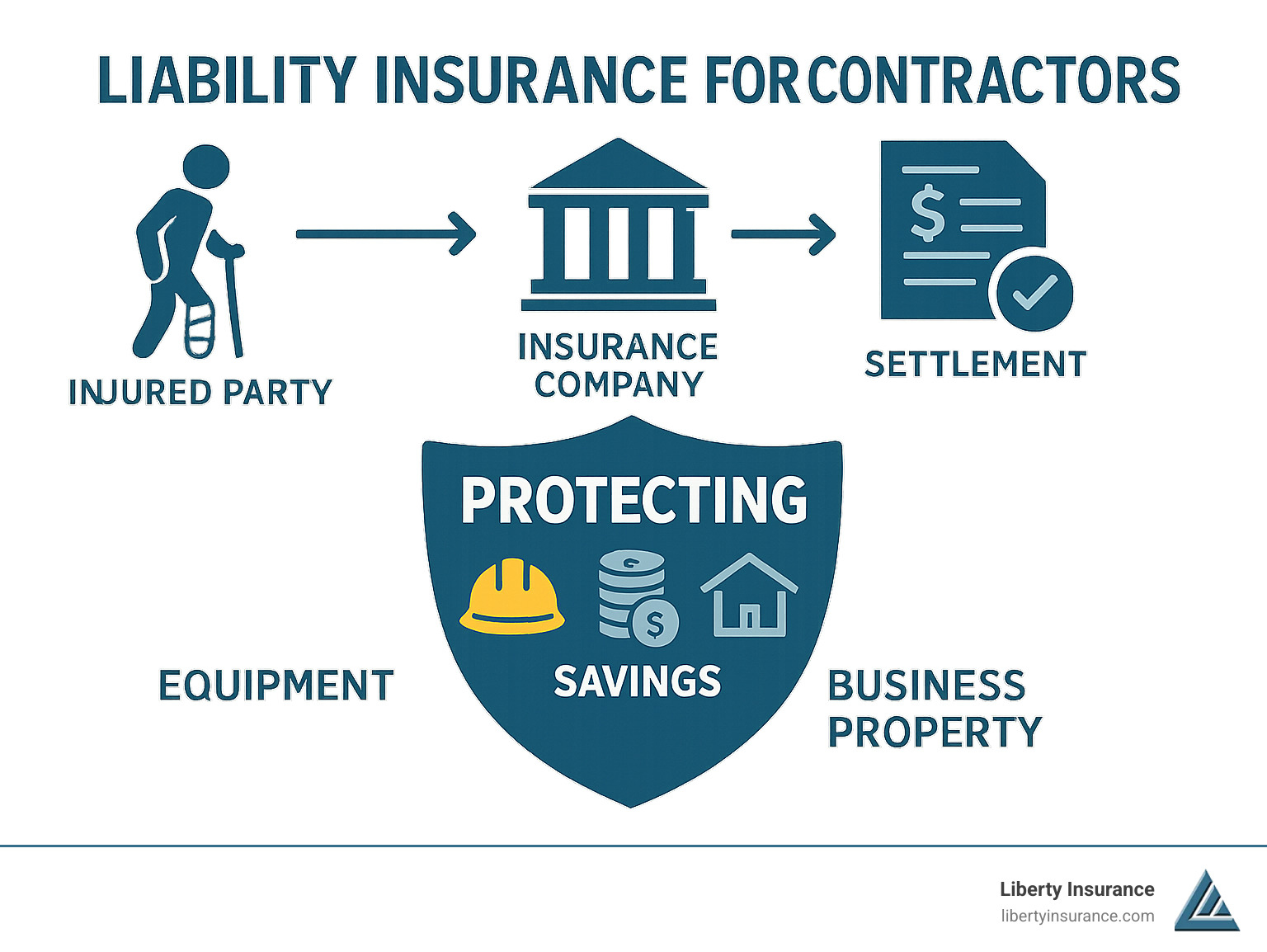
Liability insurance for contractors is essential coverage that protects your business from third-party claims involving bodily injury, property damage, and legal costs. Without it, a single accident could bankrupt your business. This insurance typically covers:
- Bodily injury claims: Medical costs if someone is hurt on your job site.
- Property damage: Repair costs if you damage client property.
- Legal defense: Attorney fees and court costs, even if you’re not at fault.
- Personal and advertising injury: Protection against libel, slander, or copyright claims.
- Medical payments: Immediate medical expenses for minor injuries, regardless of fault.
The stakes are high. The average trip and fall accident costs a business owner $20,000, and for contractors, the risks are even greater. Many clients won’t hire uninsured contractors, making proper coverage essential for staying competitive and protecting your professional reputation.
I’m Andrew Harris, a Certified Insurance Counselor with over 15 years of experience helping contractors secure liability insurance for contractors. As PIA National’s 2020 Agent of the Year, I’ve seen how the right coverage can save a business from financial ruin. My goal is to provide you with the insights needed to protect your livelihood.
Liability insurance for contractors terms to know:
- NJ builders risk insurance
- New Jersey contractor bonds
- workers’ compensation insurance for independent contractors new jersey
The High-Stakes World of Contracting: Why You Can’t Afford to Be Uninsured
In the dynamic world of contracting, every job site presents new risks. Your work inherently involves interacting with third parties and their property, meaning a small misstep can lead to significant financial repercussions. A misplaced tool, a moment of distraction, or a precariously placed ladder can trigger costly lawsuits. Liability insurance for contractors is your essential shield against these events, covering bodily injury, property damage, and the daunting legal defense expenses that follow.
In today’s competitive market, clients demand proof of insurance. Without it, you’re not just unprotected; you’re often out of the running for new jobs. Consider these common claim scenarios, expanded to show their real-world impact:
- Water Damage: You’re a plumber who installs a new water line for a kitchen remodel. Weeks later, a fitting you installed fails overnight, flooding the newly renovated kitchen and seeping into the finished basement below. The client claims tens of thousands of dollars in damages for ruined custom cabinets, warped hardwood floors, and mold remediation. Your policy could cover the extensive repair costs, preventing a catastrophic financial loss for your business.
- Visitor Injury: You’re a general contractor overseeing a home addition. The client’s neighbor stops by to see the progress, trips over an extension cord you ran across the driveway, and suffers a severe wrist fracture requiring surgery and extensive physical therapy. They sue for medical expenses, lost wages, and pain and suffering. Your policy can help with their medical costs and provide the legal defense needed to handle the lawsuit.
- Neighboring Property Damage: As an excavation contractor, you’re digging a foundation for a new home. Your mini-excavator operator misjudges the property line and accidentally collapses a section of the neighbor’s expensive stone retaining wall. General liability can provide coverage for the cost to rebuild the neighbor’s wall, smoothing over a tense situation and protecting your reputation.
What Specific Risks Do Contractors Face?
The nature of contracting exposes you to a wide array of risks that liability insurance is designed to cover:
- Bodily Injury Claims: The most common and potentially severe risk. A client, visitor, or passerby is injured due to your operations. This could be a slip and fall on a wet surface, an injury from falling debris from scaffolding, or even dust from your work aggravating a person’s asthma, leading to a claim.
- Property Damage Claims: Accidents happen. You might damage a client’s property (e.g., an excavator hitting a fence, spilling paint on a carpet) or a neighboring property while working. This also includes damage that isn’t immediately obvious, like causing electrical surges that fry a client’s home entertainment system.
- Personal and Advertising Injury: This protects against claims of slander, libel, or copyright infringement in your advertising. For instance, if you use a client’s project photos in your marketing portfolio without their explicit written permission, they could sue. If your marketing materials are too similar to a competitor’s, your policy could offer protection. You can find more info about copyright infringement claims.
- Completed Operations Risks: Your responsibility doesn’t end when you pack up your tools. If your work causes damage or injury later (e.g., a faulty electrical installation causes a fire months after you’ve been paid, or a deck you built collapses a year later), this coverage is crucial for long-term protection against latent defects in your work.
- Lawsuit Costs: You can be sued even if you’ve done nothing wrong. A frivolous lawsuit still requires a legal defense. Your policy can cover defense costs, including lawyer’s fees, court fees, and expert witness expenses, regardless of the lawsuit’s merit. These costs alone can be financially crippling without insurance.
For contractors in the Garden State, understanding New Jersey Liability Insurance specifics is crucial.
What Are the Consequences of Not Having Insurance?
Operating without liability insurance for contractors is a gamble you can’t afford to take. The consequences can be catastrophic and far-reaching:
- Out-of-Pocket Payments: You are personally responsible for every dollar of a claim, including medical bills, property repairs, and legal fees. A single significant claim could force you to liquidate business assets, drain your personal savings, or even put your home at risk.
- Inability to Get Licensed or Pull Permits: Many states, counties, and municipalities, including those in New Jersey, require proof of insurance to obtain or renew a contractor’s license and to pull permits for jobs. No insurance means no legal work.
- Losing Bids and Contracts: Sophisticated clients and virtually all general contractors require a Certificate of Insurance (COI) before they will even consider your bid. Without one, you are automatically disqualified from most commercial projects and many residential ones.
- Damaged Professional Reputation: An uninsured accident can lead to negative online reviews, loss of referrals, and a reputation for being unprofessional or risky to hire. Rebuilding that trust can take years.
- Potential Bankruptcy: A major lawsuit can easily exceed the value of your business, forcing you into bankruptcy. This not only shutters your company but can also have a lasting negative impact on your personal credit and future business opportunities.
Decoding Your Policy: Key Types of Liability Insurance for Contractors
Think of liability insurance for contractors as the blueprint for your financial protection. Understanding what each part of your policy does is key to ensuring you’re properly covered without any dangerous gaps.
What Is Covered by Liability Insurance for Contractors?
When we talk about liability insurance for contractors, we’re usually referring to Commercial General Liability (CGL) insurance. This is your foundational policy, covering the most common third-party risks you face in your daily operations.
Your CGL policy covers five main areas:
- Bodily injury protection: This is for when your work, actions, or job site conditions cause physical harm to a non-employee. It covers their medical bills, lost wages from being unable to work, and legal costs if they sue for damages. For example, if a visitor slips on sawdust and breaks a hip, your policy would handle the associated medical and legal costs up to your policy limit.
- Property damage coverage: This protects you when you accidentally damage someone else’s property. This could be a major event, like an excavator hitting a buried utility line, or something smaller, like scratching a hardwood floor with a ladder or drilling through a wall into a neighbor’s TV. It covers the cost of repair or replacement for the damaged property.
- Legal defense costs: This vital component covers attorney fees, court costs, and other legal expenses to defend you against a lawsuit, even if the claim is ultimately found to be baseless. Without this, the cost of simply defending yourself could bankrupt your business, regardless of the outcome.
- Medical payments coverage: This provides for immediate, minor medical attention for injuries sustained by a third party on your job site, regardless of who is at fault. For instance, if a client cuts their hand on a piece of scrap metal, this coverage can pay for their trip to an urgent care center, often preventing a small incident from escalating into a larger liability claim.
- Personal and advertising injury protection: This covers non-physical damages arising from your business activities. It includes claims of slander (spoken defamation), libel (written defamation), or copyright infringement. If you accidentally use copyrighted images in your marketing materials or make a disparaging remark about a competitor that leads to a lawsuit, this coverage can help. You can find more info about copyright infringement claims to understand these risks.
For contractors in the Garden State, securing comprehensive General Liability Insurance NJ is a critical first step.
General Liability vs. Professional Liability
It’s crucial to understand the difference between General Liability (GL) and Professional Liability (PL), as they cover different types of risks. A gap in this understanding can leave you exposed.
| Feature | General Liability (GL) | Professional Liability (PL) (Errors & Omissions – E&O) |
|---|---|---|
| What it Covers | Physical injury to third parties, physical damage to property of others, personal and advertising injury. | Financial loss to third parties due to your professional mistakes, errors, omissions, or negligence in advice or service. |
| Nature of Claim | Accidents, slips, falls, property damage, libel/slander. | Bad advice, design flaws, missed deadlines, poor workmanship leading to financial loss, breach of contract. |
| When it Applies | When your operations cause physical harm or damage. | When your professional service or advice causes a client to suffer financial harm. |
| Example | A client trips over your tools on a job site and breaks an arm. | An HVAC contractor makes an error interpreting plans, leading to incorrect equipment installation that needs to be redone, causing project delays and financial losses for the client. |
In short, GL covers physical damages (e.g., your scaffolding dents a car), while PL, also known as Errors & Omissions (E&O), covers financial losses from professional mistakes (e.g., a design flaw in your plans causes costly rework). Contractors who provide design-build services, construction management, or specialized consulting often need both. Your GL handles the “oops, I broke something” moments, while Professional Liability Insurance covers the “oops, I made a professional mistake” situations.
Common Policy Exclusions and Add-ons
No policy covers everything. Understanding common exclusions helps you identify gaps in your coverage that need to be addressed with endorsements (add-ons) or separate policies.
Your CGL policy typically will not cover:
- Injuries to your own employees: This is a major exclusion. Employee injuries are covered by Workers’ Compensation insurance, which is required by law in most states if you have employees.
- Damage to your own property: You need Commercial Property Insurance for your office or shop and a separate Inland Marine policy for tools and equipment.
- Auto accidents: Your work trucks, vans, and other vehicles require a separate Commercial Auto policy. This includes accidents caused while driving to or from a job site.
- Faulty workmanship: This is a critical distinction. The policy may cover the resulting damage from your faulty work (e.g., water damage from a bad pipe install), but it won’t pay to redo your actual work (i.e., the cost to replace the pipe itself).
- Intentional acts or criminal conduct: Insurance is for accidents. It will not cover damages you cause on purpose.
- Pollution: Standard CGL policies have a broad pollution exclusion. If your work causes a release of pollutants (e.g., a fuel spill, chemical leak), you would need a specific Pollution Liability policy.
- Electronic Data: Liability for the loss of electronic data is typically excluded and requires a Cyber Liability policy.
To fill these gaps, work with an agent to add endorsements like Hired and Non-Owned Auto Liability (for rented vehicles or employees using their own cars for business) or to purchase separate, essential policies.
Investing in Protection: How to Get the Right Coverage at the Right Price
Investing in liability insurance for contractors is a smart business move that provides protection and opens up new opportunities. It’s not an expense to be minimized, but a tool to be optimized. Here’s how to get the right coverage at a price that makes sense for your business.

How Much Does Liability Insurance for Contractors Cost?
Insurance pricing is like bidding on a job; it’s unique to your specific situation. Insurers are experts in risk assessment, and they consider several key factors to determine your premium:
- Type of Trade: This is one of the biggest factors. Higher-risk trades like Fully Insured Roofing Contractors in New Jersey, demolition experts, electricians, and plumbers typically have higher premiums due to the greater potential for severe accidents. Lower-risk trades like painters, flooring installers, or consultants will generally pay less.
- Business Size and Revenue: More revenue and more employees mean more work, more exposure, and therefore more risk. A solo handyman might pay around $550 per year for a basic policy, while a general contractor with a crew of ten and millions in revenue could see costs in the tens of thousands.
- Location: Premiums vary significantly by state and even by county. Working in densely populated urban areas, regions with a history of high litigation rates (like certain parts of New Jersey), or coastal areas with weather-related risks can increase costs.
- Claims History & Experience: A clean claims history is your best asset for lower premiums. Insurers reward businesses that demonstrate a commitment to safety. Conversely, multiple past claims will signal higher risk and lead to higher costs. Years of experience in the industry can also lead to more favorable rates.
- Subcontractor Use: If you hire subcontractors, your insurer will want to know how you manage that risk. They will look favorably on contractors who require subs to carry their own insurance and name you as an additional insured.
How to Choose the Right Amount of Coverage
Selecting the right coverage limit is a critical decision that involves balancing adequate protection with your budget. Underinsuring your business to save a few dollars is a recipe for disaster.
- Assess Your Risk Profile: Consider the scale and complexity of your typical projects. A contractor doing large commercial builds or working on critical infrastructure carries far more risk than one focused on small residential renovations. The potential for a multi-million dollar lawsuit is much higher in the former.
- Check Contract Requirements: This is often the deciding factor. Many clients and general contractors mandate specific coverage limits, often $1 million per occurrence and $2 million aggregate. For larger projects, these requirements can be $5 million or more. These are non-negotiable to get the job.
- Follow Industry Standards: Most professional contractors carry at least a $1,000,000 / $2,000,000 general liability policy. Knowing what’s standard for your trade and region is a good benchmark for your minimum coverage.
- Understand Limits and Deductibles: Your policy limit is the maximum an insurer will pay for a covered claim. Your deductible is your out-of-pocket cost per claim. A higher deductible can lower your premium, but you must ensure it’s an amount you can comfortably pay at a moment’s notice.
- Consider a Commercial Umbrella Policy: For high-value projects, or if you have significant business or personal assets to protect, an umbrella policy is essential. It provides an extra layer of liability protection (typically in increments of $1 million) that sits on top of your general liability and commercial auto policies. It kicks in when the limits of the underlying policies are exhausted.
Our Small Business Insurance NJ options can be customized to fit your specific needs.
The Process of Getting a Quote
Getting a quote is straightforward if you’re prepared.
- Gather Your Information: Have your legal business name, address, federal tax ID (EIN), detailed description of services offered, projected annual revenue, payroll figures, number of employees, years of experience, and any prior claims history ready.
- Work with an Independent Agent: An experienced independent agent provides expertise that online-only forms can’t. They represent multiple carriers, allowing them to shop the market for you. More importantly, they act as your risk management advisor, helping to identify potential coverage gaps and ensuring you meet all contractual requirements.
- Compare Quotes Carefully: Look beyond the bottom-line price. An apples-to-apples comparison means ensuring the coverage limits, deductibles, endorsements, and exclusions are the same across quotes. Research the insurer’s A.M. Best rating for financial stability and their reputation for claims service.
- Bind the Policy: Once you choose a policy, your agent will help you “bind” coverage. This is the final step that makes the policy effective. You’ll make your first payment and receive your policy documents and your all-important Certificate of Insurance (COI).
Putting Your Insurance to Work: Practical On-the-Job Essentials
Having the right liability insurance for contractors is the first step. Knowing how to use it as a tool in your daily operations is what truly protects your business and helps it grow.
The Certificate of Insurance (COI): Your Golden Ticket
Your Certificate of Insurance (COI) is a one-page document that serves as a snapshot of your coverage. It’s the standard proof you provide to clients and general contractors that you are insured.
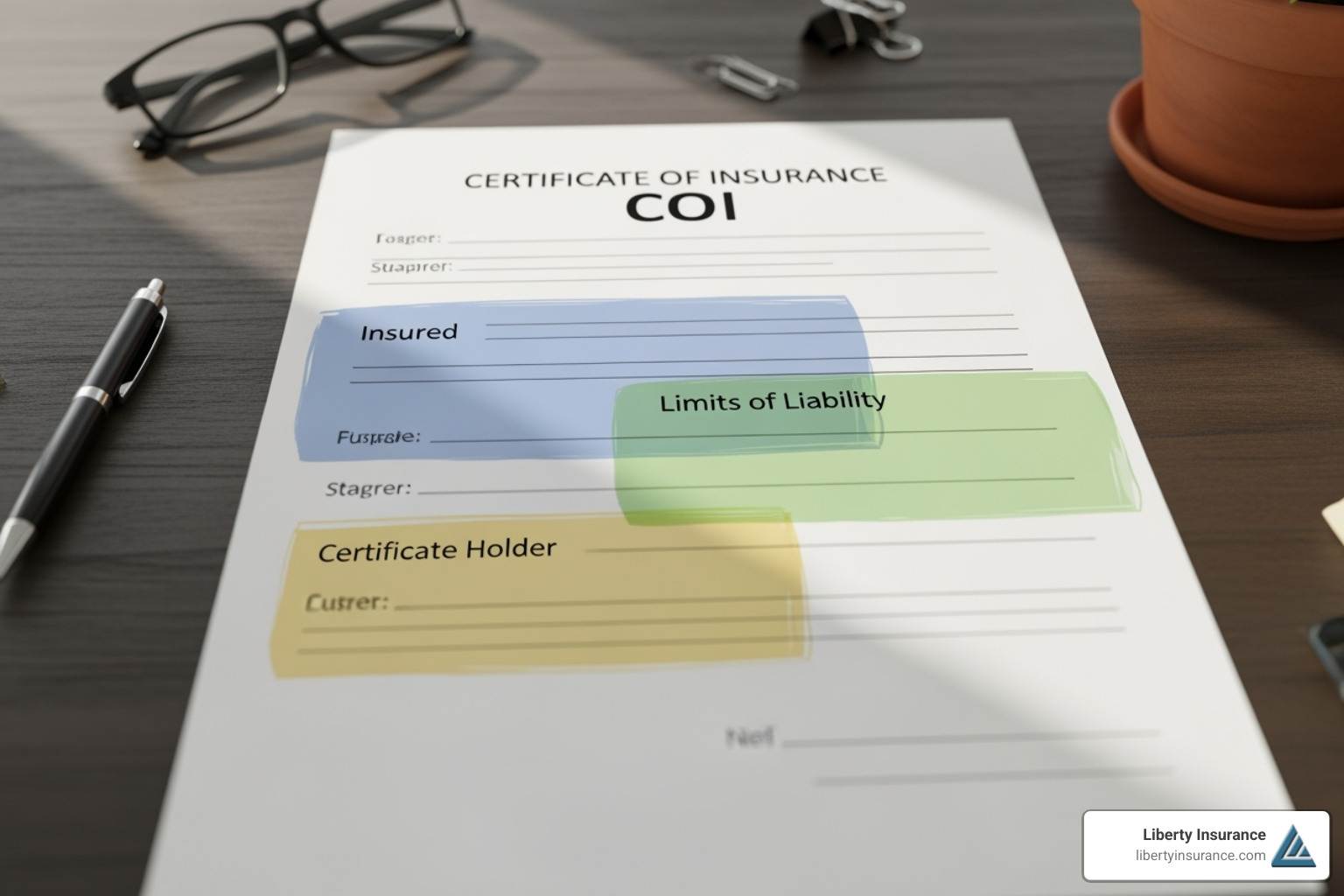
A COI shows your policy numbers, effective dates, coverage types (General Liability, Auto, Workers’ Comp), and liability limits. Clients and general contractors require it before you can set foot on a job site. They need this assurance that if an accident related to your work occurs, your insurance policy will be the first line of defense, protecting their own assets from being targeted in a lawsuit. Without a valid COI, you will be denied access to many job sites and lose out on bids.
Getting a COI is simple. Your insurance agent can issue one quickly, often within minutes or hours of your request. A common and critical request is to name a client or general contractor as an Additional Insured on your policy. This endorsement extends your policy’s protection to them for claims arising specifically from your ongoing operations for them. This is a standard contractual requirement and is often included at no extra cost.
Insurance and Subcontractors: Managing Your Risk
If you hire subcontractors, you are taking on their risk. Managing this exposure is one of the most important things a general contractor can do.
- Require Proof of Insurance: Never allow a subcontractor to begin work without first providing a valid COI that meets your minimum requirements. This confirms they have their own coverage for their potential mistakes.
- Request to Be an Additional Insured: Just as clients ask of you, you must require your subs to name your business as an Additional Insured on their general liability policy. This is non-negotiable. It provides you with a direct defense from their policy if a claim arises from their work, preventing it from hitting your policy first.
- Use Indemnification and Hold Harmless Agreements: Your subcontractor contract should contain a strong indemnification clause. This is a legal provision stating that the subcontractor agrees to defend, indemnify (reimburse), and hold you harmless from any claims, damages, or legal costs arising out of their work. This contractual risk transfer works in tandem with their insurance.
- Avoid Uninsured Subcontractors at All Costs: Hiring an uninsured sub is a massive, unnecessary risk. If they cause an accident, injure someone, or damage property, you and your insurance policy will likely be held fully liable for all damages and legal fees. The few dollars you might save by hiring a cheaper, uninsured sub are not worth the potential for a six- or seven-figure lawsuit.
State and Project-Specific Requirements
Insurance requirements vary significantly by location and by project. Liability insurance for contractors is a universal need for nearly all trades, including general, electrical, plumbing, HVAC, roofing, and landscaping contractors.
New Jersey has specific licensing requirements for many trades, such as home improvement contractors, electricians, and plumbers, which often include carrying a minimum amount of liability insurance (e.g., $500,000 per occurrence for HICs). Always check with the New Jersey Division of Consumer Affairs for the current rules for your specific trade.
Beyond New Jersey, states like California, Florida, and Texas have their own stringent insurance and bonding requirements for licensure. It is your responsibility to know and comply with the laws wherever you work.
Furthermore, every project contract will detail the specific insurance you must carry. These requirements can change from job to job. A small residential remodel may only require a standard $1M/$2M policy, while a job for a municipality or a large corporation may require higher limits, specific endorsements, and an umbrella policy. Read every contract carefully. Industry groups, like the B.C. Construction Association and similar regional associations, are also valuable resources for staying informed on industry standards and best practices.
Your insurance is a working tool that builds trust, manages risk, and protects your assets. Use it wisely.
Frequently Asked Questions about Liability Insurance for Contractors
Over my years helping contractors secure proper coverage, I’ve noticed the same questions come up again and again. These aren’t just simple inquiries – they’re the real concerns that keep contractors up at night, wondering if they’re truly protected. Let me address the most common ones with the clarity you deserve.
What’s the difference between being licensed, bonded, and insured?
This trio of terms gets tossed around so often that many contractors and clients assume they’re interchangeable. They are fundamentally different, and understanding the distinction is key to operating professionally.
- Licensed: This means you have met your state or local government’s requirements (e.g., testing, experience, background checks) to legally perform your trade. It’s a credential that proves your competency and permission to work.
- Bonded: A surety bond is a three-party financial guarantee. It protects your client (the obligee) from financial loss if you (the principal) fail to complete a job, pay for labor and materials, or meet other contractual obligations. The surety company pays the client, and then you must reimburse the surety. It protects them from you.
- Insured: Liability insurance for contractors protects your business from the financial consequences of accidents and negligence, such as third-party bodily injury or property damage. It protects you and your assets from unforeseen events. It pays for damages and legal defense on your behalf.
A professional contractor needs all three to be fully protected and trusted by clients.
Does my liability insurance cover my tools?
No. This is one of the most common and costly misconceptions. General liability insurance covers damage you cause to other people’s property, not your own. If your tools are stolen from a job site, damaged in a fire at your shop, or fall from your truck, your general liability policy will not pay to replace them.
To protect your valuable tools and equipment, you need a separate policy called inland marine insurance or a tool and equipment floater. This policy is designed to cover your property whether it’s in transit, on a job site, or in temporary storage. It is essential for any contractor whose livelihood depends on their equipment.
Can I get liability insurance for a single project?
Yes, project-specific or short-term policies are available. This can be a good option for contractors who work seasonally or take on an occasional, unique job that has insurance requirements far exceeding their normal policy (e.g., a residential contractor taking on a single large commercial project).
However, for most full-time contractors, an annual policy is far more practical and cost-effective. It provides continuous coverage without any dangerous gaps between projects, which is the safest way to operate your business. An annual policy ensures your completed operations are covered and you don’t have to scramble for insurance every time a new job comes up.
What should I do if a claim is filed against me?
First, do not admit fault or offer to pay for damages. Immediately contact your insurance agent or the claims number on your policy. Provide them with all the details of the incident, including names of witnesses, photos of the scene, and any relevant documents. Your insurance company will then take the lead, assigning a claims adjuster to investigate the situation, determine the validity of the claim, and handle your legal defense if necessary. Promptly reporting a claim is a condition of your policy and is the most important step you can take to ensure you are protected.
What is the difference between an ‘occurrence’ and a ‘claims-made’ policy?
This is a critical technical difference. Most contractors will have an occurrence policy. This type of policy covers claims for incidents that occurred during the policy period, regardless of when the claim is actually filed. For example, if a deck you built in 2023 collapses in 2025, your 2023 policy would respond, even if it’s expired.
A claims-made policy, more common for professional liability, only covers claims that are made during the policy period. To have coverage for past work, you must maintain continuous coverage, often by purchasing “tail coverage” when you retire or close your business. For general liability, an occurrence form is almost always preferable for contractors.
Conclusion
It should be clear that liability insurance for contractors is not just another business expense—it’s a foundational investment in your company’s survival and growth.
This coverage is the financial shield that protects everything you’ve worked to build from a single, costly accident. It provides the peace of mind to focus on your work, knowing your personal and business assets are secure.
In today’s market, being properly insured is also a mark of professionalism. It builds trust with clients, opens the door to larger projects, and gives you a competitive edge. Operating without it is a gamble with your business’s future.
Getting the right protection doesn’t have to be complicated. With proper guidance, you can secure a policy that fits your specific trade and budget, allowing you to build, create, and grow your business with confidence.
For a comprehensive review of your business needs and to secure the right Contractors Insurance New Jersey, contact the experts at Liberty Insurance today. We understand the unique challenges contractors face and are here to help you get the protection you deserve.

