
Why Business Financial Protection Is Your First Line of Defense
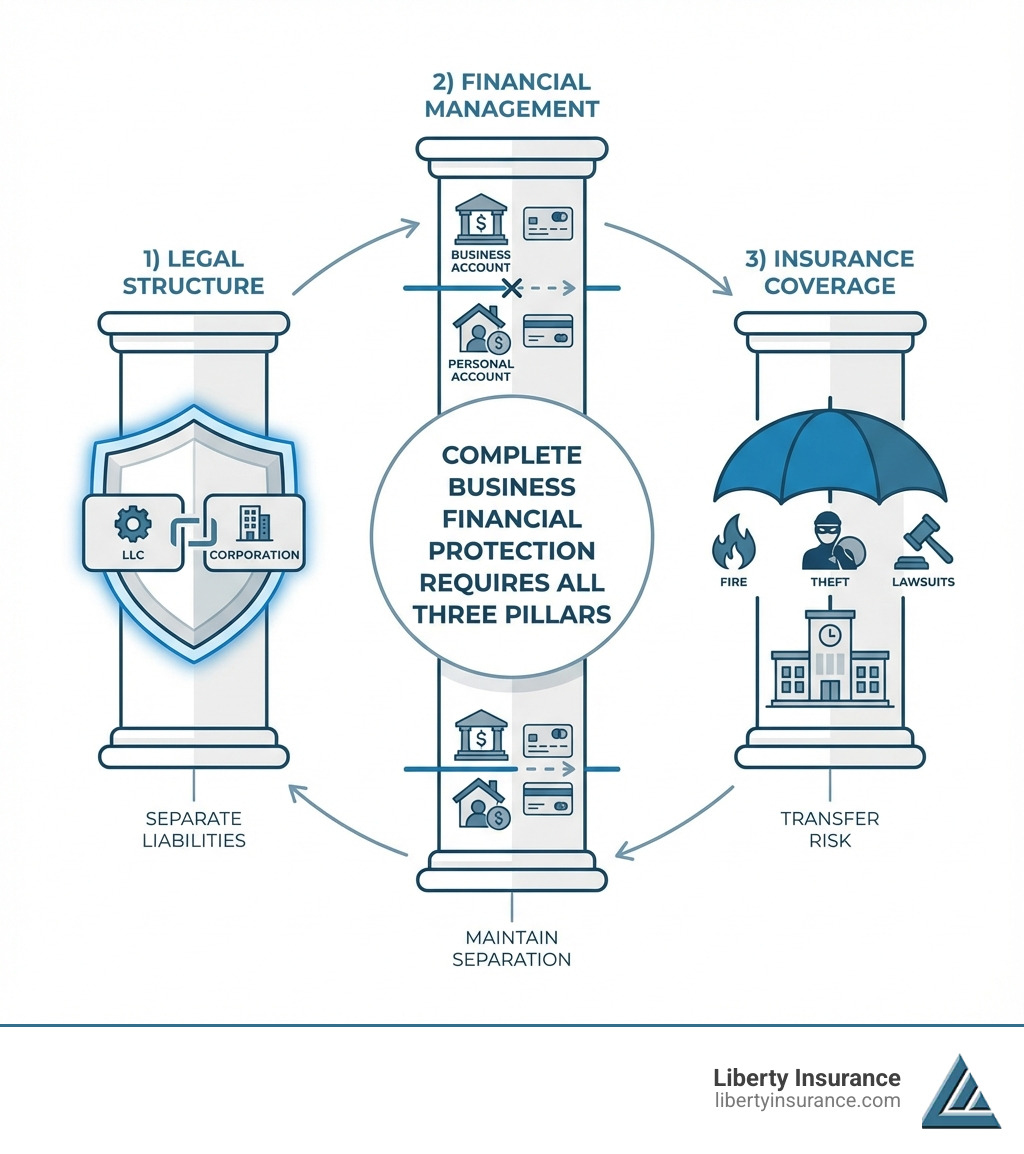
Business financial protection is a comprehensive strategy that shields your company’s assets, income, and operations from unexpected threats like lawsuits, natural disasters, theft, and economic disruptions. At its core, effective protection rests on three essential pillars:
- Legal Structure – Incorporating your business (LLC, S-Corp, or C-Corp) to separate personal assets from business liabilities
- Financial Management – Maintaining strict separation between personal and business finances through dedicated accounts and credit cards
- Insurance Coverage – Transferring risk through policies like general liability, commercial property, professional liability, and business interruption insurance
As with any investment, business owners must take risks to reap financial rewards. You likely used personal savings to launch your venture, acquired equipment and inventory, and built a reputation over time. But one disaster, lawsuit, or data breach could wipe out everything you’ve worked to build. The end result of these challenges could impact not only your business growth but also your ability to meet personal financial goals and plan for a secure retirement.
The federal government requires businesses with employees to carry workers’ compensation, unemployment, and disability insurance. Beyond these legal requirements, protecting your business demands a proactive approach custom to your specific risks—whether you’re operating from a leased office space, managing inventory, or providing professional services.
I’m Andrew Harris, and as a Certified Insurance Counselor (CIC) and Accredited Advisor in Insurance (AAI), I’ve spent over a decade helping small business owners develop comprehensive business financial protection strategies that safeguard both their companies and personal assets. In this guide, I’ll walk you through the essential steps every business owner needs to take to avoid getting burned by preventable losses.
Fortifying Your Foundation: Legal Structure and Financial Separation

This section explains how to create a legal shield between your personal and business finances, a critical first step in asset protection. Without this fundamental separation, all your other efforts at business financial protection might be undermined. Imagine trying to protect a castle without building its walls first – it simply won’t work!
Why Your Business Structure Matters
One of the most crucial decisions you’ll make as a business owner in New Jersey is choosing your legal structure. This decision directly impacts your personal liability for business debts and actions. For sole proprietorships, there’s no legal separation between you and your business. This means that if your business incurs debt, faces a lawsuit, or even makes a professional mistake, your personal assets—like your home, savings, and other investments—are at risk. It’s like sailing without a life raft; any business storm could sink your personal finances too.
This is why incorporating your business is often the first and most vital step in business financial protection. Structures like a Limited Liability Company (LLC), S Corporation, or C Corporation create a separate legal entity. This separation means that, generally, creditors can only pursue the business’s assets to satisfy claims, not your personal assets. For instance, in an LLC or corporation, corporate officers typically have no personal liability for corporate debts, breaches of contract, or injuries caused by the corporation or its employees. This legal firewall is paramount for safeguarding your personal net worth.
The protection offered by these structures allows business owners to take calculated risks and pursue growth without constantly fearing that a business setback could jeopardize their family’s financial security. For new businesses, the focus is heavily on protecting personal assets from business failure. As businesses mature and acquire more assets, the strategy expands to protecting both personal and business assets from external claims and liabilities. It’s a foundational element that shields you from personal liability for business debts or actions, ensuring that your entrepreneurial journey doesn’t come at the cost of your personal financial peace of mind.
The Critical Importance of Separating Finances
Once you’ve established a separate legal entity, the next essential step in business financial protection is to maintain a clear and unwavering separation between your personal and business assets. This isn’t just about good bookkeeping; it’s about reinforcing the legal separation you’ve worked so hard to create.
Commingling funds—mixing personal money with business money—is a common pitfall for many business owners, especially those just starting out. However, this practice can have severe implications. In a worst-case scenario, if your business is sued, a court could decide to “pierce the corporate veil.” This means they could disregard the legal protection of your LLC or corporation and hold you personally liable for business debts and lawsuits, precisely what you tried to avoid by incorporating. It’s like building that strong castle wall, then leaving the gate wide open.
Maintaining distinct bank accounts and credit cards for your business is crucial for several reasons:
- Clear Financial Health Assessment: Separate accounts provide a transparent view of your business’s financial performance, making it easier to track income, expenses, and profitability.
- Simplified Accounting: It streamlines the accounting process, making it much easier to prepare financial statements and manage cash flow.
- Tax Purposes: Clear financial records are invaluable during tax season. Separating finances helps avoid potential IRS audit issues by clearly delineating business expenses from personal ones. You can find more guidance on this through the IRS Small Business and Self-Employed Tax Center Portal.
- Professionalism: It projects a more professional image to clients, suppliers, and lenders.
In short, separating personal and business assets is not merely a best practice; it’s a vital component of your overall business financial protection strategy, ensuring the legal integrity of your entity and the clarity of your financial operations.
The Role of Insurance in Comprehensive Business Financial Protection

Now that we’ve built our legal and financial foundations, it’s time to talk about the mighty shield of insurance. This section details how transferring risk through insurance is a non-negotiable part of a sound financial strategy, deflecting potential disasters that could otherwise derail your business.
Assessing Your Risks to Determine Insurance Needs
Before you can adequately protect your business, you need to understand what you’re protecting it from. This involves a thorough risk assessment. We encourage business owners in Millstone Township, Trenton, and across New Jersey to take a step back and consider all potential hazards. What are the primary risks that businesses face that could jeopardize their assets?
Start by documenting all your assets – not just physical ones like your office building, equipment, and inventory, but also financial assets like cash flow, and intangible assets like your client list and business reputation. Then, map out potential threats and vulnerabilities against each. These could include:
- Property Damage: Fire, storm, flooding, theft, vandalism.
- Liability Claims: Customer injuries on your premises, product defects, professional errors.
- Operational Disruptions: Equipment breakdown, supply chain issues, cyberattacks.
- Employee-Related Risks: Workplace injuries, employee dishonesty.
- Natural Disasters: Given New Jersey’s weather patterns, consider coastal storms, heavy snowfall, and potential flooding.
Conducting a comprehensive risk assessment helps you identify potential accidents, natural disasters, or lawsuits that could cause damage. We recommend carrying out regular asset checks and reviewing financial documents like balance sheets and profit and loss statements to determine your insurance needs and the true value of your business assets. The goal is to insure against things you wouldn’t be able to pay for on your own, transferring that risk to an insurance company. An experienced insurance advisor can help you assess these risks and advise on appropriate risk minimization processes.
Essential Types of Business Insurance
Once you understand your risks, we can explore the types of insurance crucial for safeguarding your business assets. Business insurance protects against financial losses due to property damage, loss of physical assets, professional mistakes, and legal fees. Here are six common types that form the backbone of business financial protection:
- General Liability Insurance: This is often the first policy a business owner considers. It protects your business from claims of bodily injury, property damage, advertising injury, and personal injury that occur as a result of your business operations. Think of a client slipping and falling in your Trenton office, or accidental damage to a customer’s property.
- Product Liability Insurance: If your business manufactures, distributes, or sells products, this coverage is essential. It protects you from financial losses if a product you sell causes injury or damage due to a defect.
- Professional Liability Insurance (Errors & Omissions – E&O): For businesses that provide professional services (e.g., consultants, accountants, real estate agents, IT professionals), this insurance covers claims of negligence, errors, or omissions in the services you provide. A mistake in advice or service could lead to a costly lawsuit, and this policy protects against such claims.
- Commercial Property Insurance: This is where Liberty Insurance truly shines. Our commercial property insurance protects your physical assets, such as your business premises, equipment, inventory, and even the landscaping, from damage or loss due to events like fire, theft, vandalism, or certain natural disasters. Whether you own a storefront in New Brunswick or a warehouse in Toms River, protecting your physical assets is paramount. You can explore more about our offerings for your Business.
- Home-Based Business Insurance: If you operate your business from your home in Princeton or elsewhere, your homeowner’s policy likely offers very limited coverage for business assets or liability. A home-based business insurance policy, often an add-on rider, provides specific protection for your business equipment and liability exposures.
- Business Owner’s Policy (BOP): Many small to medium-sized businesses opt for a BOP, which combines general liability, commercial property, and often business interruption insurance into one convenient and often more affordable package. It simplifies your insurance buying process and provides comprehensive coverage.
| Insurance Type | What it Covers | Why it’s Crucial |
|---|---|---|
| General Liability | Bodily injury, property damage, advertising injury to third parties | Protects against common accidents and lawsuits, a fundamental layer of business financial protection. |
| Commercial Property | Damage to business property (buildings, equipment, inventory) from perils | Safeguards your physical assets, ensuring you can rebuild or replace after a disaster. |
| Professional Liability | Claims of negligence, errors, or omissions in professional services | Essential for service-based businesses to protect against costly malpractice or error lawsuits. |
| Workers’ Compensation | Employee medical expenses and lost wages for work-related injuries/illnesses | Legally required in New Jersey for businesses with employees, protects both employees and the business from related costs. |
Specialized Coverage for Deeper Protection
Beyond the essential policies, several specialized coverages offer deeper layers of business financial protection, addressing specific risks that could significantly impact your operations and finances.
Business Interruption Insurance: This is a lifesaver for businesses facing unexpected operational shutdowns. Business interruption insurance covers loss of income during periods when your business cannot operate as usual due to an unexpected event. It aims to put your business back in the same trading position it was in before the event occurred. For example, if a fire damages your store in Millstone Township, or essential equipment breaks down, this policy can compensate for your pre-tax shortfall in profits and any increased costs of running your business (like temporary relocation expenses). Some policies even extend coverage to events affecting suppliers or customers, or if access to your premises is hindered. It’s often included in, or offered as an optional extra to, business insurance packages.
Cyber Liability Insurance: A data breach isn’t just an IT problem; it’s a financial catastrophe waiting to happen. Cyber liability insurance helps cover the costs associated with data breaches, including notification costs, credit monitoring, legal fees, and regulatory fines. It’s becoming increasingly vital for any business that handles sensitive customer data.
Disability Insurance: While often thought of as personal, disability insurance can be crucial for business financial protection, especially for sole proprietors or key employees. If a business owner or a critical employee becomes disabled and cannot work, this insurance can provide income replacement, ensuring the business doesn’t suffer unduly from their absence.
Key Person Insurance: For businesses with critical individuals whose sudden absence (due to death or disability) would severely impact operations and profitability, key person insurance provides a payout to the business. This capital can be used to cover operational costs, find and train a replacement, or pay off debts. It’s a strategic way to protect the financial stability of your business during a difficult transition. You can learn more about how we help protect your most valuable assets with More info about our services.
Navigating Legal Requirements and Purchasing Your Policy
Understanding the legal requirements for business insurance is paramount, particularly in New Jersey. The federal government mandates that businesses with employees carry workers’ compensation, unemployment, and disability insurance. However, states like New Jersey often have specific requirements that go beyond federal mandates.
In New Jersey, for example:
- Workers’ Compensation Insurance: If you have employees, this is legally required. It covers medical treatment, wages lost, and other benefits for employees who are injured or become ill due to their job.
- Unemployment Insurance: Businesses must contribute to state unemployment funds to provide temporary financial assistance to eligible workers who lose their jobs through no fault of their own.
- Temporary Disability Insurance (TDI) / Family Leave Insurance (FLI): New Jersey is one of the few states that requires employers to provide TDI and FLI benefits, which offer wage replacement for non-work-related illnesses or injuries, and for bonding with a new child or caring for a sick family member.
- Commercial Auto Insurance: If your business owns or uses vehicles, commercial auto insurance is a legal requirement.
- Professional Indemnity Insurance: For certain professional sectors (e.g., legal, accountancy, healthcare), professional indemnity insurance is often a regulatory requirement.
Purchasing Your Policy:
The process of securing the right business financial protection involves a few key steps:
- Assess Your Risks: As discussed, identify potential hazards specific to your business operations.
- Find a Reputable, Licensed Agent: Look for an agent in your local area, whether that’s Toms River, New Brunswick, or Princeton, who understands your industry and prioritizes your needs. They can help you steer the complexities of different policies and state-specific requirements.
- Shop Around: Don’t settle for the first quote. Compare rates, terms, and benefits from multiple insurance providers to ensure you’re getting the best value and coverage.
- Re-assess Annually: Your business isn’t static. As it grows, changes operations, or acquires new equipment, your insurance needs will evolve. We recommend re-assessing your coverage annually to ensure it remains adequate.
For more comprehensive guidance, the SBA offers resources on how to get business insurance. Our team at Liberty Insurance is also ready to help you find customizable coverage solutions custom to your New Jersey business, safeguarding against disasters such as fire and theft, and ensuring your peace of mind.
Beyond Physical Assets: Protecting Intangibles and Preventing Fraud
Protecting your business goes beyond insuring buildings and equipment; your reputation, data, and intellectual property are invaluable assets that also need safeguarding. These intangible assets, while not always visible, are often the most critical for long-term success and require a robust business financial protection strategy.
Safeguarding Your Intellectual Property and Reputation
Intangible assets like your brand reputation, customer goodwill, trade secrets, and proprietary knowledge are often harder to insure and recover than physical assets, but their loss can be devastating.
- Intellectual Property (IP): This includes trademarks (your brand name and logo), patents (inventions), copyrights (original creative works), and trade secrets (confidential business information like recipes or client lists). Protecting your IP involves:
- Registration: Registering your trademarks and patents with the U.S. Patent and Trademark Office provides legal protection and deters infringement.
- Non-Disclosure Agreements (NDAs): Use NDAs with employees, contractors, and partners to protect trade secrets and confidential information.
- Enforcement: Be prepared to legally defend your IP if it’s infringed upon.
- Reputation Management: Your reputation is built over years but can be damaged in moments. Proactive reputation management involves:
- Customer Service: Providing excellent service builds loyalty and positive word-of-mouth.
- Online Monitoring: Keeping an eye on online reviews and social media mentions allows you to address negative feedback promptly and professionally.
- Crisis Communication Plan: Having a plan in place for how to respond to negative events can mitigate reputational damage.
By putting in place specific policies and following best practices in managing these assets, you create a strong defense against potential harm.
Building a Defense Against Scams and Fraud
Unfortunately, the digital age has also ushered in an era of sophisticated scams and fraud attempts targeting businesses. Protecting your finances means building a strong defense against these threats.
- Impersonation Scams: Be vigilant against unsolicited communications. For example, the FDIC has warned about an increase in impersonation scams where victims receive phone calls, text messages, or emails purporting to be from the Federal Deposit Insurance Corporation (FDIC) or the FDIC Office of Inspector General (OIG). The FDIC will never ask you to provide money or other personally identifiable information. If you suspect fraud, contact the OIG Hotline.
- Phishing: This involves fraudulent attempts to obtain sensitive information (like usernames, passwords, and credit card details) by disguising as a trustworthy entity in an electronic communication. Train your employees to recognize phishing emails, texts, and calls.
- Cybersecurity Best Practices: Implement robust cybersecurity measures, including strong passwords, multi-factor authentication, regular software updates, and firewalls.
- Employee Training: Your employees are often your first line of defense. Regular training on scam awareness, cybersecurity protocols, and internal controls is crucial. They need to know what to look for and how to respond if they encounter a suspicious request.
- Internal Controls: Implement checks and balances in your financial processes to prevent internal fraud. Segregation of duties, regular audits, and clear authorization procedures can significantly reduce risk.
The Federal Trade Commission (FTC) is the nation’s consumer protection agency and offers valuable resources for businesses. The FTC actively fights scams and fraud, taking reports about scammers and businesses that don’t make good on their promises. They share these reports with law enforcement partners and use them to investigate fraud and eliminate unfair business practices. You can find more information and report fraud to the FTC. The FTC also works to stop illegal robocallers, which often represent a form of unsolicited and potentially fraudulent communication. Staying informed and proactive are your best tools against these evolving threats to your business financial protection.
Key Resources for Small Business Owners
Navigating the complexities of business financial protection and management can feel overwhelming, but you’re not alone. This section provides a curated list of government and non-profit resources designed to help businesses like yours in New Jersey thrive.
Government and Non-Profit Support
These organizations offer a wealth of information, training, and mentorship to help you strengthen your business’s financial resilience:
- Small Business Administration (SBA): The SBA is a federal agency dedicated to helping small businesses start, grow, and succeed. They offer a wide range of programs, including counseling, capital access, and contracting opportunities. They maintain district offices across the country, including in New Jersey, to provide localized support.
- Small Business Development Centers (SBDCs): SBDCs offer no-cost business assistance and free or low-cost training to new and existing businesses. With nearly 1,000 local centers, including several across New Jersey, they provide expert advice on various topics from financial management to marketing.
- SCORE Association: SCORE is the nation’s largest network of volunteer, expert business mentors. They offer free business training and one-on-one mentorship to help small businesses get off the ground, grow, and achieve their goals. There are local SCORE chapters throughout New Jersey ready to assist.
- FDIC’s Money Smart for Small Business Guide: The Federal Deposit Insurance Corporation (FDIC) offers a comprehensive Money Smart for Small Business guide with training modules and resources on financial and risk management, tax planning, and more. It’s an excellent tool for enhancing your business financial protection knowledge.
Financial and Lending Resources
Access to capital is often critical for both starting and protecting a business. Here are key resources for financial and lending support:
- Banks and Credit Unions: These are primary sources of capital for small businesses. You can find lists of banks through the Federal Deposit Insurance Corporation (FDIC) BankFind and explore options for credit unions or search for credit unions in your local area.
- Community Development Financial Institutions (CDFIs): CDFIs are specialized, mission-driven financial institutions focused on providing capital and financial services to underserved communities and individuals. They play a vital role in creating economic opportunity. You can find a list of certified community development financial institutions.
- Minority Depository Institutions (MDIs): MDIs nationwide are financial institutions that primarily serve minority communities. They are known for making a greater percentage of small-business loans to minority borrowers than other financial institutions, fostering economic viability in these communities.
These resources can provide the guidance and capital needed to build and maintain robust business financial protection.
Frequently Asked Questions about Business Financial protection
What is the single most important first step for a new business owner to take for financial protection?
The most critical first step is choosing the right legal structure. Forming a separate legal entity, such as an LLC or a corporation, creates a legal shield between your personal assets and your business liabilities. Without this foundational step, your personal wealth (home, savings) is at risk if the business faces lawsuits or debts.
How do asset protection strategies differ for new versus established businesses?
New businesses typically focus on foundational protection: incorporating to establish liability separation, securing essential insurance like general liability and commercial property, and setting up separate bank accounts. Established businesses need more complex strategies, such as advanced insurance policies (key person, cyber liability), formalizing buy-sell agreements for succession planning, and implementing robust intellectual property protection and internal fraud controls as their assets and risks grow.
What are the biggest implications of blending personal and business assets?
The primary risk is “piercing the corporate veil.” If you commingle funds, a court can disregard your LLC or corporation’s legal separation and hold you personally liable for business debts and lawsuits. This completely nullifies the main benefit of incorporating. It also creates major headaches for accounting, makes it difficult to assess your business’s true financial health, and can trigger IRS audits.
How can I protect myself from personal liability for business debts?
The best ways are to form a separate legal entity (LLC or corporation), consistently maintain a strict separation between personal and business finances (separate accounts, no commingling), and secure adequate business liability insurance. Insurance acts as a financial backstop to cover claims that might otherwise exceed the business’s assets.
How often should I review my business financial protection plan?
You should conduct a thorough review of your financial protection plan, including all insurance policies, at least once a year. Additionally, a review is necessary whenever your business undergoes a significant change, such as hiring new employees, moving to a larger facility, launching a new product line, or experiencing substantial revenue growth. This ensures your coverage remains adequate for your evolving risks.
Is Business Interruption Insurance really necessary for a small business?
For most small businesses, yes. Consider if your business could survive a month or more with zero income if a fire, flood, or major equipment failure forced you to shut down temporarily. Business interruption insurance covers this lost income and ongoing expenses (like rent and payroll), providing the cash flow needed to survive a disaster and reopen your doors. It’s a critical component of a resilient financial strategy.
Conclusion
As we’ve explored, building strong business financial protection isn’t a one-time task; it’s an ongoing commitment to proactive protection and smart risk management. From the initial decision of your legal structure to the daily practice of financial separation, and the strategic transfer of risk through comprehensive insurance, every step contributes to your business’s financial resilience.
At Liberty Insurance, we understand the unique challenges and aspirations of business owners in New Jersey. We provide customizable commercial property insurance, protecting your physical assets like equipment and inventory, and stand ready to help you safeguard against disasters such as fire and theft. By implementing these essential steps—from proper legal structuring to comprehensive insurance coverage—you build a resilient enterprise prepared for challenges and ready for growth.
We’re here to help you steer the complexities and ensure your business is protected, allowing you to focus on what you do best: innovating, serving your customers, and achieving long-term success. Don’t get burned; protect your dream.
Learn more about essential coverage for your business’s key personnel.

