
Why Smart Business Owners Prioritize Employee Health Benefits
Business health insurance options are more than just a line item in your budget; they are a strategic investment in your team’s well-being and your company’s future success. While adding benefits to your list of responsibilities might feel overwhelming, it’s a crucial step for sustainable growth, enhanced productivity, and building a resilient company culture. In a competitive market, a robust benefits package is a powerful differentiator.
Quick Overview: Top Business Health Insurance Options
- Traditional Group Plans: HMO, PPO, and POS plans offering network-based coverage for your entire team.
- Marketplace Options: SHOP coverage designed specifically for businesses with 1-50 employees.
- Level-Funded Plans: A hybrid model offering potential surplus refunds if claims are lower than expected.
- ICHRA Plans: A modern approach to reimburse employees for their individual health insurance premiums.
- Health Spending & Savings Accounts: Flexible, tax-advantaged accounts like HSAs and FSAs for medical expenses.
Offering benefits can help protect the physical, financial, and mental well-being of your employees, while also helping you attract and retain top talent. The challenge isn’t whether to offer health insurance—it’s understanding which option works best for your unique situation. With options ranging from traditional group plans to modern reimbursement arrangements, the landscape can feel complex. But with the right guidance, you can steer these choices confidently.
I’m Andrew Harris, and I’ve spent years helping business owners like you understand and implement effective health insurance strategies. Through my experience as a Certified Insurance Counselor and work with Liberty Insurance, I’ve seen how the right business health insurance options can transform both employee satisfaction and business success.
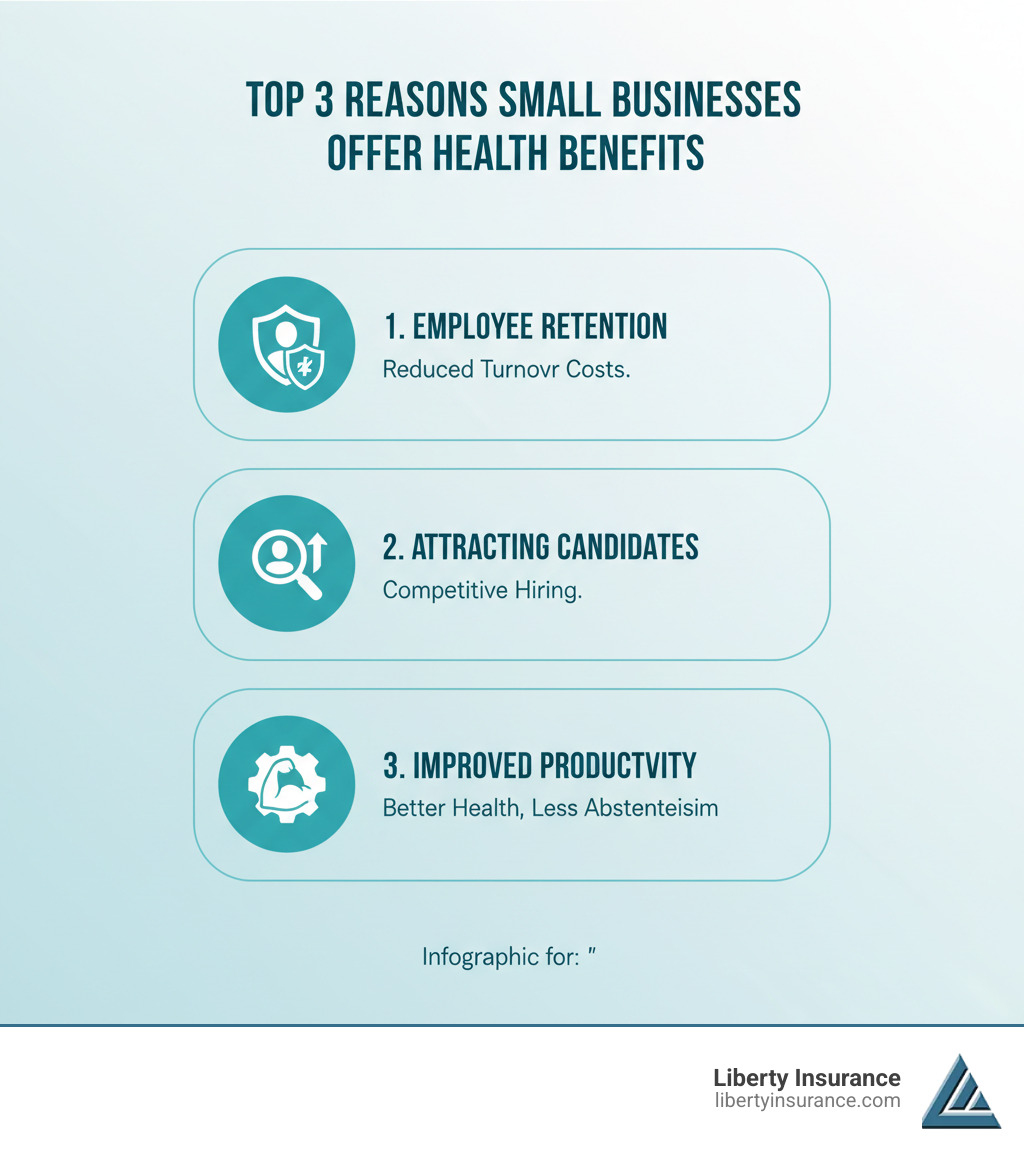
Offering health insurance to your employees isn’t just a kind gesture; it’s a strategic move that can significantly bolster your business’s stability and growth. By protecting your most valuable asset—your people—you foster a healthier, happier workforce and gain a competitive edge.
Attracting and Retaining Top Talent

In today’s competitive job market, a strong benefits package is often second only to salary for many candidates. Offering quality business health insurance options sends a clear message that you value your team, which translates into several key advantages:
- Improved Recruitment & Retention: A competitive benefits package makes your job offers stand out and encourages skilled professionals to stay, reducing turnover and training costs.
- Increased Loyalty and Morale: Employees who feel supported are more loyal and engaged, contributing to a stronger company culture and a more positive work environment.
- Reduced Absenteeism & Increased Productivity: Access to preventative care and prompt treatment keeps your team healthier and more productive, reducing sick days and improving focus.
Furthermore, different generations in the workforce place varying levels of importance on benefits. While older employees may prioritize robust, low-deductible plans, younger generations like Millennials and Gen Z often seek flexibility, mental health support, and wellness perks. A well-designed benefits strategy acknowledges these diverse needs, making your company an attractive workplace for a wider range of talent.
Offering comprehensive employee benefits is an investment in your human capital. For more insights, explore our resources on More info about Life, Health & Benefits.
Understanding the Tax Benefits
One of the most significant advantages of offering business health insurance options is the tax benefits. For small businesses, these savings can be substantial and can be reinvested into growth or enhancing benefits further.
- Deductible Business Expense: Premiums your business pays for group health, dental, and vision benefits are generally 100% tax-deductible as a business expense, lowering your overall tax burden.
- Tax-Free Benefit for Employees: The value of health and dental benefits employees receive is typically excluded from their gross income, meaning it’s a tax-free form of compensation. This increases their effective pay without raising their taxable income.
- Payroll Tax Savings: Because the employer’s premium contributions are not considered wages, you do not pay payroll taxes (like Social Security and Medicare) on that amount.
- Potential Tax Credits: Small businesses may qualify for the Small Business Health Care Tax Credit to help offset costs. To be eligible, you generally must:
- Have fewer than 25 full-time equivalent (FTE) employees.
- Pay average annual wages below a federally indexed amount (around $56,000 per FTE for 2023, adjusted for inflation annually).
- Pay at least 50% of the premium cost for employee-only coverage.
- Purchase the plan through the SHOP (Small Business Health Options Program) marketplace.
The credit can be worth up to 50% of the premiums you pay (35% for tax-exempt employers), making it a powerful incentive for very small businesses.
These tax advantages make offering health insurance a financially sound and cost-effective strategy. To learn more about optimizing your business’s financial health, visit More info about Small Business Insurance NJ.
Navigating the Landscape of Business Health Insurance Options
Navigating business health insurance options doesn’t have to be complicated. Different models are designed for different business needs, budgets, and philosophies. Understanding the basics of each type—from the most traditional to the most modern—will empower you to find the right fit for your team.

Whether you’re running a small firm with a handful of employees or a rapidly growing startup, there’s a health insurance solution that aligns with your goals. The key is matching the plan’s features with your team’s needs and your company’s financial strategy.
Traditional Group Health Plans
Traditional group health plans are a reliable choice, covering your entire eligible team under a single policy. You and your employees typically share the premium cost. A key advantage of group plans is guaranteed acceptance, meaning eligible employees cannot be denied coverage because of pre-existing health conditions. This predictability also makes budgeting easier for both you and your team.
- HMO (Health Maintenance Organization): These plans often have lower premiums. They require members to use doctors, hospitals, and specialists within their network and to select a Primary Care Physician (PCP) who manages their care. A referral from the PCP is typically needed to see a specialist. This model helps control costs but offers less flexibility.
- PPO (Preferred Provider Organization): PPO plans are popular due to their flexibility. Members have a network of “preferred” providers but can also see doctors and specialists out-of-network, though at a higher out-of-pocket cost. A PCP is not required, and referrals are not needed to see specialists, giving employees more freedom of choice.
- POS (Point of Service): A POS plan is a hybrid of an HMO and a PPO. Like an HMO, it may require a PCP and referrals for in-network care. However, like a PPO, it allows members to go out-of-network for care, usually at a higher cost. It offers a balance between cost savings and flexibility.
- EPO (Exclusive Provider Organization): An EPO plan is a more restrictive version of a PPO. Members must use doctors and hospitals within the plan’s network, and there is generally no coverage for out-of-network care (except in emergencies). However, unlike an HMO, you don’t typically need a PCP or referrals to see specialists within the network.
- HDHP (High-Deductible Health Plan): An HDHP can be structured as an HMO, PPO, or EPO, but it features a higher deductible than traditional plans. In exchange, the monthly premiums are significantly lower. HDHPs are the only plans that can be paired with a Health Savings Account (HSA), allowing employees to save pre-tax money for medical expenses.
For businesses ready to explore these solutions, learn more at More info about Group Health Insurance.
Marketplace Options for Small Businesses
Government-supported marketplaces are designed to help small businesses find quality, affordable coverage. The most well-known is the SHOP (Small Business Health Options Program).
Designed for businesses with 1-50 full-time equivalent employees, SHOP allows you to compare plans from various private insurers in one place. A major benefit of using SHOP is that it’s the only way to qualify for the Small Business Health Care Tax Credit. SHOP marketplaces offer plans across different “metal tiers”:
- Bronze: Lower monthly premiums, but higher out-of-pocket costs when care is needed.
- Silver: Moderate premiums and moderate out-of-pocket costs. A popular middle-ground choice.
- Gold: Higher monthly premiums, but lower costs for care.
- Platinum: Highest monthly premiums, but the lowest out-of-pocket costs.
Offering multiple tiers allows you to set a contribution level and let employees choose the plan that best fits their health needs and personal budget.
To explore how marketplace options might work for your business, visit More info about Small Business Health Insurance.
Alternative & Modern Business Health Insurance Options
Innovative alternatives to traditional plans offer more cost control and flexibility, making them ideal for the modern business that values choice and budget predictability.
Level-Funded Plans: This is a hybrid approach that combines the cost-saving potential of self-funding with the financial predictability of a fully insured plan. You pay a fixed monthly amount that covers estimated claims, administrative fees, and stop-loss insurance. The stop-loss insurance is crucial as it protects your business from unexpectedly high claims. If your team’s actual healthcare claims are lower than expected at the end of the year, you can receive a refund of the surplus. This makes it an attractive option for businesses with a relatively healthy workforce.
Individual Coverage Health Reimbursement Arrangement (ICHRA): An ICHRA is a simple yet powerful concept that represents a shift from defined benefits to defined contributions. Instead of choosing a group plan for everyone, you provide employees with a tax-free monthly allowance. Employees then use this money to purchase their own individual insurance plan from the open market. This gives you complete budget predictability (you set the allowance) and your employees maximum choice. ICHRAs work for businesses of any size and allow you to tailor contributions based on employee class (e.g., full-time vs. part-time), age, or family size, as long as it’s done in a compliant manner.
Health Savings Accounts (HSAs) and Flexible Spending Accounts (FSAs): These are not insurance plans themselves, but tax-advantaged accounts that can be offered alongside a health plan.
- HSAs are paired with a high-deductible health plan (HDHP). Both employer and employee can contribute pre-tax funds, which can be used for medical expenses, grow tax-free, and are owned by the employee (they are portable).
- FSAs are offered with any type of group plan (except an HDHP/HSA combo for the same person). Employees contribute pre-tax money, but the funds are typically “use-it-or-lose-it” by the end of the plan year and are owned by the employer.
These modern approaches represent the future of business health insurance options, acknowledging that one size doesn’t fit all.
For employees shopping for individual plans, understanding the market is crucial. Learn more at More info about Individual Health Insurance.
| Plan Type | Key Features | Network Structure | Cost Control for Employer | Employee Flexibility |
|---|---|---|---|---|
| HMO (Health Maintenance Organization) | Lower premiums, requires PCP, referrals for specialists, fixed co-pays. | Restricted to specific network providers. | Predictable, generally lower premiums. | Less choice of providers, requires referrals. |
| PPO (Preferred Provider Organization) | Higher premiums, no PCP required, no referrals needed, out-of-network options. | Broader network, out-of-network at higher cost. | Higher premiums, but more control over plan design. | More choice of providers, no referrals needed. |
| HDHP with HSA | Low premiums, high deductible, paired with a tax-advantaged savings account. | Varies (PPO, HMO, etc.). | Lower premium costs, encourages consumerism. | Lower premiums, but high initial out-of-pocket costs. |
| Level-Funded Plan | Hybrid self-funded, fixed monthly payments, potential surplus refunds. | Varies by provider, often PPO-like. | Potential for refunds if claims are low, stop-loss protection. | Similar to PPO, but with potential for employer savings. |
| ICHRA (Individual Coverage HRA) | Employer reimburses individual market premiums and expenses. | Employees choose any individual market plan. | Defined contribution, highly predictable budget. | Maximum choice, employees select own plan. |
Designing a Plan That Works for You and Your Team
Designing the right benefits package means balancing your budget with your team’s diverse needs. Customization is key. A one-size-fits-all approach rarely works, so start by assessing your employees’ demographics, life stages, and health priorities to guide your decisions.
Smart budgeting isn’t about cutting corners; it’s about investing where it matters most to your team. You might find that your employees value mental health support or comprehensive dental benefits more than other perks. Understanding these needs through anonymous surveys or discussions is the first step to building a successful and appreciated plan.
Budgeting for Your Benefits Package
Before diving into plan options, it’s crucial to establish a clear budget. Your budget will determine your contribution strategy and the types of plans you can realistically offer. Consider these common approaches:
- Contribution Strategy: Decide how you’ll share costs with employees. Will you pay a fixed percentage of the premium (e.g., 75% of the employee-only cost) or a fixed dollar amount (e.g., $400 per month per employee)? Many employers use a tiered approach, contributing a higher percentage for employee-only coverage and a lower percentage for dependent or family coverage.
- Balancing Costs: Health insurance involves a trade-off between monthly premiums and out-of-pocket costs (deductibles, copayments, coinsurance). Plans with lower premiums typically have higher deductibles, and vice versa. Consider offering multiple plan options, such as a low-premium, high-deductible plan alongside a higher-premium, lower-deductible plan, to give employees a choice that fits their financial situation.
Core Coverage Components
Core coverage is the foundation of your benefits package. These are the benefits employees expect and rely on most.
Medical Coverage: This is the cornerstone, handling everything from routine doctor visits and preventative screenings to unexpected hospital stays and surgeries. It ensures your team can address health issues promptly without facing catastrophic financial burdens. For businesses looking to provide comprehensive medical coverage, More info about Employee Health Coverage offers detailed insights.
Prescription Drug Coverage: This is crucial for employees managing chronic conditions or dealing with acute illnesses. It helps them afford necessary medications, stay healthy, and remain productive.
Dental and Vision Care: These are essential for overall well-being.
- Dental plans typically cover services in three categories: preventative (cleanings, X-rays), basic (fillings, extractions), and major (crowns, bridges, root canals). Offering dental care encourages regular check-ups, preventing more serious and costly issues down the line. For comprehensive dental solutions, explore More info about Group Dental Coverage.
- Vision plans help with the cost of annual eye exams, glasses, and contacts. In our screen-heavy world, this benefit helps reduce eye strain and supports employee comfort and productivity. Learn more about protecting your team’s vision at More info about Comprehensive Vision Care for Your Team.
Supplemental and Ancillary Benefits
Once your foundation is solid, supplemental (or ancillary) benefits provide a financial safety net that shows your team you care about their complete security. These are often low-cost for the employer but highly valued by employees.
- Disability Insurance: This is vital for protecting an employee’s income if they’re unable to work due to a non-work-related illness or injury. Short-term disability (STD) typically covers a portion of income for a few weeks to a few months, while long-term disability (LTD) provides coverage for an extended period, sometimes until retirement. Learn how to protect your team’s income with More info about Income Protection Insurance.
- Life and Accidental Death & Dismemberment (AD&D) Insurance: This offers peace of mind by providing a financial benefit to an employee’s designated beneficiaries. Group life insurance is often surprisingly affordable, and many employers offer a base amount (e.g., 1x salary) at no cost to the employee, with the option to purchase additional voluntary coverage.
For details, visit More info about Group Life and ADD Insurance. - Critical Illness and Accident Insurance: These policies provide a lump-sum cash payment directly to the employee if they are diagnosed with a covered critical illness (like cancer or a heart attack) or suffer a covered accident. This money can be used for anything, from medical bills to mortgage payments, helping to ease financial stress during a difficult time. Explore additional benefits at More info about Group Supplemental Benefits.
Supporting Employee Well-being and Mental Health
Today’s successful business health insurance options recognize that supporting mental and emotional health is smart business. A focus on well-being leads to a more engaged, resilient, and productive workforce.
- Employee Assistance Programs (EAPs): These programs offer confidential, 24/7 support for a wide range of personal and work-related issues, including stress, financial concerns, legal questions, and substance abuse. They are a low-cost, high-impact benefit.
- Virtual Mental Health Services: Many modern health plans include access to telehealth platforms that provide convenient and discreet access to therapy, counseling, and psychiatry.
- Wellness Programs: Go beyond insurance by actively promoting a healthy culture. This can include fitness challenges, gym membership reimbursements, stress management workshops, smoking cessation programs, and financial wellness seminars.
Beyond offering benefits, it’s important to create a workplace culture that fosters open communication and reduces the stigma around mental health. When you prioritize your team’s complete well-being, you build a stronger company from the inside out.
The Process: From Selection to Management
Choosing the right business health insurance options is just the beginning. Smooth implementation and ongoing management are what make a plan truly successful. A systematic approach, combined with expert guidance and modern digital tools, can transform this complex task into a manageable and rewarding process.

A Step-by-Step Guide to Choosing and Implementing Your Plan
Follow these steps to navigate the process efficiently and confidently.
1. Define Your Goals and Budget
Before looking at plans, look inward. What are you trying to achieve? Attract top talent? Retain your current team? Simply provide a baseline of care? At the same time, determine a realistic monthly or annual budget. This involves deciding on your contribution strategy—how much you’ll pay toward employee premiums. This foundational step will guide all subsequent decisions.
2. Partner with an Insurance Advisor or Broker
An independent insurance advisor is your expert guide and long-term partner. Don’t go it alone. At Liberty Insurance, we pride ourselves on being that trusted guide. An experienced advisor transforms your insurance experience by:
- Performing a Needs Analysis: They start by understanding your business, culture, employee demographics, and budget to find the right fit, not just the most expensive plan.
- Navigating the Market: An advisor has deep knowledge of the market, understands the nuances between carriers and plans, and leverages relationships to negotiate better rates on your behalf.
- Simplifying Comparisons: They will present you with clear, side-by-side comparisons of quotes and plan designs, translating complex insurance jargon into plain English.
3. Gather Quotes and Select Your Plan
Your advisor will collect the necessary information (an employee census with dates of birth, genders, and zip codes) to gather quotes from multiple insurance carriers. They will help you analyze the trade-offs between premiums, deductibles, networks, and overall value. Once you’ve selected the best plan(s) for your business, your advisor will help you complete the carrier application.
4. Communicate and Enroll Your Team
Implementation is all about communication. Your employees need to understand their new benefits to appreciate their value. Work with your advisor to:
- Announce the New Plan: Clearly communicate what is being offered, why, and what the costs will be.
- Hold Enrollment Meetings: Host informational sessions (in-person or virtual) where employees can ask questions directly.
- Provide Clear Materials: Distribute benefit summaries and enrollment guides.
- Leverage Digital Tools: Use a benefits administration platform to streamline the enrollment process. These platforms allow employees to view plans, compare options, and make their selections online, reducing paperwork and saving everyone time.
5. Manage, Support, and Review Annually
Your role doesn’t end after enrollment. Ongoing administration includes adding new hires, removing terminated employees, and managing billing. A good advisor will act as your advocate for claims issues and policy questions. It’s also critical to review your plan annually. Healthcare needs, costs, and plan options change every year. An annual review ensures your benefits package remains competitive, compliant, and aligned with your business goals.
Leveraging Digital Tools for Easy Administration
Modern digital tools have revolutionized benefits administration. Secure online portals and benefits administration platforms replace paperwork and phone tag with straightforward online management.
- For Employers: These tools provide a central dashboard to manage enrollment, view invoices, process employee changes, and ensure compliance. Many platforms integrate directly with payroll systems, automating deductions and saving countless hours of administrative work.
- For Employees: Self-service portals empower employees to manage their own benefits. They can enroll in plans, view coverage details, print digital ID cards, find in-network doctors, and access telemedicine services 24/7 from their computer or smartphone.
By embracing these digital solutions, you free up valuable time to focus on what you do best: growing your business.
Ready to experience this level of support? Find an Agent/Broker near you and discover how much easier managing your business health insurance can be. When you’re ready to see how modern technology can simplify your health insurance management, we’re here to help: Get Small Business Health Insurance | Liberty Insurance.
Frequently Asked Questions about Business Health Insurance
Choosing business health insurance options naturally brings up questions. Here are clear, concise answers to the most common concerns we hear from small business owners.
How many employees do I need to qualify for small business health insurance?
In most states, insurance carriers require at least two participating employees to qualify for a small group health plan. This typically includes you as the business owner (if you are a W-2 employee) plus one other full-time W-2 employee who is not your spouse. This requirement helps insurers spread risk across a group. For businesses with only one employee, options like an ICHRA or a standard individual plan are better alternatives. Government marketplace options like SHOP are generally available for businesses with 1-50 employees. Since rules can vary by carrier and state, it’s always best to work with an advisor to confirm your eligibility.
What are my responsibilities under the Affordable Care Act (ACA)?
The ACA’s requirements vary by business size.
- Businesses with fewer than 50 full-time equivalent (FTE) employees are not required to offer health insurance. You can choose to offer it as a benefit, but there is no penalty if you don’t.
- Businesses with 50 or more FTEs are considered Applicable Large Employers (ALEs) and are subject to the “employer mandate.” This means you must offer affordable, minimum-value health coverage to at least 95% of your full-time employees and their dependents, or you may face significant tax penalties. An advisor can help you calculate your FTE count and ensure your plan meets ACA standards.
What is COBRA and do I need to offer it?
COBRA (Consolidated Omnibus Budget Reconciliation Act) is a federal law that requires most employers with 20 or more employees to offer a temporary continuation of group health coverage to employees and their families after they leave the business or experience other qualifying events. The employee typically pays the full premium plus a small administrative fee. If you have fewer than 20 employees, you may be subject to state-level “mini-COBRA” laws, so it’s important to understand your local obligations.
How much do employers typically contribute to health insurance premiums?
There is no legal requirement for how much you must contribute (unless you want to qualify for the Small Business Health Care Tax Credit, which requires paying at least 50%). However, to encourage participation and remain competitive, most employers contribute a significant portion. A common benchmark is for employers to pay 50-80% of the premium for employee-only coverage and a smaller percentage (e.g., 25-50%) for dependent coverage. Your contribution strategy is a key part of your overall compensation philosophy.
Can I offer different benefits to different groups of employees?
Yes, but you must follow specific rules to avoid discrimination. With traditional group plans, you generally cannot offer a better plan to executives than to other staff. However, you can create distinct “employee classes” based on bona fide job-based criteria, such as full-time vs. part-time, salaried vs. hourly, or geographic location. All employees within a class must be treated the same. An ICHRA offers much more flexibility in this area, allowing you to set different reimbursement allowances for different classes of employees.
What is an ICHRA and how is it different from a traditional group plan?
The Individual Coverage Health Reimbursement Arrangement (ICHRA) is a modern, flexible alternative to a one-size-fits-all group plan. Instead of the employer choosing the plan, you provide a tax-free monthly allowance that employees use to purchase their own individual health insurance plan from the marketplace.
Here’s the difference:
- For Employers: ICHRA offers predictable, fixed costs. You decide the contribution amount, and that’s your total expense. There are no fluctuating premiums based on claims or annual renewal negotiations. It simplifies administration significantly.
- For Employees: ICHRA offers maximum choice and portability. Employees can select any plan from the individual market that fits their personal health needs, doctor preferences, and budget. If they leave the company, they can keep their insurance plan.
This defined-contribution model is a win-win, giving you budget certainty and your team ultimate flexibility. It’s a customizable and popular option for businesses of any size that want to offer valuable benefits without the complexity of managing a group plan.
Conclusion
Your journey through business health insurance options is a strategic step toward building a stronger, more resilient company. As we’ve explored, offering health benefits is a powerful investment in your team and your bottom line—it’s essential for attracting top talent, improving retention, boosting productivity, and leveraging significant tax advantages.
Today’s insurance landscape offers a rich variety of choices designed to fit businesses of all sizes and budgets. Whether you prefer the predictability of traditional group plans (like PPOs or HMOs), the savings potential of Level-Funded options, or the ultimate flexibility of an ICHRA, there is a solution that can be tailored to your unique business needs. The key is to move beyond seeing insurance as an expense and view it as a strategic tool for growth.
With the right guidance from an experienced advisor and the efficiency of modern digital tools, the process of selecting, implementing, and managing your benefits is more straightforward than ever. At Liberty Insurance, we’ve seen firsthand how the right health benefits transform a workplace. They create a culture where people feel valued, secure, and supported, which in turn fosters a loyal, engaged, and highly productive workforce that secures your competitive edge.
The path forward is clear. The most important step is the first one. Start by assessing your team’s needs, defining your budget, and exploring the options that align with your long-term goals. This is not a one-time transaction but the beginning of an ongoing strategy to invest in your people.
Take the next step toward building a healthier, happier, and more productive workplace. Your future self—and your employees—will thank you for it.

