
Why Business Interruption Insurance is Critical for New Jersey Businesses
Business interruption insurance nj provides essential financial protection when a disaster forces your business to close temporarily. This coverage helps replace lost income and covers ongoing expenses like rent, payroll, and loan payments while your business cannot operate.
Key Components of Business Interruption Insurance in New Jersey:
- Lost Income Protection – Covers revenue you would have earned during the closure.
- Continuing Expenses – Pays for rent, payroll, taxes, and loan payments that continue despite the closure.
- Extra Expenses – Covers costs to minimize business interruption, such as temporary relocation or equipment rental.
- Period of Restoration – The duration of coverage while your property is being repaired or replaced.
- Covered Perils – Fire, theft, vandalism, wind damage, and other specified disasters.
If a disaster forced your New Jersey business to close for weeks or months, the financial impact could be devastating. According to FEMA, 25% of businesses fail to reopen after a disaster.
New Jersey businesses face unique risks, from coastal storms like Hurricane Sandy—which caused $30 billion in damage to NJ businesses in 2012—to winter storms and urban perils. While 30-40% of small business owners have this coverage, many don’t fully understand their policy.
The legal landscape in New Jersey has become complex. The NJ Supreme Court ruled that standard policies don’t cover losses from events like COVID-19 shutdowns without direct physical damage to property. This makes understanding your policy language more critical than ever.
I’m Andrew Harris, a Certified Insurance Counselor (CIC) specializing in business interruption insurance nj for over a decade at Liberty Insurance. Recognized as PIA National’s 2020 Agent of the Year and serving as Treasurer of Professional Insurance Agents of New Jersey, I’ve helped hundreds of businesses secure the right coverage and steer claims successfully.
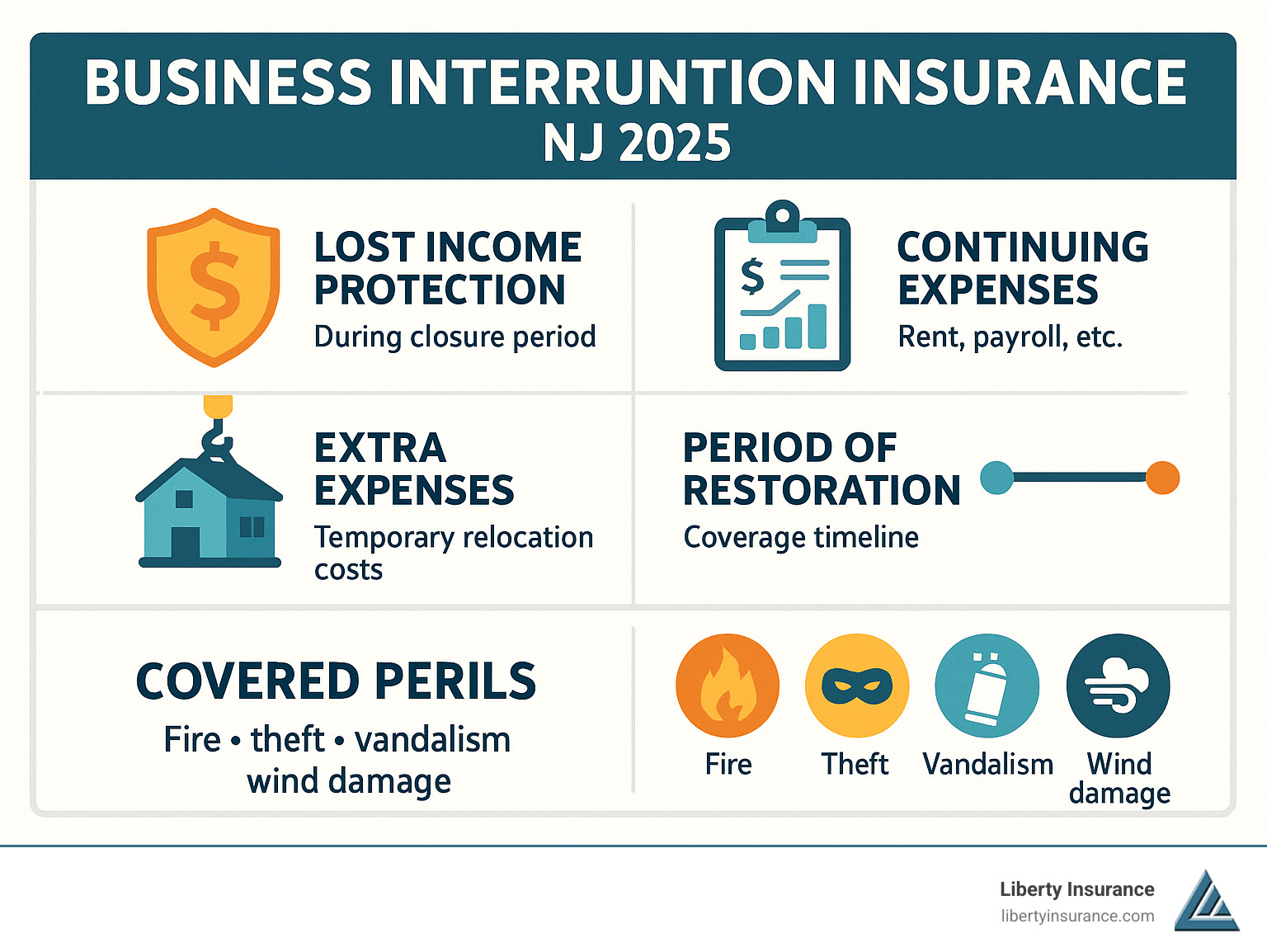
Simple guide to business interruption insurance nj:
What Does Business Interruption Insurance Cover in New Jersey?
When disaster forces your New Jersey business to close, business interruption insurance nj acts as a financial bridge to carry you over the disruption. The core of this coverage is protecting your lost net income by replacing revenue you would have earned. It also handles continuing operating expenses that persist even when your business is closed.
These expenses include rent, payroll, taxes, and loan payments, which don’t stop during a closure. This support is available during the “period of restoration”—the time it takes to repair or replace damaged property and resume operations. Your policy will clearly define this timeframe.
This coverage is triggered by “covered perils” that cause direct physical damage to your property. Common examples include fire, theft, vandalism, and wind damage from severe storms. According to the III, business interruption insurance can cover losses from riots, civil commotion, and vandalism. This coverage is typically part of your commercial property insurance; if your property isn’t physically damaged by a covered event, the business interruption portion usually won’t activate.
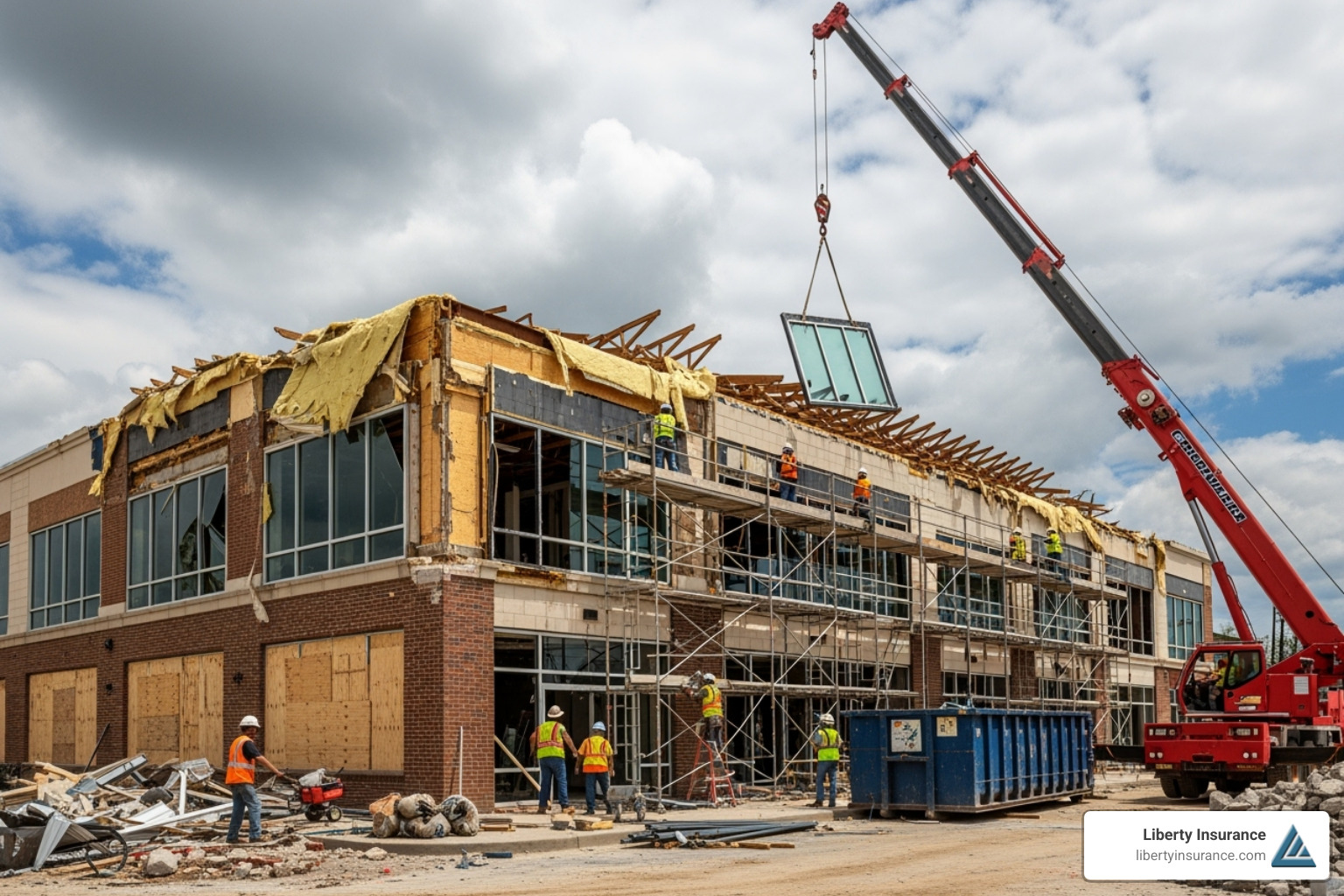
Business Income vs. Extra Expense Coverage
While “business income” and “business interruption” are often used interchangeably, it’s also vital to understand Extra Expense Coverage. The distinction can be critical to your recovery.
Business Income coverage focuses on lost revenue protection and covering normal operating costs during a shutdown. It’s your primary shield against lost profits, helping you meet financial commitments like payroll and rent.
Extra Expense Coverage covers additional costs incurred to minimize the interruption or operate from a temporary location. This can include temporary relocation, equipment rental, or overtime pay for employees. The goal is mitigating further loss and maintaining business continuity. While Business Income replaces lost revenue, Extra Expense helps you proactively manage the recovery.
Understanding Different Types of Business Interruption Coverage
Beyond basic business interruption insurance nj, specialized endorsements or separate policies can address unique scenarios and are crucial for comprehensive protection.
Contingent Business Interruption (CBI) protects against supply chain disruption. If a covered peril damages a key supplier or customer, disrupting your business, CBI provides coverage where a standard policy wouldn’t because your own property was not damaged.
Extended Business Interruption (EBI) addresses the post-repair income gap. It can take time for revenue to return to pre-disaster levels after reopening. EBI helps bridge this gap while you work on returning to pre-loss revenue.
Civil Authority Coverage applies to government-ordered shutdowns caused by nearby property damage. If authorities prohibit access to your business because a neighboring property suffered a covered loss, this coverage can replace lost income. The requirements are strict: the order must be due to direct physical damage to nearby property from a covered peril, and coverage often has waiting periods and duration limits.
The Legal Landscape of Business Interruption Insurance NJ
Understanding business interruption insurance nj coverage is only half the battle; the other is navigating New Jersey’s legal landscape, which dictates how policies pay out. Landmark court decisions have recently shaped how these claims are handled, clarifying policy language and setting precedents. This legal framework directly impacts claim outcomes. Let’s review the key legal principles every New Jersey business owner should know.

The “Direct Physical Loss or Damage” Requirement in New Jersey
Most business interruption insurance nj policies are triggered by “direct physical loss or damage.” As recent court battles have shown, this phrase is critical in determining whether a claim is paid. The New Jersey Supreme Court clarified this in the AC Ocean Walk case, ruling that direct physical loss or damage requires tangible, physical alteration or destruction of property. This means there must be visible damage, not just financial harm.
This interpretation means that being unable to use your property isn’t enough to trigger coverage. A government-ordered closure, without physical damage to your property, will not be covered by a standard policy. The implications for claims are significant: if a fire damages a neighbor’s building and the city evacuates your block, that might qualify. But if health authorities order all restaurants to close without any physical damage, standard policies typically won’t cover your losses.
Common Exclusions: Viruses, Pandemics, and Government Shutdowns
The history of virus exclusions is a cautionary tale. After the 2003 SARS outbreak, many insurers began adding virus and bacteria exclusions. The Insurance Services Office (ISO) created a standard exclusion form in 2006 to eliminate coverage for losses from viruses or bacteria.
In 2020, these exclusions became critical. Thousands of New Jersey businesses filed COVID-19 claims, only to be denied due to these exclusions. The NJ Supreme Court’s decision in the AC Ocean Walk case reinforced that standard policies generally don’t cover pandemic losses without physical property damage. New Jersey was the first state to introduce legislation to force insurers to cover these losses retroactively, but the bill was ultimately tabled.
The reality is that government shutdown orders alone, without accompanying physical damage, typically don’t trigger coverage under standard policies.
How Civil Authority Coverage Applies in New Jersey
Civil Authority Coverage is a potential exception, but this specialized provision has strict requirements that often surprise business owners. For this coverage to apply in New Jersey, a formal government order must prohibit access to your business. Crucially, this order must stem from direct physical damage to nearby property caused by a covered peril.
For example, if a gas explosion damages buildings on your street and the fire department cordons off the block, civil authority coverage might apply to your undamaged store. However, most policies include waiting periods (often 72 hours) and have a limited duration (typically 30 days or less). As experts note, coverage depends entirely on meeting these precise conditions. Broad government shutdowns, like those during the pandemic, generally don’t trigger this coverage because they weren’t tied to specific, nearby physical damage.
Securing the Right Business Interruption Policy for Your NJ Business
Securing the right business interruption insurance nj isn’t a one-size-fits-all task. It requires careful planning, proactive steps, and professional guidance to make informed decisions that safeguard your business.

How is the Cost of Business Interruption Insurance Determined?
The cost of your business interruption insurance nj policy depends on a thorough risk assessment by the insurer. Key factors include:
- Industry Type: Some industries, like restaurants or manufacturing, have a higher risk of incidents than others, like a real estate agency.
- Location: A business in a coastal town like Toms River faces higher risks from storms than one inland in Princeton. Proximity to fire stations and local crime rates also play a role.
- Number of Employees: More employees can increase potential exposure and affect costs.
- Coverage Limits: Higher maximum payouts for lost income and expenses mean higher premiums.
- Prior Loss History: A history of claims can indicate higher future risk and increase costs.
- Safety Measures: Businesses with robust safety measures, like fire suppression systems or alarms, may qualify for lower premiums.
Steps to Ensure Adequate Coverage for your business interruption insurance nj
Ensuring you have the right business interruption insurance nj is a critical part of your business resilience strategy. It’s not just about having a policy, but the right one for your unique operations. We recommend the following key steps:
- Conduct a thorough risk assessment: Identify potential perils specific to your NJ location and industry.
- Calculate potential income loss accurately: Work with financial professionals to project earnings and expenses to determine appropriate coverage limits.
- Review your Business Owner’s Policy (BOP) for existing coverage: Many BOPs include basic BI coverage, but the limits may be insufficient. You can learn more about understanding Business Owner’s Policies (BOPs) here.
- Keep meticulous financial records: Clear financial documentation is vital to prove your losses in a claim.
- Understand policy limits and deductibles: Know the maximum payout and your out-of-pocket costs before coverage begins.
- Perform an annual policy review with your agent: An annual check-up ensures your coverage remains aligned with your evolving business.
Finding Reliable Resources in New Jersey
Navigating business interruption insurance nj can be daunting, but you don’t have to do it alone. New Jersey offers several reliable resources for business owners.
- Independent Insurance Agents: We recommend working with local independent agents in New Jersey. They work with multiple insurers to find the best coverage and pricing for your needs, acting as your advocate.
- NJ Department of Banking and Insurance (NJDOBI): This state department is a crucial resource. Following P.L.2021, c.98, the NJDOBI created a mandated one-page summary for Business Interruption Coverage. Insurers must provide this summary to new and renewing policyholders, ensuring clear and consistent information. You can access this summary and other valuable information on the NJDOBI website.
- Policyholder Rights: Familiarize yourself with your rights as a policyholder. The NJDOBI website also provides guidance on filing complaints if you believe a claim has been unfairly handled.
Frequently Asked Questions about Business Interruption Insurance in NJ
Business owners often have questions about business interruption insurance nj. Let’s address the most common concerns with straight answers.
How long does business interruption coverage last?
Business interruption insurance nj coverage doesn’t last forever; understanding its timeline is crucial. Coverage applies during the “period of restoration,” the time required to return to normal operations after a covered loss. This period begins after a waiting period (often 24-72 hours) and ends when your property is repaired or replaced and operations resume at pre-loss capacity.
Most standard policies cap this period at 12 months. If your business needs longer to recover (e.g., complex manufacturing), you can add extended period endorsements to stretch coverage, sometimes up to 720 days. Discuss your realistic recovery timeline with your agent to ensure your coverage is sufficient and won’t run out prematurely.
Do I need business interruption insurance if I have a Business Owner’s Policy (BOP)?
If you have a Business Owner’s Policy (BOP), it likely includes some business interruption coverage. BOPs are convenient packages bundling property, liability, and business interruption insurance nj. However, the standard limits in a BOP may be too basic for your needs. While sufficient for a small shop, they might fall short for a business with higher overhead, like a restaurant or manufacturer.
The smart move is to review your BOP’s business interruption provisions with your agent. Assess if the limits are adequate for a realistic recovery period. If not, you can increase the limits or consider a stand-alone policy for more comprehensive protection. For more details on BOPs, you can learn about understanding Business Owner’s Policies (BOPs).
What should I do immediately after an event that interrupts my business?
When a disaster interrupts your business, your actions in the first few hours and days are critical for your insurance claim and recovery.
First, mitigate further damage, as required by most policies. This includes covering a damaged roof, securing the premises after a break-in, or shutting off utilities after a fire. This shows your insurer you are acting responsibly.
Next, document everything. Take extensive photos and videos of the damage from all angles before cleanup. Save all receipts for emergency repairs and other related expenses.
Your financial records are crucial for proving your claim. Gather recent tax returns, profit and loss statements, payroll records, and bank statements to document your normal income and expenses.
Finally, contact your insurance agent immediately. Prompt notification is a policy requirement. Your agent will guide you through the claims process, explain what information is needed, and help you meet important deadlines. The more organized and proactive you are, the better your chances of a fair and timely settlement.
Conclusion
For a New Jersey business, business interruption insurance nj can mean the difference between a temporary setback and permanent closure. This coverage is a financial lifeline when disaster strikes.
New Jersey’s legal landscape makes it clear that policy language is key. The Supreme Court’s ruling on “direct physical loss” highlights the importance of understanding your policy’s specific coverages and exclusions before a disaster occurs.
New Jersey businesses face unique challenges, from coastal storms to urban risks, making this coverage vital. The $30 billion in business damage from Hurricane Sandy is a stark reminder of the potential for devastation and the long road to recovery.
The good news is that with proper planning and the right coverage, your business can survive a disaster. Proactive planning involves understanding risks, calculating exposure, and working with knowledgeable professionals.
At Liberty Insurance, we’ve seen how the right business interruption insurance nj policy transforms a catastrophe into a manageable challenge. We understand your business is more than just numbers—it’s your dream and a community cornerstone. We are committed to helping you steer these complexities with confidence. Whether you’re a small shop in Princeton or a manufacturer on the shore, we’ll help you find coverage that fits your needs and budget.
Don’t wait for a disaster to test your coverage. Act now to make informed decisions. When rebuilding begins, your focus should be on your business, not on financial worries.
Learn more about specialized business insurance for contractors

