
Why Understanding SIMPLE IRA vs. SEP IRA Options Is Critical for Your Business
When running a small business, deciding between a SIMPLE IRA and a SEP IRA plan can feel overwhelming. Both options are designed to be easier and less expensive than a full 401(k), but they work very differently in practice.
Quick Comparison: SEP IRA vs. SIMPLE IRA
| Feature | SEP IRA | SIMPLE IRA |
|---|---|---|
| Who Contributes | Employer only | Employer + Employee |
| Business Size | Any size | 100 or fewer employees |
| 2024 Contribution Limit | Up to $69,000 or 25% of pay | $16,000 employee + employer match / 2% nonelective |
| Contribution Flexibility | Discretionary employer contributions | Mandatory employer contributions each year |
| Employee Deferrals | Not allowed | Allowed, via salary reduction |
| Catch-Up Contributions (50+) | Not available | Yes, additional $3,500 (2024) |
| Best For | Fluctuating income, self-employed, owner-focused savings | Stable income, employee engagement and retention |
Both SEP (Simplified Employee Pension) IRAs and SIMPLE (Savings Incentive Match Plan for Employees) IRAs offer straightforward, low-cost alternatives to traditional 401(k) plans. The key differences lie in:
- Who contributes (employer only vs. employer + employees)
- How much flexibility you have around contributions from year to year
- How much you and your employees can save annually
- Which businesses are eligible based on size and workforce
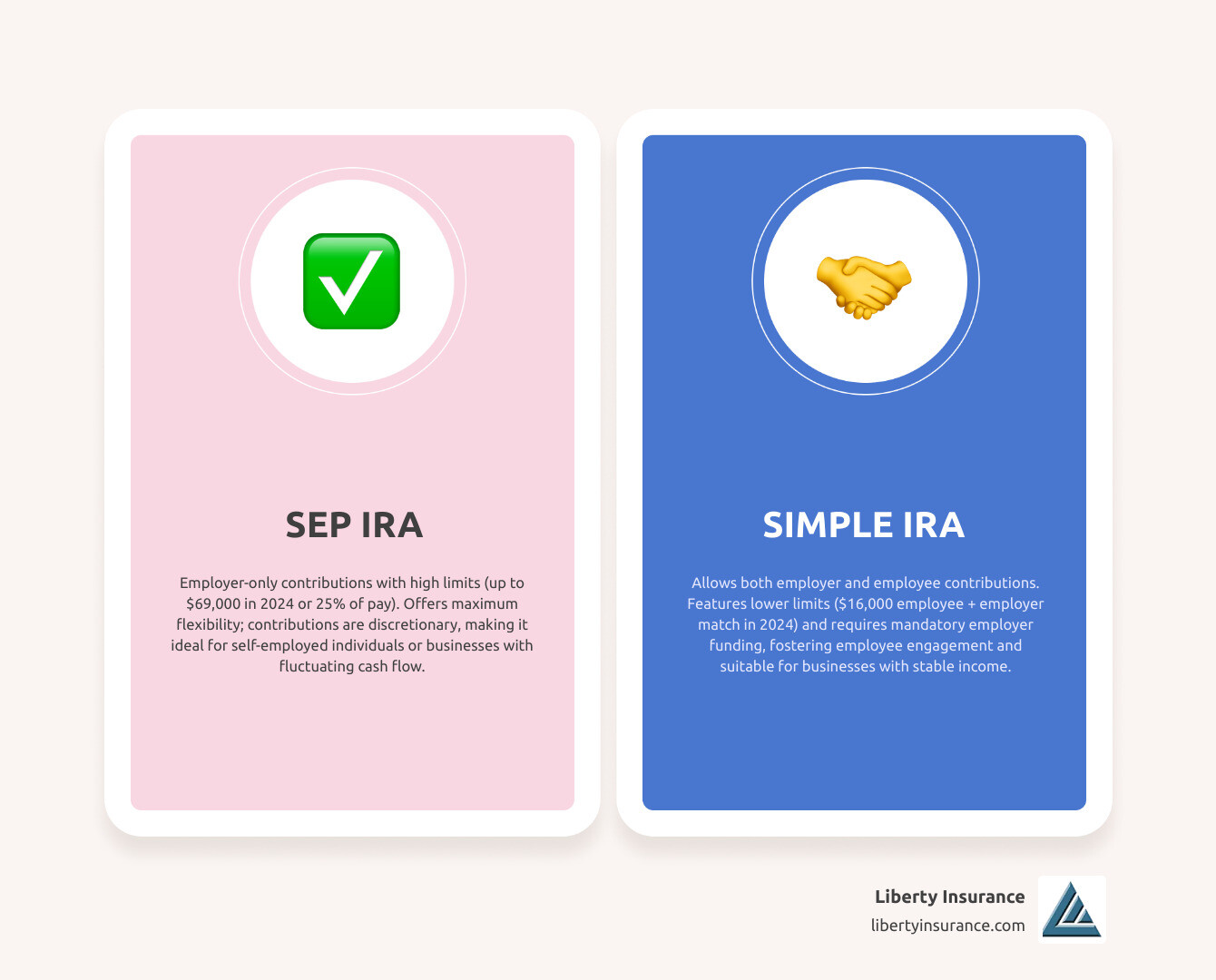
A SEP IRA is funded solely by the employer, offering high contribution limits and the flexibility to skip contributions during lean years. This makes SEPs especially attractive for self-employed professionals, businesses with highly variable income, and owners who want to prioritize their own retirement savings.
A SIMPLE IRA allows both employer and employee contributions. Employees can contribute through salary deferrals, and you must provide either a matching contribution or a small contribution for all eligible employees. This structure encourages employees to save and creates a visible benefit that helps with recruiting and retention.
I’m Andrew Harris, and I’ve helped countless New Jersey business owners steer the SIMPLE IRA vs. SEP IRA decision. The right plan aligns with your business’s cash flow, growth stage, personal retirement goals, and employee retention strategy.
This guide covers eligibility, contribution limits, tax implications, administrative considerations, and real-world scenarios to help you determine which plan is right for your business.
What Are SEP and SIMPLE IRAs? A Primer for Small Businesses
For many New Jersey businesses, the complexity and cost of a 401(k) are prohibitive. That’s where SEP IRAs and SIMPLE IRAs shine. These plans offer a tax-advantaged way to save for retirement with lower administrative burden than a traditional 401(k).
Both plan types use individual IRA accounts for each participant, allow contributions to grow tax-deferred until withdrawal, avoid complex nondiscrimination testing, and typically come with low or no ongoing plan administration fees.
What Is a Simplified Employee Pension (SEP) IRA?
A Simplified Employee Pension (SEP) IRA is a retirement plan funded entirely by the employer. Employers, including self-employed individuals, contribute to traditional IRAs established for each eligible employee.
Key features of a SEP IRA include:
Employer-only contributions: You decide whether to contribute each year. Employees cannot make salary-deferral contributions into the SEP account itself.
High contribution limits: For 2024, you can contribute up to the lesser of $69,000 or 25% of eligible compensation for each participant.
Uniform percentage requirement: You must contribute the same percentage of compensation for all eligible employees, including yourself.
Flexibility from year to year: You can change the contribution percentage annually or skip contributions when cash flow is tight.
Business eligibility: Available to businesses of any size.
Simplicity of administration: No annual Form 5500 filing is required. Setup usually involves a short plan document and opening SEP IRA accounts for participants.
SEP IRAs are powerful tools for self-employed individuals, owners who want to front-load retirement savings in strong years, and businesses with variable or seasonal revenue. For more details, refer to the IRS page on the Simplified Employee Pension plan (SEP).
What Is a SIMPLE IRA?
A SIMPLE IRA (Savings Incentive Match Plan for Employees) is designed for small employers and incorporates both employer and employee contributions. Employees can elect to defer a portion of their salary into the plan, and the employer must make a contribution each year.
Core elements of a SIMPLE IRA include:
Employee salary deferrals: Eligible employees may contribute up to the annual SIMPLE deferral limit. These contributions are typically pre-tax.
Mandatory employer contributions: Each year, you must choose either:
- Matching contribution of up to 3% of compensation for employees who defer, or
- 2% nonelective contribution for all eligible employees
Eligibility limited to small employers: Only businesses with 100 or fewer employees who earned at least $5,000 in the prior year can maintain a SIMPLE IRA plan.
Catch-up contributions: Employees age 50 or older can contribute additional amounts.
Straightforward rules: Like SEPs, SIMPLE IRAs do not require annual Form 5500 filings.
SIMPLE IRAs are well-suited for employers with steady cash flow that can support annual contributions, companies with under 100 employees that want a robust retirement benefit, and businesses focused on recruiting and retaining employees. For specifics, see the IRS guide on the SIMPLE IRA plan.
The Core Differences: A Detailed SIMPLE IRA vs. SEP IRA Breakdown
Understanding the distinctions between these two retirement plans is crucial for New Jersey business owners.
Eligibility: Who Can Offer and Who Can Participate?
Business Eligibility
- SEP IRA: Can be offered by a business of any size, from a self-employed individual to a larger company.
- SIMPLE IRA: Limited to businesses with 100 or fewer employees who earned at least $5,000 in the preceding year. A two-year grace period applies if you grow beyond this limit.
Employee Eligibility
SEP IRA: An employee is generally eligible if they have reached age 21, worked for you in at least three of the last five years, and received at least $750 in compensation in 2024. More details are available in the IRS’s Retirement plans: FAQs regarding SEPs.
SIMPLE IRA: An employee is generally eligible if they earned at least $5,000 in compensation during any two preceding years and are expected to earn at least $5,000 in the current year.
Contribution Rules: How Money Enters the Plan
| Feature | SEP IRA | SIMPLE IRA |
|---|---|---|
| Contribution Source | Employer only | Employer + Employee |
| 2024 Employee Deferral Limit | Not applicable | $16,000 |
| 2024 Catch-Up (Age 50+) | Not available | Additional $3,500 |
| 2024 Employer Limit | Lesser of $69,000 or 25% of compensation | Mandatory: up to 3% match, or 2% nonelective |
| Employer Contribution Flexibility | Fully discretionary | Mandatory every year |
| Uniform Contribution Requirement | Same % of pay for all eligible employees | Match only to those who defer, or 2% to all |
How SEP IRA Contributions Work
- Only the employer contributes to a SEP IRA
- For 2024, you can contribute the lesser of $69,000 or 25% of eligible compensation for each participant
- You decide each year what percentage to contribute (up to the legal maximum)
- The same contribution percentage must be applied to all eligible employees
See IRS guidance on SEP contribution limits.
How SIMPLE IRA Contributions Work
- Employees may defer up to $16,000 for 2024 (plus $3,500 catch-up for age 50+)
- Employers must choose either matching up to 3% of compensation or 2% nonelective contribution for all eligible employees
- Unlike SEPs, you cannot skip employer contributions
More information at SIMPLE IRA Contribution Limits.
Administrative Lift: Setup, Maintenance, and Reporting
Setup Deadlines
- SEP IRA: Can be set up as late as your business’s tax filing deadline, including extensions.
- SIMPLE IRA: Generally must be established by October 1 of the year in which contributions will begin.
Ongoing Administration
Both plans avoid annual Form 5500 filings and complex nondiscrimination tests. Employer responsibilities include establishing a plan document, ensuring account setup, and for SIMPLE IRAs, providing annual employee notices. For more on retirement accounts, explore individual retirement accounts.
SEP IRA vs. SIMPLE IRA: Making the Right Choice for Your Business
Choosing the right retirement plan is a strategic decision that depends on your objectives as an owner, your workforce, and your business’s financial profile.

When to Choose a SEP IRA: Pros, Cons, and Ideal Use Cases
Pros of a SEP IRA
- High contribution limits: 2024 limit of $69,000 or 25% of compensation allows substantial retirement savings
- Contribution flexibility: Change or skip contributions annually based on business performance
- Simple administration: No employee contributions to track, no Form 5500 filings
- Available to any size business: No employee cap like SIMPLE IRAs
Cons of a SEP IRA
- Employer-only funding: Employees cannot contribute their own money
- Uniform contribution rate: Must contribute same percentage for all eligible employees
- No catch-up contributions: No special provision for employees age 50+
- Less effective as retention tool: Less visible as a benefit compared to matching plans
A SEP IRA Is Best For
- Self-employed individuals and owner-only businesses maximizing retirement savings
- Businesses with unpredictable or seasonal cash flow
- Companies preferring a simple, employer-funded plan
When to Choose a SIMPLE IRA: Pros, Cons, and Ideal Use Cases
Pros of a SIMPLE IRA
- Employee participation: Employees can contribute pre-tax dollars via salary deferrals
- Guaranteed employer contribution: Mandatory match or 2% nonelective contribution
- Catch-up contributions: Additional $3,500 for employees 50+ in 2024
- Relatively simple and low cost: Easier than 401(k)s
Cons of a SIMPLE IRA
- Lower contribution limits: $16,000 primary limit (or $19,500 with catch-up)
- Mandatory employer funding: Must contribute every year
- 100-employee limit: Only for businesses with 100 or fewer employees
- Harsher early withdrawal penalty: 25% penalty within first two years
A SIMPLE IRA Is Best For
- Businesses with stable cash flow for yearly employer contributions
- Companies with fewer than 100 employees wanting a competitive retirement benefit
- Employers focused on employee engagement and retention
For additional insights, see our page about SIMPLE IRA small business.
Real-World Scenarios: Which Plan Fits Best?
To make these concepts more concrete, let’s look at two common New Jersey business scenarios.
Scenario 1: The Solo Consultant
Profile: Sarah is a self-employed IT consultant operating as a sole proprietor. Her income is highly variable, ranging from $90,000 in a slow year to $200,000 in a great year. She has no employees and her primary goal is to maximize her own retirement savings in a tax-efficient way, especially during high-income years.
Analysis: A SIMPLE IRA is a poor choice for Sarah. The 2024 employee deferral limit of $16,000 is far below what she could potentially save. The employer contribution component is irrelevant as she has no employees to match.
Recommendation: SEP IRA. The SEP IRA is the clear winner. It allows her to contribute up to 25% of her net adjusted self-employment income, up to the $69,000 limit. In a $200,000 year, she could contribute a substantial amount (after accounting for self-employment taxes, this would be around $37,000). Crucially, in a lean $90,000 year, she has the flexibility to reduce her contribution percentage or even contribute nothing at all, without any penalty or compliance issue. The SEP IRA perfectly aligns with her fluctuating income and aggressive savings goals.
Scenario 2: The Growing Landscaping Business
Profile: GreenScapes LLC is a landscaping company with 15 full-time employees. The owner, Mike, has built a business with relatively stable, predictable revenue. He’s concerned about employee turnover and wants to offer a retirement benefit to compete with larger firms, but the cost and administrative burden of a 401(k) seem daunting.
Analysis: A SEP IRA presents a challenge for GreenScapes. If Mike wants to contribute for himself, he must contribute the same percentage of compensation for all 15 eligible employees. If he wants to contribute 10% of his own $100,000 salary ($10,000), he must also contribute 10% for every employee, which could become a significant and unpredictable expense. Furthermore, employees have no way to contribute their own savings to the plan.
Recommendation: SIMPLE IRA. The SIMPLE IRA is an excellent fit. It empowers employees to save for their own future through salary deferrals. Mike is only required to make a matching contribution (up to 3%) for those employees who choose to participate. This makes the cost more manageable and directly rewards employees who are engaged in saving. Alternatively, the 2% nonelective contribution provides a predictable, modest benefit to all employees, fostering goodwill and loyalty. The SIMPLE IRA provides a valuable, visible benefit that helps with retention without the complexity of a 401(k).
Tax Implications: SIMPLE IRA vs. SEP IRA Comparison
Employer Tax Deductions
Contributions to either plan are generally tax-deductible business expenses, reducing your business’s taxable income.
Tax-Deferred Growth
In both plans, contributions and investment earnings grow tax-deferred. Participants don’t pay tax until withdrawal.
Taxation of Retirement Withdrawals
Funds withdrawn in retirement (typically after age 59½) are taxed as ordinary income.
Early Withdrawal Penalties
- Standard rule: Withdrawals before age 59½ are subject to a 10% early-withdrawal penalty plus regular income tax
- SIMPLE IRA 2-year rule: Withdrawals within the first two years of participation are subject to a 25% penalty if taken before age 59½. The IRS explains more about this 25 percent levy in certain circumstances.
How Do SIMPLE IRA and SEP IRA Plans Compare to a 401(k)?
While this guide focuses on SIMPLE IRAs and SEP IRAs, many business owners also want to understand how these plans stack up against the more widely known 401(k). For a number of New Jersey small businesses, a 401(k) may be a long‑term goal, but it is important to understand the trade‑offs before deciding whether to leap directly to a 401(k) or start with a SEP or SIMPLE.
Complexity and Cost
SEP and SIMPLE IRAs:
- Designed for simplicity with low start‑up and administrative costs.
- No requirement for annual Form 5500 filing.
- No nondiscrimination testing, top‑heavy testing, or plan‑level audits under typical circumstances.
401(k) plans:
- The most complex and often the most expensive small‑business retirement option.
- Usually require:
- A third‑party administrator (TPA)
- Ongoing compliance testing
- Annual Form 5500 filings
- More involved plan documents and regular amendments as rules change
If you are just getting started with offering retirement benefits and want to minimize overhead, a SEP or SIMPLE IRA is usually more practical than an immediate jump to a 401(k).
Administrative Burden
SEP and SIMPLE IRAs:
- Minimal employer responsibilities aside from:
- Establishing plan documents
- Opening accounts
- Funding contributions
- Providing required notices (SIMPLE only)
- Investment choices are typically handled directly between participants and the financial institution, keeping employer duties light.
- Minimal employer responsibilities aside from:
401(k)s:
- Require structured procedures around:
- Enrollment and eligibility tracking
- Deferral changes
- Loans and hardship withdrawals (if allowed)
- Compliance testing (ADP/ACP, top‑heavy, etc.)
- Coordination with payroll providers and recordkeepers
- Require structured procedures around:
Contribution Limits and Structure
401(k) plans:
- Allow higher employee deferrals than SIMPLE IRAs:
- For 2024, employees can contribute up to $23,000 (plus catch‑up contributions for those 50+).
- Total annual contribution limit (employee + employer combined) is $69,000 for 2024 (or higher with catch‑ups for those 50+), similar to the SEP annual cap but structured differently.
- Contributions can be allocated in more flexible ways using matching formulas, profit‑sharing, and, in some designs, different contribution rates for different groups (subject to testing).
- Allow higher employee deferrals than SIMPLE IRAs:
SEP IRAs:
- High combined limit (up to $69,000 or 25% of compensation in 2024), but contributions are employer‑only and must be the same percentage for all eligible employees.
SIMPLE IRAs:
- Lower deferral limit than 401(k)s: $16,000 (plus $3,500 catch‑up for age 50+ in 2024).
- Employer contributions are limited to the SIMPLE matching or 2% nonelective structure.
Plan Features and Flexibility
Loans:
- 401(k) plans can allow participant loans, enabling employees to borrow from their account balances within regulatory limits.
- SEP and SIMPLE IRAs do not allow loans; borrowing from these accounts is treated as a distribution and is subject to tax and potentially penalties.
Roth options and SECURE 2.0 Act Updates:
- Thanks to the landmark SECURE 2.0 Act of 2022, the rules for small business retirement plans have evolved, adding more flexibility.
- Roth Contributions: Previously, SEP and SIMPLE IRAs could only accept pre-tax contributions. SECURE 2.0 now permits these plans to include a Roth (after-tax) component. This means employees can make Roth deferrals to a SIMPLE IRA, and employers can be given the option to make Roth matching or nonelective contributions to both SEP and SIMPLE IRAs. This allows for tax-free growth and qualified withdrawals in retirement, a powerful planning tool.
- Increased SIMPLE IRA Contributions: For employers with 25 or fewer employees, SECURE 2.0 allows for higher employee deferral and catch-up limits starting in 2024, provided the employer makes a higher matching or nonelective contribution. For employers with 26 to 100 employees, the law allows them to make an additional nonelective contribution of up to 10% of compensation (capped at $5,000 per employee).
- Provider Availability: It is important to note that while these features are now permitted by law, their availability depends on the financial institutions (custodians) that offer the plans. Business owners should verify with their chosen provider that these new options have been implemented.
Vesting:
- Contributions to SEP and SIMPLE IRAs are 100% immediately vested. Employees own the money as soon as it’s contributed, and it cannot be taken back.
- 401(k) plans can use vesting schedules for employer contributions, such as graded (e.g., 20% per year) or cliff vesting after a certain number of years, which can encourage retention.
When a 401(k) May Be the Better Choice
As your business grows, there are scenarios where a 401(k) can make more sense than sticking with a SEP or SIMPLE IRA:
- You want higher deferral limits and more contribution flexibility for highly compensated employees.
- You need features like loans or hardship withdrawals.
- You want to design tiered benefits or more complex allocation formulas across different employee groups.
- Your workforce has grown beyond SIMPLE IRA eligibility, or your benefits strategy requires the added sophistication and plan design options of a 401(k).
For most small businesses in New Jersey seeking a cost‑effective, easy‑to‑manage plan, a SEP or SIMPLE IRA is an excellent starting point. A 401(k) becomes more appealing as:
- Your employee headcount rises
- Your budget for plan administration increases
- Your executives or owners need specialized contribution strategies and plan features that SEPs and SIMPLEs cannot provide.
Frequently Asked Questions About SIMPLE IRAs and SEP IRAs
Which plan is better for a business with fluctuating cash flow?
A SEP IRA is typically superior for businesses with unpredictable revenue. You can decide how much to contribute each year, from 0% up to the legal maximum, and skip contributions entirely in lean years. This flexibility is ideal for seasonal contractors or professional practices with variable billings. A SIMPLE IRA requires mandatory employer contributions every year, which can strain tight cash flow.
Can I have a SEP or SIMPLE IRA for my business if I already have a 401(k) from another job?
Yes. You can establish and contribute to a SEP IRA or SIMPLE IRA for your self-employment income or small business, even if you participate in a 401(k) at another job. The plans are separate, though certain overall IRS limits and coordination rules can apply. Consult a tax professional to ensure you remain within combined contribution limits.
What happens if my business grows beyond 100 employees while I have a SIMPLE IRA?
The IRS generally provides a two-year grace period during which you can continue your SIMPLE IRA plan. This grace period gives you time to evaluate options (such as a 401(k) or SEP IRA), design and implement a new plan, and properly communicate changes to employees.
Can I switch from a SIMPLE IRA to a SEP IRA or a 401(k)?
Yes, but timing matters. SIMPLE IRAs operate on a calendar-year basis. To switch, you generally continue the SIMPLE IRA through December 31 and establish the new plan to begin January 1 of the following year. Employee contributions to the SIMPLE must stop when the plan is terminated.
Can employees still contribute to a traditional or Roth IRA if they are in a SEP or SIMPLE IRA?
Yes. Employees can often contribute to their own traditional or Roth IRAs in addition to participating in a SEP or SIMPLE IRA, subject to annual IRA contribution limits and income-based eligibility rules. Participation in a SEP or SIMPLE does not automatically prevent IRA contributions, but it can affect whether certain contributions are deductible.
How do SEP and SIMPLE IRAs relate to state-mandated retirement programs?
Many states, including New Jersey with its NJ Secure Choice Savings Program, have enacted laws requiring employers who don’t offer a workplace retirement plan to automatically enroll their employees in a state-sponsored IRA program. Establishing a qualified retirement plan, such as a SEP IRA or a SIMPLE IRA, exempts your business from these state mandates. Opting for a SEP or SIMPLE plan often provides significant advantages over the state-run options, including higher contribution limits, the ability for employers to make tax-deductible contributions, and greater control over plan design and investment choices.
Conclusion
Choosing between a SIMPLE IRA and a SEP IRA is a pivotal decision for any New Jersey small business owner. Both plans offer simplified, powerful ways to save for retirement without the complexity and cost of a full 401(k), but they serve slightly different purposes.
Key Takeaways
SEP IRA:
- Best for maximum contribution flexibility and high annual limits.
- Ideal for:
- Self‑employed individuals and owner‑only businesses
- Companies with fluctuating cash flow that may need to skip contributions in some years
- Situations where the owner wants to prioritize their own retirement savings and has few or no employees
SIMPLE IRA:
- Best for encouraging employee savings with mandatory employer contributions and salary deferrals.
- Ideal for:
- Businesses under 100 employees with stable cash flow
- Employers who want a visible, easy‑to‑understand benefit that supports employee engagement and retention
The right choice depends on your business’s:
- Cash flow pattern (steady vs. variable)
- Size and growth trajectory
- Owner savings goals and time horizon to retirement
- Philosophy on employee benefits and competitiveness in your labor market
At Liberty Insurance, we understand that financial security goes beyond commercial property or liability coverage. It includes building a secure retirement foundation for you and your employees. Making an informed retirement plan choice is a crucial step in that process.
We can help you:
- Analyze your cash flow and workforce needs
- Compare SIMPLE, SEP, and 401(k) options in the context of your broader financial picture
- Implement the plan you choose and coordinate with your payroll and investment providers
We’re here to help you navigate these important decisions. Explore our wealth management services to see how we can support your journey toward long‑term financial well‑being for both you and your team.

