
Why Your Primary Insurance Might Not Be Enough
Commercial excess liability coverage provides additional protection when a claim exceeds the limits of your primary liability policies, such as general liability, commercial auto, or employers liability insurance. Here’s a quick overview:
- What it is: Extra insurance that kicks in after your primary policy limits are exhausted.
- How it works: Extends coverage limits from $1 million up to $25 million or more.
- Who needs it: Businesses with significant assets, high-risk operations, or contractual requirements.
- Average cost: Approximately $480 per year for each $1 million in additional coverage.
- Key difference from umbrella: Excess liability increases limits on one specific underlying policy, while umbrella insurance can cover multiple policies and may offer broader coverage.
A customer slip-and-fall, a serious company vehicle accident, or a fire that spreads to neighboring properties can all result in claims that exceed standard insurance limits. The financial impact can be devastating, potentially forcing a business to close its doors.
That’s where commercial excess liability coverage becomes critical. It acts as a financial safety net, protecting your business assets when claims surpass what your primary insurance will pay. Think of it as “insurance for your insurance”—an additional layer of protection that can mean the difference between weathering a catastrophic loss and facing bankruptcy.
As experienced insurance advisors, we’ve helped countless New Jersey business owners understand how commercial excess liability coverage can protect their operations. With over a decade of experience in commercial insurance, we’ll guide you through everything you need to know about this essential coverage.
What is Commercial Excess Liability Coverage and How Does It Work?
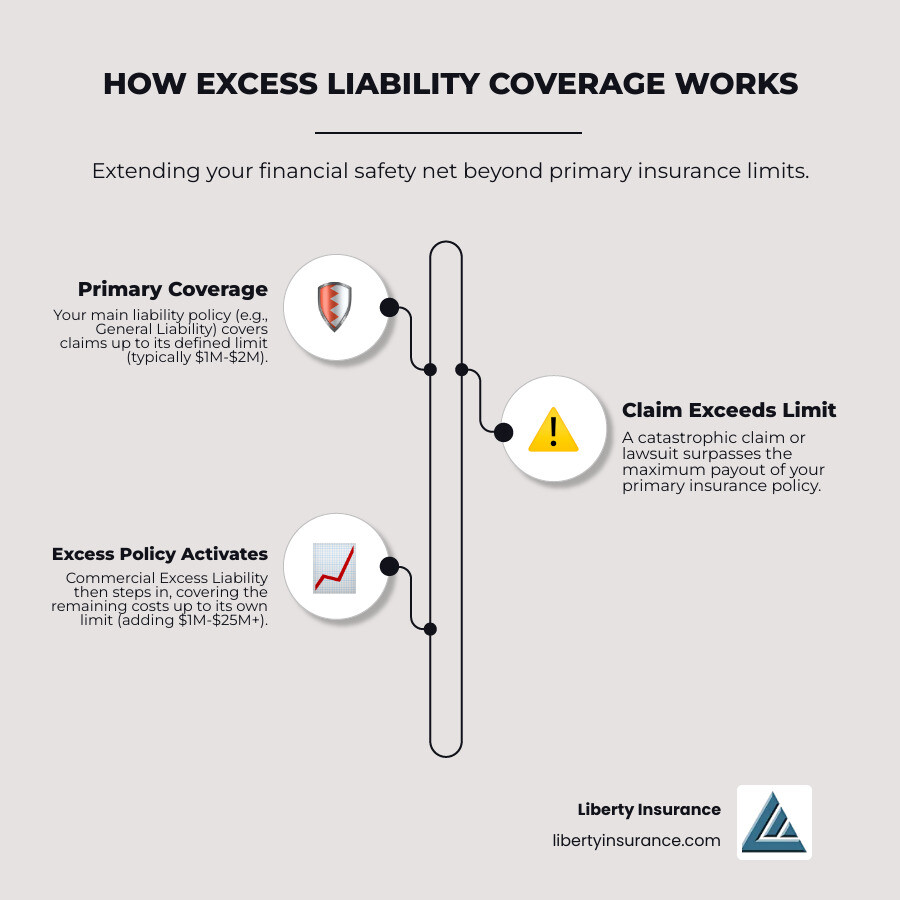
Think of commercial excess liability coverage as a financial cushion that activates when a claim is too large for your regular insurance to handle. It sits above your primary business insurance policies, waiting to spring into action when a liability claim exceeds what your standard coverage will pay. It doesn’t change what you’re covered for, but it dramatically increases how much protection you have.
The Core Function: Extending Your Financial Safety Net
Commercial excess liability coverage increases the dollar limits on a specific underlying insurance policy. For example, if your Commercial General Insurance policy has a $1 million limit and you face a $2.5 million claim, your primary policy pays its maximum of $1 million. The excess liability policy then covers the remaining $1.5 million, assuming you have enough coverage.
This is known as “follow-form” coverage. Your excess policy follows the same terms, conditions, and exclusions as the underlying policy it supplements. If your primary policy covers an incident, your excess policy will too, just with higher limits. We most commonly see this coverage layered on top of commercial general liability, Commercial Auto Insurance, or employer’s liability policies.
A Real-World Scenario: Putting Excess Liability to the Test

Imagine your landscaping business has a general liability policy with a $1 million limit. An employee accidentally damages a gas line, causing an explosion that injures a homeowner and damages neighboring properties. The court awards the plaintiffs $2.8 million.
Your primary general liability policy would pay its full $1 million limit. Your excess liability policy would then kick in to cover the remaining $1.8 million. With a $2 million excess policy, you’d be fully covered. Without it, your business would be responsible for that $1.8 million, likely leading to liquidating assets or bankruptcy.
What Commercial Excess Liability Insurance Covers
Commercial excess liability coverage provides a deeper financial well for the coverages you already have. It extends protection for:
- Judgments and settlements: It covers court-awarded damages or agreed-upon settlements that exceed your primary policy’s limits.
- Legal defense costs: Once your primary policy’s limits are reached, many excess policies also step in to cover ongoing legal expenses.
- Bodily injury: This includes claims for physical harm suffered on your premises or due to your operations.
- Property damage: This covers damage your business causes to someone else’s property.
- Personal and advertising injury: It extends protection for non-physical harms like libel, slander, or copyright infringement.
Understanding how excess liability works with the various Types of Business Insurance you carry is key to building a comprehensive defense against catastrophic claims.
Excess Liability vs. Umbrella Insurance: A Critical Distinction
Many business owners confuse excess liability and umbrella insurance, but understanding the difference is crucial for proper protection.
Scope of Coverage: The “Follow Form” Principle
Commercial excess liability coverage is a specific tool designed to extend the limits of one particular underlying policy. It “follows the form,” meaning it mirrors that single policy’s terms, conditions, and exclusions. The only thing that changes is the dollar amount available to pay claims. If your general liability policy doesn’t cover something, neither will your excess policy.
Umbrella Liability Insurance, however, casts a wider net. An umbrella policy can sit over multiple underlying policies at once (general liability, commercial auto, employer’s liability). More importantly, umbrella policies may offer “drop-down” coverage, meaning they can cover certain claims that fall through the gaps in your primary policies, often after a self-insured retention is met.
As Investopedia notes, think of this type of insurance as an additional layer of personal protection coverage that activates when other coverage is exhausted. It provides both deeper and broader protection.
Breadth of Coverage and Key Differences
This table highlights the key differences:
| Feature | Commercial Excess Liability Insurance | Commercial Umbrella Insurance |
|---|---|---|
| Policies Covered | Typically one specific underlying policy | Multiple underlying policies (General Liability, Commercial Auto, Employer’s Liability, etc.) |
| Coverage Scope | Extends limits only (“follow-form”) | Extends limits AND may provide broader coverage for perils not covered by primary policies (“drop-down” coverage) |
| Drop-Down Coverage | No | Yes, for certain claims not covered by primary policies, after an SIR is met |
| Self-Insured Retention (SIR) | Not typically applicable; the underlying policy’s limit acts as the “deductible” | Often includes an SIR, which functions like a deductible for claims where the umbrella “drops down” to cover a gap |
Drop-down coverage means an umbrella policy might cover a claim that isn’t covered by any of your primary policies, but only after you pay a Self-Insured Retention (SIR). An SIR is like a deductible you pay out-of-pocket before the umbrella policy kicks in for those gap claims. With excess liability, the entire limit of your underlying policy serves as the “deductible”; once it’s paid out, the excess coverage takes over.
Practical Decision Framework: Excess vs. Umbrella
Consider an umbrella if you:
- Need one policy to sit above several liability lines (GL, auto, employer’s liability) for simplicity and breadth.
- Face potential coverage gaps in primary policies (e.g., non-owned watercraft liability, certain libel/slander situations) and want limited drop-down ability after an SIR.
Consider a follow-form excess if you:
- Want precise, cost-effective higher limits over a specific primary policy (e.g., GL only) and are comfortable with the primary policy’s scope.
- Have tightly negotiated primary coverage terms and prefer your excess to mirror those exactly without additional variables.
In practice, many businesses use both, building a tower with a first-layer umbrella over multiple lines and additional excess layers that follow form.
Real-World Example of Drop-Down
A retailer’s GL excludes certain advertising injury claims based on a contractual liability clause. The umbrella includes limited drop-down for some advertising injury not covered by GL, subject to a $25,000 SIR. The umbrella could step in for a covered allegation of disparagement once the SIR is met, even though the GL declined the claim. A follow-form excess above the GL would not respond in this scenario.
Common Pitfalls to Avoid
- Assuming all umbrellas drop down for everything: Most umbrellas only drop down for specifically listed perils and still exclude professional liability, pollution, and employment practices unless endorsed.
- Non-concurrency: If your umbrella contains broader or different exclusions than your primary, you may have unexpected gaps. For example, your primary general liability policy might have a specific exception allowing coverage for a certain type of contractual liability, but your umbrella policy might have a blanket contractual liability exclusion. In this case, a claim that falls under that exception would be covered by the primary policy but denied by the umbrella, creating a significant coverage gap. This is why it’s critical to review policies side-by-side at binding and renewal to ensure their terms align.
- Minimum underlying requirements: Umbrellas often require certain minimum limits in the underlying policies. Falling below them can trigger larger out-of-pocket obligations before the umbrella responds.
What About Excess and Surplus (E&S) Lines?
You might also hear the term “excess and surplus lines.” This doesn’t refer to a type of coverage but to a special segment of the insurance market. The E&S market handles unique, complex, or high-risk businesses that the standard insurance market may not cover.
E&S carriers are “non-admitted” insurers, meaning they have more flexibility to customize policies for unusual risks. You might encounter the E&S market if your business is in a high-risk industry or has a difficult claims history. An E&S carrier can write an excess liability or umbrella policy, just like a standard carrier. The key takeaway is that E&S describes where you get the insurance, not what kind of insurance it is. You can learn more about Commercial Excess and Umbrella Liability Coverage | The Institutes.
Assessing Your Need and the Cost of Coverage
Deciding if you need commercial excess liability coverage is a critical risk management step. It’s a smart layer of protection that guards against financial storms that could otherwise sink your business.

Who Needs Commercial Excess Liability Coverage?
While every business has risk, certain companies face exposures that make this coverage a necessity:
- High-risk industries: Construction, manufacturing, energy, and trucking operations face more opportunities for serious incidents that can generate claims far exceeding standard policy limits.
- Significant assets: If you own your building, have valuable equipment, or hold substantial cash reserves, you have more to protect.
- Public-facing operations: Retail stores, restaurants, hotels, and event venues have high foot traffic, which increases liability exposure from slip-and-falls or other accidents.
- Contractual requirements: Many large clients, landlords, and project owners require vendors to carry liability limits of $2 million, $5 million, or more.
- Vehicle fleets: The more commercial vehicles you have on the road, the greater the potential for a catastrophic auto accident.
- Businesses that use subcontractors: If a subcontractor you hire causes a major loss and is underinsured, your business could be held liable. Excess coverage protects you from these vicarious liability scenarios.
- Operations involving hazardous materials: Companies that transport, store, or use chemicals or other hazardous substances face the risk of catastrophic environmental or bodily injury claims.
Our Do I Need Excess Liability Insurance? Guide can help you further evaluate your unique risk profile.
Factors Influencing the Cost
The cost of commercial excess liability coverage depends on several factors:
- Coverage limits: A $5 million policy costs more than a $1 million policy, but the cost per million often decreases as you add more coverage.
- Industry risk: A roofing contractor will pay more than a marketing consultant because their industry has a higher likelihood of severe claims.
- Claims history: A business with a clean record will receive more favorable rates than one with multiple recent claims.
- Business location: The legal environment and jury verdict trends in areas like New Jersey can influence how carriers price coverage.
- Underlying policy limits: Carrying higher primary policy limits can sometimes lower the cost of your excess coverage.
Based on industry data, you can expect to pay approximately $480 in annual premiums for each $1 million of additional coverage. For a $3 million policy, this might be around $3,000 annually.
The Benefits of Investing in Higher Limits
The value of excess coverage far outweighs its cost. The primary benefits include:
- Asset protection: It creates a protective barrier between a catastrophic claim and your business assets.
- Preventing bankruptcy: A single large, uncovered loss can force a successful business to close its doors.
- Fulfilling contracts and enabling growth: Higher liability limits allow you to bid on larger projects.
- Peace of mind: Knowing your business is protected against catastrophic claims allows you to focus on growth.
- Cost-effectiveness: Paying a predictable premium is a small price compared to the potentially devastating cost of an uncovered multi-million dollar lawsuit.
It’s a smart investment in your business’s future stability as part of your overall Business Insurance strategy.
Frequently Asked Questions about Commercial Excess Liability Coverage
Business owners often have questions about commercial excess liability coverage. Here are answers to the most common ones.
How much excess liability coverage do I need?
There is no one-size-fits-all answer. The right amount depends on your specific business. To determine your need, consider:
- Asset valuation: A good rule of thumb is to carry liability limits that at least match the total value of your business assets (real estate, equipment, cash reserves, etc.).
- Potential for large claims: Evaluate your industry. A construction company in Howell Township faces different risks than a consulting firm in Red Bank. Research verdicts and settlements in your sector.
- Contractual obligations: Check your contracts with clients and landlords. Many require minimum liability limits, often from $1 million to $5 million or more.
We typically see businesses carry excess limits of at least $1 million, with many in high-risk industries opting for $25 million or more. Higher limits are often more affordable per million, making robust protection a smart investment.
Does excess liability have its own deductible?
No, commercial excess liability coverage typically does not have its own separate deductible.
Instead, the limit of your underlying primary policy acts as the deductible. For example, if you have a $1 million primary policy and a $2.3 million claim, your primary policy pays the first $1 million. Once that is exhausted, your excess policy seamlessly covers the remaining $1.3 million. You don’t have to pay another out-of-pocket amount for the excess layer to kick in.
How can a business obtain a policy?
Getting the right policy involves a few key steps:
- Consult an experienced insurance agent: Work with a broker who specializes in commercial insurance. They can properly assess your risks and structure a policy that fits your business.
- Complete a needs assessment: Your agent will review your operations, assets, contracts, and existing policies to understand your specific exposures and recommend the right amount of coverage.
- Go through underwriting: The insurance carrier will evaluate your business’s risk profile, including your industry, claims history, and safety programs, to determine your eligibility and premium.
- Policy issuance: Once approved, your policy is issued, and the extra layer of protection is in place. Your agent should review your coverage with you periodically as your business grows.
Our team at Liberty Insurance specializes in helping New Jersey businesses steer these decisions. We understand the local market and can help you structure the right protection. You can start the process by requesting a Get Business Insurance Quote from our team today.
Will my excess policy cover punitive damages?
It depends on state law and policy language. Some states restrict insuring punitive damages, and many policies exclude them or only cover punitive damages vicariously assessed against an employer. Review your forms and ask your broker to clarify how punitive and exemplary damages are treated in your jurisdiction.
Does excess liability extend worldwide?
Most excess policies follow the underlying policy’s territory. If your underlying has worldwide coverage and suits can be brought in the U.S. or where required, the excess typically follows. International operations may require local policies and a coordinated global program—coordinate with your broker to avoid gaps.
Does excess liability cover professional liability, cyber, or pollution?
Generally, no. A standard follow-form excess policy is designed to sit over your casualty liability policies: general liability, auto liability, and employer’s liability. It will not extend over specialty or professional lines like Errors & Omissions (E&O), Cyber Liability, or Pollution Liability. These policies have their own unique risk profiles and require their own dedicated excess policies. Attempting to use a general excess policy for these lines would create significant gaps, as the terms and conditions would not align. To get higher limits for professional, cyber, or pollution risks, you must purchase a specific excess policy designed to follow the form of that particular underlying specialty policy.
Can a different carrier provide my excess than my primary?
Yes. It’s common for a different insurer to provide the excess layer. The excess carrier will rely on the underlying carrier’s defense and claims handling, so choose reputable markets and ensure clear communication among carriers and your broker.
What happens if my underlying limits don’t meet the excess policy’s minimum requirements?
Excess policies often specify minimum underlying limits. If your underlying policy falls below those limits, you may be responsible for the shortfall before the excess responds. Keep your underlying policies at or above the required minimums and notify your broker before making changes.
Will my excess policy defend me or just indemnify?
Follow-form excess typically mirrors the underlying defense provisions. Some excess policies have a “duty to defend” once they attach; others are “duty to indemnify” and may reimburse defense costs rather than appoint counsel. Confirm the defense language in your form, particularly around when and how the excess attaches.
How does claims-made coverage affect my excess?
If your underlying is claims-made (common in certain employer’s liability or specialty lines), your excess should match the retroactive date and reporting provisions. If you buy tail coverage on the primary, arrange corresponding tail coverage on the excess to maintain continuity.
Can I name additional insureds on my excess policy?
Typically, yes—additional insured status granted in the underlying policy usually carries through to the follow-form excess. That said, some umbrellas and excess policies require explicit scheduling or contain restrictions. Share key contract requirements with your broker to ensure certificates reflect the correct wording (e.g., primary and noncontributory, waiver of subrogation) where applicable.
How do I file a claim under an excess policy?
- Report the loss to your primary carrier and your broker immediately.
- If the loss appears severe, your broker will notify the excess carrier(s) and help coordinate claim reporting.
- The primary carrier typically leads the defense and settlement until its limits are exhausted, at which point the excess attaches. Maintain open communication with all parties as reserves change and new information emerges.
What are the most common mistakes businesses make with excess coverage?
- Allowing non-concurrency between primary and excess forms.
- Reducing underlying limits mid-term without alerting the excess carrier.
- Assuming umbrellas cover everything (they don’t) or that excess always includes defense outside limits (not always).
- Failing to update certificates and additional insured endorsements when contracts change.
These FAQs provide general guidance. Actual coverage depends on policy wording and applicable law. Review your policies and consult your broker for advice tailored to your operations.
Conclusion: Securing Your Business’s Future

In today’s legal landscape, a single accident can result in claims that far exceed what most primary insurance policies cover. Commercial excess liability coverage is your business’s financial firewall against these catastrophic events.
While your primary policies handle everyday claims, excess liability steps in when a claim threatens your company’s existence, protecting everything you’ve worked to build. In an environment of rising litigation costs and higher settlements, hoping for the best is not a viable strategy.
Adding this extra layer of protection ensures your business can weather any storm, maintain financial stability, and continue to thrive. It protects your assets, your reputation, and your peace of mind, ensuring that one bad day doesn’t undo years of hard work.
At Liberty Insurance, we understand what’s at stake for New Jersey businesses. We take the time to understand your unique situation and recommend coverage that makes sense for you. Don’t wait until it’s too late.
Learn more and get a quote for Excess Liability Insurance today.

