
Why Commercial Risk Insurance Is Essential for Business Protection
Commercial risk insurance protects your business from financial losses due to property damage, liability claims, cyber attacks, and operational disruptions. Here’s what you need to know:
Core Coverage Types:
- General Liability – Protects against customer injury claims and property damage
- Commercial Property – Covers building damage, equipment, and inventory losses
- Cyber Liability – Shields against data breaches and ransomware attacks
- Professional Liability – Defends against errors and omissions claims
- Business Interruption – Replaces lost income during forced closures
- Workers’ Compensation – Covers employee injury costs (required in most states)
The commercial insurance landscape is rapidly evolving. 78% of US organizations see AI as an emerging risk, while cyber insurance rates have dropped 15% from their peak, creating opportunities for smart buyers. Meanwhile, inflation continues to drive up claims costs faster than premium rates in many markets.
For small business owners, the stakes couldn’t be higher. A single fire, lawsuit, or cyber breach can wipe out years of hard work. Yet many businesses hold too much uninsured risk – particularly in cyber security where most US and European firms face “enormous” exposure according to recent industry analysis.
I’m Andrew Harris, a Certified Insurance Counselor (CIC) and PIA National’s 2020 Agent of the Year, with over 15 years specializing in commercial risk insurance solutions for businesses like yours. I’ve helped hundreds of companies steer complex coverage decisions and optimize their protection strategies.
Commercial risk insurance vocabulary:
Top Picks for Commercial Risk Insurance
After helping businesses across New Jersey steer their insurance needs for over 15 years, I’ve learned that smart commercial risk insurance selection can make or break a company’s future. The numbers tell the story – the US property & casualty industry recorded $21.6 billion in net underwriting losses in 2023, which shows just how critical proper coverage has become.
Every business faces six major risk categories: economic, compliance, security, reputation, operational, and competitive challenges. While insurance can’t solve every problem, it provides essential protection for the risks that could otherwise destroy your business overnight.
Let me walk you through the coverage types that consistently prove their worth when disaster strikes.
Best Commercial Risk Insurance for Property & Liability
Think of property and liability coverage as your business’s financial armor. These two coverages form the backbone of any solid commercial risk insurance program because they protect against the most common – and potentially devastating – losses.
Commercial Property Insurance becomes your lifeline when the unexpected happens. It covers building damage from fire, wind, vandalism, and civil disturbances. Beyond that, it protects your equipment, machinery, inventory, and business personal property. Most importantly, it includes loss of income coverage to keep your bills paid while you rebuild.
I’ll never forget helping a Princeton manufacturing client who faced a warehouse fire that destroyed $300,000 worth of inventory. Because they had maintained adequate property coverage at full replacement value with our Inflation Guard endorsements, they avoided a massive coinsurance penalty and recovered every dollar. They were back in business within three months instead of closing permanently.
General Liability Insurance protects you when someone gets hurt on your property or claims your business damaged their property. It covers customer slip-and-fall injuries, advertising injury claims, product liability issues, and even some professional negligence situations when properly structured.
The math is simple but sobering. Small businesses typically pay around $42 monthly for general liability coverage, but a single lawsuit can easily cost hundreds of thousands. Just last year, I helped a Millstone Township retail client whose customer tripped over merchandise. The medical bills, lost wages, and legal costs reached $85,000, but their coverage handled everything seamlessly.
More info about Commercial Property Insurance
| Coverage Type | What It Protects | Average Monthly Cost | Best For |
|---|---|---|---|
| Commercial Property | Buildings, equipment, inventory | Varies by property value | Businesses with physical assets |
| General Liability | Third-party injury/damage claims | $42 | All businesses with customer contact |
| Professional Liability | Errors and omissions | $61 | Service-based businesses |
| Workers’ Compensation | Employee injuries | $45 | Businesses with employees |
Cyber & Technology Threat Coverage

Here’s something that keeps me up at night: most US and European businesses are sitting on “enormous” cyber risk exposure without realizing it. Cyber threats aren’t just headlines anymore – they’re daily realities that can cripple businesses in hours.
Cyber Liability Insurance has become as essential as locking your doors at night. It covers data breach notification costs, ransomware payments and recovery, business interruption from cyber attacks, legal defense against privacy lawsuits, credit monitoring for affected customers, and forensic investigation expenses.
The silver lining? Cyber insurance rates have dropped 15% from their peak, making this an ideal time to secure robust coverage. Insurers are offering higher limits and broader coverage as the market stabilizes.
But here’s where things get interesting – and concerning. With 78% of organizations viewing AI as an emerging risk, we’re entering uncharted territory. Artificial intelligence creates new vulnerabilities, from deepfake fraud to AI-powered attacks that can adapt faster than traditional defenses.
Let me share a real story that illustrates why cyber coverage matters. A New Jersey accounting firm got hit with ransomware during tax season – their worst nightmare. The attack encrypted client tax returns and brought operations to a halt. Their cyber policy covered the $25,000 ransom payment, $40,000 in forensic investigation costs, and $15,000 in business interruption losses. Without that $80,000 in coverage, they would have faced bankruptcy during their busiest season.
More info about Cyber Risk Insurance
Budget-Friendly Commercial Risk Insurance Bundles
Small business owners often tell me they feel caught between needing comprehensive protection and watching every penny. That’s where smart bundling strategies can save the day – and your budget.
Business Owner’s Policies (BOPs) combine property and liability coverage into packages designed specifically for smaller operations. You’ll typically save 20-30% compared to buying separate policies, plus you get simplified policy management, streamlined claims handling, built-in business interruption coverage, and automatic coverage improvements.
Multi-policy discounts can stretch your savings even further. When you bundle commercial auto with property and liability, workers’ compensation with general liability, cyber coverage with professional liability, or crime insurance or fidelity insurance with property coverage, the savings add up quickly.
I regularly help New Jersey small businesses save 15-25% on their total insurance costs through strategic bundling. One Toms River restaurant owner was thrilled when we combined their property, liability, liquor liability, and workers’ compensation into a comprehensive package that saved them $3,200 annually. That’s real money they could reinvest in their business.
The key is finding the right balance between coverage and cost without leaving dangerous gaps in protection.
More info about General Liability Insurance for Small Business
More info about Business Insurance
How to Assess Your Risk & Choose the Right Coverage
Effective commercial risk insurance starts with understanding your unique risk profile. Every business faces different exposures based on industry, location, operations, and growth stage. Here’s how we help clients assess their needs systematically.
Risk Assessment Framework:
- Economic Risks – Market downturns, inflation, supply chain disruptions
- Compliance Risks – Regulatory violations, licensing issues, safety standards
- Security Risks – Cyber attacks, theft, fraud, workplace violence
- Reputation Risks – Social media crises, product recalls, negative publicity
- Operational Risks – Equipment failures, key person loss, natural disasters
- Competitive Risks – Market share loss, technological disruption
While insurance can’t address all these risks directly, it provides crucial protection for the insurable ones. Claims costs driven by inflation continue rising faster than rates in many markets, making proper coverage selection more critical than ever.
Self-Audit Checklist for Commercial Risk Insurance Needs
Use this checklist to identify your coverage gaps before meeting with an insurance professional:
Location & Property Hazards:
- [ ] Fire risks from nearby businesses or natural areas
- [ ] Flood zones or water damage potential
- [ ] Crime rates in your business district
- [ ] Earthquake or severe weather exposure
- [ ] Building age and construction materials
Inventory & Revenue Patterns:
- [ ] Seasonal inventory fluctuations
- [ ] Peak revenue periods requiring higher limits
- [ ] Expensive equipment or specialized machinery
- [ ] Valuable documents or data storage
- [ ] Work-in-progress or finished goods values
Professional Services Exposure:
- [ ] Client contracts requiring specific coverage
- [ ] Professional licensing requirements
- [ ] Errors and omissions potential
- [ ] Fiduciary responsibilities
- [ ] Intellectual property risks
Supply Chain Dependencies:
- [ ] Single-source suppliers creating bottlenecks
- [ ] International shipping exposures
- [ ] Just-in-time inventory vulnerabilities
- [ ] Key customer concentration risks
- [ ] Transportation and logistics dependencies
This self-audit helps prioritize your insurance needs and ensures nothing falls through the cracks during policy discussions.
More info about Types of Business Insurance
Working with Brokers & Insurers
The right insurance partnership makes all the difference in your commercial risk insurance program. Here’s what to expect from professional insurance advisors and how to maximize the relationship.
What Quality Brokers Provide:
- Comprehensive risk assessment and gap analysis
- Market access to multiple insurance carriers
- Claims advocacy and support throughout the process
- Annual policy reviews and optimization recommendations
- Industry-specific expertise and benchmarking data
We believe in the power of data and analytics to manage risk and uncover opportunities. Our approach involves continuous monitoring rather than annual “set it and forget it” policies.
Key Questions for Your Broker:
- How do our limits compare to similar businesses?
- What emerging risks should we prepare for?
- Are there coverage gaps in our current program?
- How can we optimize our deductible strategy?
- What loss control services are available?
Red Flags to Avoid:
- Brokers who only focus on price, not coverage quality
- Lack of industry-specific knowledge
- Poor claims support or slow response times
- Failure to review policies annually
- No risk management or loss control guidance
The most effective broker relationships involve regular communication, not just annual renewals. We schedule quarterly check-ins with our clients to discuss business changes, emerging risks, and market conditions that might affect their coverage needs.
Emerging Risks & Innovations Shaping Commercial Policies

The world of commercial risk insurance is changing before our eyes. New threats are emerging faster than ever, while cutting-edge technology is creating both opportunities and challenges for business owners.
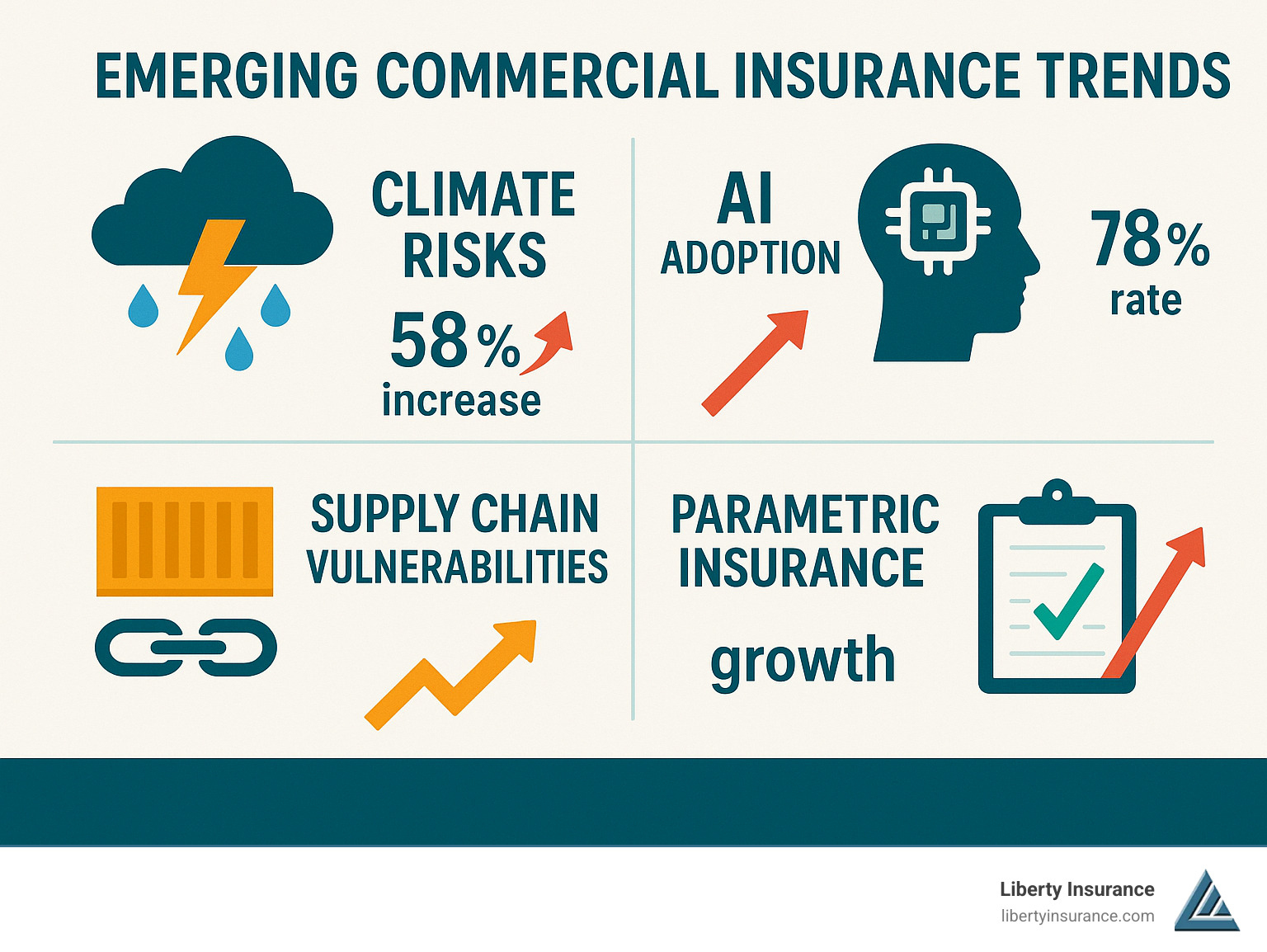
Think about it – just five years ago, most businesses weren’t worried about AI liability or ransomware attacks. Today, these risks keep CEOs awake at night. Meanwhile, climate change is making “once-in-a-century” storms feel like annual events, and supply chains that seemed rock-solid are proving surprisingly fragile.
AI adoption is creating particularly interesting challenges. With 78% of US organizations now viewing artificial intelligence as an emerging risk, we’re seeing entirely new types of claims. What happens when an AI system makes a biased hiring decision? Who’s liable when an autonomous delivery vehicle causes an accident? These questions are reshaping how we think about professional liability and general liability coverage.
Supply chain fragility became painfully obvious during the pandemic, but the vulnerabilities run deeper than most business owners realize. A single supplier shutdown in Asia can ripple through American businesses for months. We’re helping clients understand how contingent business interruption coverage can protect against these distant but devastating risks.
The insurance industry is responding with innovative solutions. Parametric triggers are gaining popularity because they eliminate the traditional “prove your loss” headaches. When wind speeds hit 100 mph or an earthquake measures 6.0 on the Richter scale, the policy pays out automatically. No adjusters, no disputes, no waiting months for settlement.
According to the STATE OF THE MARKET report, these rapid changes in the global risk landscape are forcing insurers to completely rethink their approach to underwriting and claims handling.
Predictive analytics are helping us spot problems before they become claims. Telematics in commercial vehicles can predict mechanical failures weeks in advance. It’s like having a crystal ball, except this one actually works.
Tech-Driven Claims & Prevention Tools
Remember when filing an insurance claim meant stacks of paperwork and weeks of back-and-forth phone calls? Those days are disappearing fast, thanks to technology that’s making both claims handling and risk prevention smarter and faster.
Drones are revolutionizing property inspections. Instead of sending adjusters onto dangerous roofs after storms, we can deploy drones to capture detailed damage photos within hours. One recent hail claim in central New Jersey was assessed, approved, and paid within 48 hours thanks to drone technology – a process that used to take weeks.
IoT sensors are like having a security guard that never sleeps. These tiny devices monitor everything from temperature fluctuations in server rooms to vibration patterns in manufacturing equipment. When something’s about to fail, they sound the alarm before disaster strikes. We’ve seen clients prevent major equipment failures simply because a sensor detected unusual vibration patterns.
Automated payments and data pre-fill technology mean less paperwork and faster settlements. When a client submits a claim through our mobile app, the system automatically pulls policy details, contact information, and even weather data for that location and time. What used to require hours of data entry now happens instantly.
The prevention side is even more exciting. Predictive analytics can spot patterns that human eyes miss. One manufacturing client avoided a $200,000 equipment failure because our monitoring system detected subtle changes in motor performance three weeks before the breakdown would have occurred.
These innovations aren’t just fancy gadgets – they’re delivering real results. Clients who actively use these prevention technologies typically see 15-20% fewer claims and often qualify for premium discounts. More importantly, they avoid the headaches and business disruptions that come with major losses.
More info about Business Interruption Insurance
Frequently Asked Questions about Commercial Risk Insurance
How often should I update my commercial risk insurance portfolio?
Think of your commercial risk insurance like a living document that grows with your business. We always tell our clients that their coverage should evolve as quickly as their company does.
Annual reviews are your baseline – but don’t wait a full year if your business changes significantly. We recommend starting renewal discussions 90 days early for complex accounts and 60 days for standard policies. This gives us time to shop the market and negotiate the best terms.
But here’s where many business owners slip up: they forget to update coverage when major changes happen. Revenue jumps exceeding 25% should trigger an immediate policy review. So should new locations, additional employees, expensive equipment purchases, or changes in what your business actually does.
One of our clients learned this lesson the hard way. They doubled their revenue in 18 months but never increased their business interruption limits. We caught it during a mid-year check-in, but imagine if they’d had a major loss with half the coverage they actually needed.
Regulatory changes can also force updates. New industry requirements, state law modifications, or licensing changes might affect your coverage mandates. We stay on top of these changes so you don’t have to worry about compliance gaps.
What factors influence premium pricing the most?
Insurance pricing isn’t mysterious once you understand what carriers look at. Your industry classification matters most – a manufacturing shop will always pay more than an accounting firm because the risks are simply different.
Your payroll and revenue numbers directly impact premiums since they represent your exposure base. More employees and higher revenues generally mean higher premiums, but that’s because there’s more to protect.
Claims history carries huge weight. A business with no losses for five years will pay significantly less than one with multiple claims. This is why we emphasize loss prevention – it pays dividends at renewal time.
Coverage limits and deductibles create the biggest opportunity for cost control. Higher deductibles can substantially reduce premiums, while higher limits increase them (though not always proportionally). We help clients find the sweet spot between adequate protection and manageable costs.
Your location, building features, safety programs, credit score, and years in business all factor into pricing too. The good news? Many of these elements are within your control.
For context, small businesses typically pay around $42 monthly for general liability, $61 for professional liability, and $45 for workers’ compensation. But these numbers vary dramatically based on your specific situation.
What happens when I file a claim?
Nobody wants to deal with a claim, but knowing what to expect makes the process much less stressful. We’ve guided hundreds of clients through this process, and preparation really makes a difference.
The first 24 hours are critical. Ensure everyone’s safety first, then contact us immediately. Document everything with photos and written notes, but avoid making statements about what caused the incident. Your adjuster will handle the investigation properly.
Within the first two weeks, an adjuster gets assigned and begins investigating. They’ll inspect the scene, interview witnesses, assess damages, and analyze your coverage. You might receive a “reservation of rights” letter – don’t panic. This is standard procedure that protects both you and the insurance company while the investigation continues.
Resolution typically takes 2-8 weeks depending on complexity. Simple property claims often resolve in 2-4 weeks, while complex liability matters can take 2-6 months. Cyber breach claims usually fall somewhere in between at 1-3 months.
We maintain a 92% claims satisfaction rate because we don’t disappear when you need us most. You’ll have a dedicated advocate fighting for your interests throughout the entire process. We know the adjusters, understand the coverage language, and make sure you get everything you’re entitled to under your policy.
The key is staying organized, responding promptly to requests, and letting your insurance team handle the negotiations. That’s what you pay us for, and we take that responsibility seriously.
Conclusion & Next Steps
Running a business today feels like navigating a minefield sometimes. Between the $21.6 billion in industry underwriting losses in 2023 and 78% of organizations struggling with AI-related risks, it’s clear the business world isn’t getting any safer.
But here’s what gives me hope: smart business owners who take commercial risk insurance seriously aren’t just surviving – they’re thriving. They’re the ones who sleep well at night knowing their life’s work is protected.
Think about it this way. You wouldn’t drive without car insurance or own a home without homeowner’s coverage. Your business deserves the same thoughtful protection. The difference is that commercial risk insurance is more complex, with more moving parts and emerging risks to consider.
The timing couldn’t be better to act. Cyber insurance rates have dropped 15% from their peak, making comprehensive protection more affordable than it’s been in years. New coverage options for everything from AI liability to climate-related risks are becoming available. The insurance market is finally working in favor of smart buyers.
So what’s your next move? Start with an honest look at your current coverage using our self-audit checklist. Most business owners find gaps they never knew existed. Then consider how emerging risks like artificial intelligence, climate change, and supply chain disruptions might affect your specific business.
Don’t overlook the power of bundling coverages either. We regularly help New Jersey businesses save 15-25% on their total insurance costs while actually improving their protection. It’s one of those rare win-win situations.
Here at Liberty Insurance, we’ve built our reputation on understanding the unique challenges facing businesses across New Jersey. Whether you’re running a tech startup in Princeton or managing a family manufacturing business in New Brunswick, we know the risks that keep you up at night.
We’re not just selling policies – we’re building partnerships. From our offices in Millstone Township, Trenton, Toms River, New Brunswick, and Princeton, we work alongside you to create risk management strategies that grow with your business. Because your success is our success.
The best time to fix your roof is when the sun is shining. The same goes for commercial risk insurance. Don’t wait for a crisis to find your coverage gaps. Let’s have a conversation about protecting what you’ve worked so hard to build.
Ready to take the next step? We’d love to hear about your business and help you build the confidence that comes with proper protection.

