
The Essential Guide to Contractors Insurance in New Jersey
Contractors insurance New Jersey provides vital protection for construction professionals against liability claims, property damage, and workplace injuries. If you’re looking for quick answers about contractor insurance requirements in New Jersey, here’s what you need to know:
| Insurance Type | Required? | Typical Limits | Average Monthly Cost |
|---|---|---|---|
| General Liability | Yes (for home improvement) | $1M per occurrence/$2M aggregate | $100 |
| Workers’ Compensation | Yes (with employees) | Statutory limits | $370 |
| Commercial Auto | Yes (for business vehicles) | 15/30/5 minimum | $237 |
| Tools & Equipment | Recommended | Varies by value | Part of BOP |
| Builder’s Risk | Project-specific | Value of project | 0.15-0.75% of value |
Did you know that 40% of small business owners have no insurance coverage at all, while 75% are underinsured? For New Jersey contractors, this gap can be devastatinga single accident or lawsuit can bankrupt an unprotected business overnight.
The New Jersey Home Improvement and Home Elevation Contractor Licensing Act requires contractors who work in home improvement or home elevation to show proof of commercial general liability insurance in a minimum amount of $500,000 per occurrence. However, most clients and contracts will require higher limits of $1,000,000 per occurrence.
Whether you’re a general contractor managing large commercial projects, a specialized trade contractor, or a home improvement professional, having the right insurance coverage isn’t just about legal complianceit’s about protecting everything you’ve worked for.
I’m Andrew Harris, a Certified Insurance Counselor with extensive experience helping New Jersey contractors find the right insurance solutions to protect their businesses. As someone who has worked with countless contractors across New Jersey, I understand the unique risks and contractors insurance New Jersey requirements that affect your business operations.

Learn more about Contractors insurance New Jersey:
What You’ll Learn
In this comprehensive guide, we’ll cover everything you need to know about contractors insurance New Jersey, including:
- Legal requirements for different types of contractors
- Essential coverage options to protect your business
- Cost factors that influence your premium rates
- Strategies to save money while maintaining adequate protection
- How to purchase and manage your insurance policies
- Steps for filing claims efficiently
By the end of this guide, you’ll have the knowledge to make informed decisions about your insurance needs, ensuring your business remains protected against the various risks inherent in the construction industry.
Understanding Contractors Insurance in New Jersey
When we talk about Contractors insurance New Jersey, we’re really discussing your business’s safety net. Think of it as a collection of policies designed specifically for construction professionals like you—protecting against the financial fallout from accidents, property damage, injuries, and those dreaded lawsuits that keep you up at night.
Here in the Garden State, some insurance coverages aren’t just nice-to-haves—they’re mandated by state law. Others might be required by your clients, property owners, or local municipalities before you can even break ground on a project.
Construction is inherently risky business. From workers taking tumbles to accidental property damage and contract disputes, these risks are part of your daily reality. Insurance serves as your risk transfer partner, shifting potential financial burdens from your business to an insurance carrier in exchange for your premium payments.
Who Needs Contractors Insurance in New Jersey?
If you’re swinging hammers, installing pipes, or wiring buildings in New Jersey, chances are you need some form of contractors insurance. This includes general contractors, home builders, electricians, plumbers, HVAC technicians, roofers, carpenters, painters, masons, excavators, landscapers, drywall installers, and flooring specialists—just to name a few.
What you specifically need varies based on several factors. Home improvement contractors face different requirements than those working on commercial projects. A sole proprietor with no employees has different needs than a company with a crew of 20. The scope of your projects—whether residential or commercial—and their value also play important roles. Don’t forget that many clients require insurance beyond state minimums, and local municipalities may impose their own insurance mandates.
For home improvement contractors, the New Jersey Division of Consumer Affairs doesn’t just suggest insurance—they require registration and proof of coverage. If you’re handling commercial projects, be prepared for requirements from clients, property owners, and local building departments.
What Does “Contractors Insurance New Jersey” Cover?
Contractors insurance New Jersey isn’t just one policy—it’s a protective suite custom to your specific risks:
General Liability Insurance forms the foundation of your protection, covering third-party bodily injury (like when a client trips over your extension cord), property damage (accidentally putting a hole in someone’s wall), and even advertising injury claims.
Workers’ Compensation Insurance is your employees’ safety net, providing medical benefits and wage replacement when they’re injured on the job. In New Jersey, this isn’t optional if you have employees—it’s the law.
Commercial Auto Insurance protects the vehicles that keep your business moving, covering liability for accidents and physical damage to your work trucks and vans.
Builder’s Risk Insurance stands guard over your projects during construction, protecting against damage from fire, wind, theft, and other covered perils.
Tools and Equipment Insurance (also called inland marine insurance) keeps your valuable tools and equipment covered whether they’re at your office, in transit, or at job sites.
Professional Liability Insurance has your back when clients claim you made errors or omissions in your professional services or advice.
Surety Bonds provide guarantees that you’ll fulfill your contractual obligations and comply with state regulations.
Why New Jersey Contractors Can’t Ignore Insurance
Going without proper insurance in New Jersey isn’t just risky—it could be business suicide. The consequences are real and severe:
Operating without required insurance can land you in hot water with legal penalties including fines, license suspension, or even criminal charges in some cases. Without insurance, every dollar of damages, injuries, and legal costs comes directly from your pocket. Consider that the average slip-and-fall claim exceeds $30,000, while serious injuries can result in multi-million-dollar judgments.
Most clients and general contractors simply won’t hire uninsured contractors—no insurance means lost business opportunities. And don’t forget about regulatory compliance: The Home Improvement and Home Elevation Contractor Licensing Act specifically requires general liability insurance of at least $500,000 per occurrence.
Here’s a sobering thought: In today’s lawsuit-happy environment, even a minor accident can spiral into a major legal battle. With research showing that 40% of small businesses carry no insurance at all and 75% are underinsured, contractors like you are particularly vulnerable to financial catastrophe from unforeseen events.
The bottom line? Contractors insurance New Jersey isn’t just paperwork—it’s peace of mind that protects everything you’ve worked so hard to build.
Core Coverages & Legal Requirements
Let’s break down what you really need to know about insurance as a New Jersey contractor. Think of this as your protection toolkit – some pieces are absolutely necessary by law, while others are smart additions that could save your business one day.
General Liability—The Cornerstone
If there’s one policy every contractor needs, it’s general liability. This is your first line of defense against the everyday risks of construction work.
Contractors insurance New Jersey starts with general liability because it protects you when the unexpected happens. Imagine a client tripping over your extension cord and breaking an ankle, or your crew accidentally damaging a homeowner’s prized antique cabinet. These things happen even to the most careful professionals.
New Jersey law requires home improvement contractors to carry at least $500,000 in general liability coverage, but don’t stop there. The industry standard is much higher – $1 million per occurrence and $2 million aggregate – for good reason. Medical bills and lawsuits can add up fast!
What makes general liability especially valuable is its “completed operations” coverage. This protects you even after you’ve finished a job. So if that beautiful custom shelving you installed falls down six months later and injures someone, you’re still covered.
Learn more about general liability insurance for small businesses
Workers’ Compensation—Employee Protection
If you have employees in New Jersey, workers’ compensation isn’t optional – it’s the law. This coverage does double duty: it protects your workers and shields your business from potentially devastating claims.
When a worker gets hurt on the job (and in construction, it happens), workers’ comp covers their medical treatment, helps replace lost wages, and provides rehabilitation services. In the worst cases, it provides death benefits to families.
The cost typically runs about $8,441 per employee annually, but varies widely depending on what type of work you do. Roofing companies pay much more than painting contractors, for instance, because the risk levels differ dramatically.
The penalties for skipping this coverage are severe – up to $5,000 for the first 10 days without coverage, and another $5,000 for each additional 10-day period. Some contractors have even faced criminal charges. It’s simply not worth the risk.
Learn more about workers’ compensation insurance for independent contractors in New Jersey
Commercial Auto & Fleet Risks
That pickup truck with your company logo? You need commercial auto insurance for it. Your personal auto policy likely won’t cover accidents that happen while you’re working.
New Jersey’s minimum requirements (25/50/25 plus $15,000 in PIP) are just that – minimums. Most contractors carry at least $1 million in coverage because a serious accident could easily exceed those state minimums.
Don’t forget about hired and non-owned auto coverage, which protects you when renting vehicles or when employees use their personal cars for work errands. And if you’re hauling expensive tools and equipment, make sure they’re covered too.
I once worked with a contractor whose employee sideswiped a luxury car while driving to a job site. That single accident would have cost over $100,000 without proper coverage – far more than years of premium payments.
Learn more about commercial property insurance in NJ
Builder’s Risk & Tools/Equipment
Your projects and tools represent a major investment. Builder’s risk insurance protects projects under construction from disasters like fires, storms, theft, and vandalism.
This coverage is typically project-specific and can be purchased by you, the property owner, or the general contractor. It covers not just the building materials and supplies, but also soft costs like architectural fees if you need to restart after a disaster.
For your tools and equipment, inland marine insurance is essential. Despite its odd name (which dates back to when goods were transported via inland waterways), this coverage protects your valuable tools whether they’re at your shop, in transit, or at the job site.
Tool theft is unfortunately common in construction – I’ve seen contractors lose thousands in equipment overnight. Without coverage, replacing everything comes straight from your pocket.
For specialized installations, consider installation floaters that protect materials during transit, storage, and installation until the project is completed.
Learn more about home improvement contractor insurance in NJ
Surety Bonds & Compliance
While not technically insurance, surety bonds often go hand-in-hand with your Contractors insurance New Jersey package. These bonds are essentially a guarantee that you’ll fulfill your obligations.
There are several types you might need:
- License bonds for certain trades
- Performance bonds guaranteeing you’ll complete projects as promised
- Payment bonds ensuring you’ll pay subcontractors and suppliers
- Bid bonds guaranteeing you’ll take the job if your bid wins
Bond premiums typically run 1-3% of the bond amount, with better rates for contractors with strong credit and experience. Many government contracts and municipal projects require these bonds, and they’re regulated by the New Jersey Department of Banking and Insurance.
I’ve seen contractors miss out on lucrative opportunities simply because they didn’t have the right bonds in place. Don’t let that happen to you!
Learn more about New Jersey Contractor Bonds
Pricing, Cost Drivers & Saving Strategies

Let’s talk moneybecause I know that’s what you’re really wondering about. How much is this contractors insurance New Jersey going to cost you, and more importantly, how can you keep those premiums manageable?
How Much Does Contractors Insurance Cost in New Jersey?
I won’t sugarcoat itinsurance costs vary widely depending on your specific situation. But I can give you some ballpark figures to help with your planning:
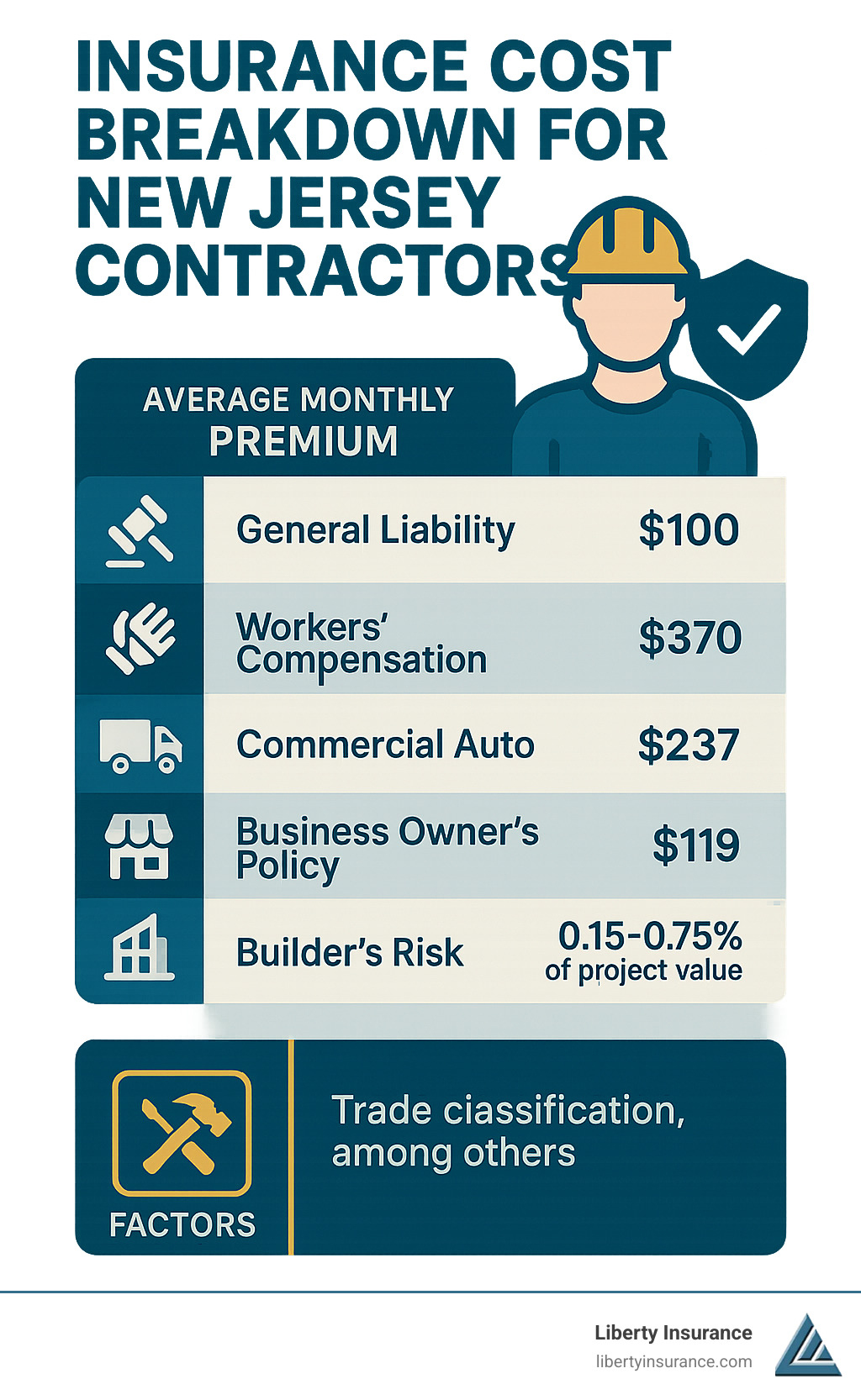
The average New Jersey contractor spends about $100 monthly on general liability insurancethat’s your foundation coverage. If you have employees, expect to pay around $370 monthly for workers’ compensation (this is typically your biggest insurance expense). For your work vehicles, commercial auto insurance runs about $237 per month.
Many smaller contractors benefit from a Business Owner’s Policy (BOP), which bundles property and liability coverage at a more affordable $19 monthly. And if you’re working on specific construction projects, builder’s risk insurance typically costs between 0.15-0.75% of the total project value.
All told, a typical small to medium contracting business in New Jersey might budget between $5,000 and $15,000 annually for comprehensive coverage. That might sound steep, but compare it to the cost of a single uninsured claimsuddenly it looks like a bargain!
Factors That Move Your Premium
Your contractors insurance New Jersey costs aren’t set in stone. Several key factors can push your premiums up or down:
What you do matters enormouslytrade classification is probably the biggest factor. Roofers and demolition crews face much higher premiums than painters or carpenters because their work involves greater risks.
Your annual revenue and payroll size directly impact your premiums, especially for workers’ comp, which is calculated primarily based on payroll amounts within each job classification.
Got a spotless record? That helps! Your claims history significantly influences what you’ll pay. Maintaining a clean record for 3-5 years can lead to substantial discountsI’ve seen premiums drop by as much as 25% for contractors with spotless records.
New to the business? You’ll likely pay more than established companies with proven safety records. Insurance companies love experienceit usually means fewer claims.
Your choice of coverage limits and deductibles naturally affects your premium. Higher deductibles mean lower premiums, but make sure you can actually afford to pay that deductible if something goes wrong!
Even your location within New Jersey matters. Urban contractors typically pay more than those in rural areas due to higher claim frequencies and costs.
The size of your vehicle fleet and number of drivers directly impact your commercial auto premiums. And formal safety programs can qualify you for meaningful discounts across several policy types.
Learn more about types of business insurance
Bundling & Risk Management Tips
Now for the good stuffhow to keep those costs down without sacrificing protection:
Bundle your policies whenever possible. Combining multiple policies with the same carrier often shaves 10-15% off your premium. That’s real money back in your pocket!
Smart contractors know that safety pays. Implementing a formal safety program with regular training and documentation can substantially reduce your workers’ comp premiums. One of my clients cut their workers’ comp costs by nearly 20% after implementing a comprehensive safety program.
Consider increasing deductibles strategically. If you have the cash reserves to handle a higher out-of-pocket cost when claims occur, the premium savings can be significant. Just be realistic about what you can afford if something goes wrong.
Managing subcontractor risk is huge. Always require certificates of insurance from your substhis transfers risk away from your business and can prevent your premiums from increasing due to claims that should be covered by others.
Your workers’ compensation experience modifier (EMR) directly affects what you pay. Keeping claims low and implementing return-to-work programs improves your EMR over time, potentially saving thousands annually.
Don’t set and forget your insurance. Annual policy reviews with your agent ensure your coverage still matches your business needs and helps identify potential savings as your business evolves.
Many insurers offer discounts for paying premiums annually rather than monthlysometimes as much as 5-8%. If you can manage the cash flow, this is an easy win.
The New Jersey Department of Labor and Workforce Development offers excellent resources for improving workplace safety, which translates directly to lower workers’ compensation costs. Their guidance is practical and specifically custom to New Jersey regulations.
Learn more about cost reduction strategies from the NJ Division of Workers’ Compensation
Insurance isn’t just an expenseit’s a strategic business investment that protects everything you’ve built. With the right approach, you can get comprehensive protection without breaking the bank.
Buying, Managing & Claiming Contractors Insurance New Jersey

Now that you understand what coverage you need, let’s talk about how to actually get your Contractors insurance New Jersey policies up and running—and what to do when you need to use them.
Getting a Quote & Proof of Coverage Fast
The insurance journey doesn’t have to be complicated. Think of it like estimating a job—you need the right information before you can give an accurate price.
Before reaching out for quotes, take a few minutes to gather your business details. This includes basics like your business name and structure, tax ID number, and years in business. You’ll also want to have employee and payroll information, annual revenue figures, and details about the types of projects you typically handle. Don’t forget to include information about your equipment values, vehicles, and any claims you’ve had in the past 3-5 years.
With this information in hand, you’re ready to request quotes. Working with an independent agent can be a real time-saver since they can shop multiple carriers at once. At Liberty Insurance, we pride ourselves on providing quotes from several top-rated carriers so you can compare options without making a dozen phone calls.
When comparing quotes, look beyond just the price tag. A slightly higher premium might come with significantly better coverage or lower deductibles. It’s about finding the best value, not just the lowest cost.
Once you’ve made your choice, the binding process is straightforward—sign the necessary paperwork, make your initial payment, and you’re covered. Most insurers can now provide same-day Certificates of Insurance (COIs), which you’ll need to show clients and municipalities that you’re properly insured.
The days of waiting for paperwork to arrive by mail are long gone. Modern insurance providers offer digital tools that put you in control. Need to add an additional insured for tomorrow’s job? Want to check if your premium payment went through? Most carriers now offer online portals and mobile apps that let you handle these tasks 24/7, without waiting on hold or scheduling an appointment.
Learn more about business insurance options
Filing a Claim Without the Headache
Even the most careful contractors occasionally need to file a claim. When that happens, knowing the process can save you time, money, and a lot of frustration.
The golden rule of claims: report promptly. As soon as an incident occurs, contact your insurance carrier. Most policies have specific reporting timeframes, and missing these deadlines can jeopardize your coverage.
Documentation is your best friend during the claims process. Take plenty of photos from multiple angles. Gather contact information from witnesses. Keep detailed notes about what happened, when, and who was involved. This information will be invaluable to the claims adjuster investigating your case.
Speaking of adjusters—they’re there to help, not hinder. Providing them with thorough, accurate information helps them process your claim more quickly. Be responsive to their questions and requests for additional documentation.
In New Jersey, insurance companies must acknowledge receipt of claims within 10 working days and accept or deny claims within 30 days after receiving proof of loss. Once accepted, payment must be issued within 30 days. If you’re not seeing this timeline in action, don’t hesitate to follow up.
Common claim mistakes are easy to avoid if you know what they are. Never admit fault at the scene of an incident—that’s for the insurance companies to determine. Don’t make repairs before an adjuster has inspected the damage (unless absolutely necessary to prevent further damage). Keep your statements consistent across all communications, and document everything.
Avoiding Coverage Gaps for Subcontractors
If you work with subcontractors, their insurance situation directly affects yours. One uninsured subcontractor can create massive liability issues for your business.
Always use written contracts that clearly outline insurance requirements. At minimum, your subcontractors should carry general liability insurance with limits equal to or greater than yours. If they have employees, they need workers’ compensation coverage. If they’re using vehicles, they need auto liability. For specialized trades, professional liability coverage may also be appropriate.
Additional insured status is crucial—require subcontractors to name your company as an additional insured on their general liability policy. This extends their coverage to you for claims arising from their work.
Before any work begins, collect and verify certificates of insurance. Don’t just file them away—check expiration dates and set reminders to obtain new certificates when old ones expire. A certificate that’s expired is as good as no insurance at all.
Include indemnification and hold harmless clauses in your contracts. These legal provisions help transfer risk away from your business when claims arise from a subcontractor’s work.
Some trades carry higher risks than others. You might want to require higher insurance limits for subcontractors doing particularly hazardous work like roofing, demolition, or excavation.
Here’s a real-world scenario: A subcontractor’s employee gets injured on your job site. If that subcontractor doesn’t have proper workers’ compensation insurance, the injured worker might file a claim against your policy. Not only could this lead to an immediate financial hit through your deductible, but it could also increase your premiums for years to come.
Managing your Contractors insurance New Jersey policies doesn’t have to be overwhelming. With the right approach to purchasing, claiming, and managing subcontractor requirements, you can protect your business without spending hours on paperwork.
Frequently Asked Questions about Contractors Insurance New Jersey
Is contractors insurance required by law in NJ?
Absolutely! New Jersey has some pretty clear requirements when it comes to contractor insurance. If you’re working in the Garden State, you need to know that:
Workers’ compensation is a must-have if you have employees—no exceptions here. The state takes this one seriously because it protects your workers if they’re injured on the job.
For home improvement and home elevation contractors, general liability insurance with at least $500,000 per occurrence is legally required. This isn’t just a suggestion—it’s written into the Home Improvement and Home Elevation Contractor Licensing Act.
If your business owns vehicles, commercial auto insurance with minimum liability limits of 15/30/5 is non-negotiable. Your personal auto policy won’t cut it for business use.
Beyond these state requirements, don’t forget that many New Jersey towns and cities add their own insurance mandates. For instance, Atlantic City requires contractors to carry $1 million in general liability and name the city as an additional insured. Always check local requirements before starting a new project!
What are the minimum limits for general contractors?
While the legal minimum for general liability insurance in New Jersey is $500,000 per occurrence for home improvement contractors, in practice, this is rarely enough.
Most clients and contracts will expect you to carry what’s become the industry standard: $1,000,000 per occurrence with a $2,000,000 aggregate limit. This isn’t just about compliance—it’s about having genuine protection for your business.
For other coverages, these are the typical minimums you’ll need:
Workers’ compensation should include statutory limits for Coverage A (the part that covers employee injuries) and $500,000/$500,000/$500,000 for employer’s liability (Coverage B).
For commercial auto, most professionals carry at least $1,000,000 in combined single limit coverage, well above the state minimum.
Many larger projects will also require umbrella/excess liability coverage ranging from $1 million to $5 million, depending on the project’s size and scope.
Home elevation contractors face an additional requirement: cargo/inland marine insurance with at least $1 million in coverage to protect equipment and materials being transported or stored.
Can I bundle policies for a discount?
Yes, and you definitely should! Bundling your insurance policies is one of the smartest ways to save money while maintaining comprehensive coverage. Most New Jersey contractors can save between 10-15% by keeping multiple policies with the same carrier.
The most common bundle starts with a Business Owner’s Policy (BOP), which already combines general liability and property coverage at a lower rate than buying them separately. Think of it as the insurance world’s version of a value meal!
Adding commercial auto coverage to your package typically triggers additional discounts. Many of our contractors at Liberty Insurance find this bundling approach saves them hundreds of dollars annually.
For larger operations, look into contractor-specific package policies that wrap general liability, property, auto, and inland marine coverage into one convenient policy with built-in savings.
If you need higher limits, adding an umbrella policy often comes with a discount on your underlying policies—essentially giving you much more coverage for just a little more money.
We understand that insurance can feel complicated and expensive, but the right bundling strategy can make a significant difference to your bottom line while ensuring you’re properly protected. At Liberty Insurance, we specialize in finding the most cost-effective combinations for New Jersey contractors based on their specific business operations.
Conclusion
Let’s face itnavigating contractors insurance New Jersey can feel like trying to read blueprints in the dark. But having the right coverage isn’t just paperworkit’s your business’s safety net when things go sideways on a job site.
As we’ve explored throughout this guide, protecting your contracting business isn’t optional in today’s world. Legal compliance is just the starting pointnot the finish line. Those minimum requirements ($500,000 in general liability for home improvement contractors) might keep you legal, but they won’t necessarily keep you solvent after a serious claim.
Think of insurance like your tool beltyou wouldn’t show up to a job with just a hammer, would you? The same goes for your coverage. Most successful contractors carry at least $1M/$2M in general liability, statutory workers’ comp, and $1M in auto coverage. These higher limits exist because, frankly, today’s construction claims can easily exceed the minimums.
Smart contractors know that managing insurance costs doesn’t mean cutting corners. It means being strategic. Bundling your policies can save you 10-15% right off the bat. Implementing a solid safety program not only protects your team but can significantly reduce your premiums over time. And properly managing your subcontractors’ insurance requirements prevents their claims from becoming your problem.
Your business isn’t staticit grows, evolves, and changes with each project. That’s why your insurance needs regular check-ups too. Set a calendar reminder for an annual review with your agent. What worked for your three-person operation might not cut it now that you’ve grown to fifteen employees and expanded into commercial work.
At Liberty Insurance, we’ve helped countless New Jersey contractors find that sweet spotcomprehensive protection without overpaying. With our offices throughout the state (Millstone Township, Trenton, Toms River, New Brunswick, and Princeton), we understand the unique challenges Garden State contractors face.
Before you click away, take a moment to consider: When was the last time you really looked at your coverage? Are your limits appropriate for your current project size? Have you explored potential discounts? Don’t wait for a claim to find you’re underinsuredby then, it’s already too late.
Ready to make sure your business is properly protected? Let’s talk. Your peace of mind is worth a conversation.
Learn more about our specialized contractor insurance options

