
Why Your New Jersey Freight Business Needs Proper Bonding
A New Jersey freight broker bond is a federally mandated $75,000 surety bond (Form BMC-84) required by the Federal Motor Carrier Safety Administration (FMCSA) for all freight brokers and forwarders operating in interstate commerce. This bond protects motor carriers and shippers by guaranteeing payment for services rendered, even if the broker fails to fulfill contractual obligations. In the high-stakes world of logistics, where New Jersey serves as a critical gateway for the entire Eastern Seaboard, this bond is the bedrock of professional credibility.
Quick Facts About New Jersey Freight Broker Bonds:
- Bond Amount: $75,000 (federal minimum since October 1, 2013, established by the MAP-21 Act)
- Who Needs It: All freight brokers and property brokers with MC Numbers operating in interstate commerce, including those based in Newark, Jersey City, and Elizabeth.
- Cost Range: 1-15% of bond amount annually ($750-$11,250), based on credit and business history.
- Approval Time: Typically 24-48 hours after application through a specialized surety provider.
- Renewal: Annual renewal required to maintain FMCSA operating authority and avoid immediate suspension.
- Alternative: BMC-85 Trust Fund (requires full $75,000 deposit vs. annual premium, often tying up vital working capital).
Whether you’re launching a new brokerage operation in Newark, expanding your logistics business across state lines into New York or Pennsylvania, or simply ensuring compliance with federal regulations, understanding freight broker bonds is critical. Operating without this bond means immediate revocation of your FMCSA authority—effectively shutting down your business overnight and potentially leading to significant federal fines. New Jersey’s position as a logistics powerhouse, home to the Port of New York and New Jersey, makes compliance even more vital as the volume of freight moving through the state is immense.
New Jersey brokers face both federal requirements through the FMCSA and potential state-specific obligations, particularly if handling agricultural commodities within state borders. The bonding landscape can feel complex, especially when you’re trying to balance startup costs, maintain carrier relationships, and navigate regulatory paperwork. The bond acts as a safety net, ensuring that the carriers who do the heavy lifting are paid for their work, which in turn keeps the supply chain moving smoothly.
I’m Andrew Harris, and as a Certified Insurance Counselor with experience in commercial surety products, I’ve helped countless New Jersey businesses secure their New Jersey freight broker bonds while optimizing their overall risk management strategies. Understanding how these bonds fit into your broader business insurance portfolio is essential for long-term success in the freight industry. In this guide, we will explore the nuances of the BMC-84, the costs involved, and the specific New Jersey regulations that might impact your operations.
New jersey freight broker bond basics:
Understanding the New Jersey Freight Broker Bond (BMC-84)

In the Garden State, freight brokers are the glue that holds the supply chain together. Whether you are operating out of Trenton, New Brunswick, or the bustling logistics hubs near Port Newark, you are acting as a transportation intermediary. But with great power comes great regulatory oversight. The new jersey freight broker bond, specifically the BMC-84, is a license surety bond mandated by the FMCSA. It serves as a financial guarantee that you will play by the rules and fulfill your financial obligations to the carriers and shippers you work with.
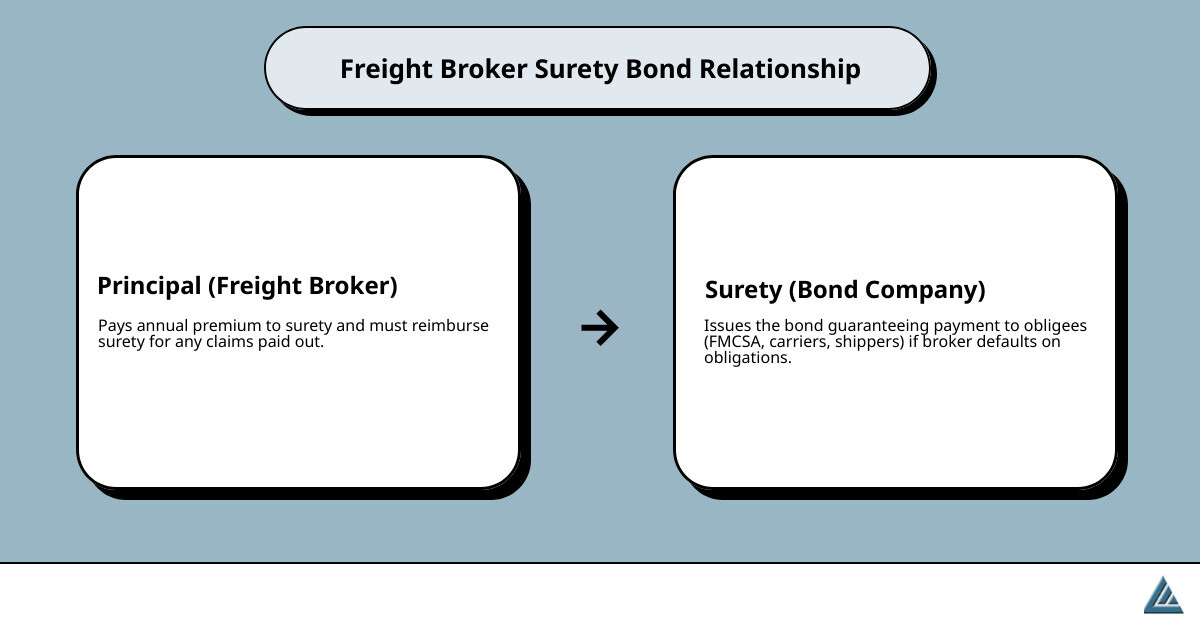
The bond is essentially a contract between three parties, and understanding this relationship is key to understanding how the bond protects the industry:
- The Principal: That’s you, the freight broker or forwarder. You are the party purchasing the bond and promising to adhere to FMCSA regulations and contractual agreements.
- The Obligee: The FMCSA (Federal Motor Carrier Safety Administration), which requires the bond to protect the public interest and ensure the integrity of the transportation industry.
- The Surety: The insurance or bond company that backs your financial promise. They provide the $75,000 guarantee to the Obligee on your behalf.
While many industry veterans still call it an “ICC Bond” (a throwback to the old Interstate Commerce Commission which was abolished in 1995), the modern standard is the BMC-84. This bond is necessary for anyone providing brokerage or freight forwarding services. It covers both property brokers (who arrange for the transport of general goods) and household goods brokers (who specialize in moving personal effects). If you are handling the movement of goods across state lines, the federal government wants to ensure that if you don’t pay the carrier who actually hauled the load, there is a $75,000 safety net in place to make them whole.
For more detailed information on how these fit into the local landscape, check out our guide on Surety Bonds New Jersey and review the official federal broker registration guidelines. It is important to note that the bond is not insurance for your business; rather, it is a line of credit extended to you by the surety company to ensure your creditors (the carriers) are paid.
Who Needs a New Jersey Freight Broker Bond?
If you are involved in interstate commerce—meaning you arrange for the transportation of property by motor carrier for compensation across state lines—you need this bond. This applies to:
- Freight Brokers: Those who arrange transportation but don’t actually own the trucks or employ the drivers. They act as the middleman between shippers and carriers.
- Freight Forwarders: Those who may assemble or consolidate shipments and assume responsibility for the transportation from origin to destination. They often take physical possession of the goods at some point in the process.
To operate legally, you must first obtain an MC Number (Motor Carrier Number) and a USDOT Number. Once you apply for your Broker’s Authority (which carries a $300 FMCSA application fee), you have a 90-day window to get your new jersey freight broker bond filed. Without it, your operating authority will not be granted, and you’ll be stuck at the starting line, unable to legally book a single load.
BMC-84 Surety Bond: Key Features and Benefits
Choosing a BMC-84 surety bond over a BMC-85 trust fund is a common crossroad for New Jersey brokers. Here is why we often recommend the bond:
| Feature | BMC-84 Surety Bond | BMC-85 Trust Fund |
|---|---|---|
| Upfront Capital | Annual premium (approx. $750 – $3,750 for good credit) | Full $75,000 cash deposit required |
| Claim Handling | Surety investigates claims for validity | Trust may pay out more readily without investigation |
| Asset Liquidity | Keeps your cash in your business for growth | Ties up $75,000 in a bank account |
| Renewal | Annual premium payment | Annual administrative fees and potential top-offs |
The biggest benefit of the BMC-84 is capital preservation. Instead of parking $75,000 in a trust account where it collects dust, you pay a small annual premium and keep your working capital for operations, marketing, and scaling your brokerage. In a competitive market like New Jersey, having that $75,000 available for payroll or technology investments can be the difference between success and failure. Furthermore, the surety company acts as a professional claims adjuster. If a carrier files a frivolous claim against you, the surety will investigate the facts before paying out a dime, protecting you from unfair demands.
When selecting a provider, ensure you are working with NJ Approved Surety Companies to ensure your filing is accepted without delay. The FMCSA maintains a list of approved sureties, and using an unapproved company will result in your application being rejected.
Financial Obligations: Costs and the $75,000 Requirement
The $75,000 bond amount isn’t a random number we pulled out of a hat. It was established by the MAP-21 Act (Moving Ahead for Progress in the 21st Century) and became effective on October 1, 2013. Before this, the requirement was a mere $10,000, a figure that had not been updated for decades and was widely considered insufficient to protect carriers in the modern economy. The jump to $75,000 was designed to weed out “bad actors,” reduce the frequency of non-payment, and ensure that only financially responsible entities were operating in the multi-billion dollar freight industry.
For a New Jersey business, this bond is a key part of your New Jersey Business Insurance portfolio. It acts as a risk mitigation tool that signals to carriers that you are a legitimate, creditworthy partner. In an industry built on trust, having a valid BMC-84 on file is your “license to do business.”
Premium Factors and Bad Credit Options
So, how much is this going to cost you? The premium is not $75,000; it is a percentage of that amount, known as the premium rate. Several factors influence your specific rate, as the surety company is essentially assessing the risk that they will have to pay out a claim on your behalf:
- Credit Score (FICO): This is the most significant factor. A high credit score indicates financial responsibility and a lower risk of default.
- Years in Business: New ventures may pay slightly more than established firms because they lack a proven track record of financial stability.
- Financial Statements: For larger operations or those with borderline credit, strong business financials (balance sheets, P&L statements) can lower your rate.
- Claim History: A clean record is your best friend during renewal. If you have a history of claims being filed against your bond, your rates will skyrocket, or you may be denied coverage altogether.
Typical Premium Ranges:
- Good Credit (700+): 1% to 5% ($750 – $3,750 per year). This is the standard range for most healthy brokerages.
- Fair/Poor Credit (Below 650): 5% to 15% ($3,750 – $11,250 per year). These rates reflect the higher risk the surety is taking.
If your credit isn’t exactly “Elite,” don’t panic. There are high-risk surety programs available specifically for the freight industry. While the premiums are higher, they allow you to obtain your new jersey freight broker bond and start generating the revenue needed to improve your credit score over time. Many brokers start in the high-risk pool and, after a year or two of clean operations and improved credit, move into the standard market with much lower rates.
Steps to Secure Your New Jersey Freight Broker Bond
Getting bonded is actually one of the faster parts of the registration process, provided you have your paperwork in order. Here is our typical workflow at Liberty Insurance:
- Application: You fill out a simple online form with your business details, ownership information, and MC number (if you have it already).
- Underwriting: The surety reviews your credit and financial standing. This usually takes 24 to 48 hours. They may ask for additional documentation if the business is complex.
- Quote: You receive a quote for the annual premium. This quote is typically valid for 30 days.
- Payment: Once you accept and pay the premium, the bond is issued.
- Filing: The surety company files the BMC-84 electronically with the FMCSA via their online portal. You will receive a copy for your records.
It is a streamlined process designed to get you on the road quickly. For more on the different types of financial guarantees and how they can protect your business assets, visit our page on Bonds. Remember, the bond must be in the exact legal name of the entity registered with the FMCSA.
New Jersey Specifics: Agricultural and Maintenance Bonds
While the BMC-84 is a federal requirement for interstate commerce, New Jersey has some unique “Garden State” rules you need to know about—especially if you are brokering local produce. New Jersey is a major producer of blueberries, cranberries, tomatoes, and peaches, and the state takes the protection of its farmers very seriously. Under N.J.A.C. 2:72, the New Jersey Department of Agriculture requires licensing and bonding for “Commission Merchants, Dealers, Brokers, and Agents” who buy perishable agricultural commodities on credit from NJ growers.
This is an intrastate requirement that exists alongside the federal bond. If you are brokering Jersey tomatoes or corn within state lines, you may need a state-specific bond ranging from $5,000 to $150,000, depending on your annual purchase volume. These NJ Agriculture bonding rules are designed to protect local farmers from non-payment. Because perishable goods can’t be “returned” or resold once they’ve spoiled, the bond ensures the farmer gets paid even if the broker defaults. Failure to secure this state bond while operating in the agricultural sector can lead to state-level fines and the loss of your NJ business license.
Maintenance and Performance Bond Overlap
In the logistics world, you might also run into requirements for maintenance and performance bonds. This is particularly common if your brokerage handles specialized contracts for public works, infrastructure projects, or large-scale construction logistics in places like Princeton, Millstone Township, or Jersey City.
- Performance Bonds: These guarantee that the contract (such as a multi-year logistics contract for a municipality) will be completed according to the specific terms and conditions agreed upon.
- Maintenance Bonds: These guarantee that the work (or the logistics of the project) will remain free of defects or failures for a set period after completion.
While these are separate from your new jersey freight broker bond, they often come from the same surety providers. If your business model involves long-term government contracts or specialized industrial logistics, you should familiarize yourself with Surety Bonds and how they differ from standard liability coverage. Having a relationship with a versatile surety agent allows you to pivot into these lucrative specialized contracts more easily.
Penalties for Non-Compliance in New Jersey
Operating without a valid bond is a recipe for disaster. The FMCSA monitors bond status in real-time. If your bond lapses or is cancelled (and not replaced within 30 days), the FMCSA will move to revoke your operating authority immediately. The consequences of operating without authority include:
- Fines: Hefty federal civil penalties that can reach tens of thousands of dollars per violation.
- Legal Injunctions: Being legally barred from brokering freight, which can lead to the permanent closure of your business.
- Reputational Damage: Your name and MC number will show up in the National Consumer Complaint Database, warning carriers and shippers to stay away. In the tight-knit world of New Jersey trucking, a bad reputation can be impossible to outrun.
Maintaining Compliance and Handling Claims
A new jersey freight broker bond is not a “set it and forget it” document. It requires active management and an understanding of the ongoing obligations it creates. Most bonds are valid for one year and must be renewed annually. If you decide to change your business structure (e.g., moving from a sole proprietorship to an LLC or changing your business address from Edison to Cherry Hill), you must notify both the FMCSA and your surety company. The bond is generally non-transferable, and a new entity usually requires a new bond filing.
If you ever need to cancel a bond—perhaps because you are closing the business or switching surety providers—the surety must provide 30 days’ notice to the FMCSA using Form BMC-36. During that 30-day window, you are still legally liable for any contracts made, and the bond remains in effect to cover those obligations. This “tail” period ensures that brokers cannot simply cancel a bond to avoid paying for loads that are currently in transit.
To protect your business further, we recommend looking into Motor Truck Cargo Insurance to cover the actual goods in transit. It is a common misconception that the freight broker bond covers cargo damage; it does not. The bond only covers the financial obligation to pay the carrier. If a load of electronics is stolen in Secaucus, the bond won’t pay for the lost goods, but your cargo insurance will.
Protecting Your New Jersey Freight Broker Bond Standing
The best way to keep your bond premiums low and your business healthy is to avoid claims at all costs. A single claim can make it difficult to find affordable bonding in the future. This means:
- Timely Payments: Pay your carriers on time, every time. Set up clear payment terms and stick to them. If you use a factoring company, ensure they are also operating ethically.
- Clear Communication: If a shipment is damaged or delayed, resolve the issue through the proper insurance channels rather than withholding payment arbitrarily. Communication is the best tool for preventing a carrier from filing a claim against your bond.
- Ethical Brokering: Only work with reputable carriers who have their own valid insurance and authority. Maintain transparent records of every transaction.
Good recordkeeping is your primary shield. If a carrier claims you didn’t pay them, but you have a signed proof of delivery and a record of the ACH transfer or cleared check, the surety will likely deny the claim after their investigation. For more on protecting your logistics business from the various risks of the road, read our Inland Marine Insurance Guide.
The Claims Process and Resolution
What happens if a carrier actually files a claim against your bond? The process is rigorous and designed to be fair to both parties:
- Notice: The surety company receives a formal claim from a carrier or shipper and notifies you immediately.
- Investigation: The surety asks you for your side of the story. You will need to provide proof of payment, contracts, or justification for withholding funds (such as a documented cargo claim that exceeds the freight charges).
- Resolution: If the surety determines the claim is valid and you cannot or will not pay, the surety pays the claimant (up to the $75,000 limit).
- Indemnity: This is the critical part that many brokers misunderstand—you must pay the surety back. Unlike traditional insurance where the insurance company eats the loss, a surety bond requires the principal (you) to reimburse the bond company for every penny paid out, including legal fees and administrative costs. This is known as the “Indemnity Agreement,” and it is a standard part of every bond application.
Understanding the difference between this and cargo insurance is vital for your financial planning. You can learn more about that distinction here: Is Inland Marine the Same as Cargo Insurance?
Frequently Asked Questions about NJ Freight Bonds
How long does it take to get a New Jersey Freight Broker Bond?
Most of our clients in Toms River, Newark, and throughout New Jersey receive approval within 24 to 48 hours. Once you pay the premium, the electronic filing with the FMCSA happens almost instantly. However, it may take a few business days for the FMCSA’s public Licensing & Insurance (L&I) system to reflect the update. We recommend checking the FMCSA portal regularly after your bond is filed to ensure your authority moves to “Active” status.
Can I get a bond with a credit score below 600?
Yes, absolutely. We have access to specialized “bad credit” bond programs designed for entrepreneurs who may have had past financial struggles. While the annual premium will be higher (often between 10% and 15% of the bond amount), it allows you to stay in business and build a track record. As your business grows and your credit improves, these rates typically decrease significantly at renewal. We have seen many brokers start with high rates and work their way down to the 2-3% range within a few years.
Does one bond cover multiple office locations?
Yes, provided they are all operating under the same legal entity (same Tax ID) and the same MC Number. However, if you have affiliated companies that are separate legal entities (e.g., “NJ Logistics LLC” and “Jersey Freight Inc.”), each one will likely require its own $75,000 new jersey freight broker bond. It is important to ensure that the name on the bond matches the name on your FMCSA registration exactly, down to the punctuation.
What is the difference between a BMC-84 and a BMC-85?
The BMC-84 is a surety bond where you pay an annual premium to a bond company. The BMC-85 is a trust fund where you must deposit the full $75,000 in cash into a trust account. Most small to mid-sized brokers choose the BMC-84 because it doesn’t tie up their cash. Large brokerages with massive cash reserves sometimes choose the BMC-85, though they still have to pay annual administrative fees to the trust company.
Can I cancel my bond if I decide to close my business?
Yes, you can cancel your bond at any time. However, the surety company is required by law to provide 30 days’ notice to the FMCSA before the cancellation becomes official. You will not receive a full refund of your premium in most cases, as many surety bonds are considered “fully earned” upon issuance, but some companies may offer a pro-rated return depending on the terms of the agreement.
What happens if the $75,000 limit is reached by multiple claims?
The $75,000 is the maximum amount the surety will pay out for all claims combined during a bond term. If multiple carriers file claims that exceed $75,000, the surety will typically pay them out on a pro-rata basis. However, this is a catastrophic scenario for a broker, as it would lead to the immediate loss of their authority and likely permanent debarment from the industry.
Conclusion
Navigating the world of new jersey freight broker bonds doesn’t have to be a headache. Whether you’re moving freight through the industrial corridors of Trenton, the ports of New Brunswick, or across the entire country, having the right $75,000 BMC-84 bond is the foundation of your legal operation. It is more than just a regulatory hurdle; it is a tool that protects your reputation, preserves your working capital, and ensures you remain in good standing with the FMCSA.
In a state like New Jersey, where the logistics industry is a primary driver of the economy, staying compliant is essential for long-term growth. From understanding the federal MAP-21 requirements to navigating the specific agricultural bonding rules of the Garden State, being informed is your best defense against business interruptions. Remember that your bond is a reflection of your business’s financial health and professional integrity.
At Liberty Insurance, we specialize in more than just bonds. We provide comprehensive asset protection, commercial auto coverage, general liability, and risk management strategies tailored to the unique needs of the New Jersey transportation and logistics industry. We understand the local market and the federal landscape, allowing us to provide the guidance you need to thrive. Don’t leave your operating authority or your business’s future to chance.
Ready to secure your future and get your brokerage on the right track? Apply for a New Jersey Contractor Bond or contact us today for a professional consultation on your freight brokerage’s insurance and bonding needs. Let’s get your business moving and keep the supply chain strong.

