
Understanding Your Options When State Coverage Doesn’t Apply
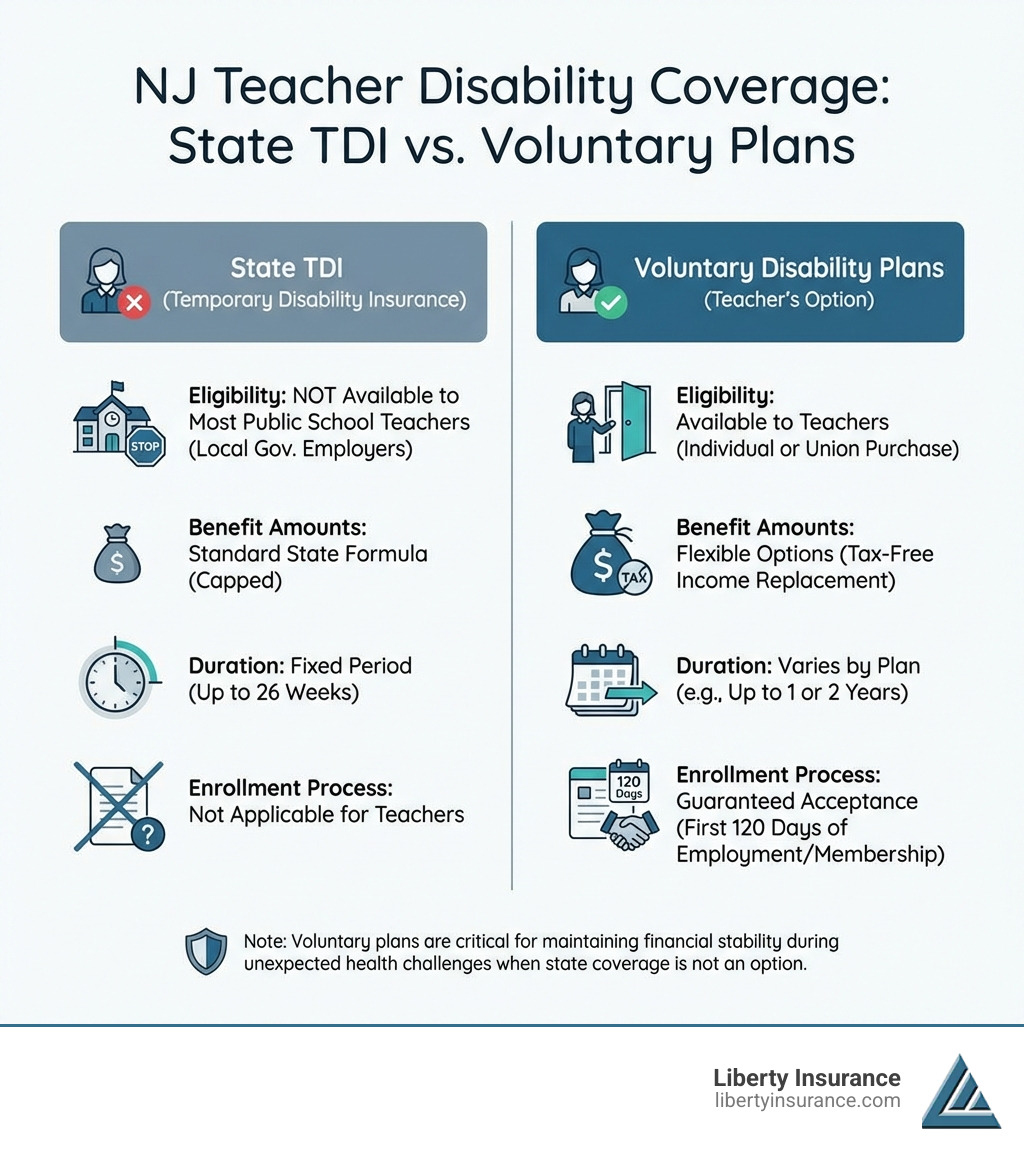
Can teachers in NJ get temp disability insurance? The answer is more complex than for most New Jersey workers. While the state offers a Temporary Disability Insurance (TDI) program to most employees, public school teachers in New Jersey are typically excluded from state TDI coverage because school districts are considered local government employers. However, teachers can access temporary disability insurance through voluntary disability plans offered by various insurance providers, often with premium payments made via payroll deduction.
Quick Answer:
- State TDI Program: Not available to most NJ public school teachers
- Voluntary Disability Plans: Primary option, purchased individually or through unions like NJEA
- Coverage Features: Benefits paid in addition to sick leave, tax-free income replacement, multiple plan options
- Enrollment Windows: Guaranteed acceptance during first 120 days of employment or membership
- Alternative Programs: Disability During Unemployment (if eligible), Disability Retirement (for permanent conditions)
This exclusion from state coverage leaves many educators wondering how to protect their income if illness or injury prevents them from working. Without temporary disability insurance, a serious health condition could mean relying solely on accumulated sick leave—which eventually runs out—leaving you without income during recovery.
This guide will help you understand the unique challenges teachers face when trying to find adequate coverage and how voluntary disability options are critical for maintaining financial stability during unexpected health challenges.
Can teachers in nj get temp disability insurance word roundup:
Why NJ Teachers Are Excluded from State Temporary Disability Insurance (TDI)
It might come as a surprise to many, but if you’re a public school teacher in Millstone Township, Trenton, Toms River, New Brunswick, Princeton, or anywhere else in New Jersey, you’re generally not covered by the state’s standard Temporary Disability Insurance (TDI) program. The short answer to “Are New Jersey teachers covered by the state’s Temporary Disability Insurance (TDI) program?” is no.
This exclusion stems from the way the New Jersey Temporary Disability Benefits Law is structured. Public school employees, like other local government employees, are not automatically included in the state’s TDI plan. While most private sector employers are mandated to provide TDI coverage (either through the state plan or an approved private plan), local government entities have the option to elect coverage for their workers. In practice, many school districts do not opt into the state TDI program.
The state’s TDI program is designed to provide cash benefits to New Jersey workers who must stop working due to a physical or mental health condition or other disability that is unrelated to their work. This vital safety net is funded through mandatory employee contributions. The contribution rate and the maximum amount of wages subject to contributions are set annually by the state, ensuring that benefits are available when needed. You can find more details about the state’s TDI program on the Official Site of The State of New Jersey.
So, what do teachers miss out on when they’re not covered by the state TDI program? Eligible claimants in the state TDI program are paid a percentage of their average weekly wage, up to a maximum weekly benefit rate that is updated each year. To qualify, a worker must have met minimum earnings requirements during a “base year” period, with the specific dollar amounts also updated annually. These benefits can be a significant help during an unexpected illness or injury, and without them, teachers must find alternative forms of income protection.
Understanding the State TDI Program You’re Not Covered By
Let’s dive a little deeper into what the state’s TDI program entails, so we can fully appreciate why finding alternative coverage is so important for educators. This state-run program is a lifeline for many, offering cash benefits when a non-work-related illness or injury temporarily sidelines you.
To qualify for state TDI, you generally need to meet minimum earnings requirements during the base year (the first four of the last five completed calendar quarters before your disability began). These specific monetary thresholds are adjusted annually. Once eligible, your healthcare provider certifies how long you need to recover, and benefits can last for up to 26 weeks. However, there’s a mandatory waiting week at the beginning of your claim, during which you won’t receive benefits—a detail that highlights the importance of having some sick leave saved up!
While state TDI provides wage replacement, it does not inherently guarantee job protection. While other state or federal laws (like FMLA) might protect your job during a leave, the TDI program itself focuses solely on providing financial support. For more information on the broader Temporary Disability and Family Leave Insurance landscape, you can refer to the Temporary Disability and Family Leave Insurance guide.
The “Optional” Clause for School Districts
The reason for this exclusion for teachers lies in the “optional” nature of TDI coverage for local government employers, which includes New Jersey’s school districts. While the state mandates TDI for most private employers, it grants local government entities the discretion to elect coverage for their employees.
Why do many districts in New Jersey, including those in our local areas like New Brunswick and Princeton, choose not to opt-in? Primarily, it often comes down to budget implications and the existence of alternative benefits. Opting into the state TDI program would require additional contributions from the school district, which can be a significant expense. Instead, many districts rely on a combination of employee sick leave policies, federal and state family leave laws, and benefits outlined in collective bargaining agreements (CBAs) with teacher unions. These existing structures are often seen as sufficient, or at least a more cost-effective solution, than enrolling in the state TDI program. However, as we’ve seen, this can leave a gap in income protection for teachers when sick leave runs out.
Voluntary Disability Insurance: Your Primary Coverage Option
Given the exclusion from state TDI, voluntary disability insurance becomes the primary and most robust option for New Jersey teachers seeking income protection. This type of coverage is specifically designed to replace a portion of your income if you become unable to work due to illness or injury.
Many teachers, often through their professional organizations like the NJEA, can purchase voluntary disability coverage underwritten by major insurance companies. A major convenience of these plans is that premium payments can often be made via payroll deduction, simplifying the process and ensuring consistent coverage.
One of the significant advantages of voluntary plans is the availability of guaranteed acceptance periods. If you enroll at the time of hire or within a specified window (e.g., the first 120 days of becoming an NJEA member), you may be able to secure coverage without answering health questions. This is a huge benefit, especially for those with pre-existing conditions.
Crucially, these voluntary plans pay benefits in addition to any accumulated sick leave you may have. Even better, they continue to pay when your sick leave is exhausted, providing a seamless financial bridge during your recovery. If you pay your premiums with after-tax dollars (which is common for voluntary plans), the benefits you receive are typically income-tax free, maximizing your financial support when you need it most. Protecting your income is paramount, and understanding your options for Income Protection Insurance is a smart move.
Exploring Voluntary Disability Plan Options
When considering voluntary disability insurance, you’ll typically encounter options for both short-term and long-term coverage, each with varying benefit durations and elimination periods. Think of it like choosing the right length of a safety net for your personal situation.

Benefit Duration refers to how long the policy will pay out. Short-term options might cover you for six months or two years, while long-term plans can extend benefits up to age 65 (or even longer, depending on the policy).
The Elimination Period (also known as the waiting period) is the time you must be continuously disabled before benefits begin. Common elimination periods include 14, 30, 60, 90, or 180 days. Your choice of elimination period often depends on how much sick leave you have saved and your personal financial reserves. A longer elimination period usually means lower premiums.
For New Jersey educators, plans endorsed by professional organizations, for example, offer distinct choices:
| Plan Name | Coverage Type | Benefit Duration | Elimination Periods (Common) | Key Feature |
|---|---|---|---|---|
| Sample Short-Term Plan (6-Month) | Short-Term Disability | Up to 6 months | 14, 30, 60, 90 days | Ideal for shorter recovery periods. |
| Sample Short-Term Plan (2-Year) | Short-Term Disability | Up to 2 years | 14, 30, 60, 90 days | Provides extended short-term protection. |
| Sample Comprehensive Plan | Short & Long-Term Disability | Up to age 65 (if disability before age 60) | 14, 30, 60, 90, 180 days | Comprehensive, combining short-term and long-term income protection. |
Choosing the right plan involves assessing your sick leave bank, your emergency savings, and your comfort level with risk. For instance, if you have a robust sick leave accrual, you might opt for a longer elimination period to save on premiums.
Eligibility and How Benefits Are Calculated
Eligibility for voluntary disability plans for teachers in New Jersey typically requires you to be an active member of a professional organization like the NJEA and work a minimum number of hours per week (e.g., at least 15 hours).
Enrollment windows are crucial for securing coverage, especially with guaranteed acceptance:
- New Member Enrollment: Often, you have a window (e.g., the first 120 days of becoming an NJEA member) to enroll with guaranteed acceptance, meaning you won’t need to answer health questions.
- Open Enrollment: Many plans have annual open enrollment periods where you can enroll or increase your coverage, sometimes with limited or no health questions.
- After Leave of Absence: If you were previously covered and return from an unpaid leave, you might have a window to re-enroll.
- Anytime Application: You can usually apply at any time, but you will likely need to answer health questions and undergo medical underwriting.
When it comes to calculating your benefit, voluntary plans typically replace a percentage of your pre-disability income, up to a maximum monthly benefit. For example, some plans allow NJEA members to enroll for up to $7,500 of Disability Insurance coverage. The exact percentage (e.g., 60% or 70% of your salary) and the maximum monthly payout will depend on the specific plan you choose.
Some long-term disability plans even offer a Cost-of-Living Adjustment (COLA), which can increase your monthly benefit by a small percentage (e.g., 3% annually) after you’ve been on claim for a certain period. This helps your benefits keep pace with inflation over time. For a deeper dive into how long-term disability generally works, our Long-Term Disability Insurance Complete Guide offers valuable insights.
What’s Covered Under Voluntary Disability Plans?
One of the great strengths of voluntary disability plans custom for educators is their comprehensive coverage. They understand that disabilities aren’t just about physical injuries, but encompass a wide range of conditions that can prevent you from performing your duties in the classroom.
The NJEA Disability Insurance Plan, for example, is designed to cover a broad spectrum of disabilities, including:
- Mental and behavioral health conditions: This is incredibly important, as stress, anxiety, and depression can significantly impact one’s ability to work.
- Pregnancy and childbirth: Complications related to pregnancy and childbirth are typically covered, providing essential support during a vulnerable time.
- Illness: Any non-work-related illness that prevents you from working, from a severe flu to a chronic condition, is generally covered.
- Accidental injury: If you suffer an injury outside of work, whether it’s a slip and fall or a sports injury, these plans can provide benefits.
- Cancer-related illnesses: The financial strain of cancer treatment can be immense, and these plans offer crucial income replacement.
- Chronic illness: Conditions like diabetes, arthritis, or autoimmune disorders that flare up and prevent work are also typically included.
It’s important to be aware of pre-existing condition limitations. Most policies have a clause regarding conditions you had before the policy started. There’s usually a waiting period (e.g., 12 months) before benefits will be paid for a pre-existing condition. However, if you enroll during a guaranteed acceptance period, these limitations may be waived or reduced.
Additionally, many plans offer partial disability benefits. This is a fantastic feature for when you’re recovering but not yet ready to return to full-time work. If you can work part-time but your earnings are reduced due to your disability, the plan may pay a portion of your benefit to help bridge the income gap, easing your transition back to the classroom.
Can Teachers in NJ Get Temp Disability Insurance Through Other Avenues?
While voluntary disability insurance is your primary and most reliable path to income protection as a New Jersey teacher, it’s worth exploring other avenues that might offer some form of temporary or permanent disability support under specific circumstances. These are often not direct substitutes for temporary disability insurance but can provide crucial assistance.

It’s a good idea to understand all your options, whether you’re looking for short-term help or facing a long-term inability to work. For general guidance on applying for disability, you can visit our page on How to Apply for Disability.
So, can teachers in NJ get temp disability insurance if they become unemployed?
This is a specific and somewhat nuanced situation. If a worker becomes totally disabled and has been out of covered employment for more than 14 days, they may be eligible for benefits under the New Jersey Disability During Unemployment program. These are often referred to as Section 4(f) claims, as they are primarily unemployment insurance claims established under Section 4(f) of the Unemployment Compensation law.
To be eligible for the Disability During Unemployment program, you must meet several criteria:
- You must meet all the requirements of the Unemployment Compensation law.
- You must be totally unable to work.
- You must be under the care of a legally licensed medical professional (physician, dentist, podiatrist, optometrist, chiropractor, psychologist, or advanced practice nurse).
- You must have earned a minimum amount of wages in a job covered by New Jersey’s disability insurance program during the base period of the claim.
However, here’s the catch for teachers: “Employment with local governments that have not elected disability coverage for their workers is not covered for disability benefits.” This means if your school district did not opt into the state TDI program (which is common), you would likely not have “covered employment” for the purposes of the Disability During Unemployment program either.
If you do qualify, the weekly benefit rate is calculated similarly to regular TDI benefits, and there’s a maximum combined collection for unemployment insurance and 4(f) benefits, which is one and one-half times the maximum benefit amount of the unemployment claim. For more detailed information on this specific program, you can consult the Disability During Unemployment program in New Jersey.
Disability Retirement for Public School Employees (PERS & TPAF)
For New Jersey public school employees, including teachers, who face a permanent and total disability that prevents them from working, there are disability retirement benefits available through the Public Employees’ Retirement System (PERS) and the Teachers’ Pension and Annuity Fund (TPAF). This is not temporary disability insurance; it’s a retirement benefit for long-term, permanent conditions.
There are two main types of disability retirement:
- Ordinary Disability Retirement: To qualify, you generally need 10 or more years of New Jersey service credit and must be permanently and totally disabled from performing your job duties. The annual benefit is calculated as the higher of 43.6% of your Final Average Salary or 1.64% of your Final Average Salary for each year of service credit.
- Accidental Disability Retirement: This is for permanent and total disabilities that are a direct result of a traumatic event occurring during and as a result of your job duties. There’s no service credit requirement, but strict criteria apply to what constitutes a “traumatic event.” The annual benefit is 72.7% of your base salary at the time of the traumatic event.
These disability retirement benefits are subject to federal tax, just like other pensions, but are not subject to New Jersey State income tax until you reach age 65. If approved, you’re also covered by group life insurance in the amount of 1 1/2 times your final salary until you reach normal retirement age. For a comprehensive overview of these benefits, refer to the Disability Retirement Benefits Information for PERS and TPAF Members. This is a vital safety net for career-ending disabilities, but it doesn’t address the need for temporary income replacement.
Navigating Related NJ Leave and Insurance Programs
Understanding the full spectrum of leave and insurance programs in New Jersey can feel like navigating a maze. For teachers, it’s especially important to know how different benefits interact and what they cover. We’re talking about wage replacement versus job protection, and how to coordinate various types of leave to ensure you’re fully supported.
Paid Family Leave (PFL) vs. Your Own Disability
New Jersey’s Paid Family Leave (PFL) program is a wonderful benefit, but it’s important not to confuse it with coverage for your own disability. PFL is designed to provide cash benefits when you need to take time off to care for a family member with a serious medical condition, or to bond with a new child (birth, adoption, or foster placement).
The PFL program, initiated by the A-873 bill, extends the state’s temporary disability insurance program to provide these family leave benefits. Like TDI, PFL is financed by deductions from employee paychecks. When the bill was passed in 2008, the benefit was set at a certain level; however, these benefit amounts and durations have been updated since then and are subject to change. The core purpose remains: to support family care, not your personal illness or injury. For more details on the original legislation, you can review A-873, the Paid Family Leave bill. So, if you’re out due to your own health issue, PFL won’t be the answer.
How NJ Earned Sick Leave Interacts with Disability
New Jersey’s Earned Sick Leave law is a significant benefit for nearly all employees, including teachers. This law mandates that employers provide full-time, part-time, and temporary employees with up to 40 hours of earned sick leave per year. You can use this leave for various reasons, including your own illness or injury, caring for a family member, or attending school-related meetings.
For teachers with disability insurance, earned sick leave plays a crucial role, especially during the elimination period of a voluntary disability policy. Since most disability plans have a waiting period (e.g., 14, 30, or 60 days) before benefits begin, your accumulated sick leave can be used to cover this initial period, ensuring you have some income from day one of your disability. Once your sick leave is exhausted, your disability insurance benefits can then kick in, seamlessly continuing your income protection. This coordination helps minimize the financial impact of an unexpected absence. You can learn more about this and other leave programs on the New Jersey Paid Family and Medical Leave page.
Disability Insurance vs. Critical Illness Insurance
When we talk about protecting your income and financial well-being, two types of insurance often come up: disability insurance and critical illness insurance. While both are valuable, they serve different purposes. Understanding these differences is key to building a comprehensive financial safety net.
Disability Insurance: This is primarily about income replacement. If you become disabled due to an illness or injury and cannot work, disability insurance provides regular (usually monthly) cash benefits to replace a portion of your lost income. These benefits are designed to help you cover your living expenses, from mortgage payments to groceries, while you’re unable to earn a paycheck. This is the core of what we’ve been discussing when asking “can teachers in nj get temp disability insurance?” Learn more about it on our Disability page.
Critical Illness Insurance: In contrast, critical illness insurance provides a lump-sum payment if you are diagnosed with a specific covered condition, such as cancer, a heart attack, or a stroke. This payout is typically made upon diagnosis, regardless of whether you’re able to work. The funds from critical illness insurance are yours to use however you see fit—whether it’s for medical bills, experimental treatments, travel for care, or even just to maintain your lifestyle while you recover. It’s a supplementary form of coverage that offers financial flexibility during a major health crisis.
While disability insurance covers the inability to work due to a broader range of conditions, critical illness insurance provides immediate financial relief for specific, severe diagnoses. Many educators find that having both types of coverage offers the most robust protection against life’s uncertainties.
Conclusion
So, can teachers in NJ get temp disability insurance? The definitive answer is that while New Jersey public school teachers are generally not covered by the state’s Temporary Disability Insurance (TDI) program, they absolutely can and should secure income protection through voluntary disability plans. This distinction is vital for every educator in New Jersey, from Millstone Township to Princeton, to understand.
Our research shows that voluntary plans, often available through professional organizations like the NJEA and underwritten by major insurance providers, offer the most practical and comprehensive solution. These plans provide crucial income replacement, pay benefits in addition to sick leave, and often come with convenient payroll deduction options and guaranteed acceptance periods.
At Liberty Insurance, we understand the importance of protecting your financial future, whether through commercial property insurance for businesses or by providing clear guidance on personal income protection. Proactive financial planning, especially for such a dedicated profession, is not just a recommendation—it’s a necessity. By exploring and securing voluntary disability insurance, you can ensure that an unexpected illness or injury won’t derail your financial stability. Take the step today to protect your income and your peace of mind.
For further information on securing your financial future, explore our resources on Long-Term Disability Insurance.

