
Understanding Your Income Protection Options in the Garden State
Your ability to earn an income is your most valuable financial asset. Yet, an unexpected illness or injury can jeopardize that asset in an instant. Statistics show that more than one in four of today’s 20-year-olds will become disabled before reaching retirement age. In New Jersey, a robust safety net exists to help you navigate these challenging times. Disability Insurance NJ provides critical financial support when you’re unable to work due to illness, injury, or significant family caregiving needs. These state-mandated programs offer partial wage replacement, funded by small payroll deductions from your paychecks, ensuring you have a source of income when you need it most.
Quick Overview of NJ State Benefits:
- Temporary Disability Insurance (TDI): This program covers your own non-work-related illness or injury. It provides benefits for up to 26 weeks, helping you manage your finances while you recover.
- Family Leave Insurance (FLI): This program provides paid leave for bonding with a new child (birth, adoption, or foster care) or for caring for a seriously ill family member. It offers up to 12 consecutive weeks of benefits.
- 2025 Benefit Rate: For claims filed in 2025, you can receive up to $1,081 per week. This amount is calculated as 85% of your average weekly wage, capped at the state’s maximum.
- Monetary Eligibility: To qualify, you must have earned at least $303 per week for 20 weeks OR a total of $15,200 in your “base year” period before the leave begins.
- How to Apply: The fastest and recommended method is to apply online at myleavebenefits.nj.gov. You can also apply by mail or fax.
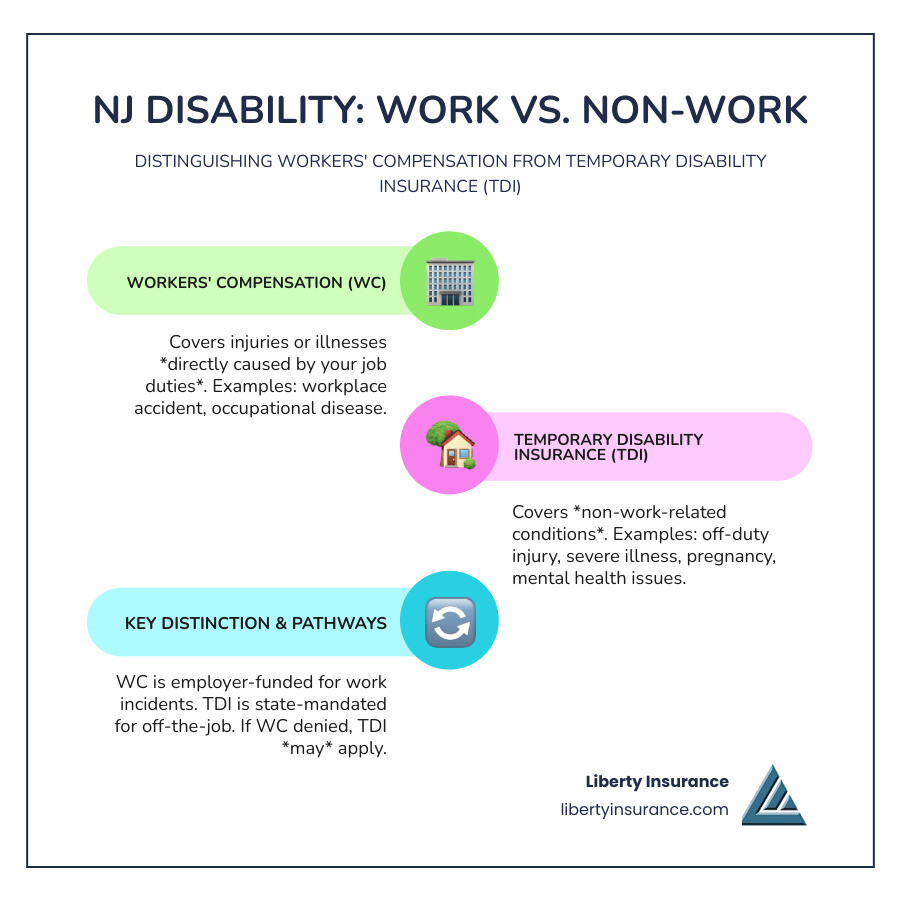
It’s crucial to distinguish between work-related and non-work-related disabilities. Injuries sustained on the job are covered by a separate program, Workers’ Compensation. TDI steps in for those off-the-job disabilities that can disrupt life, such as a car accident, a serious illness like cancer, complications from pregnancy, or a mental health condition requiring time away from work.
This guide offers a comprehensive overview of New Jersey’s Temporary Disability Insurance (TDI) and Family Leave Insurance (FLI) programs. We’ll cover eligibility in detail, explain how benefits are calculated, walk through the application process, and clarify the differences between state and private plans to help you protect your income.
I’m Andrew Harris, and I’ve spent over a decade helping New Jersey businesses and individuals steer insurance protection, including comprehensive guidance on Disability Insurance NJ options.
Understanding New Jersey’s Temporary Disability Insurance (TDI)
When an unexpected illness or off-the-job injury prevents you from working, New Jersey’s Temporary Disability Insurance (TDI) program provides essential cash benefits to replace a portion of your lost wages. TDI is specifically designed to cover non-work-related conditions. This includes a wide range of situations, from recovering from a planned surgery or managing a chronic illness to navigating the physical recovery from pregnancy and childbirth. If you slip on ice in your driveway, develop pneumonia, or need to take time off to manage a serious mental health condition, TDI is the program designed to provide financial support during your absence from work.
What is TDI and Who is Eligible?
TDI offers short-term disability coverage for a maximum of 26 weeks for a single disability period, provided your healthcare provider continues to certify your need to be out of work. To qualify for these benefits, you must first meet New Jersey’s monetary eligibility requirements. For claims filed in 2025, you must have worked in New Jersey and earned at least $303 per week for 20 or more weeks during your base year, or a combined total of $15,200 during that same period.
Your “base year” is a critical concept; it is defined as the first four of the last five completed calendar quarters before the week your disability begins. A base week is any calendar week within that timeframe where you earned the minimum weekly threshold ($303 for 2025 claims). For example, if your disability starts in May 2025 (the second quarter), your base year would be January 1, 2024, through December 31, 2024. The state would analyze your earnings during this period to determine your eligibility.
The TDI program is funded entirely through your own payroll deductions. For 2025, the worker contribution rate is 0.23% on the first $165,400 in covered wages. This means the maximum annual contribution any worker will make is $380.42.
How TDI Benefits are Calculated and Paid
Once your claim is approved, you will receive 85% of your average weekly wage, a figure calculated based on your earnings during your base year. For 2025, the maximum weekly benefit is capped at $1,081.
There is a mandatory seven-day waiting period before benefits begin. This means you will not be paid for the first week of your disability. However, if your disability continues for more than three consecutive weeks (21 days), the state will retroactively pay you for that initial waiting week. Some exceptions to the waiting week may apply, so it’s worth checking the specific rules.
Benefits are typically paid every two weeks via a prepaid debit card from Money Network/My Banking Direct. This card will arrive in a plain, unmarked envelope, which can be easily mistaken for junk mail, so be vigilant when checking your mail after filing. If you have issues with your card, you can contact Money Network/My Banking Direct for assistance.
The TDI Application Process in NJ
The state offers several ways to apply for Disability Insurance NJ benefits: online, by mail, or by fax. The online application is by far the fastest and most efficient method. You can start an application online through the state’s official portal.
A crucial part of your application is the medical certification. Your healthcare provider must complete a section of the form that documents your medical condition, confirms you are unable to work, and provides an estimated duration for your time away from work. If you apply online, the system will generate a unique Online Form ID for your claim. You must provide this ID to your doctor’s office, which allows them to log in and submit their portion of the certification electronically. This integrated process significantly speeds up claim determination.
You must file your application within 30 days from your first day of disability. Missing this deadline without a valid reason can lead to a reduction in benefits or an outright denial of your claim. To help you prepare, the state offers a helpful application video that walks you through the steps. After submitting, you can check your claim status online at any time.
Family Leave Insurance (FLI): For Bonding and Caregiving

While TDI supports you during your own medical leave, New Jersey’s Family Leave Insurance (FLI) program provides a financial lifeline when you need to step away from work to care for others. FLI provides paid benefits for three primary reasons:
- Bonding with a new child during the first 12 months after birth, adoption, or foster care placement.
- Caring for a family member with a serious health condition. A “family member” is broadly defined to include a spouse, domestic partner, civil union partner, child (of any age), parent, parent-in-law, sibling, grandparent, grandchild, or any other individual related by blood or with whom you have a relationship equivalent to a family.
- Handling matters related to domestic or sexual violence. This allows you or a family member to seek medical attention, counseling, or legal assistance related to such an incident.
For new mothers, TDI and FLI work in tandem to provide comprehensive maternity leave coverage. A mother can first use TDI for her physical recovery from childbirth (typically 6 weeks for a vaginal birth and 8 weeks for a C-section). Once the TDI claim ends, she can seamlessly transition to an FLI claim to receive benefits for bonding time with the new baby.
FLI vs. TDI: Key Differences
The core difference is straightforward: TDI is for your own health, while FLI is for caring for others or bonding with a new child. This fundamental distinction leads to several key operational differences:
- Duration: FLI provides up to 12 consecutive weeks of benefits or can be taken on an intermittent basis for up to 56 individual days (equivalent to 8 weeks) within a 12-month period. TDI provides up to 26 weeks for a continuous period of disability.
- Waiting Period: FLI has no waiting period. Benefits can begin on the first day of your leave. TDI has a seven-day waiting period before benefits are paid.
- Flexibility: FLI’s intermittent leave option is incredibly valuable for situations that don’t require a full-time absence, such as taking a parent to weekly chemotherapy appointments or attending regular therapy sessions. You can learn more about Taking Family Leave in Parts.
FLI Eligibility and Benefit Calculation
The financial requirements for FLI are identical to those for TDI. For claims filed in 2025, you must have earned at least $303 per week for 20 weeks or a total of $15,200 during your base year (the first four of the last five completed calendar quarters).
The benefit calculation is also the same: 85% of your average weekly wage, up to the 2025 maximum of $1,081 per week. The FLI program is funded by your payroll deductions. For 2025, the contribution is 0.33% of your covered wages, up to the wage cap of $165,400, with a maximum annual contribution of $545.82.
How to Apply for FLI Benefits
The application process for FLI is similar to TDI, with online, mail, and fax options available. The required documentation will vary based on your reason for taking leave:
- Bonding: You will need to provide proof of the child’s birth or documentation of the adoption or foster care placement.
- Caregiving: The family member’s healthcare provider must complete a medical certification detailing the serious health condition.
- Domestic/Sexual Violence: You will need to provide specific supporting documentation as required by the state, which could include a police report, restraining order, or a letter from a certified counselor.
For foreseeable leaves, such as bonding with a newborn or a planned medical treatment for a family member, you are required to give your employer 30 days’ advance notice. For unforeseeable emergencies, you must notify your employer as soon as possible. While this notice doesn’t affect your eligibility for state benefits, it is a professional courtesy and is required to secure any job protection rights you may have. The state provides helpful application video tutorials to guide you through the process.
Navigating Your Disability Insurance NJ Claim
Managing your Disability Insurance NJ claim effectively involves understanding the type of plan you have, your separate job protection rights, and how to handle potential issues like denials or overpayments. Here’s what you need to know after you file your application.

State Plan vs. Private Plan Disability Insurance NJ
Not all TDI and FLI coverage in New Jersey is administered directly by the state. Employers have the option to provide these benefits through an approved private plan, which can be fully insured by a commercial carrier or self-insured by the company. By law, any private plan must offer benefits that are at least equal to, or better than, the state plan in terms of benefit amount, duration, and eligibility requirements. Some private plans may offer higher weekly benefits or have no waiting period, for example.
Your employer is legally required to inform you of your coverage type, usually through a posted notice in the workplace or in your employee handbook. If you’re unsure, ask your HR department. Knowing your plan type is critical because if you have a private plan, you must file your claim directly with that insurance carrier, not with the State of New Jersey. If you encounter problems with a private plan claim, such as an unfair denial, the state’s Private Plan Compliance Section can intervene on your behalf.
If you work multiple jobs with different plan types (e.g., one with the state plan, one with a private plan), your eligibility is determined by combining earnings from all covered NJ employment. The state will then determine which plan (or combination of plans) is responsible for paying your benefits.
Job Protection, Taxes, and Other Considerations
It is absolutely critical to understand that receiving TDI or FLI benefits does not automatically protect your job. These are wage replacement programs only. Job protection is governed by separate, distinct laws: the federal Family and Medical Leave Act (FMLA) and the New Jersey Family Leave Act (NJFLA).
These laws have their own strict eligibility rules. To see if you qualify, use the state’s helpful Job Protection Coverage Checker.
| Law | Employer Size | Employee Eligibility | Leave Provided |
|---|---|---|---|
| FMLA | 50+ employees | Worked 1,250 hours in the last 12 months | Up to 12 weeks of unpaid, job-protected leave for own health, family care, or bonding. |
| NJFLA | 30+ employees | Worked 1,000 hours in the last 12 months | Up to 12 weeks of unpaid, job-protected leave for family care or bonding (does not cover own health). |
Regarding taxes, TDI and FLI benefits are considered taxable income for federal income tax purposes and for FICA/Medicare taxes. However, these benefits are not taxed by the state of New Jersey. The state automatically deducts FICA/Medicare contributions from state plan benefits but will only withhold federal income tax if you specifically request it during your application.
Common Claim Issues: Part-Time Work, Denials, and Overpayments
Returning to Work Part-Time: As you recover, your doctor may clear you for a return to work on a reduced or part-time schedule. You can work part-time and still receive partial TDI benefits to supplement your reduced income. This partial benefit period can last up to 8 weeks, with a possible extension to 12 weeks if medically necessary.
Claim Denials: Denials can occur for various reasons: not meeting the monetary earnings requirements, providing insufficient medical evidence, or filing your claim after the 30-day deadline. If your condition is deemed work-related, your TDI claim will be denied and you will be instructed to file a Workers’ Compensation claim. You have the right to appeal any denial. For state plan claims, you can file an appeal through the online portal. For private plan denials, you must first complete the carrier’s internal appeal process. If that is unsuccessful, you can then appeal to the state.
Overpayments: If you are paid more in benefits than you were eligible for, the state will issue a notice demanding repayment. This can happen if you return to work earlier than expected and don’t report it, or if there was a calculation error. It is crucial to respond to these notices promptly. Repayment plans are often available, and you have the right to appeal an overpayment determination if you believe it is incorrect.
Additional Disability Resources and Programs in New Jersey
Beyond the foundational TDI and FLI programs, New Jersey offers several other crucial programs designed to support residents with disabilities, particularly those who need ongoing health coverage or assistance in returning to the workforce.

NJ WorkAbility and Other Health Coverage
The NJ WorkAbility program is designed to eliminate a common fear for people with disabilities: losing essential health coverage upon returning to work. It provides full Medicaid health coverage to employed individuals with disabilities (age 16 and over) whose income or assets might otherwise make them ineligible. The program has been expanded to no longer count spousal income or have asset limits, empowering participants to earn more and build savings without risking their healthcare. While a small monthly premium may be required for some, special income calculations make eligibility more accessible than standard Medicaid. You can find more NJ WorkAbility program details on the state’s website.
For other residents, NJ FamilyCare is the state’s publicly funded health insurance program, providing affordable coverage for children and adults. It includes specific Aged, Blind, Disabled (ABD) Programs that offer comprehensive healthcare for those who may need community-based support or long-term care services.
Federal and State Support Systems
Social Security Administration (SSA): If your disability is severe and expected to last for more than a year, you may be eligible for federal disability benefits. The two main programs are:
- Social Security Disability Insurance (SSDI): An earned benefit for individuals who have worked and paid FICA taxes long enough to be “insured.”
- Supplemental Security Income (SSI): A needs-based program for individuals with limited income and resources, regardless of work history.
Often, you must exhaust your state short-term TDI benefits before being approved for these long-term federal programs.
Division of Vocational Rehabilitation Services (DVRS): Part of the NJ Department of Labor, DVRS helps individuals with disabilities prepare for, find, and maintain employment. Services can include career counseling, job training, and workplace accommodations.
Where to Find Help for Your Disability Insurance NJ Questions
Navigating Disability Insurance NJ can be complex, but numerous resources are available to assist you:
MyLeaveBenefits.NJ.gov: The official MyLeaveBenefits.NJ.gov website from the NJ Department of Labor is the primary hub for all TDI and FLI information, including detailed guides, FAQs, and application portals.
Division of Disability Services (DDS): The DDS provides information on employment support and programs like NJ WorkAbility for residents living with a disability.
Disability Benefits 101 (DB101): This Disability Benefits 101 resource is a powerful online tool with calculators and estimators that show how work and earnings can impact your state and federal benefits, helping you make informed employment decisions.
County Social Services: Your local county social services agencies can provide in-person assistance with applications for programs like NJ FamilyCare and connect you with other local resources.
Frequently Asked Questions about Disability Insurance in NJ
Here are clear, straightforward answers to the most common questions we hear from New Jersey workers about disability insurance and related leave benefits.
What’s the difference between Workers’ Compensation and Temporary Disability Insurance?
The key difference is the origin of your medical condition. Workers’ Compensation is an insurance program that covers injuries or illnesses that happen on the job or are a direct result of your work duties (e.g., a back injury from lifting heavy equipment at work). Temporary Disability Insurance (TDI) covers non-work-related conditions that happen off the job, such as a personal illness, pregnancy, or an accident during your personal time (e.g., breaking your leg while skiing).
If a Workers’ Compensation claim is denied because the condition is not deemed work-related, you may then be able to apply for TDI benefits. For any work-related issues, your first point of contact should be the Division of Workers’ Compensation.
Can I receive TDI benefits for pregnancy and childbirth?
Yes, absolutely. Under New Jersey’s Disability Insurance NJ program, pregnancy and childbirth are treated like any other medical condition that prevents you from working. Your healthcare provider will certify the period you are medically unable to work. This typically includes time before your due date if there are complications and a standard recovery period after delivery (usually six weeks for a vaginal delivery and eight weeks for a C-section). After your TDI benefits for medical recovery end, you can seamlessly transition to Family Leave Insurance (FLI) to receive benefits while bonding with your new child. This powerful combination provides comprehensive financial support for new parents.
What happens to my health insurance while I’m on leave?
This depends on whether you have job protection under FMLA or NJFLA. If your leave is covered by FMLA, your employer is required to maintain your group health insurance coverage under the same terms and conditions as if you had continued to work. You will still be responsible for paying your portion of the premium. If you are not covered by FMLA, your employer is not legally required to continue your health benefits, though some may do so as a matter of policy. In this case, you may be eligible to continue your coverage through COBRA, but you would be responsible for the full premium.
What if I have more than one job?
If you work for more than one employer in New Jersey, your eligibility for TDI or FLI is based on your combined earnings from all covered employment. When you file your claim, you must report all of your recent employers. The state will then determine your eligibility and benefit rate based on your total earnings. The responsibility for paying the claim will be assigned to the state plan or the appropriate private plan(s) based on your employment at the time your leave begins.
Are self-employed individuals or gig workers eligible for TDI/FLI?
Generally, self-employed individuals and independent contractors (gig workers) are not automatically covered because they do not have an employer making payroll contributions on their behalf. However, New Jersey offers a Disability During Unemployment program that combines TDI and unemployment benefits for those who become disabled while unemployed. Additionally, self-employed individuals can elect to purchase optional private short-term disability coverage to protect their income.
How long do I have to file a TDI or FLI claim?
Timely filing is critical, as the deadlines are firm and can directly impact your benefits:
For TDI: You must file your claim within 30 days of your first day of disability. Filing late without a documented good cause can lead to a reduction in benefits for each day you are late, or a complete denial.
For FLI: The notice requirements are more about informing your employer. For a foreseeable leave (like childbirth or planned surgery), you should give your employer 30 days’ advance notice. For an unforeseeable emergency, you must notify your employer as soon as reasonably possible. While this notice is for job protection purposes, it’s also best practice to file your claim with the state promptly once your leave begins.
Conclusion: Securing Your Financial Future
This guide has detailed New Jersey’s robust Disability Insurance NJ programs, explaining how Temporary Disability Insurance (TDI) and Family Leave Insurance (FLI) provide a crucial financial safety net. These state-mandated programs are a lifeline for workers facing unexpected health issues or significant family caregiving needs, funded by the payroll deductions you’ve already made. You are now equipped with the key information on eligibility requirements, benefit calculations (up to $1,081 per week in 2025), and the step-by-step application process.
You know that TDI offers up to 26 weeks of wage replacement for your own medical recovery, while FLI provides up to 12 weeks for family bonding or caregiving. This knowledge empowers you to confidently access the benefits you have earned when life’s challenges arise.
However, it is absolutely crucial to remember that TDI and FLI are short-term solutions. Once the maximum benefit period ends, the state’s wage replacement coverage stops. This raises an important question that every worker should consider: what happens if a disability lasts longer than six months? State programs have firm limits, which is why planning for long-term income protection is an essential component of a sound financial plan.
Your ability to earn an income is your most valuable asset. Just as businesses protect their physical property with insurance, individuals must protect their earning potential. While we at Liberty Insurance specialize in safeguarding commercial properties and assets, we recognize the parallel importance of personal financial security. Supplementing state benefits with a private long-term disability (LTD) insurance policy is the wisest step toward building a truly resilient financial future.
When exploring LTD policies, look for key features that provide comprehensive protection:
- Definition of Disability: An “own-occupation” definition is superior, as it pays benefits if you cannot perform your specific job, whereas an “any-occupation” definition only pays if you cannot perform any job for which you are qualified.
- Residual Disability Rider: This feature provides partial benefits if you can return to work part-time, supplementing your reduced income.
- Cost-of-Living Adjustment (COLA): This rider increases your benefit over time to keep pace with inflation, protecting your purchasing power during a long-term claim.
To fully protect your earning potential against all unforeseen circumstances, it’s important to evaluate all your options. Learn more about long-term disability insurance options.
Use the resources in this guide, understand the limits of state programs, and don’t hesitate to seek professional advice to ensure you have comprehensive protection. Your financial security during life’s unexpected challenges is too important to leave to chance.

