
Why Your Income is Your Most Valuable Asset in Princeton
Disability insurance Princeton NJ protects your income if illness or injury prevents you from working. Here’s what Princeton residents need to know:
Quick Overview of Local Disability Insurance Options:
- New Jersey TDI Program: Provides up to 26 weeks of benefits at 85% of average weekly wage (maximum $1,037/week in 2024)
- Individual Policies: Replace 60-70% of income, customizable terms, portable between jobs
- Group Coverage: Often provided by employers, but may be limited and non-portable
- Business Policies: Include Key-Person and Business Overhead Expense coverage for entrepreneurs
Average Cost: $100-300/month for individual coverage, depending on age, occupation, and benefit amount
Your ability to earn an income is your most valuable financial asset, yet many Princeton residents overlook protecting it. An unexpected illness or injury can devastate your finances, especially with Princeton’s high cost of living. Disability insurance provides a critical safety net, ensuring you have income to cover bills and maintain your lifestyle if you can’t work.
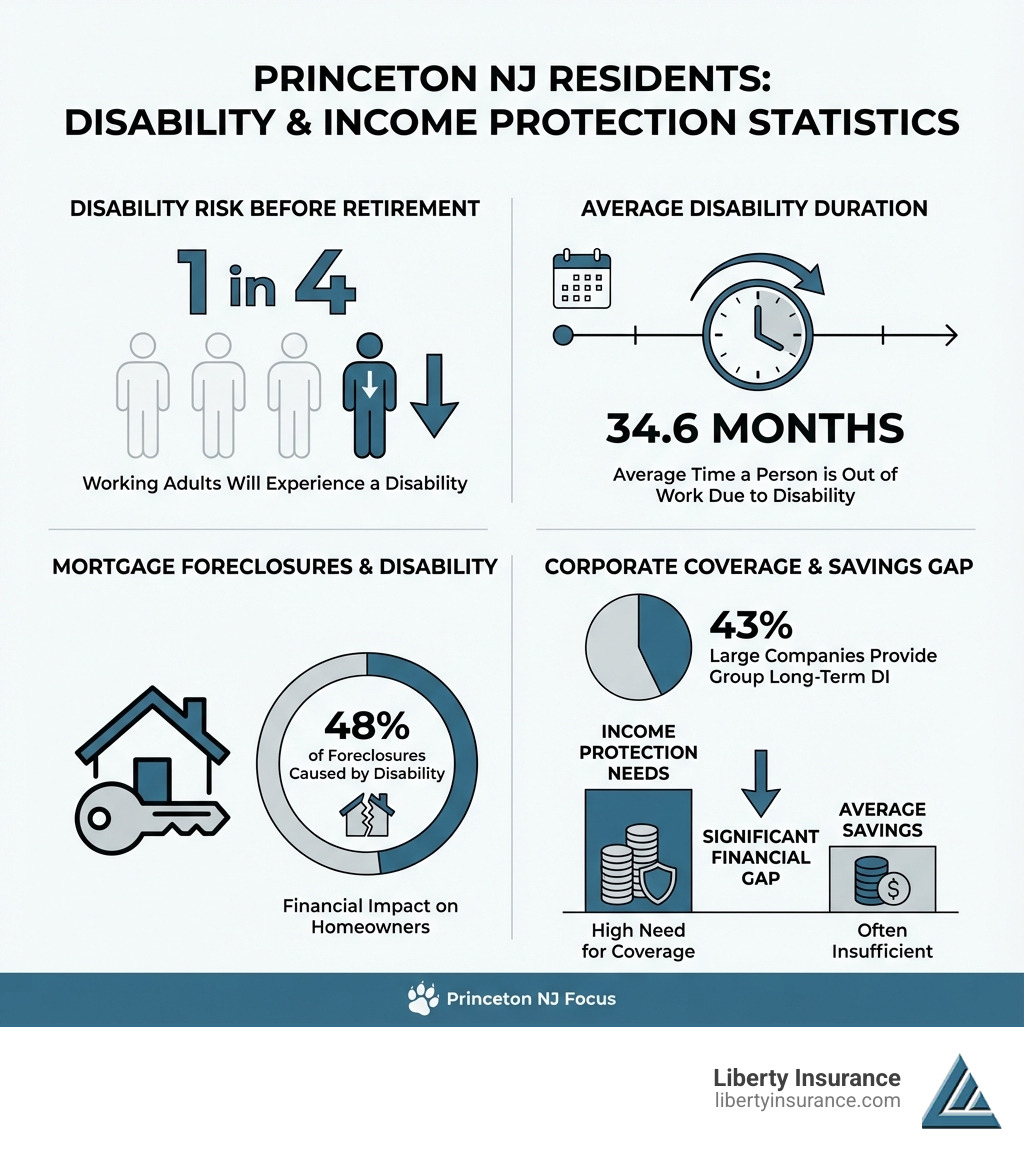
The statistics are sobering: more than 1 in 4 people will become disabled before retirement. Without proper coverage, a disability can quickly erode savings and jeopardize your family’s financial security.
I’m Andrew Harris, a Certified Insurance Counselor (CIC) and Accredited Advisor in Insurance (AAI). I’ve spent my career helping individuals and businesses steer complex insurance decisions, including disability insurance Princeton NJ options custom to our community. Through my work with Liberty Insurance, I’ve seen how the right coverage provides financial stability during life’s most challenging moments.
Understanding the Fundamentals of Disability Insurance
Disability insurance, or income protection, replaces a portion of your earned income if a disability prevents you from working. It provides financial security, ensuring your bills can be paid and your family’s lifestyle maintained if an unexpected injury or illness occurs. The need is common; statistics show more than one in four people will face a disability before retirement, making this coverage essential to prevent depleting savings or accumulating debt.
New Jersey provides a safety net with its Temporary Disability Insurance (TDI) program. This state-mandated plan offers short-term benefits for up to 26 weeks for non-work-related illnesses or injuries. While valuable, TDI often falls short for higher earners and is limited in duration, making private disability insurance crucial for comprehensive, long-term protection. You can learn more at New Jersey’s TDI Program.
Unlike employer-sponsored plans, private disability insurance is portable. If you change jobs or move to another of our service areas like Toms River or Millstone Township, your individual policy goes with you, providing continuous coverage.
Short-Term vs. Long-Term Disability: A Comparison
Disability insurance comes in two main types: short-term (STD) and long-term (LTD). They serve different purposes and cover different timeframes.
| Feature | Short-Term Disability (STD) | Long-Term Disability (LTD) |
|---|---|---|
| Benefit Period | Typically 3 to 6 months, sometimes up to a year. New Jersey’s TDI provides up to 26 weeks. | Can last for several years, often until retirement age (e.g., 65, 67, or 70), or for a specified number of years. |
| Elimination Period | Usually 0 to 14 days. This is the waiting period before benefits begin. | Typically 30, 60, 90, or 180 days, but can be longer. Often starts when STD benefits end. |
| Coverage Amount | Often replaces 60-70% of your gross income, sometimes more, up to a weekly maximum. | Typically replaces 50-70% of your gross income, up to a monthly maximum. |
| Typical Use Case | Recovery from surgery, short-term illness (e.g., severe flu, pneumonia), or pregnancy leave. | Chronic illness (e.g., cancer, heart disease), severe accidents, or debilitating mental health conditions that prevent long-term work. |
STD bridges the gap for temporary conditions, while LTD provides financial stability for extended periods. LTD is arguably the most critical for protecting against catastrophic financial loss. For a deeper dive, explore our Long-Term Disability Insurance guide.
Group Plans vs. Individual Policies
Many employers in Princeton and Central New Jersey offer group disability coverage. While a great benefit, it’s important to understand its limitations compared to individual policies.

Group plans are often inexpensive and accessible but come with drawbacks:
- Benefit Amount: Coverage may be limited to base salary, excluding bonuses or commissions, creating a significant gap for high earners.
- Portability: Coverage typically ends when you leave your employer, leaving you unprotected if you switch jobs or become self-employed.
- Tax Implications: Benefits from employer-paid policies are usually taxable, reducing the net amount you receive.
Individual disability insurance offers greater control and flexibility:
- Custom Coverage: You can tailor the benefit amount, elimination period, and benefit period to your specific needs.
- Comprehensive Income Protection: Policies can be designed to cover a higher percentage of your total income, including bonuses and commissions.
- Portability: The policy is yours and stays with you throughout your career.
- Tax-Free Benefits: When you pay premiums with after-tax dollars, benefits are typically received tax-free.
For many professionals, the best strategy is to supplement a group plan with a robust individual policy to ensure comprehensive protection. Learn more in our Long-Term Disability Insurance Complete Guide.
Key Types of Disability Insurance for Princeton Professionals and Business Owners
Princeton’s diverse demographic of professionals and entrepreneurs often requires specialized disability insurance solutions. Beyond standard policies, options like High-Limit, Key-Person, and Business Overhead Expense (BOE) insurance are crucial for safeguarding both personal income and business continuity.
Individual and High-Limit Policies
For high-earning professionals in Princeton, a standard individual policy may not offer enough coverage. High-limit policies are designed to protect a larger portion of your income, ensuring your lifestyle is maintained if you cannot work. These policies can cover income beyond base salary, including bonuses and commissions, with some plans offering benefits from $2,000 to $100,000 per month.
A critical feature for professionals is the “own-occupation” definition of disability. This means you are considered disabled if you cannot perform the duties of your specific occupation, even if you could work in another field. For a surgeon, lawyer, or professor, this distinction is vital. You can also add riders to customize your coverage, such as a Cost-of-Living Adjustment (COLA) rider, which increases your benefits over time to keep pace with inflation.
Business-Specific Disability Insurance in Princeton NJ
For business owners, a personal disability can jeopardize the entire enterprise. Specialized business disability insurance protects the company’s financial stability.

Key-Person Disability Insurance: This policy pays benefits to the company if a crucial employee, like a founder or lead developer, becomes disabled. The funds can cover the cost of hiring a replacement, offset lost revenue, and help the business stay afloat during the transition.
Business Overhead Expense (BOE) Insurance: If you are a self-employed professional, your business expenses like rent, utilities, and employee salaries continue even if you can’t work. BOE coverage reimburses your business for these ongoing overhead costs, preventing a collapse while you recover and allowing you to return to a functioning operation.
These business-specific policies are essential for protecting your entrepreneurial endeavors in Princeton, ensuring your hard work and investment are secure.
How to Secure the Right Disability Insurance Princeton NJ
Finding the right disability insurance Princeton NJ can feel like navigating a maze, but it doesn’t have to be. We’re here to simplify the process and help you secure coverage that truly meets your needs. It involves understanding how much coverage you need, what the application entails, and how to choose a policy that truly protects you.
Calculating Your Ideal Coverage Amount
Determining the right amount of disability insurance isn’t a “one-size-fits-all” scenario. It’s a personal financial decision that depends on your unique circumstances. We recommend considering the following factors:
- Monthly Expenses: Start by listing all your essential monthly expenses: mortgage/rent, utilities, groceries, transportation, insurance premiums, and any necessary debt payments. This is your baseline.
- Existing Savings: How much do you have in your emergency fund? This can cover short-term needs, but relying solely on savings for a long-term disability is risky.
- Other Income Sources: Do you have a spouse’s income, investments, or other benefits that could contribute?
- Family Needs: Factor in dependents, their education costs, and any special needs.
- Lifestyle: While disability insurance typically replaces 60-70% of your gross income, ensuring you can maintain your current standard of living is key.
A good rule of thumb is to aim for coverage that replaces 60-70% of your gross income. This percentage generally allows you to cover most of your essential expenses, especially since disability benefits from individually paid policies are often tax-free. While online calculators can provide a fast estimate, we encourage a personalized assessment to refine that estimate with your detailed income and expense information. Consider your future income potential as well; as your career progresses, your coverage needs may increase.
The Application and Underwriting Process for Disability Insurance Princeton NJ
Applying for disability insurance involves a few key steps, designed to help the insurer accurately assess your risk and offer you appropriate coverage. We guide you through each part of the process for your disability insurance Princeton NJ policy.
- Application Form: You’ll complete a detailed application, providing personal information, employment history, and financial details.
- Medical Exam: For individual policies, a medical exam is often required, similar to a life insurance exam. This includes basic measurements, blood and urine samples, and sometimes an EKG. The insurer will also review your medical history, including past illnesses, surgeries, and current medications. Be honest and thorough; transparency helps ensure your policy is valid when you need it.
- Occupation Class: Your occupation plays a significant role in determining your premium and eligibility. Professions with lower risk (e.g., office workers) typically pay less than those with higher physical demands or hazards (e.g., construction workers).
- Financial Verification: Insurers will verify your income to ensure the amount of coverage you’re seeking is appropriate and aligns with your earnings. This prevents over-insurance and helps maintain the integrity of the system.
The underwriting process can take several weeks, but it’s a necessary step to secure robust, reliable coverage. For more insights on this, you can refer to our guide on How to Apply for Disability.
Finding a Provider and Understanding Your Policy
Choosing a disability insurance provider and understanding your policy’s nuances are crucial steps. As Liberty Insurance, we work as independent agents, meaning we’re not tied to a single insurance company. This allows us to compare quotes from multiple top-rated carriers, ensuring you get the best coverage at a competitive price for your disability insurance Princeton NJ.
When reviewing policies, pay close attention to the fine print, especially these key definitions:
- Definition of Disability: This is perhaps the most critical clause.
- “Own-Occupation”: As discussed, this means you’re considered disabled if you can’t perform the main duties of your specific job, even if you could do another type of work. This offers the broadest protection and is highly recommended for specialized professionals in Princeton.
- “Any-Occupation”: This means you’re only considered disabled if you can’t perform the duties of any occupation for which you are reasonably suited by education, training, or experience. This is a much stricter definition and can make it harder to qualify for benefits.
- Elimination Period (Waiting Period): This is the length of time you must be disabled and out of work before your benefits begin. Common periods are 30, 60, 90, or 180 days. A longer elimination period typically results in a lower premium.
- Benefit Period: This specifies how long you will receive benefits once the elimination period is over and your claim is approved. It can range from a few years to age 65 or 67.
Don’t hesitate to ask questions and seek clarification on any terms you don’t understand. We’re here to help you steer the complexities and ensure you feel confident in your coverage. For a comprehensive overview, check out our Disability Insurance NJ Guide.
Managing Your Policy: Reviews, Updates, and Exclusions
Disability insurance isn’t a “set it and forget it” product. It’s a dynamic tool that should evolve with your life. Just as your career, family, and financial situation change, so too should your disability coverage. Regularly reviewing and updating your policy ensures it remains a robust safety net, ready to catch you if life throws a curveball. Being aware of potential exclusions and limitations is also key to avoiding unpleasant surprises if you ever need to file a claim.
When to Review and Update Your Coverage
Life is full of milestones and changes, and many of them should trigger a review of your disability insurance Princeton NJ policy. We recommend an annual check-in, but definitely consider an update when:
- Your Income Increases: As your salary grows, so does the financial impact of losing it. Your coverage should keep pace to protect your improved lifestyle.
- Job Changes or Promotions: A new role, especially one with increased responsibilities or a different risk profile, might warrant a policy review. If you move from a group plan to self-employment, an individual policy becomes paramount.
- Becoming Self-Employed: This is a major trigger! You’re now responsible for your own income protection and business continuity. Business Overhead Expense and Key-Person policies become essential.
- Marriage or Having Children: Your financial responsibilities expand significantly. Your spouse and children rely on your income, making robust disability coverage even more critical.
- Taking on New Debt: A new mortgage for a home in Princeton, a substantial business loan, or other significant financial commitments mean you have more to protect.
These life events are opportunities to ensure your policy accurately reflects your current situation and provides adequate protection for your future.
Common Policy Exclusions and Limitations
While disability insurance offers vital protection, it’s crucial to understand what it doesn’t cover. Policies contain exclusions, limitations, and reduction-of-benefits provisions, which are standard in the industry. Knowing these in advance can prevent disappointment during a claim. Common exclusions include:
- Pre-existing Conditions: Some policies may have limitations or waiting periods for conditions you had before obtaining coverage.
- Acts of War: Injuries or illnesses sustained during acts of war are typically excluded.
- Self-Inflicted Injuries: Injuries resulting from suicide attempts or intentional self-harm are not covered.
- Normal Pregnancy: While complications from pregnancy are usually covered, a normal, uncomplicated pregnancy that results in temporary time off is often covered by short-term disability or state TDI programs, not typically by long-term disability.
- Specific Hazardous Activities: If you engage in extremely risky hobbies (e.g., professional skydiving, car racing) and don’t disclose them, or if they are explicitly excluded, injuries from these activities might not be covered.
Additionally, policies may have reduction of benefits provisions. This means your monthly benefit might be reduced if you receive income from other sources, such as Social Security Disability benefits or workers’ compensation. It’s important to understand how your policy integrates with these other benefits. Being well-informed about these details ensures you have a clear picture of your coverage. For more general information on disability, you can visit our page on Disability.
Frequently Asked Questions about Disability Insurance
We often get excellent questions from our clients in Princeton, Trenton, and across New Jersey about the specifics of disability insurance. Here are some of the most common ones we hear:
How are disability insurance benefits taxed?
The taxability of disability insurance benefits generally depends on who pays the premiums.
- If you pay the premiums with after-tax dollars (i.e., you pay them yourself): The benefits you receive are typically tax-free. This is a significant advantage, as it means the full benefit amount goes directly to you to cover your expenses.
- If your employer pays the premiums (e.g., for a group policy) and you don’t pay taxes on that benefit: The benefits you receive are generally considered taxable income. This means the actual amount you receive will be less than the stated benefit, as taxes will be withheld.
- If you and your employer share the premium cost: A portion of your benefits may be taxable, corresponding to the percentage of the premium paid by your employer.
It’s always a good idea to consult with a tax professional regarding your specific situation, especially when planning your coverage.
What is an “elimination period”?
The “elimination period,” also known as the waiting period, is the length of time you must be continuously disabled and unable to work before you can start receiving benefit payments from your disability insurance policy. Think of it as a deductible for time.
Common elimination periods for long-term disability insurance are 30, 60, 90, or 180 days, though some policies offer even longer options. A shorter elimination period means you’ll start receiving benefits sooner, but it typically results in a higher premium. Conversely, choosing a longer elimination period can lower your premium, as you’re taking on more of the initial financial risk yourself. When selecting an elimination period, consider your emergency savings and any short-term disability coverage you might have (like New Jersey’s TDI program or an employer-sponsored STD plan), as these can help bridge the gap.
What’s the difference between “own-occupation” and “any-occupation” definitions of disability?
This is one of the most critical distinctions in disability insurance, especially for professionals in specialized fields in Princeton.
“Own-Occupation” Definition: This is the more protective and generally preferred definition. Under an “own-occupation” policy, you are considered disabled if you are unable to perform the substantial and material duties of your specific occupation. For example, if you are a surgeon and develop a hand tremor that prevents you from performing surgery, you would be considered disabled under an “own-occupation” policy, even if you could still teach medical school or work in a different capacity. This definition allows you to still receive benefits even if you are able to work in a different field.
“Any-Occupation” Definition: This is a much stricter definition. Under an “any-occupation” policy, you are considered disabled only if you are unable to perform the duties of any occupation for which you are reasonably suited by your education, training, or experience. Using the surgeon example, if an “any-occupation” policy determines you could still work as a medical consultant or teach, you might not be considered disabled and would not receive benefits.
For professionals, an “own-occupation” policy offers significantly broader protection for your specialized skills and earning potential. While it typically comes with a higher premium, the peace of mind and comprehensive coverage it provides are often well worth the investment, particularly for those whose careers are built on highly specialized expertise.
Conclusion: Securing Your Financial Future in Princeton
In a vibrant and dynamic community like Princeton, our lives are filled with ambition, hard work, and the pursuit of a comfortable lifestyle. Yet, as we’ve explored, the unexpected can happen to anyone. Your ability to earn an income is truly your most valuable asset, and protecting it with comprehensive disability insurance Princeton NJ is not just a smart financial move—it’s a fundamental act of self-care and responsibility for your loved ones.
We’ve seen how disability can strike anyone, at any time, and the potentially devastating financial consequences if you’re unprepared. From the essential role of short-term and long-term coverage to the specialized needs of business owners and high-income professionals, we’ve highlighted the many facets of this critical protection. Understanding the differences between group and individual plans, knowing how to calculate your coverage needs, and being aware of policy details like the definition of disability are all key steps in building a resilient financial future.
At Liberty Insurance, we believe in proactive financial planning. We are dedicated to helping our neighbors in Princeton, Trenton, New Brunswick, Toms River, and Millstone Township secure their financial well-being. We’re here to guide you through the options, compare policies, and ensure you have the peace of mind that comes with knowing your income is protected.
Don’t wait for a disability to realize the importance of this coverage. Take the next step today to protect your family and lifestyle. For a comprehensive review of all your coverage needs, explore our personal insurance solutions.

