
Why Disaster Recovery Insurance is Critical for Small Business Survival
Disaster recovery insurance helps businesses recover financially from unexpected events like fires, floods, or cyberattacks. It covers lost income, extra expenses, and property damage during the recovery period.
Key Components of Disaster Recovery Insurance:
- Business Interruption Coverage – Replaces lost income during closure.
- Commercial Property Insurance – Covers building and equipment damage.
- Extra Expense Coverage – Pays for temporary relocation costs.
- Contingent Business Interruption – Protects against supplier disruptions.
The numbers are sobering: in 2023 alone, natural catastrophes caused $3.1 billion in insured losses across Canada, marking it as the fourth costliest year on record. For small businesses, these aren’t just statistics—they represent existential threats.
When disaster strikes, downtime can cost large organizations up to $9,000 per minute. For small businesses on tighter margins, even a few days of closure can be financially ruinous. Yet research shows that each percentage point increase in insurance penetration can reduce recovery times by almost 12 months.
The reality is that 61% of small business owners don’t have a formal disaster recovery plan. This gap between risk and preparation leaves countless businesses vulnerable to events that could destroy years of hard work in mere hours.
However, businesses with comprehensive disaster recovery insurance and solid planning recover faster and stronger. This guide will show you how to build that protection.
I’m Andrew Harris, a Certified Insurance Counselor (CIC) and 2020 PIA National Agent of the Year. Over my career, I’ve seen how proper disaster recovery insurance can mean the difference between a temporary setback and permanent closure.
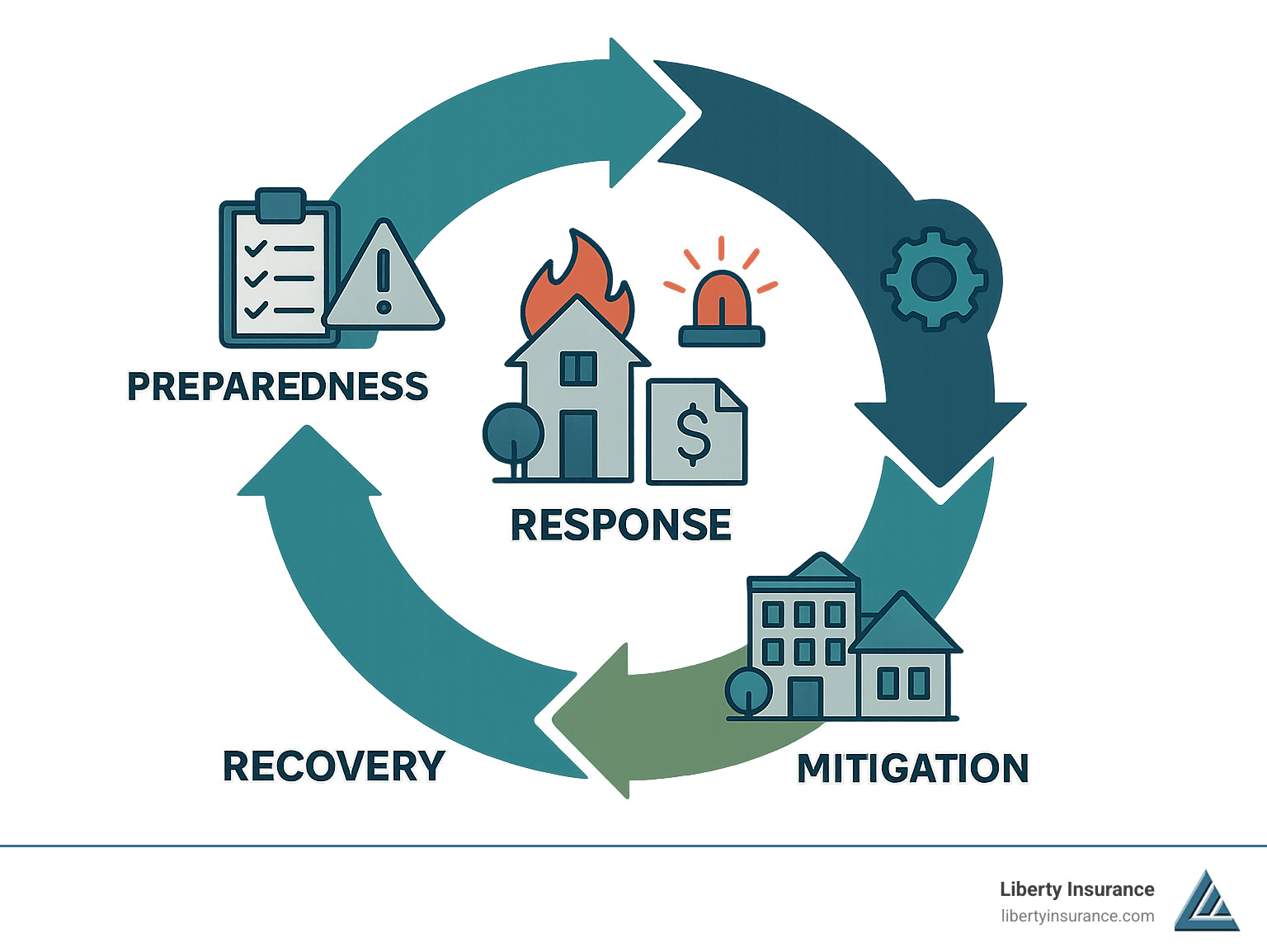
Why Every Small Business Needs a Disaster Recovery Plan (DRP)
Imagine arriving at your office to find it flooded from a burst pipe or destroyed by a fire. This scenario is why every small business needs a Disaster Recovery Plan (DRP)—a detailed roadmap to guide you through the chaos when disaster strikes.
A DRP is a comprehensive strategy that outlines how your business will respond to, recover from, and continue operating during and after an emergency. Whether it’s a natural disaster, cyberattack, or equipment failure, your DRP is your lifeline back to normal operations.

At its core, business continuity is what separates businesses that survive disasters from those that don’t. A solid DRP helps you bounce back faster and stronger than your competition.
Climate change has made extreme weather events like wildfires, floods, and severe storms more frequent and intense across North America. Without a plan, the consequences can be devastating: lost revenue for every day you’re closed, customers who might never return, and a damaged reputation. The good news is that businesses with comprehensive DRPs see improved resilience, faster recovery times, and increased stakeholder confidence. Scientific studies consistently show the benefits of disaster mitigation, proving that preparation pays off.
The Rising Tide of Natural Disasters in North America
The statistics are hard to ignore. In 2023, natural catastrophes caused $3.1 billion in insured losses across Canada, and 2024 was even worse, with insured catastrophic losses reaching $9.1 billion. In Quebec alone, the average cost of insured catastrophic claims has topped $877 million per year over the past five years. These numbers represent thousands of businesses forced to close, some forever.
Wildfires have become particularly devastating, while floods remain the most common natural disaster. Severe storms can destroy inventory and equipment in minutes. The economic impact on small businesses is harsh, as they often lack the resources of large corporations to absorb such losses.
The Unseen Costs of Downtime
Beyond the visible damage, the real threat is often the downtime costs that accumulate while you’re closed. Research shows that downtime can cost large organizations up to $9,000 per minute. While the per-minute cost for small businesses may be lower, the impact is just as devastating due to smaller financial cushions.
Lost revenue is just the beginning. Every day you’re closed, you risk permanent customer churn as clients find alternatives. Supply chain disruption is another major factor; if a key supplier is hit, your operations can grind to a halt. Finally, uncertainty can harm employee morale, leading valuable team members to seek more stable employment.
This is where disaster recovery insurance becomes crucial. The right coverage can replace lost income, cover extra expenses, and provide the financial stability needed to steer the recovery process.
The Digital Disaster: Cyberattacks and Ransomware
In today’s connected world, a disaster doesn’t have to be physical. Cyberattacks, particularly ransomware, represent one of the most significant threats to small businesses. A successful attack can lock you out of your own data, crippling your operations, and demanding a hefty ransom. A DRP is not just for floods and fires; it’s your playbook for responding to a digital siege. It should outline immediate steps to isolate affected systems, protocols for data restoration from clean backups (rendering the ransom demand moot), and communication plans for notifying customers about a potential data breach. Without a DRP, businesses are often forced to pay the ransom with no guarantee of data recovery, facing prolonged downtime and severe reputational damage.
More info about Business Interruption Insurance
Building Your Fortress: Key Components of a Comprehensive DRP
Think of a disaster recovery plan as a fortress protecting your business. A strong DRP has multiple layers of protection working together to keep your business safe and operational when disaster strikes.

A complete DRP includes a risk assessment, a Business Impact Analysis, emergency response procedures, and data backup and recovery strategies. Clear communication protocols, defined roles and responsibilities, and evacuation procedures are also essential. Finally, regular testing and maintenance ensure your plan remains effective.
Step 1: Conduct a Risk and Business Impact Analysis
To protect your business, you must first understand its vulnerabilities. Are you in a flood-prone area? Is your power grid unreliable? Are you a target for cyber threats? Consider your dependencies, such as key suppliers.
Once you’ve identified potential hazards, conduct a Business Impact Analysis to assess the potential costs. How much revenue would you lose per day, week, or month of downtime? What would be the impact on customer relationships? The goal is to prioritize your critical functions—the absolute must-haves that keep your business running—so you can focus your defenses where they matter most.
Common risks to assess: natural disasters, cyber attacks, power outages, equipment failure, supply chain disruptions, human error, public health crises, and civil unrest. Let’s look closer at a few of these:
- Cyber Attacks: Beyond data theft, consider ransomware that locks your systems, or denial-of-service (DoS) attacks that take your website offline.
- Supply Chain Disruptions: Don’t just think about your primary supplier. What if their key supplier has a problem? Map your dependencies several tiers deep to understand the full scope of your risk.
- Human Error: This is one of the most common but overlooked risks. It can range from an employee accidentally deleting a critical file to falling for a phishing scam that compromises your entire network.
Step 2: Establish Recovery Objectives and Data Protection
Next, set two critical targets for your recovery planning.
Your Recovery Time Objective (RTO) defines the maximum acceptable downtime for a critical business function. Be realistic; a faster recovery may cost more, but a slower one could cost you customers.
Your Recovery Point Objective (RPO) addresses data loss by defining how much data you can afford to lose. For a business processing transactions all day, losing an hour of data could be devastating; for others, a day’s worth might be acceptable.
Recovery Point Objectives (RPO)
Data backup strategies are your best defense against data loss. We recommend the 3-2-1 backup rule: keep three copies of your data on two different types of media, with one copy stored off-site.
Cloud-based solutions offer a secure way to protect data in off-site data centers, accessible from anywhere. This allows you to continue operating even if your physical location is compromised. Also, consider off-site storage for backup equipment and important documents. As digital threats grow, your disaster recovery insurance should include cyber protection.
More info about Cyber Risk Insurance
Step 3: Develop Communication and Response Protocols
In a crisis, a clear communication plan is essential for a fast recovery. Your internal communication plan must account for system outages. Have a plan to reach employees if phones or internet are down, such as a phone tree.
External stakeholder communication is equally vital. Customers and suppliers need to know what’s happening. Prepare pre-scripted messages for different scenarios to save time. Designate a calm, clear spokesperson to prevent mixed messages.
Your emergency response procedures should be simple and easy to follow under stress. Evacuation routes must be clearly marked and practiced. Emergency contact lists should be accessible both physically and remotely. Keep emergency supplies like flashlights, radios, and first-aid kits on hand.
Step 4: Test, Train, and Maintain Your Plan
An untested disaster recovery plan is likely to fail. Regular testing and refinement are critical for success.
Tabletop exercises are dress rehearsals. Gather your team to walk through different disaster scenarios, which helps reveal gaps in your plan.
Disaster simulations take testing further. Practice restoring data from backups and test remote work procedures to ensure they function under pressure. To ensure comprehensive readiness, consider a tiered approach to testing:
- Plan Walkthrough: The simplest test, where you and your team read through the plan to check for clarity and obvious errors.
- Tabletop Exercise: As mentioned, this involves discussing a simulated scenario to validate the plan’s procedures without touching any actual systems.
- Full Simulation/Interruption Test: The most thorough test. This involves a live simulation, such as actually failing over to a backup data center or restoring specific services from backups. While disruptive to plan, it’s the only way to be certain your technical recovery strategies work as expected.
Regular employee training ensures everyone knows their role. Make training engaging and relevant. Your DRP needs annual plan reviews at a minimum, and should be updated after any major business changes, such as new equipment, suppliers, or technology. Continuous improvement is key to building a resilient plan.
The Financial Safety Net: The Critical Role of Disaster Recovery Insurance
Even the best Disaster Recovery Plan (DRP) can’t prevent all losses. Disaster recovery insurance is the financial safety net for your DRP, providing the capital to rebuild, replace what’s lost, and get your business back on its feet quickly. Without it, a brilliant DRP can be stalled by overwhelming costs.

The power of insurance in speeding up recovery is remarkable. Studies show that for every percentage point increase in insurance penetration, recovery times can be reduced by nearly 12 months. Countries with strong insurance coverage often recover from disasters in under a year, while those with little coverage may take over four years. This highlights how quickly your business can return to normal with the right protection.
Disaster recovery insurance provides the funds to replace lost income, cover operating expenses, and pay for temporary relocation if needed. It’s the mechanism that ensures your business has the resources to execute its DRP.
For more details on protecting your physical assets, explore our commercial property insurance options.
More info about Commercial Property Insurance
Understanding Your Core Disaster Recovery Insurance Coverage
Disaster recovery insurance is typically a combination of policies that work together to provide comprehensive protection. Here are the core coverages we recommend:
Business Interruption Insurance: This is often the most critical piece. It replaces lost income and covers ongoing operating expenses (like rent and payroll) if your business must close temporarily due to a covered disaster.
Commercial Property Insurance: A specialty at Liberty Insurance, this coverage protects your physical assets, including buildings, equipment, inventory, and furniture. It covers damage from events like fire, theft, and windstorms, helping you rebuild from the ground up.
Extra Expense Coverage: Often paired with business interruption, this covers additional costs to keep operations going after a disaster, such as renting a temporary office or leasing equipment. Its goal is to minimize the length of the business interruption.
Contingent Business Interruption: This important coverage protects you if your business suffers a loss due to a problem with a key supplier or customer. For example, if your main parts manufacturer has a fire, this coverage can soften the financial blow.
Together, these policies create a strong shield against the varied financial impacts of a disaster.
Tailoring Your Policy: Endorsements for Specific Perils
A common mistake is assuming basic commercial property insurance covers everything. Standard policies often have significant exclusions for specific natural disasters, which is why tailoring your policy with endorsements is vital.
For example, damage from floods, tsunamis, or earthquakes is typically not covered by a standard policy. If your business is in an area prone to coastal or riverine flooding, like parts of New Jersey, separate flood insurance is a must.
Flood insurance
Similarly, while earthquakes are not common in our region, they can happen. Earthquake insurance usually needs to be purchased as a separate policy or added as an endorsement.
Other important endorsements to consider include:
- Sewer backup endorsement: Covers damage from water backing up from sewers or drains.
- Overland water coverage: Addresses damage from surface water, like heavy rainfall, flowing into your business.
- Utility Service Interruption: What happens if a storm knocks out power, water, or communication lines for an extended period, forcing you to close even if your property is undamaged? This endorsement can cover lost income and extra expenses resulting from a covered utility outage.
How to Determine the Right Coverage Amount
Choosing the right limit for your Business Interruption insurance is crucial. A common method is to complete a business interruption worksheet, provided by your insurer. This worksheet guides you through calculating your projected gross earnings and profits for the 12 months following the policy’s start date. You’ll need to consider your revenue, cost of goods sold, and continuing operating expenses (like rent, salaries for key employees, and taxes). It’s also vital to select an adequate indemnity period—the maximum length of time the policy will pay out. A standard 12-month period may not be enough for a business that requires specialized equipment or a lengthy rebuild. Work with your broker to realistically assess how long your recovery would take.
Reviewing your policies with an experienced broker is the best way to identify and fill critical coverage gaps before a disaster strikes. We can help you understand what is and isn’t covered.
Navigating the Aftermath: Public Aid vs. Private Insurance
After a disaster, it’s important to understand the difference between government assistance and your private disaster recovery insurance. In the United States, the Federal Emergency Management Agency (FEMA) provides federal aid, and the Small Business Administration (SBA) offers low-interest disaster loans. In Canada, similar programs like the Disaster Financial Assistance Arrangements (DFAA) and Disaster Recovery Assistance for Ontarians (DRAO) exist to help.
Disaster Financial Assistance Arrangements (DFAA) in Canada
Disaster Recovery Assistance for Ontarians (DRAO)
Here’s the crucial point: government programs are designed to supplement, not replace, private insurance. They are a safety net for uninsurable losses. The DRAO program, for example, explicitly states it is not a substitute for insurance, and any insurance payments received are deducted from eligible assistance.
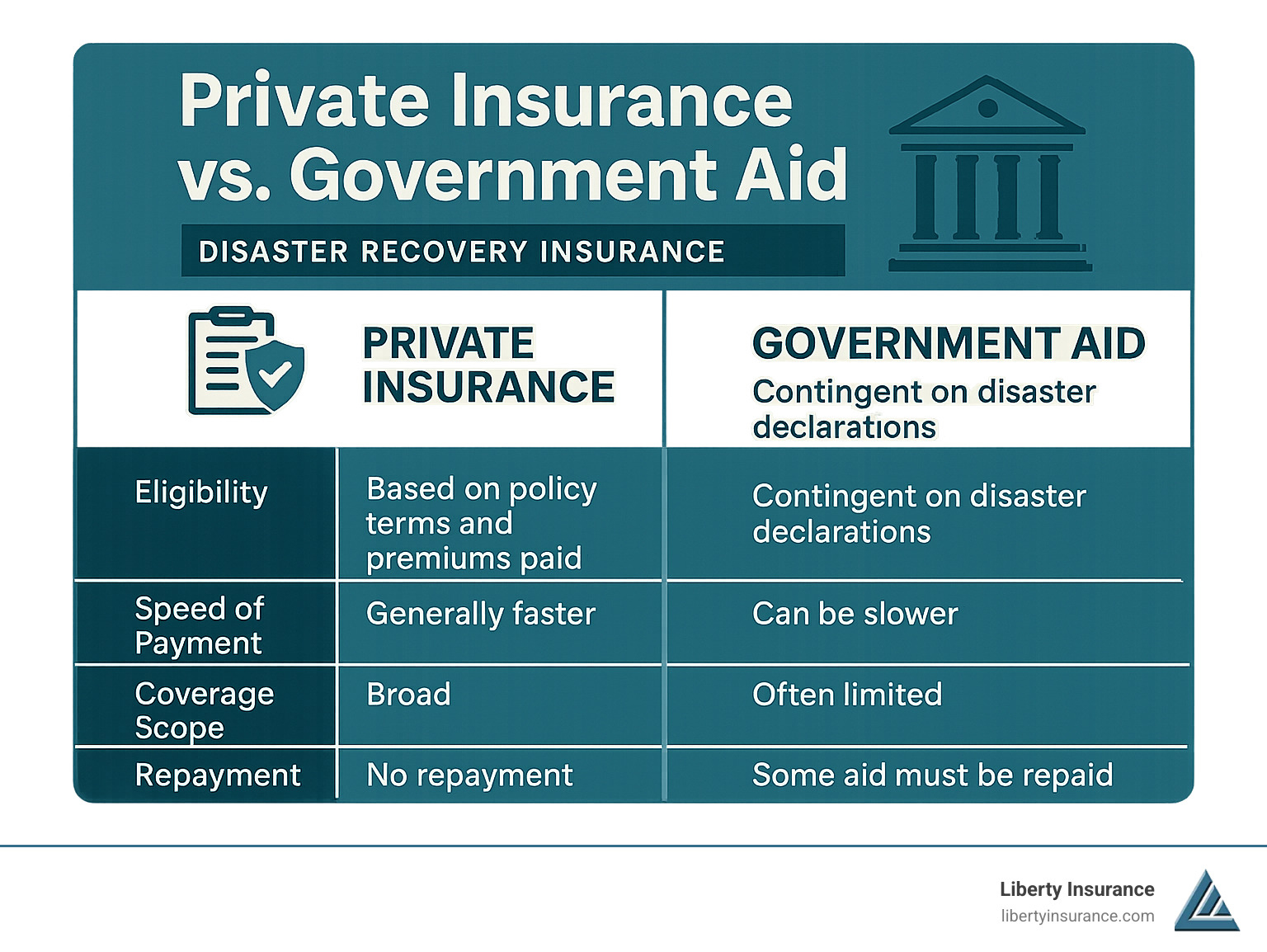
The differences between private insurance and government aid are significant:
Eligibility: Private insurance eligibility is based on your policy terms. Government aid often depends on official disaster declarations and may include means testing.
Speed: Private insurance is generally designed for faster payouts. Government assistance can involve lengthy bureaucratic processes, which is critical when you’re losing money daily.
Coverage Scope: Your disaster recovery insurance provides broad protection as defined in your policy, including vital business interruption coverage. Government aid is often limited to basic needs and uninsurable losses; it won’t replace the revenue you’re losing.
Repayment: Private insurance claims do not require repayment. Some government assistance, particularly low-interest loans, must be repaid over time, adding debt during a difficult recovery.
A sobering reality is that more than half the time, communities hit by floods aren’t declared federal disaster areas, meaning federal aid from FEMA is unavailable. Even when aid is available, it’s often in the form of loans that must be repaid. For example, SBA disaster loans are a critical resource, but they add debt to your balance sheet at a time when your revenue has stopped. Furthermore, government aid is designed to cover basic, uninsurable needs to make a property habitable or a business operational again—it will not compensate you for lost profits or all of your extra expenses.
This is why disaster recovery insurance is your primary line of defense. It provides a more predictable, comprehensive, and faster path to recovery. Government aid is a helpful supplement, but relying on it as your main strategy leaves your business vulnerable.
Frequently Asked Questions about Disaster Recovery
Business owners often ask similar questions when preparing for unexpected events. Here are answers to some of the most common ones.
What’s the difference between a Disaster Recovery Plan (DRP) and a Business Continuity Plan (BCP)?
There is an important distinction between these two plans.
A Disaster Recovery Plan (DRP) focuses specifically on restoring your IT infrastructure and data after a disruptive event. Its primary goal is to get your technical systems back online as quickly as possible to minimize data loss and downtime.
A Business Continuity Plan (BCP) is a broader, more holistic strategy. It encompasses the entire business—people, processes, suppliers, and technology—to ensure essential functions can continue during and after a disaster. A DRP is a critical component of an overall BCP.
Does my basic commercial property insurance cover all natural disasters?
No, a basic commercial property insurance policy does not cover all natural disasters. While it typically covers common perils like fire, wind, tornadoes, and hail, there are significant exclusions. Most standard policies do not cover damage from floods, earthquakes, landslides, or sewer back-up.
This is why it’s crucial to review your policy and purchase specific endorsements or separate policies for risks like flood or earthquake, especially if your business is in a vulnerable area. Don’t assume you’re covered.
How often should I test my disaster recovery plan?
Your DRP should be tested at least annually to ensure it is effective. A plan that isn’t practiced is unlikely to work in a real crisis.
In addition to annual testing, you should review and re-test your plan under the following circumstances:
- After major business changes: This includes new locations, new equipment, or changes to core services.
- After technology updates: New software, hardware, or cloud services require updates to your DRP.
- After significant personnel changes: New team members must be trained, and roles may shift.
- After any real-world incident: Even a minor disruption provides valuable lessons for improving your plan.
Regular testing identifies weaknesses, ensures your team is prepared, and builds confidence in your ability to recover smoothly and effectively.
How much does disaster recovery insurance cost?
The cost of disaster recovery insurance isn’t a single price; it’s a blend of the premiums for the different policies that make up your coverage, such as commercial property and business interruption insurance. The final cost depends on several factors:
- Industry and Risk Level: A restaurant with a high risk of fire will pay more than a home-based consulting business.
- Location: Businesses in areas prone to floods, hurricanes, or wildfires will face higher premiums for that specific peril coverage.
- Coverage Limits and Deductibles: Higher coverage limits and lower deductibles will increase your premium.
- Business Revenue: The amount of income you need to replace under a business interruption policy directly impacts its cost.
- Claims History: A business with a history of frequent claims will be seen as higher risk.
While it’s an added expense, the cost of insurance is a fraction of the potential cost of a single uninsured disaster. An independent insurance broker can help you get quotes from multiple carriers to find the most competitive and comprehensive coverage for your budget.
Conclusion: Building a Resilient Future for Your Business
Navigating the complexities of business in today’s unpredictable world requires more than just ambition; it demands foresight and preparation. We’ve explored the critical importance of a robust Disaster Recovery Plan (DRP), from understanding the rising tide of natural catastrophes to mitigating the unseen costs of downtime. We’ve also highlighted the essential components of building your business fortress, from risk assessment and data protection to communication and continuous testing.
But perhaps the most crucial takeaway is the indispensable role of disaster recovery insurance. It’s not just a piece of paper; it’s your financial lifeline, ensuring that when the unexpected happens, you have the capital to rebuild, recover, and continue serving your customers. While government aid can offer supplemental support, private insurance remains your primary and most reliable path to a swift and comprehensive recovery.
The path to resilience is an ongoing journey, not a destination. It involves proactive planning, comprehensive insurance coverage, and a commitment to regularly review and adapt your strategies. Taking that first step today can mean the difference between a temporary setback and a devastating loss for your business.
At Liberty Insurance, we understand the unique challenges faced by businesses in places like Millstone Township NJ, Trenton NJ, Toms River NJ, New Brunswick NJ, and Princeton NJ. We are dedicated to providing customizable commercial property insurance solutions that safeguard your physical assets and help you build a resilient future. We’re here to help you protect what you’ve built and ensure you can rebound stronger than ever.

Ready to secure your business’s future? Let us help you steer the complexities of disaster recovery insurance and develop a plan custom to your needs.

