
Why Caterers Face Serious Financial Risk When Serving Alcohol
Do caterers need liquor liability insurance? Yes, absolutely. Here’s what every catering business owner needs to know:
Quick Answer:
- Legal requirement: 43 states have dram shop laws holding caterers liable for alcohol-related incidents
- Venue requirement: Most event venues require proof of liquor liability coverage before allowing alcohol service
- Financial protection: Claims can reach millions of dollars
- Coverage starts: As low as $550 per year or $35.42 per month for basic protection
The catering industry has exploded in recent years, with more businesses offering full-service events that include alcohol. But serving cocktails without proper coverage could literally bankrupt your business overnight.
When you serve alcohol at weddings, corporate events, or private parties, you’re not just responsible for food safety – you’re also liable if an intoxicated guest causes injury or property damage. Even if you think you’re covered under general liability insurance, alcohol-related claims are specifically excluded from standard policies.
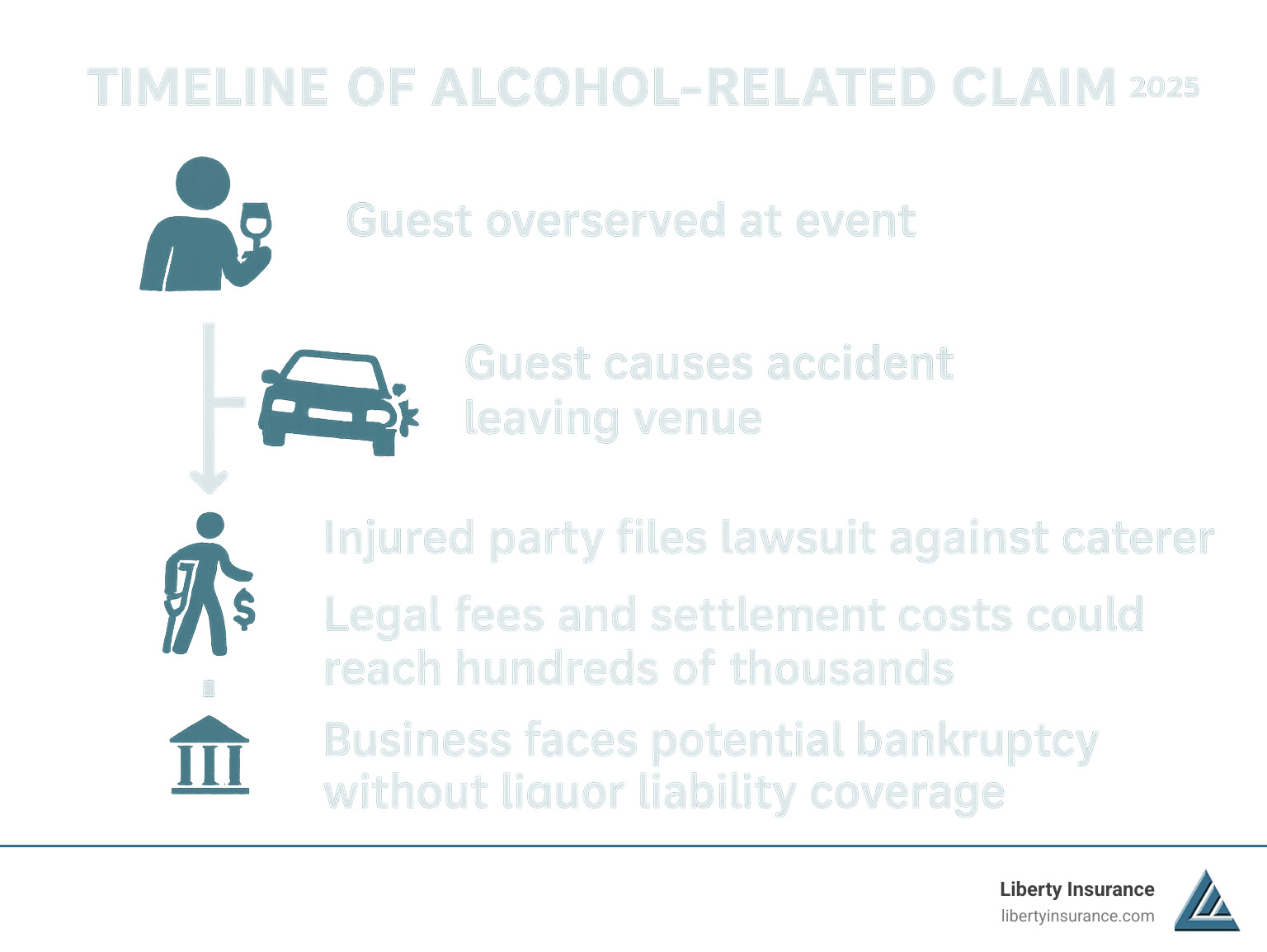
The stakes are incredibly high. A single incident involving an overserved guest could result in:
- DUI accidents with serious injuries
- Property damage at expensive venues
- Assault and battery claims
- Legal fees that drain your business savings
Do caterers need liquor liability insurance terms you need:
- bartender liability insurance
- what does liquor liability insurance cover
- event liquor liability insurance
Understanding Liquor Liability vs. General Liability
Here’s the biggest mistake I see caterers make: assuming their general liability insurance covers everything. It absolutely doesn’t – and this gap could destroy your business overnight.
General liability insurance covers everyday catering mishaps – a guest slips on your floor, your server knocks over an expensive vase, or someone gets food poisoning. These are normal business risks.
But liquor liability insurance (also called dram shop insurance) covers completely different risks. This protects you when an intoxicated guest causes problems after you’ve served them alcohol. General liability policies specifically exclude alcohol-related claims.
The negligence standard in these cases often focuses on overservice to visibly drunk guests and underage drinking. Courts look at whether you should have known better – did the guest slur their words? Were they stumbling?
I’ve watched caterers learn this lesson the hard way. One client assumed their general liability would cover an incident where an overserved wedding guest caused a three-car pileup. The insurance company denied the claim instantly because it involved alcohol service. The caterer faced a $400,000 lawsuit with zero coverage.
That’s exactly why you need both policies working together – Liquor Liability Insurance for alcohol-related incidents, and general liability for everything else.
How Liquor Liability Works for Caterers
When someone gets hurt because of your intoxicated customer, liquor liability insurance steps in as your financial shield. The coverage works on a third-party basis – protecting you from claims brought by people harmed by guests you served.
Third-party injury claims are often the most expensive. Picture this: a wedding guest you overserved gets into a bar fight and seriously injures another person. Your policy covers the victim’s medical bills, lost wages, and pain and suffering damages.
Property damage coverage handles expensive items your intoxicated guests break or destroy. Legal defense might be the most valuable part – even if you win a lawsuit, defense costs can drain your business savings.
Most venue contracts now require proof of liquor liability coverage before you can serve alcohol on their property.
Do Caterers Need Liquor Liability Insurance?

Picture this: You’re catering a beautiful wedding reception, and the champagne is flowing as guests celebrate. Everyone’s having a wonderful time – until one overserved guest gets behind the wheel and causes a serious accident. Suddenly, you’re facing a lawsuit that could wipe out everything you’ve built.
Do caterers need liquor liability insurance? Absolutely, and here’s why this coverage isn’t optional – it’s essential for your business survival.
The legal landscape is crystal clear. Forty-two states have dram shop laws that hold caterers financially responsible when intoxicated customers cause harm to others. This means if you serve alcohol to someone who later injures another person or damages property, you could be on the hook for massive damages.
The financial exposure is genuinely frightening. We’ve witnessed liquor liability claims start at a few thousand dollars for minor incidents and skyrocket to multi-million dollar settlements for serious injuries.
But it’s not just about state laws. Most event venues now refuse to allow alcohol service unless you can provide proof of liquor liability coverage. These venues protect themselves by requiring you to have proper insurance.
Many states won’t even issue you a liquor license or temporary alcohol permit without proof of coverage. Without these permits, you’re legally prohibited from serving alcohol at events.
State Laws & Venue Requirements
The honest answer to “do caterers need liquor liability insurance” depends partly on where you operate, but coverage has become practically universal due to venue requirements and industry standards.
Dram shop laws create a patchwork of liability across the United States. Some states operate under strict liability standards – you’re responsible for any harm caused by customers you served, period. Others follow a negligence-based approach, where you’re only liable if you were clearly negligent.
Only seven states have limited or no dram shop liability, but don’t let that fool you. Federal courts can apply other states’ laws in multi-state incidents, and venue contracts typically require coverage regardless of local laws.
Minimum coverage limits range from $100,000 in some states to $1 million or more in others. However, we typically recommend higher limits regardless of state requirements.
Additional insured clauses have become standard practice. This means your policy must specifically name the event venue as an additional insured party, extending your coverage to protect them from alcohol-related claims.
Risks & Real-World Claims
The Wedding That Turned Into a Nightmare: A wedding caterer kept serving champagne to a clearly intoxicated guest. The guest left the reception, got behind the wheel, and caused a three-car pileup. The resulting lawsuit sought $1.2 million in damages. Without liquor liability coverage, this caterer would have lost everything.
Corporate Events Gone Wrong: At a company holiday party, two overserved executives got into a physical altercation. The caterer’s liquor liability policy covered the $75,000 settlement and legal defense costs.

Business closure risk represents perhaps the most heartbreaking consequence. Small catering businesses that operate without proper coverage often can’t survive even a single major claim.
Coverage Details, Costs & Savings
When caterers ask “do caterers need liquor liability insurance,” the cost question usually follows. The great news? Protection is surprisingly affordable – often costing less than what you’d spend on coffee in a month.
Liquor liability insurance uses two key limits. The per occurrence limit covers individual incidents. The aggregate limit is your total protection for the entire policy year. Most caterers choose combinations like $1 million per occurrence with $2 million aggregate.
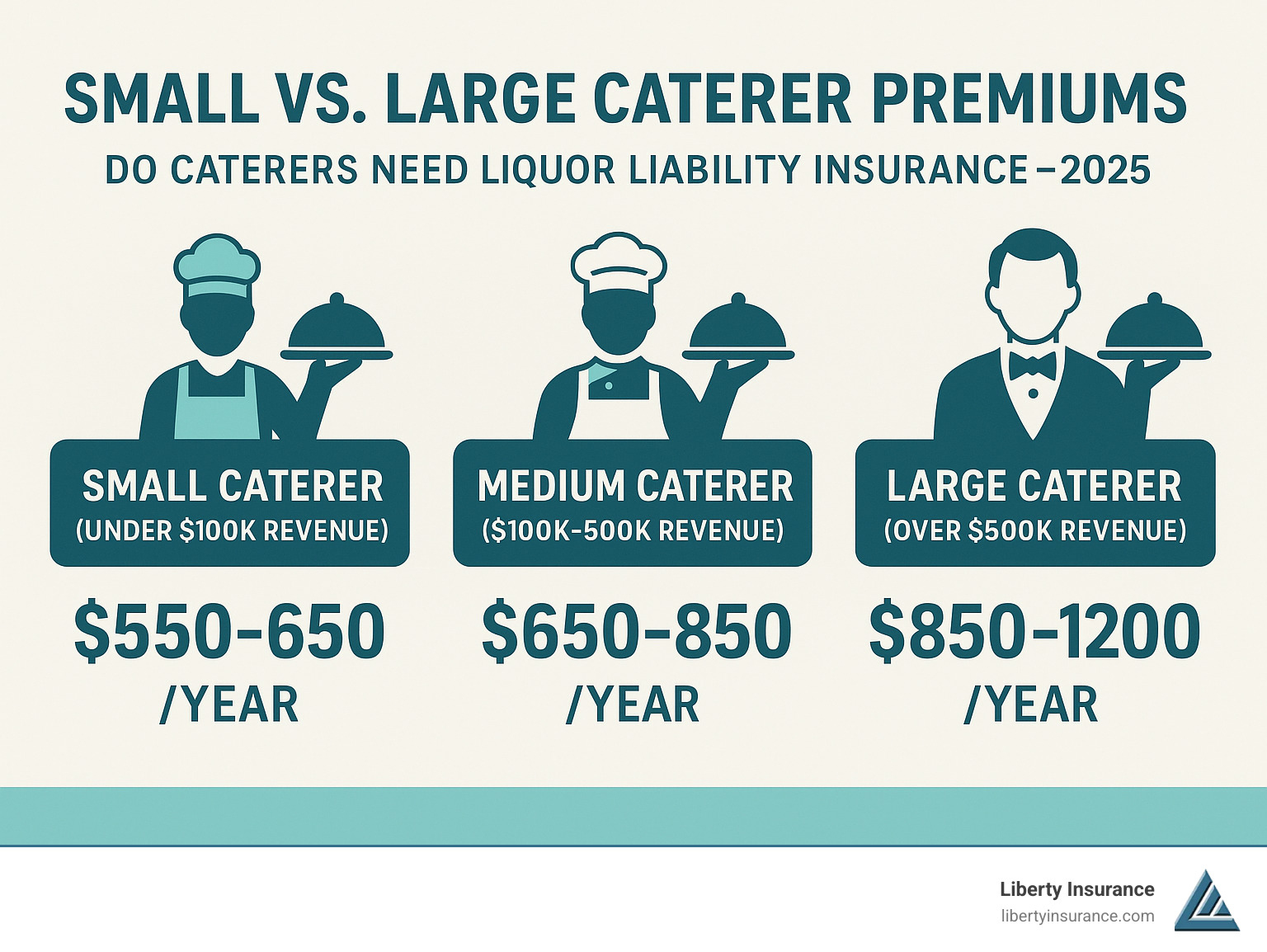
Here’s what you’ll actually pay: Our Liberty Insurance clients typically see premiums ranging from $550 to $1,000 annually for solid basic coverage. The sweet spot? About $65 per month – roughly $780 per year for protection that could save your entire business.
Several factors influence what you’ll pay. Your alcohol sales percentage makes a huge difference – caterers earning 40% of revenue from booze pay more than those with just 10% alcohol sales. Your claims history is like your driving record for insurance. Where you operate matters too – some states see more liquor liability lawsuits.
Annual policies make sense if you’re regularly serving alcohol. Event-specific policies start around $275 for 1-3 days and work great for occasional alcohol service.
What’s Covered (Bodily Injury, Property Damage, Legal Fees)
Bodily injury coverage handles medical bills, rehabilitation costs, lost wages, and pain and suffering damages when intoxicated guests hurt others. These claims can easily reach six figures for serious injuries.
Property damage coverage kicks in when drunk guests break things – backing into venue fountains, crashing into cars, or driving through fences. Your policy covers repair costs and replacement expenses.
Legal defense costs might be the most valuable part, paid in addition to your policy limits. Your insurance company provides experienced attorneys and handles all legal expenses. Even winning cases can cost $50,000+ in legal fees.
Settlement payouts come into play when it makes more financial sense to settle than fight. Insurance companies have skilled negotiators who can often resolve claims for much less than jury awards.
Premium Ranges & Cost Factors
Annual policies offer the best value for regular alcohol service. Small operations typically pay $550-650 yearly, while larger businesses see $850-1,200 depending on risk factors.
Event policies starting at $275 for 1-3 days work perfectly for occasional alcohol service.
Add-on pricing is reasonable. Assault and battery coverage adds $50-100 annually. Equipment coverage runs $100-200. Multi-policy discounts often save 10-15% when bundling with other insurance.
Ready to see what coverage costs for your situation? Get a Quote
Ways to Lower Your Liquor Liability Exposure
TIPS training for staff often qualifies for premium discounts. Strict ID checking policies prevent underage drinking incidents. Stop-service protocols are critical – staff must recognize intoxication signs and refuse service professionally.
Scientific research on signs of intoxication shows clear warning signs: slurred speech, loss of coordination, aggressive behavior, bloodshot eyes, and strong alcohol odor.
Water stations throughout events encourage hydration. Incident documentation creates valuable protection if claims arise later. These strategies work together to prevent incidents and potentially lower premiums.
Proving & Verifying Coverage at Events
Having liquor liability insurance is only half the battle – you also need to prove you have it when venues and event planners ask.
Certificate of Insurance (COI) basics: Think of a COI as your insurance “report card” showing venues exactly what coverage you have. Your certificate should clearly display your policy number and insurance company name, coverage limits, policy effective dates, and additional insured parties if required.
Additional insured requirements have become standard in venue contracts. When venues ask to be added as additional insured, they’re asking your insurance to protect them too if something goes wrong with alcohol service.
Policy number verification is where things get tricky. Some venues call your insurance company to confirm your policy is active. Expiry date monitoring is crucial – expired COIs can literally shut down your event.
Certificates of Insurance & Additional Insureds
24/7 dashboard access is a game-changer for busy caterers. With Liberty Insurance, you can generate certificates anytime, even at midnight on Sunday if a venue needs it Monday morning.
Unlimited COI generation saves money and headaches. Some insurers charge fees for additional certificates, but we provide unlimited generation at no extra cost.
Additional insured endorsement wording needs to be precise. The certificate should clearly state that the venue is covered for liability arising from your alcohol service operations.
Digital delivery options speed up the process. Certificates can be emailed directly to venues, eliminating postal delays.
Bundling Liquor Liability with Other Policies
Smart caterers combine liquor liability insurance with other business coverage for both financial savings and simplified management.
General liability combination is the most popular bundle, providing comprehensive protection while often reducing total premiums. Discounted premium benefits typically range from 10-15% off individual policy premiums.
Simplified claims management becomes invaluable when incidents involve multiple coverage types. Single renewal dates eliminate confusion of managing multiple policy expiration dates.
For comprehensive coverage options, explore our General and Liquor Liability Insurance bundle.
Frequently Asked Questions about Caterers & Liquor Liability
Do caterers need liquor liability insurance if alcohol is BYOB?
Do caterers need liquor liability insurance even when guests bring their own bottles? In most cases, yes.
Even with BYOB events, social host liability laws don’t always let you off the hook. If you’re facilitating service – providing ice, mixers, or having staff open bottles and serve drinks – you could still be held responsible when things go wrong.
Many venues that allow BYOB still require proof of liquor liability coverage because risks don’t disappear just because alcohol came from elsewhere. Given how affordable coverage is – often under $100 per month – it’s not worth the risk to go without it.
What’s the difference between host liquor liability and a caterer’s liquor liability policy?
Host liquor liability covers small, incidental alcohol situations where you’re not making money from booze – like providing wine at client appreciation dinners. It’s usually an add-on to general liability with low limits like $25,000-$100,000.
A caterer’s liquor liability policy is standalone coverage for businesses that regularly serve alcohol. Coverage limits start at $1 million because risks are much higher when alcohol service is part of your business model.
The profit motive separates these worlds. If you’re charging for drinks or building alcohol costs into pricing, you need the commercial policy. Host liquor liability won’t protect commercial operations.
How can an event planner confirm a caterer’s coverage limits?
Start by requesting a current certificate of insurance showing liquor liability coverage specifically. Don’t accept vague certificates listing only general liability.
Verify everything directly with the insurance carrier. Fraudulent certificates are becoming more common, and a quick phone call can save you from nasty surprises.
Make sure your venue is listed as an additional insured on the caterer’s policy. Establish minimum coverage requirements upfront – we typically recommend at least $1 million per occurrence and $2 million aggregate.
Conclusion
Do caterers need liquor liability insurance? After everything we’ve covered, the answer couldn’t be clearer: absolutely, without question. The risks are real, the costs can be devastating, and the protection is surprisingly affordable.
Here’s what we’ve learned: 43 states have dram shop laws that can make you personally responsible when things go wrong. We’ve seen claims reach into the millions, turning successful catering businesses into bankruptcy cases overnight. But comprehensive coverage starts at just $550 per year.
The landscape has changed dramatically. Venues aren’t just asking for proof of liquor liability insurance anymore – they’re demanding it. Event planners won’t consider caterers who can’t provide proper certificates. The question isn’t whether you can afford coverage, it’s whether you can afford to operate without it.
Your catering business represents years of hard work and dreams turned into reality. Every wedding you’ve made perfect, every corporate event that went smoothly, every satisfied client – all of that can disappear after one alcohol-related incident.
The peace of mind that comes with proper liquor liability coverage is transformative. You can focus on creating magical moments your clients remember forever, knowing your business is protected.

Ready to protect what you’ve built? Liberty Insurance makes getting coverage simple and straightforward. Our team understands the catering industry inside and out, and we’re here to help you find the right protection at a price that makes sense for your business.
Don’t wait another day. Explore our Liquor Liability Policy options right now. Your business deserves protection, and your family deserves the security that comes with knowing you’re covered.
The bottom line? Serving cocktails without coverage is like playing Russian roulette with your business. Why take that risk when protection is so affordable and peace of mind is priceless?

