
Why Understanding Excess Liability Insurance Protects Your Business
Excess coverage insurance is additional liability protection that kicks in when a claim exceeds the limits of your primary insurance policy. It acts as a safety net, covering costs that would otherwise come directly out of your business assets.
Quick Definition:
- What it is: A secondary insurance policy that provides coverage above your primary policy limits.
- When it activates: After your primary insurance reaches its maximum payout on a covered claim.
- What it protects: Your business assets and financial stability from catastrophic claims.
- How it differs from umbrella insurance: Excess coverage typically extends one specific primary policy, while umbrella insurance can cover multiple policies and may fill coverage gaps.
Imagine your company vehicle causes an accident resulting in $2 million in damages, but your commercial auto insurance only covers up to $1 million. Without excess coverage, your business would be responsible for the remaining $1 million—a sum that could lead to bankruptcy or asset seizure.
The reality is sobering: settlement amounts for serious accidents regularly reach into the millions. A distracted driving incident can result in a $5 million settlement, and a fire that spreads from your business can trigger similar multi-million dollar claims. Your primary insurance policies were never designed to handle these catastrophic scenarios alone. They provide essential protection for everyday risks, but their limits can be exhausted quickly when disaster strikes.
I’m Andrew Harris, a Certified Insurance Counselor. I’ve helped businesses across New Jersey structure excess coverage solutions to protect against devastating financial losses. I’ve seen how the right excess liability policy can mean the difference between a business surviving a catastrophic claim and closing its doors permanently.
What is Excess Coverage Insurance and How Does It Work?
What happens when a claim exceeds your primary insurance limits? Your Commercial General Insurance and Commercial Auto Insurance policies are your first line of defense, but every policy has a maximum payout limit.
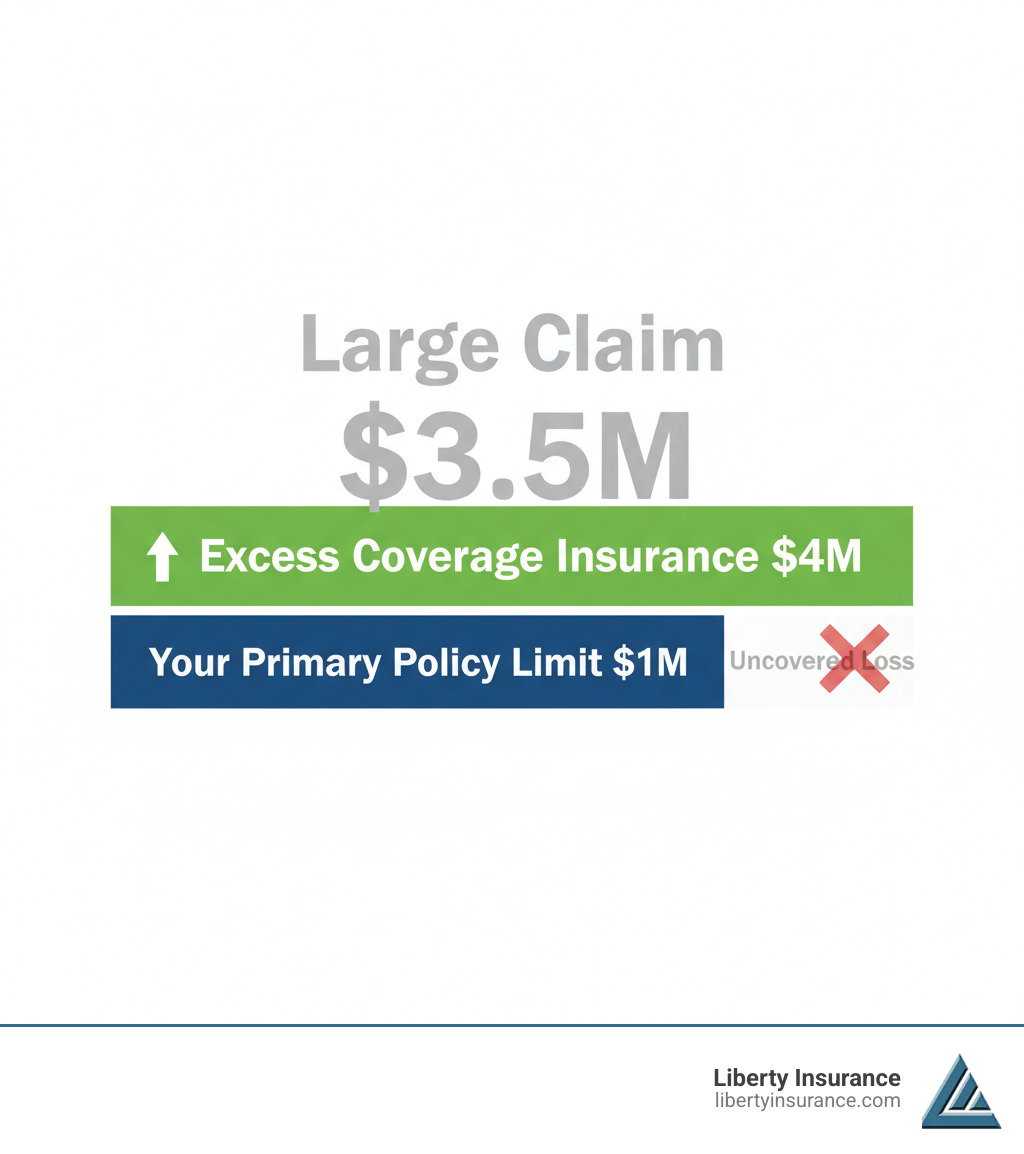
Excess coverage insurance is the safety net that catches you when those limits aren’t enough. It’s a backup policy that sits quietly in the background, ready to activate only when a large claim exhausts your primary coverage. For example, if your $1 million commercial auto policy faces a $2.5 million claim, your primary policy pays its full $1 million. Your excess coverage then kicks in to cover the remaining $1.5 million. Without it, your business would be on the hook for that amount, potentially leading to bankruptcy.
A key feature is that excess coverage typically “follows form,” meaning it adopts the same terms and conditions as your primary policy. This simplifies the process by extending the protection you already have to a higher limit.
The Trigger: When Does Excess Liability Insurance Kick In?
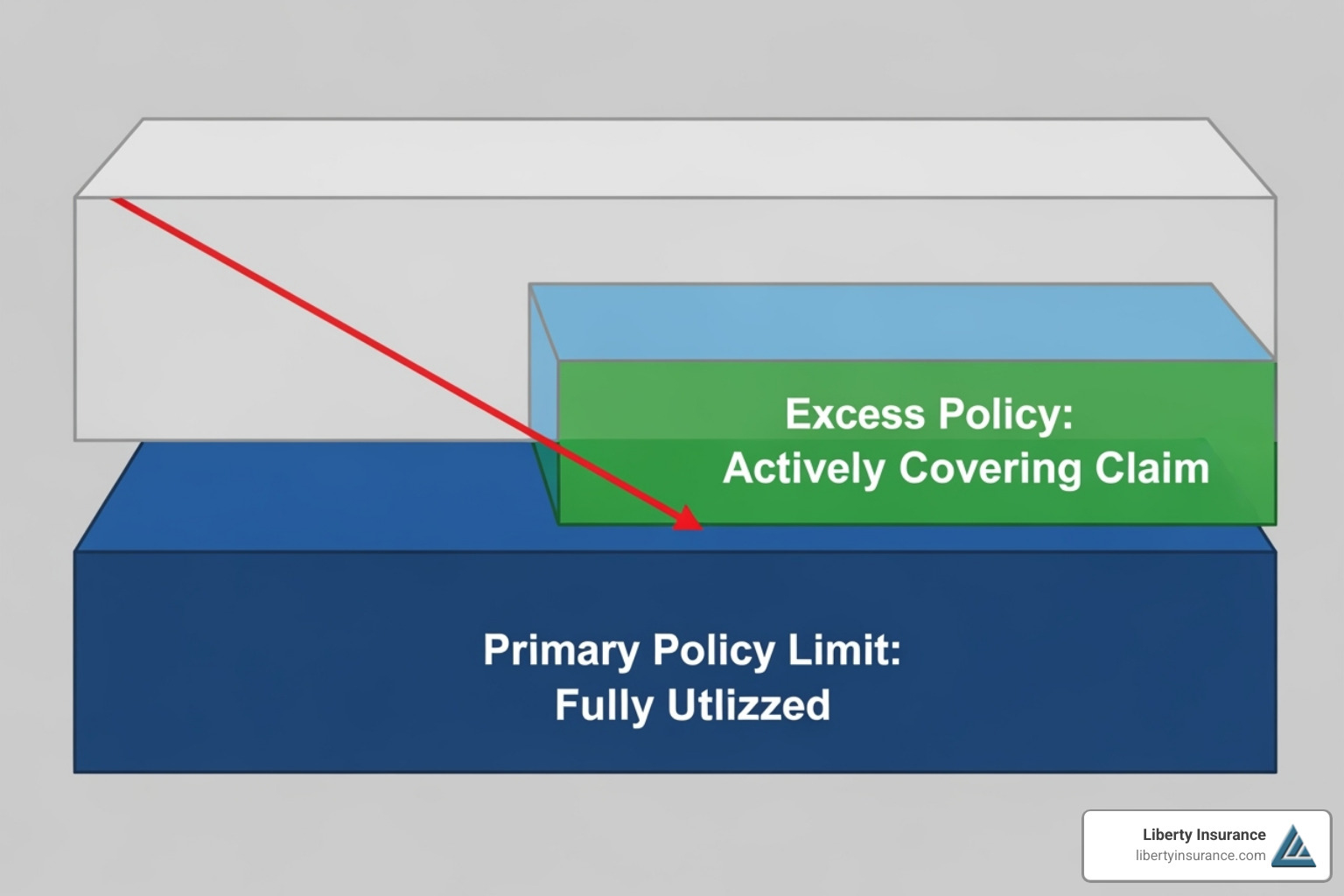
Your excess coverage activates when your primary policy limits are exhausted. This can happen in two ways:
- Per-Occurrence Limit Exhaustion: A single, catastrophic incident causes damages that exceed your primary policy’s maximum payout for one claim. The $2.5 million accident mentioned earlier is a perfect example. The primary $1 million limit is exhausted by one event, triggering the excess policy.
- Aggregate Limit Exhaustion: Your primary policy has a total cap on what it will pay out during the policy period, regardless of the number of claims. If several smaller claims throughout the year add up and hit this aggregate limit, your excess policy will cover any subsequent claims in that period.
When activated, your excess policy covers both defense costs (legal fees) and indemnity payments (the settlement or judgment). This comprehensive protection is what shields your business from financial ruin in the face of multi-million dollar claims.
The Foundation: Primary Policies You Can Extend
Excess coverage builds on top of your existing primary liability policies. You can’t add the upper floors without a solid foundation. Common primary policies to extend include:
- Commercial General Liability (CGL): Your core coverage for bodily injury or property damage claims on your premises or due to your operations.
- Commercial Auto Liability: Essential for any business using vehicles, protecting against accidents that can result in multi-million dollar claims, especially with the rising number of uninsured drivers.
- Employer’s Liability: Part of your Workers’ Compensation policy, this protects you if an employee sues for a work-related injury outside the standard workers’ comp system.
- Professional Liability (E&O): Protects service-based businesses from claims of negligence, errors, or bad advice that cause a client financial harm.
- Directors & Officers (D&O) Liability: Shields the personal assets of your company’s leadership from lawsuits alleging wrongful acts in managing the company.
Our Liability Insurance New Jersey Guide offers more detail for businesses in Millstone Township, Trenton, and other local areas. Extending these policies with excess coverage builds the layers of protection needed to withstand catastrophic claims.
Excess Liability vs. Umbrella Insurance: A Critical Distinction
Many business owners use “excess liability” and “umbrella insurance” interchangeably, but they are not the same. While both provide additional liability protection, understanding the difference in their scope and nature is crucial for securing the right coverage.
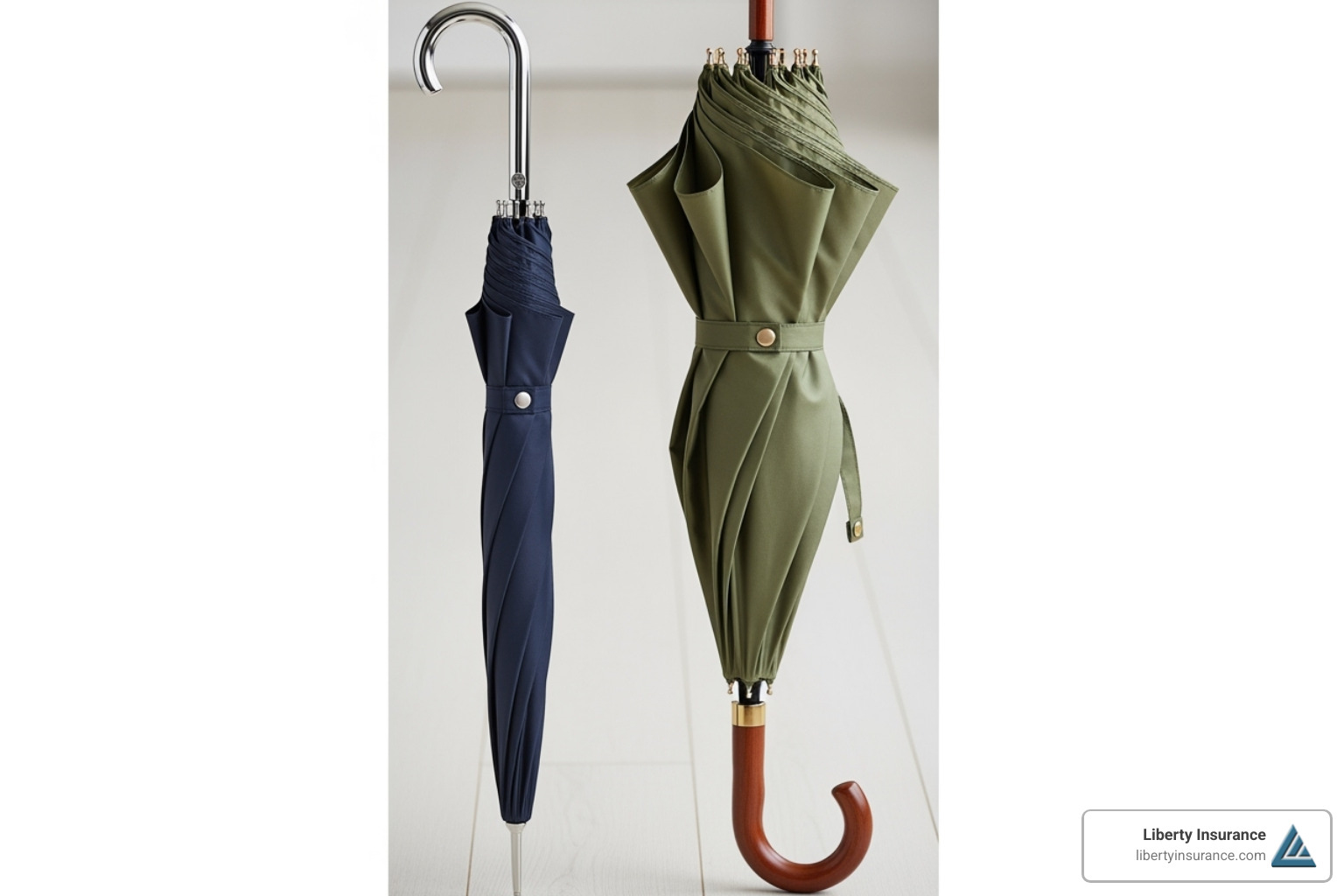
Think of it this way: excess coverage insurance adds more height to one specific wall of your financial fortress. It’s targeted. Umbrella insurance adds height to multiple walls and may even build a roof over some previously exposed areas. It’s broader.
Understanding “Follow Form” Excess Coverage Insurance
The defining feature of excess coverage insurance is that it “follows form.” This means it adopts the exact same terms, conditions, and exclusions of the single, specific primary policy it extends. If your commercial auto policy covers a certain claim up to $1 million, a “follow form” excess policy simply adds more money—say, another $4 million—for that exact same type of claim. Its sole purpose is to increase the financial limit for a specific, identified risk, which makes claims processing straightforward once the primary limit is paid.
Understanding Umbrella Insurance
Umbrella insurance is broader. A single umbrella policy can extend the limits of multiple primary policies at once, such as your general liability, commercial auto, and employer’s liability. More importantly, an umbrella policy may also fill certain gaps by covering claims that your primary policies don’t, like libel or slander. This “gap-filling” capability is a key differentiator.
When an umbrella policy covers a claim not addressed by an underlying policy, you typically first pay a Self-Insured Retention (SIR), which acts like a deductible. Because it offers broader protection and has its own terms, it doesn’t strictly “follow form” like an excess policy. For more on this, our Umbrella Liability Insurance guide offers a detailed look.
Here’s a quick comparison:
| Feature | Excess Liability Insurance | Umbrella Insurance |
|---|---|---|
| Number of Policies Covered | One primary policy. | Multiple primary policies. |
| Coverage Scope | Extends the limits of the specific primary policy. | Extends limits of multiple primary policies and potentially fills coverage gaps. |
| Terms & Conditions | “Follows form”—identical to the primary policy. | Has its own terms, conditions, and exclusions, which may differ from primary policies. |
| Gap Filling | No. Only provides additional capacity for existing coverage. | Yes. Can provide coverage for claims not covered by primary policies (subject to SIR). |
Understanding these nuances helps us craft the most effective coverage strategy for your New Jersey business.
Who Needs This Extra Layer of Protection?
Many business owners assume excess coverage insurance is only for massive corporations. The truth is, businesses of all sizesfrom a small contractor in Toms River to a growing firm in Princetoncan face a catastrophic claim that financially cripples them. The question isn’t just “Am I insured?” but “Is my insurance enough to save my business?”
Many larger clients also require their vendors to carry liability limits that exceed standard primary policies. Having adequate excess coverage might not be optional; it could be the price of admission for bidding on major contracts. A comprehensive Business Insurance portfolio that includes this layer protects everything you’ve worked to build. Our Insurance for Business Owners guide explores this philosophy in more depth.
High-Risk Businesses and Professionals
Some industries face higher liability exposures due to the nature of their work. For these businesses, excess coverage insurance is essential.
- Construction: Heavy equipment and complex projects create constant risk of serious injury or property damage.
- Manufacturing: A single defective product can lead to widespread harm and numerous liability claims.
- Transportation and Trucking: A serious commercial vehicle accident can result in catastrophic injuries and multi-million dollar settlements.
- Healthcare Providers: Constant exposure to malpractice claims where a single error can trigger an enormous lawsuit.
- Lawyers and Legal Firms: Professional liability is a major concern, as a mistake in a high-value transaction can easily exhaust primary coverage, as noted by legal risk management resources such as the ABA Lawyers’ Professional Liability Committee.
- Hospitality and Real Estate: Businesses serving the public or managing properties face daily exposure to patron injuries, liquor liability, and tenant claims.
Specific Risks That Demand Higher Limits
Beyond your industry, certain types of events are prone to generating claims that blow past primary limits.
- Severe Bodily Injury: Catastrophic injuries can lead to millions in medical bills, lost wages, and pain and suffering damages.
- Major Property Damage: A fire that spreads to neighboring businesses or a faulty product that damages expensive infrastructure can trigger claims far exceeding a typical Commercial Property Insurance liability sub-limit.
- Product Liability: A single design flaw can affect thousands of users, leading to class-action lawsuits with massive settlements.
- Professional Malpractice: Errors by accountants, architects, or consultants can cause significant financial losses for clients, resulting in huge claims.
- Fleet Vehicle Accidents: A single serious accident involving multiple injuries can quickly exhaust a commercial auto policy, a risk amplified by the number of uninsured drivers on the road.
Our General Liability Insurance Small Business guide covers foundational protection, but businesses in New Jersey need to build upon it. Excess coverage provides that critical next layer.
Benefits, Costs, and Customization of Excess Coverage Insurance
Investing in excess coverage insurance isn’t just another expense—it’s an investment in your business’s survival. The value goes beyond a bigger policy number; it’s about the confidence to grow your business without fearing that one catastrophic event will erase everything you’ve built.

The Key Benefits of Securing Higher Limits
In practical terms, excess coverage insurance is your financial lifeline when a catastrophic claim hits. It delivers several key benefits:
- Protects Your Assets: It creates a barrier between a massive judgment and your business assets (equipment, property, inventory). Without it, courts can order the seizure and sale of everything you own.
- Prevents Bankruptcy: A multi-million dollar shortfall can force even a long-standing business to close its doors. Excess coverage can literally save your company from extinction.
- Opens Up Bigger Opportunities: Many corporate and government contracts require liability limits of $5 million or more. Excess coverage makes you eligible to compete for these larger projects.
- Ensures Business Continuity: With robust coverage, you can focus on managing a crisis and keeping your operations running, rather than worrying if you can afford the judgment.
- Covers Catastrophic Judgments: With settlements for events like distracted driving or fires reaching $5 million or more, excess coverage ensures you can meet these demands without liquidating your company.
How is the Cost of an Excess Coverage Insurance Policy Determined?
Premiums for excess coverage insurance are based on your specific risk profile. Insurers look at several concrete factors:
- Underlying Policy Limits: Higher primary limits can sometimes lower your excess premium, as you are retaining more of the initial risk.
- Industry and Risk Profile: A construction company faces different risks and costs than an accounting firm. High-risk industries naturally command higher premiums.
- Claims History: A clean record (often called “loss runs”) demonstrates good risk management and can lead to more favorable pricing. A history of frequent or severe claims will increase costs significantly.
- Desired Excess Limit: Higher limits cost more, but the price doesn’t increase proportionally. The first million dollars of excess coverage is typically the most expensive; each additional million costs progressively less.
- Company Size and Revenue: Larger operations have greater exposure due to more employees, customers, and assets, which is reflected in the premium.
- Location: Local legal environments and claim trends in New Jersey can influence pricing. Areas known for high jury awards (sometimes called “judicial hellholes”) can lead to higher premiums.
Despite the myths, the cost is often a small fraction of what an uninsured catastrophic claim would be, a point highlighted by industry education sources like the Insurance Information Institute.
Can Policies Be Customized?
Absolutely. Cookie-cutter solutions don’t work, which is why customization is key. We don’t just pull a number out of thin air; we work with you to determine the right limits for your specific situation by assessing your assets, revenue, and contractual obligations.
One powerful customization tool is choosing which policies to extend. A “follow form” excess policy lets you target your highest-risk exposure with precision. For example, you can purchase excess coverage specifically for your commercial auto liability if you operate a large fleet, which can be a more affordable and strategic approach than a broader umbrella policy. This allows you to allocate your insurance budget to the areas where you need it most.
Working with a broker transforms this process. We act as your advocate, analyzing your primary policies for gaps and shopping the market to find the right policy that aligns with your unique exposures. Our Commercial Insurance Ultimate Guide explores this philosophy of personalized protection. The right coverage is one that’s been carefully custom to protect what you’ve built.
The Process of Obtaining an Excess Coverage Quote
Getting a quote for excess coverage is more involved than for a standard policy because the underwriter is taking on significant risk. You’ll need to provide comprehensive information about your primary policies, including the carrier, policy numbers, and limits. Be prepared to share detailed information about your business operations, revenue, and at least five years of claims history (loss runs). Underwriters will scrutinize your risk management practices, such as safety protocols, employee training programs, and contractual risk transfer methods (e.g., requiring subcontractors to have their own insurance). A thorough application demonstrates that you are a well-managed risk, which can lead to more favorable terms and pricing. Working with an experienced broker is invaluable here, as they can help you package your submission effectively to present your business in the best possible light to insurers.
Real-World Scenarios: When Excess Coverage is Crucial
Sometimes the best way to understand why excess coverage insurance matters is to see it in action. These scenarios are based on real events that happen to businesses, often when they least expect it. For companies in Toms River, Trenton, and across New Jersey, these stories could easily be their own.
Scenario 1: The Multi-Vehicle Pile-Up
A delivery driver for your company glances at a text. In that two-second distraction, the truck drifts into another lane, causing a five-car pile-up on a busy highway. Three people suffer serious, life-altering injuries.
The claims quickly add up. Medical bills, lost wages, and pain and suffering damages total $3.5 million. Your Commercial Auto Insurance policy has a $1 million liability limit. After your primary policy pays its maximum, your business is left facing a $2.5 million shortfall—enough to cause bankruptcy.
How Excess Coverage Helps: With a $5 million excess coverage insurance policy, the remaining $2.5 million is covered. Your business survives, your employees keep their jobs, and you can focus on improving safety protocols instead of liquidating assets.
Scenario 2: The Devastating Commercial Property Fire
An electrical malfunction in your equipment sparks a fire in your unit within a commercial complex. The fire spreads to two neighboring businesses, destroying their inventory and equipment and forcing them to close for months.
The total damages, including property loss and lost income for the other businesses, reach $4 million. Your Commercial General Insurance has a $2 million limit. Once that’s exhausted, you’re on the hook for the remaining $2 million, a sum that would have bankrupted the company.
How Excess Coverage Helps: A $5 million excess policy kicked in after the primary coverage was exhausted, covering the additional $2 million. The affected businesses were compensated, and your company was able to continue operating. Your own Commercial Property Insurance protects your assets, but excess coverage protects you from liability for damage to others.
Scenario 3: The Uninsured Driver Catastrophe
An employee driving their personal car on a business errand is hit by an uninsured driver who runs a red light. Your employee sustains severe injuries, facing $1.5 million in medical bills and long-term care needs.
The at-fault driver has no insurance and no assets. Your business’s Uninsured/Underinsured Motorist (UM/UIM) coverage has a $500,000 limit, which barely scratches the surface of the costs. This is a growing risk, as articles on uninsured/underinsured motorist coverage explain.
How Excess Coverage Helps: An excess coverage insurance policy that extends your UM/UIM limits covers the remaining $1 million. Your employee gets the financial resources needed for recovery, and your business avoids the legal and moral fallout of a massive coverage gap.
Scenario 4: The Professional Services Error
An architectural firm designs a new commercial building. A year after completion, a major structural flaw is discovered, stemming from a calculation error in the original blueprints. The building is deemed unsafe, and rectifying the error requires extensive, multi-million dollar reconstruction. The building owner sues the architectural firm for professional negligence.
The firm’s Professional Liability (Errors & Omissions) policy has a $2 million limit. The total cost of the lawsuit, including legal defense and the final settlement, comes to $4.5 million. After the primary E&O policy pays its full limit, the firm is personally liable for the remaining $2.5 million.
How Excess Coverage Helps: A “follow form” excess liability policy purchased specifically to sit on top of the E&O insurance covers the additional $2.5 million. This targeted protection saves the firm’s partners from losing their personal assets and allows the business to weather a potentially company-ending lawsuit, preserving its reputation and ability to continue operating.
Conclusion
We’ve explored the critical details of excess coverage insurance, from how it works to who needs it. The message is clear: in a world where a single accident can trigger a multi-million dollar claim, relying on primary insurance limits alone is a significant risk.
Excess coverage insurance isn’t a luxury. It’s a practical, often affordable safeguard for the business you’ve worked so hard to build. Whether you’re in Toms River, Princeton, or New Brunswick, you face real risks that can exceed your primary policy limits faster than you might imagine. We’ve seen too many businesses face financial ruin after a catastrophic fire, a multi-vehicle accident, or an incident with an uninsured driver because they assumed their standard policies were enough.
At Liberty Insurance, we don’t believe in one-size-fits-all solutions. We work with businesses across New Jersey to assess their specific risks and build customized excess liability solutions that make sense for their operations and budget.
The peace of mind that comes from knowing your business can survive a worst-case scenario is invaluable. It allows you to focus on growth, take on larger contracts, and operate with confidence. Don’t wait for a catastrophic claim to find your coverage falls short.
Let’s have a conversation about your current insurance portfolio and how excess coverage insurance can protect your business’s future.
Protect your business with the right Excess Liability Insurance policy

