
Why Excess Liability Insurance Matters for Your Business
Excess Liability Insurance provides critical protection above the limits of your primary liability policies, such as general liability, commercial auto, or employer’s liability. When a catastrophic claim exceeds your standard policy limits, this coverage steps in to cover the remaining costs, protecting your business assets from devastating financial losses.
Quick Answer:
- What it is: Additional insurance that increases the dollar limits of your existing liability policies.
- When it activates: After your primary insurance policy reaches its maximum payout.
- Who needs it: Businesses with significant assets, high-risk operations, public exposure, or contractual requirements.
- Key benefit: Protects against bankruptcy from large claims that could otherwise wipe out your business.
One severe accident—a customer slip-and-fall, a major company vehicle collision, or a product defect—can drain your assets and threaten everything you’ve built. Consider that real-world auto accident claims have reached over $26 million. If your standard policy maxes out at $1 or $2 million, your business is responsible for the rest. Excess liability insurance is designed to fill that gap.
For business owners, this coverage is a crucial safety net, especially if you lease commercial space, employ a team, or serve customers on-site. Many landlords and clients now require higher liability limits than standard policies provide, making excess coverage not just smart, but often mandatory.
I’m Andrew Harris, a Certified Insurance Counselor specializing in commercial insurance. I’ve helped countless New Jersey businesses secure Excess Liability Insurance custom to their unique risks. My goal is to explain this coverage simply so you can make an informed decision for your company’s future.
Quick Excess Liability Insurance terms:
What is Excess Liability Insurance and How Does It Work?
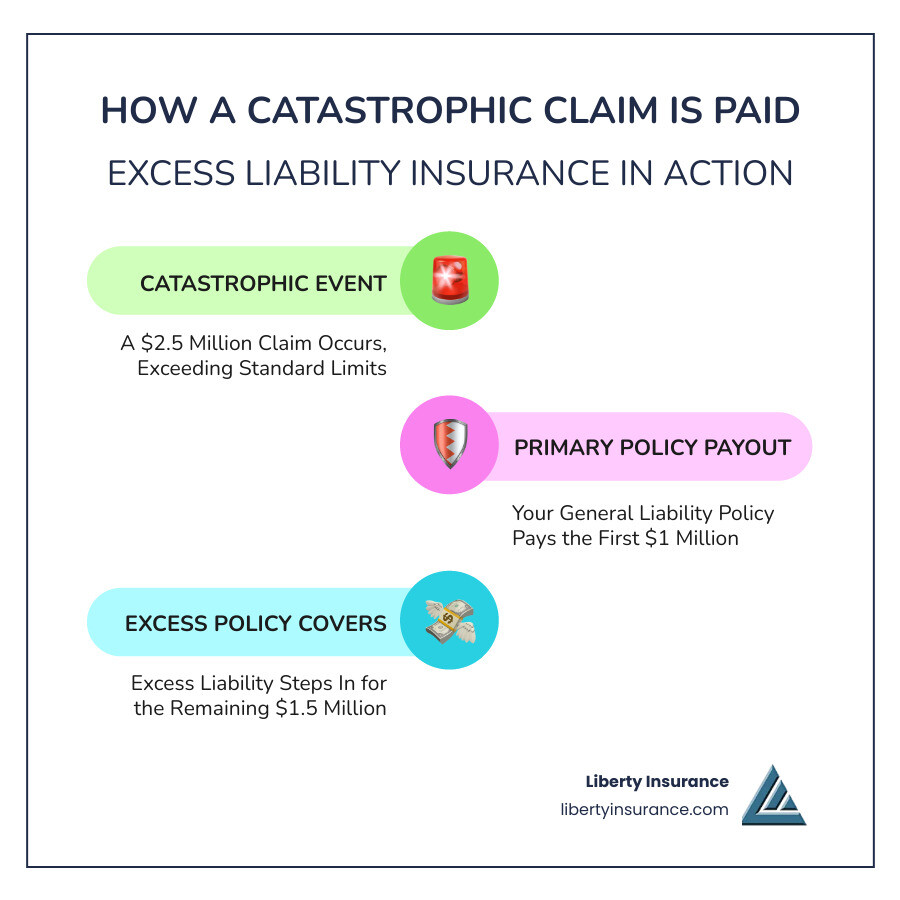
Imagine a serious accident occurs at your business—a customer is severely injured on your property, or an employee causes a major collision in a company vehicle. The resulting lawsuit comes to $3 million, but your primary insurance policy only covers $1 million. Without additional protection, your business would be responsible for the remaining $2 million.
This is where Excess Liability Insurance comes in. It is an extra layer of financial protection that activates when your primary liability policies reach their limits. Think of it as a safety net for your safety net, capable of preventing a catastrophic claim from destroying your business.

Defining Excess Liability Insurance
Excess Liability Insurance is essentially insurance for your insurance. It doesn’t introduce new types of coverage; instead, it increases the dollar limits on the liability policies you already have. For example, if your General Liability Insurance Small Business policy has a $1 million limit and a claim settles for $1.5 million, your primary policy pays its $1 million maximum. An excess policy would then cover the remaining $500,000, protecting your business and personal assets.
This type of coverage is typically a “follow-form” policy, meaning it mirrors the exact terms, conditions, and exclusions of your underlying coverage. If your primary policy, like Commercial Auto Insurance or employer’s liability, covers a specific risk, your excess policy will too—just with a higher payout limit. This simplicity makes it easier to manage, as you aren’t dealing with a new set of rules or exclusions. The excess policy simply follows what the primary policy does. Depending on the carrier, it can be written to provide excess limits over various policies, including Directors and Officers (D&O) or Professional Liability, not just the standard general liability.
The Mechanics of an Excess Policy
Excess Liability Insurance only activates after your primary policy’s limits are completely exhausted. It sits on top of your existing coverage, ready to be used when a large claim arises. This exhaustion can happen in two ways, depending on how your primary policy is structured.
Let’s use an example. Your business has a general liability policy with a per-occurrence limit of $1 million (the max paid for a single incident) and an aggregate limit of $2 million (the total paid during the policy period). A severe accident leads to a $2.75 million settlement. Here’s how it works:
- Your primary general liability policy pays its full $1 million per-occurrence limit.
- Your business is still liable for the remaining $1.75 million.
- Your Excess Liability Insurance policy, providing an additional $2 million in coverage, kicks in to pay that $1.75 million.
Alternatively, your excess policy can be triggered if your aggregate limit is exhausted by multiple smaller claims. For instance, if three separate incidents during the year result in payouts of $700,000, $800,000, and $600,000, your primary policy’s $2 million aggregate limit would be exhausted after the third claim. The excess policy would then cover the remaining $100,000 from that third claim and any subsequent covered claims during the policy period. Additionally, excess coverage may help cover ongoing legal defense costs even after your primary policy’s limit for damages is reached, providing another layer of financial security during a major claim.

This is why excess liability is a crucial financial safety net. It ensures one catastrophic event doesn’t undo years of hard work, offering peace of mind that is invaluable to any business owner.
Key Differences: Excess Liability vs. Commercial Umbrella vs. E&S Lines
When seeking additional liability protection, you’ll encounter similar-sounding terms like Excess Liability Insurance, commercial umbrella insurance, and excess and surplus (E&S) lines. While all provide extra coverage, they function differently. Understanding these distinctions is key to choosing the right protection for your Business Insurance needs.
Excess Liability vs. Commercial Umbrella Insurance
Both Excess Liability Insurance and commercial umbrella insurance provide additional funds when your primary policy limits are exhausted, but their scope differs. Excess Liability Insurance is a “follow-form” policy that simply increases the dollar limit of a single underlying policy, like your general liability or commercial auto. It mirrors the exact terms and exclusions of that policy.
Commercial umbrella insurance is broader. It can increase the limits of multiple underlying policies (general liability, commercial auto, and employer’s liability) simultaneously. More importantly, it can offer “drop-down” coverage for certain claims that your primary policies don’t cover at all, though this is subject to a Self-Insured Retention (SIR), which is like a deductible for this extra coverage. For a detailed comparison, many resources like this article from Forbes Advisor on umbrella vs. excess liability can be helpful. For independent overviews, see the Insurance Information Institute’s explainer What Is Umbrella or Excess Liability Insurance? and the Wikipedia entry on Umbrella insurance.
Here’s a quick comparison:
| Feature | Excess Liability Insurance | Commercial Umbrella Insurance |
|---|---|---|
| Coverage Scope | Increases the limits of a single underlying policy. | Can broaden coverage and apply to multiple underlying policies. |
| “Drop-Down” Coverage | No, it strictly follows the underlying policy’s terms. | Yes, may cover claims excluded by primary policies, subject to a SIR. |
| Best For | Businesses needing higher limits for a specific, existing coverage. | Businesses wanting higher limits across multiple policies and gap coverage. |
If you just need to increase your existing protection, Excess Liability Insurance is a straightforward and affordable choice. If you want higher limits and broader protection for potential gaps, Umbrella Liability Insurance may be a better fit.
Excess Liability vs. Excess and Surplus (E&S) Lines Insurance
These two terms are often confused, but they are fundamentally different. Excess Liability Insurance adds more coverage on top of standard policies from admitted carriers—insurance companies licensed and regulated by your state and backed by state guaranty funds.
Excess and Surplus (E&S) Lines Insurance is for businesses with unique or high-risk operations that standard insurers won’t cover. E&S policies are sold by non-admitted carriers, which are not licensed in every state and are not backed by state guaranty funds. This allows them greater flexibility to create customized policies for hard-to-place risks, such as businesses in emerging industries or those with a difficult claims history. E&S can provide primary or excess coverage for risks that fall outside the standard insurance market. For more background, see Excess and surplus lines insurance and the NAIC consumer guide to surplus lines insurance.
Coverage, Costs, and Benefits of Excess Liability Insurance
Protecting your business requires a robust risk management strategy, and Excess Liability Insurance is a cornerstone of that plan. Whether your business is in Trenton NJ or Toms River NJ, this coverage is an essential part of your Commercial Insurance Ultimate Guide.
What Does Excess Liability Insurance Cover?
Excess Liability Insurance does not add new types of coverage; it extends the dollar limits of your existing liability policies. It acts as a financial booster for your primary protection.
- General Liability Insurance: This is your first defense against third-party claims like bodily injury or property damage. If a slip-and-fall at your Millstone Township NJ office results in a $2 million lawsuit, but your policy limit is $1 million, excess liability covers the remaining $1 million.
- Employer’s Liability Insurance: This protects you if an employee sues for an injury, alleging that unsafe conditions caused it. Excess liability provides additional funds if the claim exceeds your primary policy’s limits.
- Commercial Auto Liability: A serious accident involving a company vehicle can easily surpass a $1 million limit. Excess liability provides the extra coverage needed to handle catastrophic auto claims.
Essentially, whatever your primary policy covers—bodily injury, property damage, legal defense costs—your excess policy extends those same protections to a much higher limit.
The Key Benefits of Added Protection
Smart business owners see Excess Liability Insurance as a vital investment. The key benefits include:
- Asset Protection: It prevents a catastrophic lawsuit from forcing you to liquidate business or personal assets to pay a judgment. A large claim can threaten your company, home, and retirement savings. Our Business Asset Protection Ultimate Guide explains this in more detail.
- Bankruptcy Prevention: A multi-million dollar judgment can be a death sentence for a small or medium-sized business. Excess liability provides the financial strength to survive such an event.
- Meeting Contractual Requirements: Many clients and landlords, especially for construction projects in New Jersey, require liability limits of $2 million, $5 million, or more. Excess coverage allows you to qualify for these lucrative opportunities.
- Peace of Mind: Knowing you are protected from worst-case scenarios allows you to focus on growing your business instead of worrying about potential accidents.
Understanding the Cost of Excess Liability Insurance
For the protection it offers, Excess Liability Insurance is surprisingly affordable. On average, businesses pay about $480 annually for each $1 million of additional coverage—roughly $40 per month. However, this is just a benchmark, and your actual premium will depend on a detailed risk assessment by an underwriter.
Several key factors influence your final premium:
- Coverage Amount: The more coverage you buy, the higher the total premium. However, the cost per million often decreases as you add more layers of coverage. For example, the second million of coverage may cost less than the first million.
- Industry and Risk: This is one of the most significant factors. High-risk industries like construction, trucking, manufacturing, and hospitality will have higher premiums due to greater exposure to large claims. In contrast, low-risk, office-based businesses like consulting firms or freelance writers will pay significantly less.
- Claims History: Underwriters will closely examine your loss history. A business with a clean record and no prior liability claims will secure much lower rates. A history of frequent or severe claims signals higher risk and will lead to increased costs or even difficulty obtaining coverage.
- Business Operations: Specifics about your operations matter. Factors like your annual revenue (higher revenue can be perceived as having “deeper pockets” in a lawsuit), number of employees (more employees means more exposure to employer’s liability claims), and physical location (operating in a highly litigious area can increase rates) all influence your final premium.
- Underlying Policy Limits: Excess carriers require you to maintain a certain minimum limit on your primary policies (e.g., $1 million per occurrence). Higher primary limits may result in a lower excess premium, as you are taking on more of the initial risk.
While $480 per million is a useful benchmark, the only way to know your true cost is to get a personalized quote. An experienced agent can help you navigate these factors and present your business favorably to underwriters to find competitive pricing for the right amount of coverage.
Who Needs This Coverage and Real-World Scenarios
No business owner wants to dwell on worst-case scenarios, but being prepared is the key to long-term success. Excess Liability Insurance is a financial firewall that stands between a catastrophic event and your business’s survival.

Identifying Your Business’s Need for Excess Liability Insurance
The question isn’t “Can I afford this coverage?” but rather “Can my business afford to be without it?” You should strongly consider Excess Liability Insurance if your business:
- Operates in a high-risk industry, such as construction, manufacturing, or real estate. Our Contractors Insurance New Jersey guide details these risks.
- Is open to the public, like a retail store, restaurant, or hotel, where customer injuries can lead to large claims.
- Owns or operates vehicles, as a single severe auto accident can result in multi-million dollar liability.
- Has significant business assets to protect, including property, equipment, and cash reserves.
- Needs to meet contractual requirements from clients or landlords who demand liability limits higher than a standard policy provides.
If a major incident could plausibly exceed your current policy limits, you need this coverage. Our Do I Need Excess Liability Insurance Guide? can help you assess your specific needs.
Real-Life Examples of Catastrophic Claims
These real-world examples show why Excess Liability Insurance is so critical:
- A dog bite claim settled for $7.7 million after a victim suffered devastating, permanent injuries. A standard homeowner’s policy would have left the owner personally liable for over $7 million.
- A homeowner liability claim reached $8.9 million when a service technician fell through an unsafe attic floor, resulting in catastrophic, disabling injuries. The homeowner’s excess policy covered the massive settlement.
- An auto accident claim resulted in a $26.2 million payout after a pedestrian was struck by a vehicle, suffering a traumatic brain injury and requiring an amputation. The driver’s standard auto policy was exhausted almost instantly, leaving the excess policy to cover the bulk of the settlement.
These cases prove that catastrophic claims can happen to anyone. The difference between financial survival and ruin often comes down to having that extra layer of protection in place before disaster strikes.
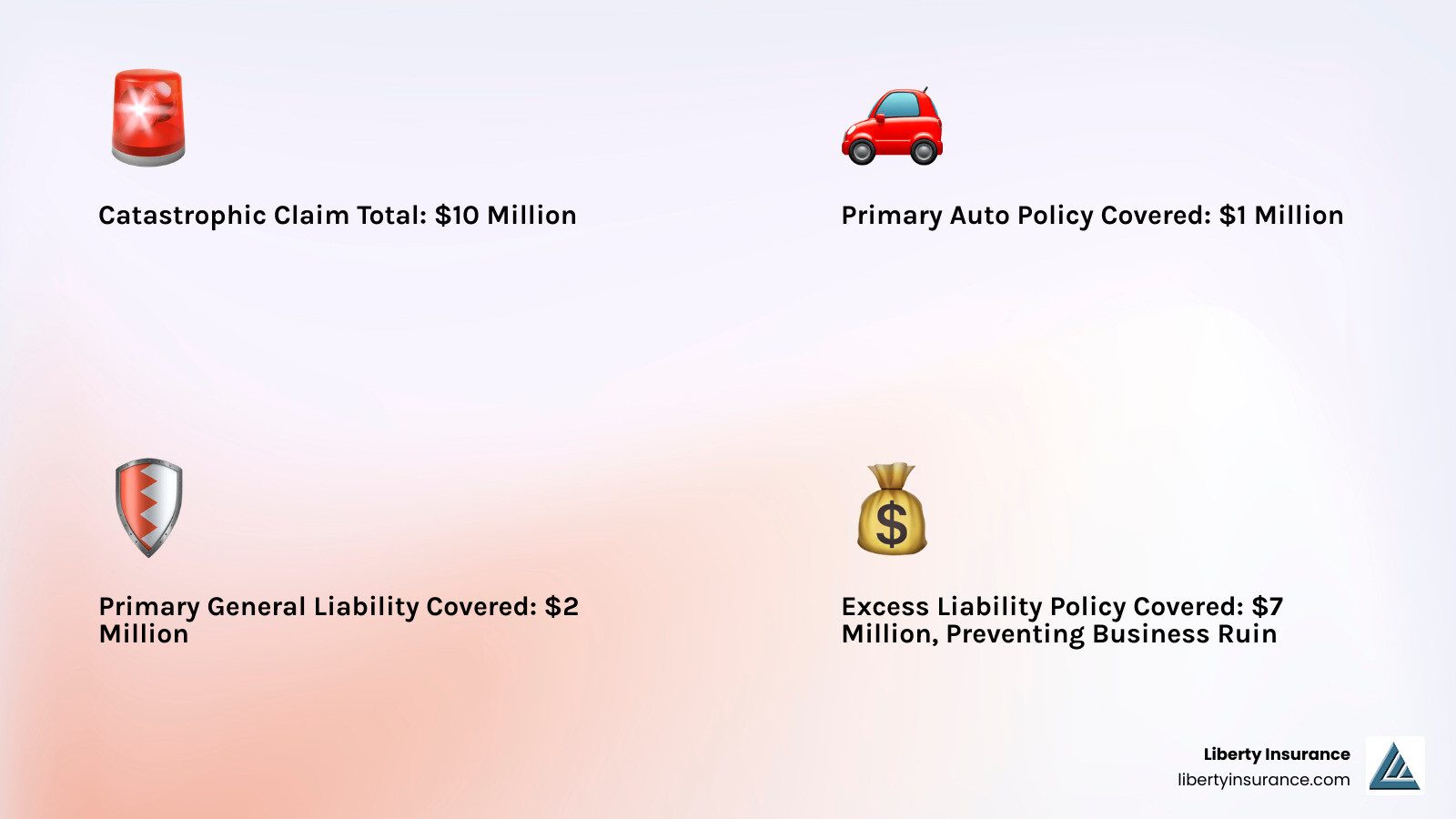
Frequently Asked Questions about Excess Liability Insurance
Insurance can be complex, so it’s natural to have questions. At Liberty Insurance, we believe in providing clear, straightforward answers. Here are some of the most common questions we hear about Excess Liability Insurance.
Does excess liability insurance have a deductible?
No, not in the traditional sense. The “deductible” for your Excess Liability Insurance is the full limit of your underlying primary policy. Your excess coverage only activates after your primary policy has paid its maximum amount. For example, if your general liability policy has a $1 million limit, that $1 million must be exhausted before your excess policy begins to pay. You will not have a separate deductible for the excess policy itself.
The only exception is with some commercial umbrella policies, which may have a Self-Insured Retention (SIR). A SIR applies only when the umbrella policy covers a claim that your primary policy does not (known as “drop-down” coverage).
Can I get excess liability for personal insurance?
Yes, you can. For individuals, this coverage is called a Personal Umbrella Policy. It functions just like its commercial counterpart, sitting on top of your personal homeowners and auto insurance policies.
A personal umbrella policy provides an extra layer of liability protection if a claim exceeds your primary policy limits, such as from a major car accident or a serious injury on your property. It is crucial for protecting personal assets like your home, savings, and retirement accounts from being drained by a large lawsuit.
How much excess liability coverage do I need?
There is no one-size-fits-all answer; the right amount depends on your specific business. To determine your needs, consider the following:
- Your risk exposure: Do you operate heavy machinery, have high public foot traffic, or use a fleet of vehicles? Higher risk means you need higher limits.
- Your asset value: Calculate the total value of your business property, equipment, inventory, and cash reserves. Your coverage should be sufficient to protect these assets.
- Contractual requirements: Check if your client or lease agreements mandate minimum liability limits, which can often be $2 million, $5 million, or more.
- Worst-case scenarios: Think about the potential financial impact of a catastrophic event. Could a single accident result in a multi-million dollar judgment?
Most businesses carry between $1 million and $10 million in excess liability coverage, but higher limits are available. An experienced agent can help you assess your vulnerabilities and select an appropriate amount. For more guidance, see our guide on How Much Excess Liability Insurance Do I Need?.
Can I buy excess liability insurance as a standalone policy?
No, excess liability is not a standalone product. It is designed specifically to provide coverage in excess of an existing primary liability policy. You must have an underlying policy, such as general liability or commercial auto, in place first. The excess insurance carrier will require proof of this primary coverage and will need to approve of the underlying insurance company, typically looking for insurers with strong financial stability ratings (e.g., an “A” rating from AM Best).
What information do I need to get an excess liability quote?
To get an accurate quote, you will need to provide information that helps the insurer assess your business’s risk profile. Be prepared to share:
- Details of your primary liability policies: This includes the name of the insurance carrier, the policy limits (both per-occurrence and aggregate), and the policy numbers.
- Business operations information: A description of what your business does, your annual revenue, and the number of employees.
- Claims history: A record of any liability claims your business has filed in the past 3-5 years.
- Desired coverage amount: How much additional coverage you are seeking (e.g., $1 million, $5 million, etc.).
Conclusion: Securing Your Business’s Future
Think about everything you’ve invested in your business—the hard work, the reputation, and the team you’ve built. A single catastrophic accident could put it all at risk. In today’s litigious world, a primary liability policy may not be enough to protect you from a multi-million dollar claim.
Excess Liability Insurance bridges the critical gap between your standard coverage and the financial protection your business truly needs to survive a major event. It’s about building a resilient foundation that allows you to sleep at night, knowing your assets, employees, and future are secure. Whether you’re in Trenton, Toms River, or Princeton, this extra layer of protection lets you focus on growth instead of worrying about what could go wrong.
At Liberty Insurance, we help business owners across New Jersey—from Millstone Township to New Brunswick—craft protection strategies that fit their unique risks. Excess Liability Insurance isn’t a one-size-fits-all product; it’s a vital component of a comprehensive risk management plan.
Don’t wait for a disaster to find you’re underinsured. Take a proactive step to secure your business’s future today. Explore our complete guide to Excess Liability Insurance or Get Business Insurance Quote to see how affordable this essential peace of mind can be. Let’s work together to build an insurance portfolio that empowers your business to thrive for years to come.

