
Why Trustees Need a Financial Safety Net

Fiduciary insurance for trustees is a specialized form of liability coverage that protects individuals serving as trustees from personal financial loss when they are sued for alleged errors, omissions, or breaches of duty in managing trust assets or employee benefit plans. Here’s what you need to know:
What Fiduciary Insurance for Trustees Covers:
- Defense Costs – Legal fees to defend against claims, even if groundless
- Settlements and Judgments – Financial awards resulting from lawsuits
- Breach of Duty Claims – Allegations of mismanagement or negligence
- Administrative Errors – Mistakes in processing or plan administration
- Personal Asset Protection – Shields your home, savings, and other personal wealth
Who Needs This Coverage:
- Trustees of family trusts
- Employee benefit plan administrators
- Pension plan fiduciaries
- Anyone with discretionary control over plan assets
Average Cost of Claims:
The average fiduciary liability case exceeds $1.2 million in costs, with defense expenses alone often topping $1 million even before any settlement.
When you accept the role of trustee, you take on a position where a single mistake—even one made in good faith—can put your personal assets at risk. Whether managing a family trust or overseeing an employee retirement plan, the law holds you to an extraordinarily high standard of care.
The reality is stark: trustees can be held personally liable for breaches of fiduciary duty. This means your home, savings, and retirement accounts could be on the line if a beneficiary sues. A claim might allege poor investment decisions, failure to follow plan documents, or a simple administrative error. In today’s litigious environment, even unfounded allegations can cost hundreds of thousands of dollars to defend.
This is where fiduciary insurance for trustees becomes essential. It acts as a financial shield, protecting both the trust assets and your personal wealth from the crushing costs of litigation. Unlike indemnification clauses in trust documents—which may not cover individual negligence—a proper fiduciary liability policy provides comprehensive protection when you need it most.
As Andrew Harris, a Certified Insurance Counselor specializing in risk management for fiduciaries, I’ve seen how critical proper fiduciary insurance for trustees is. Working with trustees across New Jersey and beyond, I help steer these complex coverage needs to ensure personal assets remain secure.
This guide will walk you through the risks you face, what fiduciary liability insurance covers, how it differs from other policies, and how to choose the right protection. Understanding this coverage isn’t optional—it’s about protecting your financial future.
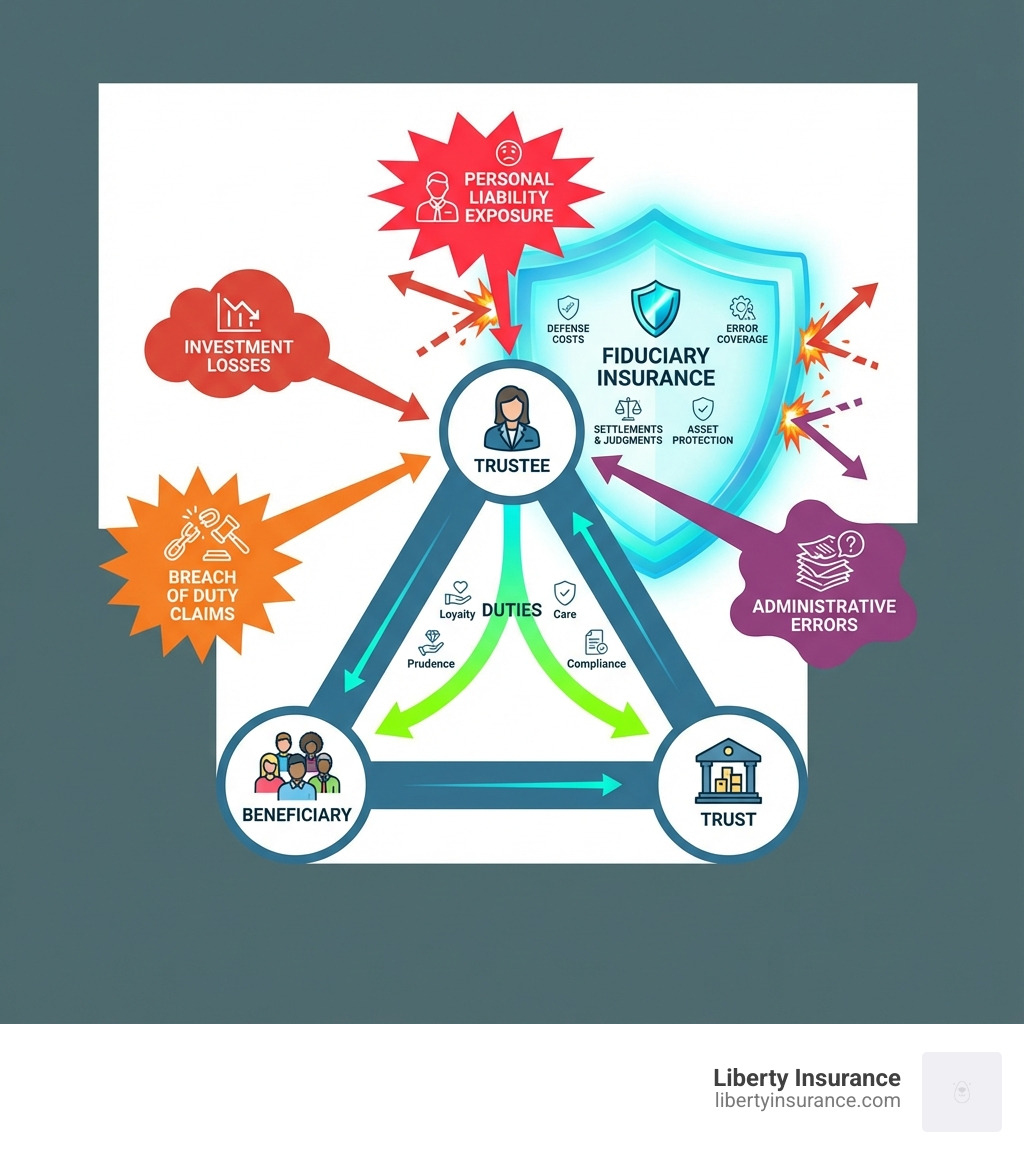
Basic fiduciary insurance for trustees vocab:
Understanding the Trustee’s Role and Risks

Acting as a trustee places you in a position of immense trust to manage assets for others. This section explores a trustee’s core duties and the substantial personal and financial risks involved if those duties are breached. Fiduciary insurance for trustees is an essential shield that protects your personal assets from these significant risks.
The Core Duties of a Fiduciary Trustee
A fiduciary relationship implies a deep level of loyalty and care. For trustees, these duties are legal obligations.
- Duty of Loyalty: You must act solely in the best interests of the beneficiaries, avoiding any conflicts of interest that could compromise your impartiality.
- Duty of Care (Prudence): You must manage the trust’s assets with the skill and diligence a prudent person would exercise, which includes making informed investment decisions and seeking professional advice when needed.
- Duty to Follow Trust Documents: You must adhere strictly to the terms of the trust agreement or plan document. Deviating from these instructions can lead to liability.
- Duty to Account and Inform: You must keep meticulous records, provide regular and accurate accountings to beneficiaries, and keep them reasonably informed about the trust’s administration.
- Duty of Impartiality: If there are multiple beneficiaries, you must treat them all fairly and equitably according to the trust’s terms.
- Selecting and Monitoring Advisors: If you hire professionals like financial advisors or lawyers, you have a duty to select them prudently and monitor their performance.
For a broader overview of fiduciary obligations in different roles (such as executors and attorneys), you can review this background on fiduciary responsibilities.
Navigating the High-Stakes World of Trustee Liability
Even with the best intentions, trustees face a multitude of potential liabilities.
- Personal Liability Risk: Unlike a corporation, trustees can be held personally liable for breaches of duty. This means your home, savings, and other investments are directly at risk.
- Investment Mismanagement: Allegations of imprudent investment decisions or failure to diversify can lead to significant claims, especially if the trust suffers losses.
- Administrative Errors and Omissions: Simple mistakes, like incorrect distributions or improper record-keeping, can trigger lawsuits.
- Conflicts of Interest: Even perceived conflicts can lead to claims if a beneficiary believes you prioritized your own interests over theirs.
- Beneficiary Disputes: Disagreements among beneficiaries can drag you into costly legal battles.
The Legal Landscape: ERISA and Other Regulations
The legal framework governing fiduciary duties is robust, particularly in the United States.
- Employee Retirement Income Security Act (ERISA): This federal law sets minimum standards for most private industry retirement and health plans. If you are a trustee of an employee benefit plan, you are a fiduciary under ERISA and can be held personally liable for breaches of duty. Claims can arise from administrative errors, misinformation, or risky investments. You can read more about the statute itself on ERISA.
- US Department of Labor (DOL) Rules: The DOL enforces ERISA and issues regulations that clarify fiduciary responsibilities. They actively pursue investigations and enforcement actions.
- State Laws: Beyond federal laws, state laws like those in New Jersey also govern trusts and estates, dictating duties regarding loyalty, prudence, and accounting.
The Consequences of a Breach
If a trustee is found liable for a breach of fiduciary duty, the consequences can be severe:
- Personal Asset Seizure: Courts can order the seizure of your personal assets to satisfy judgments.
- Costly Legal Defense: Even if you are cleared of wrongdoing, legal fees can be astronomical. Defense costs alone can exceed $1 million in complex cases.
- Court-Ordered Damages: You could be ordered to pay substantial damages to the beneficiaries or plan.
- Regulatory Fines: For ERISA plans, the DOL can impose significant fines for violations.
- Removal as a Trustee: A court can remove you from your position, damaging your reputation.
- Reputational Damage: An accusation alone can tarnish your professional and personal standing.
What is Fiduciary Insurance for Trustees and What Does It Cover?
This section defines fiduciary liability insurance, detailing who and what it protects, and what it typically does not cover.
Defining Fiduciary Liability Insurance
Fiduciary insurance for trustees is a specialized liability policy designed to protect individuals and organizations with discretionary authority over trust assets or employee benefit plans. It’s a safety net for those legally bound to act in the best interest of others.
Who is protected:
- Trustees: Individual trustees for family trusts or boards overseeing large pension funds.
- Plan Administrators: Individuals or committees responsible for administering employee benefit plans.
- The Sponsoring Company: The organization that establishes the benefit plan.
- The Plan Itself: The policy can also cover the plan as an entity.
- Other Fiduciaries: Anyone who exercises discretionary control over plan assets or administration.
With ERISA’s strict rules holding fiduciaries personally liable, fiduciary insurance for trustees provides the financial resources to defend against lawsuits alleging negligence or breach of duty, crucially protecting your personal assets.
Covered Claims: What You’re Protected Against
A robust fiduciary insurance for trustees policy covers a wide array of potential claims.
- Breach of Fiduciary Duty: The core coverage, protecting against claims that you failed to act in the beneficiaries’ best interests.
- Negligence in Plan Administration: Covers claims arising from unintentional errors in managing the plan.
- Errors and Omissions: Protects against claims stemming from mistakes, oversights, or omissions in your duties.
- Improper Investment Advice: Covers allegations of imprudent investment decisions or advice that caused financial losses.
- Wrongful Denial of Benefits: Protects against claims arising from mistakes in calculating or denying participant benefits.
- Defense Costs: A critical benefit, this covers legal fees, court costs, and investigation expenses for a covered claim, often in addition to the policy limit.
- Settlements and Judgments: The policy pays for settlements and court-ordered judgments up to the policy limits.
Understanding Common Policy Exclusions
While coverage is broad, it’s crucial to understand what fiduciary insurance for trustees typically doesn’t cover:
- Intentional Fraudulent or Criminal Acts: Insurance protects against unintentional errors, not deliberate wrongdoing.
- Dishonesty Resulting in Personal Profit: If you personally profit from dishonest actions, the policy will not cover the resulting penalties.
- Bodily Injury and Property Damage Claims: These claims are covered by other policies, such as general liability or commercial property insurance. At Liberty Insurance, we offer commercial property insurance to protect a business’s physical assets.
- Claims Known Before the Policy Start Date: A claim or wrongful act you were aware of before the policy’s effective date will usually be excluded.
- Cyber and Data Privacy Breaches: While a fiduciary breach might result from a cyber incident, the direct costs of a data breach (like notification and forensics) typically require a separate cyber liability insurance policy.
Comparing Fiduciary Insurance with Other Policies

It’s crucial to understand how fiduciary insurance for trustees differs from other management liability coverages to ensure there are no gaps in your protection. Many businesses, especially in New Jersey, find they need a suite of policies for comprehensive protection.
Fiduciary Liability vs. Directors & Officers (D&O) Insurance
These two policies are often confused but serve distinct purposes.
- Focus: Fiduciary Liability insurance is laser-focused on managing employee benefit plans or trusts. D&O insurance protects a company’s leaders from claims related to broad corporate governance and mismanagement.
- Who is Protected: Fiduciary Liability protects plan fiduciaries (trustees, administrators). D&O protects a company’s directors and officers.
- Why You May Need Both: A D&O policy won’t cover an ERISA violation, and a fiduciary policy won’t cover a shareholder lawsuit. If your leaders serve in both capacities, having both policies is essential for comprehensive protection.
Fiduciary Liability vs. ERISA Fidelity Bonds
This is another common point of confusion for those managing ERISA plans.
- Who/What is Protected: Fiduciary Liability insurance protects the fiduciary from personal liability. An ERISA Fidelity Bond protects the plan’s assets from theft.
- What is Covered: Fiduciary Liability covers mismanagement and errors. An ERISA bond covers fraud and dishonesty, like embezzlement.
- Legal Requirement: ERISA legally requires plans to be bonded. However, a bond does not cover breaches of fiduciary duty. For that, you need fiduciary insurance for trustees.
Fiduciary Insurance vs. Trust Indemnity Agreements
Trust documents often contain clauses to protect the trustee, but these have significant limitations.
- Broader Protection: Insurance can provide coverage in cases of negligence where an indemnity clause might fall short.
- Fills Critical Gaps: Indemnity agreements may exclude protection for a trustee’s individual negligence. Insurance is designed to fill this gap for honest mistakes.
- Preserves Trust Assets: Relying on an indemnity means legal costs are paid from the trust’s assets, depleting them. Fiduciary insurance for trustees pays these costs directly, keeping the trust intact.
| Feature | Fiduciary Liability Insurance | D&O Insurance | ERISA Fidelity Bond |
|---|---|---|---|
| Primary Purpose | Protects fiduciaries and plan/trust for breaches of duty and errors in benefit plan/trust management. | Protects directors and officers for wrongful acts in corporate governance and management. | Protects the employee benefit plan from losses due to fraud or dishonesty by those handling funds. |
| Who Is Protected | Individual fiduciaries, plan/trust, sponsoring organization. | Individual directors and officers, sometimes the company itself (entity coverage). | The employee benefit plan itself. |
| What Is Covered | Negligence, errors, omissions, breach of fiduciary duty, improper investment advice, wrongful denial of benefits, defense costs, settlements, judgments. | Mismanagement, breach of corporate duty, regulatory non-compliance, shareholder lawsuits, defense costs, settlements, judgments. | Theft, embezzlement, larceny, and other dishonest acts by plan officials. |
Choosing and Managing Your Fiduciary Liability Policy
Selecting the right policy requires careful consideration of its terms and structure. For our New Jersey clients, understanding these nuances is key to securing peace of mind.
Key Considerations for Selecting a Fiduciary Insurance for Trustees Policy
When shopping for fiduciary insurance for trustees, consider the following:
- Risk Exposure: Assess the size of the trust assets, the number of beneficiaries, the types of investments, and your prior claims history.
- Policy Limits and Deductibles: The average fiduciary liability case exceeds $1.2 million, so adequate limits are crucial. We help you balance robust protection with reasonable premiums.
- Insurer’s Financial Strength: A policy is only as good as the company backing it. Choose an insurer with a proven track record of paying claims.
- ‘Duty to Defend’ vs. Reimbursement: A ‘Duty to Defend’ policy, where the insurer manages and pays for your defense from the start, is generally preferred over a reimbursement policy where you pay upfront.
- More info about business insurance: For a broader understanding of how various insurance policies can protect your business, you can always learn more about business insurance.
The Nuances of Claims-Made Policies
Most fiduciary insurance for trustees policies are “claims-made,” which is different from the “occurrence” policies used for auto or home insurance.
- Claims-Made vs. Occurrence: An occurrence policy covers incidents that happen during the policy period. A claims-made policy covers claims that are reported during the policy period, for acts that occurred after a specified “retroactive date.”
- Retroactive Date: This is the date from which your coverage for wrongful acts begins. It’s vital to ensure this date aligns with your earliest fiduciary responsibilities.
- Continuous Coverage: Because of the claims-made structure, it is critical to maintain continuous coverage to avoid gaps where claims might not be covered.
- Reporting Requirements: You must report a potential claim to your insurer as soon as you become aware of it and within the policy period.
The Role of an Extended Reporting Period (ERP)
An ERP, or “tail” coverage, is a crucial feature for claims-made policies.
- What it is: An ERP allows you to report claims after your policy has expired, as long as the wrongful act occurred before expiration.
- When it is necessary: An ERP is essential if you retire as a trustee, your policy is not renewed, or you switch insurers. It ensures you’re protected for past actions long after you’ve stepped away from the role.
Can Plan Assets Be Used to Purchase Insurance?
This is a common question for trustees of ERISA-governed plans.
- ERISA Rules: ERISA Section 410(b) allows for the purchase of fiduciary insurance for trustees. However, the rules are complex. If the policy allows the insurer to seek reimbursement from a liable fiduciary (a “recourse provision”), the plan cannot pay for that portion of the coverage.
- Splitting Premiums: It’s often permissible for a plan to pay for the portion of the premium that covers the plan and “non-recourse” coverage for fiduciaries. The fiduciaries would then pay for the portion covering any recourse provisions.
- Seek Legal Counsel: Given the complexities of ERISA and state laws, it is highly recommended to seek legal counsel before using plan assets to purchase insurance. This ensures compliance and avoids further liability.
Proactive Risk Management and Best Practices
While fiduciary insurance for trustees is a critical financial backstop, your first and best line of defense is a robust risk management strategy. Implementing and documenting strong governance practices not only minimizes the chance of a claim but also provides powerful evidence of your diligence if a claim does arise.
Here are essential best practices every trustee should adopt:
Develop and Adhere to a Written Investment Policy Statement (IPS): This is the cornerstone of prudent investment management. A comprehensive IPS should be a formal, written document that clearly outlines:
- The purpose and objectives of the trust or plan.
- The roles and responsibilities of the trustee, investment committee, and any third-party advisors.
- The risk tolerance and time horizon for the assets.
- Target asset allocation ranges and diversification strategies.
- Criteria for selecting and deselecting investment options.
- A schedule and process for regularly reviewing the IPS and investment performance against established benchmarks.
Maintain Meticulous Documentation of All Decisions: In a lawsuit, undocumented actions are often indefensible. Your records are your best defense. Create a “paper trail” that includes:
- Detailed Meeting Minutes: Record who was present, what was discussed, what materials were reviewed, the decisions made, and the rationale behind each decision.
- Decision Logs: For actions taken outside of formal meetings, document the decision and the reasons for it.
- Service Provider Due Diligence: Keep records of your process for selecting and monitoring advisors, including RFPs, interview notes, fee analyses, and performance reviews.
Implement a Formal Process for Hiring and Monitoring Service Providers: Delegating a task does not delegate your fiduciary responsibility. You retain the duty to prudently select and monitor any professionals you hire (e.g., investment managers, consultants, attorneys). This process should involve:
- Benchmarking provider fees and services to ensure they are reasonable.
- Regularly reviewing provider performance against the IPS and industry benchmarks.
- Documenting these reviews and any actions taken as a result.
Conduct Regular Fiduciary Training: The legal and financial landscape is constantly changing. Ensure all trustees and committee members receive ongoing education on their duties, emerging risks (like cybersecurity), and current best practices under laws like ERISA. Documenting this training demonstrates a commitment to upholding your responsibilities.
Perform Periodic Compliance and Operational Reviews: Mistakes in administration are a common source of claims. Regularly audit your procedures to ensure they align with the plan or trust documents and all relevant laws. This includes reviewing:
- Participant eligibility, enrollment, and contribution processing.
- Distribution and loan procedures.
- Beneficiary notices and disclosures to ensure they are timely and accurate.
- Fidelity bond coverage to ensure it meets legal requirements.
More info about wealth management: Effective wealth management is intrinsically linked to these prudent fiduciary practices. For those managing significant assets, our wealth management services can provide additional guidance on building and executing these frameworks.
Frequently Asked Questions about Fiduciary Insurance for Trustees
Here are answers to some of the most common questions trustees have about this essential coverage.
How much does fiduciary liability insurance cost?
The cost of fiduciary insurance for trustees varies based on several factors:
- Total Value of Plan Assets: Larger asset bases mean higher exposure and premiums.
- Number of Participants/Beneficiaries: More individuals can increase the likelihood of claims.
- Type of Investments: High-risk or complex strategies can increase premiums.
- Past Claims History: A history of claims will typically result in higher costs.
- Desired Coverage Limits and Deductible: Higher limits and lower deductibles increase the premium.
Coverage limits can start around $500,000 for a small fund and exceed $25 million for very large funds. We work with our New Jersey clients to find the right balance of coverage and cost.
Can an individual trustee purchase their own policy?
Yes. Individual or “lay” trustees, especially those serving family trusts, can and often should purchase their own policies. This is important if the trust itself does not provide adequate coverage or if existing coverage could leave your personal assets exposed. A personal policy ensures your assets are protected, giving you peace of mind.
Does this insurance cover honest mistakes?
Yes, that is the primary purpose of fiduciary insurance for trustees. It is designed to protect against claims arising from alleged errors, omissions, and negligence. The policy is there to shield you from unintentional mistakes made in good faith. It generally does not cover intentional fraud, criminal acts, or dishonesty for personal profit.
Conclusion: Securing Your Legacy as a Trustee
The role of a trustee carries immense responsibility and significant personal risk. A breach of duty, even an unintentional one, can have devastating financial consequences, potentially eroding your personal wealth and tarnishing your reputation. Fiduciary insurance for trustees is not a luxury; it is a fundamental tool for protecting your personal assets and enabling you to serve your beneficiaries with confidence and peace of mind.
By understanding your duties, implementing strong governance frameworks, carefully documenting your decisions, and securing the right coverage, you can build a shield that protects your legacy. We at Liberty Insurance are committed to helping fiduciaries across New Jersey and beyond steer these complexities with robust and reliable coverage solutions, ensuring you can focus on your vital role without constant worry.
Learn more about fiduciary liability insurance and how we can help you safeguard your financial future.

