
Why Understanding Fiduciary Liability Insurance is Critical for Business Owners
What is a fiduciary liability insurance policy? It’s specialized coverage that protects businesses and the individuals who oversee employee benefit plans—such as 401(k) plans, pensions, ESOPs, health and welfare plans, and more—against claims alleging mismanagement, breach of fiduciary duty, or administrative errors. The coverage typically pays for legal defense costs, settlements, and judgments arising from claims brought by plan participants, beneficiaries, or regulators.
If your company sponsors employee benefit plans, you take on fiduciary responsibilities under the Employee Retirement Income Security Act (ERISA). ERISA imposes what courts often describe as the highest duty known to law. That standard requires fiduciaries to act solely in the interest of participants and beneficiaries, with prudence and loyalty, and in accordance with plan documents. Violations (even accidental ones) can lead to personal liability. In other words, plaintiffs may pursue the personal assets of fiduciaries—your home, savings, or investments—if there’s a breach of duty and the plan suffers losses.
Many owners assume risk is limited to large public companies, but litigation trends increasingly affect small and mid-sized businesses. Claims can stem from excessive fees in a 401(k), a delay in enrolling an employee in health coverage, a failure to monitor a vendor, or an alleged imprudent investment lineup. Defense costs alone—regardless of fault—can be significant.
Fiduciary liability insurance is designed to address these exposures by providing a backstop for both your company and the individuals serving in fiduciary roles. In addition to paying defense costs, policies can cover settlements and judgments, and often include coverage for regulatory investigations by the Department of Labor (DOL) or Internal Revenue Service (IRS). Because most policies are written on a claims-made basis, they respond to claims first made during the policy period (subject to the policy’s terms), which makes continuity and attention to retroactive dates particularly important.
This guide explains what a fiduciary liability insurance policy is, who is considered a fiduciary, what typical policies cover (and exclude), how this coverage differs from Employee Benefits Liability (EBL), ERISA fidelity bonds, Directors & Officers (D&O), and Professional Liability (E&O), and practical steps to structure coverage and reduce risk.
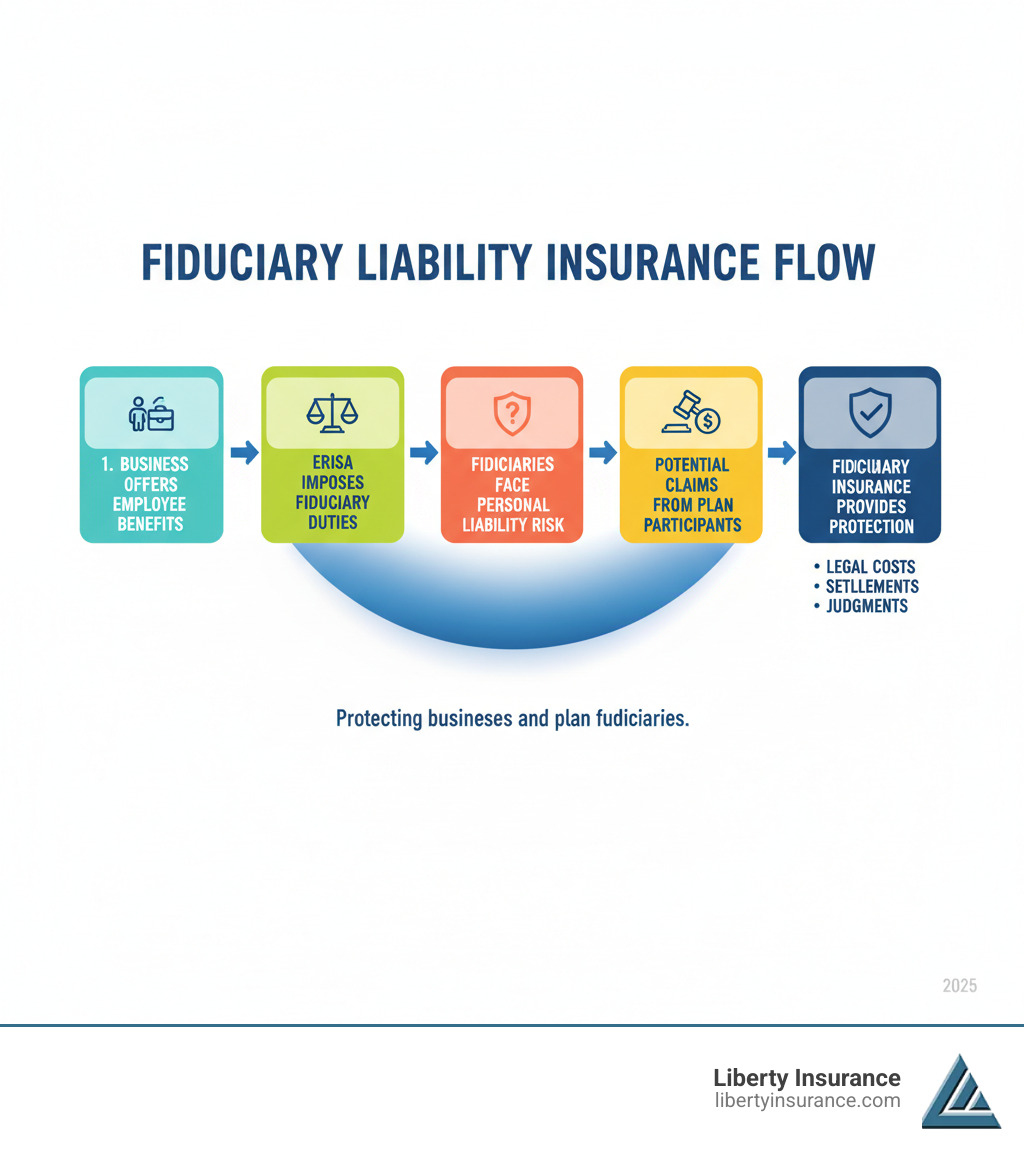
In short, understanding what a fiduciary liability insurance policy is—and how it works—can protect your organization’s balance sheet and your leaders’ personal assets, while allowing your team to confidently deliver the benefits your employees value.
Understanding Your Fiduciary Role and Responsibilities
The moment your organization sponsors an employee benefit plan, you take on fiduciary duties under federal law. Knowing who is a fiduciary, what fiduciaries must do, and how liability attaches is essential to managing risk.
Who is considered a fiduciary?
Under ERISA, fiduciary status is determined by function, not title. A fiduciary is anyone who exercises discretionary authority or control over plan management or plan assets, or anyone who has discretionary responsibility in plan administration. That can include:
- The plan sponsor (the employer) when acting in a fiduciary capacity
- The plan administrator or committee that runs the plan
- Trustees holding and managing plan assets
- Members of an investment or retirement plan committee
- Directors and officers when they exercise discretionary control over plan matters
- Employees (e.g., HR or finance staff) who make discretionary decisions about the plan
ERISA also recognizes functional fiduciaries—individuals who may not be named in plan documents but effectively act in a fiduciary capacity based on their actions. For example, an HR manager who selects a 401(k) provider or a CFO who negotiates plan fees could be deemed fiduciaries.
In addition, ERISA allows for different fiduciary roles to be delegated or shared. For example, a 3(21) investment advisor provides investment advice for a fee and shares fiduciary responsibility, whereas a 3(38) investment manager assumes discretion over investment decisions (and the associated fiduciary responsibility) subject to oversight by the plan sponsor. Even when you delegate, however, you retain the duty to prudently select and monitor service providers.
Settlor versus fiduciary functions
Not every employer decision related to benefits is a fiduciary act. “Settlor” functions—such as deciding whether to establish, amend, or terminate a plan, or determining plan design and eligibility rules—are business decisions and generally are not fiduciary duties. In contrast, implementing and administering the plan in accordance with its terms and ERISA’s requirements (e.g., selecting investments, monitoring fees, processing claims) are fiduciary functions.
Clarifying which actions are fiduciary versus settlor can help structure governance and, importantly, align insurance coverage appropriately.
Core fiduciary duties under ERISA
ERISA imposes rigorous standards, including:
- Duty of loyalty: Act solely in the interest of plan participants and beneficiaries for the exclusive purpose of providing benefits and paying plan expenses.
- Duty of prudence (the “prudent expert” rule): Act with the care, skill, prudence, and diligence that a prudent person acting in a like capacity and familiar with such matters would use. This “prudent expert” standard is a high bar. It means a fiduciary is expected to have the expertise of a professional in that area or to hire qualified advisors to provide that expertise. Simply acting in good faith is not enough; the process and decisions must be sound.
- Duty to diversify: Diversify plan investments to minimize the risk of large losses unless it is clearly imprudent not to do so.
- Duty to follow plan documents: Adhere to plan terms and documents, but only insofar as they are consistent with ERISA and applicable law.
- Duty to ensure fees are reasonable: Regularly benchmark and monitor all plan fees and services to ensure they are reasonable for the services provided.
- Duty to avoid prohibited transactions: Fiduciaries must not engage in transactions that constitute a conflict of interest. This includes self-dealing, such as a fiduciary using plan assets for their own interest, or transactions between the plan and a “party in interest” (e.g., the employer, certain service providers, or relatives of fiduciaries).
The Department of Labor provides detailed guidance on fiduciary responsibilities.
Co-fiduciary liability
Fiduciaries can be held liable for their own breaches and, in certain circumstances, for the breaches of co-fiduciaries. This can occur if a fiduciary:
- Knowingly participates in or conceals a breach by another fiduciary.
- Fails to comply with their own duties, which enables another fiduciary to commit a breach.
- Has knowledge of a breach by a co-fiduciary and fails to make reasonable efforts to remedy it.
For example, if an investment committee member knows that another member is pushing for an imprudent investment to benefit a personal connection but says nothing, they can be held personally liable for the resulting plan losses alongside the other member. This also applies to the duty to monitor those to whom responsibilities have been delegated, such as a third-party administrator or investment manager.
How and why personal assets are at risk
Under ERISA Section 409, fiduciaries who breach their duties are personally liable to make good to the plan any losses resulting from the breach and to restore any profits made through improper use of plan assets. Plans cannot use their assets to indemnify fiduciaries for breaches. While companies may provide indemnification, such agreements can be limited by law, plan terms, or corporate solvency. Additionally, plan assets cannot fund a fiduciary’s defense—even if the fiduciary is ultimately vindicated—so defense costs must be borne by the individual or their insurer unless the sponsor indemnifies them.
This is precisely where fiduciary liability insurance fits: it can fund defense and, subject to policy terms and exclusions, settlements and judgments, protecting both the company and the personal assets of insured fiduciaries.
What is a Fiduciary Liability Insurance Policy? A Deep Dive into Coverage
A fiduciary liability insurance policy is designed to address the unique exposures arising from sponsoring and administering employee benefit plans. It protects the organization and insured individuals against claims alleging a breach of fiduciary duty, errors in judgment, or administrative missteps in plan management.
Who is protected by the policy?
Policies typically extend coverage to:
- Insured persons: current and former directors, officers, trustees, plan administrators, members of plan committees, and employees acting in a fiduciary capacity
- The plan sponsor entity: the employer sponsoring the plan
- Sponsored plans: retirement plans (e.g., 401(k), 403(b), pension, profit sharing, ESOP) and welfare plans (e.g., medical, dental, vision, life, disability, severance, cafeteria plans), as scheduled in the policy
Coverage for outside service providers (recordkeepers, TPAs, advisors) is not a substitute for their own insurance; they generally need their own E&O/fiduciary coverage. However, your policy can respond to claims that you failed to prudently select or monitor those providers.
How does the coverage work?
Most fiduciary liability policies are written on a claims-made and reported basis. That means:
- The policy responds to claims first made against an insured and reported to the carrier during the policy period or any applicable extended reporting period (ERP), subject to a retroactive date
- A retroactive (or prior acts) date establishes how far back wrongful acts can have occurred and still be covered; earlier retro dates generally broaden coverage
- An ERP or “tail” allows additional time to report claims after the policy expires or is non-renewed; tails are especially relevant in mergers, acquisitions, or plan terminations
Policies may be written on a duty-to-defend or reimbursement basis:
- Duty to defend: the insurer takes control of the defense and appoints counsel (often from a panel), subject to the insured’s cooperation and consent rights
- Reimbursement: the insured selects counsel and manages the defense, and the insurer reimburses covered defense costs as incurred
What does a fiduciary liability policy typically cover?
Subject to the policy’s definitions, terms, conditions, and exclusions, coverage generally includes:
- Legal defense costs: attorney’s fees, expert costs, court fees; these are usually inside the limits of liability (defense costs reduce the available limit)
- Settlements and judgments: amounts the insured is legally obligated to pay following a claim alleging a wrongful act in the administration of a plan
- Regulatory investigations and proceedings: coverage for certain costs associated with responding to DOL, IRS, or other regulatory inquiries or proceedings related to fiduciary duties
- Voluntary compliance program sublimits: some policies offer limited coverage for certain civil penalties or plan corrections (varies by carrier)
Key defined terms to review include “claim,” “wrongful act,” “loss,” “plan,” and “insured.” Better forms often include coverage for claims arising from alleged breaches of co-fiduciary duties and carve-backs for certain penalties where insurable.
Common retentions, limits, and sublimits
- Retentions (deductibles): typically apply per claim and vary with company size and risk profile
- Limits: set the insurer’s maximum payment per claim and in the aggregate; defense costs usually erode limits, so adequate limits are crucial
- Sublimits: may apply to specific exposures (e.g., penalties, voluntary correction programs, settlor acts defense)
What are some common claims scenarios?

Claims can arise from seemingly routine decisions or oversight lapses, such as:
- Excessive fees: allegations that investment or recordkeeping fees were unreasonable and eroded participants’ savings
- Imprudent investment options: claims that the investment menu was not properly vetted or monitored
- Failure to diversify: concentration in a single asset class or employer stock causing significant losses
- Improper selection/monitoring of service providers: allegations that the plan sponsor failed to prudently select, monitor, or replace vendors
- Administrative errors: delayed or missed enrollment, contribution processing errors, QDRO handling mistakes
- Wrongful denial of benefits: disputes over eligibility or benefit amounts in health, disability, or life plans
- COBRA and notice failures: alleged deficiencies in required notices and continuation coverage practices
- Conflicts of interest or prohibited transactions: decisions that allegedly benefit the employer or fiduciaries at the expense of participants
Real-world example: A mid-sized employer faces a class action alleging that its 401(k) plan’s investment lineup used high-fee share classes when cheaper institutional share classes were available. Defense costs alone can reach seven figures. A fiduciary liability policy with appropriate limits helps shield both the company and individual fiduciaries from these expenses.
Important nuances and coordination with other coverages
- Employee Benefits Liability (EBL): generally covers administrative errors or omissions but not breaches of fiduciary duty
- ERISA fidelity bond: protects the plan from theft or fraud by those who handle plan funds; distinct from fiduciary liability
- D&O Insurance: typically excludes claims related to ERISA plan management; fiduciary liability fills this gap
- Cyber and privacy: HIPAA-related privacy incidents may be addressed in part by cyber insurance, but fiduciary liability may provide coverage for certain HIPAA civil penalties where insurable
No two policies are identical. Review terms carefully with a knowledgeable broker to tailor coverage to your plans and governance practices.
Key Distinctions: Fiduciary Liability vs. Other Coverages
Many business leaders assume existing insurance will protect them from plan-related claims. In reality, fiduciary exposures are typically excluded or only partially addressed by other policies. Understanding how fiduciary liability differs from EBL, ERISA bonds, D&O, and E&O helps avoid coverage gaps.
| Feature | Fiduciary Liability Insurance | Employee Benefits Liability (EBL) | ERISA Bond | Directors & Officers (D&O) Insurance | Errors & Omissions (E&O) Insurance (Professional Liability) |
|---|---|---|---|---|---|
| Who is Protected | Company, fiduciaries (directors, officers, plan administrators, employees) | Company, employees involved in administration | The plan and its participants | Directors & Officers of the company | Professionals (individuals or firms) providing specific services |
| What is Covered | Breaches of fiduciary duty, mismanagement of benefit plans, imprudent investments, administrative errors (broader) | Administrative errors in benefits (e.g., enrollment mistakes, clerical errors) | Losses to the plan due to fraud or dishonesty of individuals handling plan funds | Wrongful acts in corporate governance/management (excluding benefit plans) | Negligence, errors, omissions in professional services (e.g., legal, accounting, consulting) |
| Primary Purpose | Protect fiduciaries/company from breach of duty claims related to benefit plans | Cover administrative errors in benefits | Protect plan assets from theft/fraud by bonded individuals | Protect corporate leadership from claims related to executive duties | Protect professionals from claims arising from their services |
| Legal Status | Recommended, not legally required | Often an endorsement to General Liability or separate policy | Legally required for most ERISA plans | Recommended, not legally required | Recommended for service-based businesses |
Fiduciary Liability vs. Employee Benefits Liability (EBL)
This is the most common confusion point.
- Fiduciary liability: addresses discretionary, strategic plan decisions (e.g., investment selection, provider monitoring, fee oversight) and alleged breaches of fiduciary duty. Usually claims-made.
- EBL: addresses clerical or administrative errors (e.g., enrollment, terminations, processing mistakes). Often occurrence-based and narrower in scope.
Think of fiduciary liability as coverage for plan governance and prudence, while EBL is for day-to-day administrative slip-ups. Most organizations that sponsor plans can benefit from both.
Fiduciary Liability Insurance vs. ERISA Bonds
ERISA fidelity bonds are legally mandated for those who handle plan funds. The bond protects the plan (not the fiduciaries) against loss due to fraud or dishonesty. Minimum bond amounts are typically at least 10% of plan assets (subject to caps), with higher caps for plans holding employer securities.
Fiduciary liability insurance, by contrast, is not legally required and protects fiduciaries and the sponsoring employer from lawsuits alleging breaches of duty, errors, or mismanagement. The bond addresses crime, while fiduciary insurance addresses civil liability for fiduciary decisions.
Fiduciary Liability vs. D&O and E&O Insurance
- D&O insurance protects directors and officers against claims alleging wrongful acts in their capacity as corporate leaders, but it typically excludes fiduciary claims relating to plan management.
- E&O (professional liability) protects firms and individuals providing professional services (e.g., investment advisors, TPAs) from negligence allegations in their services. Your plan’s service providers should carry E&O/fiduciary coverage of their own.
Fiduciary liability is purpose-built for ERISA plan governance risks. Assuming D&O or E&O automatically covers plan-related claims is a common and costly mistake.
The Nuts and Bolts of a Fiduciary Liability Policy
Understanding the mechanics of what is a fiduciary liability insurance policy—who it covers, what it excludes, and how to tailor it—will help you buy with confidence and avoid unpleasant surprises at claim time.
Who and what is covered by the policy?
A well-structured fiduciary liability policy typically covers:
- Insured persons: current and former directors, officers, trustees, committee members, and employees acting in a fiduciary or plan administrative capacity
- The plan sponsor entity: the employer sponsoring the plan(s)
- Sponsored plans: retirement plans (401(k), 403(b), pension, ESOP, profit sharing) and welfare plans (medical, dental, vision, life, disability, severance, cafeteria plans), as listed in the policy
Coverage applies to alleged wrongful acts in the administration of a plan, including decisions about plan investments, interpretation of plan terms, selection and monitoring of vendors, and benefit determinations.
Policy structure: claims-made, retro dates, and tail coverage
- Claims-made and reported: the policy responds to claims first made and reported during the policy period (or ERP), subject to the retroactive date
- Retroactive date: determines how far back acts can have occurred and still be covered; earlier is broader
- Extended reporting period (ERP/tail): extra time to report claims after expiration; particularly useful for plan mergers, spin-offs, or company transactions
- Run-off coverage: available when operations are sold/merged; it fixes the coverage to past acts for a defined period
Key definitions and conditions to scrutinize
- Claim: ensure it captures demands for monetary or non-monetary relief, civil proceedings, written demands, and regulatory investigations relating to fiduciary duties
- Wrongful act: broad, including actual or alleged breaches of fiduciary duty, errors, omissions, negligent acts in plan administration
- Loss: confirm inclusion of defense costs, settlements, judgments, and punitive/exemplary damages where insurable
- Interrelated wrongful acts: understand how related claims are treated (often as a single claim), which affects limits and retentions
- Prior/pending litigation date: claims arising out of matters pending before this date are excluded
- Severability: strengthen protection so one insured’s misrepresentation does not bar coverage for others
- Allocation: if a claim involves covered and uncovered matters or parties, terms determine how defense and loss are allocated
- Consent to settle/hammer clause: affects settlement dynamics and insured’s contribution if declining a recommended settlement
Common exclusions: what a fiduciary liability policy does NOT cover
While robust, these policies typically exclude:
- Intentional fraud, criminal acts, and personal profit to which the insured was not legally entitled
- Civil penalties and fines, except as specifically endorsed
- Benefits due (the payment of benefits owed under plan terms)
- Bodily injury and property damage (handled by general liability)
- Failure to fund or meet minimum funding obligations for defined benefit plans
- Duties performed as a settlor (although some carriers offer limited defense coverage by endorsement)
Always review endorsements—some carriers offer limited coverage for HIPAA civil penalties, PPACA penalties, or IRS excise taxes where insurable by law, usually with sublimits and specific conditions.
Key improvements and features to look for
- Defense outside the limits (or separate defense limits) where available
- Most-favorable-jurisdiction language for punitive damages
- Broad definition of plan to include new or acquired plans automatically
- Coverage for voluntary correction program expenses (limited and carrier-specific)
- Coverage for fiduciary breach claims arising from employer stock or company-securities funds
- Priority of payments provision (ensures individuals are paid before the entity in the event limits are eroding)
- Panel counsel flexibility and pre-approved rates; or reimbursement options for preferred counsel
Underwriting: what carriers typically ask for
Be prepared to provide:
- A completed fiduciary liability application
- Most recent plan Form 5500s with schedules (for applicable plans)
- Plan asset size, number of participants, and contribution levels
- Details on investment menus, target-date funds, and use of employer stock
- Governance documents: committee charters, meeting minutes, investment policy statement (IPS)
- Fee benchmarking practices, use of independent advisors, and service provider reviews
- Claims history and regulatory inquiries (if any)
Sound governance can improve underwriting outcomes and pricing—clear documentation and consistent processes matter.
Practical risk management to reduce fiduciary exposure
- Establish a fiduciary committee with a clear charter, meeting cadence, and documented decisions
- Maintain and follow an investment policy statement (IPS)
- Regularly benchmark fees and services; issue and evaluate RFPs for providers on a prudent schedule
- Monitor target-date funds, stable value funds, and default investment alternatives (QDIA)
- Review participant communications, SPDs, SMMs, and required notices
- Implement a robust vendor oversight program with performance metrics and periodic audits
- Train fiduciaries annually on ERISA duties and conflicts of interest
- Maintain a fiduciary file: agendas, minutes, reports, fee analyses, and decisions
These practices won’t eliminate risk but can mitigate it—and will be invaluable in defending a claim.
Is fiduciary liability insurance legally required?
No. Fiduciary liability insurance is not mandated by ERISA. That differentiates it from the ERISA fidelity bond, which is required for those who handle plan funds. However, given the personal liability exposure and the high cost of defending fiduciary claims, this coverage is a prudent—and for many, essential—part of a comprehensive risk management strategy.
Why This Coverage is a Non-Negotiable for Modern Businesses
If you offer employee benefits, you carry fiduciary responsibilities that expose both your organization and individual decision-makers to significant risk. In today’s legal environment, understanding what is a fiduciary liability insurance policy—and securing the right one—has become a practical necessity.

The landscape of fiduciary risk is constantly evolving. Recent industry observations highlight key realities:
- Broadening Litigation: Excessive fee litigation, once focused on Fortune 500 plans, now routinely targets small and mid-sized plans. Plaintiff firms use sophisticated data mining to identify plans with potentially high fees or underperforming investments, making no employer immune.
- Escalating Defense Costs: The cost to defend a fiduciary class action can easily reach seven figures, even for claims that are ultimately dismissed. These costs are incurred long before any finding of wrongdoing.
- Emerging Cyber and Privacy Risks: A cybersecurity breach that exposes participants’ personal data can be viewed as a fiduciary breach for failing to prudently select and monitor a recordkeeper with adequate security protocols. The DOL has issued cybersecurity best practices guidance, signaling its focus on this area.
- Scrutiny of Investment Choices: Beyond fees, fiduciaries face claims related to the prudence of specific investment options, such as target-date funds or funds with Environmental, Social, and Governance (ESG) mandates. Navigating these choices requires a documented, prudent process.
- Increased Regulatory Oversight: The Department of Labor (DOL) is actively auditing plans of all sizes. An audit can be triggered for numerous reasons and can lead to costly corrective actions or even litigation if breaches are found.
Protecting Leaders and the Balance Sheet
Fiduciary liability insurance safeguards the personal assets of individuals serving as fiduciaries and protects the company’s financial stability. Without it, a single class action or regulatory investigation can consume resources intended for growth, hiring, or innovation. With it, organizations can navigate disputes with experienced counsel and financial backing, allowing leadership to remain focused on running the business.
The Amplified Risk of Outsourcing
Delegating plan functions to third-party administrators (TPAs), recordkeepers, and investment advisors is common and often prudent. However, a common misconception is that outsourcing eliminates fiduciary risk. In reality, it transforms it: the primary duty shifts from performing the function to prudently selecting and monitoring the provider.
ERISA requires ongoing oversight. If a recordkeeper’s error persists, an advisor’s recommendations prove imprudent, or a vendor’s cybersecurity fails, plaintiffs will allege that the plan sponsor and its fiduciaries failed in their duty to monitor. Your contract with the provider will not shield you from this liability. Fiduciary liability policies are specifically designed to respond to these “failure to monitor” allegations against the sponsor and its fiduciaries.
This coverage, combined with disciplined governance and a robust vendor oversight program, provides the strongest defense against the complex and evolving risks of offering employee benefits.
Conclusion
If your business offers employee benefits, the exposure that comes with managing them is real, personal, and growing. Claims targeting benefit plans are not limited to large corporations; they affect employers across markets and industries—including businesses throughout New Jersey, from Millstone Township to Princeton, Trenton to Toms River.
Understanding what is a fiduciary liability insurance policy is the first step. Acting on that knowledge—by strengthening governance, benchmarking fees, training fiduciaries, and purchasing well-structured coverage—helps protect both your leadership team and your company’s financial health. Defense costs alone can be substantial; having the right policy in place before a claim arises is critical risk management.
At Liberty Insurance, we understand the unique challenges facing New Jersey businesses. Our comprehensive Business Insurance solutions are designed to create a safety net that protects your business from all angles. We make the complex simple, ensuring you have the right protection in place before you need it.
Don’t wait for a claim to expose gaps. Explore our Fiduciary Liability Insurance options and see how we can help protect the people and the business you’ve worked hard to build. Peace of mind comes from having the right insurance from a team that cares about your success.

