
Why Fire and Theft Insurance is a Non-Negotiable for Your Business
Imagine arriving at your business one morning to find the doors forced open and your most valuable equipment gone. Or worse, seeing the aftermath of a fire that has ravaged your inventory and workspace. These scenarios are every business owner’s nightmare, and they can happen in an instant, threatening to wipe out years of hard work. This is where fire and theft insurance steps in, not as a luxury, but as a fundamental layer of protection for your livelihood.
This specialized type of property and casualty insurance is designed to shield your business assets from two of the most common and devastating perils: fire and theft. While it might sound limited, this focused coverage is a powerful tool for managing risk without the higher cost of a comprehensive, all-risk policy. It’s the sensible middle ground for businesses that need robust protection against specific, high-impact threats.
Key Aspects of Fire and Theft Insurance:
- Targeted Coverage: Primarily protects your physical assets—buildings, equipment, inventory, and vehicles—from damage or loss due to fire, lightning, explosion, and theft-related events like burglary and vandalism.
- Cost-Effective: Premiums are generally more affordable than comprehensive policies because the scope of covered perils is narrower. This makes it an accessible option for small to medium-sized businesses managing their budgets.
- Customizable Protection: You can tailor your policy with specific coverage limits, deductibles, and endorsements to match your business’s unique risk profile and financial situation.
- Essential for Leases and Loans: Landlords and lenders often require proof of fire insurance as a minimum condition for commercial leases and business loans to protect their investment in the property.
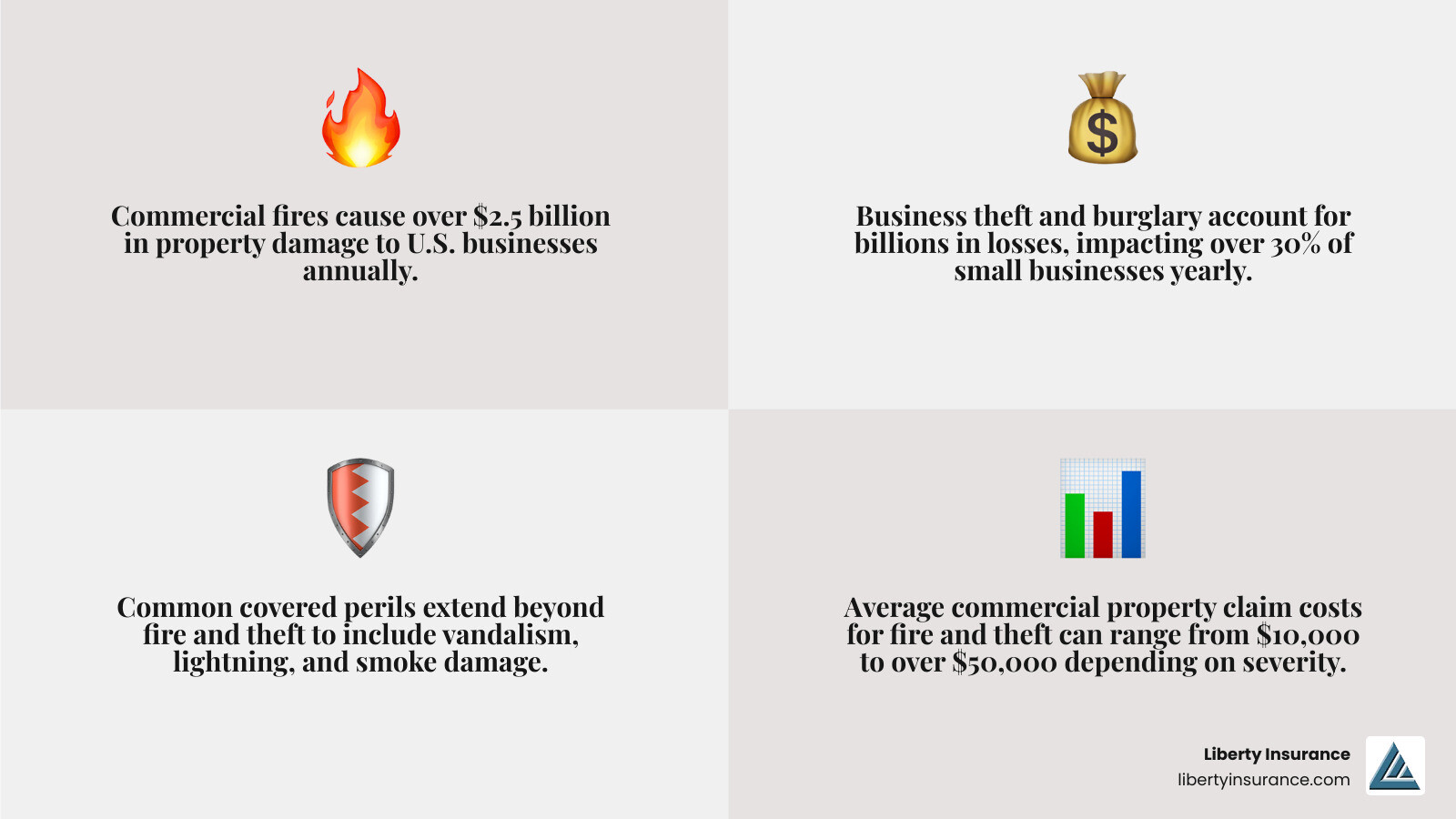
As research from the National Fire Protection Association (NFPA) consistently shows, commercial properties are highly susceptible to fires, with issues ranging from cooking equipment and electrical malfunctions to arson. Similarly, theft remains a persistent threat, from opportunistic shoplifting to organized burglaries. Without the right insurance, a single incident could be financially catastrophic.
Whether you’re running a busy restaurant in Newark, a retail shop in Jersey City, or a contracting business with a fleet of vans, understanding your insurance options is critical. This guide will walk you through everything you need to know about fire and theft insurance, from what it covers to how to choose the right policy for your New Jersey business. I’m Andrew Harris, a Certified Insurance Counselor (CIC) and Accredited Advisor in Insurance (AAI), and with over 15 years of experience, I’ve helped hundreds of business owners steer these exact decisions to secure their future.
What is Fire and Theft Insurance?
Think of fire and theft insurance as a specialized guardian for your business assets. It’s a type of property insurance that provides a focused shield against two of the most common and potentially devastating perils: fire and theft. This policy is often referred to as “Named Perils” or “Specified Perils” coverage because it explicitly lists the risks it covers, which typically include fire, lightning, explosion, and various forms of theft.
Unlike a comprehensive or “All-Risk” policy that covers everything unless it’s specifically excluded, a fire and theft policy covers only the perils named in the policy documents. This targeted approach makes it a more affordable option than broader coverage, offering a crucial safety net for businesses that want to protect their physical assets without paying for coverage they may not need.
Imagine you own a local retail store in Paterson, NJ. A faulty wire in a display case sparks a fire overnight, causing significant smoke and water damage from the sprinkler system. Or, consider a scenario where your warehouse in Elizabeth is broken into, and thousands of dollars in inventory are stolen. In both cases, a fire and theft policy would be the financial lifeline that helps you recover, repair, and restock, preventing a single incident from becoming a business-ending catastrophe.
This type of coverage can be applied to different aspects of your business, and it’s important to understand the distinction.
The Two Main Contexts: Property and Auto
When we discuss fire and theft insurance, we’re generally talking about two distinct categories of protection, each with its own specific applications.
1. Commercial Property Insurance:
This is the most common context for fire and theft coverage. It’s designed to protect your physical business location and its contents. This includes:
- The Building: If you own the building your business operates from, this policy covers the structure itself against fire damage.
- Contents & Inventory: This is critical for any business. It covers your stock, raw materials, furniture, fixtures, and office equipment from both fire and theft.
- Machinery and Equipment: For manufacturers, restaurants, or specialized service providers, this protects the expensive machinery essential to your operations.
In the context of property, “theft” is a broad term. It can cover everything from a smash-and-grab burglary that results in stolen goods and a broken window to vandalism that occurs during an attempted break-in. For a business owner, having this protection is fundamental. Our Commercial Property Insurance can be custom to provide the precise level of fire and theft protection your business requires.
2. Commercial Auto Insurance:
For your business vehicles, fire and theft insurance is an optional coverage that sits between basic liability and full comprehensive insurance. It’s often bundled with “Combined Additional Coverage” (CAC) and is sometimes called “Limited Comprehensive.”
This policy protects your work trucks, vans, or cars from non-collision-related incidents. If your delivery van is stolen from a job site in Trenton or your work truck catches fire due to an engine malfunction, this coverage would pay for the repair or replacement of the vehicle itself. It’s an excellent option for older vehicles that still have significant value but may not warrant the higher cost of full comprehensive coverage. Our Commercial Auto Insurance experts can help you decide if this is the right fit for your fleet.
How It Works: The Claims Process in a Nutshell
Facing a loss from a fire or theft is stressful enough without being confused about the insurance process. Here’s a simplified breakdown of what to expect when you need to make a claim:
- Secure the Scene & Notify Authorities: Your first priority is safety. In case of a fire, call 911 immediately. For a theft, report it to the police. A fire or police report is crucial for your insurance claim.
- Contact Your Insurer: Report the incident to your insurance agent or company as soon as possible. They will guide you through the next steps and provide you with the necessary claim forms.
- Document the Damage: Before you clean up, take extensive photos and videos of the damage from every angle. Make a detailed list of all stolen or damaged items, including their description, age, and estimated value. Gather any receipts or proofs of purchase you have.
- The Adjuster’s Assessment: Your insurer will assign a claims adjuster to investigate the loss. The adjuster will review your documentation, inspect the damage, and determine the value of your claim based on your policy terms.
- Pay Your Deductible: The deductible is the amount you agreed to pay out-of-pocket before your insurance coverage begins. For example, if your claim is for $15,000 and you have a $1,000 deductible, you will cover the first $1,000, and the insurance company will pay the remaining $14,000.
- Settlement and Repair: Once the claim is approved, your insurer will issue a payment to cover the cost of repairs or replacement of the damaged or stolen property, up to the limits of your policy. This payment might be based on the Actual Cash Value (ACV), which accounts for depreciation, or the Replacement Cost (RC), which covers the cost of replacing the item with a new, similar one. Our goal is to help you get back on your feet with minimal financial disruption.
Understanding Your Coverage: What’s Included and What’s Not
When you purchase fire and theft insurance, you’re buying a specific promise of protection. Knowing the exact details of that promise is crucial to avoiding surprises when you need to file a claim. Think of your policy as a detailed agreement that outlines precisely what perils are covered, what situations are excluded, and what extra protections you can add. A thorough review of your Commercial Property Insurance Policy is the best way to understand your coverage, but here’s a general guide to what you can typically expect.
Specific Perils Typically Covered
Fire and theft insurance is a “named perils” policy, meaning it only covers the risks specifically listed in the contract. While policies can vary, the standard covered perils usually include:
- Fire: This is the core of the policy. It covers damage caused by hostile fires (fires that are uncontrolled and break out from where they are supposed to be). This also typically includes damage from smoke, soot, and the water or chemicals used by firefighters to extinguish the blaze.
- Lightning: Direct damage caused by a lightning strike, such as a fire or damage to your building’s structure or electrical systems.
- Explosion: Covers damage from the explosion of gas lines, boilers, or other equipment on your premises.
- Theft: This is a broad category that often includes:
- Burglary: The unlawful entry into your building with the intent to steal. Evidence of forced entry, like a broken window or a pried-open door, is usually required.
- Robbery: The taking of property by force or threat of violence against a person.
- Looting: Often covered if it occurs during a riot or civil commotion.
- Vandalism or Malicious Mischief: Intentional damage or destruction of your property by a third party. This can range from graffiti to smashed windows and destroyed equipment.
- Windstorm and Hail: Damage caused by high winds or hailstones. This is a valuable protection, especially in areas prone to severe weather. However, coverage for certain coastal areas in New Jersey might have specific limitations or higher deductibles.
- Damage from Aircraft or Vehicles: Covers damage to your property if it’s struck by an aircraft, spacecraft, or a vehicle not owned by you.
Our Commercial Fire Damage Insurance policies are designed to provide robust protection against these specific risks, ensuring your business can recover from a catastrophic event.
Common Exclusions and Restrictions
Just as important as knowing what’s covered is understanding what’s not covered. These exclusions are in place because the risks are either too large, better covered by a different type of policy, or within the business owner’s control. Common exclusions include:
- Flood and Water Damage: Damage from rising water, such as rivers overflowing, storm surges, or sewer backups, is almost always excluded. You need a separate Flood Insurance policy for this, often through the National Flood Insurance Program (NFIP).
- Earth Movement: This includes earthquakes, landslides, and sinkholes. Like flood insurance, this requires a separate, specialized policy.
- Employee Theft: Standard fire and theft policies cover theft by external parties. If an employee steals from you, that falls under a different type of policy called Crime Insurance or a Fidelity Bond. Our Business Crime Insurance can protect you from this internal risk.
- Wear and Tear: Insurance is designed for sudden and accidental events, not for the gradual deterioration of property. Rust, rot, mold (unless caused by a covered peril), and general aging are not covered.
- Negligence or Intentional Acts: If you intentionally damage your own property, it’s considered fraud and is not covered. Gross negligence, such as leaving the premises open uped and unsecured, could also lead to a claim denial.
- Collision (for Vehicles): Fire and theft coverage for a vehicle does not cover damage from an accident where you are at fault. For that, you would need Collision coverage.
Important Add-ons (Endorsements) to Consider
Your basic fire and theft policy provides a strong foundation, but you can improve it with optional coverages, known as endorsements or riders, to create a more comprehensive safety net.
- Business Interruption Insurance: This is arguably the most critical add-on for any business. If a fire or major theft forces you to shut down temporarily, this coverage helps replace your lost income and covers ongoing operating expenses like rent, payroll, and utilities. It ensures that a property loss doesn’t turn into a complete business failure. You can learn more on business interruption coverage to see how vital it is.
- Extra Expense Coverage: This often goes hand-in-hand with business interruption. It covers the additional costs of keeping your business running at a temporary location while your primary site is being repaired, such as rent for a temporary space, moving costs, and equipment rental.
- Debris Removal: After a major fire, the cost of clearing away the rubble and damaged materials can be substantial. This endorsement provides additional funds specifically for cleanup, which can sometimes exceed the limits of a standard policy.
- Spoilage Coverage: Essential for restaurants, florists, and grocery stores, this covers the loss of perishable goods if they spoil due to a covered event, like a fire causing a power outage that shuts down your refrigeration systems.
- Contents Coverage (Replacement Cost vs. Actual Cash Value): Ensure your policy covers your business personal property at Replacement Cost (RC) rather than Actual Cash Value (ACV). RC pays to replace your damaged items with new ones of similar kind and quality, while ACV only pays what the items were worth at the time of the loss, factoring in depreciation. Our Business-Personal-Property-Insurance options can be structured to give you the best protection.
Comparing Policy Types: Fire & Theft vs. Comprehensive vs. Third-Party
Navigating business insurance can feel like learning a new language, with terms like “comprehensive,” “named perils,” and “liability” often causing confusion. Understanding the key differences between these policy types is crucial for making an informed decision that protects your business without overpaying for unnecessary coverage. Let’s break down how fire and theft insurance compares to other common options.

The Spectrum of Coverage
Think of your insurance options as a spectrum, from the most basic legal requirement to the most complete protection available.
Third-Party Liability (or Commercial General Liability): This is the most basic form of business insurance. It does not cover your own property. Instead, it protects your business if you are found legally responsible for injuring another person or damaging their property. For example, if a customer slips and falls in your store, or your work causes damage to a client’s home, this policy would cover their medical bills or repair costs. It is essential for every business, but it offers no protection for your own assets.
Fire and Theft Insurance (Named Perils): This is the next step up. It protects your own property (buildings, equipment, inventory, vehicles) from a specific list of dangers, or “perils.” As the name suggests, fire and theft are the core coverages, but it often includes others like lightning, windstorms, and vandalism. It’s a cost-effective way to protect against the most common and severe threats without paying for a full comprehensive policy.
Comprehensive Insurance (All-Risk or Open Perils): This is the highest level of property and auto insurance. Instead of listing what is covered, a comprehensive policy covers everything except for what is specifically excluded in the policy documents. This provides much broader protection against a wider range of potential incidents, including things like falling objects or accidental damage not covered by a named perils policy. For vehicles, it also covers non-collision events like weather damage, vandalism, and theft.
At-a-Glance Comparison
| Feature Covered | Third-Party Liability Only | Fire and Theft Insurance | Comprehensive (All-Risk) Insurance |
|---|---|---|---|
| Damage to Other People’s Property | Yes | No (This is a separate liability policy) | No (This is a separate liability policy) |
| Injury to Others | Yes | No (This is a separate liability policy) | No (This is a separate liability policy) |
| Damage to Your Property from Fire | No | Yes | Yes |
| Theft of Your Property/Vehicles | No | Yes | Yes |
| Damage from Vandalism | No | Yes | Yes |
| Damage from Weather (Wind, Hail) | No | Yes (Typically included) | Yes |
| Damage from Falling Objects | No | No (Usually not included) | Yes |
| Accidental Damage (e.g., vehicle collision) | No (Only covers the other party’s vehicle) | No (Does not cover collision damage to your vehicle) | Yes (Collision coverage is often bundled with or added to comprehensive auto policies) |
| Cost | Lowest | Moderate | Highest |
| Best For | Meeting legal minimums; businesses with few physical assets. | Businesses seeking a balance of essential property protection and affordability. | Businesses with high-value assets, those with financing/lease requirements, or those seeking maximum peace of mind. |
Choosing the right level of coverage depends on your risk tolerance, budget, and the nature of your business. For a deeper dive into all the options available, explore our guide on the Types of Business Insurance.
Who Needs Fire and Theft Insurance?
While virtually every business can benefit from the protection offered by fire and theft insurance, it is particularly crucial for certain industries where the risk of these events is higher or the potential financial impact is more severe. If your business relies heavily on physical assets like inventory, equipment, or a commercial space, this coverage is not just a good idea—it’s a fundamental part of a sound risk management strategy.
Here’s a look at some of the businesses that should consider fire and theft insurance a top priority:
1. Retail Stores and Boutiques
Retailers are prime candidates for this type of insurance. They hold valuable inventory on-site, making them attractive targets for theft, from organized burglary to shoplifting. Furthermore, the combination of electrical systems for lighting and displays, customer foot traffic, and stored goods creates a significant fire risk. A fire and theft policy protects both the merchandise on the shelves and the physical store itself.
2. Restaurants, Cafes, and Food Service Businesses
Commercial kitchens are high-risk environments for fires. With open flames, hot cooking surfaces, deep fryers, and complex ventilation systems, the potential for a fire is an everyday reality. A fire can not only destroy expensive kitchen equipment but also lead to prolonged business interruption. Spoilage coverage, often added to a fire and theft policy, is also vital for protecting refrigerated and frozen inventory in the event of a power outage caused by a fire.
3. Warehouses and Distribution Centers
These facilities store vast quantities of goods, making them a high-value target for large-scale theft. The sheer volume of inventory means that a fire can spread rapidly, leading to catastrophic losses. For businesses in logistics, warehousing, or e-commerce fulfillment, fire and theft insurance is essential for protecting the core of their operation.
4. Contractors and Tradespeople (Electricians, Plumbers, Carpenters)
Contractors often have thousands of dollars worth of tools and equipment stored in work vans, at job sites, or in a workshop. These assets are highly vulnerable to theft. A fire in a workshop or a vehicle fire could destroy a tradesperson’s entire set of tools, effectively putting them out of business overnight. A specialized form of this coverage, often called an Inland Marine or Contractor’s Equipment policy, can be custom to protect tools and equipment wherever they are.
5. Manufacturing and Production Facilities
Manufacturing plants use heavy machinery, electrical systems, and often flammable materials, all of which increase the risk of fire and explosions. The equipment itself is incredibly expensive to repair or replace. A robust fire and theft policy, combined with equipment breakdown coverage, is critical for mitigating these substantial risks.
6. Office-Based Businesses
Even businesses that don’t handle physical inventory can suffer significant losses. Think about the cost of replacing all your computers, servers, office furniture, and important documents after a fire or a break-in. Fire and theft insurance provides the financial backstop to get your office operational again quickly.
7. Landlords and Commercial Property Owners
If you own a building that you lease to other businesses, you have a significant investment to protect. A fire and theft policy (often part of a larger Business Building Insurance package) is fundamental. It covers the structure of the building itself, and most lenders and mortgage holders will require you to carry this coverage as a condition of your loan.
How to Choose the Right Fire and Theft Policy
Selecting the right insurance policy can feel overwhelming, but breaking it down into a logical process makes it manageable. The goal is to find a policy that provides adequate protection for your specific needs without overpaying for coverage you don’t require. Here’s a step-by-step guide to help you choose the best fire and theft insurance for your business.
Step 1: Assess Your Unique Risks
Start by evaluating the specific risks your business faces. Consider:
- Location: Is your business in an area with a high crime rate? Is it prone to wildfires or severe weather like windstorms?
- Building Construction: Is your building made of fire-resistant materials like brick or concrete, or is it a wood-frame structure?
- Business Operations: Do you work with flammable materials, heavy machinery, or high-end electronics? The nature of your work directly impacts your risk level.
- Security Measures: Do you have a monitored alarm system, security cameras, fire sprinklers, and smoke detectors? These can not only reduce your risk but also lower your premiums.
Step 2: Create a Detailed Inventory of Your Assets
To know how much coverage you need, you must first know the value of what you’re insuring. Create a comprehensive list of all your business assets, including:
- Building: If you own it, what is its current replacement cost?
- Inventory: What is the total value of your stock or raw materials?
- Equipment & Machinery: List all computers, tools, specialized machinery, and office furniture.
- Vehicles: List each commercial vehicle’s make, model, year, and any custom modifications.
For each item, try to find its original purchase price and estimate what it would cost to replace it today. This inventory is invaluable not only for getting an accurate quote but also for streamlining the claims process if you ever need to file one.
Step 3: Decide Between Actual Cash Value (ACV) and Replacement Cost (RC)
This is one of the most important decisions you’ll make.
- Actual Cash Value (ACV): This coverage pays for the cost to replace your damaged property minus depreciation. For example, if a 5-year-old computer is destroyed, ACV will pay you what a 5-year-old computer is worth, which is much less than the cost of a new one. ACV policies have lower premiums.
- Replacement Cost (RC): This coverage pays the full cost to replace your damaged property with a new, similar item at today’s prices, without any deduction for depreciation. While the premiums are higher, RC coverage provides a much better financial safety net, ensuring you can fully rebuild and replace what you lost.
For most businesses, Replacement Cost coverage is highly recommended as it provides the funds needed to get back to business without a significant out-of-pocket expense.
Step 4: Select an Appropriate Deductible
Your deductible is the amount you pay out-of-pocket for a claim before your insurance kicks in. A higher deductible will lower your premium, while a lower deductible will increase it. Choose a deductible that you can comfortably afford to pay on short notice. Don’t be tempted by a very low premium if the associated high deductible would be a financial hardship in an emergency.
Step 5: Review Policy Exclusions and Consider Add-ons
Carefully read the policy’s exclusions section. Understand what is not covered (e.g., flood, earthquake, employee theft). Then, consider if you need to add endorsements to fill those gaps. As discussed earlier, Business Interruption Insurance is a vital add-on for most businesses to cover lost income and ongoing expenses while you recover from a fire or theft.
Step 6: Compare Quotes from Reputable Insurers
Don’t accept the first offer you receive. Work with an independent insurance agent or broker who can gather quotes from multiple carriers. This allows you to compare not just prices but also the specific terms, limits, and service ratings of different insurance companies. When you’re ready, you can easily Get an Insurance Quote with us to start the process.
The Claims Process: A Step-by-Step Guide
When disaster strikes, knowing what to do can make a stressful situation more manageable. The insurance claims process is designed to be systematic, but being prepared can help ensure it goes as smoothly and quickly as possible. Here’s a detailed look at the steps you should take after experiencing a fire, theft, or other covered event.
Step 1: Prioritize Safety and Mitigate Further Damage
Your first and most important responsibility is to ensure the safety of yourself, your employees, and your customers.
- In case of fire: Evacuate immediately and call 911. Do not re-enter the building until the fire department has declared it safe.
- In case of theft or vandalism: Do not touch anything. Call the police immediately to file a report. A police report is essential documentation for your insurance claim.
Once the immediate danger has passed, take reasonable steps to prevent further damage. This is known as your “duty to mitigate.” For example, you might board up a broken window to prevent looting or weather damage, or place a tarp over a damaged roof to stop rain from getting in. Keep receipts for any temporary repairs, as these may be reimbursable under your policy.
Step 2: Notify Your Insurance Company Promptly
Contact your insurance agent or the insurance company’s claims department as soon as possible. The sooner you report the loss, the sooner they can begin the process of helping you recover. Be prepared to provide:
- Your policy number.
- The date, time, and location of the incident.
- A brief description of what happened.
- The contact information for any authorities you’ve notified (e.g., police or fire department).
Your insurer will assign you a claim number and an adjuster who will be your main point of contact throughout the process.
Step 3: Document the Damage Thoroughly
This is a critical step. Before you clean up or dispose of anything (unless it’s a safety hazard), document the extent of the loss in detail.
- Take Photos and Videos: Use your smartphone to take numerous pictures and videos of the damage from different angles. Capture both wide shots of the affected area and close-ups of specific damaged items.
- Create an Inventory: Make a comprehensive list of all damaged, destroyed, or stolen items. For each item, include a description, brand, model number, original cost, and approximate age. If you have receipts, manuals, or original packaging, gather them together.
- Gather Records: Collect any relevant documents, such as the police or fire report, witness statements, and repair estimates.
Step 4: Cooperate with the Insurance Adjuster
The insurance company will assign an adjuster to investigate your claim. The adjuster’s job is to assess the scope of the damage and determine the value of your loss according to the terms of your policy. They will likely schedule a time to visit your property to inspect the damage in person. Be cooperative, honest, and provide all the documentation you’ve gathered. A smooth and transparent inspection process can help expedite your claim.
Step 5: Review the Settlement Offer and Finalize the Claim
After the investigation, the adjuster will provide you with a settlement offer. This document will detail the covered damages and the amount the insurance company will pay. Review this offer carefully to ensure it accurately reflects your losses and is in line with your policy’s coverage (e.g., Replacement Cost vs. Actual Cash Value).
If you agree with the settlement, you will sign a release, and the insurer will issue payment, minus your deductible. If you disagree with the offer, you have the right to negotiate. You can provide additional documentation or get your own independent estimates to support your case. Once an agreement is reached, the claim is settled, and you can begin the process of rebuilding and replacing what was lost.
Factors That Influence Your Fire and Theft Insurance Premium
When an insurance company calculates your premium, they are essentially assessing risk. The higher the perceived risk of a claim, the higher your premium will be. Understanding the factors that influence this calculation can empower you to make changes that may lower your costs over time. Here are the key elements that determine the price of your fire and theft insurance policy:
1. Location of Your Business
Where your business is located plays a significant role. Insurers use geographic data to assess risk, including:
- Crime Rates: Businesses in areas with higher rates of theft and vandalism will face higher premiums.
- Proximity to a Fire Station: The closer your business is to a well-equipped fire department, the faster they can respond, potentially reducing the severity of a fire. This can lead to lower rates.
- Fire Hydrant Access: Easy access to fire hydrants is also a positive factor.
- Natural Hazard Zones: While standard policies often exclude floods and earthquakes, proximity to areas prone to wildfires or severe windstorms can still impact your fire and wind coverage rates.
2. Construction and Age of the Building
The materials used to build your commercial property are a major consideration.
- Construction Type: Buildings made of fire-resistant materials like masonry or steel (classified as “joisted masonry” or “non-combustible”) are cheaper to insure than those with wood frames.
- Age and Condition: Older buildings may have outdated electrical wiring or plumbing, increasing the risk of fire. A well-maintained building with updated systems will generally secure a better rate.
3. Your Business’s Industry and Operations
What you do for a living matters. An office-based business has a much lower fire risk than a restaurant with commercial cooking equipment or a woodworking shop filled with flammable materials and sawdust. Insurers classify businesses by risk level, and this is a primary driver of your premium.
4. Value of Insured Property
This is a straightforward calculation: the more your property is worth, the more it will cost to insure. The total value of your building, equipment, and inventory directly impacts the coverage limits you need, and higher limits mean higher premiums.
5. Security and Safety Features
Proactive risk management is rewarded by insurers. You can often earn significant discounts by installing and maintaining:
- Fire Suppression Systems: Monitored smoke and heat detectors, automatic sprinkler systems, and fire extinguishers.
- Security Systems: A centrally monitored burglar alarm, surveillance cameras, and high-quality locks.
6. Your Claims History
Your past insurance claims record is a strong predictor of future claims. A business with a history of frequent or large fire or theft claims will be seen as a higher risk and will likely pay more for coverage. Conversely, a clean claims history can help you secure more favorable rates.
7. Your Chosen Deductible and Coverage Options
Finally, the choices you make when structuring your policy have a direct impact on cost:
- Deductible: As mentioned earlier, a higher deductible means you take on more of the initial risk, which lowers your premium.
- Coverage Type: Choosing Replacement Cost (RC) coverage is more expensive than Actual Cash Value (ACV) coverage, but it provides greater financial protection.

