
Navigating Your Disability Application Journey
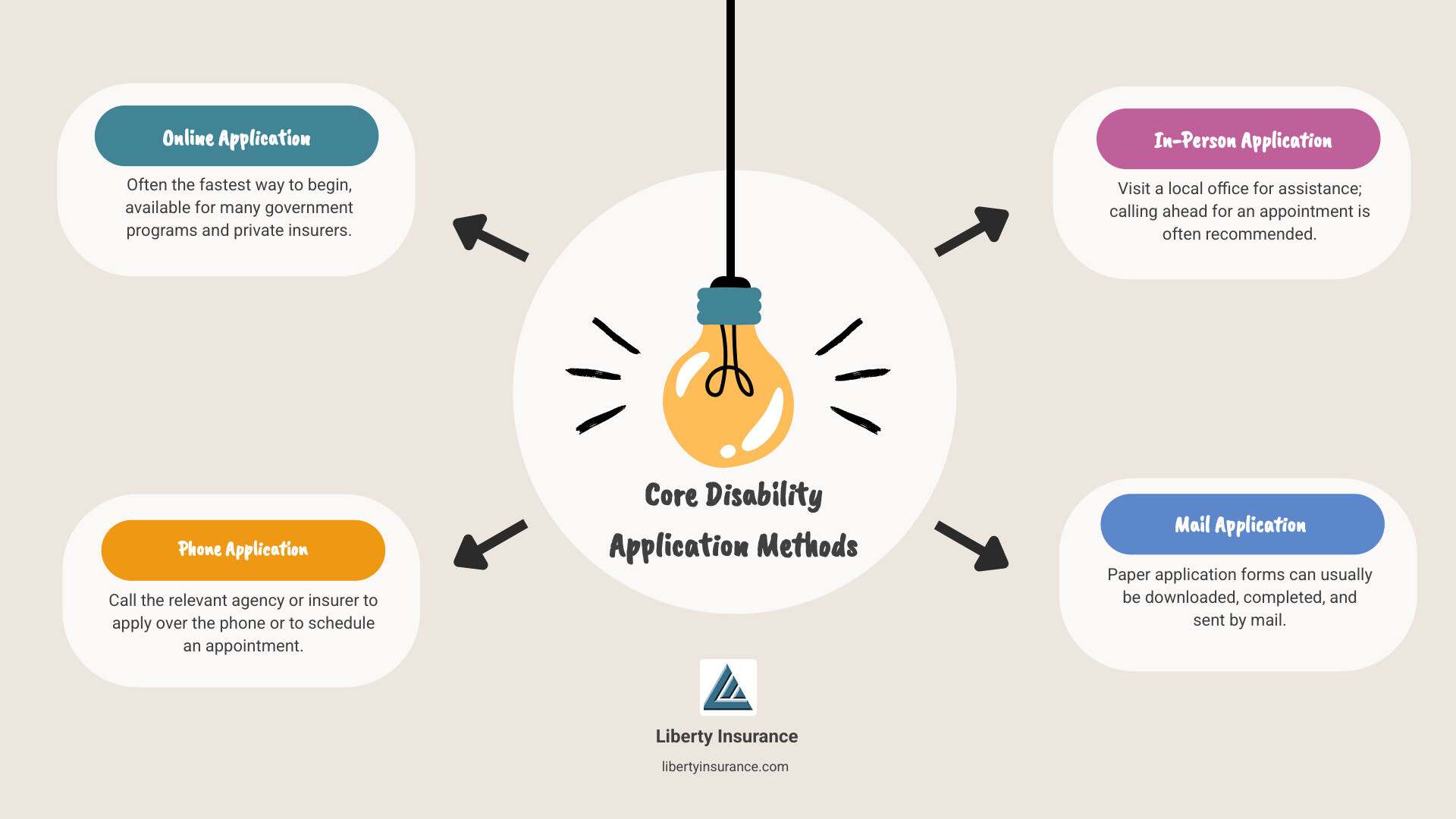
Understanding how to apply for disability can feel overwhelming when you’re already facing health challenges. The process typically begins with an application submitted online, by phone, in person, or through the mail, with online portals often being the fastest method.
While few people like to think about it, the risk of disability is significant. Studies show a 20-year-old worker has a 1-in-4 chance of becoming disabled before retirement age. When a medical condition prevents you from working, disability benefits provide a critical financial safety net. This guide will walk you through the complex world of disability applications, covering options in the U.S., Canada, and through private insurance to make the process clear and manageable.
My name is Andrew Harris, and with Certified Insurance Counselor (CIC) and Accredited Advisor in Insurance (AAI) designations, I have years of experience helping people steer complex insurance topics. My goal is to explain how to apply for disability and access other crucial benefits in simple, understandable terms.
Understanding and Preparing for Your Disability Application
Applying for disability benefits requires careful preparation. Whether you’re dealing with a government program or a private insurer, understanding the landscape and gathering your documents beforehand makes the process much more manageable.

Types of Benefits: Government vs. Private Insurance
When learning how to apply for disability, you must first identify which type of benefit you’re seeking.
Government programs, like those run by the Social Security Administration (SSA) in the U.S., are tax-funded social safety nets. They provide basic financial support for those who can’t work due to severe, long-term disability.
Private insurance benefits come from policies you or your employer pay for. They replace a portion of your income. Employer plans often include both Short-Term Disability (STD) and Long-Term Disability (LTD).
A crucial difference in private insurance is the definition of “disability.” Many STD policies use an “own occupation” definition, meaning you qualify if you can’t perform your specific job. LTD policies often start with “own occupation” but may switch to a stricter “any occupation” definition after two years. This transition is a critical point in many claims, as it becomes harder to prove you cannot perform any job for which you are reasonably suited by education, training, or experience.
Assembling Your Core Application Documents
Gathering documents before you apply will save time and prevent delays. Think of this as building the foundation of your case. Here’s what you’ll generally need:
- Personal Identification: Social Security Number, birth certificate (or proof of legal residency/citizenship). If you are applying for benefits for your spouse or children, you will also need their birth certificates and Social Security numbers, as well as your marriage certificate.
- Medical Information: This is the heart of your claim. Compile a comprehensive list of all doctors, hospitals, clinics, and therapists you have seen for your condition, including their full contact information and the dates of your visits. List all medications you take, including dosages and any side effects. While the SSA and insurers will request records directly, it is wise to gather your own copies of key documents, such as MRI reports, blood test results, specialist consultation notes, and hospital discharge summaries. This ensures you know what is in your file and can point to the most critical evidence.
- Work History: Document all jobs from the last 15 years. This is crucial for the SSA to determine if you can return to your past relevant work. For each job, list your title, dates of employment, rate of pay, and a detailed description of your daily duties. Be specific: instead of “office work,” write “typed for 6 hours daily, lifted 20-pound boxes of paper, and sat in meetings for 2 hours.” Collect recent W-2 forms or self-employment tax returns to prove your work history and earnings.
- Banking Information: Have your bank account and routing number ready for direct deposit. This ensures that if your claim is approved, you will receive your payments without delay.
Extra items that strengthen your claim
Beyond the basics, these items can provide powerful, persuasive context:
- Symptom diary: A detailed, daily or weekly log of your symptoms (pain levels, fatigue, cognitive difficulties) and how they affect your ability to perform daily tasks like cooking, cleaning, or driving.
- Functional capacity evidence: This includes formal assessments from physical or occupational therapists (Functional Capacity Evaluations or FCEs) that objectively measure your physical abilities, such as how long you can sit, stand, walk, or how much you can lift.
- Treating provider letters: A detailed statement or “Medical Source Statement” from your primary treating specialist is often more valuable than hundreds of pages of medical records. This letter should clearly state your diagnosis, prognosis, and, most importantly, specific functional limitations (e.g., “Patient cannot stand for more than 10 minutes at a time” or “Patient would be absent from work more than 3 days per month due to their condition”).
- Job descriptions: Provide both the official HR job description and your own plain-language summary of your actual job duties. This helps the claims examiner understand the real-world demands of your past work.
- Third-party statements: Written statements from former supervisors, coworkers, or family members who have witnessed how your condition impacts your ability to function can be very compelling.
Timing Your Application
- Government benefits (SSA): Apply as soon as you and your doctor believe your condition will prevent you from working for at least 12 months. There is a five-month waiting period for SSDI benefits, so the sooner you apply, the sooner your potential benefits can begin.
- Private STD/LTD: File promptly according to your policy’s deadlines, which are often within 30-90 days of your last day of work. Missing these deadlines can result in a denial of your claim.
- FMLA/paid leave: The Family and Medical Leave Act (FMLA) can provide job protection while you are out on disability. It often runs concurrently with STD benefits, so you should coordinate with your HR department to manage all available leave and benefits to avoid gaps in pay or coverage.
How to Apply for Government Disability Benefits in Canada
Before covering the U.S. programs relevant to our New Jersey community, it’s helpful to briefly touch on Canada’s system. This information does not apply to residents of Millstone Township, Trenton, or elsewhere in NJ, but provides broader context on how to apply for disability for those with connections north of the border.
Canada uses a two-tiered system with both federal and provincial disability programs. The primary federal program is the Canada Disability Benefit (CDB), a newer initiative for working-age Canadians with disabilities. Applications can be submitted through various methods, including the CDB application portal.
At the provincial level, an example is the Ontario Disability Support Program (ODSP). This program provides income support, health benefits, and employment assistance. The application process, which can be started at the ODSP application portal, requires a healthcare professional to complete a detailed Disability Determination Package (DDP). Applicants can check their status via the MyBenefits portal.
While these programs are vital for Canadians, the next section focuses on the U.S. Social Security benefits that are relevant to you.
How to Apply for Government Disability Benefits in the United States
For residents of the United States, including those in Millstone Township, Trenton, and across New Jersey, the Social Security Administration (SSA) is the main resource for government disability benefits.
Understanding SSA Programs: SSDI vs. SSI
The SSA runs two distinct disability programs:
Social Security Disability Insurance (SSDI) is an earned benefit for individuals who have worked and paid Social Security taxes. Your eligibility and benefit amount are based on your work history. After 24 months of receiving SSDI, you become eligible for Medicare.
Supplemental Security Income (SSI) is a needs-based program for disabled adults and children with limited income and resources, regardless of work history. SSI recipients are typically eligible for Medicaid immediately.
| Criteria | SSDI | SSI |
|---|---|---|
| Funding Source | Social Security taxes | General tax revenues |
| Eligibility | Requires sufficient work history | Based on financial need |
| Healthcare Coverage | Medicare (after 24-month wait) | Medicaid (generally immediate) |
Both programs use the same strict definition of disability: a medical condition expected to last at least one year or result in death that prevents you from engaging in “substantial gainful activity” (SGA).
How to Apply for Disability: The SSA Online Process
The most convenient way to apply is through the online disability application at https://secure.ssa.gov/iClaim/dib. You can also apply by phone at 1-800-772-1213 or in person at a local Social Security office.
When you apply, you’ll need to provide personal, medical, and work history information. Don’t delay applying if you’re missing something – the SSA can help you obtain necessary documents.
After submission, the SSA forwards your application to your state’s Disability Determination Services (DDS) for medical evaluation. The average processing time is six to eight months.
What you complete when applying
- Initial application for SSDI and/or SSI
- Adult Disability Report (SSA-3368): Full medical and work history
- Work History Report (SSA-3369): Detailed job duties for the last 15 years
- Function Report (SSA-3373): How your condition affects daily activities
- Authorization (SSA-827): Allows SSA/DDS to request your records
The SSA’s 5-Step Disability Evaluation Process
The DDS uses a five-step process to evaluate your claim:
- Are you working? If earning above SGA limit, you’re generally found not disabled
- Is your condition severe? Must significantly limit basic work activities for 12+ months
- Does your condition meet a listing? Checks against SSA’s Listing of Impairments
- Can you do your past work? If yes, claim is denied
- Can you do any other work? Considers age, education, and skills
Find more details in the SSA’s official publication on the evaluation process.
Practical tips to strengthen your SSA claim
- Establish regular care: Consistent visits with specialists matter
- Document functional limits: Be precise about walking distance, sitting/standing duration, lifting capacity
- Be consistent: Align what you say to providers, on forms, and in examinations
- Follow treatment: Adherence to prescribed treatment strengthens your case
Expedited paths and special considerations
- Compassionate Allowances: Certain severe diagnoses receive expedited decisions
- Terminal illness (TERI): Terminal cases are prioritized
- Work credits (SSDI): You need enough recent work to qualify; requirements depend on age
- Protective filing date: Starting an online application establishes an earlier filing date
- Back pay: If approved, you may receive past-due benefits from your established onset date
After You Apply: The Review Process and Next Steps
Submitting your application is a major milestone, but the process continues. Here’s what to expect during the review phase.

The Insurance Company’s Review Process (for Private Plans)
After submitting a private disability claim, a case manager is assigned. The process typically involves:
- Functional Telephone Interview: Discussion about daily activities and work impact
- Medical Record Review: Internal medical consultants review your file
- Additional assessments: May include Independent Medical Examination (IME) or Functional Capacity Evaluation (FCE)
Many employer-sponsored LTD plans are governed by ERISA and follow strict timelines for decisions and appeals.
What to Expect While You Wait
Processing times vary: SSA applications average 6 to 8 months, while private claims can take weeks to months. Check your SSA application status online in your my Social Security account. For private claims, contact your case manager.
While waiting:
- Continue medical treatment
- Respond promptly to information requests
- Keep detailed records of all communications
- Meet all deadlines (appeals typically have 60-day windows for SSA)
Handling a Decision: Approval vs. Denial
If approved, you’ll receive a letter detailing your benefit amount and start date. For SSDI, there’s a 5-month waiting period, with benefits beginning in the sixth full month after disability onset. You become eligible for Medicare after receiving SSDI for 24 months.
For private benefits:
- Review offsets and coordination with other benefits
- Prepare for ongoing proof requirements
- Understand own-occupation to any-occupation transitions
If denied, don’t give up. The SSA appeals process has several levels:
- Reconsideration
- Hearing before an Administrative Law Judge
- Appeals Council Review
- Federal Court lawsuit
File appeals on time and submit new evidence addressing denial reasons. Many people hire an attorney specializing in disability law for appeals.
Life after approval
- Continuing Disability Reviews (CDR): SSA periodically reviews your case
- Work incentives: Trial Work Period lets you test employment without losing benefits
- Gradual return planning: Coordinate with doctors and case managers
Frequently Asked Questions about How to Apply for Disability
How long does the disability application process take?
For the Social Security Administration, an initial decision takes an average of 6 to 8 months. Appeals can extend this to over a year. Private insurance claims range from a few weeks to several months. Submit a complete application and respond quickly to requests to speed up the process.
Can I work while applying for or receiving disability benefits?
Yes, but there are strict rules. For SSA benefits, earnings must generally be below the “Substantial Gainful Activity” (SGA) limit. Once approved, the SSA has work incentive programs like the Ticket to Work program. Private disability policies have their own rules, with some allowing partial disability provisions.
What’s the difference between government disability benefits and private disability insurance?
Understanding this is key when learning how to apply for disability:
- Purpose: Government benefits provide basic support; private insurance replaces income percentage
- Funding: Government uses taxes; private uses premiums
- Eligibility: Government has strict legal definitions; private depends on policy terms
- Benefit Amount: Government benefits are modest; private typically replaces 60-70% of income
Do I need a lawyer to apply for disability?
Not necessarily. Many people apply independently and are approved. However, if denied, a representative can help steer appeals, gather evidence, and meet deadlines. For SSA cases, attorney fees are typically contingency-based and capped by law.
What medical conditions are most commonly approved?
Approval depends on documented functional limitations rather than diagnosis alone. Conditions like severe musculoskeletal disorders, neurological diseases, cancer, heart failure, chronic respiratory disorders, autoimmune diseases, and serious mental health conditions can qualify if evidence shows you cannot sustain full-time work.
How much will I receive if approved?
- SSDI: Based on lifetime earnings and payroll tax contributions
- SSI: Set federal benefit reduced by countable income and resources
- LTD: Typically 60-70% of pre-disability earnings, subject to offsets
What if my condition improves after approval?
SSA conducts Continuing Disability Reviews (CDRs). If your condition improves enough to work at substantial levels, benefits may stop after due process. Private insurance also conducts periodic reviews.
How do workers’ compensation and disability benefits interact?
Receiving workers’ compensation can reduce SSDI and LTD payments. Report all such benefits to avoid overpayments.
What are the most common mistakes to avoid?
- Waiting too long to apply
- Minimizing symptoms on forms
- Inconsistent statements across records
- Missing appeal deadlines
- Not following prescribed treatment
Conclusion: Your Path to Financial Security
You now have a roadmap for how to apply for disability. While the process can be complex, involving many steps and waiting periods, you are now equipped with the knowledge to steer it.
We’ve covered the types of benefits (government vs. private), the documents you need, the application steps for the Social Security Administration, and what to do after you receive a decision. The most important takeaways are that preparation and persistence are your greatest allies. Gather your documents early, keep detailed records, and don’t give up if you receive a denial—many successful claims are approved on appeal.
Government programs like SSDI and SSI provide an essential safety net. However, these benefits are often modest and may not be enough to maintain your lifestyle. This is where private long-term disability insurance becomes invaluable, typically replacing 60–70% of your income and providing financial stability during a difficult time.
At Liberty Insurance, we specialize in commercial property insurance, protecting your business’s physical assets. We also believe in a holistic approach to business protection, which includes supporting your team. Offering comprehensive benefits like disability insurance is not just good business; it builds a loyal, secure workforce. Being proactive about understanding your disability coverage options is a key step toward financial security.
Next steps:
- Organize your medical and work records and start your SSA application if appropriate.
- Review your employer benefits and policy deadlines; file STD/LTD on time.
- Keep a clear log of symptoms and treatments; follow through on care plans.
- If denied, appeal promptly and consider professional representation.
Find out more about protecting your income and find how the right coverage can provide peace of mind for you and your team.

