
Why Your Business Property Needs Protection Beyond Your Four Walls
In today’s dynamic business environment, your company’s most valuable assets are rarely confined to a single location. The modern economy thrives on mobility—from construction equipment moving to a new job site and high-value products being shipped to customers, to critical data servers being installed at a client’s office. This constant movement, while essential for growth, creates significant risks that a standard commercial property insurance policy is not designed to cover.
Inland marine insurance for business is the specialized shield that protects your company’s property once it leaves your primary location. Whether it’s equipment traveling to job sites, goods in transit, or inventory stored temporarily at third-party warehouses, this coverage is designed to move with your assets. Here’s what you need to know:
- What it covers: Mobile equipment, contractors’ tools, computers and electronics, inventory in transit, property at temporary locations, fine art, and other high-value items stored off-site.
- Key protection: It provides crucial financial protection against common risks like theft, collision damage, fire, vandalism, and loss during land-based transport.
- Who needs it: A wide range of industries, including construction contractors, truckers, technology firms, healthcare providers with mobile equipment, art galleries, event planners, and any business that ships or transports high-value items.
- Main benefit: It fills the critical and often overlooked gaps left by standard commercial property insurance, which typically only covers assets at the fixed business address listed on the policy.
Despite its confusing name, inland marine insurance has nothing to do with the open sea. It’s a specialized form of property coverage that protects the lifeblood of businesses whose assets are constantly on the move. Industry data consistently shows that cargo theft and transportation accidents are among the most frequent and costly causes of inland marine losses—risks that standard property policies simply don’t address. A single stolen trailer of goods or a damaged piece of heavy machinery can lead to crippling financial losses, project delays, and reputational damage.
Do you transport expensive equipment to client sites, ship products to customers, or store inventory at a third-party warehouse? If you answered yes to any of these questions, you likely have a significant coverage gap that could cost your business thousands, or even millions, if something goes wrong. The right inland marine policy can mean the difference between a minor, manageable setback and a business-ending financial disaster.
What is Inland Marine Insurance? Explaining the Coverage
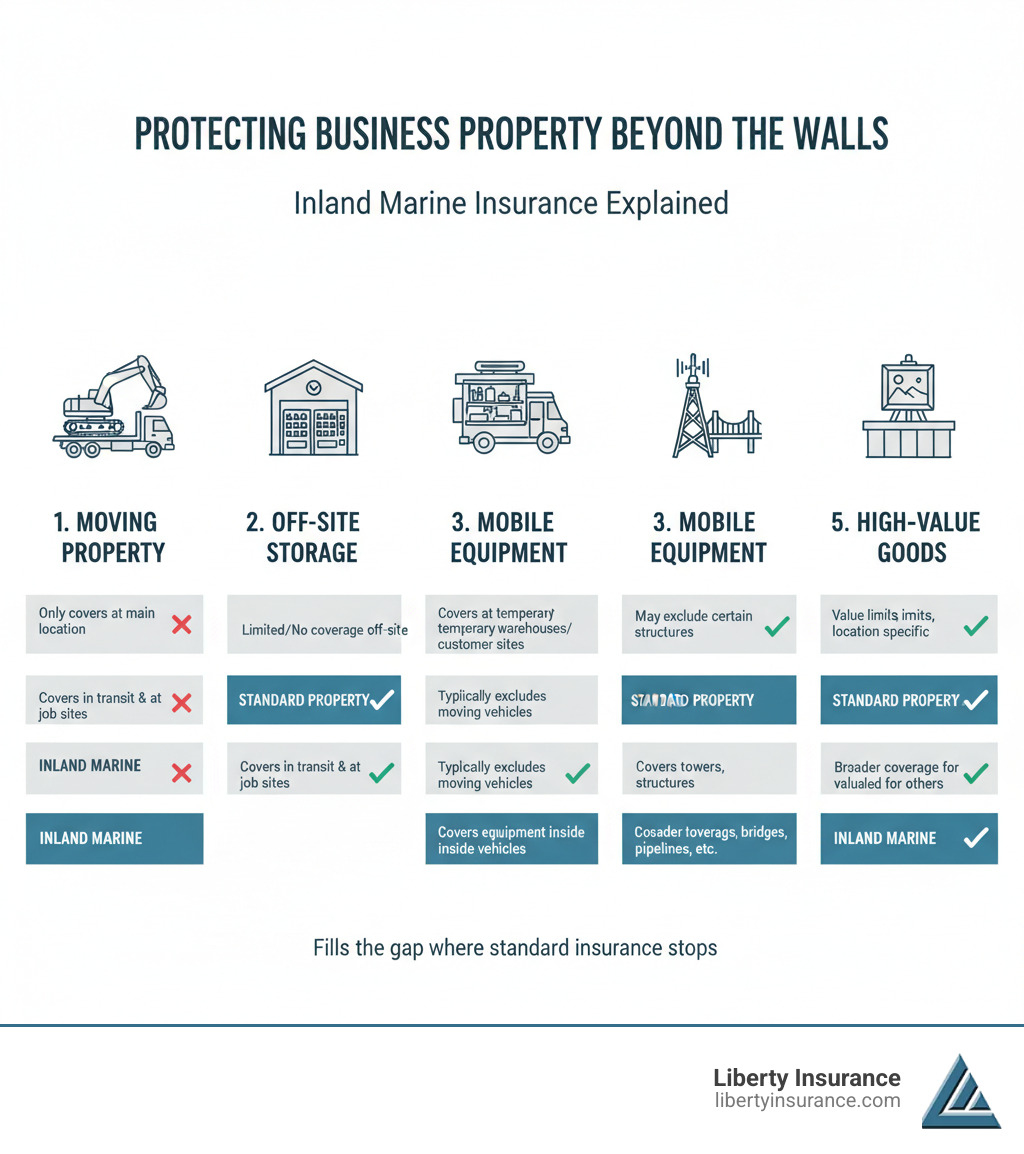
Inland marine insurance for business is a specialized type of business insurance that protects your property while it is in transit or temporarily away from your primary business location. It covers property that is on the move—traveling over land, temporarily stored off-site, or part of a mobile operation. It acts as a critical supplement to your standard commercial property insurance, protecting the assets that leave your four walls.
At its core, inland marine insurance is designed to follow your movable property wherever it goes. Think about the contractor who drives a $50,000 excavator to a job site in Trenton or the IT consultant transporting delicate servers to a client’s office in Cherry Hill. If that valuable equipment is damaged in a traffic accident, stolen from a job site overnight, or destroyed by a fire at a temporary storage facility, this policy provides the financial protection to repair or replace the asset and keep your business running.
Inland Marine vs. Ocean Marine Insurance
The name “inland marine” is a historical artifact from a time when insurance was broadly categorized into fire, life, and marine (ocean). As commerce expanded inland from coastal ports via railways and trucks, a new form of coverage was needed to protect goods during these land-based journeys. This gave rise to “inland” marine insurance to distinguish it from its seafaring counterpart. For a concise overview of the coverage and its history, see Inland marine insurance.
- Ocean marine insurance protects goods, cargo, and vessels primarily during transit over water, including international sea voyages. It also covers risks associated with maritime operations, such as liability for collisions at sea.
- Inland marine insurance focuses on land-based transportation and movable property. It covers items transported by truck, rail, or air freight within a country, as well as property that is mobile by nature (like a food truck) or temporarily in someone else’s care.
For most businesses operating in New Jersey, from construction firms to tech companies, inland marine is the essential coverage that addresses day-to-day operational risks involving mobile property.
How It Complements Your Commercial Property Insurance
Inland marine insurance for business doesn’t replace your commercial property insurance; it works in tandem with it to create a comprehensive blanket of protection. Your standard commercial property policy is fundamental, protecting assets at your main business location—your building, office furniture, stationary equipment, and on-site inventory. However, this coverage is geographically specific and typically limited to the address listed on your policy, sometimes with a small radius of extension (e.g., 100 or 500 feet from the premises).
That’s where inland marine insurance becomes essential. It picks up where your property insurance stops, protecting your mobile assets and property in transit. When your construction crew loads a truck with $100,000 worth of tools and drives to a job site in Newark, your standard property policy typically won’t cover those items once they are beyond the policy’s location boundary. An inland marine policy will, covering them during the journey, while at the job site, and during the return trip.
This complementary relationship means you need both types of coverage to be fully protected. Without it, you’re effectively self-insuring every time your valuable assets leave your primary location, exposing your business to significant financial risk.
| Feature | Commercial Property Insurance | Inland Marine Insurance |
|---|---|---|
| Property Covered | Buildings, fixtures, inventory, equipment at a fixed, scheduled location. | Movable property, property in transit, specialized equipment, property at temporary locations, and property in the care of others. |
| Location of Coverage | Primarily at the main business premises listed on the policy. | Wherever the covered property is located, particularly when in transit, at job sites, or off-site. |
| Primary Risk | Damage to stationary property from perils like fire, theft, or windstorm at the insured location. | Damage, loss, or theft of property while it is moving, temporarily stored, or in a mobile capacity. |
| Purpose | Protects the fixed assets and physical foundation of your business. | Fills the coverage gaps for mobile assets and property that is away from your fixed business locations. |
Understanding this distinction is crucial for protecting your business comprehensively. Your assets need protection wherever they go, and that’s precisely what inland marine insurance provides.
What Property and Risks Does Inland Marine Insurance Cover?
The true value of inland marine coverage lies in its flexibility. It can be customized to protect virtually any type of asset that leaves your main location or is inherently mobile. Whether you’re hauling heavy construction machinery across New Jersey, shipping delicate electronics to a client, or holding a customer’s valuable property for repair, understanding what this coverage protects—and the risks it guards against—is key to avoiding a devastating financial loss.
Key Property & Equipment Covered
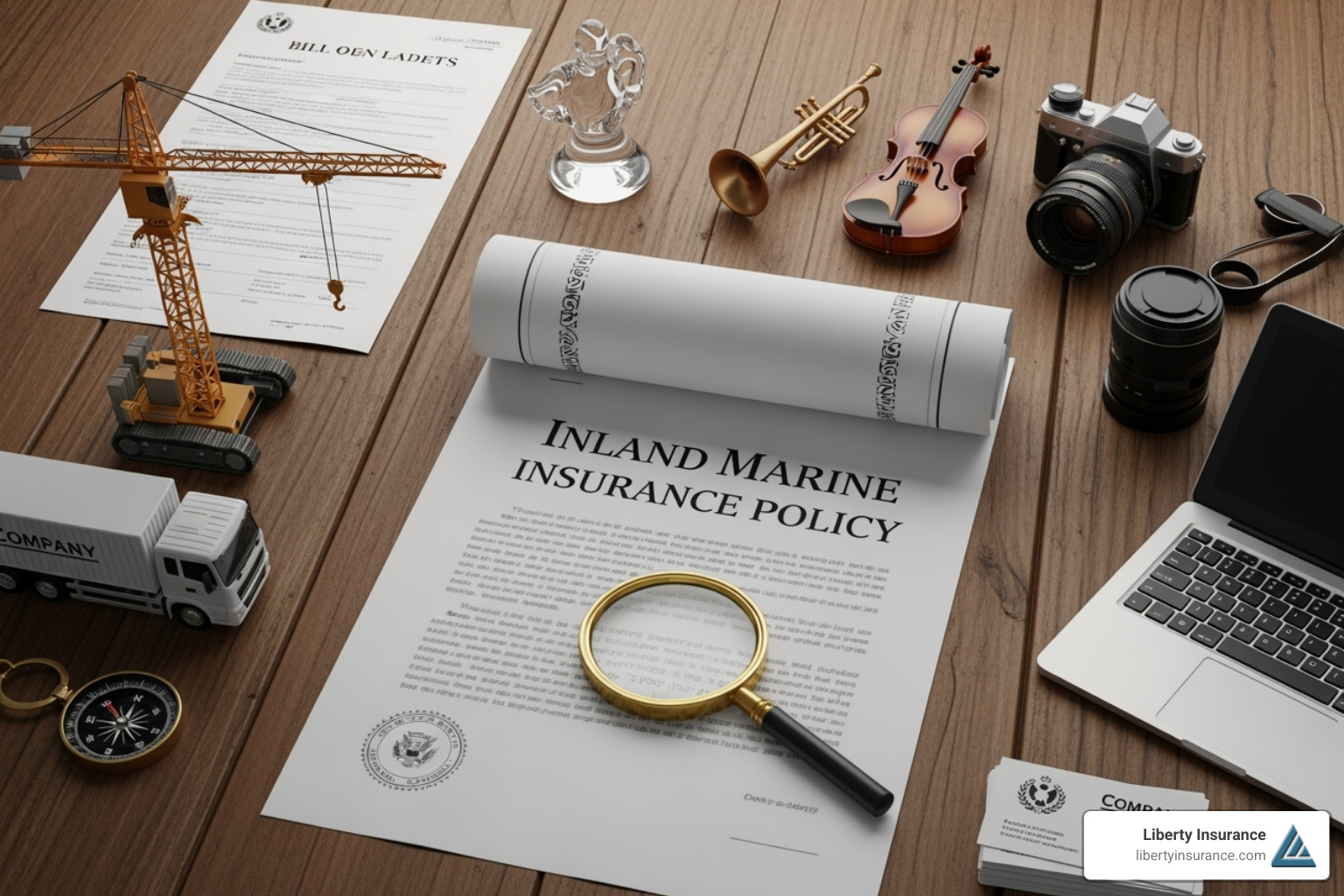
If your property moves, travels to job sites, or spends time away from your primary business premises, it likely qualifies for inland marine insurance for business. Common examples include:
- Contractors’ tools and equipment: This is one of the most common uses. It covers everything from hand tools and power tools to heavy machinery like excavators, bulldozers, cranes, and forklifts, especially when transported between job sites, stored overnight at a location, or used on a project.
- Computer equipment and electronics: This includes servers, laptops, specialized diagnostic equipment, audio/visual gear, and scientific instruments being transported for delivery, installation, or use at a remote location.
- Mobile medical devices: Crucial for mobile clinics, home healthcare services, and hospitals. This covers portable X-ray machines, ultrasound devices, and other diagnostic equipment transported between medical facilities.
- Fine art and exhibition materials: Protects valuable artwork, sculptures, antiques, and collectibles while in transit to, on display at, or returning from galleries, museums, or private showings. It also covers trade show booths and product displays.
- Bailee’s coverage: This is essential if you temporarily hold or control someone else’s property for service, repair, or storage. It protects your business from liability if that customer’s property is damaged or stolen while in your care. Examples include auto repair shops, computer repair services, dry cleaners, and warehouses.
- Accounts Receivable: This coverage protects against losses caused by the damage or destruction of your accounts receivable records. It can cover the cost of reconstructing those records and any collections you can’t make as a result.
- Other mobile property: This is a broad category that can include communication towers, musical instruments for a traveling band, photography equipment, and property that constitutes a mobile business, like vending machines or food truck equipment.
Common Types of Inland Marine Policies
Inland marine insurance is not a one-size-fits-all product. It is often structured as specialized “floaters” or policies tailored to specific industries and situations. A “floater” is a policy that follows the insured property wherever it goes.
- Builder’s Risk Insurance: A fundamental policy for construction projects, it protects structures and materials during new construction or renovation. It covers assets on the job site, in transit, or at a temporary storage location.
- Motor Truck Cargo Insurance: Protects the owner of the goods (the shipper) or the transporter (the trucker) from financial loss if the client’s goods are damaged or lost while being transported.
- Installation Floater: Covers materials and equipment from the moment they leave your warehouse until they are fully installed and accepted by the client. This is vital for HVAC contractors, electricians, and IT installers.
- Contractors’ Equipment Floater: Protects a contractor’s owned, leased, or borrowed tools and machinery at a job site, in transit, or in temporary storage.
- Exhibition and Fine Art Coverage: Serves galleries, museums, and businesses that exhibit valuable items, protecting pieces while on display, in storage, or in transit.
- Riggers Liability: Provides specialized coverage for businesses that move or hoist heavy equipment (like HVAC units or industrial machinery), protecting against damage to the property being lifted as well as liability for damage caused by the lifting operation.
Perils It Protects Against
Inland marine insurance for business is most often written on an “all-risk” or “open peril” basis. This is a significant advantage, as it means the policy covers any peril that is not specifically excluded in the policy language. This provides much broader protection than “named-peril” policies, which only cover the dangers explicitly listed (e.g., fire, lightning, hail).
Common covered perils include:
- Cargo theft: From a vehicle, job site, or temporary storage location.
- Collision damage: Harm to your equipment or goods resulting from a vehicle accident during transit.
- Vandalism and malicious mischief.
- Fire, windstorms, and other weather events.
- Mishandling: Damage from dropping or accidents during loading, unloading, or installation.
- Water damage from burst pipes or sprinkler leakage.
While comprehensive, all policies have standard exclusions. It is vital to read your policy to understand what is not covered. Common exclusions include damage from earthquakes and floods (though coverage can sometimes be added by endorsement), mechanical breakdown, wear and tear, employee dishonesty, mysterious disappearance, and inherent vice (damage caused by the nature of the property itself, like food spoiling).
Who Needs Inland Marine Insurance for Business and Why?
While any business with mobile assets can benefit from this coverage, certain industries rely on inland marine insurance for business as a fundamental part of their risk management strategy. If your business model involves moving valuable items, working at multiple locations, or taking temporary possession of customer property, this insurance isn’t just a good idea—it’s an operational necessity.
Top Industries That Benefit from Inland Marine Insurance for Business

Your most valuable assets may not be sitting safely inside a building. If your business model involves property on the move, you likely need this coverage. Key industries include:
- Construction contractors: Your tools, heavy machinery (excavators, cranes), and building materials are constantly moving between sites in places like Millstone Township, NJ, making them highly vulnerable to theft, vandalism, and transit-related damage.
- Transportation and logistics: Trucking companies and freight forwarders are responsible for other people’s property. Motor Truck Cargo coverage is essential to protect them from liability for lost or damaged client goods.
- Technology and IT firms: Transporting and installing high-value, sensitive assets like servers, networking hardware, and electronic equipment creates significant risk of damage during transit or installation.
- Healthcare providers and mobile clinics: Mobile diagnostic machines (MRI, ultrasound), lab equipment, and other sensitive medical devices require protection during transport between hospitals, clinics, and patient homes.
- Art galleries, museums, and collectors: Fine Art coverage is indispensable for protecting irreplaceable items during transit for exhibitions, loans, sales, or storage.
- Photographers and videographers: Expensive camera bodies, lenses, lighting, and sound equipment travel to various indoor and outdoor locations for shoots, exposing them to numerous risks.
- Food trucks and mobile vendors: The entire business—including cooking equipment, generators, inventory, and POS systems—is mobile and vulnerable to accidents, theft, and fire.
- Equipment rental companies: Your core business assets are constantly in transit or in the hands of others, requiring coverage that follows them wherever they go.
- Renewable energy contractors: Transporting and installing large, specialized, and often fragile components like solar panels and wind turbines requires robust protection against damage during the complex logistics process.
- Event Planners and Production Companies: These businesses transport and use expensive audio/visual equipment, staging, lighting, and decor at various venues, all of which are at risk.
- Mobile Pet Services: Grooming vans and mobile veterinary clinics contain specialized equipment and are, by definition, always on the move, making them a perfect fit for inland marine coverage.
Real-World Scenarios: When Coverage is Crucial
Consider these common situations where inland marine insurance can prevent a business-ending disaster:
Scenario 1: Construction Site Theft. A contractor’s excavator is stolen overnight from a fenced, but not fully secured, job site. Without a contractors’ equipment floater, the company faces the full replacement cost of over $100,000, halting work and jeopardizing project deadlines. With coverage, they can file a claim, get a replacement, and get back to work with minimal disruption.
Scenario 2: Damage During Transit. An IT firm is transporting a new server rack to a client in Princeton, NJ. The delivery truck is involved in a collision, and the server is damaged beyond repair. An installation floater or electronic data processing policy covers the loss, saving the firm from a huge financial hit and preserving a crucial client relationship.
Scenario 3: Mishandled Valuables. A gallery loans a valuable painting to a museum for a special exhibit. During transport by a specialized art handler, the crate is accidentally dropped, and the painting’s frame is shattered, and the canvas is torn. The gallery’s exhibition and fine art coverage steps in to cover the restoration costs and diminished value, protecting the gallery’s assets and reputation.
Scenario 4: Damaged Customer Property. A computer repair shop has a customer’s high-end gaming laptop for a screen replacement. A pipe bursts in the shop overnight, causing extensive water damage to the laptop. The shop’s bailee’s coverage would respond to pay for the replacement of the customer’s damaged property, preventing a lawsuit and maintaining customer goodwill.
How to Secure the Right Inland Marine Policy
Getting the right coverage requires a clear understanding of your assets, the risks they face, and the specific terms of the insurance policy. Following a structured approach ensures you get the protection you need without paying for coverage you don’t, or worse, finding out you’re underinsured after a loss.
Step 1: Assess Your Coverage Needs
Before you can look at policies, you must take a thorough inventory of what you need to protect. This assessment is the foundation of a robust inland marine insurance for business policy.
- Create an Asset Inventory: List all movable equipment, tools, and other property that leaves your premises. For each item, include a detailed description, make, model, serial number, and its current value. This list is not only crucial for determining coverage limits but is also invaluable in the event of a claim.
- Determine Property Value: You need to decide between replacement cost value (RCV) and actual cash value (ACV). This choice significantly impacts your premium and your payout after a loss.
- Replacement Cost (RCV): Pays the cost to replace the damaged property with a new item of similar kind and quality, without deducting for depreciation. This is often preferred for critical equipment as it allows you to get your business fully operational again quickly.
- Actual Cash Value (ACV): Pays the replacement cost minus depreciation. For example, if a 5-year-old piece of equipment with a 10-year lifespan is destroyed, ACV might only pay for 50% of a new one. While ACV policies have lower premiums, the payout may not be enough to replace the asset.
- Example: A generator purchased for $10,000 five years ago is stolen. A new one costs $12,000. An RCV policy would pay the full $12,000 (minus deductible). An ACV policy, factoring in depreciation, might only pay $6,000, leaving you to cover the other half.
- Assess Your Risk: Consider the maximum value of property that might be in transit or at an off-site location at any one time. Evaluate your operational risks. Do you travel through high-crime areas? Are job sites secure? Do employees follow strict security protocols? Understanding these risks helps you and your agent tailor your coverage and implement risk management strategies.
Step 2: Understand Policy Costs and Exclusions
The cost of inland marine insurance for business is directly related to the level of risk your insurer takes on. Just as important as the cost are the things a policy won’t cover.
Premium Factors:
- Property Value & Type: Higher value and more fragile items (like electronics or art) generally increase premiums compared to durable items (like hand tools).
- Transit & Location: The frequency and distance of transit, as well as the security of the locations where property is used or stored, can raise or lower costs.
- Security Measures: Proactive risk management, such as using GPS tracking on vehicles and equipment, secure overnight storage, and robust employee training, can potentially lower premiums.
- Claims History: A history of frequent losses will likely result in higher premiums.
- Deductibles: Choosing a higher deductible (the amount you pay out-of-pocket on a claim) will lower your premium, but ensure it’s an amount your business can comfortably afford.
Common Exclusions:
- Stationary property at your main business address (this should be covered by your commercial property insurance).
- Vehicles themselves (these are covered by commercial auto insurance).
- Wear and tear, rust, corrosion, or mechanical breakdown from age or poor maintenance.
- Inherent vice (damage from the property’s own nature, like food spoiling or wood warping).
- Intentional or dishonest acts by you or your employees.
- Catastrophic events like earthquakes and floods (these often require a separate policy or endorsement).
- Property shipped by sea (this requires ocean marine insurance).
Important: Coverage terms, limits, and availability vary by insurer and by state (including in New Jersey). This overview is for general informational purposes only and does not amend, modify, or replace any policy language. Always review your policy documents and consult a licensed insurance professional about your specific situation.
Step 3: Obtaining Your Inland Marine Insurance for Business
With your assessment complete, you’re ready to secure coverage.
- Gather Documentation: Have your detailed asset inventory, valuations, business operational details, and any relevant contracts (especially those requiring you to carry insurance) ready.
- Get a Quote: Reach out to an experienced, independent insurance professional. At Liberty Insurance, we understand the unique challenges of mobile assets. Be transparent about your operations, property, and risk management practices to ensure you get a policy that truly fits your needs.
- Review the Policy: Don’t just look at the price. Carefully read the coverage limits, sub-limits (lower limits for specific items like tools), deductibles, and any endorsements or exclusions. Ask your agent to explain any co-insurance clauses, which could penalize you for being underinsured.
- Confirm Your Certificate of Insurance (COI): Many clients and general contractors will require a COI as proof of coverage before work can begin. Ensure your policy allows for easy and quick generation of these certificates. At Liberty Insurance, we make it simple to get the documentation you need to start a new project without delay.
By following these steps, you can confidently obtain the right inland marine insurance for business. Learn more about protecting your cargo in transit and how Liberty Insurance can help safeguard your business wherever your work takes you.
Frequently Asked Questions about Inland Marine Insurance
We understand that inland marine insurance for business can be a complex topic with unique terminology. Here are answers to some of the questions we hear most often from business owners.
Can I add inland marine coverage to my existing Business Owner’s Policy (BOP)?
Yes, in many cases, inland marine coverage can be added as an endorsement or “floater” to an existing Business Owner’s Policy (BOP) or Commercial Package Policy (CPP). This is often a convenient and cost-effective option for businesses with moderate needs, such as a photographer with a few thousand dollars in camera gear or a consultant who travels with a high-end laptop. It bundles everything under a single policy and simplifies billing.
However, for businesses with very high-value equipment (like heavy construction machinery), complex transit risks, or a large volume of movable property, a standalone inland marine insurance for business policy is often a better fit. A standalone policy typically offers higher limits, more specialized terms, and broader coverage that can be precisely tailored to your industry’s unique risks. An experienced agent can help you analyze your exposure and determine which approach makes the most sense for your business.
Does inland marine insurance cover rented or leased equipment?
Absolutely, and this is a vital feature for many contractors and businesses. Many inland marine policies, particularly Contractors’ Equipment floaters, can be structured to cover equipment that you own, as well as equipment you rent, lease, or borrow from others. This is often referred to as “Leased and Rented Equipment” coverage. It protects you from being held liable under your rental agreement for a rented excavator or crane that gets damaged or stolen while in your care, custody, and control. It’s crucial to review your rental contracts and confirm with your insurer that your policy explicitly includes this coverage and that the limits are adequate to meet the contract’s requirements.
What is the difference between a contractor’s equipment floater and motor truck cargo insurance?
This is a common point of confusion. While both are types of inland marine insurance, they cover different property.
- A Contractor’s Equipment Floater covers your business’s owned or rented equipment. It protects your tools and machinery while in transit, at a job site, or in storage.
- Motor Truck Cargo Insurance covers your client’s property that you are transporting for a fee. It protects you, the transporter, from liability if your client’s goods are lost or damaged while in your possession.
A contractor needs an equipment floater for their bulldozer. A trucking company hired to move that bulldozer for the contractor would need motor truck cargo insurance.
Is my property covered if it’s in an employee’s personal vehicle?
This is a critical question for many businesses. The answer is: it depends on your specific policy language. Some inland marine policies may provide coverage for business property in any vehicle, while others may have limitations or exclusions for property in vehicles not owned by the business. If your employees regularly transport company tools or equipment in their personal cars or trucks, you must verify this with your insurance provider. You may need a specific endorsement to ensure coverage applies, protecting your assets regardless of who is driving.
What should I do if I need to file a claim?
If an incident occurs that may lead to an inland marine insurance for business claim, acting quickly and methodically can ensure a smoother process. After ensuring everyone is safe, follow these steps:
- Document Everything: Take extensive photos and videos of the damaged property and the scene of the incident from multiple angles. If possible, show the context of the damage.
- Gather Relevant Documents: Collect shipping manifests, bills of lading, rental agreements, purchase receipts, and your detailed asset inventory to help establish ownership, value, and the circumstances of the loss.
- File a Police Report: If theft, vandalism, or a vehicle collision is involved, file a police report immediately. This official record is almost always required by insurers for claims involving criminal activity.
- Mitigate Further Loss: Take reasonable steps to protect the property from further damage, but do not dispose of any damaged items until your insurer has had a chance to inspect them.
- Contact Your Insurance Provider: Report the loss to your insurance agent or provider as soon as possible. Prompt notification is a policy condition and is key to a timely resolution. At Liberty Insurance, we are committed to making the claims process as smooth as possible so you can get back to running your business.

Conclusion
In the modern business landscape, success is often defined by mobility and flexibility. Your business doesn’t operate in a bubble. Your most valuable equipment travels to job sites, your finished products move between warehouses and customers, and your essential tools ride in work trucks every single day. Every time a valuable asset leaves your main location, it faces a unique set of risks—theft, collision, mishandling, and more—that standard property insurance simply wasn’t designed to cover.
That is precisely why inland marine insurance for business exists. It is the specific, tailored solution designed to protect the assets that keep your business running when they venture beyond your four walls. Whether you’re a general contractor in Toms River, a technology firm in Princeton, or a mobile food vendor serving customers all across New Jersey, this specialized coverage fills the critical gaps in your insurance portfolio that could otherwise expose you to devastating, and often uninsured, financial losses.
The key takeaway is simple: if your business depends on movable assets, you need movable protection. A stolen excavator, a damaged shipment of electronics, or a collision on the highway that destroys your tools should be a manageable setback, not a business-ending disaster. With the right inland marine policy in place, you gain the financial security and peace of mind to operate with confidence, knowing your assets are protected wherever your work takes you.
Don’t wait for a costly loss to discover a gap in your coverage. Be proactive. Take the time now to conduct a thorough evaluation of your mobile assets and operational risks. Here at Liberty Insurance, our experienced professionals are ready to partner with you to analyze your needs and craft a policy that safeguards your business’s foundation, no matter where it may be.
Liberty Insurance; Learn more about protecting your cargo in transit

