
Understanding Inland Marine Insurance: A Guide for Business Owners
Inland Marine Insurance is a specialized type of commercial property insurance that covers movable property, equipment, and goods that are transported over land or stored off-site. Despite its confusing name, it has nothing to do with water—it protects your business property wherever it travels, whether that’s tools moving between job sites, inventory in transit to customers, or equipment temporarily stored in a warehouse.
I’m Andrew Harris. As a Certified Insurance Counselor with over a decade of experience helping businesses secure comprehensive coverage, I’ve seen how Inland Marine Insurance protects companies from devastating losses when equipment is damaged or stolen away from their main location. In this guide, I’ll explain what it covers, what it doesn’t, who needs it, how to choose limits and endorsements, how pricing works, and how it dovetails with the rest of your insurance program—so you can buy with confidence.
Quick definition
- Inland Marine Insurance: A “floater” policy that follows property wherever it goes—on the road, at job sites, at temporary storage, or in your care, custody, or control.
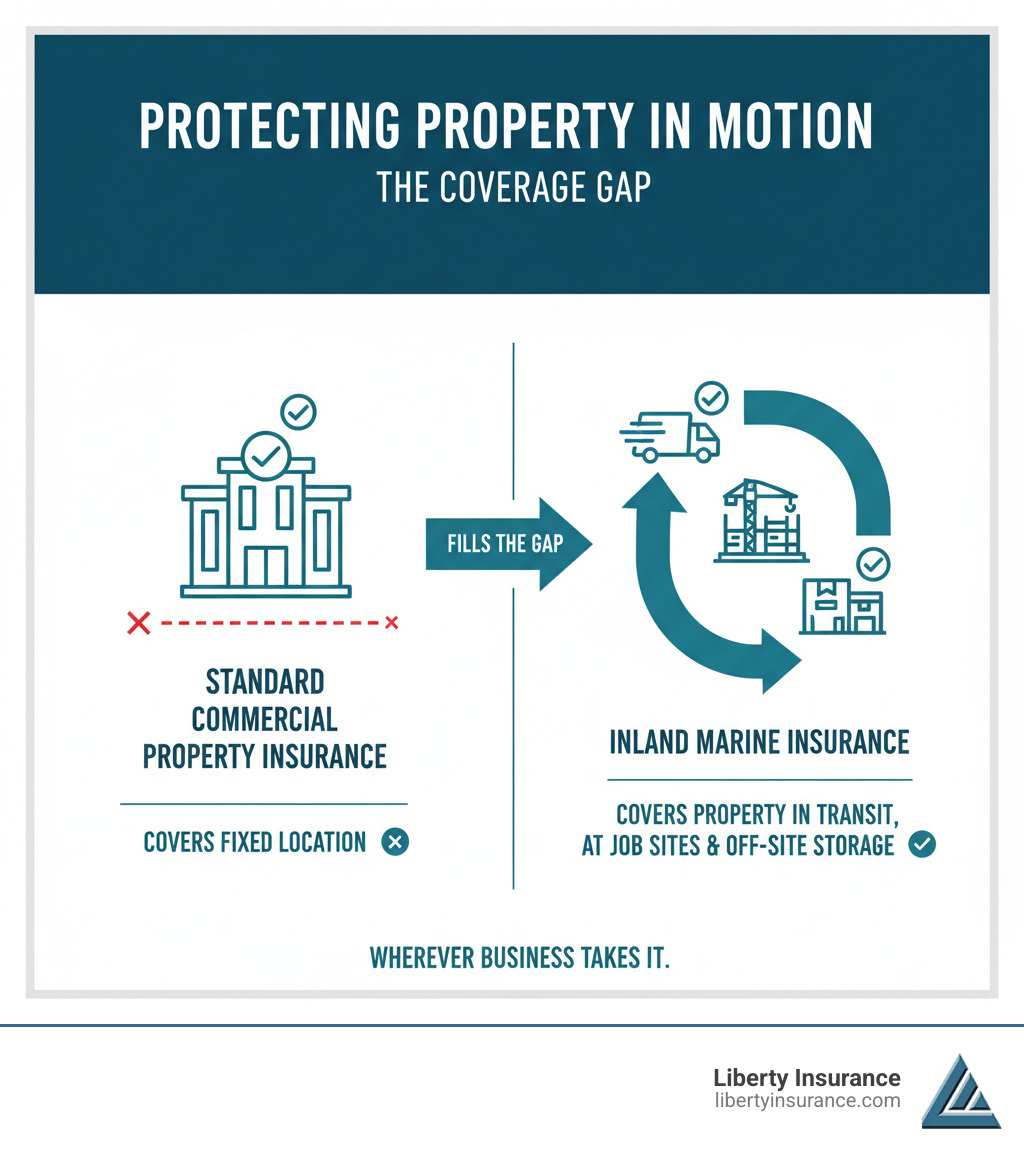
- Core purpose: Fill the coverage gap left by standard property policies, which usually protect items only at your fixed address.
What Inland Marine Insurance Covers
- Property in transit: Equipment, inventory, or materials being transported by truck, train, messenger, or other land-based methods.
- Mobile equipment: Tools and machinery that move between locations for your business operations—contractor’s tools, cameras, drones, survey gear, medical devices, event gear, and more.
- Property at temporary locations: Items stored off-site or at job sites away from your main business address, including pop-up retail, trade shows, and staging yards.
- Customer property in your care: Goods you’re repairing, storing, cleaning, or transporting for clients (bailee coverage).
- High-value specialized items: Fine art, collectibles, scientific and medical equipment, musical instruments, EDP/IT equipment, and other unique assets.
- Installation projects: Materials and equipment from the moment they leave your premises until they’re installed and accepted by the customer (installation floater).
- Leased or rented equipment: Items you rent or borrow from others that are on the move.
Why You Need It
Standard commercial property insurance typically only covers property at your fixed business location. If your equipment leaves that address—even just to go to a job site or be stored in a vehicle overnight—it may not be protected. Inland Marine Insurance fills this critical gap, acting as a floater policy that moves with your property wherever your business takes it.
Small businesses pay an average of $29 per month (about $350 annually) for inland marine coverage, making it an affordable way to protect mobile assets that could cost thousands to replace.
Who needs Inland Marine Insurance? Real-world examples
- Contractors and trades: Carpenters, electricians, HVAC, plumbers, roofers, landscapers, and solar installers moving tools and equipment between job sites.
- Technology and creative professionals: Photographers, videographers, IT consultants, AV/event production companies transporting high-value gear.
- Healthcare and science: Mobile medical practices, labs, and clinics with diagnostic devices, imaging tools, and portable equipment.
- Retailers and wholesalers: Businesses shipping goods to customers, moving inventory between locations, or storing items at third-party warehouses.
- Logistics and service firms: Couriers, repair shops, and storage businesses holding customer property (bailee exposure).
- Museums, galleries, and collectors: Fine art on exhibit, in transit, or on loan between locations.
- Agriculture and energy: Portable pumps, sensors, drones, and specialized machinery used across fields or sites.
If your property regularly leaves your main address—or if you temporarily hold customers’ goods—you likely need inland marine coverage.
Common Inland Marine policy types (floaters)
- Contractor’s equipment floater: Covers mobile tools and machinery used at job sites; can schedule high-value items and include rental reimbursement if equipment is down due to a covered loss.
- Installation floater: Covers materials, supplies, and equipment from departure to installation and acceptance by the customer; ideal for electrical, HVAC, and interior build-out work.
- Transportation (property in transit) floater: Covers your goods while being transported by you or a third party.
- Bailee’s customer coverage: Protects customer property in your care, custody, or control (e.g., dry cleaners, repair shops, storage businesses).
- Fine arts floater: Covers art on premises and in transit; can be scheduled or blanket, with agreed value for unique pieces.
- Electronic data processing (EDP) equipment: Covers servers, laptops, networking gear, and sometimes data/media; often broader than standard property coverage for offsite use.
- Tool and equipment schedules: Lets you list specific high-value items with serials, descriptions, and agreed values; often paired with a blanket limit for smaller tools.
Note: Some specialties (e.g., builder’s risk) are often categorized under inland marine in the industry, though they may be written on their own forms.
What Inland Marine Insurance typically excludes
- Wear and tear, gradual deterioration, rust, corrosion.
- Mechanical breakdown (sometimes buyback available for certain classes).
- Employee dishonesty and theft by insiders (separate crime policy needed).
- Voluntary parting due to fraud or trick-into-giving-up property.
- Unexplained disappearance or inventory shortage without evidence of loss.
- War, nuclear hazard, government seizure.
- Contraband or illegal trade.
- Certain unattended vehicle thefts unless specific security conditions are met (varies by carrier—often requires locked vehicle, hidden from view, alarm, etc.).
- International transit outside the policy territory unless endorsed.
Always review the exclusions and any protective safeguards endorsements (e.g., GPS tracking, alarms, storage requirements) that can affect coverage.
Key coverage features and choices
- Coverage basis: Many inland marine forms are written on “all-risk” (open perils) bases—covering any cause of loss not specifically excluded. This is broader than named-peril coverage.
- Scheduled vs. blanket: Schedule unique, high-value items to ensure accurate limits and valuation. Use blanket coverage for groups of lower-value tools or inventory.
- Valuation: Replacement cost (RC), actual cash value (ACV), or agreed value (common for fine art and custom equipment). Understand how depreciation may apply to unscheduled items.
- Sublimits: Pay attention to theft, transit, or unattended vehicle sublimits.
- Deductibles: Typically per occurrence; can be set higher to control premium.
- Coinsurance: Some policies include coinsurance requirements (e.g., 80% or 100% of total value). If underinsured, partial losses can be penalized. Ask for alternatives (agreed value) when appropriate.
- Territory: Often U.S. and Canada; add worldwide transit/temporary locations if you travel internationally.
- Newly acquired property: Automatic coverage may apply for a limited amount/time; schedule promptly to avoid gaps.
How much coverage do you need?
- Inventory your movable property
- List tools, equipment, devices, and materials that travel or live off-site.
- Include serial numbers, purchase dates, and replacement costs.
- Separate by type and value
- High-value items: Consider scheduling with specific limits and agreed valuation when needed.
- Low-value tools: Use a blanket limit; ensure the per-item cap suits your tool set.
- Consider peak exposures
- For installation/transportation floaters, estimate peak values in transit or at the job site.
- For bailees, model maximum customer property you may hold at once.
- Choose valuation method
- Replacement cost for most tools/equipment is standard; agreed value for unique or custom items; consider ACV if budget-sensitive and depreciation is acceptable.
- Set deductibles and sublimits thoughtfully
- Balance premium savings with potential out-of-pocket costs.
- Mind coinsurance
- If coinsurance applies, insure to value to avoid partial loss penalties.
Pricing: What determines the premium?
While averages are helpful, your price depends on a number of underwriting factors:
- Class of business and loss history: Claims frequency and severity for your industry and your specific account.
- Property type and values: High-tech or theft-attractive items can rate higher; the presence of serial numbers and tracking helps.
- Mobility and radius: How often items move, how far, and by what means (own vehicles vs. common carriers).
- Storage and security: Night storage location, locks, alarms, GPS, job-site security, and chain-of-custody procedures.
- Territory and crime scores: Urban vs. rural, theft/vandalism data, catastrophe exposure.
- Deductibles and sublimits: Higher deductibles generally lower cost.
- Coverage breadth: Replacement cost, agreed value, worldwide territory, and special endorsements all influence premium.
As noted earlier, many small businesses see costs around $29 per month, but heavier equipment users or high-limit schedules will pay more. The good news: carriers often credit strong risk controls.
Claims: How they work and how to prepare
- Report promptly: Notify your agent/carrier as soon as practical; theft losses often require police reports.
- Document ownership and value: Keep purchase records, photos, serial numbers, and a current schedule of equipment.
- Provide incident details: Where and when the loss occurred, security measures in place, and steps taken to mitigate further loss.
- Protect remaining property: Take reasonable steps to prevent additional damage.
- Keep receipts: For emergency repairs or rentals if your policy offers rental reimbursement.
Tip: Pre-loss organization speeds claim settlement. Maintain a current inventory and store it in the cloud or off-site.
Risk management to reduce claims and premiums
- Job-site security: Lockboxes, tool cribs, fencing, lighting, cameras, and sign-in/out procedures.
- Vehicle protocols: Hide tools from view, alarm systems, immobilizers, GPS trackers, and locked enclosed storage when unattended.
- Mark and track assets: Engrave or tag gear; use asset management software and serialized inventories.
- Split loads: Avoid keeping all valuables in a single vehicle or trailer overnight.
- Staff training: Chain-of-custody procedures, buddy system for high-value moves, and incident reporting.
- Vendor vetting: Check carriers’ motor truck cargo coverage and liability limits; require certificates of insurance when outsourcing transport or storage.
- Disaster planning: Back-up power and climate controls for sensitive equipment; flood and wildfire awareness when staging gear.
How Inland Marine fits with your other policies (at a glance)
- General liability: Covers damage or injury you cause to others—not your own property. Inland marine protects your property.
- Commercial auto: Covers the vehicle itself; inland marine covers the tools/equipment inside.
- Property/BOP: Covers at your premises; inland marine covers off-premises and in transit.
- Motor truck cargo (for carriers): Protects a carrier’s liability for customers’ goods; inland marine can protect an owner’s goods regardless of carrier liability.
Common mistakes to avoid
- Assuming your BOP covers tools in a vehicle or at a job site—often it doesn’t, or only with small sublimits.
- Failing to schedule high-value items and then facing per-item caps.
- Ignoring coinsurance: Underinsuring can reduce partial-loss payouts.
- Overlooking customer property exposure: If you hold, repair, or store others’ goods, add bailee coverage.
- Not updating schedules: Add new purchases and remove sold/retired items promptly.
- Missing security conditions: Read protective safeguard requirements and comply.
Sample scenarios
- Contractor tool theft: A service van is broken into overnight; $18,000 of tools stolen. Inland marine responds (subject to policy conditions), even though the loss was off-premises.
- Installation damage: $60,000 of HVAC units are damaged when a temporary crane malfunctions during placement. The installation floater covers materials until installation and acceptance.
- Customer property: A repair shop’s customer-owned instrument is damaged in a small fire at the shop. Bailee’s customer coverage pays for repair or replacement.
- Trade-show loss: A retailer’s display inventory is stolen from a locked booth after hours. Inland marine covers property at temporary locations.
- Photographer travel: Lenses and cameras are damaged when luggage is mishandled in transit. With proper territory and transit coverage, inland marine responds.
Buying checklist: How to compare quotes
- Confirm property categories: Tools, equipment, inventory, customer property, fine arts, EDP—make sure each exposure is addressed.
- Verify limits and per-item caps: Check blanket vs. scheduled limits and any single-article restrictions.
- Review valuation: Replacement cost vs. ACV vs. agreed value; note depreciation assumptions.
- Check exclusions and endorsements: Unattended vehicle conditions, mysterious disappearance, employee dishonesty, international coverage.
- Look for helpful extras: Rental reimbursement for equipment downtime, expediting expense, debris removal, newly acquired property coverage.
- Understand coinsurance: Ask for agreed value or reportable form if applicable to avoid penalties.
- Align with other policies: Avoid overlaps and gaps with property, auto, motor truck cargo, and liability policies.
- Vet the carrier: Financial strength, claims reputation, industry expertise.
FAQs
- Is inland marine the same as cargo insurance? Not exactly. If you own the goods and want them protected wherever they travel, inland marine is often the right fit. If you’re a carrier transporting someone else’s goods, motor truck cargo addresses your liability to the owner; the owner might still carry inland marine.
- Does it cover theft from a vehicle? Often yes, but many policies require the vehicle to be locked and the property hidden from view; some impose sublimits or exclude overnight street parking. Read your form.
- Can I get worldwide coverage? Many policies are U.S./Canada territory by default. Worldwide options exist; ask for an endorsement if you travel internationally.
- What about drones and aviation exposures? Some carriers cover drones as scheduled equipment but exclude aviation liability; you may need separate UAV liability coverage.
- How do I insure rented/borrowed equipment? Many contractor floaters include coverage for rented or borrowed equipment, sometimes with separate limits and conditions. Ask about rental reimbursement as well.
The bottom line
If your business owns property that moves, Inland Marine Insurance is the most efficient way to protect it. It fills a critical gap left by standard property and auto policies, travels with your assets, and can be customized to match your operations. Done right, it’s a modest premium for a potentially business-saving payout after a theft, accident, or catastrophic event away from your main location.
Inland Marine Insurance vocabulary:
What is Inland Marine Insurance and Why Is It Called That?
I get it—the name Inland Marine Insurance sounds like it belongs on a fishing boat, not protecting your construction equipment or photography gear. If your business is nowhere near the ocean, you’re probably wondering why “marine” is in the name at all. The confusion is completely understandable, and as an insurance counselor, it’s a question I hear all the time.
Here’s the truth: the “marine” part is really just a historical quirk. Today, this coverage has nothing to do with boats or water. Instead, it’s all about protecting your business property when it’s on the move—traveling between job sites, stored temporarily off-site, or in transit to customers. Because the coverage moves with your property wherever it goes, it’s often called a floater policy. Think of it as insurance that floats along with your assets, rather than staying anchored to one fixed location.
The surprising history behind the name “Inland Marine”
To understand where this odd name came from, we need to go back a few centuries. The very first commercial insurance policies were ocean marine insurance contracts, created to protect merchants whose cargo was crossing the seas on ships. International trade was booming, but it was also risky—storms, pirates, and shipwrecks could wipe out an entire shipment in an instant.
As commerce grew, insurers realized that cargo didn’t just need protection while it was on the water. Once goods arrived at the port, they still had to travel inland to reach their final destination. What happened if a fire destroyed them in a warehouse, or if they were damaged while being transported by wagon?
Then came the Industrial Revolution, which changed everything. Suddenly, railroads crisscrossed the country, and trucks began hauling goods over long distances. Businesses needed insurance for property traveling over land, not just across the ocean. Insurers adapted their existing marine policies to cover these new “inland” risks, extending the same broad, all-risk protection they’d been offering for ships to cover trains, trucks, and other land-based transport.
The official stamp of approval came in 1933 with the Nationwide Marine Definition, adopted by the National Association of Insurance Commissioners. This document formally classified what types of property and risks could be insured under marine and inland marine coverage, cementing its place in the insurance world.
Today, the term persists because the coverage lineage and underwriting approach remain distinct from standard property insurance. In practice, inland marine is the modern home for a variety of “floaters” that protect mobile or unique property wherever it goes.
How it differs from standard commercial property insurance
Here’s where things get practical. The biggest difference between Inland Marine Insurance and standard commercial property insurance comes down to one simple question: where is your property located?
Standard commercial property insurance—including what you might have as part of a Business Owner’s Policy (BOP)—is designed to protect property at a fixed address. Your office building, the inventory in your warehouse, the furniture in your storefront—all of that is covered while it’s at your main business location. This type of policy does a great job protecting stationary assets within those four walls.
But what happens when your property leaves that address? Maybe your contractor loads $15,000 worth of tools into a work truck. Or your IT consultant carries expensive laptops and servers to a client’s office. Or your catering company transports equipment to an event venue. In most cases, your standard property policy either won’t cover these items once they leave your premises, or it will only provide minimal coverage—often just a small sub-limit that’s nowhere near enough to replace high-value equipment.
That’s the gap Inland Marine Insurance was designed to fill. Instead of protecting property at a fixed location, it protects property wherever it travels. The coverage literally moves with your assets, whether they’re in a vehicle, at a temporary job site, stored in a rented warehouse, or even in your customers’ possession.
Here’s a side-by-side comparison to make the differences crystal clear:
| Feature | Standard Commercial Property Insurance | Inland Marine Insurance |
|---|---|---|
| Covered property location | Primarily at your specific business address, with very limited off-premises coverage | Covers property wherever it travels—in transit, at job sites, in temporary storage, or at customer locations |
| Perils covered | Usually covers named perils (specific risks like fire or theft listed in the policy) at your location | Often provides all-risk coverage, protecting against any peril unless it’s specifically excluded—much broader protection |
| Property type | Stationary assets like your building, furniture, fixtures, and inventory at your main location | Mobile equipment, tools, merchandise in transit, specialized items, property in others’ care, and even infrastructure like communication towers and bridges |
| Policy name | Part of a Business Owner’s Policy (BOP) or Commercial Package Policy | Known as a floater policy because coverage floats with the property |
Additional distinctions and nuances:
- Valuation and scheduling: Inland marine often relies more on scheduled property with agreed values for high-cost items, while property policies more commonly default to blanket limits for on-premises contents.
- Sublimits and conditions: Inland marine forms can include specific sublimits for theft from vehicles or mysterious disappearance and may impose protective safeguards. Property policies tend to focus on building-level protections.
- Coinsurance and reporting: Many inland marine forms carry coinsurance or use reportable values (e.g., monthly reporting) to match fluctuating exposures like installation and bailee risks.
How Inland Marine complements your other business policies
Think of your business insurance as a team of players, each with a specific role. Inland Marine Insurance doesn’t replace your other policies—it works alongside them to create comprehensive protection.
- General Liability Insurance: Protects you when you accidentally damage someone else’s property or cause bodily injury to a third party. It does not cover your property. Inland marine covers your property, including when it’s in your care, custody, or control at off-site locations (subject to form and endorsements).
- Commercial Auto Insurance: Covers your vehicles themselves—if your work truck is in an accident, that policy pays to repair the truck. But what about the $20,000 worth of tools and equipment inside it? That’s where inland marine coverage comes in. The auto policy protects the vehicle; inland marine protects the cargo you own.
- Business Owner’s Policy (BOP): May provide some off-premises coverage, but it’s typically capped at a low percentage of your total property coverage—often 10% or less—and may not extend to all perils or locations. Inland marine broadens and increases those protections.
- Motor Truck Cargo: If you’re a carrier transporting other people’s goods, motor truck cargo covers your legal liability for those goods. If you own the goods and want first-party coverage regardless of carrier liability, inland marine is often the right approach.
When all these policies work together—general liability, commercial auto, your BOP, and inland marine—you get truly comprehensive protection. Each policy handles what it does best, and together they create a safety net that covers your business from every angle. That’s the kind of coverage ecosystem that lets you focus on running your business instead of worrying about what might go wrong.
Is inland marine always necessary?
Not always. If your business property is largely stationary and rarely leaves your main location—and your BOP/property policy offers sufficient off-premises extensions—you may not need a dedicated inland marine policy. Likewise, if your only exposure is shipping via reputable carriers and you purchase shipment-specific insurance or your vendors carry the risk until delivery (per contract terms), a separate floater may be redundant. That said, most modern businesses have at least some mobile property exposures, and the modest premium for inland marine often justifies the broader and more dependable protection.
Contract and compliance considerations
- Certificates of insurance: Clients may require evidence of inland marine or bailee coverage when you work at their location or take possession of their property.
- Loss payees: Equipment lessors and finance companies often require being named as loss payees on scheduled items.
- Protective safeguards: Contracts may mandate specific site or vehicle security; ensure your policy terms match your contractual obligations.
- International work: Cross-border projects may require endorsements for territory, customs, and valuation.
Final takeaway
The name might be old-fashioned, but the protection is modern and essential. Inland Marine Insurance exists to cover the gap between fixed-location property insurance and the real, mobile way businesses operate today. If your business equipment, materials, or customer property ever leaves your four walls, a tailored inland marine solution is one of the most efficient, cost-effective protections you can buy.
You can dive deeper into this historical context and how it applies to modern businesses with our comprehensive guide: Understanding inland marine insurance | Liberty Insurance.

