
Understanding Key Man Insurance as a Business Deduction
Is key man insurance a business expense that you can deduct on your taxes? This is one of the most frequent and critical questions business owners ask when considering this type of coverage. The desire to find tax-deductible expenses is a cornerstone of smart financial management, but when it comes to key person insurance, the answer requires a deeper understanding of its strategic purpose beyond simple tax write-offs.
The short answer is no—in most standard arrangements, key man insurance premiums are not tax-deductible. The Internal Revenue Service (IRS) has clear guidelines on this, and misunderstanding them can lead to compliance issues. Here’s a more detailed breakdown of the fundamental principles:
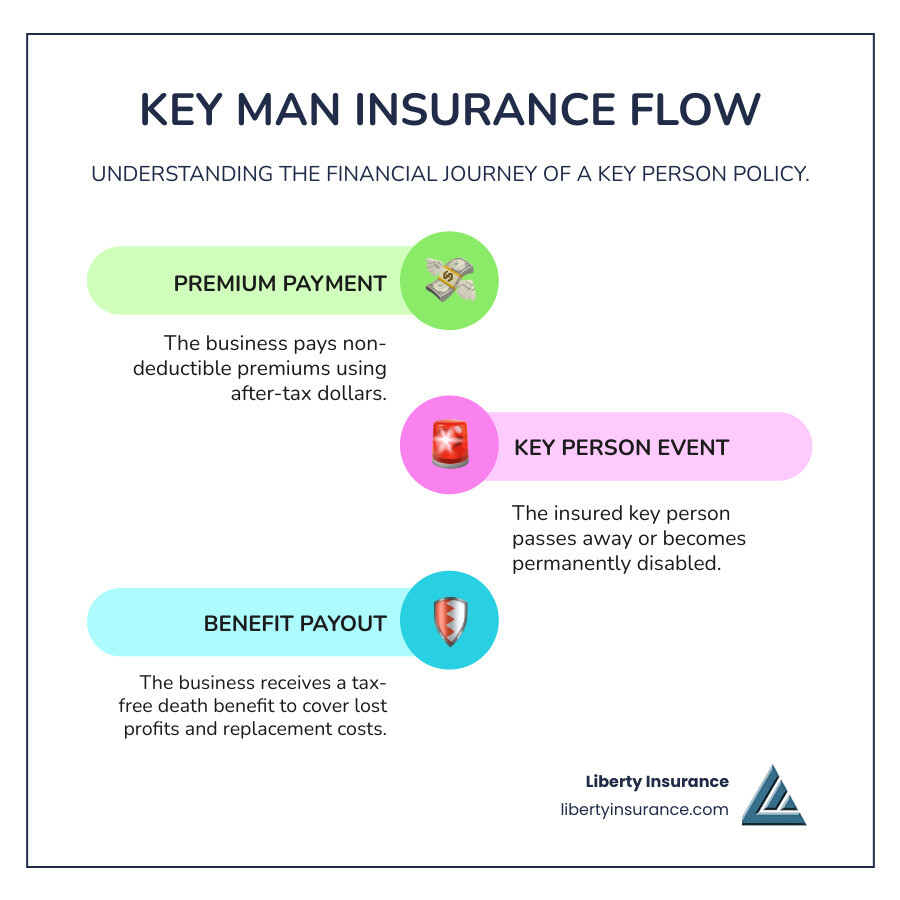
- Non-Deductible Premiums: When your business is the named beneficiary of the policy, the premiums you pay are considered a capital expenditure, not a deductible operating expense. You are essentially purchasing an asset designed to protect the business’s financial health.
- Tax-Free Death Benefits: The primary reason for the non-deductible premiums is that the death benefit paid out to the business is generally received free from federal income tax under IRC Section 101(a).
- The IRS’s Quid Pro Quo Reasoning: The logic is straightforward: the tax code does not permit a business to deduct the cost of an expense (the premium) that generates tax-free income (the death benefit). This prevents a double tax benefit.
- The Strategic Trade-Off: This creates a clear trade-off. You must use after-tax dollars to fund the policy, but in return, your business receives a potentially substantial sum of money tax-free precisely when it is most vulnerable—after the loss of a critical employee.
While the lack of an upfront deduction might seem like a drawback, the tax-free nature of the payout makes key man insurance an incredibly efficient tool for business continuity and financial stability. The rules, however, are not without their complexities. The Pension Protection Act of 2006 (PPA) introduced specific notice, consent, and reporting requirements that must be met to preserve this tax-free status. Navigating these regulations is essential for ensuring your policy performs as expected.
I’m Andrew Harris, a Certified Insurance Counselor (CIC) and Accredited Advisor in Insurance (AAI). At Liberty Insurance, my focus is on helping businesses navigate complex insurance decisions. We work with you to structure key person coverage that not only provides optimal financial protection but also ensures full tax compliance, safeguarding your investment for the long term.
What is Key Man Insurance and Why Do Businesses Need It?
Key man insurance, also known as key person insurance, is a specific application of life insurance designed to protect a business from the financial repercussions of losing its most valuable employees. In this arrangement, the business purchases a life insurance policy on a key individual, pays the premiums, and is the sole beneficiary of the death benefit. It is not an employee benefit; it is a strategic tool for corporate risk management.

Why is this protection so vital? The loss of a key person can trigger a cascade of negative events, from plummeting sales to a loss of investor confidence. Studies have shown that following a founding entrepreneur’s death, approximately 60% of a business’s sales are lost. Key man insurance provides a crucial infusion of cash to ensure business continuity and financial stability during these turbulent times.
Here’s a more detailed look at how it helps:
- Covering Lost Profits and Revenue: If a key individual, such as a star salesperson or a visionary CEO, is directly responsible for a significant portion of your revenue, their sudden absence can create an immediate and substantial financial gap. The insurance payout provides working capital to help the business meet its obligations—like payroll, rent, and supplier payments—while it reorganizes and recovers.
- Funding Recruitment and Training: Finding and training a suitable replacement for a highly skilled or experienced key person is a costly and time-consuming endeavor. Costs can include executive search firm fees, multiple rounds of interviews, relocation expenses, and the salary of the new hire, who may take months or even years to become as productive as their predecessor. The policy proceeds can cover these significant expenses without draining the company’s operational budget.
- Securing and Repaying Loans: Many lenders, including the Small Business Administration (SBA) and commercial banks, often require key man insurance as a condition for a loan. It serves as a form of collateral, assuring the lender that the business will have the means to repay its debts even if the individual critical to its success is no longer there. This is especially common for businesses seeking loans or investments where the loan’s viability is tied to one or two people.
- Facilitating Shareholder Buyouts: In companies with multiple owners, a buy-sell agreement is often funded with life insurance. Key man insurance can serve this purpose, providing the necessary funds for the surviving owners to purchase the deceased shareholder’s shares from their estate. This ensures a smooth transition of ownership, prevents the deceased’s family from being forced into running the business, and avoids burdening the company with debt to finance the buyout.
- Boosting Investor and Stakeholder Confidence: Having key man insurance in place sends a powerful message to investors, board members, and employees. It demonstrates that leadership has engaged in prudent risk management and is prepared for unforeseen catastrophes. This can be crucial for maintaining stability and preventing a panic that could further harm the business. It’s an Essential Coverage for Your Business’s Key Personnel.
Who Qualifies as a “Key Person”?
A “key person” is any individual whose death or disability would cause a significant, measurable financial loss to the company. Identifying these individuals is a critical first step. To do this, ask: “Whose absence would materially impact our revenue, operations, or strategic direction?” Common examples include:
- CEO or Founder: The strategic leader and visionary, often the public face of the company and the driving force behind its culture and growth.
- Top Salesperson: An individual who consistently generates a disproportionately large share of the company’s revenue or manages its most important client relationships.
- Head of Product Development or R&D: The innovator responsible for creating and maintaining the company’s core products, services, or intellectual property.
- Critical Technical Expert: Someone with irreplaceable specialized skills, such as a lead software architect, a proprietary process engineer, or a scientist with unique knowledge.
- Partner in a Professional Firm: In law, accounting, or medical firms, the loss of a partner can disrupt client relationships and necessitate a buyout of their ownership stake.
- Chief Financial Officer (CFO): The person who manages the company’s finances, investor relations, and access to capital.
Essentially, if you cannot easily and quickly replace someone without the business suffering a significant setback, they are likely a key person.
How Key Man Insurance Differs from Other Business Insurance
It’s crucial to distinguish key man insurance from other common business policies, as its purpose, beneficiary, and tax treatment are unique.
| Feature | Key Man Insurance | General Liability Insurance | Property Insurance | Directors & Officers (D&O) |
|---|---|---|---|---|
| Purpose | Protects the business from the financial loss of a key employee. | Protects against third-party claims of bodily injury or property damage. | Protects physical assets like buildings and equipment from damage or loss. | Protects the personal assets of directors and officers from lawsuits related to their management decisions. |
| Beneficiary | The business. | The third party who suffered the loss. | The business. | The directors and officers. |
| Premium Deductibility | No, premiums are not deductible when the business is the beneficiary. | Yes, premiums are typically a deductible business expense. | Yes, premiums are typically a deductible business expense. | Yes, premiums are typically a deductible business expense. |
| Benefit Taxation | No, the death benefit is generally received income tax-free. | N/A (payouts are for liabilities, not income). | N/A (payouts restore asset value, not create income). | N/A (payouts cover legal fees and settlements). |
Navigating the Pension Protection Act of 2006
The tax-free status of key man insurance death benefits is not automatic. The Pension Protection Act of 2006 (PPA) established critical compliance requirements for employer-owned life insurance (EOLI) policies, which include most key man policies. These rules were enacted to prevent perceived abuses of corporate-owned life insurance and apply to all policies issued after August 17, 2006. Policies issued before this date are generally “grandfathered” and exempt from these specific PPA requirements, though other tax rules may still apply.

If you own or are planning to purchase a key man insurance policy, you must strictly comply with all requirements of the Pension Protection Act of 2006. Failure to do so can have a devastating financial consequence: the death benefit, which you expected to be tax-free, could become fully taxable as ordinary income.
Notice, Consent, and Reporting Requirements: A Step-by-Step Guide
The PPA’s requirements are designed to ensure transparency and protect employees. To maintain the tax-free status of your policy’s death benefit, you must follow these steps precisely before the policy is issued:
- Provide Written Notification: You must notify the insured employee in writing that you, the employer, intend to purchase a life insurance policy on their life. This notice must clearly state that the business will be the beneficiary of any proceeds.
- Specify Maximum Coverage Amount: The notice must also inform the employee of the maximum face amount of life insurance the company intends to purchase on their life.
- Obtain Written Consent: The employee must provide their written consent to be insured. This consent document must acknowledge that the business is the applicant and beneficiary and that the coverage may continue even after the employee terminates their employment with the company.
- Maintain Documentation: Both the written notice and the employee’s consent must be kept on file as long as the policy is in force. These documents are critical proof of compliance in the event of an IRS audit.
- File Form 8925 Annually: You must file Form 8925 (Report of Employer-Owned Life Insurance Contracts) with your annual tax return for every year the policy is in effect. This form reports the number of insured employees, the total amount of coverage in force, and confirms that valid consent was obtained. Failure to file this form is a common and costly mistake.
When Death Benefits Can Become Taxable Under IRC Section 101(j)
Even with proper notice and consent, IRC Section 101(j)(1) states that death benefits from an EOLI policy can become taxable to the extent they exceed the total premiums paid. However, the tax-free status is preserved if the insured individual meets one of the following “safe harbor” exceptions at the time the policy is issued:
- Recent Employee: The insured was an employee at any time during the 12-month period ending on the date of their death.
- Director: The insured was a director of the company, meaning they were a formal member of the board of directors with fiduciary duties.
- Highly Compensated Employee (HCE): The insured was a “highly compensated employee” as defined by the tax code. This generally includes:
- An employee who was a 5% or more owner of the business at any time during the current or preceding year.
- An employee who received compensation from the business in excess of a specific, inflation-adjusted amount in the preceding year (e.g., $135,000 for 2022, for planning in 2023).
- One of the five highest-paid officers of the company.
Example of a Compliance Failure: Imagine a company buys a $2 million policy on its star engineer. They get verbal consent but fail to document it in writing. The engineer leaves the company two years later. Five years after that, the engineer tragically passes away. Because the company failed the initial notice and consent requirements and the insured was not an employee within 12 months of death, the entire $2 million death benefit (less premiums paid) becomes taxable income to the business, resulting in a massive and unexpected tax bill.
Proper PPA compliance is not optional; it is a fundamental requirement for protecting your business’s financial interests and securing the tax advantages of your key man policy.
Exceptions and the Importance of Professional Guidance
While the answer to is key man insurance a business expense is generally no for standard policies, the world of business insurance and taxation is filled with exceptions and complex structures. Misconceptions are rampant. Many business owners logically assume that since other insurance premiums are deductible, key man premiums should be as well. However, the rules are fundamentally different due to the tax-free nature of the death benefit.
The complexity multiplies when businesses explore advanced strategies like split-dollar arrangements or executive bonus plans. These structures can alter the ownership, premium payment flow, and tax implications dramatically, sometimes allowing for a deduction but creating taxable income elsewhere. Without expert guidance, businesses can easily fall into tax traps.

This is why consulting a qualified tax professional is non-negotiable. A Certified Public Accountant (CPA) who specializes in business taxation can analyze your specific situation and ensure compliance with all federal and state laws. For complex arrangements, legal counsel is also crucial to draft the necessary agreements and align the insurance strategy with your broader business goals.
Are there any exceptions where key man insurance premiums are deductible?
Yes, but these exceptions change the fundamental nature of the policy away from traditional key man insurance where the business is the sole beneficiary. These are not loopholes but rather different strategic applications of life insurance in a business context.
1. Executive Bonus Arrangement (Section 162 Plan)
In this strategy, the business pays a bonus to the key employee, and the business can deduct that bonus as compensation. The employee then uses the after-tax bonus money to pay the premiums on a life insurance policy that they personally own.
- Deductibility for Business: The business can deduct the bonus payments under IRC Section 162 as a reasonable and necessary business expense.
- Taxation for Employee: The bonus is considered taxable income to the employee.
- Beneficiary: The employee names their own beneficiary (e.g., their family). The business has no right to the death benefit.
This is not true key person protection; it is a form of employee benefit used to attract and retain top talent. The business gets a tax deduction but loses the direct financial protection of the death benefit.
2. Split-Dollar Life Insurance
Split-dollar is not a type of policy but an agreement that details how premiums, cash values, and death benefits are split between an employer and an employee. These arrangements are highly complex and governed by specific Treasury regulations.
- Economic Benefit Regime: Typically, the employer pays the premiums, and the employee must recognize the value of the life insurance coverage they receive as taxable income each year. The employer cannot deduct the premium payments.
- Loan Regime: Alternatively, the employer’s premium payments can be treated as a series of loans to the employee. If the loan charges adequate interest, there is no taxable income to the employee. The employer cannot deduct the premium payments.
In both cases, the business typically has a right to be repaid its premium payments from the policy’s cash value or death benefit, with the remainder going to the employee’s designated beneficiary. While these can be powerful estate planning and executive retention tools, they do not offer the same straightforward business protection as a standard key man policy and their premium payments are generally not deductible.
Consequences of Misinterpreting the Rules
Getting the rules wrong can be far more costly than paying premiums with after-tax dollars. The potential consequences include:
- Disallowed Deductions and Tax Penalties: If you incorrectly deduct premiums, the IRS will disallow the deduction upon audit. You will owe back taxes on the deducted amount, plus interest and substantial accuracy-related penalties.
- Triggering an IRS Audit: Improperly deducting key man premiums or failing to file Form 8925 are red flags that can increase your chances of a full-blown IRS audit, which is a time-consuming, stressful, and expensive process.
- Taxation of the Death Benefit: This is the most catastrophic outcome. As discussed, failing to meet the PPA’s notice and consent requirements or other IRC rules can cause the entire death benefit to be treated as taxable income. A $2 million tax-free benefit could suddenly become a $2 million income event, creating a tax liability of hundreds of thousands of dollars at the worst possible time.
- Undermining the Policy’s Purpose: The financial strain from these tax consequences can undermine the very reason you bought the insurance—to provide stability during a crisis. Instead of a lifeline, the policy becomes a financial liability.
Proper compliance isn’t just about following rules; it’s about ensuring your financial safety net works as intended.
Frequently Asked Questions about Key Man Insurance Deductibility
We understand that the intersection of insurance, business operations, and tax law can be confusing. Here are detailed answers to the most common questions we hear from business owners across New Jersey and beyond regarding is key man insurance a business expense and its related implications.
What happens if a key person leaves the company?
Since the business owns the policy and has paid the premiums, it retains full control when the insured employee leaves. You have several strategic options:
- Surrender the Policy: If the policy is a form of permanent life insurance (like whole life or universal life), it will have accumulated a cash value. You can surrender the policy to the insurance carrier and receive this cash surrender value. Tax Implication: Any gain in the cash value over the total premiums paid is considered taxable income to the business.
- Transfer the Policy to the Employee: The business can transfer ownership of the policy to the departing employee. This is often done as part of a severance or buyout agreement. The employee would then become responsible for future premium payments. Tax Implication: The fair market value of the policy at the time of transfer is generally considered taxable compensation to the employee under IRC Section 83. The business may be able to take a corresponding deduction.
- Sell the Policy to the Employee: The business can sell the policy to the departing employee for its fair market value (often the cash surrender value or a higher interpolated terminal reserve value). Tax Implication: This is typically a clean transaction with no taxable event for the employee, and the business recognizes a gain or loss on the sale just as it would with any other asset.
- Retain the Policy: If the PPA’s notice and consent requirements were met (allowing for coverage to continue post-employment), the business can choose to keep paying the premiums. This makes sense if the person was a founder or someone whose death could still impact the business’s reputation or shareholder structure. However, be aware of the IRC 101(j) rules regarding employees who have been gone for more than 12 months.
How much key man insurance coverage do I need?
There is no one-size-fits-all answer; the correct amount depends on the specific financial impact the key person’s loss would have on your business. A thorough analysis is recommended, but here are a few common methods to guide your estimation:
- Multiple of Salary Method: This is the simplest approach, suggesting coverage of 5 to 10 times the key person’s annual salary and bonus. It’s easy to calculate but may not accurately reflect the person’s true value.
- Replacement Cost Method: This method focuses on the direct costs of replacing the key person. You would sum up the estimated costs of hiring an executive search firm, recruitment expenses, training costs, and the compensation needed to attract a qualified replacement, plus the estimated lost income during the transition period.
- Contribution to Profits Method: This is a more precise method for roles that directly generate revenue. Example: A top salesperson generates $2 million in annual sales with a 20% profit margin, contributing $400,000 in profit to the business. It’s estimated it would take three years to find and train a replacement to reach that level. The company might seek a policy for 3 x $400,000 = $1.2 million to cover the lost profits during that transition.
- Business Valuation Method: For a founder or CEO, their loss might impact the entire company’s valuation. The coverage amount could be based on the estimated drop in business value or the amount needed to secure a loan to stabilize the company.
We recommend a hybrid approach, using these methods to arrive at a well-justified figure. Consulting with your financial and insurance advisors is crucial to get this right.
Does the type of business entity (S-Corp, C-Corp, LLC) change the deductibility rules?
No, the fundamental rule that premiums are not deductible and death benefits are generally tax-free applies across all business structures—S-Corps, C-Corps, LLCs, and partnerships—as dictated by IRS Section 264(a)(1).
However, the secondary tax implications can differ significantly:
- C-Corporations: While the death benefit is free from regular income tax, it can be subject to the Corporate Alternative Minimum Tax (AMT). The death benefit (less the policy’s cash value) is included as an adjustment in calculating a C-Corp’s Adjusted Current Earnings (ACE), which can trigger AMT liability in the year the benefit is received. This potential tax must be factored into financial planning.
- Pass-Through Entities (S-Corps, LLCs, Partnerships): For these entities, the income and expenses of the business flow through to the owners’ personal tax returns. Since the key man premiums are not deductible at the business level, they do not pass through as deductions to the owners. Furthermore, these non-deductible premium payments decrease the owner’s basis in their company stock (for an S-Corp) or partnership interest (for an LLC/Partnership). Conversely, the tax-free death benefit received by the business increases the owner’s basis. This is an important accounting detail for the owners’ personal tax situation.
Conclusion: Protecting Your Business Beyond the Tax Code
While the initial question is often “is key man insurance a business expense for tax purposes?”, the answer—generally no—should not deter you from recognizing its profound strategic value. Focusing solely on deductibility misses the entire point of this powerful financial tool. You are not paying for a tax write-off; you are making a capital investment in your business’s resilience and longevity.
Key man insurance is fundamentally about risk management. It is a proactive strategy for protecting your operations, reassuring your stakeholders, and providing your company with invaluable peace of mind. It ensures that a personal tragedy does not have to become a corporate catastrophe.
The loss of a key person can trigger a domino effect: revenue plummets, projects stall, lenders get nervous, and employee morale wavers. A key man insurance policy acts as an immediate financial bridge over this turmoil. It provides the tax-free capital needed to:
- Recruit and train a high-caliber replacement.
- Offset lost revenue and maintain cash flow.
- Reassure creditors and investors of the company’s stability.
- Fund buy-sell agreements to ensure an orderly ownership transition.
At Liberty Insurance, we have guided countless business owners through these complex decisions, from the tech startups in Princeton to the established family businesses in Millstone Township. We know from experience that the real value of key man insurance isn’t measured in tax deductions—it’s measured in business survival.
The trade-off is one of the best in the financial world: you pay premiums with after-tax dollars to receive a potentially massive, income-tax-free benefit when your business is at its most vulnerable. It is a calculated decision to forgo a small, annual tax deduction in exchange for securing your company’s future against a significant, unpredictable threat.
Your business is more than an entry on a tax return; it’s your legacy and your livelihood. Key man insurance is one of the most effective ways to protect it, regardless of the tax code.
Ready to move beyond the tax questions and focus on building a resilient future for your business? Take the next step in securing your business’s future with essential coverage for your key personnel.

