
Understanding Your Investment in Liquor Liability Protection

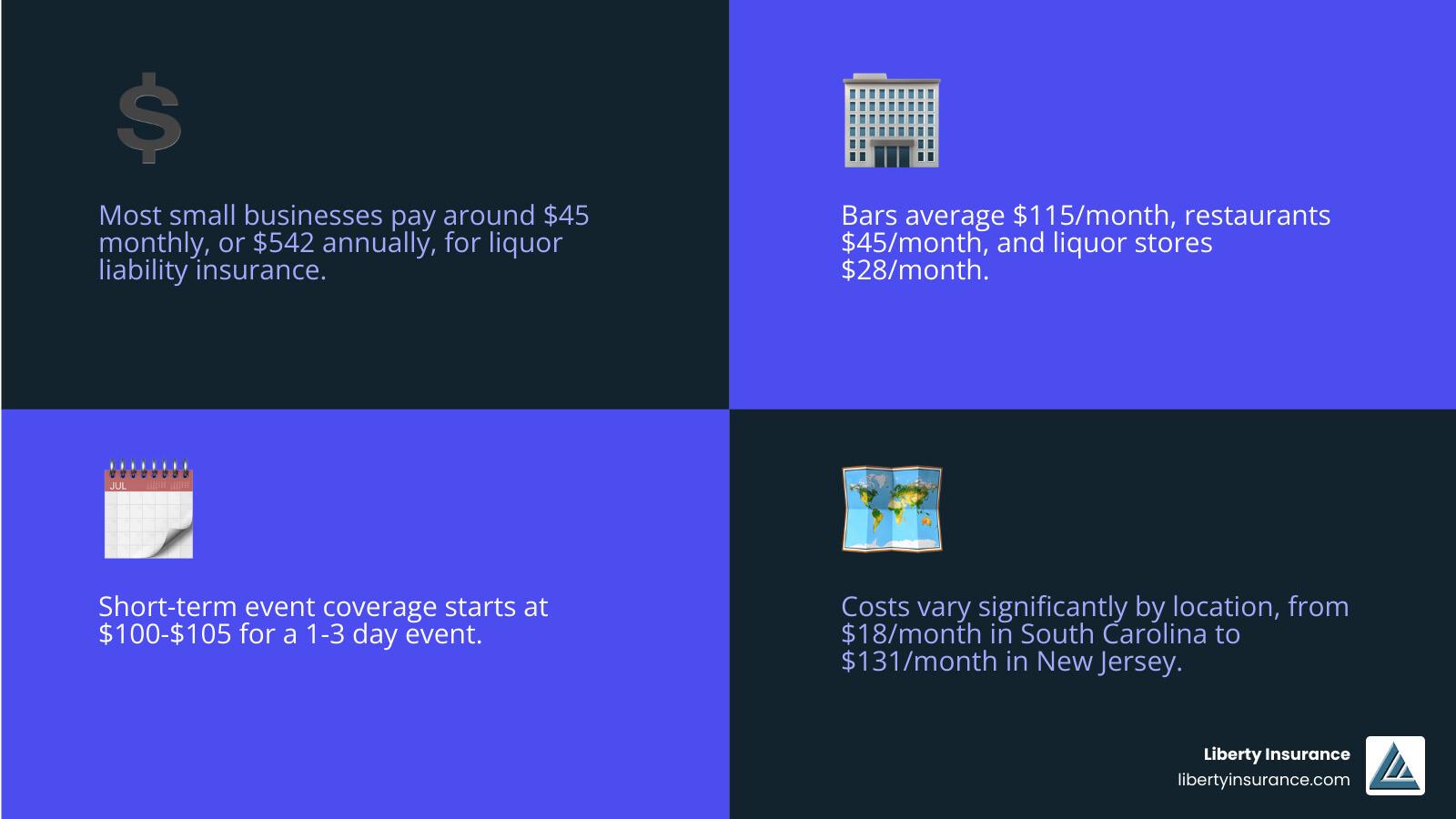
Liquor liability insurance cost typically ranges from $28 to $115 per month, with most small businesses paying around $45 monthly or approximately $542 annually. However, your actual premium depends on several key factors:
- Business Type: Bars ($115/month average) pay significantly more than restaurants ($45/month) or liquor stores ($28/month)
- Coverage Limits: $1 million for restaurants, $2 million for bars
- Event Coverage: Short-term policies start at $100-$105 for a 1-3 day event
- Location: Costs vary by state (from $18/month in South Carolina to $131/month in New Jersey)
- Alcohol Sales Volume: Higher percentage of alcohol revenue increases premiums
If you serve, sell, or distribute alcohol, understanding these costs isn’t just about budgeting—it’s about protecting your business from potentially devastating financial losses. A single alcohol-related incident can result in judgments exceeding $500,000, making this coverage essential for any establishment involved in the alcohol business.
Whether you operate a busy bar in Trenton, a family restaurant in Princeton, or cater events throughout New Jersey, the price you pay for protection varies based on your specific risk profile. The good news? Many of these factors are within your control, and strategic decisions can significantly reduce your premiums.
I’m Andrew Harris, a Certified Insurance Counselor with over a decade of experience helping New Jersey businesses steer liquor liability insurance cost and coverage decisions. Through my work with the Professional Insurance Agents of New Jersey and as PIA National’s 2020 Agent of the Year, I’ve guided countless establishments in securing the right protection at the right price.
Understanding the Average Liquor Liability Insurance Cost
Navigating insurance can sometimes feel like trying to mix a perfect cocktail blindfolded. But when it comes to liquor liability insurance cost, we’re here to shed some light on what you can generally expect to pay, whether you’re running a full-time establishment or hosting a one-off event. This section breaks down what businesses can typically expect to pay for liquor liability coverage, from annual policies to short-term event insurance.
Average Premiums for Your Annual Liquor Liability Insurance Cost
For most small businesses, the liquor liability insurance cost is surprisingly manageable. On average, businesses typically pay around $45 per month, which translates to about $542 annually. We’ve found that over half (52%) of policyholders actually pay even less than $50 per month for their coverage. This median cost provides a good benchmark, excluding the outlier high and low premiums that can skew simple averages.
However, this is an average. The actual cost can range more broadly, from as low as $28 to $115 per month, or approximately $336 to $1,379 annually. This wide range exists because, like a fine wine, the price is influenced by many unique characteristics of your business. Our goal at Liberty Insurance is to help you understand these nuances to ensure you get the right coverage for your specific needs, whether you’re a busy bar in Trenton or a quaint restaurant in Princeton.
It’s clear that securing proper Liquor Liability Insurance is a vital step for any business serving alcohol.
Comparing Costs: Bars vs. Restaurants vs. Other Businesses
The type of establishment you operate is one of the most significant factors influencing your liquor liability insurance cost. Think about it: a busy bar where alcohol sales are the primary revenue driver inherently carries a different risk profile than a family-friendly restaurant where alcohol is an ancillary offering.
Here’s a quick comparison of average monthly and annual costs for different types of establishments:
| Business Type | Average Monthly Cost | Average Annual Cost |
|---|---|---|
| Bars | $115 | $1,379 |
| Restaurants | $45 | $542 |
| Liquor Stores | $28 | $336 |
| Caterers | $150 to $850 (annually) | $150 to $850 (annually) |
As you can see, bars typically face higher premiums, averaging around $115 per month. This is largely due to a higher percentage of their total sales coming from alcohol, which translates to increased exposure to alcohol-related incidents. Restaurants, on the other hand, often see lower rates, averaging about $45 per month, because alcohol sales usually represent a smaller portion of their overall revenue. Liquor stores, while selling alcohol, typically have less direct interaction with intoxicated patrons on-site, leading to even lower average monthly costs around $28.
For businesses like bars, understanding these differences is crucial for budgeting and risk management. We offer specialized guidance for Liability Insurance for Bars to ensure they are adequately protected.
The Liquor Liability Insurance Cost for Short-Term and Event Coverage
Not every business serves alcohol all year round. If you’re planning a special event, like a wedding reception, a corporate party, a festival, or even a one-time pop-up bar, you’ll need short-term or event-based liquor liability insurance. This type of coverage is designed for temporary situations and can be surprisingly affordable.
The cost for short-term coverage typically starts around $100 to $105 for a 1-3 day event. This makes it a cost-effective solution for event planners, caterers, or individuals hosting private functions where alcohol will be served. For example, if you’re a caterer handling a wedding in New Brunswick, this specific coverage would be ideal.
It’s important to differentiate between general event liquor liability and what’s known as host liquor liability. Host liquor liability is usually included in general liability policies and covers situations where you’re providing alcohol but not selling it as your primary business. This is common for office holiday parties or private gatherings. However, if you are actively selling or serving alcohol as part of your event’s commercial operation, then a dedicated Event Liquor Liability Insurance policy is what you need. We also provide comprehensive information on Host Liquor Liability Insurance Cost for those who need it.
Key Factors That Influence Your Premium
Just like a chef carefully selects ingredients for a dish, insurers carefully analyze various factors to determine your liquor liability insurance cost. The price of your policy isn’t random; it’s a reflection of the unique risks associated with your business. Understanding these ingredients in the underwriting process can help you anticipate and even influence your premium.
Coverage Limits and Deductibles
One of the most direct influences on your liquor liability insurance cost is the amount of coverage you choose. This typically involves two main figures: the “per-occurrence limit” (the maximum an insurer will pay for a single incident) and the “aggregate limit” (the total maximum an insurer will pay over the policy period). Higher limits, naturally, provide more comprehensive protection but also come with a higher premium.
For example, our experience shows that restaurant owners typically opt for a $1 million liquor liability limit, while bar businesses often choose a $2 million limit. This difference reflects the varying risk exposures between these establishments. While a $1 million policy might seem substantial, an alcohol-related incident can easily result in damages exceeding $500,000, making adequate coverage an absolute necessity. It’s not about if you need coverage, but how much. We can help you understand What Does Liquor Liability Insurance Cover? to make an informed decision.
Deductibles also play a significant role. A deductible is the amount you agree to pay out-of-pocket before your insurance coverage kicks in. Generally, choosing a higher deductible will result in a lower premium. It’s a balancing act: a higher deductible saves you money upfront, but you need to ensure you can comfortably cover that amount if a claim arises. The standard deductible for many liquor liability policies is $1,000.
Business Type and Alcohol Sales Volume
We’ve touched on this already, but it bears repeating: the very nature of your business and how much alcohol you sell are paramount in determining your liquor liability insurance cost.
- Bars and Taverns: These establishments are inherently higher risk because their primary business revolves around alcohol sales. Consequently, they face some of the highest premiums.
- Restaurants: While they serve alcohol, food sales often make up a larger portion of their revenue, generally leading to lower premiums than bars.
- Caterers and Event Vendors: Their risk can vary depending on the frequency and scale of events, and whether alcohol is a primary offering or an add-on.
- Liquor Stores: Although they sell alcohol, the risk of an on-premises incident caused by an intoxicated patron is typically lower than in a consumption-focused venue, resulting in lower premiums.
The percentage of your gross annual income derived from alcohol sales is a critical metric. Businesses with a higher volume of alcohol sales generally translate to a higher risk profile in the eyes of insurers, leading to a higher premium. It’s a simple equation: more alcohol, more potential for incidents, more cost for protection. For specific guidance custom to your establishment, check out our resources on Bars Restaurants and Taverns Liquor Liability Insurance.
The Impact of Your Business Location and State Laws
Where your business is located significantly impacts your liquor liability insurance cost. This isn’t just about local market rates; it’s heavily influenced by state-specific regulations, particularly “dram shop laws.”
Dram shop laws exist in 43 states, plus Washington D.C., and they hold establishments that sell or serve alcohol legally responsible for damages caused by intoxicated patrons they served. New Jersey, like many other states, has its own set of dram shop laws, creating a legal environment where liquor liability coverage is practically essential, even if not always technically mandated by the state.
Our data shows that the average monthly liquor liability insurance cost in New Jersey is around $131. This is higher than the national average, reflecting the legal landscape and potentially higher coverage requirements or risk perception within the state. For comparison, states like South Carolina might see averages around $18, while New York can be around $130. This highlights how dramatically location can affect costs.
Even where state law doesn’t explicitly mandate insurance, local licensing authorities in places like Trenton, Princeton, or Toms River often do. They want to ensure businesses have the financial backing to cover potential liabilities. Understanding these nuances is a key part of securing effective New Jersey Business Insurance. You can learn more about these regulations and See Which States Have Dram Shop Laws.
Your Business’s Claims History
Your business’s past behavior is a strong predictor of future risk, and insurers pay close attention to it. Your claims history, including the frequency and severity of past liquor liability claims, directly impacts your premium.
A business with a clean claims history—meaning few to no past claims—is viewed as lower risk and will generally qualify for more favorable insurance rates. Conversely, a history of multiple or severe liquor liability claims signals higher risk to insurers, which can lead to higher premiums or, in some cases, difficulty obtaining coverage.
This underscores the importance of not just having insurance, but also actively managing risk to prevent claims from occurring. Maintaining a clean record is one of the most effective ways to keep your liquor liability insurance cost down over time. It’s a testament to good business practices and responsible alcohol service. For more on protecting your overall operations, visit our Business Insurance page.
How to Reduce Your Liquor Liability Insurance Premiums
While some cost factors are fixed, like your location or the inherent nature of your business, there are several proactive steps you can take to lower your insurance rates and make coverage more affordable. We believe in empowering our clients to take control of their premiums, and it often starts with smart choices and diligent practices.
Implement Smart Risk Management Practices
One of the most effective ways to reduce your liquor liability insurance cost is by actively minimizing the risks associated with serving alcohol. Insurers love to see businesses take responsibility, and they often reward it with lower premiums.
- Employee Training Programs: Invest in formal alcohol service training programs for your staff. Certifications like TiPS Alcohol Safety Training or ServSafe Alcohol demonstrate a commitment to responsible service. Businesses with certified staff may see premium reductions of around 15-20%. We’ve seen small restaurants in Princeton save significantly on their premiums after implementing comprehensive training programs.
- Strict ID-Checking Policies: Ensure all staff are rigorously checking IDs to prevent serving minors. This is a fundamental step in risk reduction.
- Smart Serving Practices: Encourage responsible consumption by:
- Offering food options: Food slows alcohol absorption.
- Providing non-alcoholic drinks: Make water readily available and offer free soda or mocktails for designated drivers.
- Limiting drink quantities: Implementing policies on the number of drinks served to a patron.
- Recognizing and cutting off visibly intoxicated patrons: This is crucial, though sometimes challenging.
- Documenting Incidents: Thoroughly document any incidents, no matter how minor, and any interventions taken (e.g., cutting off service, calling a cab for a patron). This can be invaluable in defending against future claims.
By implementing these practices, you not only create a safer environment for your patrons and community but also signal to insurers that you are a lower-risk client, potentially leading to significant savings on your liquor liability insurance cost.
Make Strategic Policy and Payment Choices
Beyond day-to-day risk management, several strategic decisions regarding your insurance policy itself can help trim your premiums.
- Bundling Policies: Combining your liquor liability insurance with other essential coverages, such as a Business Owner’s Policy (BOP) which typically bundles general liability and commercial property insurance, can lead to substantial discounts. Many insurers offer a 10-15% discount for bundling. This is a smart move for many businesses, including those in Millstone Township and Toms River, allowing for comprehensive protection at a more affordable rate. Explore our options for General and Liquor Liability Insurance.
- Higher Deductibles: As discussed, opting for a higher deductible means you pay more out-of-pocket if a claim occurs, but it significantly lowers your upfront premium. Increasing your deductible from, say, $1,000 to $2,500 or $5,000 might reduce your premium by 10-15%. Just ensure you have the financial reserves to cover that higher deductible if needed.
- Paying Premiums Annually: While monthly payments offer convenience, paying your annual premium in one lump sum often comes with a discount, typically around 5-10%. It’s a simple way to save money if your cash flow allows it. A client in Trenton, for instance, saved nearly $400 annually by bundling their liquor liability with existing coverage and paying upfront.
By thoughtfully considering these policy and payment strategies, you can effectively manage your liquor liability insurance cost without compromising on essential protection.
Frequently Asked Questions about Liquor Liability Insurance
We understand that securing the right insurance can bring up a lot of questions. Here, we address some of the most common inquiries our New Jersey clients have about liquor liability insurance.
Is liquor liability insurance required by law?
This is a common question, and the answer can be a bit nuanced. While it’s not universally mandated by state law across all states, there are several scenarios where liquor liability insurance becomes a de facto requirement:
- State Regulations: Some states explicitly require liquor liability insurance to obtain or maintain a liquor license.
- Local Ordinances: Even if your state doesn’t require it, local municipalities in places like New Brunswick or Princeton might. Local licensing authorities often make this a condition for operating.
- Dram Shop Laws: As we mentioned, 43 states plus D.C. have dram shop laws. These laws create significant legal liability for businesses that serve alcohol to intoxicated individuals who then cause harm. Even without a direct insurance mandate, the immense financial risk posed by these laws makes coverage practically essential.
- Landlord and Lender Requirements: Many landlords, especially for commercial properties, will require proof of adequate liquor liability insurance as part of your lease agreement. Lenders might also impose this requirement.
In short, while it may not always be legally mandatory, it is a business necessity in most cases to protect against potentially devastating financial losses from lawsuits.
Does general liability insurance cover alcohol-related incidents?
A very important distinction to make! Many business owners mistakenly believe their general liability insurance policy covers all potential risks, including those related to alcohol. Unfortunately, this is a common misconception.
For businesses that sell, serve, or distribute alcohol as part of their operations (like bars, restaurants, or caterers), standard general liability insurance policies almost always include an exclusion for alcohol-related incidents. This means that if an intoxicated patron causes injury or damage after being served by your establishment, your general liability policy would likely not cover the resulting legal fees, settlements, or medical expenses.
The exception to this is host liquor liability coverage, which is typically included in general liability policies. However, host liquor liability is designed for businesses that don’t sell alcohol but allow its consumption on their premises (e.g., an office hosting a holiday party where employees bring their own wine). It does not cover operations where alcohol is sold or served for a fee.
Therefore, if your business is in the business of selling or serving alcohol, you absolutely need a separate, dedicated liquor liability insurance policy to ensure you’re adequately protected. For more details, you can read about What Is Host Liquor Liability Insurance?.
What exactly does liquor liability insurance cover?
This is a critical question, as understanding your coverage is just as important as knowing the liquor liability insurance cost. A dedicated liquor liability policy is designed to cover the specific risks that come with serving alcohol. If your business is sued for an incident involving an intoxicated patron, this insurance typically covers:
- Legal and Defense Costs: This includes attorney fees, court fees, and other legal expenses required to defend your business against a claim, regardless of whether the lawsuit has merit.
- Judgments and Settlements: If your business is found liable for damages, the policy will cover the settlement or court-ordered judgment, up to your policy’s limits.
- Medical Expenses: It can cover the medical bills of a third party who was injured by an intoxicated person you served (e.g., the victim of a drunk driving accident).
- Property Damage: The policy covers costs to repair or replace property damaged by an intoxicated patron (e.g., if they crash their car into another vehicle or building after leaving your establishment).
- Assault and Battery Claims: Many liquor liability policies include or offer coverage for claims arising from fights or other physical altercations. This is a vital component for bars and nightclubs, as these incidents can lead to expensive lawsuits.
Essentially, it protects your business’s assets from the potentially catastrophic financial fallout of an alcohol-related claim. Without it, you would be responsible for paying these costs out of pocket.
What’s the difference between liquor liability and host liquor liability?
This distinction is crucial for understanding what type of coverage your business needs and directly impacts your liquor liability insurance cost.
Liquor Liability Insurance: This policy is specifically designed for businesses that are in the business of manufacturing, selling, serving, or distributing alcoholic beverages. This includes establishments such as bars, restaurants, nightclubs, liquor stores, breweries, wineries, and caterers. It protects against claims of bodily injury or property damage arising from the actions of an intoxicated person who was served alcohol by your business. For instance, if a patron leaves your bar in Toms River intoxicated and causes a car accident, your liquor liability policy would respond to claims against your business. This is the comprehensive Liquor Liability Policy we often discuss.
Host Liquor Liability Insurance: This type of coverage is for businesses or individuals who are not in the business of selling or serving alcohol, but rather provide it gratuitously (e.g., at no charge) at an event. Examples include:
- An office holiday party where the company provides alcohol for its employees.
- A grand opening event where complimentary drinks are offered.
- A wedding reception where the hosts provide an open bar.
Host liquor liability is typically included as part of a general liability insurance policy. It protects the host against claims resulting from the actions of an intoxicated guest who consumed alcohol provided by the host. The key difference is the commercial aspect: if you are selling or profiting from the alcohol, you need liquor liability. If you are simply providing it as a host, host liquor liability is usually sufficient.
Conclusion
Navigating the complexities of liquor liability insurance cost might seem daunting, but as we’ve explored, it’s a vital investment for any New Jersey business that serves, sells, or distributes alcohol. The cost is variable, influenced by factors like your business type, alcohol sales volume, location, coverage limits, and claims history. Yet, many of these factors are controllable through smart risk management and strategic policy choices.
Liquor liability insurance isn’t just another expense; it’s essential protection that provides invaluable peace of mind, safeguarding your business from potentially ruinous financial losses. At Liberty Insurance, we’re dedicated to providing expert guidance and customizable solutions to help you protect your business, whether you’re in Millstone Township, Trenton, Toms River, New Brunswick, or Princeton.
Don’t leave your business exposed to unnecessary risks. Reach out to us today for a personalized quote and expert guidance on protecting your business with the right liquor liability insurance. For comprehensive protection against alcohol-related risks, you can Get a quote for event liquor liability insurance or contact us directly to speak with a specialist who understands your unique business needs. We’re here to help you pour responsibly and operate confidently.

