
Why Understanding Loss of Revenue Matters for Your Business
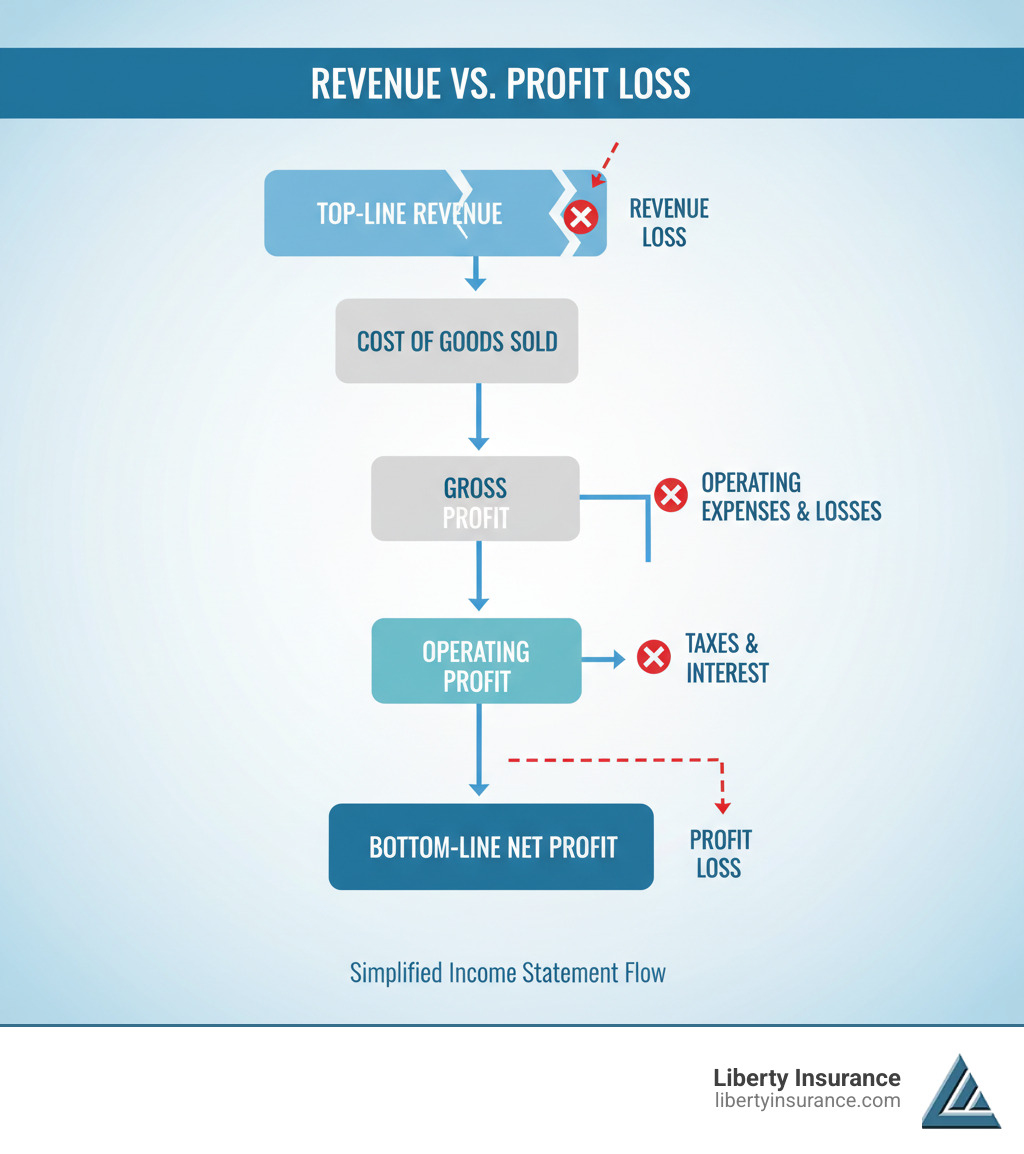
Loss of revenue is the income your business expected to earn but didn’t receive due to unforeseen circumstances like natural disasters, equipment breakdowns, or forced closures. It’s different from loss of profit because it affects your total income (top-line) before expenses are considered, directly reducing your cash flow.
According to research from MGI, 42% of companies experience revenue leakage—money that should have been earned but slips away. This statistic highlights just how common revenue loss issues are across all industries and why active prevention, measurement, and protection strategies matter.
For small business owners, understanding the difference between losing revenue and losing profit is crucial. Revenue loss hits your business immediately and directly affects your ability to pay bills and maintain operations. The distinction becomes especially important when dealing with insurance claims, legal contracts, bank covenants, and financial planning. A fire that forces your restaurant to close for two months doesn’t just reduce your profit margins—it eliminates your revenue stream entirely during that period and can trigger downstream issues like payroll disruption, missed loan payments, and supply chain penalties.
I’m Andrew Harris, a CIC and AAI designated professional with Liberty Insurance. I’ve helped countless business owners steer loss of revenue claims and understand how proper insurance protects their financial stability. My experience shows that preparation is critical, as most owners don’t grasp these concepts until a crisis hits. The businesses that weather disruptions best tend to have clear documentation, calibrated coverage, and a playbook for fast recovery.
Before diving deeper, here’s what you’ll take away from this guide:
- A practical definition of loss of revenue, and how it differs from loss of profit and loss of business.
- The legal and contractual nuances that determine whether you can recover losses.
- A step-by-step framework to calculate loss of revenue, with examples.
- Common pitfalls that derail claims and how to avoid them.
- Proven mitigation tactics to prevent revenue leakage in the first place.
- An insurance roadmap, including business interruption and related coverages that act as financial lifelines.
- A comprehensive FAQ drawn from real client conversations.
Why it matters now:
- Disruptions are more frequent—from extreme weather and cyber incidents to supply chain shocks and utility outages.
- Margins are tighter. A few weeks without income can erase an entire year’s gains.
- Customers have more alternatives. If you’re down, they may switch for good, compounding short-term loss into long-term erosion.
Use this article as a reference you can come back to when negotiating contracts, planning continuity, or preparing an insurance submission. The goal is simple: reduce avoidable loss, transfer the risk you can’t control, and recover faster when the unexpected happens.
What is Loss of Revenue? The Core Concepts Explained
When your business faces unexpected challenges, understanding loss of revenue is crucial. It’s the income you were on track to earn but couldn’t due to circumstances beyond your control. For example, if a fire closes your New Jersey bakery for two weeks, the income you would have made during that time is your loss of revenue.
The Legal Definition of ‘Loss of Revenue’ in Commercial Contracts
In commercial contracts, loss of revenue is a precise legal term. It typically refers to income that should have been earned from normal operations but was lost due to a “covered” cause specified in your contract or insurance policy. For instance, a contract might define it as “the revenue which the business could reasonably have expected to earn, calculated using the average monthly revenue over the previous six months.” This specificity is vital for a smooth claims process, especially with Commercial General Insurance.
Key legal nuances include:
- Scope of “revenue”: Clarifying whether revenue includes service fees, subscriptions, and usage-based charges
- Adjustments: Accounting for seasonality, sales trends, and atypical events
- Exclusions: Understanding whether “loss of revenue” falls under indirect or consequential loss exclusions
- Evidentiary standards: Specific documentation requirements like audited statements or CRM exports
Key Differences: Loss of Revenue vs. Loss of Profit
Many business owners confuse loss of revenue and loss of profit. Loss of revenue hits your top line—the total money coming in before expenses. Loss of profit affects your bottom line—what’s left after paying all bills. A restaurant closed by a power outage loses revenue. A business with rising delivery costs might see sales stay the same but profit shrink.
| Attribute | Loss of Revenue | Loss of Profit |
|---|---|---|
| Definition | Reduction in total income from sales and operations | Reduction in net income after all expenses are deducted |
| Calculation Focus | Gross sales and service fees before any costs | Net income and profitability margins after expenses |
| Common Causes | Operational shutdowns, reduced sales, market downturns | Increased operating costs, supply chain inefficiencies, reduced margins |
| Impact on Business | Direct hit to cash flow and operational capacity | Affects financial health and long-term sustainability |
| Documentation | Sales ledgers, invoices, POS/CRM reports | P&L statements, cost allocations, COGS and overhead records |
| Insurance Relevance | Central to Business Interruption claims | Often addressed via profit-based indemnity methods |
Related Financial Terms: Loss of Business and Revenue Leakage
Two other terms complete the picture of potential risks to your business.
- Loss of business is broader than loss of revenue, including damage to your company’s market position and customer relationships. If an incident causes customers to switch to competitors permanently, you’re dealing with a loss of business that extends beyond the immediate revenue impact.
- Revenue leakage is a gradual loss of money through inefficiencies like billing errors, uncollected payments, or pricing mistakes. According to EY research, companies can lose up to 5% of their earnings this way. Unlike sudden disasters, leakage is often preventable with better systems and processes.
Protecting your business from these financial risks requires a comprehensive approach. For detailed strategies on safeguarding your company’s assets, explore our guide on Business Asset Protection.
Identifying the Causes and Calculating the Impact
Understanding what causes loss of revenue and how to quantify it is the first step toward effective risk management and recovery.
Common Scenarios Leading to a Loss of Revenue Claim
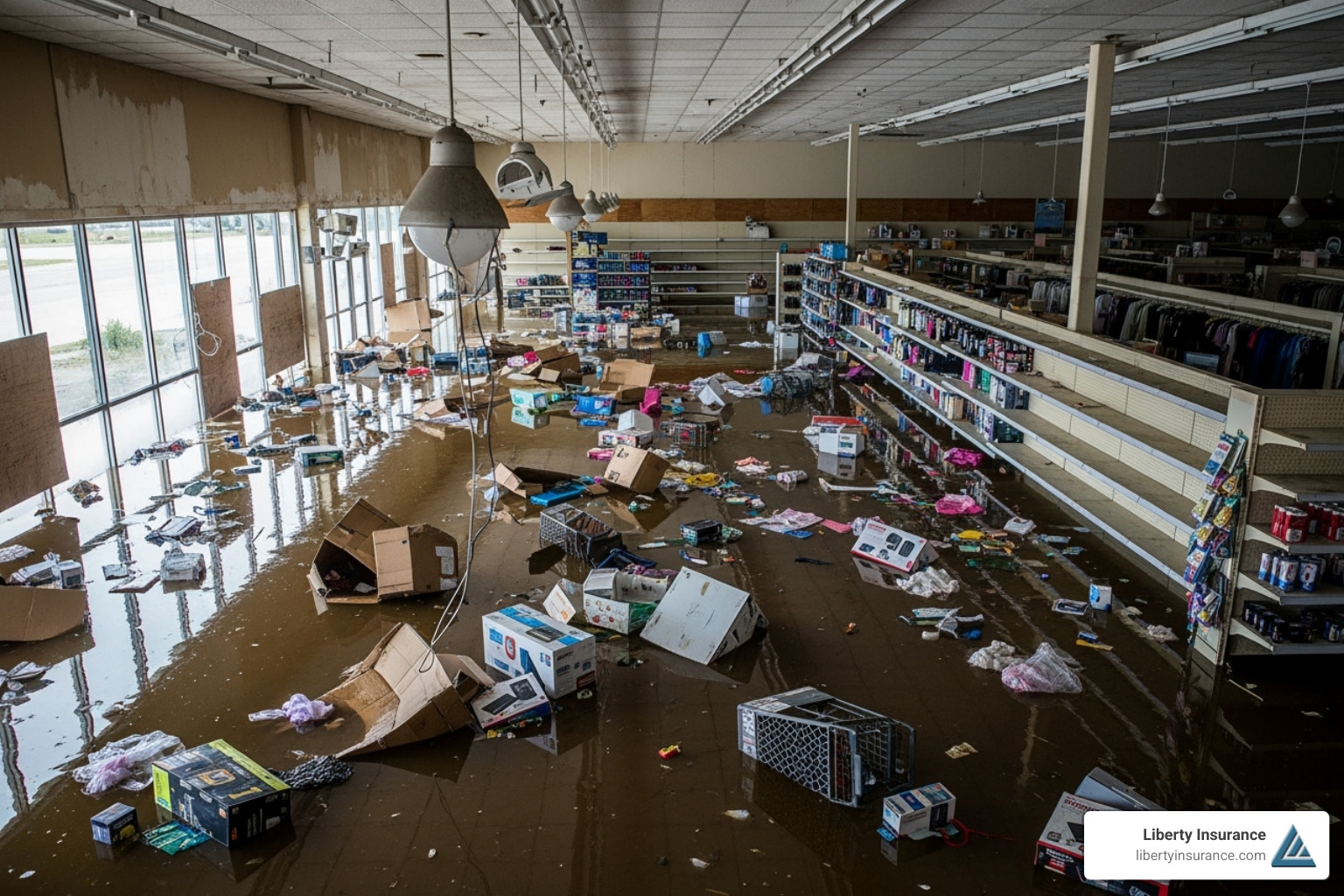
Loss of revenue can stem from various events:
- Operational Disruptions: Power outages, IT failures, or regulatory changes halting business
- Supply Chain Failure: Critical supplier inability to deliver materials
- Natural Disasters: Fires, floods, or storms causing physical damage. This is where Disaster Recovery Insurance and Commercial Fire Damage Insurance are invaluable
- Equipment Breakdown: Failure of crucial machinery
- Cyber Incidents: Ransomware, DDoS attacks, or data loss disrupting operations
- Market Shifts: Sudden changes in consumer demand or new competition
- Government Orders: Mandatory closures or restricted capacity
- Key Person Loss: Temporary unavailability of critical roles
How to Calculate Loss of Revenue
Calculating loss of revenue determines what revenue would have been generated had the disruptive event not occurred:
- Define the Loss Period: From the triggering event to restoration of operations
- Establish a Baseline: Use historical financial statements and sales reports to set expected revenue
- Adjust for Real-World Factors: Incorporate marketing campaigns, new product launches, price changes
- Compute Actual Revenue During the Period: Include any partial operations or alternative channels
- Calculate the Differential: Expected revenue minus actual revenue realized
- Account for Mitigation: Document extra expenses that helped reduce the loss
- Validate with Independent Sources: Use forensic accounting to triangulate numbers
A simplified formula: Expected Revenue for Loss Period – Actual Revenue Earned = Loss of Revenue
Illustrative Example
- Baseline monthly revenue: $400,000
- Growth trend expected: +5% month-over-month for two months
- Anticipated revenue absent the incident: $861,000
- Actual revenue during shutdown: $130,000
- Loss of revenue: $731,000
Data you’ll need includes sales history (12-24 months), product/service mix, signed orders, marketing calendars, and CRM pipeline data.

Practical Challenges in Proving Your Claim
Proving loss of revenue presents several challenges:
- Quantifying Loss: Proving what would have been earned involves reasonable assumptions that can be debated
- Proving Causation: You must show direct causation between the event and lost revenue
- Documentation: Insurers require meticulous records including historical financials and forecasts
- Mitigation Duty: Most policies expect reasonable steps to reduce losses
- Expert Testimony: Forensic accountants often provide credible analysis. They might use tools like the Bank of Canada exchange rate for international transactions for consistency
A well-organized financial story supported by verifiable data greatly increases the likelihood of a timely, favorable recovery.
The Legal and Contractual Landscape of Revenue Loss
The way “loss of revenue” is defined in your contracts and interpreted by law has significant financial implications in a dispute. It’s the difference between having a clear roadmap and wandering in the dark when you need to recover lost money.
Drafting and Interpreting ‘Loss of Revenue’ Clauses
When it comes to contract drafting, precision is everything. A vague “loss of revenue” clause creates ambiguity. Your contract needs specificity, defining what “revenue” means for your business (e.g., gross sales, service fees, subscriptions, recurring charges), the measurement period, and any adjustments for seasonality or growth.
Key clause components to consider:
- Definition and Scope: Clarify whether revenue includes discounts, rebates, and chargebacks, and whether taxes and shipping are excluded.
- Triggering Events: Specify events that qualify (e.g., supplier failure, government order) and any exclusions (e.g., pandemics, force majeure carve-outs).
- Indemnity Structure: Identify who bears responsibility, caps on liability, and whether consequential or indirect losses are excluded—many contracts exclude “loss of revenue” as consequential unless expressly included.
- Evidence and Audit Rights: Outline the records needed to substantiate claims and allow for independent review.
- Mitigation Duty: State the reasonable steps expected to reduce loss and how those efforts are credited.
- Recovery Period: Define how long compensation applies and whether an extended period post-restoration is recognized.
Courts interpret the plain meaning of the words, so expert legal review before you sign is crucial.
Legal Doctrines and Precedents
- Causation and Foreseeability: You must demonstrate the event caused the loss and that such loss was foreseeable at contract formation (Hadley v. Baxendale principles in many common-law jurisdictions).
- Limitations of Liability: Caps and exclusions frequently limit recovery regardless of actual loss.
- Force Majeure: These provisions may excuse performance but don’t automatically grant compensation; they can also exclude pandemics or government orders if not expressly included.
- Duty to Mitigate: Failure to take reasonable steps to reduce loss can bar recovery for the avoidable portion.
Governmental Acts and Regulatory Considerations
The broader legal authority also shapes how revenue loss is handled. Case law provides the foundation for how courts will likely rule, establishing distinctions between “loss of revenue,” “loss of business,” and “loss of profit.” These interpretations can vary by jurisdiction.
Government legislation, like tax laws, provides detailed rules for reporting and recovering from revenue losses. The GST/VAT rules in various jurisdictions can affect how you book revenue and make claims for rebates. Even federal regulations like the Fair Debt Collection Practices Act come into play when businesses try to recover lost income from unpaid debts. Grants, loans, or relief programs may also carry coordination rules with insurance proceeds to prevent double recovery. The tax implications of loss of revenue can be complex, affecting taxable income, deductions for extra expenses, and timing differences—coordinate with your tax advisor early.
Protecting Your Business from Loss of Revenue
While we can’t prevent every disruption, we can implement strategies and secure insurance to protect our business’s financial stability. Think of it like weatherproofing your home—you can’t control the storm, but you can make sure your roof doesn’t leak when it hits.

Mitigation Strategies to Reduce Revenue Leakage
The most effective way to protect against loss of revenue is to stop money from slipping through the cracks. This “revenue leakage” can be stopped with proactive strategies.
- Process audits: Regularly review your billing, invoicing, and collection processes for errors where mistakes can happen. Implement maker-checker controls for credit notes and write-offs.
- Automation: Use modern billing and CRM tools to reduce human error and ensure timely payments. Automate dunning and payment reminders.
- Pricing optimization: Revisit your pricing regularly to reflect rising costs and changing market conditions. Use discount governance and guardrails.
- Customer retention: Focus on keeping existing customers happy. Research from McKinsey shows that businesses excelling at personalization can generate 40% more revenue from those activities.
- Employee training: Ensure your team understands pricing, contracts, and collection procedures to guard your revenue stream. Train front-line staff to spot leakage (e.g., scope creep or free services).
- Continuity planning: Maintain a tested business continuity and disaster recovery plan, including alternate sites, suppliers, and critical system backups.
- Cyber hygiene: Enforce MFA, patch management, backups, EDR, and incident response runbooks to prevent cyber-induced shutdowns.

The Role of Insurance in Covering Your Loss of Revenue
When disruptions happen, insurance is your financial lifeline.
- Business Interruption Insurance (BI): Designed to replace the income you lose when you can’t operate normally due to a covered property loss. If a covered event forces you to close temporarily, this coverage helps replace lost income and cover ongoing expenses like payroll and rent. For example, if a fire closes your Toms River, NJ, restaurant for two months, your Business Interruption Insurance would compensate you for the income you would have earned.
- Commercial Property Insurance: The foundation for BI. Many BI policies require the interruption to arise from direct physical loss or damage insured under your Commercial Property Insurance Business Interruption policy.
- Extra Expense: Pays the reasonable and necessary costs to reduce the loss and speed recovery (e.g., renting a temporary space, rush shipping, overtime labor).
- Civil Authority: Covers lost income when access to your premises is prohibited by government order due to nearby property damage.
- Contingent Business Interruption: Extends protection to losses stemming from supplier or customer locations suffering covered damage.
- Ordinary Payroll and Extended Period of Indemnity: Options that help you keep staff on payroll and cover the ramp-up period after reopening.
Understanding your policy details is crucial:
- Covered perils: Know what events (fire, windstorm, etc.) your policy protects against and any exclusions (e.g., flood or earthquake without specific endorsements).
- Waiting period: Many policies include a time deductible (e.g., 24–72 hours) before BI coverage begins.
- Indemnity period: This determines how long your insurer will pay for your loss of revenue, including the time needed to return to normal operating levels.
- Policy limits and sublimits: Ensure your BI limit, extra expense sublimit, and any contingent coverage are sized to your exposure.
- Documentation expectations: Keep financials, POS/CRM exports, and backup logs ready; fast documentation speeds claim resolution.
At Liberty Insurance, we customize Business Interruption Coverage solutions that align with your specific risks, helping you build a financial safety net.
Buying Checklist
- Current revenue, gross margin, and fixed cost profile documented
- Seasonality and peak periods mapped
- Critical suppliers/customers identified (and contingent exposures quantified)
- Recovery time objectives and alternate site plans established
- Accurate business income worksheet completed
- Adequate limits selected with extended indemnity where needed
Comprehensive Claims Playbook
When a disruption occurs, a structured response is critical. This playbook expands on the key steps to navigate the claims process effectively and maximize your recovery.
1. Immediate Response: Secure and Notify
Your first priority is safety. Secure the site to prevent further damage or injury. Once the immediate danger has passed, notify your insurance carrier without delay. Prompt notification is a policy requirement and starts the claims process. Have your policy number and a preliminary description of the event ready. This first call sets the tone for the entire claim.
2. Meticulous Documentation of Impact
Begin documenting everything immediately. Use photos and videos to capture the full extent of the physical damage from multiple angles. Create detailed incident logs that record a timeline of events, actions taken, and communications. Gather any official reports, such as those from the fire department, police, or utility companies. This evidence is non-negotiable for proving the cause and extent of the loss.
3. Activate Continuity and Track Extra Expenses
Implement your business continuity plan to mitigate the loss. This could involve shifting to a temporary location, rerouting supply chains, or enabling remote work. Crucially, you must track every single expense incurred to reduce the loss—these are your “Extra Expenses.” Set up a separate accounting code for these costs, keep all receipts, and maintain a clear log explaining why each expense was necessary. This includes costs like renting equipment, paying overtime, or rush shipping fees.
4. Establish a Centralized Claim File
Designate a single point of contact within your company to manage the claim. Create a centralized digital and physical file to store all documentation, correspondence with the insurer, vendor quotes, and expense records. An organized evidence log that cross-references documents with your claim narrative will streamline the review process for the adjuster and any forensic accountants involved.
5. Proactive Data Submission and Methodology Alignment
Don’t wait for the adjuster to ask for information. Proactively provide the financial data needed to establish your baseline revenue, including historical P&L statements, sales reports, tax returns, and budgets. Most importantly, work with the adjuster early to agree on the methodology for calculating the loss of revenue. Aligning on the calculation approach upfront prevents major disputes down the road.
6. Manage Cash Flow with Interim Payments
Business interruption claims can take time to settle fully. Ask your insurer for interim payments (advances) based on the undisputed portions of your claim. These payments are a critical lifeline that can help you cover ongoing expenses like rent and payroll while you’re recovering, preventing a cash flow crisis from compounding the initial disaster.
7. Finalize the Claim with a Strong Narrative
To close the claim, you will submit a final “Proof of Loss” document. This isn’t just a spreadsheet; it’s a comprehensive package that includes your final, reconciled calculation supported by all the evidence you’ve gathered. Write a clear narrative that tells the story of the loss, explains your calculations, and demonstrates how you met your duty to mitigate. A well-documented, professionally presented final submission makes it easier for the insurer to approve and pay the full, fair value of your claim.
Frequently Asked Questions about Loss of Revenue
Here are answers to the most common questions I hear from business owners about loss of revenue, based on real-world client conversations.
What is the main difference between loss of revenue and loss of profit?
This is the most common question. As we’ve discussed, loss of revenue is a drop in your total income (top-line), often from an inability to operate. Loss of profit is a drop in your net income after all expenses are paid (bottom-line). You can lose profit even with steady revenue if your costs rise. Understanding this difference is crucial for financial planning and insurance claims.
Can I claim for loss of revenue if my business is forced to close temporarily?
Yes, this is precisely what Business Interruption Insurance NJ is for. If a “covered peril” under your Commercial Property Insurance—like a fire or wind damage—forces a temporary shutdown, you can file a claim for the resulting loss of revenue. For example, if a fire closes your Princeton restaurant, the policy helps replace lost income and can even cover extra expenses to minimize the disruption, like renting a temporary space.
How do I prove how much revenue I lost?
Proving loss of revenue requires solid evidence, making good record-keeping essential. The foundation is your historical financial data: profit and loss statements, sales reports, and tax returns that show your normal revenue patterns. You also need to account for factors that would have affected revenue during the loss period, like a new contract or a planned marketing campaign. Because of these complexities, a forensic accountant is often recommended for significant claims. Their expert analysis provides credible support. Think of your financial records as insurance for your insurance—the better your documentation, the smoother your claim will be.
Does business interruption cover revenue loss from supply chain issues?
Often yes—if you have contingent business interruption coverage and the supplier or customer location suffered direct physical damage from a covered peril that disrupts your operations. Read your policy to confirm scope and sublimits.
What if I was partially operating during the interruption?
You can still claim the difference between expected and actual revenue. Document partial capacity, hours, and alternate channels used. Extra Expense coverage may apply to costs that enabled partial operations and reduced overall loss.
Can startups or seasonal businesses claim loss of revenue?
Yes, but the methodology differs. Startups may rely more on signed contracts, pipeline data, and reasonable projections. Seasonal businesses should use prior-year comparable periods and clearly explain seasonal patterns.
Are pandemics or government shutdowns covered?
Coverage depends on policy language and jurisdiction. Many policies require direct physical loss or damage and exclude virus-related losses unless you have specific endorsements. Civil authority coverage requires qualifying property damage and government orders that prohibit access.
How long does the insurer pay for loss of revenue?
Up to the policy’s “period of restoration”—from the date of loss until repairs are completed with reasonable speed. Some policies include an extended period of indemnity to cover the ramp-up time after reopening.
Do I need to keep paying employees to qualify for coverage?
Not necessarily for revenue loss, but some policies offer “ordinary payroll” coverage to help retain staff during the outage. This can significantly improve your recovery trajectory.
Will an insurance payout be taxable?
Tax treatment varies by jurisdiction and circumstances. Some payments replace profits and may be taxable; extra expenses may offset deductions. Consult your tax advisor early to plan appropriately.
What documentation speeds up my claim?
- Sales by day/week for 12–24 months
- POS and CRM exports
- Signed orders, subscriptions, backlog
- Banking and merchant statements
- Marketing calendars and campaign results
- Inventory and production records
How do deductibles work for business interruption?
Most BI policies use a time-based waiting period (e.g., 72 hours) instead of a dollar deductible. Losses within that window aren’t covered.
What if my contract excludes consequential damages—am I out of luck?
Not always. It depends on how your contract defines “consequential” and whether “loss of revenue” is specifically included or excluded. Careful drafting upfront or negotiation of carve-backs can preserve recovery rights.
Do forensic accountants really help?
Yes. They translate your data into defensible calculations, accelerate adjuster alignment, and often increase the accuracy and acceptance of your claim. Their fees may be recoverable under certain policies or treated as part of your recovery strategy.
Can I recover lost market share or reputation damage?
Typically, direct BI coverage focuses on measurable income loss during the defined period. Long-term loss of business or brand impact is harder to quantify and often not covered unless explicitly stated.
Conclusion

Understanding loss of revenue is your financial lifeline when things go wrong. It’s about learning to swim before you’re in the deep end.
We’ve clarified that loss of revenue hits your top-line income, while loss of profit affects your bottom line. This distinction is crucial for contracts and insurance claims. We also highlighted the importance of identifying risks—from supply chain failures and cyberattacks to natural disasters—and showed how to calculate loss with defensible methods. With 42% of companies experiencing revenue leakage, preparation isn’t optional.
Clear contracts and right-sized insurance are your safety net. Precise definitions, sensible indemnity structures, and robust business interruption coverage can be the difference between a temporary setback and a business-ending event. Equally important is disciplined prevention: process audits, pricing governance, customer retention, and continuity planning.
At Liberty Insurance, we’ve seen how the right preparation can mean the difference between a stressful scramble and a measured recovery. We don’t just sell policies; we help build a fortress around your financial future.
Your next steps:
- Map your critical revenue drivers and quantify exposure.
- Tighten processes to eliminate leakage.
- Confirm your BI limits, waiting periods, and extensions match your risk profile.
- Stage documentation now so claims move quickly later.
Don’t wait for a disaster. Take the next step today and learn more about protecting your business with Event Insurance. Being prepared isn’t just smart—it’s essential.

