
Why Manufacturing Workers Comp is Critical for Your Business
Manufacturing workers comp is a state-mandated insurance that covers medical costs and lost wages when employees get injured on the job. Here’s what every manufacturing business owner needs to know:
Key Components of Manufacturing Workers Comp:
- Medical Coverage – Pays for all injury-related medical expenses
- Lost Wage Benefits – Provides partial income replacement (typically 60-70% of wages)
- Disability Benefits – Covers temporary or permanent disability payments
- Legal Protection – Shields your business from employee lawsuits
- State Requirement – Mandatory in almost every state for businesses with employees
The manufacturing industry faces serious injury risks every day. Over 100,000 manufacturing workers suffer job-related injuries annually, with the most common causes being:
- 40% – Contact with objects or equipment
- 24% – Overexertion from lifting or repetitive tasks
- 19% – Slips, trips, and falls
- 8% – Repetitive motion injuries
- 6% – Contact with harmful substances
These injuries don’t just hurt your employees – they can devastate your business financially. Without proper workers comp coverage, a single serious injury could result in tens of thousands in medical bills, lost productivity, and potential lawsuits.
Manufacturing workers comp operates on a no-fault system, meaning injured employees receive benefits regardless of who caused the accident. This protects both your workers and your business, creating a win-win situation that keeps your operation running smoothly.
I’m Andrew Harris, and through my work with Liberty Insurance and designation as PIA National’s Agent of the Year, I’ve helped countless manufacturing businesses steer manufacturing workers comp requirements while protecting their bottom line. My experience with high-risk industries has shown me that the right coverage strategy can mean the difference between a minor setback and a business-ending crisis.

Similar topics to manufacturing workers comp:
- manufacturing insurance
- manufacturing liability insurance
- types of insurance for manufacturing companies
Why Workers’ Compensation is Essential in the Manufacturing Sector
In manufacturing, protecting your team is job number one. The industry’s powerful machinery and busy production lines create inherent risks, making manufacturing workers comp more than just a rule—it’s a vital safety net for both your employees and your business. Without proper coverage, even a minor accident can lead to significant financial hardship for the injured worker and your company.
Manufacturing workers comp acts as a financial shield, ensuring employees receive medical care and wage support without worrying about bills. For business owners, it provides protection from costly lawsuits. This “no-fault” system is a cornerstone of workplace safety, providing benefits regardless of who caused the accident, as long as it was work-related. This avoids lengthy legal battles, letting you focus on your operations.
A strong workers’ comp program also boosts morale. When employees feel secure and cared for, it builds trust, improves productivity, and increases retention. It’s an investment in your people that pays dividends.
To fully protect your business, explore all your options, including the different Types of Insurance for Manufacturing Companies. A deeper look at Understanding Workers’ Compensation can also help you grasp its full value.
Common Injuries in Manufacturing
Even with the best safety measures, accidents can happen. In manufacturing, certain injuries are more common. The data shows:
- Contact with Objects: The most frequent issue at 40% of incidents, this includes being struck by falling tools, getting caught in machinery, or touching sharp objects.
- Overexertion: Making up 24% of injuries, this results from muscle strain due to heavy lifting, pushing, pulling, or repetitive tasks common on assembly lines.
- Slips, Trips, and Falls: These account for 19% of injuries and can be caused by wet floors, uneven surfaces, or misplaced tools in a busy plant.
- Repetitive Motion Injuries: At 8%, these injuries, like carpal tunnel syndrome, develop over time from performing the same tasks repeatedly, such as in assembly or packaging.
- Exposure to Harmful Substances: Though smaller at 6%, contact with chemicals, solvents, dust, or fumes can cause serious health issues.
Understanding these common risks is the first step toward creating effective safety plans. For more detailed data, see More on workplace injuries from the BLS.
What Benefits Does Manufacturing Workers Comp Provide?
When a manufacturing employee is injured on the job, manufacturing workers comp provides a range of benefits to support their recovery and offer long-term support if needed. Key benefits include:
Medical Expenses: Workers’ comp covers all necessary medical treatments related to the work injury, including doctor visits, hospital stays, surgery, and medication. The goal is to ensure the employee receives prompt and effective care.
Lost Wages: If an injury prevents an employee from working, workers’ comp provides partial wage replacement, typically 60-70% of their average weekly pay, depending on the state. This helps maintain financial stability during recovery.
Rehabilitation Costs: Coverage extends to rehabilitation services like physical and occupational therapy. In some cases, it may cover vocational training to help an employee learn new skills if they cannot return to their previous job.
Disability Benefits: For injuries resulting in a lasting impairment, disability benefits are available. These can be for permanent partial disability (if the employee can still work in some capacity) or permanent total disability (if they cannot work again).
Death Benefits: In the tragic event of a fatal work injury, benefits are provided to the employee’s family to cover funeral expenses and provide ongoing financial support.
These comprehensive benefits demonstrate that manufacturing workers comp is a vital shield for your team. While workers’ comp is for work-related incidents, employees might also consider Income Protection Insurance for additional security.
How Are Manufacturing Workers Comp Premiums Calculated and Controlled?
Understanding how manufacturing workers comp premiums are calculated is key to managing costs. Premiums aren’t a flat fee but a dynamic calculation reflecting your industry’s risks and your business’s safety record.

Premiums are based on a formula that includes several critical factors:
- Payroll: A fundamental component, as rates are typically applied per $100 of payroll. Higher payroll means higher potential exposure and premiums.
- Industry Classification Codes: Businesses are assigned codes by organizations like the NCCI based on their operations. Manufacturing has many specific codes (e.g., food, metal, chemical), each with a base rate reflecting that sector’s typical risks. Accurate classification is crucial to avoid overpayment.
- Experience Modification Rate (EMR): Your EMR, or “Mod,” is a multiplier that adjusts your premium based on your claims history compared to the industry average. An EMR below 1.0 earns a discount for a strong safety record, while an EMR above 1.0 results in a surcharge for a poor one.
- Claims History: Past claims directly influence your EMR. Frequent or severe claims increase your EMR and premiums, creating a strong incentive to prevent injuries.
While some factors are external, you have significant control over your EMR through proactive safety management.
Strategies to Reduce Claims and Costs
Reducing manufacturing workers comp costs protects your bottom line and, more importantly, your team. The most effective strategy is preventing injuries before they happen. Here are key strategies:
- Proactive Safety Programs: Invest in comprehensive safety training covering machine operation, lockout/tagout, and chemical handling. Regular audits and a strong safety culture, where employees are encouraged to report hazards, are essential for prevention.
- Return-to-Work Programs: When injuries occur, a structured return-to-work program is crucial. Offering modified or light-duty assignments gets employees back to work sooner, reducing lost wage benefits and aiding their recovery.
- Regular Equipment Maintenance: Poorly maintained machinery is a leading cause of injuries. A rigorous preventive maintenance schedule for all equipment significantly reduces accident risk and extends the life of your assets.
- Employee Training and Ergonomic Improvements: Training on ergonomic principles, proper lifting techniques, and the use of ergonomic tools can prevent overexertion and repetitive motion injuries.

By integrating these strategies, you can lower your EMR, reduce premiums, and create a safer, more productive environment. Protecting your Insurance for Manufacturing Equipment and ensuring sound Commercial Property Insurance NJ are also vital parts of your overall risk management strategy in New Jersey.
Understanding Your Legal Obligations
Understanding your legal obligations for manufacturing workers comp is crucial. While workers’ compensation is state-mandated nationwide, specific requirements vary by state. This is especially relevant for businesses in New Jersey.
- State-Mandated Coverage: Nearly every state requires businesses with employees to have workers’ compensation insurance. For most manufacturing operations, this is mandatory from the first employee. Non-compliance can lead to severe penalties, including fines and stop-work orders.
- Reporting Deadlines: Strict deadlines apply when an employee is injured. The employee must notify you, and you must report the incident to your insurer or the state board within a limited timeframe (e.g., 72 hours). Missing deadlines can jeopardize the claim and lead to penalties.
- Consequences of Non-Compliance: Failing to carry proper coverage is serious. You could be held personally liable for an injured employee’s medical bills and lost wages, and you may lose the “exclusive remedy” protection, opening your business to direct lawsuits.
- Employer Liability: Workers’ comp is the “exclusive remedy,” protecting you from most employee lawsuits. However, employer’s liability insurance, part of your policy, provides coverage in rare cases where a lawsuit is permitted (e.g., gross negligence).
For New Jersey businesses, know the regulations from the Division of Workers’ Compensation – NJ.gov. Ensuring you have adequate Employee Compensation Insurance is fundamental to fulfilling your legal duties.
Navigating the Workers’ Compensation Claims Process
When an injury occurs at your manufacturing facility, your response in the first few hours and days is critical for both your employee’s care and your business’s protection. The manufacturing workers comp claims process can seem overwhelming, but it becomes manageable when broken down into clear steps.
The employee injury report is the starting point. Employees must report injuries to you immediately, even if they seem minor, and this must be documented. An initial report protects everyone, as minor issues can become more serious later.
Getting medical treatment is the next priority. State rules vary on who chooses the initial medical provider, but prompt attention is essential to establish the work-related nature of the injury and ensure proper care.
Filing the claim with your insurance carrier is a distinct step from the internal injury report. You, the employer, are responsible for filing the formal claim with your manufacturing workers comp insurer, providing detailed information about the incident.
Staying in touch with your insurer is key to a smooth process. Your claims adjuster is your main contact; a good working relationship helps resolve the claim efficiently.
Disputes can arise over the cause of an injury or the extent of benefits. States have established procedures for resolving these issues, often starting with mediation. Thorough documentation from the beginning is your best tool in these situations.
The Claims Process for Manufacturing Workers Comp
Effectively managing a manufacturing workers comp claim from day one requires solid preparation and systems.
Immediate reporting is critical. States often mandate reporting to your insurer or state board within 24 to 72 hours. Missing these deadlines can lead to penalties and complications. When an injury occurs, gather information promptly. If safe, take photos of the scene, speak with witnesses, and note all contributing factors.
Seeking medical attention should never be delayed. Understand your state’s rules on provider selection. Directing an employee to a clinic familiar with occupational injuries can ensure proper documentation and care.
Document everything. Maintain detailed records of conversations, medical reports, missed workdays, and accommodation efforts. A well-organized file with incident reports, medical records, and insurer communications is essential.
Communication with your insurer must be frequent and honest. Your claims adjuster is a resource, so return calls promptly and provide requested information quickly to help them resolve the claim efficiently.
Modified duty programs are highly effective. Once an employee is medically cleared for light or restricted duty, find suitable tasks for them. This reduces lost wage costs, keeps the employee engaged, and can accelerate their recovery.
Successful claims management hinges on organization and open communication. When you, your employee, and your insurer work toward the shared goals of recovery and a safe return to work, the process is much smoother. For employees with injuries that may have long-term effects, understanding options like Long Term Disability Insurance can provide additional peace of mind.
Frequently Asked Questions about Manufacturing Workers Comp
When it comes to manufacturing workers comp, we hear the same questions time and again from business owners who want to make sure they’re doing right by their employees while protecting their companies. Let’s tackle the most common concerns with straightforward answers that cut through the confusion.
What happens if an injury is caused by an employee’s own mistake?
Even if an employee’s mistake caused their injury, they are still covered. Manufacturing workers comp is a no-fault system, meaning benefits are provided regardless of who was at fault, as long as the injury occurred in the course of employment. The system is designed to provide care for honest mistakes and accidents. The primary exceptions are for injuries resulting from intoxication, illegal drug use, or intentional self-harm. Otherwise, events like equipment malfunctions or simple errors are covered.
Does workers’ comp cover temporary or part-time manufacturing workers?
Yes. Manufacturing workers comp covers all employees, including full-time, part-time, temporary, and seasonal workers, starting from their first day. A temporary worker faces the same risks as a permanent one and is entitled to the same protection. This is crucial for businesses that use flexible staffing, as state laws require everyone working in your facility to be covered.
Can a manufacturing business be sued by an injured employee who receives workers’ comp?
Generally, no. Workers’ compensation includes an exclusive remedy provision. In exchange for providing no-fault benefits, this provision protects your business from most civil lawsuits related to a workplace injury. An employee who receives workers’ comp benefits cannot sue you for damages like pain and suffering. This “grand bargain” replaces unpredictable lawsuit costs with the manageable cost of insurance premiums. While there are rare exceptions, such as cases of intentional harm by an employer, the exclusive remedy provision protects you in the vast majority of situations.
Protecting Your Business and Your Team
As we’ve explored, manufacturing workers comp is much more than just a legal requirement. It’s a key part of running a successful manufacturing business. It shows how much we care about our employees. It’s a vital safety net, making sure they get the care and support they need if something unexpected happens.
But the good news doesn’t stop there. By being smart about managing risks, we can actually prevent problems. Think about it: when we create a strong safety culture, invest in tools that are easy on the body, keep our machines in top shape, and help injured employees get back to work smoothly, we make injuries less likely. This means fewer accidents. And fewer accidents often lead to lower manufacturing workers comp premiums, which is great for our bottom line. It’s a win-win: safer workplaces mean healthier employees, which leads to smoother operations and a more profitable business.
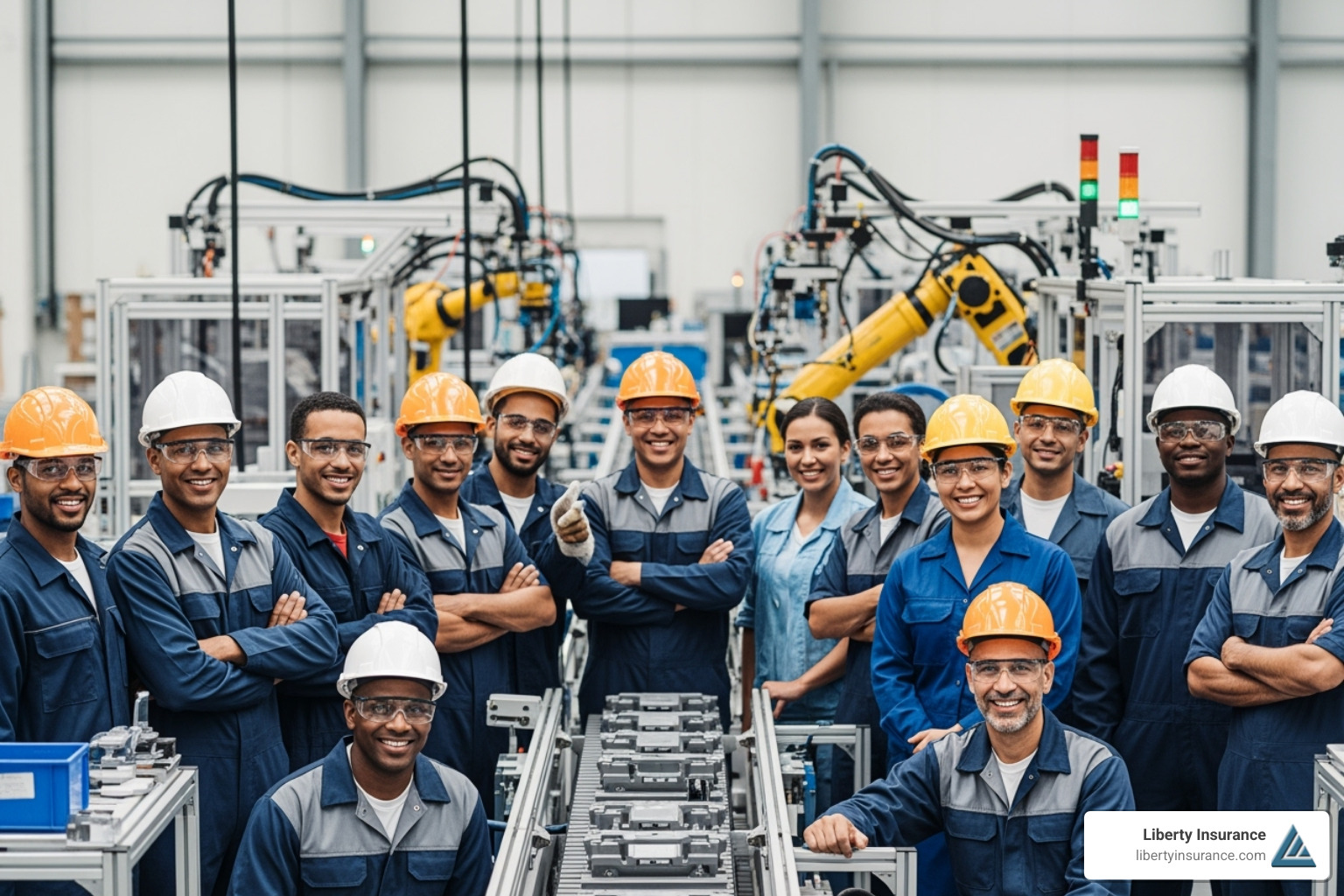
At Liberty Insurance, we get it. We understand the specific challenges and risks that come with manufacturing. We’re not just here to sell policies. We’re here to be your partner. We help you steer the tricky parts of manufacturing workers comp and other important insurance needs. We work to find solutions that protect your valuable equipment and inventory, just as diligently as we protect your most important asset: your people.
By putting safety first and making sure you have the right Business Insurance, we can guard your operations against unexpected events. This helps ensure your long-term success and gives you real peace of mind. Let’s work together to build a future where our manufacturing facilities are not only highly productive but also shining examples of safety and care for everyone.

