
Understanding New Jersey Contractor Bond Requirements
Let’s explain New Jersey contractor bonds together! These financial guarantees are more than just paperwork—they’re a crucial safety net that protects both your business and your customers. At their core, these bonds are three-party agreements involving you (the principal), the state of New Jersey (the obligee), and a surety company that backs the guarantee.
Think of your contractor bond as a promise that you’ll follow the rules and treat customers fairly. Unlike insurance that protects you directly, bonds primarily protect consumers by ensuring they have financial recourse if something goes wrong.
For quick reference, here’s what you need to know about the major bond requirements in our state:
| Bond Type | Amount | Who Needs It | Deadline |
|---|---|---|---|
| Home Improvement Compliance | $10,000-$50,000 | Home improvement contractors | March 31, 2025 |
| Home Elevation Compliance | $10,000-$50,000 | Home elevation contractors | March 31, 2025 |
| Electrical | $1,000 | Licensed electricians | Varies |
| Plumbing | $3,000 | Licensed plumbers | Varies |
| HVAC | $3,000 | HVAC contractors | Varies |
The contracting landscape in New Jersey is changing significantly in 2025. If you’re in the home improvement or elevation business, you’ll need to secure your bond before March 31, 2025, when your current registration expires. Your required bond amount will scale with your business—$10,000 for smaller operations up to $50,000 for contractors handling larger projects.
Getting properly bonded isn’t just about checking a box for compliance. When you have the right bond in place, it signals to potential clients that you’re financially stable and committed to ethical business practices. It’s a mark of professionalism that can set you apart in a competitive market.
Your premium cost typically ranges from 1% to 10% of the total bond amount. What determines where you fall in that range? Primarily your credit score and business experience. Better credit means lower premiums—it’s that simple.
Hi there! I’m Andrew Harris, a Certified Insurance Counselor with over ten years of experience helping contractors steer the sometimes confusing world of New Jersey contractor bonds. I’ve guided hundreds of businesses just like yours through this process, ensuring they remain compliant while strengthening their market position.

Understanding the terminology can make this whole process much easier. If you’re looking for related coverage, you might also want to explore:
– New Jersey business insurance
– home improvement contractor insurance nj
– workers’ compensation insurance for independent contractors new jersey
A contractor bond isn’t the same as your liability insurance—they serve different purposes, but both are essential parts of protecting your business. While your bond safeguards your customers, your insurance protects your business assets. Together, they create a comprehensive safety net that allows you to focus on what you do best: building and growing your contracting business in the Garden State.
2025 Rule Changes at a Glance
Big changes are coming to New Jersey’s construction industry! On January 8, 2024, Governor Murphy signed P.L. 2023, c. 237 into law, changing how contractors operate across the Garden State. This amendment to the Contractors’ Business Registration Act (CBRA) created the Home Improvement and Home Elevation Contractor Licensing Act and established a dedicated oversight board to protect consumers and legitimate businesses alike.
The headline change for contractors is straightforward but significant: New Jersey contractor bonds are now mandatory. Every Home Improvement Contractor Business (HICB) and Home Elevation Contractor Business (HECB) must secure a compliance bond based on their contract values:
- $50,000 bond: For contracts exceeding $120,000 or annual services of $750,000+
- $25,000 bond: For contracts between $10,000-$120,000 or annual services between $150,000-$750,000
- $10,000 bond: For contracts under $10,000 or annual services below $150,000
Mark your calendars! All existing contractor registrations will expire on March 31, 2025. The renewal window opens in January 2025, giving you a three-month period to gather your documentation and secure your bond.
“These changes aren’t just paperwork – they’re reshaping consumer protection in New Jersey’s construction industry,” explains Mark Johnson, a construction attorney in Princeton. “Contractors who prepare early will have a smoother transition and a competitive edge when everyone scrambles to meet the deadline.”
For the most up-to-date information on registration requirements, check out the official Home Improvement Contractor Business page maintained by the New Jersey Division of Consumer Affairs.
Why the State Added Bonds
You might be wondering why New Jersey made these changes. There are three compelling reasons behind the new New Jersey contractor bonds requirements:
First, they deter fraud. When contractors have financial skin in the game, they’re less likely to cut corners or disappear mid-project. Think of it as the state’s way of asking, “Are you serious about this business?”
Second, these bonds provide real financial protection for homeowners. Lisa Slater, an experienced claims examiner, puts it plainly: “We’ve seen too many families left with half-finished kitchens or leaky roofs after paying deposits to contractors who vanished. These bonds give homeowners a clear path to recover damages when things go wrong.”
Third, the bonds help legitimate contractors stand out. When everyone has to meet the same standards, it levels the playing field and pushes out fly-by-night operations that undercut honest businesses.
The newly formed State Board of Home Improvement and Home Elevation Contractors will oversee this bonding program, ensuring both consumers and ethical contractors benefit from increased industry oversight. It’s a win-win for everyone except those looking to game the system.

Understanding New Jersey Contractor Bonds
A New Jersey contractor bond is more than just paperwork—it’s a promise. Think of it as a three-way handshake between you (the contractor), the government, and a surety company that backs your word with financial muscle.
Unlike insurance that protects you when things go wrong, New Jersey contractor bonds protect everyone else—your customers and the state. It’s your way of saying, “I stand behind my work and follow the rules.”
Here’s who’s involved in this important agreement:
- You (The Principal): As the contractor, you purchase the bond and promise to follow all laws and fulfill your obligations.
- The Government (The Obligee): New Jersey or local authorities require the bond as protection for the public.
- The Surety Company: Organizations like Liberty Insurance that issue the bond, essentially vouching for your reliability.
When you get a bond, you’re not buying protection for yourself. Instead, you’re providing financial security for others in case you don’t live up to your promises. It’s a vote of confidence in your own work.
There’s an important distinction between the two main types of bonds contractors need:
License bonds are your ticket to legally operate in New Jersey. They’re required to get or keep your contractor registration or license—like the new compliance bonds all home improvement contractors will need by 2025.
Contract bonds focus on specific projects (especially government work) and include bid bonds, performance bonds, and payment bonds that guarantee various aspects of a particular job.
At Liberty Insurance, we help contractors steer these requirements with our comprehensive Surety Bonds services, ensuring you meet both state and local regulations without headaches.
Who Must Obtain New Jersey Contractor Bonds?
The list of professionals who need New Jersey contractor bonds continues to grow. If you work in any of these fields, bonding is part of doing business in the Garden State:
Home improvement contractors will soon face the biggest change, with all HICBs needing compliance bonds ranging from $10,000 to $50,000 based on their contract values by March 2025.
Home elevation contractors face identical requirements, with the same tiered structure based on project size.
Electrical contractors must maintain a more modest $1,000 bond with the State Board of Examiners of Electrical Contractors to keep their licenses active.
Master plumbers need to secure a $3,000 bond filed with their licensing board—a requirement that’s been in place for years.
HVAC professionals require a $3,000 bond with the State Board of Examiners of Heating, Ventilating, Air Conditioning and Refrigeration Contractors.
Elevator trade contractors working with elevators, escalators, or moving walkways need a $10,000 bond to ensure public safety.
Beyond these state requirements, many New Jersey towns and cities have their own bonding rules. What’s sufficient in one municipality might not cut it in another, so always check local regulations before starting work in a new area.
Types of New Jersey Contractor Bonds & Minimum Amounts
The world of New Jersey contractor bonds includes various types, each with specific minimum amounts that reflect the level of financial protection they provide.
Compliance and license bonds are the most common. The new home improvement and home elevation contractor bonds will come in three tiers: $10,000 for smaller operations, $25,000 for mid-sized businesses, and $50,000 for contractors handling larger projects. Electrical contractors need just $1,000 bonds, while plumbing and HVAC professionals require $3,000 bonds. Elevator contractors face a higher $10,000 requirement due to the safety-critical nature of their work.
Municipal bonds vary widely across New Jersey’s diverse communities. Jersey City demands a substantial $15,000 contractor bond, while Ventnor City requires $4,000. If you’re opening streets in Burlington, prepare to post a $5,000 bond, and Hoboken’s street permit bonds vary based on the project’s scope.
Project-specific bonds are typically tied to contract values. Bid bonds usually amount to 5-10% of your bid, while performance and payment bonds generally equal 100% of the contract value. Maintenance bonds, which guarantee your work after completion, typically range from 10-20% of the contract amount.
“I learned the hard way that bond requirements don’t stop at the state level,” shares Mike, a contractor from Cherry Hill. “When I expanded to work in Atlantic City, I had to scramble to get additional bonding. Now I research local requirements before bidding on any job outside my usual territory.”

Cost & Underwriting: How Much Will Your Bond Cost?
Wondering what a New Jersey contractor bond will cost you? Unlike insurance where you pay the full premium, bond costs work differently – you’ll pay just a percentage of the total bond amount. Think of it as the surety company’s fee for vouching for your business.
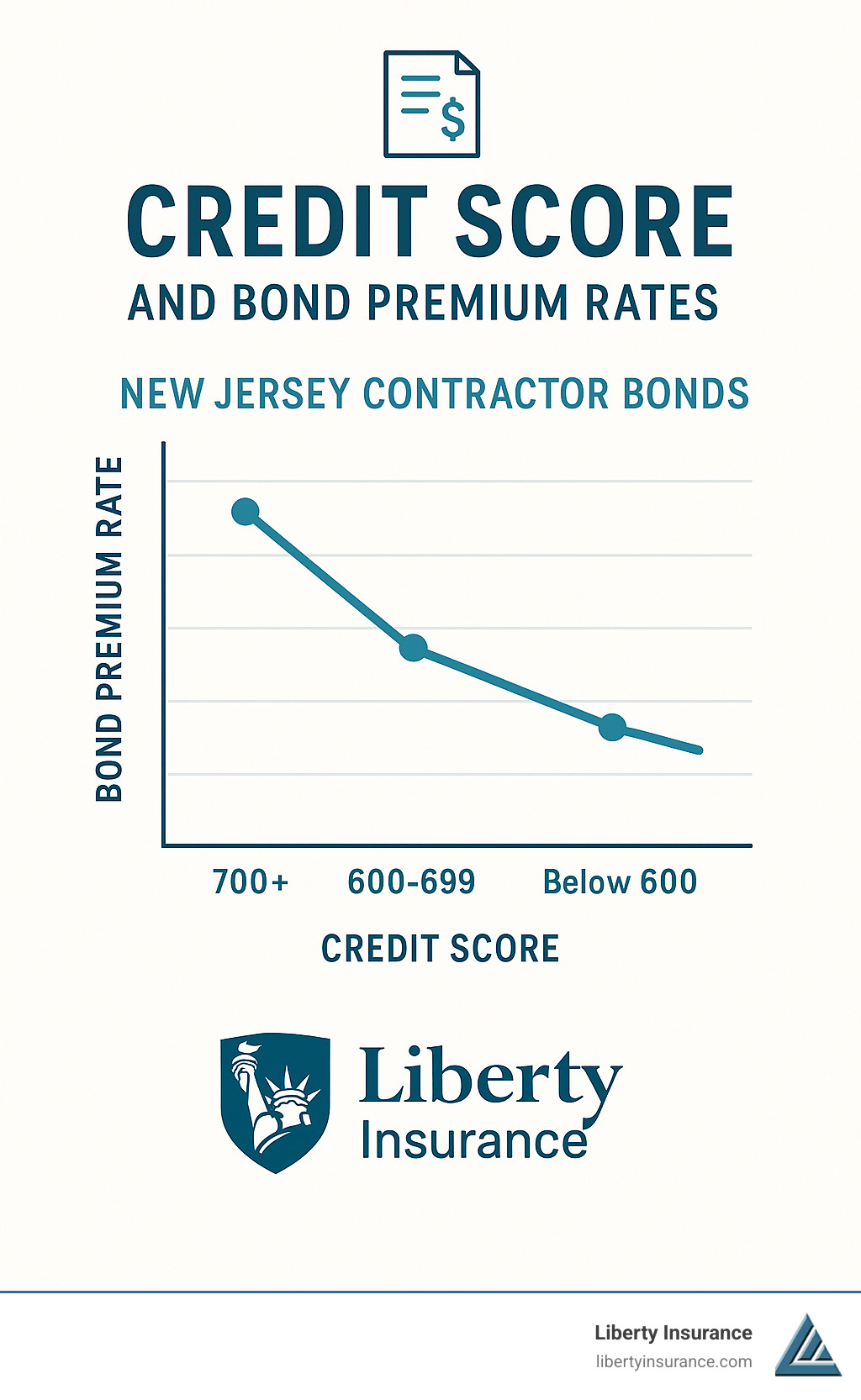
Your premium rate depends largely on your personal financial picture. Credit score is the biggest factor here – it’s like your financial report card that sureties use to gauge risk. A contractor with excellent credit might pay just 1% of the bond amount, while someone with credit challenges could pay up to 10%.
Here’s what you might expect to pay based on your credit profile:
| Credit Score | Premium Rate | $10,000 Bond Cost | $25,000 Bond Cost | $50,000 Bond Cost |
|---|---|---|---|---|
| 700+ | 1-3% | $100-$300 | $250-$750 | $500-$1,500 |
| 600-699 | 3-5% | $300-$500 | $750-$1,250 | $1,500-$2,500 |
| Below 600 | 5-10% | $500-$1,000 | $1,250-$2,500 | $2,500-$5,000 |
The good news is that smaller trade-specific bonds are much more affordable. If you’re an electrician needing that $1,000 bond, you’ll likely pay just $75-$100 per year. Plumbers and HVAC contractors with $3,000 bonds typically pay between $100-$175 annually.
“I was surprised when my $50,000 bond only cost me $650,” shares Michael, a home improvement contractor from Montclair. “My broker explained that my strong credit score and 15 years in business without claims made me a low-risk client.”
Beyond credit, sureties also consider your experience in the industry, overall financial health, and whether you’ve had any claims against previous bonds. A contractor who’s been successfully completing projects for a decade presents less risk than someone just starting out.
Most New Jersey contractor bonds can be purchased quickly online, with premiums starting at just $75 for qualified applicants. For the most accurate pricing custom to your situation, reaching out to Liberty Insurance for a personalized quote is your best bet.
Ways to Lower Your Premium
If your initial bond quote gives you sticker shock, don’t worry – there are several practical ways to bring that number down.
Improve your credit score first and foremost. This might take some time, but it’s worth the effort. Pay down debts, resolve any collections, and keep all your payments current. Even a 30-point credit score improvement can sometimes drop your rate by a full percentage point.
Bundle your policies whenever possible. At Liberty Insurance, many contractors find savings when they package their bonds with general liability, workers’ comp, or commercial auto coverage.
Maintain a clean claims history going forward. Every year you operate without claims against your bond demonstrates reliability to surety companies, potentially earning you better rates at renewal time.
Tom, a contractor from Cherry Hill, found a creative solution: “When I was starting out with less-than-perfect credit, I asked my more established business partner to co-sign my bond application. This cut my premium nearly in half.”
If you qualify for a lower tier based on your contract values, consider starting with a smaller bond and upgrading as your business grows. A contractor doing mostly small jobs under $10,000 only needs that $10,000 bond to start.
Different surety companies have different appetites for risk, so it’s worth shopping around. What matters most is finding a surety partner who understands your business and can grow with you as your contracting operation expands throughout New Jersey.
Step-by-Step Guide to Getting and Keeping Your Bond
Getting your New Jersey contractor bond is simpler than you might think. Think of it as crossing a few t’s and dotting some i’s to protect your business and your customers.
First, you’ll need to figure out which bond tier matches your business. Take a look at your typical contract values – are you mostly doing smaller jobs under $10,000, medium-sized projects between $10,000-$120,000, or larger contracts over $120,000? This will determine whether you need a $10,000, $25,000, or $50,000 bond.
Once you know your tier, it’s time to choose a surety provider. Look for one with experience in contractor bonds who can guide you through the process. At Liberty Insurance, we’ve helped hundreds of contractors just like you steer these requirements.
The application process is refreshingly straightforward – most can be completed online in less than 10 minutes. For bonds over $10,000, expect a soft credit pull (don’t worry, this won’t affect your credit score). After approval, you’ll pay your premium to activate your bond.
“I was dreading the paperwork,” says Mike Chen, a contractor from Trenton, “but the whole thing took less time than my morning coffee break. The representative walked me through each step, and I had my bond certificate the next day.”
After receiving your bond, you’ll need to file it with the New Jersey Division of Consumer Affairs or other relevant authority. Keep a copy for your records – you might need it when bidding on jobs or renewing your registration.
Don’t forget to mark your calendar for renewal about 45 days before expiration. At Liberty Insurance, we send friendly reminders to help you stay on top of deadlines. And if a claim is ever paid from your bond, be sure to replenish it promptly to maintain compliance.
Our team at Contract Surety Bonds can help you through every step of the process, with offices in Millstone Township, Trenton, Toms River, New Brunswick, and Princeton ready to assist.
Key Deadlines & Renewal Process
Understanding when your New Jersey contractor bond needs attention is crucial for keeping your business running smoothly.
The big date on everyone’s calendar is March 31, 2025 – that’s when all existing home improvement and home elevation contractor registrations expire. To prepare for this, the New Jersey Division of Consumer Affairs will open its renewal portal in January 2025.
Most contractor bonds require annual renewal, though some are “continuous,” meaning they remain in effect until canceled. But don’t be fooled – even continuous bonds require annual premium payments to stay active.
About a month or two before your bond expires, you’ll receive a renewal notice. This is a good time to review your bond amount and make sure it still aligns with your contract values. If your business has grown significantly, you might need to bump up to the next tier.
After paying your renewal premium, you’ll receive updated bond documentation that you’ll need to file with the appropriate authorities. At Liberty Insurance, we try to make this process as painless as possible with timely reminders and straightforward renewal options.
Penalties for Non-Compliance
Letting your New Jersey contractor bond lapse is like driving with an expired license – it might seem like a small oversight until you get caught. The consequences can be severe and far-reaching.
The most immediate impact is the potential suspension or revocation of your contractor registration. Without a valid registration, you legally can’t operate your business in New Jersey. This can bring your projects to a screeching halt and leave you scrambling to get back in compliance.
Financial penalties start at around $500 per violation, and they can add up quickly. Even more concerning is that contracts you enter without proper bonding may be considered voidable by the consumer, leaving you vulnerable.
Without bond protection, you’re also exposed to direct legal action from customers. Instead of a claim being handled through your bond, you could face lawsuits that target your personal and business assets.
Perhaps the most lasting damage comes to your reputation. In an industry built on trust, non-compliance signals to potential customers that you might not be reliable. As Tom Russo, a contractor from Princeton, puts it: “The $500 I save by skipping my bond renewal could cost me $50,000 in lost contracts from customers who want to work with fully compliant professionals.”
The peace of mind that comes with maintaining your New Jersey contractor bond is well worth the premium you’ll pay – typically just a small percentage of your annual revenue.

Surety Bond vs Insurance & Other Security Options
When it comes to protecting your contracting business in New Jersey, understanding the difference between bonds and insurance is crucial. They might seem similar at first glance, but they serve very different purposes.
New Jersey contractor bonds aren’t insurance policies – they’re more like financial guarantees. Think of a bond as a promise you make to your customers and the state that you’ll follow the rules and fulfill your obligations. If you break that promise, the bond provides compensation to those you’ve harmed.
Insurance, on the other hand, protects you and your business from unexpected losses. As Mike, a veteran contractor from Trenton, puts it: “My general liability insurance protects me if something goes wrong. My New Jersey contractor bond protects my customers if I do something wrong.”
The key differences between bonds and insurance are worth understanding:
| Surety Bond | Insurance |
|---|---|
| Three-party agreement | Two-party agreement |
| Protects the public and state | Protects the contractor |
| Claims must be repaid by contractor | Claims are not repaid by policyholder |
| Required for licensing | Required for risk management |
| Guarantees compliance with laws | Covers specific losses |
The new law recognizes that some contractors might prefer alternatives to traditional surety bonds. You have options, each with their own advantages and considerations:
Irrevocable Letter of Credit (ILOC): This is essentially a bank guarantee. The bank promises to pay up to a certain amount if you fail to meet your obligations. The upside? It might cost less in fees than a bond. The downside? You’ll need to provide 100% collateral upfront, which ties up your working capital.
Cash Deposit: The most straightforward option – simply deposit the full bond amount with the state. This eliminates annual premium payments, but completely freezes your capital. Plus, if a claim is made, you won’t have a claims examiner reviewing it for validity like you would with a surety bond.
“I considered the cash deposit option,” shares Jennifer, a home improvement contractor from Princeton, “but realized it would tie up $25,000 that I could be using to grow my business. The annual premium on my bond is much more manageable for my cash flow.”
When weighing your options, consider these practical factors:
- Working capital needs: Can your business afford to have funds tied up?
- Credit situation: If your credit is strong, a surety bond might be your most affordable option
- Claims protection: Only surety bonds provide professional claims investigation
- Long-term costs: While annual premiums add up, they preserve your capital for business operations
At Liberty Insurance, we understand these tradeoffs and can help you make the best choice for your specific situation. We offer comprehensive Business Insurance alongside surety bonds, providing complete protection custom to your contracting business.
The right financial security option depends on your unique business circumstances. What works for a large established contractor might not be ideal for someone just starting out. The good news is you have choices – and we’re here to help you steer them.
Local & Specialty Bond Requirements Across New Jersey
Beyond the state-level requirements, navigating the patchwork of local New Jersey contractor bonds can feel like solving a puzzle. Each municipality has its own set of rules that contractors must follow to work legally within their boundaries.
Jersey City, for instance, requires a hefty $15,000 contractor bond for various construction activities – significantly more than the neighboring towns. Meanwhile, in Ventnor City along the shore, contractors need a more modest $4,000 bond to operate. If you’re doing any work that affects streets or sidewalks in Burlington, be prepared to secure a $5,000 street opening bond.
“I learned the hard way that bond requirements aren’t uniform across the state,” shares Michael, a contractor from Montclair. “I had to delay a project in Hoboken because I didn’t realize they had specific permit bond requirements different from where I usually work.”
Hoboken indeed maintains unique bonding requirements for street openings and construction projects, while towns like Franklin Lakes and Oakland have their own specific forms and bond amounts for certain construction activities.
When working in a new town, always make it a priority to contact the local building department before submitting any bids or starting work. While the NJ Division of Consumer Affairs is your go-to resource for state-level requirements, only municipal offices can provide the exact local bond specifications you’ll need.
Staying Compliant With All Jurisdictions
Managing New Jersey contractor bonds across multiple towns requires organization and foresight. Consider developing a system to track which bonds you need where.
Research bond requirements before bidding on projects in new areas. Nothing erodes profit margins faster than finding unexpected compliance costs after you’ve already committed to a price.
Keep an organized inventory of all your bonds, including amounts, expiration dates, and which jurisdictions they cover. Many contractors find it helpful to maintain digital and physical copies of all bonds at their job sites for surprise inspections – because they do happen.
“I’ve worked in 17 different towns across New Jersey, and each one seems to have its own bonding quirks,” notes a veteran contractor from Toms River. “The smartest thing I did was create a spreadsheet tracking all requirements by location. It’s saved me countless headaches.”
When expanding your business territory or increasing your contract values, make it a habit to review and update your bonds accordingly. Sometimes securing a higher bond amount can simultaneously satisfy requirements in multiple jurisdictions, simplifying your paperwork and potentially saving money.
Building relationships with local building department staff has proven invaluable for many successful contractors. These connections often provide informal early warnings about upcoming changes to bond requirements, giving you precious time to adjust your business plans accordingly.

Compliance isn’t just about avoiding penalties – it’s about building a reputation as a professional who respects the rules and protects customers. That reputation will follow you from town to town, opening doors long after the paperwork is filed.
Frequently Asked Questions about New Jersey Contractor Bonds
What happens if a claim is filed?
When someone files a claim against your New Jersey contractor bond, it can feel intimidating at first. The process follows a straightforward path, though it requires your attention.
The surety company starts by investigating the claim to determine if it’s valid. They’ll typically contact you to hear your side of the story and review any relevant documentation. This is actually a benefit of having a bond rather than a cash deposit – you have professionals evaluating the claim’s merit.
If they find the claim valid, the surety pays the claimant up to your bond amount. This is where many contractors get confused – this payment isn’t insurance covering you. Instead, as Ronald Frank, a surety bond specialist, puts it: “When a valid claim is filed, the surety acts as your temporary bank. They pay the claim upfront, but you’re ultimately responsible for repaying that amount in full.”
You’ll need to reimburse the surety company for the full claim amount plus any legal or administrative costs they incurred. Failing to repay can lead to legal action and significant damage to your credit score, making future bonds harder and more expensive to obtain.
If you face multiple or particularly large claims, it may become difficult to secure bonds in the future – which could seriously impact your ability to operate as a contractor in New Jersey.
Are any contractors exempt from the bond requirement?
Yes, the new New Jersey contractor bond requirements do include specific exemptions, though they’re fairly limited in scope.
You might be exempt if you’re only working on property you personally own, or if you’re a bona fide charity providing services without charge. Licensed professionals like architects and engineers acting within their professional capacity are also typically exempt.
Other exemptions include employees of community associations performing work on association property, public utilities or licensed agencies regulated by the state, and major home improvement retailers with a net worth exceeding $50 million. Validly registered home elevation contractors may also be exempt from certain provisions.
However, these exemptions have specific parameters, and misinterpreting them could land you in hot water. If you think you might qualify for an exemption, it’s worth consulting with a professional to confirm before proceeding without a bond. The potential penalties for non-compliance usually far outweigh the cost of the bond itself.
Can I use an ILOC instead of a surety bond?
Yes, the new law does allow for alternatives to a New Jersey contractor bond, including an Irrevocable Letter of Credit (ILOC). But before you rush to your bank, there are some important differences to consider.
An ILOC requires you to put up 100% collateral with your bank. While this means you avoid annual premium payments to a surety company, it also ties up your working capital – potentially limiting your ability to take on new projects or handle emergencies.
Though you’re not paying a premium, banks typically charge their own fees for ILOCs. More importantly, ILOCs don’t include a claims examiner to review the validity of claims against you. With a surety bond, the company has a vested interest in verifying claims before paying them out. With an ILOC, the state can draw on the full amount for valid claims without this additional review process.
If a claim depletes your ILOC, replenishing it typically involves more paperwork and potential delays compared to a surety bond.
For most contractors, especially smaller operations where cash flow is crucial, a surety bond proves to be the more practical option. It preserves your working capital and includes professional claims examination as an added layer of protection.
At Liberty Insurance, we can help you evaluate which option best fits your specific business needs and circumstances. Every contractor’s situation is unique, and what works for a large operation might not be ideal for a smaller business.
Conclusion
Navigating the complex world of New Jersey contractor bonds might feel overwhelming at first, but understanding these requirements is absolutely essential for your business success. With the 2025 deadline quickly approaching for home improvement and home elevation contractors, there’s no better time than now to get prepared.
Think of your contractor bond as more than just a regulatory checkbox—it’s a powerful statement about your business integrity and financial stability. When homeowners see you’re properly bonded, they gain instant confidence in your services, knowing they have financial protection if things don’t go as planned.
The most important steps to take right now include figuring out which bond tier applies to your specific business (based on your typical contract values), starting your application process well ahead of time, and working to maintain or improve your credit score to secure the most favorable rates. Don’t forget to stay informed about both state and local bonding requirements—they can vary significantly from one municipality to another.
And please, mark your calendar for that January 2025 renewal window. The last thing you want is to be scrambling at the last minute when everyone else is trying to renew too!
At Liberty Insurance, we’ve walked hundreds of contractors through this exact process. Our team across New Jersey—from our offices in Millstone Township, Trenton, Toms River, New Brunswick, and Princeton—specializes in helping contractors just like you secure the bonds they need without breaking the bank.
We understand that bonding is just one piece of your overall business protection strategy. That’s why we offer comprehensive Business Insurance for Contractors alongside our surety bond services. We can help you build a complete protection package that safeguards your business assets while ensuring you meet all regulatory requirements.
By taking action now, you’ll position your contracting business for continued growth and success in New Jersey’s competitive market. And remember—we’re just a phone call away if you have questions or need guidance through the bonding process. Your success is our success, and we’re here to help you thrive in this changing regulatory landscape.

