
Understanding Your Options for NJ Auto Insurance While Away
Planning an extended trip from New Jersey involves many details, including what to do with your car. If you’re looking into how to new jersey suspend insurance while traveling, you’ll find it’s possible to save money, but it requires following specific state rules. New Jersey has strict laws to prevent uninsured driving, so understanding your options is key to avoiding fines. This guide will walk you through the legal steps for managing your auto insurance while you’re away.
Here are your main options for a car you won’t be driving:
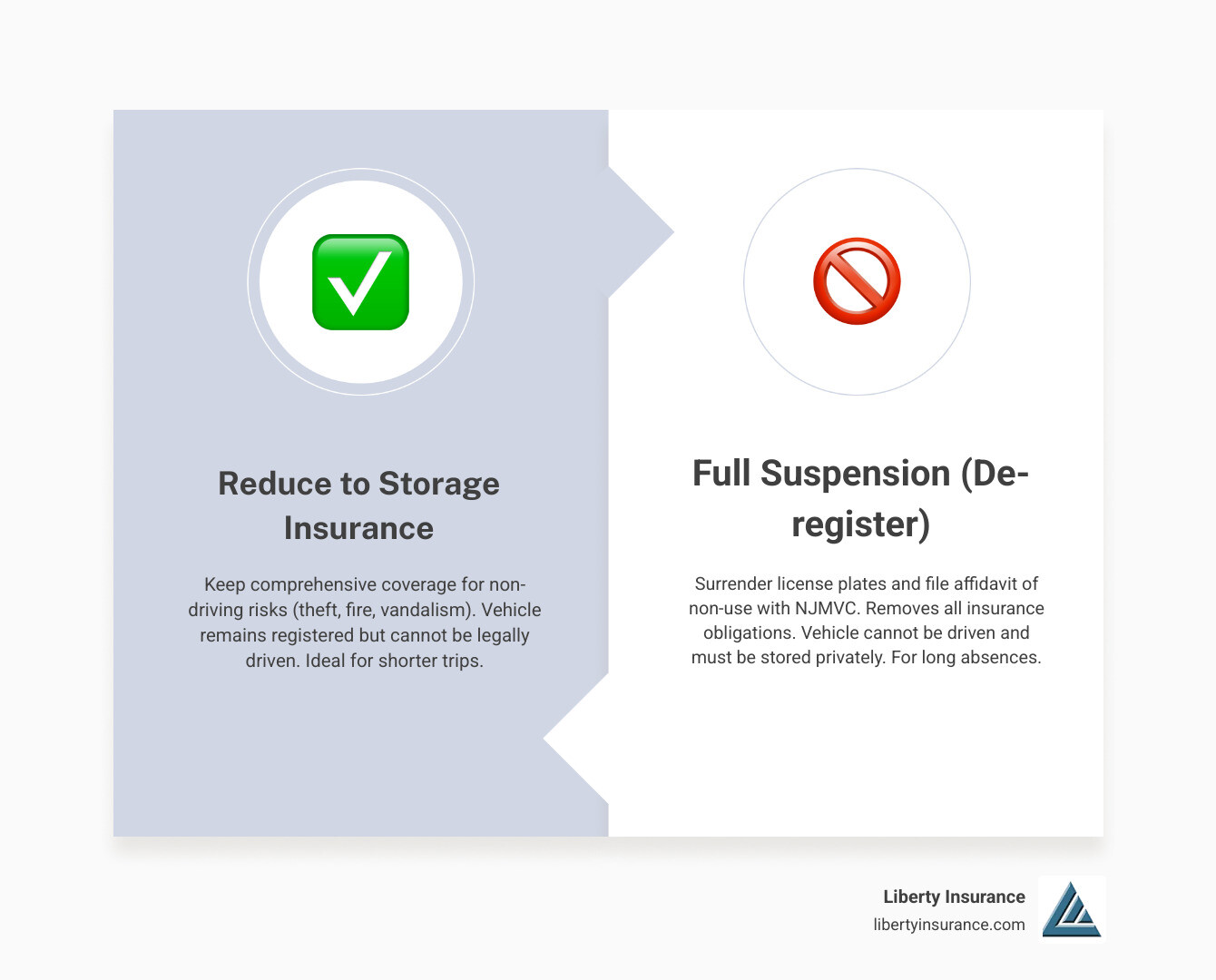
- Reduce to Storage Insurance: Keep comprehensive coverage for non-driving risks like theft or fire while dropping liability. The vehicle stays registered but cannot be legally driven. This is a good choice for shorter trips.
- Full Suspension (De-register): To completely pause insurance, you must surrender your license plates to the New Jersey Motor Vehicle Commission (NJMVC). This removes all insurance requirements, but the vehicle cannot be driven and must be stored on private property.
As Certified Insurance Counselors (CIC) and Accredited Advisors in Insurance (AAI), we help New Jersey residents steer these choices. Our expertise ensures you can manage your coverage for new jersey suspend insurance while traveling with confidence and compliance.
Understanding New Jersey’s Mandatory Auto Insurance Laws
Before you try to new jersey suspend insurance while traveling, you must understand New Jersey’s laws. If your vehicle is registered in the state, it must be insured. This is a strict requirement designed to protect all drivers from the costs associated with uninsured motorists.
New Jersey’s Minimum Insurance Requirements
Every registered vehicle in New Jersey needs three mandatory coverages:
- Liability Insurance: This protects others if you cause an accident. The minimum limits are $15,000 for bodily injury to one person, $30,000 for multiple injuries, and $5,000 for property damage. Many drivers choose higher limits for greater protection.
- Personal Injury Protection (PIP): This is New Jersey’s “no-fault” coverage. It pays for your medical bills and other expenses if you’re injured in an accident, regardless of who was at fault.
- Uninsured Motorist Coverage: This protects you if you’re in an accident caused by a driver who has no insurance.
Your insurer will provide an insurance ID card, which you can now show electronically on a smartphone. You’ll need this proof of coverage during vehicle inspections, after an accident, or if stopped by law enforcement. For more details, the NJ Department of Banking and Insurance is the official resource.
The High Cost of Driving Uninsured in NJ
New Jersey imposes severe penalties for driving without insurance.
- A first offense results in a fine between $300 and $1,000, community service, and a one-year driver’s license suspension.
- A second offense carries fines up to $5,000, 14 days in jail, and a two-year license suspension.
On top of these penalties, the NJ Motor Vehicle Commission adds surcharges of $250 annually for three years. An insurance lapse also makes you a high-risk driver, leading to much higher premiums in the future. You might even be placed in the “assigned risk pool,” where rates are substantially higher. The financial and legal consequences far outweigh any savings from skipping coverage. For official information, visit the NJ Motor Vehicle Commission website. This is why it’s critical to follow the legal process to new jersey suspend insurance while traveling.
How to Legally Suspend or Reduce Your Car Insurance While Traveling from New Jersey
In New Jersey, you can’t simply “pause” your auto insurance policy while keeping your car registered. To legally stop paying for mandatory liability coverage, you must formally take your vehicle off the road. Understanding the difference between suspending, reducing, and canceling is key.
- Suspending (De-registering): This eliminates all insurance premiums by surrendering your plates to the NJMVC. The vehicle cannot be driven at all. This is best for long-term travel (months or years).
- Reducing (Storage Insurance): This maintains comprehensive coverage for non-driving risks like theft or fire while dropping liability. The vehicle cannot be legally driven but remains registered. This is ideal for shorter trips.
- Canceling: This terminates your policy, but creates a coverage gap that leads to higher future premiums. This only makes sense if you are selling the car.
Option 1: Reduce Coverage to “Storage Insurance”
For shorter trips of a few weeks or months, reducing your policy to “storage insurance” is a practical option. This involves dropping state-mandated liability, PIP, and uninsured motorist coverages.
You keep comprehensive-only coverage, which protects your parked vehicle from non-driving events like theft, vandalism, fire, or storm damage. It’s critical to remember that with this option, your vehicle cannot be legally driven on public roads. To make this change, contact your insurer and ask to adjust your policy for storage. It’s a simple way to save money while protecting your asset.
Option 2: The Official Process to Suspend Insurance and Registration in New Jersey
For an extended absence of several months or years, the official way to new jersey suspend insurance while traveling is to de-register your vehicle. This is the only way to completely eliminate insurance payments legally.
The process requires you to surrender your license plates to the NJMVC. This action de-registers your vehicle, removing the state’s insurance mandate. You must also file an affidavit of non-use, a formal declaration that the vehicle will not be operated. Finally, the vehicle must be stored on private property, not on a public street. It cannot be driven for any reason.
If you skip these steps and let your insurance lapse, your insurance carrier will notify the NJMVC, and you will face suspension notices and penalties. The NJMVC’s Uninsured Motorist Enforcement Frequently Asked Questions provides detailed guidance on this process.
Key Considerations Before You Alter Your Policy
Before altering your policy, consider the financial and legal implications. These decisions can affect your car loan, lease agreement, and future insurance costs.

Car Loans, Leases, and Future Premiums
If you have a car loan or lease, your options are limited. Lenders and leasing companies have a financial stake in your vehicle and almost always require you to maintain comprehensive and collision coverage to protect their asset. Violating these terms can lead to the lender purchasing expensive “force-placed” insurance and adding it to your loan, or even demanding full repayment. Always review your agreement and speak with your lender first.
Furthermore, creating a coverage gap by canceling your policy can make you a higher-risk driver in the eyes of insurers. This can lead to significantly higher premiums when you seek coverage again. The New Jersey Motor Vehicle Commission (NJMVC) also tracks insurance lapses, which can result in surcharges. Maintaining continuous coverage is crucial for keeping future costs down.
Alternatives to Full Suspension for Saving Money
If a full suspension isn’t right for you, there are other ways to lower your premium without creating a coverage gap:
- Adjust deductibles: Raising your comprehensive and collision deductibles will lower your premium. Just be sure you can afford the higher out-of-pocket cost if you need to file a claim.
- Remove optional coverages: You likely don’t need extras like roadside assistance or rental reimbursement while your car is stored.
- Remove drivers: If another driver on your policy won’t be driving any vehicle, you may be able to remove them temporarily.
- Usage-Based Insurance (UBI): Also known as “pay-per-mile,” these programs track mileage. If your car isn’t being driven, your premium could drop significantly.
Reactivating Your Insurance and Registration After You Return
Getting back on the road legally after you new jersey suspend insurance while traveling is a critical final step.
First, contact your insurance company to reinstate your full coverage or purchase a new policy. Do this before you attempt to drive. Next, visit the New Jersey Motor Vehicle Commission (NJMVC) to re-register your vehicle and get new license plates. You will need to provide proof of your active New Jersey insurance policy. Have all your required paperwork ready to ensure a smooth transition back to driving.
Understanding and Avoiding Insurance Fraud in New Jersey
While looking for ways to save, like how to new jersey suspend insurance while traveling, stay within the law. New Jersey prosecutes insurance fraud aggressively, and the penalties are severe.
What Constitutes Insurance Fraud?
Insurance fraud occurs when you provide false or misleading information to an insurance company to gain a financial advantage. This includes lying on an application (e.g., misrepresenting your car’s storage location) or filing a fraudulent claim. When suspending insurance, falsifying an affidavit of non-use by driving a car you’ve declared as non-operational is a serious form of fraud.
Penalties for insurance fraud in New Jersey are harsh. They can include incarceration, civil fines up to $15,000 per violation, and the loss of your driver’s license. A fraud conviction creates a permanent record that can affect future insurance rates and employment.
How to Report Suspected Insurance Fraud
New Jersey’s Office of Insurance Fraud Prosecutor (OIFP) makes it easy to report suspected fraud while guaranteeing anonymity and confidentiality. Reporting helps keep insurance costs fair for everyone.
You can report suspected fraud by calling the OIFP hotline at (877) 55-FRAUD (877-553-7283), emailing njinsurancefraud@njdcj.org, or using the online reporting form. Every report helps protect honest drivers from the costs of fraudulent activity.
Frequently Asked Questions about Suspending NJ Auto Insurance
Navigating New Jersey’s auto insurance laws for travel can be confusing. Here are answers to some common questions.
Do I have to turn in my license plates to suspend my insurance in NJ?
Yes. To legally stop paying for mandatory liability insurance, you must surrender your license plates to the NJMVC. This de-registers your vehicle, which removes the legal requirement to insure it. If you store your car without surrendering the plates, you must continue to maintain liability coverage.
What happens if I have a car loan? Can I still suspend my insurance?
It’s highly unlikely. Lenders and leasing companies almost always require you to maintain both comprehensive and collision coverage to protect their financial interest in the vehicle. Suspending your policy would likely violate your loan agreement. A better option is to speak with your insurer about discounts for low mileage or storage.
How long can I suspend my insurance for?
There is no state-mandated time limit. Your insurance can remain suspended for as long as your vehicle is de-registered with the NJMVC. The suspension is tied to the vehicle’s legal “non-operational” status, not a specific timeframe. When you’re ready to drive again, you’ll simply reverse the process by getting a new policy and re-registering the vehicle.
Conclusion
Deciding how to manage your car insurance when you new jersey suspend insurance while traveling is a significant decision that requires careful planning. Your two main paths are reducing your policy to “storage” coverage for shorter trips or a full suspension for long-term travel, which involves de-registering your vehicle with the NJMVC.
Before making a move, always weigh the savings against the administrative steps and the potential impact on your future insurance rates. If you have a car loan or lease, your lender almost certainly requires continuous coverage, so a full suspension is likely not an option.
New Jersey’s insurance laws are strict, and the penalties for non-compliance or fraud are severe. Following the state’s legal procedures ensures peace of mind and a smooth return to the road. For business owners who need to protect physical assets like equipment and inventory during operational pauses, exploring commercial property insurance from providers like Liberty Insurance can provide crucial protection against unexpected events like fire and theft.

