
Why New Jersey’s New Contractor Laws Could Make or Break Your Business
The new jersey home improvement contractor insurance requirements have been significantly updated with the signing of P.L. 2023, c. 237 in January 2024. For home improvement and home elevation contractors in New Jersey, understanding these new mandates is critical for legal operation and long-term success. This isn’t just a minor regulatory tweak; it’s a fundamental shift in how the state oversees the industry.
The push for these reforms stems from years of consumer complaints and the state’s desire to weed out fraudulent or financially unstable operators. Events like the widespread rebuilding after Superstorm Sandy highlighted significant gaps in the old system, where homeowners were often left with shoddy work and no financial recourse. The new law aims to prevent these situations by ensuring every registered contractor has the financial backing to stand behind their work and protect the public.
Here’s what you need to know:
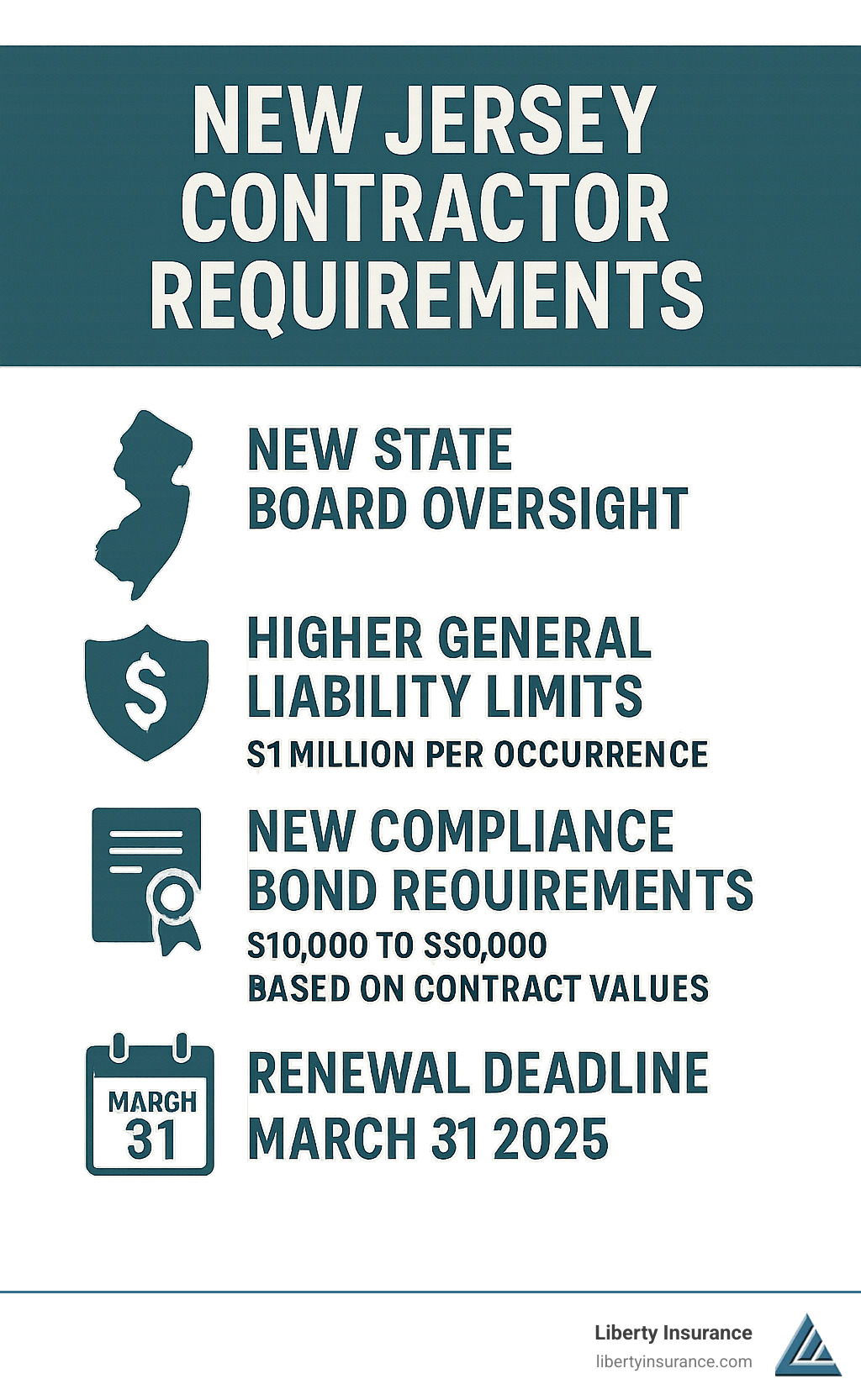
- New Insurance Minimums: General liability coverage has increased to $500,000 for Home Improvement Contractor Businesses (HICBs) and $1,000,000 for Home Elevation Contractor Businesses (HECBs).
- Mandatory Workers’ Comp: This is now required for most employers, closing a significant loophole.
- Financial Security Bonds: A new requirement for a compliance bond or letter of credit, ranging from $10,000 to $50,000 based on contract values.
- Critical Deadline: All current registrations expire on March 31, 2025, with no exceptions.
- New Oversight: The newly formed State Board of Home Improvement and Home Elevation Contractors now regulates the industry with improved enforcement powers.
These changes, driven by a need for stronger consumer protection, affect every contractor with projects over $500. The new Home Improvement and Home Elevation Contractor Licensing Act creates clearer standards and tougher enforcement, leveling the playing field for reputable professionals.
The bottom line: Non-compliance by the March 31, 2025 deadline can lead to fines up to $20,000, registration denial, inability to pull permits, and even criminal charges. The stakes have never been higher.
As a Certified Insurance Counselor (CIC) with over 15 years of experience, I’ve helped New Jersey contractors steer complex regulations. At Liberty Insurance, we have the expertise to ensure you meet the new new jersey home improvement contractor insurance requirements and protect your business.
Glossary for new jersey home improvement contractor insurance requirements:
- general liability insurance nj
- New Jersey contractor bonds
- workers’ compensation insurance for independent contractors new jersey
Understanding the New Regulatory Landscape for NJ Contractors
New Jersey has overhauled its oversight of home improvement and home elevation contractors, prioritizing consumer protection. The old Contractors Business Registration Act (CBRA) is replaced by the Home Improvement and Home Elevation Contractor Licensing Act, which established a new regulatory body: the New Jersey State Board of Home Improvement and Home Elevation Contractors.
This new Board, operating under the Division of Consumer Affairs, has significant enforcement power. While the term “registration” is still used, the new requirements—including potential examinations and continuing education—create a de facto licensing system. The Board can investigate consumer complaints, conduct random audits of your business records to verify insurance and bonding, and impose serious penalties for violations. This robust enforcement ensures that only qualified, insured, and financially responsible contractors can operate legally in the state, which ultimately benefits reputable contractors by eliminating unfair competition from those who cut corners. To ensure your coverage meets these new demands, explore Construction Insurance New Jersey options.
Who is Affected by These Changes?
The new new jersey home improvement contractor insurance requirements apply to a wide range of businesses:
- Home Improvement Contractor Businesses (HICBs): This includes any business entity performing home improvements, from sole proprietors to large corporations. The scope covers a vast array of services, including painting, landscaping, kitchen and bath remodels, roofing, siding, and HVAC work.
- Home Elevation Contractor Businesses (HECBs): These contractors face even stricter requirements due to the high-risk, specialized nature of lifting a house from its foundation, a common practice in coastal areas.
- Subcontractors: This is a critical change. Under the old rules, some subcontractors operated under the registration of a general contractor. That is no longer permitted. All subcontractors must now register independently with the state. This means every sub on your job site must have their own general liability insurance and their own financial security bond. As a general contractor, it is your responsibility to verify that every subcontractor you hire is properly registered.
- New and Existing Contractors: New applicants must meet these standards from day one to receive a registration. All existing contractor registrations expire on March 31, 2025, and renewal requires full compliance with all new rules, including the increased insurance and new bond requirement.
Whether you’re a large firm or a solo operator, understanding these changes is crucial. Reviewing General Contractor Insurance NJ options can help align your coverage with the new mandates.
Are There Any Exemptions?
While the regulations are broad, some narrow exemptions exist. It’s crucial to not assume you are exempt without verification.
Licensed professionals like plumbers, electricians, and architects are exempt, but only for work performed strictly within their license’s scope. For example, if a licensed plumber is hired to replace a water heater, they do not need to be a registered HICB. However, if that same plumber offers to remodel the entire bathroom where the water heater is located—including tiling, vanity installation, and painting—they must also register as an HICB because those tasks fall outside their plumbing license.
Other specific exemptions include:
- Work on your own property or property owned by members of your immediate family.
- Charitable or non-profit organizations working on properties they own.
- Large retailers that have a net worth of over $50 million, such as national home improvement chains.
- Maintenance work performed by employees of a public utility or a community association.
Importantly, these exemptions apply only to the HICB registration requirement. You may still need to comply with other laws, codes, and insurance mandates, such as carrying workers’ compensation for your employees. The criteria for an exemption can be complex, so always verify your status before assuming you are exempt.
Breaking Down the New Jersey Home Improvement Contractor Insurance Requirements
Under the updated new jersey home improvement contractor insurance requirements, proper insurance is mandatory for registration and renewal. The state now requires proof of coverage, such as a Certificate of Insurance (COI), before you can operate legally. This isn’t just red tape; it’s a system designed to protect consumers, employees, and your business from the financial fallout of accidents. These guaranteed financial resources ensure that if something goes wrong on a job site, there’s a way to make it right. For comprehensive solutions that meet these new standards, explore our New Jersey Business Insurance options.
Mandatory Commercial General Liability (CGL) Insurance
Commercial General Liability (CGL) insurance is your primary defense against claims of bodily injury or property damage caused by your business operations. If a client is injured on your job site or you accidentally damage a neighboring property, your CGL policy covers the resulting medical bills, repair costs, and legal fees. The policy’s per-occurrence limit is the maximum amount the insurer will pay for a single incident, while the aggregate limit is the total amount the insurer will pay for all claims during the policy period. It’s crucial that both limits meet or exceed state requirements.
The new state-mandated minimums are:
| Contractor Type | Minimum General Liability Coverage |
|---|---|
| Home Improvement Contractor Business (HICB) | $500,000 per occurrence |
| Home Elevation Contractor Business (HECB) | $1,000,000 per occurrence |
The higher limit for Home Elevation Contractor Businesses reflects the catastrophic risk involved in lifting a house. A mistake could lead to a total structural collapse, causing immense property damage and potential for serious injury. While the $500,000 minimum for Home Improvement Contractor Businesses covers many scenarios, higher limits are often recommended for better protection, as you are personally liable for any costs exceeding your policy limit. For detailed guidance, see our resource on General Liability Insurance NJ.
Mandatory Workers’ Compensation Insurance
If you have one or more employees in New Jersey, workers’ compensation insurance is required by state law (N.J.S.A. 34:15-1). This coverage is a critical safety net in the high-risk construction industry. It provides benefits for employees who are injured or fall ill as a direct result of their job, covering their medical bills, a portion of lost wages, rehabilitation services, and disability benefits. In the tragic event of a death, it provides benefits to the worker’s dependents. Without it, you would be personally liable for these costs, which can be financially devastating. The state takes this requirement very seriously, and misclassifying employees as independent contractors to avoid paying for workers’ comp is illegal and can lead to severe penalties. The law applies to nearly all employers, regardless of whether an employee is full-time, part-time, or temporary. Exemptions are very limited, typically applying only to true sole proprietors with no employees. For more details, consult our guide on Workers Compensation Insurance for Independent Contractors New Jersey and the official Workforce Development guide.
Other Crucial Insurance Policies to Consider
While CGL and Workers’ Comp are mandatory, a comprehensive insurance strategy includes other coverages to protect against common risks:
- Commercial Auto Insurance: Your personal auto policy will not cover accidents that occur while using your truck or van for business purposes. This is essential for covering liability and physical damage for vehicles used for driving to job sites, transporting materials, or hauling equipment.
- Inland Marine (Tools & Equipment) Insurance: Protects your valuable tools and equipment from theft, damage, or loss. Imagine having thousands of dollars worth of tools stolen from your truck or job site overnight. This policy ensures you can replace them quickly without a major financial hit.
- Builder’s Risk Insurance: This policy is crucial for new construction or major renovations. It covers the structure and materials on-site during the course of construction against perils like fire, theft, or vandalism. Learn more about NJ Builders Risk Insurance.
- Cargo Insurance: A specific and mandatory requirement for HECBs, this covers the structure being lifted. The state mandates a minimum limit of $1 million per occurrence to protect the homeowner’s single largest asset during the elevation process.
- Professional Liability (E&O) Insurance: Also known as Errors & Omissions, this protects against claims of professional negligence that cause financial harm to a client, even if there’s no bodily injury or property damage. For example, if a design flaw in a kitchen remodel you planned makes the space unusable and requires a costly tear-out, E&O insurance could cover the client’s financial loss.
The New Financial Security Mandate: Compliance Bonds and Letters of Credit

A significant addition to the new jersey home improvement contractor insurance requirements is the financial security mandate. Contractors must now obtain a compliance bond, an irrevocable letter of credit (ILOC), or another form of security approved by the Board. This requirement provides a direct financial guarantee that you will adhere to state regulations, fulfill your contractual obligations, and protect consumers from unlawful practices or financial harm.
This security acts as a safety net for consumers and the state. If a contractor violates the law, fails to complete a job, or a judgment is made against them that they cannot pay, a claim can be filed against the bond or ILOC to recover funds. This adds a powerful layer of accountability beyond standard insurance. For help securing this new requirement, look into Home Improvement Contractor Insurance NJ options that include bonding solutions.
How Are the Security Amounts Determined?
The required security amount is tiered based on the value of your contracts, ensuring the protection scales with the size and scope of your operations. You must determine your tier based on either your largest single contract or your total annual contract volume, whichever places you in a higher tier.
- $10,000 Security: Required for contractors with individual contracts under $10,000 or an annual contract volume under $150,000.
- $25,000 Security: Required for individual contracts between $10,000 and $120,000 or an annual volume between $150,000 and $750,000.
- $50,000 Security: Required for individual contracts over $120,000 or an annual volume of at least $750,000.
It is crucial to assess your contract values accurately to secure the correct amount and avoid registration delays or penalties for being under-secured.
Understanding Bonds vs. Letters of Credit
While both satisfy the requirement, a compliance bond (a type of surety bond) and an irrevocable letter of credit (ILOC) work differently. A bond is a three-party agreement between you (the principal), the surety company that issues the bond, and the state (the obligee). You pay an annual premium for the bond, which is a percentage of the bond amount based on your creditworthiness. An ILOC is issued by a bank and requires you to set aside the full face value of the credit (e.g., $10,000 in cash) as collateral. For most small to medium-sized contractors, a bond is often more practical as it doesn’t tie up significant cash reserves.
This financial security requirement serves several key purposes:
- Protecting Consumers: It allows consumers to recover financial losses if a contractor engages in fraud, takes a deposit and abandons a job, or fails to complete a project as agreed.
- Covering Penalties: The security can be used by the state to pay civil penalties assessed by the Board for violations of the Contractors Registration Act.
- Deterring Fraud: The financial underwriting and personal guarantee required for a bond discourages irresponsible or fraudulent operators from entering the market.
- Encouraging Completion: It creates a strong financial incentive for contractors to complete projects satisfactorily to avoid claims against their security, which can impact their ability to get bonded in the future.
This measure reflects a commitment to higher standards and financial responsibility in the industry. For more details, review the Details on the bill (P.L. 2023, c. 237).
How to Comply: Deadlines, Renewals, and Penalties

The new jersey home improvement contractor insurance requirements come with a firm deadline and severe consequences for non-compliance. The most important date for your business is March 31, 2025. Failing to meet the new standards by then will halt your operations. Getting the right insurance policies and securing a compliance bond takes time, so it’s crucial to start the process now. Our Small Business Insurance NJ team can help you steer these requirements smoothly.
Key Dates and Deadlines
The timeline is strict and non-negotiable: all current home improvement contractor registrations expire on March 31, 2025. There are no grace periods or extensions. The state’s online registration renewal portal is expected to open for renewals in January 2025, but you must have all your documentation in hand well before then. The new rules took effect in January 2024, and the State Board is already enforcing the new standards for new applicants.
A Step-by-Step Guide to Ensuring Compliance
Follow these steps to prepare for the renewal deadline and avoid any interruption to your business:
- Review Your Insurance Immediately: Contact your insurance agent to discuss the new minimums. Ensure your CGL policy meets the $500k for HICBs or $1M for HECBs per-occurrence limit. Request an updated Certificate of Insurance (COI) that lists the State of New Jersey as a certificate holder. If you have employees, secure a valid Workers’ Compensation policy.
- Secure Your Bond/ILOC: Determine which financial security tier you fall into ($10k, $25k, or $50k) based on your contract volume. Contact a surety bond producer to begin the application process, which will involve a review of your business and personal finances. Start this early, as underwriting can take time.
- Gather All Documentation: Create a digital folder with your updated COIs for general liability and workers’ comp, and proof of your bond or letter of credit. Having these documents ready will make the online renewal process much faster.
- Prepare for Online Renewal: Log in to the state portal ahead of time to ensure your business information (address, contact info, ownership details) is up-to-date for a smooth submission.
- Display Your New Registration Number: Once your renewal is approved, you will receive a new registration number. You must display this number prominently on all commercial vehicles, advertisements, and contracts to show customers and inspectors that you are a state-approved professional.
Consequences of Non-Compliance
Ignoring these mandates will have devastating effects on your business. The state has empowered the Board with significant authority to enforce the new law.
- Heavy Fines: Penalties are up to $10,000 for a first offense and $20,000 for subsequent violations. These fines can be levied for simply operating without a valid registration.
- Registration Expiration and Work Stoppage: If you are not compliant by March 31, 2025, your registration expires. You will be legally prohibited from offering, performing, or even advertising home improvement services in New Jersey.
- Permit Denials: Municipalities will not issue construction permits to unregistered contractors, effectively cutting off your pipeline of legal work.
- Criminal Charges: Operating without a registration is not just a civil offense. Serious violations, particularly those involving fraud or repeat offenses, can be prosecuted as a fourth-degree crime, which can carry penalties of up to 18 months in prison and significant fines.
- Consumer Lawsuits: The Consumer Fraud Act empowers consumers to sue non-compliant contractors for triple damages plus attorney’s fees and court costs. This means a $15,000 dispute could result in you owing the homeowner over $45,000.
The message is clear: comply with the new jersey home improvement contractor insurance requirements or risk losing your business. The cost of compliance is minimal compared to the penalties.
Frequently Asked Questions about NJ Contractor Requirements
We’ve been fielding many questions about the updated new jersey home improvement contractor insurance requirements. Here are answers to the most common ones.
What are the three main new requirements for NJ home improvement contractors?
The three biggest changes that create a new standard for operating in New Jersey are:
- Increased General Liability Insurance: Minimum coverage is now $500,000 per occurrence for HICBs and $1,000,000 for HECBs.
- New Financial Security: A tiered compliance bond or letter of credit ($10,000 to $50,000) is now required to provide a financial guarantee for your work and legal compliance.
- Stricter Oversight and Mandatory Registration for Subs: A new State Board has been created to enforce these rules, and all subcontractors must now register independently.
Do I need to register if I am a subcontractor?
Yes, absolutely. The law requires all business entities performing home improvements, including subcontractors, to have their own independent registration. You can no longer work under a general contractor’s registration. You must secure your own general liability insurance and financial security bond to comply with the law, as verified by the Division of Consumer Affairs. General contractors are also now responsible for ensuring any subs they hire are properly registered.
What is the difference between the requirements for a Home Improvement Contractor (HICB) and a Home Elevation Contractor (HECB)?
The primary difference is the insurance minimums, which reflect the higher risk of elevation work. HICBs need at least $500,000 per occurrence in general liability insurance. HECBs must carry a minimum of $1,000,000 per occurrence. Additionally, HECBs have a separate, mandatory requirement for cargo insurance of at least $1,000,000 to cover the structure itself during the lift. Both types of contractors must meet the same workers’ compensation and tiered financial security rules.
I work in New Jersey but my business is based in another state. Do I still need to register?
Yes. The law applies to any contractor who sells, offers, or performs home improvements within the State of New Jersey, regardless of where your business is physically located. You must obtain a New Jersey HICB registration and comply with all insurance and bonding requirements to work legally in the state.
Does the new compliance bond cover claims of poor workmanship?
Generally, no. The compliance bond is not a performance bond that guarantees the quality of your work. Its primary purpose is to protect consumers from financial harm resulting from violations of the law, such as fraud, taking a deposit and not performing the work, or failing to pay a court-ordered judgment. Disputes over the quality of workmanship are typically handled through the terms of your contract or civil court.
Secure Your Business and Stay Compliant
The new new jersey home improvement contractor insurance requirements have fundamentally changed the industry, creating a new standard for accountability and consumer protection. Complying with these rules builds a stronger foundation for your business.
The key takeaways are clear:
- Meet the higher general liability limits.
- Secure mandatory workers’ compensation.
- Obtain the new financial security bond.
The March 31, 2025, deadline is non-negotiable. Missing it means facing fines up to $20,000, losing your ability to pull permits, and even potential criminal charges.
However, compliance is also a competitive advantage. Homeowners are more likely to hire properly insured and bonded contractors, signaling professionalism and building trust. At Liberty Insurance, we know that comprehensive coverage protects your assets and your livelihood from unexpected disasters.
Don’t try to steer these complex requirements alone. Partner with an insurance professional who understands the new landscape. View these changes as an opportunity to lift your business.
Take action now. Get a quote for your contractor insurance needs to ensure you are not just compliant, but fully protected to thrive in New Jersey’s evolving market.

