
Introduction: The Uninsured Asset in Your Business
A key man life insurance quote helps business owners price the cost of protecting their company’s most valuable asset: the people whose skills and expertise drive success.
Quick Answer: Getting a Key Man Life Insurance Quote
- Who it covers: CEOs, top salespeople, or anyone whose loss would financially harm your business.
- Typical costs: From $51.32/month for a healthy 45-year-old to $403.25/month for a 65-year-old (for $500,000 coverage).
- How it works: The business pays premiums and receives a tax-free death benefit if the key person dies.
- Coverage amount: Often 2-3 times the key person’s salary or based on their contribution to profits.
- What you’ll need: Employee consent, health information, and financial justification for the coverage.
Consider a manufacturing company whose general manager, Jim, handles crucial client relationships and drives growth. If Jim were to pass away, the company could face devastating revenue losses and high replacement costs. Key person insurance protects businesses from this exact scenario.
Many business owners insure their equipment and property but overlook their most critical asset: their people. Losing a key employee can threaten a business’s survival as much as a fire or theft. This “human capital” risk deserves the same protection as physical assets.
I’m Andrew Harris, a Certified Insurance Counselor who has helped hundreds of New Jersey businesses secure key man life insurance quotes and implement business continuation strategies. I’ve seen how the right coverage can mean the difference between a temporary setback and permanent closure.
Key man life insurance quote helpful reading:
What is Key Person Insurance and Who Needs It?
Key person insurance (or “key man insurance”) is a life insurance policy a business buys on a vital employee. It’s a financial shield for the business if that person dies or, with certain policies, becomes disabled or critically ill.
The company owns the policy, pays the premiums, and is the beneficiary. If the insured key person passes away, the business receives a tax-free lump sum. This cash injection provides stability during a difficult transition, helping to prevent lost revenue and cover replacement costs.

Why Key Person Insurance is Crucial for Business Continuity
Businesses insure physical assets, but what about the human capital that drives success? Many small to medium-sized enterprises in New Jersey, from Millstone Township to Trenton, rely heavily on a few individuals. Losing one creates “human capital risk,” a threat as serious as losing a physical asset.
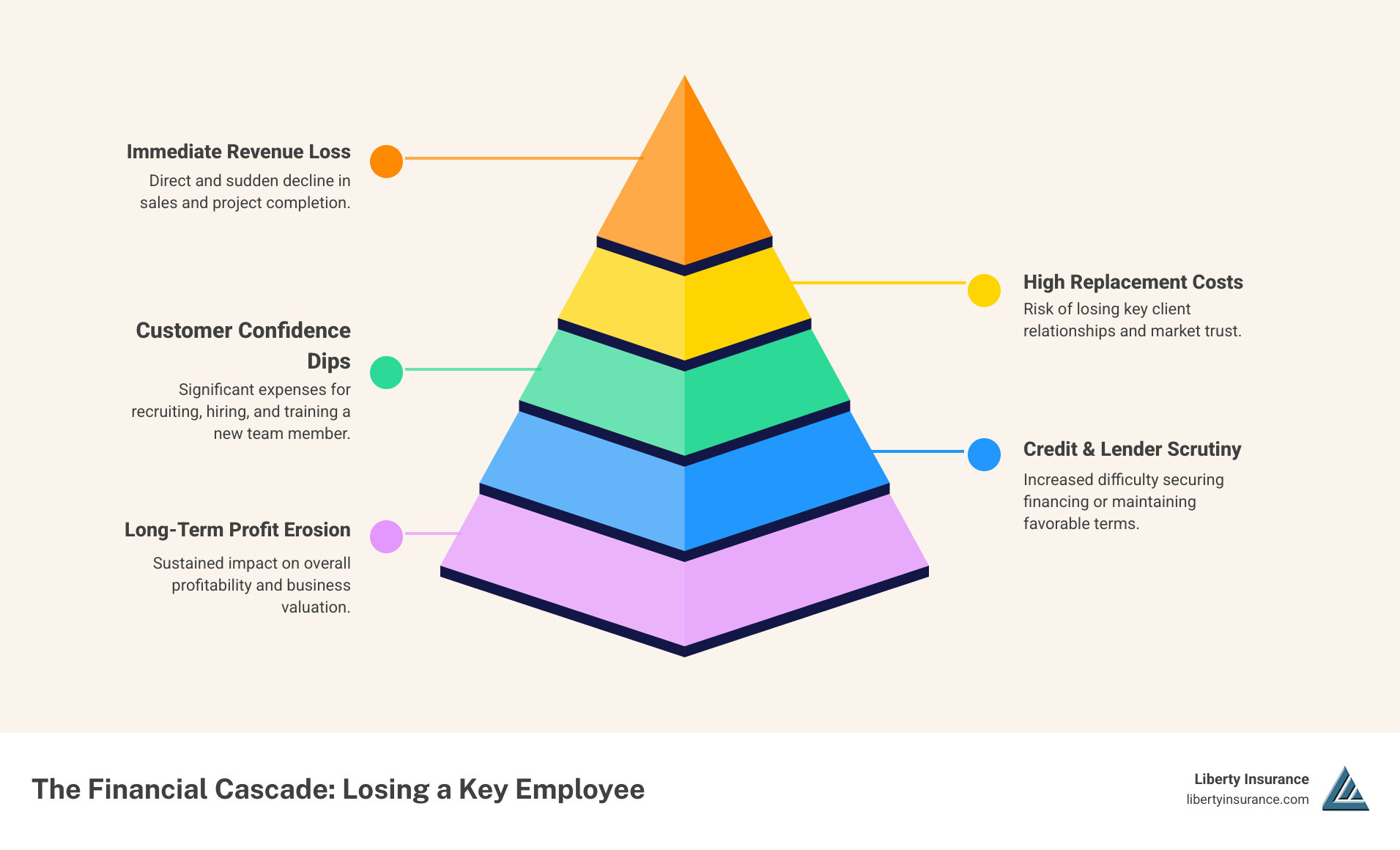
Key person insurance is a vital business continuation strategy. The loss of a key employee can cause:
- Lost Revenue: An immediate sales drop if the person was a top performer.
- Replacement Costs: Recruiting and training a replacement is expensive and time-consuming.
- Creditor Confidence: Lenders may tighten credit if they perceive the business as unstable.
- Investor Assurance: Investors often require key person insurance to protect their investment.
- Customer Loyalty: Key relationships may be lost, causing customers to leave.
In short, this insurance provides the financial breathing room to survive and adapt during a crisis. For more insights, see our Business Key Man Insurance Guide.
Identifying the ‘Key Person’ in Your Company
A “key person” isn’t always the CEO. It’s anyone whose absence would cause substantial financial harm due to their unique skills, knowledge, or relationships. The key is to identify individuals whose contributions are directly and significantly tied to revenue, operations, or strategic direction.
Examples of a key person include:
- CEO or Owner: The company’s visionary leader and primary decision-maker.
- Top Salesperson: The primary revenue driver who manages the most profitable accounts.
- Chief Operating Officer (COO): The expert manager who ensures smooth daily operations and logistical stability.
- Lead Software Developer: A technical specialist with proprietary knowledge of a core product, whose departure would halt development.
- Head Chef in a Renowned Restaurant: A creative genius whose unique culinary style and reputation are the main draw for customers.
- Indispensable Relationship Holder: Someone with critical, long-standing connections to clients, suppliers, or regulatory bodies.
- Lead Scientist or Researcher: In a biotech or R&D firm, this individual may hold the patents or knowledge essential for future products.
Our role is to help you identify these individuals in your organization, whether you’re a startup in Princeton or an established firm in Toms River. Learn more at Insurance for Business Owners.
When to Consider Key Person Insurance
While all businesses should consider it, key person insurance is especially critical in certain situations:
- Startup Phase: Founders often embody the entire business, and their loss could be fatal to the company.
- Securing Loans or Investment: Lenders and investors frequently require it as a condition for funding. Venture capitalists, in particular, often mandate key person policies on founders to protect their investment from the risk of losing the visionary leader.
- Rapid Growth: When expanding, a business often relies on a few key people to manage that growth.
- Succession Planning: It provides funds to smoothly implement a succession plan without financial pressure.
- Heavy Reliance on an Individual: If one person’s skills are disproportionately tied to your success, it’s non-negotiable.
Proactive planning is essential. Explore more at New Jersey Business Insurance.
How Key Person Insurance Works: Coverage, Benefits, and Policy Types
Understanding the mechanics of key person insurance reveals its value as a strategic business asset designed for financial stability.

The Mechanics of a Key Person Policy
The setup is straightforward:
- Business as Owner & Beneficiary: Your business owns the policy and is named the beneficiary, receiving the payout.
- Premium Payments: The business pays all policy premiums.
- Death Benefit Payout: If the insured key person dies, the insurance company pays a lump-sum death benefit to the business, typically income tax-free.
- Employee Consent: The key employee must consent to the policy and cooperate with the underwriting process.
- Underwriting Process: The insurer evaluates the key person’s health and lifestyle to assess risk and set premium rates.
This structure ensures funds flow directly to the business, allowing it to address the financial fallout without delay. For more on policies, visit our page on Insurance Policy.
Core Benefits for Your Business
The primary goal is to provide financial resources to weather the loss of a key employee. The benefits include:
- Working Capital: Provides immediate cash to cover ongoing expenses like payroll and rent.
- Debt Repayment: The payout can be used to pay off loans or reassure lenders.
- Recruiting Funds: Covers costs to find and hire a suitable replacement.
- Training Replacements: Offsets reduced productivity and training costs for a new hire.
- Orderly Dissolution: In worst-case scenarios, funds can be used to close the business responsibly, paying off debts and investors.
- Stakeholder Reassurance: Shows employees, customers, and investors that a contingency plan is in place.
Key person insurance buys your business time and flexibility, which is a critical part of any continuity plan, much like Business Interruption Insurance.
Choosing the Right Policy: Life, Disability, and Critical Illness
Key person protection extends beyond life insurance. You can customize coverage for different scenarios:
- Key Person Life Insurance: The most common form, paying a death benefit to the business. You can choose between Term Life (coverage for a specific period, less expensive) and Whole Life (lifelong coverage that builds cash value). Whole life policies can sometimes be liquidated if the employee leaves, offering added flexibility.
- Key Person Disability Insurance: Provides monthly income to the business if the key person becomes disabled and cannot work. This helps cover lost revenue or the cost of a temporary replacement.
- Key Person Critical Illness Insurance: Pays a lump-sum benefit if the key person is diagnosed with a specified illness (e.g., cancer, heart attack). This can cover productivity losses or other related expenses.
Here’s a quick comparison:
| Policy Type | Coverage Trigger | Payout Structure | Primary Purpose |
|---|---|---|---|
| Key Person Life Insurance | Death of the key person | Lump Sum | Provide capital for business continuity, debt repayment, or replacement costs. |
| Key Person Disability Insurance | Total disability of the key person | Monthly Income | Cover lost revenue or temporary replacement costs during a disability period. |
| Key Person Critical Illness Insurance | Diagnosis of a specified critical illness | Lump Sum | Mitigate financial losses during a key person’s recovery from a severe illness. |
A comprehensive strategy might involve a combination of these policies. Explore options at Life Health Benefits Insurance.
Determining Coverage and Understanding the Costs of a Key Man Life Insurance Quote
Two of the most common questions from business owners are, “How much coverage do I need, and what will it cost?” We have clear methods to answer both.
How to Calculate Your Key Person Coverage Needs
While not an exact science, we use several established methods to determine an adequate coverage amount. The goal is to arrive at a figure that is both justifiable to the insurer and sufficient for the business’s needs.
- Multiple of Salary: A common starting point is 2 to 3 times the key person’s annual salary, benefits, and bonus. This method is simple but may not capture the full value of the employee.
- Contribution to Profits: This method provides a more accurate picture. Calculate the key person’s direct contribution to pre-tax profits. For example, if a top salesperson generates $1 million in annual sales with a 20% profit margin, their contribution is $200,000 per year. A policy of $600,000 to $1,000,000 could be justified to cover the loss over a 3-5 year recovery period.
- Cost to Replace: Estimate all expenses to find and train a replacement. This includes recruiter fees (often 20-30% of salary), advertising costs, interview expenses, signing bonuses, and lost productivity and revenue during the transition, which can last six months or more.
- Business Valuation Method: This is often used for owners or partners, especially when funding a buy-sell agreement. The coverage amount is tied to the key person’s ownership stake. If a business is valued at $2 million and a partner owns 50%, a $1 million policy would provide the funds for the other partners to buy out their share.
- Debt Repayment: Link the coverage amount to outstanding business loans, especially if the key person’s involvement was critical for securing the financing. Lenders may even require this as a loan covenant.
The goal is to blend these approaches to ensure the payout allows your business to recover without severe financial strain. Get a preliminary estimate with our Key Man Insurance Calculator.
Factors That Influence Your Key Man Life Insurance Quote
The cost of a key man life insurance quote varies based on several factors. Our research shows typical monthly costs for a $500,000, 20-year term policy:
- A healthy 45-year-old man: around $51.32 per month.
- A 60-year-old male: around $124.56 per month.
- A 65-year-old key person: around $403.25 per month.
Other factors influencing your quote include:
- Age and Gender: Premiums are higher for older individuals and typically differ between genders.
- Health Status: Excellent health, confirmed by a medical exam, leads to lower rates.
- Tobacco Use: Smokers and tobacco users pay significantly more.
- Policy Type: Term life is less expensive than whole life, which builds cash value.
- Coverage Amount: Higher benefits mean higher premiums.
- High-Risk Hobbies: Activities like skydiving, scuba diving, or piloting private planes can increase rates.
- Occupation and Industry: Some jobs carry higher risks, which can affect premiums.
To get an accurate key man life insurance quote for your New Jersey business, connect with us through our Get Business Insurance Quote page.
Understanding the Tax Implications
Navigating the tax rules for key person insurance is critical.
- Premium Deductibility: Generally, premiums paid for key person insurance are not tax-deductible as a business expense. For more details on what qualifies as a business expense, you can review IRS guidance on business expenses. Always consult a tax professional for your specific situation.
- Tax-Free Death Benefit: The death benefit received by the company is generally income tax-free, provided certain IRS requirements are met (such as employee notification and consent). This means the full payout is available to your business without being reduced by corporate income taxes.
Understanding these rules is vital for proper financial planning. For a deeper dive, read our article, Is Key Man Insurance a Business Expense?.
The Process: How to Get a Key Person Life Insurance Quote and Policy
Securing a key person policy for your New Jersey business is a straightforward process when broken down into clear steps.
Step-by-Step Guide to Securing Your Key Man Life Insurance Quote
Here’s a simple roadmap to getting your business protected:
- Identify Key Personnel: Pinpoint the individuals whose loss would severely impact your business.
- Calculate Coverage Needs: Work with an advisor to determine the right coverage amount.
- Gather Information: Collect relevant business financials and personal health details for the key employee.
- Compare Quotes: Obtain and compare key man life insurance quotes from multiple carriers to ensure competitive rates. Start comparing at Compare Key Man Insurance Quotes & Save Money.
- Application Process: The business completes the application for the chosen policy.
- Underwriting and Medical Exam: The key employee undergoes a medical exam and review of their health history.
- Policy Issuance: Once approved, the policy is issued, and the business begins paying premiums.
We guide our clients through each step, ensuring a smooth process.
Using Key Person Insurance to Fund a Buy-Sell Agreement
Key person insurance is also a powerful tool for funding buy-sell agreements, which are legal contracts dictating how a partner’s share is reassigned if they leave the business.
Here’s how it works:
- Ownership Transition: If a co-owner dies, the life insurance payout provides the surviving owners with funds to purchase the deceased’s shares from their estate.
- Shareholder Buyout: This ensures a smooth transfer of ownership and prevents shares from falling into the hands of uninvolved parties.
- Funding Mechanism: It provides a dedicated, tax-free source of funds for the buyout, so surviving owners don’t have to use personal funds or take on debt.
For any business with multiple owners in Trenton or Princeton, New Jersey, integrating key person insurance into a buy-sell agreement is a best practice. Learn more with Company Owner Life Insurance.
Navigating the Application and Underwriting Process
The application process requires cooperation between the business and the key employee. You will need:
- Employee Consent Forms: The key person must provide written consent for the policy.
- Medical History and Health Examination: The employee will complete a health questionnaire and typically undergo a medical exam.
- Financial Justification: The business must provide documentation to justify the coverage amount, such as financial statements or details on the key person’s contributions.
This process ensures the policy is priced correctly and valid when a claim is made. For more details, see Key Man Insurance | Key Person Life Insurance & Disability Coverage.
Frequently Asked Questions about Key Person Insurance
Here are answers to some of the most common questions we receive from New Jersey business owners.
What happens to the policy if the key employee leaves the company?
If a key employee leaves, you have several options:
- Terminate the Policy: You can cancel the policy. For term life, coverage simply ends.
- Surrender the Policy: If it’s a whole life policy with cash value, you can surrender it to receive the accumulated value, minus any charges.
- Transfer Ownership: The business can transfer the policy to the departing employee, who would then take over premium payments, often as part of a severance package.
- Keep the Policy: The business might choose to keep a permanent policy in force, especially if it has significant cash value.
The best option depends on the policy type and the circumstances of the departure. It’s wise to have a written agreement in place covering this scenario.
Does the key employee need to consent to the policy?
Yes, absolutely. The employee must provide written consent for the business to take out a policy on their life. This is a legal requirement based on the principle of “insurable interest”—the business must stand to suffer a financial loss from the person’s death.
The employee must also participate in the underwriting process, which includes answering health questions and undergoing a medical exam. Without their full cooperation, a policy cannot be issued.
What is the difference between key person insurance and a buy-sell agreement?
While they often work together, they serve distinct purposes:
- Key Person Insurance: Protects the business from the financial impact of losing a critical employee. The business is the beneficiary and uses the funds for operational continuity. It safeguards the business’s operations.
- Buy-Sell Agreement: A legal contract among owners that dictates how ownership shares are transferred if an owner leaves. It protects the ownership structure. Key person insurance is often used as the funding mechanism for a buy-sell agreement, providing the cash for the buyout.
In short, key person insurance protects business operations, while a buy-sell agreement protects the ownership structure.
Is there a limit to how much coverage a business can purchase on a key employee?
Yes, there are limits. The coverage amount must be financially justifiable to the insurance carrier. Insurers need to see clear evidence that the requested death benefit aligns with the potential financial loss the business would suffer. They do this to prevent “over-insurance” and moral hazard.
Justification is typically demonstrated using the calculation methods discussed earlier, such as a multiple of salary, contribution to profits, or the cost to replace the individual. During underwriting, your business will likely need to provide financial documents like profit and loss statements, balance sheets, or loan agreements to support the coverage amount requested. An experienced advisor can help you package this information to justify the necessary protection.
Conclusion: Securing Your Business’s Future
In New Jersey’s dynamic business landscape, your most valuable assets aren’t on a balance sheet—they are the people who drive your success. The unexpected loss of a key employee can trigger a cascade of challenges, from lost revenue and operational chaos to diminished investor confidence and strained lender relationships.
Key person life insurance is more than just a policy; it’s a strategic risk management tool that builds resilience into your business. By securing a key man life insurance quote, you are taking a proactive step to safeguard your company’s future. This coverage provides the financial stability to navigate personnel changes, fund a search for a replacement, reassure stakeholders, and ensure operations continue smoothly. It transforms a potential catastrophe into a manageable event.
At Liberty Insurance, our expertise in Commercial Business Insurance includes crafting custom solutions to protect your human assets as effectively as your physical ones. Don’t leave your business’s continuity to chance. Learn more about Essential Coverage for Your Business’s Key Personnel and contact us today for your personalized key man life insurance quote.

