
Why RV Rental Liability Insurance Matters Before You Hit the Road
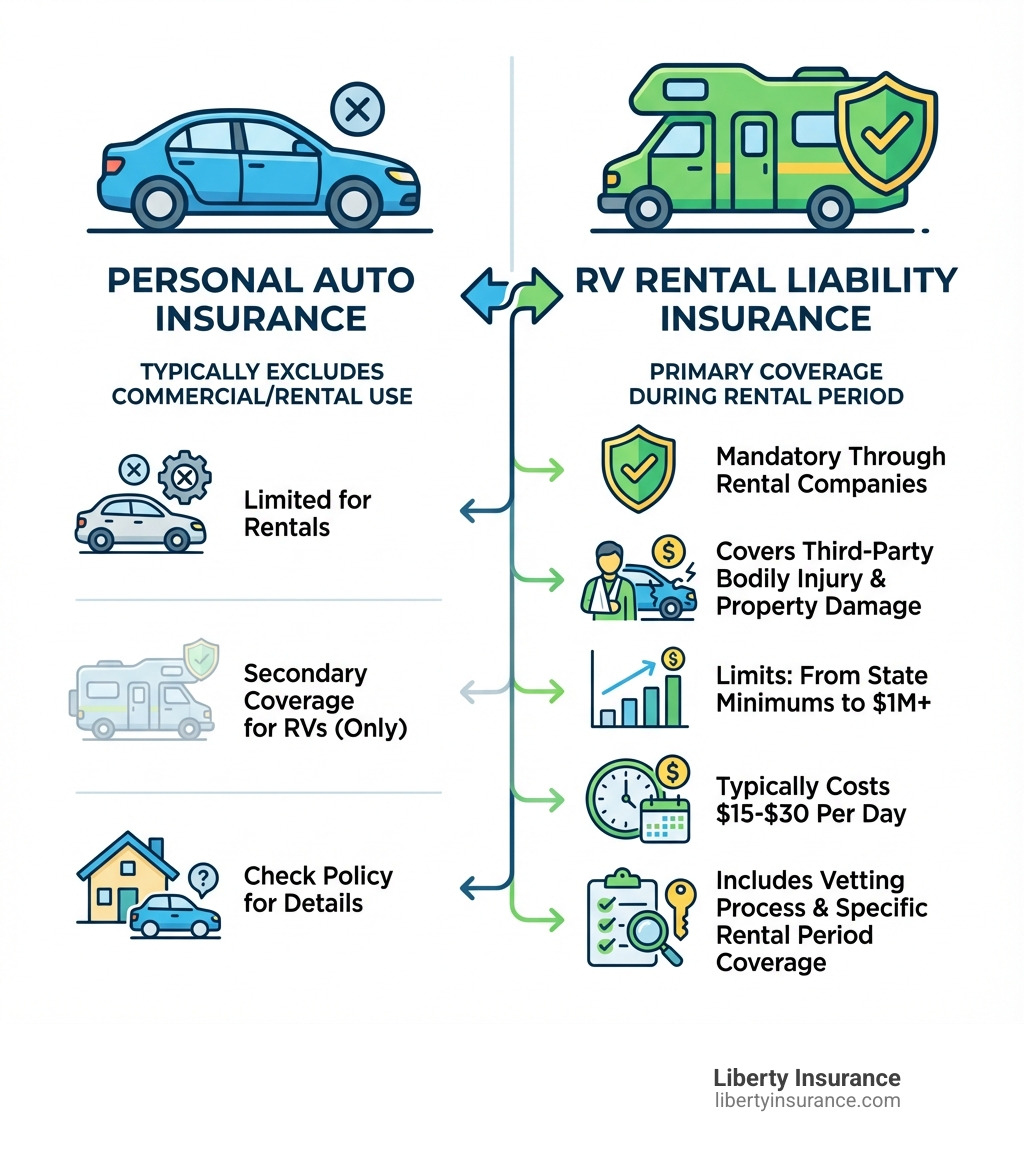
RV rental liability insurance protects you financially if you cause bodily injury to others or damage someone else’s property while operating a rented RV. Here’s what you need to know:
- What it covers: Medical bills and property damage for third parties you injure or whose property you damage
- Typical cost: $15-$30 per day, depending on RV type and coverage limits
- Coverage limits: Range from state minimums (often $50,000/$100,000/$25,000) to $1 million or more
- When it applies: During your rental period, from key pickup to return
- Key limitation: Your personal auto insurance typically won’t cover rented RVs
The open road beckons with the promise of freedom and adventure. Renting an RV offers an incredible way to explore the country without the commitment of ownership. But before you pack your bags and head out, there’s one crucial detail you can’t afford to overlook: protection.
Understanding insurance might not be as exciting as planning your route or choosing campsites, but it’s what stands between you and potential financial disaster. RVs are large, expensive vehicles that can cause significant damage in an accident. A single collision could result in hundreds of thousands of dollars in medical bills and property damage claims. Without proper liability coverage, you could be personally responsible for these costs.
If you want a neutral, big-picture overview of how auto liability works in the United States, it can help to start with the basic liability insurance concepts that apply to most vehicles, and then see how they are adapted for RV rentals.
The consequences are serious. Multi-million dollar lawsuits are common today. You could face medical bills for injured parties, repair costs for damaged vehicles or property, and even the risk of having your personal assets seized to satisfy a judgment. This isn’t meant to scare you—it’s meant to prepare you.
Most rental companies require liability insurance as part of their rental agreement, and for good reason. This coverage provides both peace of mind and financial security, allowing you to focus on creating memories instead of worrying about worst-case scenarios.
I’m Andrew Harris, a Certified Insurance Counselor who has spent years helping clients steer complex coverage needs including RV rental liability insurance. Whether you’re a first-time renter or a seasoned road warrior, understanding your liability protection is essential for any RV adventure.
Handy RV rental liability insurance terms:
What is RV Rental Liability Insurance and Why is it Crucial?
When we talk about RV rental liability insurance, we’re referring to a specific type of coverage designed to protect you, the renter, from financial responsibility if you cause an accident that results in injury to another person or damage to their property while driving a rented RV. Imagine a scenario where you’re navigating a busy street in Trenton, NJ, and accidentally back into another vehicle, or perhaps a pedestrian is injured due to an unforeseen circumstance involving your rented RV. This is where liability insurance steps in.
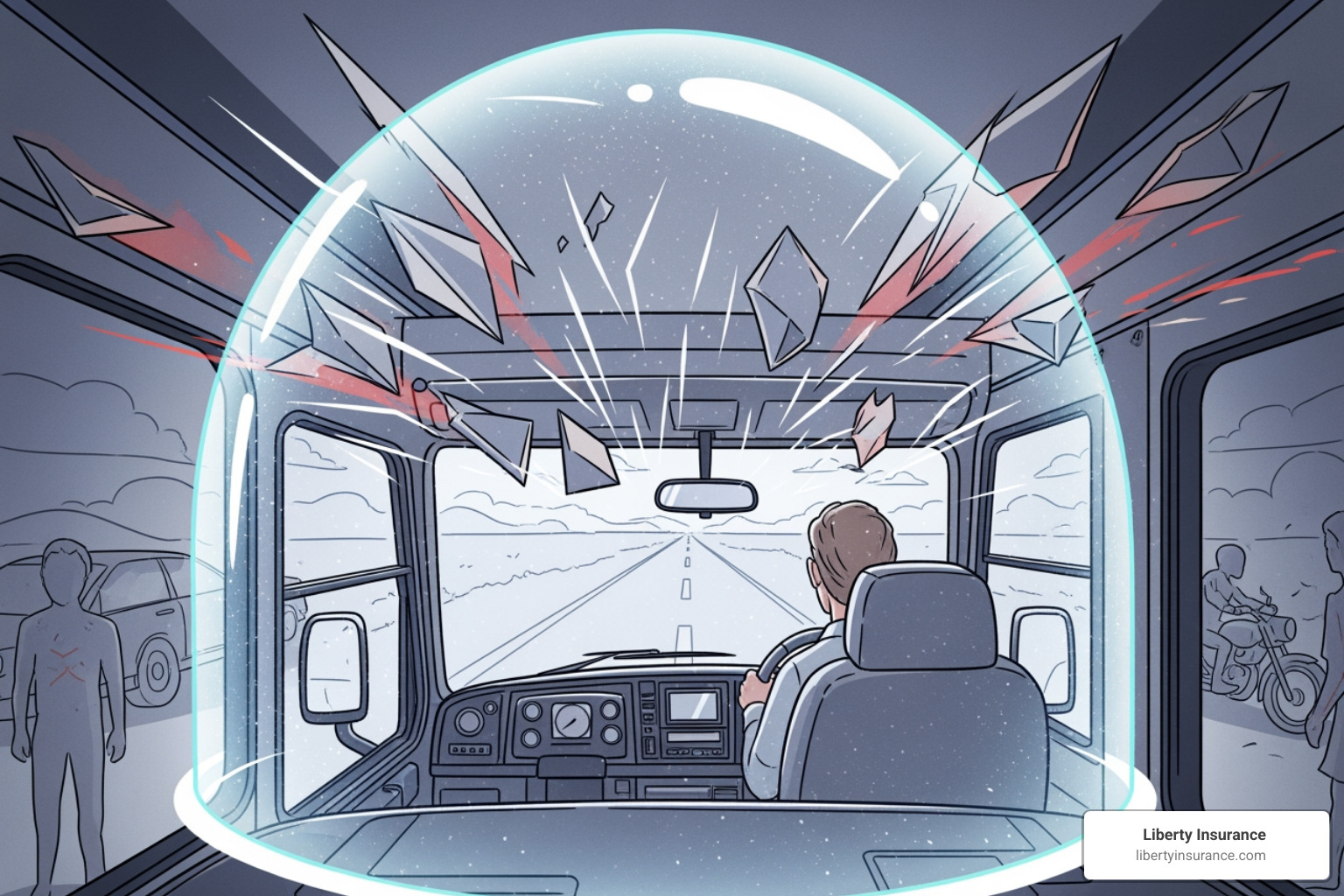
This crucial coverage provides financial protection by covering the costs associated with these third-party claims. This includes medical bills for bodily injuries sustained by others, and repair or replacement costs for property damage you cause to other vehicles, public property, or even private residences. In New Jersey, like most other states, carrying liability insurance is a legal requirement for any vehicle on the road, and this extends to rented RVs.
The stakes are particularly high with RVs. These are often large, heavy vehicles that can cause significant damage in an accident, far beyond what a typical passenger car might. The cost of repairs for specialized RV vehicles is typically higher than for standard cars and trucks, and medical expenses from an accident can quickly escalate into hundreds of thousands, or even millions, of dollars. Without adequate RV rental liability insurance, we could be personally responsible for these exorbitant costs.
Understanding the Basics of RV Rental Liability Insurance
At its core, liability insurance is about protecting you from claims made by third parties. It’s about your financial responsibility for the harm you inflict on others, not for damage to the RV you’re driving. This is a critical distinction to make when considering your rental protection.
Think of it this way:
- Bodily Injury Coverage: This pays for medical expenses, lost wages, and pain and suffering for people injured in an accident you cause. If you’re driving through a scenic route near Princeton, NJ, and an unfortunate incident occurs, this coverage would handle the costs for any injured parties.
- Property Damage Coverage: This covers the cost to repair or replace property that you damage in an accident, such as another vehicle, a fence, or a building.
It’s important to distinguish RV rental liability insurance from other types of coverage:
- Collision Coverage: This pays for damage to the rented RV itself if it’s involved in a collision, regardless of who is at fault.
- Comprehensive Coverage: This covers damage to the rented RV itself from non-collision events, such as theft, vandalism, fire, falling objects (like a tree limb in a campground near Toms River, NJ), or natural disasters.
While collision and comprehensive coverages are vital for protecting the physical RV, liability coverage is non-negotiable for rentals because it shields your personal assets from the potentially devastating financial fallout of an accident involving others. Without it, your dream vacation could quickly turn into a financial nightmare.
The High Stakes: Consequences of Inadequate Coverage
We’ve touched on it, but it bears repeating: the consequences of not having adequate RV rental liability insurance can be severe. In today’s litigious society, multi-million dollar lawsuits are common. If you cause a serious accident while driving a rented RV, you could face:
- Significant Lawsuits: Injured parties could sue you directly for medical expenses, lost wages, and pain and suffering.
- Covering Medical Bills for Others: These costs can be astronomical, potentially bankrupting an individual without insurance.
- Paying for Damage to Other Vehicles or Property: RVs can cause extensive damage to other vehicles or property, leading to massive repair or replacement bills.
- The Risk of Personal Asset Seizure: If you’re found liable and don’t have sufficient insurance, your personal assets—your home, savings, investments—could be at risk to cover the judgment.
Consider a common scenario: you misjudge the turning radius of a 35-foot Class A motorhome in a tight gas station and clip another car, injuring the driver who is stepping out of their vehicle. The damage to their car could be thousands, but their medical bills for a back injury could quickly soar into the six figures. Add to that potential lost wages and a lawsuit for pain and suffering, and the total claim could easily exceed $500,000. Without a robust liability policy, your personal assets—from your savings account to your home—would be on the line to satisfy that judgment.
Proper RV rental liability insurance is your financial safeguard. It prevents these potential financial disasters by ensuring that the insurance company handles the costs, allowing you to enjoy your RV adventure with peace of mind. Without it, every mile driven is a roll of the dice with your financial future.
Understanding Your Coverage: What’s Included and What’s Not
Navigating insurance can feel like deciphering ancient hieroglyphs, but understanding what your RV rental liability insurance covers is vital. When you secure coverage for your rented RV, you’ll typically encounter specific limits for liability. These are usually expressed as three numbers, for example, 50/100/25:
- $50,000 per person for bodily injury: The maximum the policy will pay for one person’s injuries.
- $100,000 per accident for bodily injury: The maximum the policy will pay for all injuries in a single accident.
- $25,000 for property damage: The maximum the policy will pay for damage to others’ property.
Let’s break down the 50/100/25 example further. If you cause an accident that injures three people, the ‘$50,000 per person’ limit means the policy will pay a maximum of $50,000 for each individual’s medical bills. The ‘$100,000 per accident’ limit is the total cap for all bodily injuries combined. So, if Person A has $60,000 in bills and Person B has $50,000, the policy would pay $50,000 for Person A (hitting the per-person limit) and $50,000 for Person B. The total payout of $100,000 hits the per-accident limit, and you would be personally responsible for Person A’s remaining $10,000.
These are often state minimums. However, many rental companies and third-party providers offer higher liability limits, often up to $500,000 or even $1 million, which we highly recommend given the potential costs of an RV accident. For instance, some platforms offer packages with 100/300/50 liability limits, meaning $100,000 per person, $300,000 per accident for bodily injury, and $50,000 for property damage.
Beyond core liability, an extensive RV rental protection plan often includes:
- Comprehensive Coverage: This is your shield against events beyond your control. Think theft, vandalism, fire, hail, floods, falling objects, or even hitting an animal while cruising through rural New Jersey. Some rental platforms offer up to $300,000 in comprehensive coverage for the RV itself.
- Collision Coverage: This pays for damage to the rented RV if it collides with another vehicle or object, regardless of who is at fault. It’s the coverage that helps get the RV fixed after an accident.
- Campsite Liability: This specialized coverage can be a lifesaver. It protects you if someone is injured at your rented campsite. This is not just for driving incidents. Imagine a guest visiting your campsite trips over your RV’s power cord and breaks their wrist. Or, perhaps the awning on your rented RV collapses during a sudden gust of wind, damaging the neighboring RV. Campsite liability is designed to cover these specific, non-driving-related incidents that occur in and around your stationary RV. Some plans offer campsite liability options up to $50,000.
- Interior Damage Protection: While standard liability and even comprehensive/collision often focus on the exterior or driving incidents, the interior of an RV is also susceptible to damage. Some rental companies offer optional interior damage protection, which can cover things like broken appliances, damaged cabinets, stained linens, or even lost keys, often up to $1,500. It’s a nice addition for peace of mind, especially with the wear and tear a vacation can bring.
Common Exclusions to Be Aware Of
Just as important as knowing what’s covered is understanding what’s not. No insurance policy covers everything, and RV rental policies have their specific exclusions. Common ones we see include:
- Personal Belongings: Your personal items inside the RV (clothing, electronics, jewelry) are generally not covered by the RV rental insurance. We’d advise checking your homeowners or renters insurance policy, as it might offer some limited coverage for theft of personal items, though likely with specific limits.
- Normal Wear and Tear: The natural aging and deterioration of the RV components are not covered. This is just part of operating any vehicle.
- Mechanical Breakdowns: Problems with the RV’s engine, transmission, or other mechanical systems that aren’t caused by an accident are typically excluded. This usually falls under maintenance, which is the owner’s responsibility.
- Interior Damage (often covered by security deposit): While some optional plans offer interior damage protection, many standard policies explicitly state that interior damage is not covered by the insurance and would be charged against your security deposit. So, if a lamp gets broken or a cabinet door is accidentally ripped off, be prepared for that to come out of your deposit, unless you opted for specific interior damage coverage.
- Intentional Acts: Any damage or injury caused intentionally by the renter is never covered by insurance.
- Use in Prohibited Areas: If the rental agreement specifies certain areas or activities where the RV cannot be used, coverage would likely be void if you violate these terms. This often includes prohibitions on travel into Mexico, and sometimes even Canada without prior authorization and additional insurance riders. Many policies also forbid using the RV on unpaved roads, logging roads, or for ‘off-roading’ activities, which could void your coverage entirely if you get stuck or have an accident in a prohibited area. For rentals starting in New Jersey, ensure you understand any geographic restrictions.
Always take the time to read your rental agreement and insurance policy carefully. Understanding these details upfront can save you a lot of headache and unexpected costs later.
How RV Rental Liability Insurance Works in Practice
The process of securing RV rental liability insurance is often integrated directly into your RV rental experience. For many rental companies, it’s a mandatory requirement, bundled into the rental package. This means you might not even have a choice in the matter, as the cost is often included in the daily rental price. This integration simplifies things for us, as it ensures we’re covered without having to seek out a separate policy.
The rental company plays a significant role in this process:
- Vetting Process: Before you even get the keys, most reputable rental platforms conduct a thorough vetting process. This often includes identity verification, checking your driving history, and sometimes even criminal background checks. This helps ensure that both renters and owners are reliable, contributing to a safer rental ecosystem.
- Providing Policy Options: While the base liability coverage might be mandatory, rental companies often offer different tiers of protection (e.g., “Good,” “Better,” “Best” packages) with varying deductibles and coverage limits for comprehensive and collision. You’ll typically select your preferred package during the booking or checkout process.
When Does Coverage Begin and End?
This might seem obvious, but understanding the exact start and end times of your RV rental liability insurance coverage is crucial. Generally, coverage is valid only during the rental period. This period is precisely defined: it begins the moment the keys are exchanged with you, the renter, at pickup, and it ends when the keys are returned to the owner at drop-off.
It’s vital to stick to these official start and end times. If you decide to extend your trip, you must inform the rental company and ensure that new terms are agreed upon and that your insurance coverage is extended accordingly. Driving an RV outside of the booked dates, even for a few hours, could leave you completely uninsured if an accident occurs. Always ensure continuous coverage for every moment you have possession of the RV.
What to Do in Case of an Accident
Even with the best intentions and the most careful driving, accidents can happen. If you find yourself in an accident during your RV rental, here’s what we recommend doing:
- Ensure Safety First: Check for injuries to yourself and others. If anyone is hurt, call emergency services (911 in New Jersey) immediately.
- Contact the RV Owner/Rental Company: This should be one of your first calls after ensuring everyone’s safety. They will guide you through their specific procedures and help initiate the claims process.
- Call Emergency Services/Police: If there’s significant damage, injuries, or if local laws require it, call the police to file an official report. This report is invaluable for insurance claims.
- Document Everything: Take plenty of photos and videos of the accident scene, damage to all vehicles involved, and any relevant surroundings. Get contact information from other drivers, passengers, and witnesses.
- Do Not Admit Fault: Stick to the facts when speaking with others or the police. Let the professionals determine fault.
- Initiate the Claims Process: The rental company will likely connect you with an insurance adjuster. Be prepared to provide all documentation you gathered (photos, police reports, completed rental forms).
- Understand Deductible Responsibility: You are typically responsible for the deductible amount on your chosen insurance package. If the repair costs for covered damages are less than your deductible, you will pay the full repair cost out-of-pocket. The insurance only kicks in for covered damages that exceed your deductible. Many rental companies require claims to be filed within a short window, often 48 hours of the reservation end date, so prompt action is key.
The insurance adjuster’s role is to investigate the claim, assess the damage, and determine the payout based on the policy terms. They will review the police report, photos, witness statements, and repair estimates. It’s crucial to cooperate fully with the adjuster. If there’s a dispute—for example, if you disagree with the fault assessment or the repair costs—the rental agreement will typically outline a resolution process, which may involve arbitration.
Cost, Options, and Personal Policy Limitations
Let’s talk numbers – how much does RV rental liability insurance typically cost? Money.com reports that RV rental insurance generally costs between $15 and $30 per day. This aligns with industry observations for temporary RV insurance coverage. However, pinpointing an exact figure can be tricky because these expenses are often bundled into the overall rental price, making them difficult to assess separately.
The price we pay for our RV rental insurance is influenced by several factors:
- RV Type: A large Class A motorhome will generally cost more to insure than a smaller travel trailer or campervan.
- RV Value and Age: Newer, more expensive RVs typically have higher insurance costs. Some platforms even offer liability-only coverage for older RVs (e.g., those over 20 years old), as they may not qualify for physical damage protection.
- Coverage Limits Selected: Choosing higher liability limits or adding extra coverages like interior damage protection will increase the daily rate.
- Driving Record: While less common for short-term rentals, a poor driving record could potentially impact eligibility or cost if assessed by the insurer.
Navigating Different RV Rental Liability Insurance Options
When it comes to RV rental liability insurance, we often have choices beyond just the basic requirement. Here are the typical options:
- State Statutory Minimums: This is the baseline required by law in New Jersey. While it ensures legality, these minimums are often quite low (e.g., 25/50/25 for bodily injury/property damage in New Jersey) and may not be sufficient to cover the full extent of damages in a serious RV accident.
- Higher Liability Limits: Many rental companies offer packages that significantly increase these limits, often to $500,000 or even $1 million in total liability coverage. Given the potential for multi-million dollar lawsuits, opting for these higher limits is a wise decision to protect our personal finances.
- Supplemental Liability Insurance (SLI): Sometimes available as an add-on, SLI can provide additional liability coverage above the rental company’s standard policy, offering an extra layer of protection.
Choosing the right level of protection depends on our comfort with risk, the nature of our trip, and the value of our personal assets. We always recommend considering coverage beyond the state minimums for peace of mind.
Peer-to-Peer vs. Commercial Rental Companies: Insurance Differences
The source of your RV rental significantly impacts how insurance is handled.
- Commercial Rental Companies (e.g., Cruise America, El Monte RV): These companies typically own their entire fleet. Insurance is usually straightforward: they provide a commercial insurance policy, and you are a named insured for the rental period. The cost is often bundled into the daily rate, and you may be offered options to purchase SLI or lower your deductible for physical damage.
- Peer-to-Peer (P2P) Platforms (e.g., RVshare, Outdoorsy): These platforms connect private RV owners with renters. Their insurance model is more complex. The platform partners with an insurance provider (like Roamly or a policy underwritten by major carriers) to offer a specific rental policy that supersedes the owner’s personal policy during the rental. When you book, you are essentially purchasing this temporary policy. This is why they conduct DMV checks and have age requirements—the insurance partner requires it. The coverage is only active for the exact rental dates, and the owner’s personal insurance is not involved in any claims that occur during your trip.
Can You Use Your Personal Auto Insurance?
This is a common question, and unfortunately, it’s also where a significant misconception lies. Many of us assume our personal auto insurance policy will automatically extend to cover a rented RV. However, this is rarely the case.
Here’s why your personal auto insurance typically falls short:
- RVs Often Excluded: Most personal auto policies are designed for standard passenger vehicles, not large recreational vehicles. The key phrase to look for in your personal auto policy is the ‘use of non-owned autos’ clause. For most policies, this is limited to vehicles of a similar size and type to what you have insured—typically a private passenger car, van, or pickup truck. A large, heavy motorhome is almost always excluded.
- Coverage as Secondary or “Excess”: Even if your personal policy does offer some form of coverage for a rented RV, it’s almost always secondary or “excess” coverage. This means it only kicks in after the primary insurance (usually provided by the rental company) has been exhausted. The rental company’s insurance is considered primary during the rental period.
- “Business Use” Exclusion: Renting an RV, even for a personal vacation, can sometimes be considered a “business use” in the eyes of your personal insurer. Even though it’s your vacation, the owner is receiving payment, making it a commercial transaction that personal policies are not designed to cover.
- Risk of Being Dropped: If you rely solely on your personal policy for an RV rental and an incident occurs, your insurer might deny the claim or even drop your policy for violating its terms.
The bottom line: It’s best to assume your personal auto insurance will not provide adequate primary coverage for a rented RV. Always rely on the RV rental liability insurance provided or recommended by the rental company, or a specialized third-party temporary RV insurance policy. Check with your auto insurance provider in New Jersey to understand any specific limitations they might have regarding RV rentals, but don’t count on it as your primary defense.
Frequently Asked Questions about RV Rental Insurance
We understand that RV rental insurance can be a maze of terms and conditions. To help clarify, here are answers to some of the most common questions we encounter:
What’s the difference between liability and comprehensive/collision coverage?
This is a fundamental distinction. RV rental liability insurance protects you against claims made by others. If you cause an accident, it pays for the medical expenses of injured third parties and the damage to their property. It does not pay for damage to the RV you are driving.
On the other hand, comprehensive and collision coverage protect the rented RV itself.
- Collision coverage pays for repairs to the RV if it’s damaged in a collision with another vehicle or object, regardless of who is at fault.
- Comprehensive coverage covers damage to the RV from non-collision events, such as theft, vandalism, fire, falling objects (like a tree branch), or weather-related incidents (like a hail storm in New Brunswick, NJ).
Think of liability as protecting your wallet from claims from others, while comprehensive and collision protect the owner’s RV (and by extension, your financial responsibility for it if you opted for these coverages).
Does the insurance cover damage when the RV is parked at a campsite?
Yes, specific coverages are designed for this.
- Campsite liability coverage can protect you if someone is injured at your rented campsite, for instance, if a visitor trips and falls near your RV while it’s parked. Some rental protection plans offer campsite liability options, sometimes up to $50,000.
- Comprehensive coverage protects the parked RV from non-collision events. So, if a tree falls on the RV, it’s vandalized, or catches fire while parked at your campsite in Millstone Township, NJ, comprehensive coverage would typically kick in to cover the damage to the RV itself.
- It’s worth noting that if you rent an RV that is delivered and set up for you (meaning you don’t drive it), the rental protection policy is usually active only after the RV is set up at the destination, not while it’s in transit.
What happens if repair costs are less than my deductible?
This is an important point that often surprises renters. If the cost to repair damage to the rented RV (that would otherwise be covered by collision or comprehensive) is lower than your insurance deductible, you will be responsible for paying the full repair cost out-of-pocket. The insurance policy only kicks in for covered damages that exceed your deductible amount.
For example, if you have a $1,000 deductible and cause $700 worth of damage, you’ll pay the entire $700. If you cause $1,500 worth of damage, you’ll pay your $1,000 deductible, and the insurance would cover the remaining $500. This is why it’s crucial to understand your deductible when choosing an insurance package.
Are additional drivers covered by the RV rental liability insurance?
Generally, yes, but only if they are explicitly listed on the rental agreement. During the booking process, you must declare all potential drivers. The rental company or P2P platform will usually run the same verification checks (e.g., driving record) on additional drivers as they do for the primary renter. If an unlisted person drives the RV and has an accident, the insurance claim will almost certainly be denied, leaving that driver and you, the primary renter, personally liable for all damages.
What if I’m renting a towable travel trailer? How does insurance work?
This is a critical distinction. When you rent a towable unit like a travel trailer or fifth-wheel, there are two components to the insurance. The liability coverage typically extends from your tow vehicle’s insurance policy. So, if you back the trailer into another car, it’s your truck’s liability insurance that would respond to the third-party damage claim. However, the physical damage (comprehensive and collision) to the trailer itself is not covered by your auto policy. You must purchase this coverage through the rental company. This is why rental platforms will still sell you an insurance package for a trailer—it’s to protect their asset, not to provide you with liability coverage, which you are expected to have on your tow vehicle.
Does liability insurance have a deductible?
This can be confusing. Typically, in the U.S., liability coverage does not have a deductible. If you are found at fault for an accident and your policy covers the claim, the insurance company pays the third party from the first dollar up to your policy limit. The deductibles you select during the rental process ($500, $1,000, etc.) almost always apply to the physical damage to the rented RV (i.e., comprehensive and collision coverage), not to the liability portion of the policy.
Conclusion: Ensuring a Worry-Free RV Adventure
Starting on an RV adventure promises unforgettable memories, but the journey becomes truly worry-free when we’re properly protected. Understanding RV rental liability insurance isn’t just about ticking a box; it’s about safeguarding our financial future and ensuring that a minor mishap doesn’t turn into a major disaster.
We’ve explored what RV rental liability insurance entails, how it shields us from third-party claims, and why it’s a critical, often mandatory, component of any RV rental. We’ve clarified its distinction from comprehensive and collision coverages, digd into the specific exclusions to watch out for, and outlined how coverage begins, ends, and what to do in case of an accident. We also debunked the myth about personal auto insurance covering RV rentals and discussed the various cost factors and coverage options available.
Before you hit the road, make it a priority to:
- Read the Rental Agreement: Understand every clause, especially those related to insurance.
- Understand Your Policy: Know your liability limits, deductibles, and what’s covered (and what’s not).
- Make Informed Decisions: Choose a coverage level that provides adequate protection for your specific trip and comfort level.
At Liberty Insurance, we believe in empowering you with the knowledge to make informed decisions for a safe journey. We’re here to help you steer the complexities of insurance so you can focus on the open road ahead.

