
Why Risk Retention Group Formation Matters for Your Business
Risk retention group formation is the creation of a member-owned liability insurance company. It allows businesses with similar risks to pool their resources, customize coverage, and gain control over insurance costs. The process involves a few key steps, from conducting a feasibility study to obtaining a license in a chosen domicile state and registering to operate nationwide.
Risk retention groups (RRGs) were established by the federal Liability Risk Retention Act (LRRA) of 1986. This legislation was a response to the hard insurance market of the 1980s, which made liability coverage difficult to obtain or afford. The LRRA allows businesses in similar industries, like healthcare or construction, to form their own insurance companies. These RRGs are licensed in one state but can operate across the country, thanks to federal preemption from most state insurance laws.
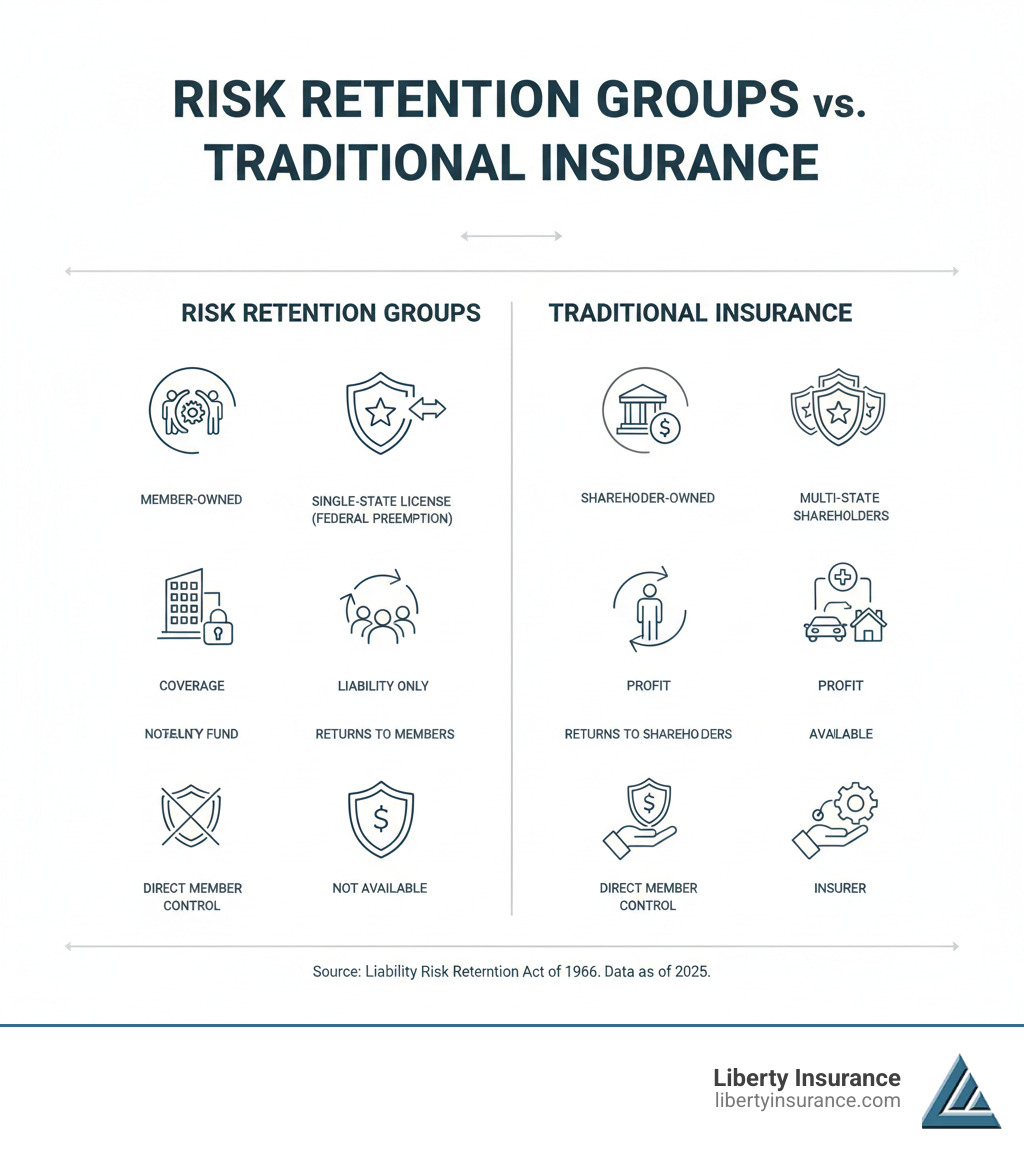
The primary appeal of an RRG is the potential for cost savings, long-term rate stability, customized coverage, and direct control over claims and underwriting. Unlike traditional insurers, RRGs return underwriting profits to their member-owners. However, forming an RRG involves complex regulations, significant financial commitments, and notable risks, such as the lack of access to state guaranty funds in case of insolvency.
I’m Andrew Harris, a Certified Insurance Counselor (CIC) and Accredited Advisor in Insurance (AAI). With experience in complex commercial insurance, I’ve helped many organizations steer risk retention group formation and determine if the RRG model fits their long-term risk management goals.
Understanding Risk Retention Groups: The Fundamentals
When the traditional insurance market fails to provide affordable liability coverage, alternative solutions like Risk Retention Groups (RRGs) become essential. Understanding the fundamentals of RRGs is the first step toward taking control of your insurance strategy.
What is a Risk Retention Group (RRG)?
An RRG is a member-owned insurance company created by businesses facing similar liability risks. For example, a group of medical practices or trucking companies can join forces to create their own insurance entity. This RRG provides liability coverage custom to its member-owners.
The concept originates from the federal Liability Risk Retention Act of 1986 (LRRA), which was enacted to solve the 1980s liability insurance crisis. The LRRA allows an RRG to be licensed in a single state (its domicile) and operate nationwide with federal preemption from most state insurance laws. This unique regulatory advantage simplifies expansion across the country.
RRGs are a type of captive insurance designed for homogeneous groups. While a traditional captive might serve one company, an RRG brings together multiple businesses, offering a powerful alternative to standard insurance for business owners.
Primary Benefits of an RRG
Businesses pursue risk retention group formation for benefits that traditional insurance often can’t match:
- Cost Savings: By eliminating intermediaries and shareholder profits, RRGs can offer coverage at a lower cost. Savings are returned to members.
- Long-Term Rate Stability: Rates are based on the group’s actual loss experience, not volatile market trends, providing predictability.
- Customized Coverage: Members design policies with terms, deductibles, and limits that fit their specific operational risks, a level of flexibility unavailable in standard policies.
- Greater Control: As member-owners, you influence policy design, claims handling, and risk management strategies. This control is tangible; members can influence the claims philosophy (e.g., deciding whether to fight or settle a claim), select defense counsel who are experts in their industry, and set the risk management standards that all members must follow. You run the company, you don’t just buy a policy.
- Improved Risk Management: Members share industry-specific knowledge and best practices, leading to better loss control and fewer claims. For instance, a group of architects in an RRG might share lessons learned from a specific type of building design flaw, leading to updated best practices for all members and preventing future claims. This collaborative environment fosters a culture of continuous improvement.
- Underwriting Profit Potential: Unlike traditional insurance where profits go to external shareholders, in an RRG, underwriting profits and investment income are returned to members via dividends or premium credits.
Allowable Coverage and Limitations
The LRRA restricts RRGs to liability insurance. Common coverages include professional liability (Errors & Omissions), general liability, Directors & Officers (D&O) liability, medical malpractice, commercial auto liability, and environmental liability. Many businesses use RRGs to secure their professional liability insurance.
However, there are clear limitations. RRGs cannot provide:
- Workers’ compensation insurance
- Property insurance, such as commercial property insurance for buildings or business interruption insurance for lost income.
- Personal lines insurance like auto or homeowners policies.
These restrictions ensure RRGs remain focused on their core purpose of managing liability risk for their members.
Ownership Structures and Membership Criteria
The ownership model is what makes an RRG unique. The LRRA requires that all owners must be insureds, and all insureds must be owners. This ensures a complete alignment of interests. Whether the RRG is owned directly by its members or by a sponsoring association, everyone has a stake in the group’s success.
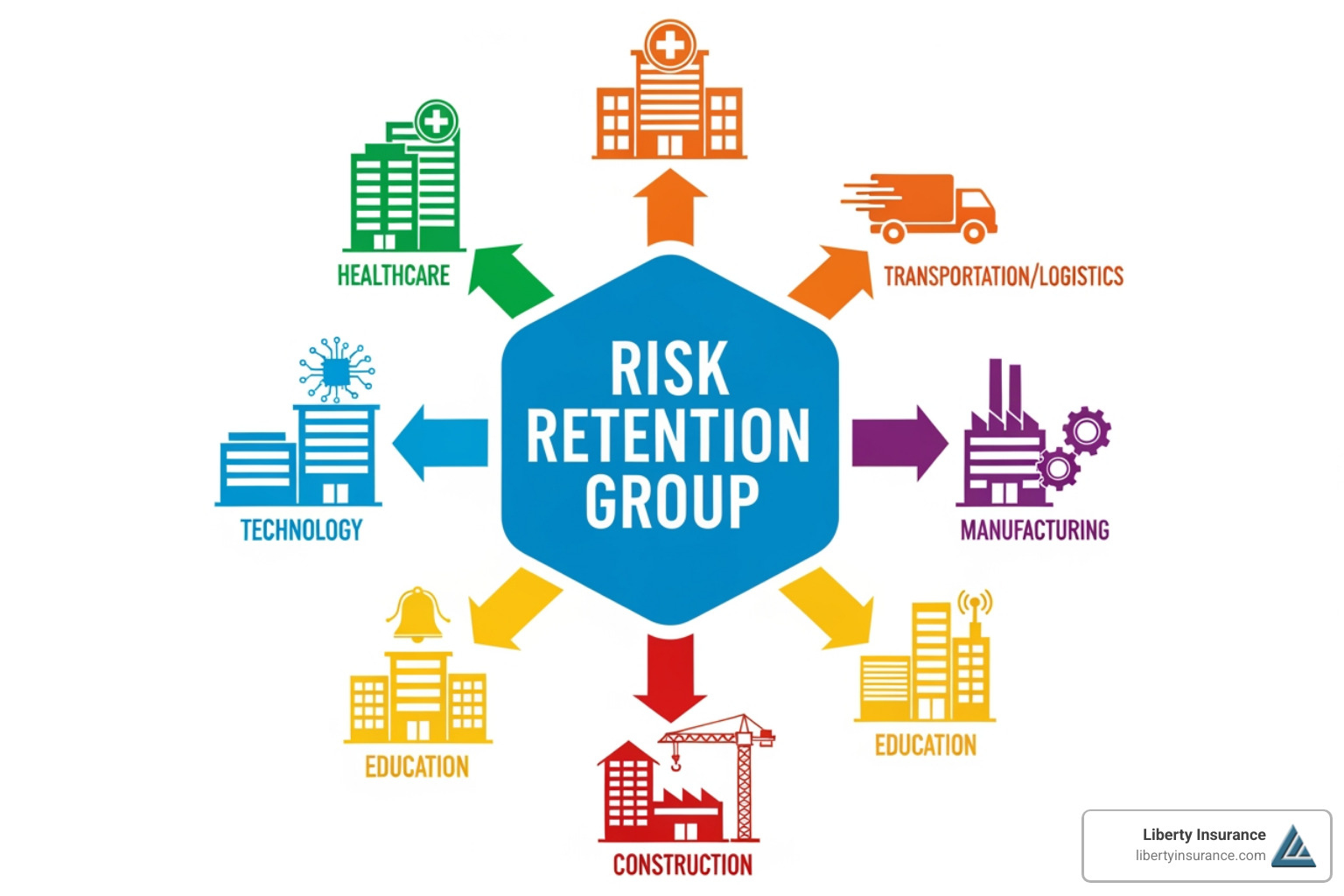
Membership is limited to a homogeneous group, meaning members must be engaged in similar businesses or activities with comparable liability exposures. For example, an RRG cannot mix construction companies with medical professionals. This homogeneity is key to developing specialized underwriting, targeted risk management, and effective corporate coverage strategies.
The Step-by-Step Guide to Risk Retention Group Formation
Starting on risk retention group formation is a strategic move that requires careful planning. It’s about building your own insurance company alongside peers who share your business challenges. Here is a walkthrough of the key steps.

Step 1: The Feasibility Study and Plan of Operation
Before forming an RRG, you must prove its viability through a feasibility study and plan of operation. This document is a regulatory requirement and serves as the blueprint for your RRG. It forces you to analyze every aspect of the proposed company.
The study must detail the liability coverages, proposed deductibles and policy limits, and rates. It includes pro forma financials projecting at least five years, based on the historical loss experience of prospective members. A critical component is an independent actuarial analysis to validate that premiums are adequate and loss reserves are sound. The plan also outlines management procedures for underwriting, claims, and risk management. For expert help in developing this crucial document, you can learn more about our captive insurance management services.
Step 2: Choosing a Domicile State
Your choice of a domiciliary state—the state where your RRG is chartered and licensed—is a critical strategic decision. The ideal domicile has a regulatory body with deep experience regulating RRGs, a knowledgeable and responsive insurance department, and efficient approval processes.
Key factors to consider include the state’s capital requirements (which may exceed the federal minimum) and its reputation for fairness and transparency. A good regulator acts as a partner, not an obstacle. For more information on state-specific requirements, the National Risk Retention Association is an excellent resource.
Step 3: Licensing and Financial Requirements for Risk Retention Group Formation
With a feasibility study and domicile selected, the next step is licensing. You must first choose a legal structure, such as a stock company, mutual company, or reciprocal exchange, based on your domicile’s laws. Your legal counsel will help determine the best fit.
Financially, the federal minimum for risk retention group formation is $500,000 in initial capital and surplus. However, your domicile state may require more, depending on the risks you plan to insure. This capital is the financial foundation that ensures your RRG can cover initial claims and expenses. It’s a core part of your business asset protection insurance strategy, safeguarding the collective group. Once your application, capital, and management team are approved, the domicile state issues your license to operate.
Step 4: Registering to Operate in Non-Domiciliary States
Federal preemption under the LRRA is a major advantage. Once licensed in its domicile, an RRG can operate in all other states without obtaining a separate insurance license in each one. This dramatically streamlines expansion compared to traditional insurers.
However, you must still register in each non-domiciliary state where you plan to do business. The process involves submitting your approved feasibility study, annual audited financial statements, and designating the state’s insurance commissioner as your agent for service of process. The NAIC Uniform Risk Retention Group Registration Form standardizes this process. Remarkably, you can typically begin writing insurance in most states within 60 days of receiving your domiciliary license.
Operating and Managing a Successful RRG
Completing the risk retention group formation process is just the beginning. Long-term success depends on strong governance, expert management, and a sound financial structure.
Governance, Regulation, and Oversight
An RRG is a fully regulated insurance company. A governing board, elected by the member-policyholders, sets the strategic direction and ensures the RRG operates in the members’ best interests. This board holds real power and responsibility. The board’s duties are extensive and include approving the annual business plan and budget, overseeing the performance of the captive manager and other service providers, establishing underwriting guidelines, and making decisions on dividend distributions. Effective governance is the bedrock of a stable RRG.
The domiciliary state is the primary regulator, responsible for licensing, solvency, and rate reviews. RRGs undergo regular exams and audits to meet NAIC accreditation standards, just like traditional insurers. We advocate for total transparency with regulators to build a strong partnership.
Non-domiciliary states have limited authority due to federal preemption but can still regulate areas like unfair claims practices and collect premium taxes. They can also step in to conduct financial examinations if a domiciliary state’s oversight is found lacking. Navigating this dual regulatory system is a key part of effective captive insurance management.
Assembling Your Team of Essential Service Providers
No RRG operates in a vacuum. A team of professional service providers is essential for success:
- Captive Manager: Coordinates day-to-day administration and acts as the primary liaison with regulators.
- Independent CPA: Prepares annual audited financial statements to ensure transparency and accuracy.
- Qualified Actuary: Provides opinions on loss reserves and premium adequacy, which is vital for long-term solvency.
- Legal Counsel: Advises on regulatory compliance, policy language, and claims defense.
- Third-Party Administrator (TPA): Manages the claims process, from intake to settlement, leveraging specialized expertise.
- Investment Manager: Manages the RRG’s assets according to a board-approved investment policy. Their goal is to generate stable returns to help cover losses and expenses, while preserving capital.
This team ensures the RRG runs smoothly and compliantly, with each expert playing a crucial role in its financial health and operational integrity.
The Role of Reinsurance and Financial Structuring
Smart financial structuring is what separates thriving RRGs from struggling ones. Reinsurance is a critical safety net, allowing the RRG to transfer catastrophic losses to a reinsurer. This protects the RRG’s balance sheet from claims that could threaten its solvency. The structure of this reinsurance is key. An RRG might use an ‘excess of loss’ treaty, where the reinsurer covers losses above a certain high threshold, or a ‘quota share’ treaty, where the reinsurer takes a fixed percentage of every risk. The choice depends on the RRG’s risk tolerance and capital base.
A large portion of the premium, often around 65%, should be set aside in a loss fund to cover retained claims. Keeping operating expenses lean (ideally 35-40% of premium) maximizes the funds available for losses and potential profit distribution to members.
When setting premiums, a best practice is to not undercut current market rates too aggressively. The cost savings in an RRG come from operational efficiency and profit returns, not from risky pricing. Finally, structuring ownership to allow members to share in underwriting profits incentivizes strong risk management, as their efforts can lead to direct financial rewards. This financial alignment is key to managing large exposures, similar to the principles behind excess liability insurance.
Understanding the Risks and Financial Implications
While the benefits of risk retention group formation are significant, it’s crucial to understand the potential disadvantages and financial risks. RRGs are a sophisticated strategy and are not suitable for every business.

Potential Disadvantages and Financial Risks
- Limited Risk Pool: Because all members are in a similar industry, the RRG has a concentrated risk profile. An industry-wide downturn or a wave of claims can strain the group’s finances without the diversification that large traditional insurers have.
- No Access to State Guaranty Funds: This is perhaps the most significant risk. If a traditional insurer fails, state guaranty funds step in to pay claims. The LRRA excludes RRGs from this protection. If your RRG becomes insolvent, members bear the financial risk directly.
- Regulatory Complexity: While federal preemption simplifies licensing, navigating the specific rules of a domicile state plus the registration and tax requirements of all non-domiciliary states requires significant expertise.
- Initial Costs and Capital Commitment: Forming an RRG involves substantial upfront costs for feasibility studies, legal fees, and actuarial analysis. Furthermore, members must contribute to the initial capital, which starts at a minimum of $500,000 and is often higher.
Understanding these risks is a vital part of developing a comprehensive commercial risk insurance strategy.
Key Financial and Legal Considerations for Risk Retention Group Formation
There are specific legal requirements that demand close attention. First, every policy issued by an RRG must contain a specific disclosure notice in at least 10-point type. This federally mandated notice must state:
“This policy is issued by your risk retention group. Your risk retention group may not be subject to all of the insurance laws and regulations of your State. State insurance insolvency guaranty funds are not available for your risk retention group.”
This ensures every member understands the unique regulatory status of the RRG and the lack of a guaranty fund backstop.
Second, ownership interests in an RRG are considered securities under federal and state law. While they are generally exempt from registration requirements, they are fully subject to anti-fraud provisions. This means anyone soliciting members or capital must disclose all material facts about the RRG’s operations and risks. Transparency is not just good practice; it’s a legal requirement. This underscores the importance of fiduciary liability insurance for the RRG’s leadership. For detailed guidance, the NAIC’s RRG Model Brief is an essential resource.
Frequently Asked Questions about RRG Formation
We often receive questions from businesses exploring risk retention group formation. Here are answers to some of the most common inquiries.
How long does it take to form a Risk Retention Group?
The formation process, from initial concept to full licensure in a domicile state, typically takes several months. This includes developing the feasibility study, securing regulatory approval, and meeting capitalization requirements. However, once licensed, an RRG can begin operating in most other states within 60 days by completing a streamlined registration process.
How are premiums determined in an RRG?
Premiums in an RRG are not based on the volatile swings of the traditional insurance market. Instead, they are developed through a rigorous actuarial process. A qualified actuary analyzes the collective historical loss data of the member group to project future losses. Premiums are then calculated to be sufficient to cover these expected losses, pay for operating and administrative expenses (including reinsurance costs), and contribute to the RRG’s capital and surplus. This data-driven approach is what creates the potential for long-term rate stability, as premiums directly reflect the group’s own performance.
Can an RRG write property insurance like commercial building coverage?
No. The Liability Risk Retention Act (LRRA) strictly limits RRGs to providing liability insurance only. They cannot write first-party coverages like commercial property insurance, business interruption insurance, or workers’ compensation. RRGs are designed to address third-party claims, so members must secure property and other non-liability coverages separately.
What happens if an RRG becomes financially insolvent?
If an RRG becomes insolvent, its policyholders face significant risk because RRGs have no access to state guaranty funds. These funds, which protect policyholders of traditional insurers, do not apply to RRGs. The domiciliary state’s insurance regulator will manage the dissolution and pay claims from remaining assets, but there is no guarantee that all claims will be paid in full. This is why every RRG policy must include a prominent notice disclosing this risk, as detailed in resources from the National Risk Retention Association.
Conclusion
As we’ve explored, risk retention group formation is a powerful strategy for managing liability risks. It offers businesses a path to gain control, achieve long-term rate stability, and obtain customized coverage that the traditional market often cannot provide. By pooling resources with industry peers, you invest in your own insurance company, with the potential for financial returns and improved risk management.
However, this path is not without its challenges. The formation process is complex, the financial commitments are significant, and members must accept the risks that come with ownership, most notably the lack of state guaranty fund protection. Success requires careful planning, robust governance, and a team of expert advisors.
At Liberty Insurance, we specialize in helping businesses evaluate sophisticated risk solutions. We can help you analyze whether an RRG is the right fit or if other business insurance solutions better serve your needs. Our goal is to empower you with the knowledge to make the best choice for your organization.
Ready to explore whether this alternative risk strategy is right for you? Contact us to learn more about captive insurance management and let’s start a conversation about your business’s future.

