
Introduction: Why Every Meal Needs a Side of Protection
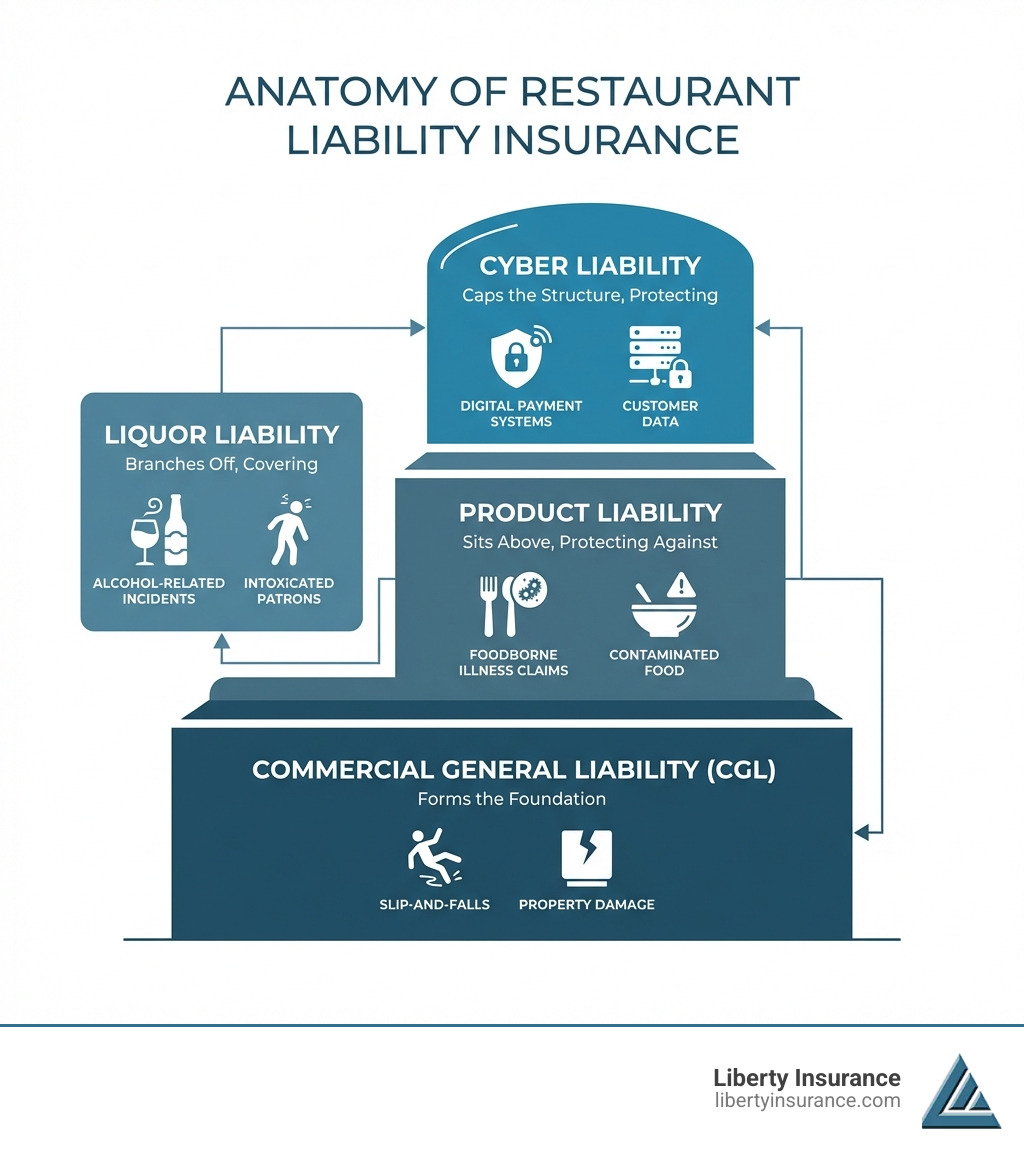
Liability insurance for restaurants is specialized coverage that protects your food service business from lawsuits and claims arising from third-party bodily injuries, property damage, foodborne illnesses, and alcohol-related incidents. It’s essential for protecting your business assets, covering legal defense costs, and ensuring business continuity when unexpected accidents occur. Key types of restaurant liability coverage include:
- Commercial General Liability (CGL) – Covers slip-and-fall accidents, customer injuries, and property damage.
- Product Liability – Protects against food poisoning and contaminated food claims.
- Liquor Liability – Covers incidents involving intoxicated patrons (required for alcohol service).
- Cyber Liability – Protects against data breaches affecting customer payment information.
Running a restaurant means facing inevitable risks. A customer could slip on a wet floor, your kitchen could accidentally serve contaminated food, or an intoxicated patron might cause an accident after leaving. Without adequate coverage, any of these scenarios could result in a lawsuit that threatens your financial stability. The consequences of being underinsured can be devastating, as third-party claims can quickly escalate into six-figure lawsuits. For example, the average cost of a customer slip-and-fall claim is around $20,000, while more complex lawsuits can easily exceed $100,000. Legal defense costs alone can drain your resources. According to the U.S. Small Business Administration, having the right insurance is a critical step in managing risk.
I’m Andrew Harris, and I’ve spent my career helping New Jersey business owners steer the complexities of liability insurance for restaurants and other commercial ventures. As a Certified Insurance Counselor and PIA National’s 2020 Agent of the Year, I’ve seen how the right coverage protects restaurant owners from financial catastrophe while allowing them to operate with confidence.
Quick liability insurance for restaurants terms:
- general and liquor liability insurance
- what does liquor liability insurance cover
- liquor liability insurance requirements by state
Why Your Business Needs Liability Insurance for Restaurants
Imagine pouring your heart and soul into creating a vibrant dining experience, only for it to be jeopardized by an unforeseen incident. This is a daily reality for restaurant owners in New Jersey, from the busy streets of Trenton to the charming towns of Millstone Township and Princeton. This is precisely why liability insurance for restaurants isn’t just an option—it’s a crucial ingredient for your business’s success and longevity.
- Mitigating Legal Defense Costs: Lawsuits, even frivolous ones, are expensive. A liability policy covers attorneys’ fees, court costs, and potential settlements, protecting your capital.
- Protecting Business Assets: A significant liability claim could force you to liquidate assets to cover damages. Adequate Business Asset Protection Ultimate Guide ensures that a single accident doesn’t dismantle your entire operation.
- Handling Inevitable Incidents: From a server spilling a drink on a laptop to a delivery driver causing minor property damage, accidents happen. The right insurance turns potential crises into manageable inconveniences.
- Building Customer Trust: Comprehensive insurance demonstrates a commitment to customer safety. It’s an unspoken assurance that you’re a responsible and reliable establishment, which helps build a loyal customer base.
The Main Course: Types of Liability Insurance Your Restaurant Needs

Just like a well-balanced menu, a complete insurance policy for your restaurant requires a variety of coverages. Each type addresses specific risks, working together to create a robust safety net for your business. Let’s dig into the essential types of liability insurance that every New Jersey restaurant owner should consider.
Commercial General Liability (CGL) Insurance
Think of Commercial General Liability (CGL) insurance as the cornerstone of your restaurant’s protection. It’s designed to cover the most common, everyday risks that can lead to lawsuits. CGL protects your business from claims of third-party bodily injury, property damage, and even advertising injury.
- Third-Party Bodily Injury: This is perhaps the most common claim. Imagine a customer slipping on a freshly mopped floor in your Princeton bistro, or tripping over an uneven sidewalk outside your Trenton diner. CGL covers their medical expenses, rehabilitation costs, and any legal fees if they decide to sue. It also extends to medical payments for minor injuries, often without a lawsuit.
- Property Damage: If a server accidentally spills a tray of food and drinks, damaging a customer’s designer handbag or phone, CGL would cover the cost of repair or replacement. Similarly, if a delivery driver accidentally backs into a customer’s mailbox, CGL helps cover the damage.
- Advertising Injury: While less common for restaurants, CGL can also cover claims related to libel, slander, or copyright infringement in your advertising. For example, if a competitor claims your marketing materials unfairly disparage their business, CGL could provide defense. This coverage, often called ‘personal and advertising injury,’ also extends to claims of wrongful eviction (if you lease space to another vendor), malicious prosecution, or invasion of a person’s privacy.
In New Jersey, having a solid CGL policy is non-negotiable. Many landlords will require it as part of your lease agreement, and for good reason. It provides a financial shield against the unpredictable nature of public interaction. For more information custom to our state, explore our General Liability Insurance NJ and Comprehensive Liability Insurance resources.
Product Liability Insurance
In the restaurant business, your product is your food. And with food comes a unique set of risks. Product liability insurance is specifically designed to protect your restaurant from claims related to foodborne illnesses, contaminated food, and other issues stemming from what you serve.
- Foodborne Illness & Food Poisoning: This is a major concern for any eatery. If a customer alleges they contracted food poisoning from a dish served at your Millstone Township restaurant, product liability insurance would cover their medical bills, lost wages, and your legal defense costs if a lawsuit arises.
- Contaminated Food: Sometimes, issues can arise even before food reaches your kitchen, or due to accidental contamination during preparation. Product liability covers claims where food is found to be contaminated, leading to illness.
- Allergic Reactions: With increasing awareness of food allergies, a mislabeled ingredient or an accidental cross-contamination could lead to a severe allergic reaction. This coverage protects you from the financial fallout of such incidents.
- Foreign Objects in Food: Finding a foreign object in food can be a deeply unpleasant experience for a customer and a serious liability for your restaurant. Product liability insurance helps cover the consequences.
Product liability often comes as an endorsement to your CGL policy or as a standalone coverage. It’s not just about covering lawsuits; it’s about safeguarding your reputation and ensuring customer confidence. A single foodborne illness outbreak can lead to negative press, damaging online reviews, and a long-term loss of trust that can be more costly than the lawsuit itself. Product liability helps manage both the financial and reputational fallout. We can provide More information on food service business insurance to help you understand how this vital coverage fits into your overall protection plan.
Liquor Liability Insurance
If your restaurant in Toms River, New Brunswick, or any other New Jersey location serves alcohol, liquor liability insurance is not just recommended—it’s often legally required. This specialized coverage addresses the unique risks associated with serving alcoholic beverages.
- Serving Intoxicated Patrons: New Jersey has “dram shop” laws, which hold establishments accountable if they serve alcohol to a visibly intoxicated person who then causes injury or property damage to themselves or others. For instance, if an over-served customer leaves your restaurant and causes a car accident, your business could be held liable. New Jersey’s dram shop law (N.J.S.A. 2A:22A-5) is particularly strict. It allows individuals who have been injured by an intoxicated person to sue the establishment that served them if the server knew (or should have known) the person was visibly intoxicated. This liability extends to car accidents, assaults, and other destructive behavior.
- Assaults and Accidents: Incidents involving intoxicated patrons, such as fights or accidental injuries to other customers, are covered by liquor liability. This includes legal fees, medical expenses for the injured party, and any settlements.
- Property Damage: If an intoxicated individual damages property within your establishment or outside after leaving, this policy can provide coverage.
Understanding the nuances of these laws and how they apply to your business is critical. Our comprehensive guides, such as Liquor Liability Guide, What Does Liquor Liability Insurance Cover?, and General and Liquor Liability Insurance, can provide the clarity you need.
Cyber Liability Insurance
Even a small restaurant processes sensitive customer data, especially through Point-of-Sale (POS) systems and online ordering platforms. This makes cyber liability insurance an increasingly critical component of your protection.
- Data Breaches: If your POS system is hacked and customer credit card information is compromised, cyber liability insurance can cover the costs associated with the breach. This includes forensic investigations, legal fees, credit monitoring services for affected customers, and public relations efforts to restore your restaurant’s reputation.
- Customer Payment Information: Restaurants handle a high volume of credit and debit card transactions. A cyber-attack could expose thousands of customer records, leading to significant financial and reputational damage.
- Notification Costs: Many states, including New Jersey, have laws requiring businesses to notify customers in the event of a data breach. These notification costs can be substantial, especially for a large number of affected individuals.
- Cyber Extortion: This coverage also protects against ransomware attacks or other forms of cyber extortion where hackers demand payment to restore your systems or data.
As we become more reliant on technology for reservations, orders, and payments, the risk of a cyber incident grows. Protecting your digital assets is as important as protecting your physical ones. Furthermore, this coverage is crucial for managing the costs associated with Payment Card Industry Data Security Standard (PCI-DSS) compliance. In the event of a breach, you may face fines and assessments from credit card companies, and cyber liability insurance can help cover these expenses, which are typically not covered by CGL. Learn more about safeguarding your business with Cyber Risk Insurance.
Comparing Key Liability Coverages
| Coverage Type | Protects Against | Example Scenario |
|---|---|---|
| Commercial General Liability | Bodily injury, property damage, and advertising injury. | A customer slips on a wet floor in your dining area and sues for medical expenses and lost wages. |
| Product Liability | Illness or injury caused by the food or beverages you serve. | A customer gets food poisoning from a contaminated dish and requires hospitalization and follow-up treatment. |
| Liquor Liability | Damages or injuries caused by an intoxicated patron. | An over-served customer gets into a car accident after leaving your establishment, and you are held liable. |
| Cyber Liability | Data breaches, cyber extortion, and other digital risks. | Your restaurant’s payment system is hacked, and customer credit card information is stolen. |
Beyond the Basics: Building a Complete Restaurant Insurance Policy

While liability insurance forms the core protection for your restaurant, a truly comprehensive safety net extends beyond these essential coverages. To fully safeguard your New Jersey establishment, you’ll want to consider additional policies that address property damage, employee well-being, and even the vehicles you use for business.
Commercial Property and Business Interruption Insurance
Your physical restaurant space and its contents are valuable assets. Commercial property insurance protects your building (if you own it) and its contents—like kitchen equipment, furniture, and inventory—against perils such as fire, theft, and vandalism. For example, if a kitchen fire damages your New Brunswick restaurant, Restaurant Property Insurance would cover the repair costs.
But what happens if that fire forces you to close for weeks? Business Interruption Insurance helps cover ongoing expenses like payroll, rent, and lost profits while your restaurant is temporarily shut down. This coverage applies during the “period of restoration,” which is the time it takes to repair or rebuild your property. It’s a vital lifeline that helps businesses bounce back after a disaster. It’s also important to note that standard commercial property policies often exclude perils like floods and earthquakes, so you may need separate coverage depending on your location’s risk.
Workers’ Compensation and Employment Practices Liability
Protecting your employees is both a legal requirement and a smart business practice.
- Workers’ Compensation: This mandatory insurance covers medical expenses and lost wages for employees who are injured or become ill on the job. Whether it’s a chef’s burn or a server’s fall, workers’ comp provides benefits without the need for a lawsuit.
- Employment Practices Liability Insurance (EPLI): EPLI protects your business against claims of wrongful termination, discrimination, harassment, and other employment-related allegations. A single claim can be costly, and Employment Practices Liability Insurance covers defense costs and potential settlements. The restaurant industry is particularly vulnerable to claims involving wage and hour disputes, alleged discrimination in hiring, retaliation against employees who report issues, and wrongful termination. EPLI is designed to address these specific management-related risks.
Commercial Auto Insurance
If your restaurant uses vehicles for business, commercial auto insurance is essential.
- Delivery Vehicles & Catering Vans: A commercial auto policy is required for any vehicles your restaurant owns. It covers liability for accidents, property damage, and injuries. Personal auto policies typically exclude business use.
- Hired and Non-Owned Auto Coverage: This extends liability protection to employees using their personal cars for business errands or deliveries. This is crucial for restaurants in busy areas like New Brunswick and Trenton. A critical, and often overlooked, exposure is the use of third-party delivery services like DoorDash or Uber Eats. While these services have their own insurance, it may not fully protect your restaurant from liability if an accident occurs. Hired and Non-Owned Auto (HNOA) coverage is specifically designed to fill this gap, providing liability protection when you use vehicles you don’t own (hired) or when employees use their own cars for your business (non-owned). Find out more with our Commercial Auto Insurance Information.
Excess Liability (Umbrella) Insurance
A catastrophic claim can exceed your primary policy limits. Excess Liability Insurance, or umbrella insurance, provides an extra layer of protection.
- Added Layer of Protection: An umbrella policy kicks in after your primary CGL, product liability, or commercial auto policies are exhausted.
- Catastrophic Claims: For major incidents like a multi-vehicle accident or a severe foodborne illness outbreak, claims can run into the millions. For example, imagine a severe liquor liability claim results in a $2.5 million judgment. If your primary liquor liability policy has a $1 million limit, it would pay that amount. Your excess liability policy would then kick in to cover the remaining $1.5 million, preventing the event from bankrupting your business. Without it, your business assets would be on the line. For help determining your needs, see How Much Excess Liability Insurance Do I Need?.
What’s the Bill? Understanding the Cost of Liability Insurance for Restaurants
When it comes to liability insurance for restaurants, one of the first questions is, “How much does it cost?” The answer isn’t a single number; it’s a reflection of your unique business and its risks.
Key Factors That Influence Your Premiums
Several factors determine the price of your restaurant’s liability insurance:
- Location: A high-traffic area in Toms River will have different risks than a quiet spot in Millstone Township.
- Business Size: The square footage and seating capacity affect the potential for incidents.
- Annual Revenue: Higher revenue often correlates with greater public exposure and risk.
- Number of Employees: More employees increase workers’ compensation costs and general liability exposure.
- Claims History: A clean record typically leads to lower premiums.
- Alcohol Sales: A higher percentage of alcohol sales increases liquor liability risk and cost.
- Type of Establishment: A small café has a different risk profile than a full-service bar or fine dining restaurant.
- Cooking Methods: The use of deep fryers or open flames can increase property and liability risks.
- Coverage Limits & Deductibles: Higher coverage limits increase premiums, while higher deductibles can lower them.
Average Cost Statistics
While costs vary, here are some general benchmarks for liability insurance for restaurants in New Jersey:
- General Liability Insurance: Averages $40 to $85 per month, or $500 to $6,000 annually.
- Liquor Liability Insurance: Averages around $75 per month or $900 per year, but varies based on sales.
- Business Owner’s Policy (BOP): Bundling general liability and property insurance, this averages around $135 per month or $1,620 per year.
These are just estimates. Your specific quote will depend on your restaurant’s unique characteristics. For a more precise estimate, explore our General Liability Insurance for Food Services resources.
How to Choose the Right Amount of Coverage
Choosing the right amount of liability insurance for restaurants is about balancing protection with cost.
- Assess Your Risks: Honestly evaluate your restaurant’s specific risks, from foot traffic to delivery services.
- Meet Legal & Lease Requirements: Ensure you meet all state-mandated coverages (like workers’ comp and liquor liability) and any requirements from your landlord.
- Consider Industry Standards: Many restaurants carry at least $2 million in Commercial General Liability (CGL) coverage as a baseline.
- Balance Cost and Protection: Work with an insurance professional to find the sweet spot between adequate coverage and an affordable premium. A slightly higher premium for more coverage can prevent a catastrophic loss.
- Protect Your Assets: Your coverage limits should be sufficient to protect the total value of your business in a worst-case scenario.
- Review and Adjust Annually: Your business is not static, and neither are its risks. Review your policies with your insurance professional at least once a year. If you’ve started a catering service, increased alcohol sales, or expanded your premises, your coverage needs will change. An annual review ensures your protection keeps pace with your success.
For personalized guidance, our team can help. We understand the local market and can tailor solutions to your needs. Visit our New Jersey Business Insurance page for more insights.
Frequently Asked Questions about Restaurant Liability Insurance
We understand that navigating liability insurance for restaurants can bring up many questions. Here are some of the most common inquiries we receive from restaurant owners in New Jersey.
What are common claims scenarios that restaurant liability insurance addresses?
Restaurant liability insurance is designed to protect your business from a wide array of potential incidents. Here are some common claims scenarios:
- Slip and Fall: A customer slips on a wet floor in your Millstone Township restaurant and is injured. Your Commercial General Liability (CGL) insurance would cover their medical expenses and your legal defense.
- Food Poisoning: A customer at your New Brunswick eatery gets sick from an undercooked dish. Product liability insurance would cover their medical bills and your legal costs.
- Liquor-Related Accident: A patron who was over-served at your Trenton bar causes a car accident. Your liquor liability insurance would respond to the resulting dram shop claim.
- Property Damage: A kitchen fire in your Princeton restaurant causes smoke damage to the neighboring business. Your CGL policy would cover the damage to their property.
- Delivery Accident: Your delivery driver causes an accident in Toms River. Your commercial auto liability insurance would cover the damages and injuries.
- Data Breach: Your restaurant’s POS system is hacked, exposing customer credit card information. Cyber liability insurance helps cover the costs of notification, credit monitoring, and legal fees.
What is the difference between general liability and professional liability insurance for a restaurant?
This is a common point of confusion.
General Liability Insurance (CGL): Covers claims of bodily injury and property damage that occur on your premises or as a result of your operations. It addresses physical risks like slip-and-falls or food poisoning. For a restaurant, this is a core coverage.
Professional Liability Insurance (E&O): Covers claims of financial loss due to professional negligence or errors in a service you provide. This is less common for restaurants but could be relevant if you offer services like event planning or nutritional consulting. For most New Jersey restaurants, CGL and product liability are the key coverages, not E&O. Learn more about Professional Liability Insurance.
Are there specific legal requirements for restaurant insurance in New Jersey?
Yes, New Jersey has several insurance requirements for restaurants:
- Workers’ Compensation: This is mandatory for most businesses with employees in New Jersey. It covers work-related injuries and illnesses.
- Liquor Liability Insurance: If your restaurant serves alcohol, you are required to carry liquor liability insurance. The state sets minimum coverage limits to protect against incidents involving intoxicated patrons.
- Commercial General Liability (CGL): While not always a state law, CGL is a standard requirement in commercial lease agreements. Your landlord will almost certainly require you to carry it.
- Commercial Auto Insurance: If your restaurant owns vehicles for business use, you must have commercial auto insurance that meets New Jersey’s minimum liability limits.
It’s crucial to consult with an insurance professional who understands New Jersey’s specific regulations to ensure your restaurant is fully compliant. It’s also important to remember that these regulations can be updated, so partnering with an insurance professional who understands New Jersey’s specific legal landscape is crucial for long-term compliance and peace of mind. For more information, visit our Insurance for Business Owners in New Jersey page.
Conclusion: Secure Your Restaurant’s Future Today
Running a restaurant is a demanding yet rewarding endeavor. You pour your passion into every dish and every customer interaction. But without the right liability insurance for restaurants, you’re leaving your hard work vulnerable to unforeseen risks that could derail your dreams.
From Commercial General Liability to specialized coverages like Product, Liquor, and Cyber Liability, a comprehensive insurance plan is your best defense. A one-size-fits-all approach doesn’t work; your Millstone Township café has different needs than a Trenton diner or a Princeton fine-dining establishment. Securing a policy custom to your unique operations is paramount.
Proactive risk management, coupled with robust insurance, is the recipe for success. It protects your investment, ensures business continuity, and gives you the peace of mind to focus on what you do best: creating exceptional dining experiences. It transforms from a mere expense into a strategic asset that builds trust with landlords, investors, and customers, ultimately enabling sustainable growth and securing your legacy in the vibrant New Jersey dining scene.
Don’t wait for an incident to find you’re underinsured. Our team at Liberty Insurance has the expertise to help you steer the complexities of restaurant liability insurance.
Ready to discuss your restaurant’s specific insurance needs and get a quote? Get a quote for your restaurant’s liability insurance today and let us help you serve up safety with confidence.

