
Why a SIMPLE IRA Small Business Plan Makes Sense for Growing Companies
A SIMPLE IRA small business plan is a retirement savings solution designed for companies with 100 or fewer employees that combines low costs, minimal paperwork, and meaningful tax benefits for both employers and employees. It’s an ideal on-ramp for a growing company that wants to offer a competitive benefit without the administrative load of a traditional 401(k).
Quick Answer: Key Features of a SIMPLE IRA for Small Businesses
- Eligibility: Businesses with 100 or fewer employees who earned $5,000+ in the previous year
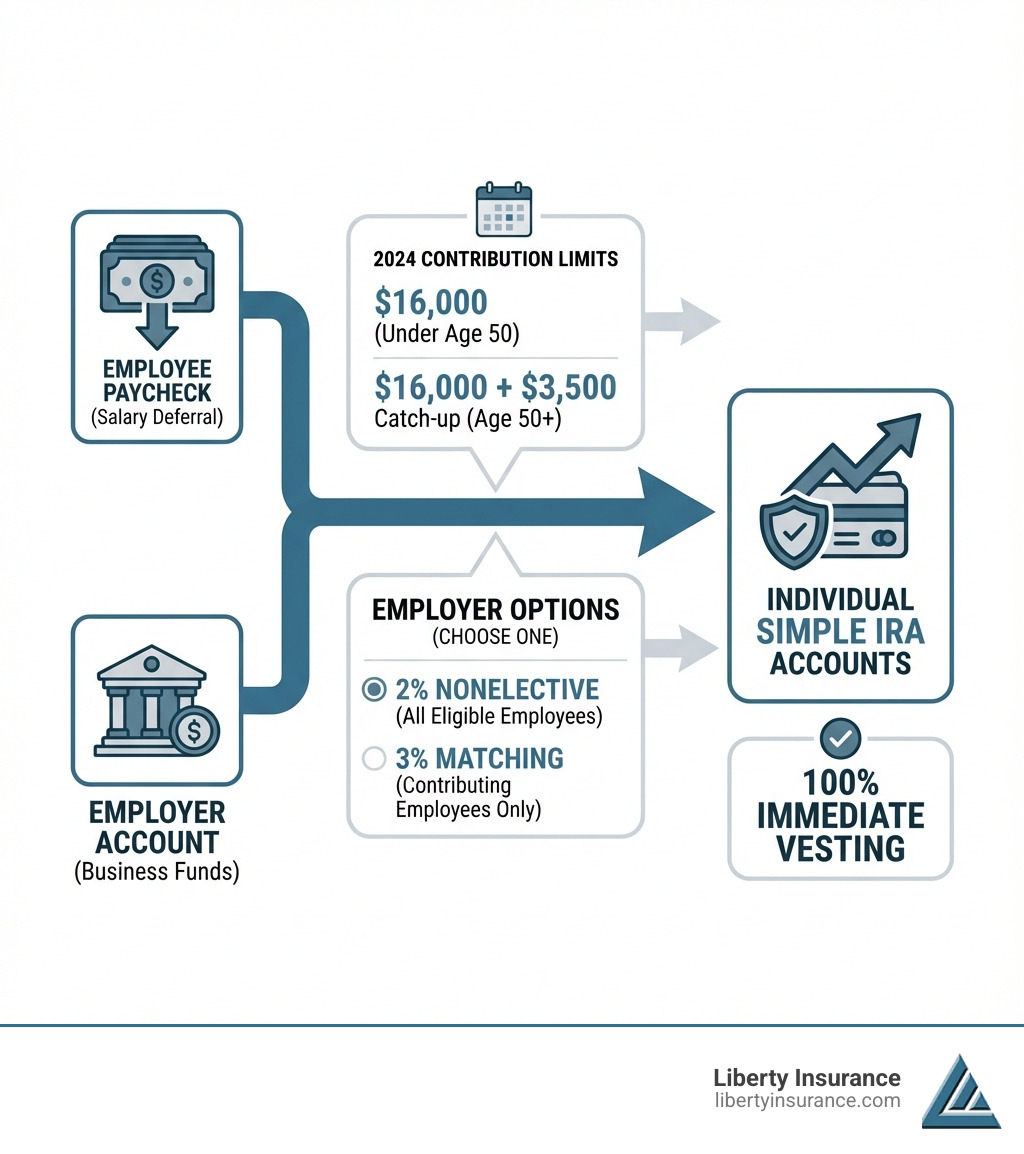
- Employee Contributions (2024): Up to $16,000, plus $3,500 catch-up for age 50+
- Employer Contributions: Choose between a 2% nonelective contribution OR a 3% matching contribution
- Tax Benefits: Employer contributions are tax-deductible; employee contributions reduce taxable income
- Administration: No annual Form 5500 reporting; financial institutions handle most details
- Vesting: All contributions are 100% vested immediately
- Setup Cost: No setup or administrative fees for most plans
- Optional Roth SIMPLE (if your provider offers it): Employees may be able to contribute after-tax for tax-free qualified withdrawals later
As a small business owner, attracting talent and securing your team’s future is top priority. A SIMPLE IRA (Savings Incentive Match Plan for Employees) offers a straightforward way to provide retirement benefits without the cost, testing, and complex filings that often come with 401(k) plans. The plan’s rules are intentionally streamlined: employees contribute via payroll, and you contribute each year using either a fixed 2% nonelective contribution for all eligible staff or a dollar-for-dollar match up to 3% of pay.
With 2024 employee contribution limits of $16,000 (plus a $3,500 catch-up for those 50+), a SIMPLE IRA delivers significant savings opportunities. Employer contributions are generally tax-deductible, and many small employers qualify for plan startup tax credits (at least $500 annually for the first three years, with potential for larger credits under current law). For most companies, there’s also no annual Form 5500 to file, which helps keep the plan affordable and manageable.
Administrative burden is minimal: your provider supplies the plan documents, custodial accounts, and annual statements, while you focus on timely payroll deductions and issuing the required annual employee notice. Another employee-friendly feature is immediate 100% vesting—every dollar belongs to your team members right away, which employees value and remember.
To make the mechanics more concrete, consider a quick example: An employee earning $60,000 elects to defer 8% ($4,800). If you choose the 3% match, you would contribute an additional $1,800 for that employee, for a total of $6,600 invested toward their retirement for the year. If you prefer the nonelective option, you would contribute a flat 2% of compensation ($1,200) whether the employee contributes or not, ensuring everyone receives a benefit.
I’m Andrew Harris, and at Liberty Insurance, I’ve helped many small business owners build growth strategies where a SIMPLE IRA small business plan is a cornerstone. In this long-form guide, you’ll find everything you need to decide if a SIMPLE IRA fits your company, how to set it up correctly, how to operate it day-to-day, and what to plan for as your workforce grows.
The Core Benefits of a SIMPLE IRA for Your Small Business
For small businesses in New Jersey communities like Princeton and Toms River, offering a SIMPLE IRA small business plan can be a game-changer for your employees, your bottom line, and your long-term stability. The plan structure is intentionally lightweight, helping you deliver a valuable benefit with minimal friction.

Let’s look at the key features that make a SIMPLE IRA so appealing:
- Low administrative costs: Unlike more complex plans, SIMPLE IRAs are designed to be affordable. Many financial institutions offer them with no setup or annual administrative fees, so more of your budget goes directly to benefits.
- No complex annual reporting: There’s generally no Form 5500 filing, which eliminates a major administrative burden. Your custodian handles most compliance and reporting work.
- Employee salary deferrals: Employees contribute pre-tax (or Roth, if available and elected), directly from their paychecks. Automation encourages participation and steady savings.
- Mandatory employer contributions: You must contribute each year—either matching up to 3% or contributing 2% for all eligible employees—demonstrating a concrete commitment to your team’s financial well-being.
- Immediate vesting: All contributions are 100% vested immediately. Employees own every dollar from day one—simple to administer and powerful for retention.
- Broad accessibility: SIMPLE IRAs are available to employers with 100 or fewer employees who earned at least $5,000 in the prior year, making them accessible to many growing companies.
Tax Advantages for Your Business and Employees
Compelling tax benefits are a major reason to choose a SIMPLE IRA small business plan.
- Tax-deductible employer contributions: Your contributions are usually deductible, lowering your taxable income.
- Startup tax credits: New plans may qualify for tax credits of at least $500 per year for the first three years. Under current law, many small employers may also qualify for additional startup and employer-contribution credits, potentially increasing the benefit.
- Tax-deferred growth on pre-tax dollars: Traditional SIMPLE IRA contributions grow tax-deferred, with taxes generally due at withdrawal in retirement.
- Optional Roth contributions (if offered): If your provider supports Roth SIMPLE contributions, employees can make after-tax deferrals for potentially tax-free qualified withdrawals later.
- Pre-tax employee contributions reduce current taxable income: Traditional salary deferrals lower employees’ current tax bill, which many appreciate each paycheck.
Simplicity and Employee Satisfaction
Beyond the financial mechanics, a SIMPLE IRA small business plan creates a cleaner, more predictable experience for you and your employees.
- Easy setup with minimal paperwork: Establish the plan using IRS Form 5304-SIMPLE (if employees choose their own provider) or 5305-SIMPLE (if you designate a provider), then notify employees during the annual election window.
- Clear annual timeline: You provide employees with a notice before the annual 60-day election period (which generally runs from November 2 through December 31 for the following calendar year). That clarity helps your team take action on time.
- A benefit that helps attract and retain talent: In a competitive job market from New Brunswick to Trenton, a retirement plan signals stability and care for employee well-being. It’s a differentiator for hiring and a steadying force for retention.
- Administrative calm: No nondiscrimination testing, no Form 5500 filings, and straightforward contribution options keep you focused on running the business while maintaining a high-impact benefit.
For official guidance on choosing a plan, we recommend consulting the IRS guidance on choosing a plan.
Understanding Contributions, Limits, and Eligibility
Now that we’ve covered the why, let’s dive into the how. Understanding the mechanics of contributions, limits, and eligibility is crucial for effectively running your SIMPLE IRA small business plan.
Who Is Eligible to Participate?
A SIMPLE IRA is designed for employers with 100 or fewer employees who earned $5,000 or more in the preceding calendar year. You cannot generally maintain another employer retirement plan for the same year.
Employee eligibility rules are straightforward:
- Employee eligibility: An employee can generally participate if they earned at least $5,000 in compensation during any two preceding calendar years and are reasonably expected to earn at least $5,000 this year.
- Look-back period: Consider the two prior calendar years to determine whether the $5,000 threshold was met in each of any two years.
- Excludable employees: You may exclude employees covered by a collective bargaining agreement where retirement benefits were bargained, and nonresident aliens with no U.S. source income.
- Less restrictive is allowed: Employers may adopt less restrictive eligibility (for example, immediate eligibility), but not more restrictive than the statutory baseline.
Contribution Limits for 2024
Keep track of limits to stay compliant and maximize savings:
- Employee salary reduction contributions: Up to $16,000 in 2024 via payroll deductions.
- Catch-up contributions: Additional $3,500 for employees age 50 and over in 2024, for a potential total of $19,500.
- Employer contributions: Required annually, using one of two options below.
- Compensation cap for employer contributions: Employer contributions are based on compensation up to the annual IRS limit ($345,000 for 2024).
- Coordinating with other jobs: If an employee participates in another employer’s plan (for example, a second job with a 401(k)), the combined employee salary deferrals across employers must not exceed the annual deferral limit. Employer contributions from each employer are subject to each plan’s rules.
For the most current limits, refer to the official IRS website.
Your Required Employer Contribution Options
As the sponsor of a SIMPLE IRA small business plan, you must make one of the following contributions each year. You choose the method annually and notify employees before the 60-day election window.
1) Matching Contribution
- Dollar-for-dollar match up to 3%: You match each participating employee’s salary deferrals up to 3% of compensation. If an employee contributes 3% or more, you contribute 3%.
- Temporary reduction to 1%: You may reduce the match to as low as 1% for up to two years out of any five-year period, provided employees are notified before the election window.
- Participation incentive: Matching aligns with employee savings behavior, encouraging greater engagement.
2) Nonelective Contribution
- Fixed 2% to all eligible employees: You contribute 2% of each eligible employee’s compensation, whether or not they personally contribute.
- Compensation cap applies: The 2% is calculated on compensation up to the IRS annual limit ($345,000 for 2024).
- Broad benefit: This option ensures every eligible worker—from Millstone Township to Monmouth County—receives a retirement contribution each year.
Examples to Make It Concrete
- 3% Match example: Employee earns $70,000 and defers 5% ($3,500). Employer contributes 3% of $70,000 ($2,100). Total into the account: $5,600.
- 2% Nonelective example: Employee earns $50,000 and contributes nothing. Employer contributes 2% of $50,000 ($1,000) anyway.
Every dollar (employee and employer) is immediately 100% vested. That simplicity reduces administrative burden and builds employee trust.
Setting Up and Managing Your SIMPLE IRA Small Business Plan
Ready to get your SIMPLE IRA small business plan rolling? The process is designed to be straightforward, allowing you to establish and manage a valuable employee benefit without getting bogged down in bureaucracy.
How to Establish Your SIMPLE IRA Plan
Follow these key steps:
- Choose a financial institution: Select a bank, mutual fund company, or brokerage firm to serve as custodian for the SIMPLE IRA accounts. Consider investment menus, participant tools, payroll integration, and service.
- Complete the plan document: Use IRS Form 5304-SIMPLE (employees choose their own provider) or Form 5305-SIMPLE (you designate one). The completed form is your plan document—keep it with your records.
- Notify eligible employees: Provide the required annual notice before the 60-day election period. The annual election window generally runs from November 2 through December 31 for the following calendar year, and your notice should specify the employer contribution formula (match or nonelective) for that upcoming year.
- Set up employee IRAs: Ensure a SIMPLE IRA is established for each participant and that payroll is configured to withhold and remit contributions.
Plan establishment deadline: To open a SIMPLE IRA for the current year, you generally must establish the plan by October 1 and notify employees. A business established after October 1 may set up a plan as soon as administratively feasible.
Ongoing Administration and Reporting
Once your SIMPLE IRA small business plan is established, ongoing administration is refreshingly simple.
- Deposit employee deferrals on time: Transmit employee salary deferrals to the custodian as soon as reasonably possible. For SIMPLE IRAs, you must deposit deferrals no later than 30 days after the end of the month in which they were withheld. A DOL safe harbor for small plans (fewer than 100 participants) treats deposits within seven business days as timely.
- Employer contribution deadlines: Matching or nonelective contributions are generally due by your business’s federal income tax filing deadline, including extensions.
- Annual notice: Each year, notify employees of the employer contribution formula for the next plan year before the 60-day election period.
- No Form 5500: Unlike 401(k)s, SIMPLE IRAs typically do not require annual Form 5500 filings. Your custodian handles most IRS reporting directly.
- Recordkeeping: Keep copies of your plan document, annual notices, payroll deferral elections, and contribution confirmations.
Operational changes you can make from year to year:
- Switch between match and nonelective: You may change your employer contribution method annually with timely notice before the election window.
- Adjust the match percentage: Reduce the 3% match to as low as 1% for up to two years out of five, with proper advance notice.
- Termination option: SIMPLE IRAs generally operate on a calendar-year basis and must be maintained for the full year. If you plan to terminate for the following year (for example, to adopt a 401(k)), provide timely notice before the next election window and follow custodian instructions.
Investment Management and Associated Fees
One of the great advantages of a SIMPLE IRA small business plan is the flexibility it offers employees in managing their own investments with minimal cost to the employer.
- Participant-directed investing: Employees choose among available options—target-date funds, index funds, mutual funds, ETFs, stocks and bonds (offerings vary by provider). Many custodians provide low-cost, diversified funds.
- No employer setup or annual fees at many providers: This keeps total program costs low, which is a big reason SIMPLE IRAs are popular with growing businesses.
- Fund-level expenses: Employees bear the underlying expense ratios of the investments they select. Encourage your team to review fees, risk, and diversification when picking funds.
- Payroll integration: Many custodians provide simple portals or payroll integrations to push contributions quickly and accurately.
With a clear timeline, simple paperwork, and provider support, most small employers can run a SIMPLE IRA smoothly with just a few recurring administrative tasks per pay period and per year.
SIMPLE IRA: Key Rules and Plan Growth Considerations
Beyond daily operations, it’s important to understand withdrawals, rollovers, and what happens as your business scales.
Withdrawals and Early Distribution Penalties
- Standard early distribution penalty: Withdrawals from a pre-tax SIMPLE IRA before age 59½ are generally subject to ordinary income tax plus a 10% federal penalty, unless an IRS exception applies (for example, certain medical expenses, disability, substantially equal periodic payments, qualified higher-education expenses, first-time home purchase up to $10,000, and others applicable to IRAs).
- Two-year rule and higher penalty: For distributions taken during the first two years of participation in a SIMPLE IRA, the early distribution penalty rate increases from 10% to 25% if no exception applies. This is designed to encourage long-term saving during the initial period.
Always consult the IRS rules or a tax professional before taking a distribution to determine whether an exception applies and how taxes will be handled.
Rollovers and Transfers
- First two years: During the first two years of participation, money in a SIMPLE IRA may be rolled over tax-free only to another SIMPLE IRA. A rollover to a traditional IRA or qualified plan during this period would be treated as a taxable distribution and may incur the 25% penalty if no exception applies.
- After two years: After satisfying the two-year requirement, participants may roll SIMPLE IRA assets to a traditional IRA, 401(k), 403(b), governmental 457(b), or back to another SIMPLE IRA without penalty. Conversions to a Roth IRA are also permissible (taxable in the year of conversion).
- Trustee-to-trustee transfers: To avoid withholding and potential issues, direct trustee-to-trustee movement is generally preferred.
Growing Beyond 100 Employees
A SIMPLE IRA is intended for employers with 100 or fewer employees who earned $5,000 or more in the prior year. If your business grows beyond this limit, you may continue the plan for the current year and, in some circumstances, may qualify for a limited grace period. After that, you should plan a transition to a different plan type (such as a 401(k)). This is an excellent sign of growth, but it requires proactive planning to ensure uninterrupted retirement benefits.
Tax Implications of a SIMPLE IRA Small Business
- Tax-deferred growth on pre-tax contributions: Savings compound without current taxation, with amounts taxed as ordinary income when withdrawn in retirement.
- Roth SIMPLE contributions (if offered): Employees who elect Roth contributions pay taxes upfront; qualified withdrawals in retirement may be tax-free. Employer contributions are always pre-tax.
- Required minimum distributions (RMDs): For pre-tax SIMPLE IRAs, participants must begin RMDs at the statutory age (currently 73 under existing law). Roth SIMPLE IRAs may be subject to different RMD treatment; consult your provider and tax advisor regarding the latest rules and potential rollovers to Roth IRAs, which generally have no lifetime RMD for the original owner.
Understanding these rules helps employees plan responsibly and allows you to coach your team through major financial decisions without overstepping into individual tax advice.
Frequently Asked Questions about SIMPLE IRAs
We encounter many common questions from small business owners about SIMPLE IRA small business plans. Here are clear answers you can rely on.
Can I have a SIMPLE IRA and another retirement plan at the same time?
- Generally, no. A business offering a SIMPLE IRA cannot maintain another qualified retirement plan (like a 401(k) or SEP IRA) for its employees in the same calendar year.
- Limited exceptions exist, but for most small businesses in New Jersey, it’s one plan at a time to preserve SIMPLE eligibility.
Are loans allowed from a SIMPLE IRA?
- No. Loans are not permitted from SIMPLE IRAs. If a loan feature is essential, consider whether a 401(k) plan might be more appropriate in a future year.
What happens if I make a mistake operating the plan?
Even with the best intentions, mistakes can happen. The IRS provides avenues for correction.
- Common errors: Late deposits of employee deferrals, miscalculated employer contributions, or missing notices.
- Correction programs: The Employee Plans Compliance Resolution System (EPCRS) allows employers to fix certain plan errors and mitigate penalties. Address issues promptly with a payroll vendor, custodian, or advisor.
- Use the official IRS checklist to stay compliant and catch issues early.
Can owners and the self-employed participate?
- Yes. Owners (including those with self-employment income) can participate if they meet eligibility rules. If you are self-employed or a partner, contribution calculations are based on net earnings from self-employment after certain deductions. Your tax professional can help determine the precise deferral and employer contribution amounts.
Can I switch between the 3% match and the 2% nonelective contribution?
- Yes, you select the employer contribution method each year, with proper notice to employees before the 60-day election window. You may also temporarily reduce the match to as low as 1% for up to two out of five years, with advance notice.
When can I terminate a SIMPLE IRA and adopt a 401(k)?
- SIMPLE IRAs generally operate on a calendar-year basis and must remain in effect for the full year. If you intend to terminate and adopt a 401(k) for the next year, provide timely notice (before the upcoming election period) and follow your custodian’s termination procedures. Be mindful of employee communications and transition timing.
What if we exceed 100 employees?
- If you surpass the 100-employee threshold, you may continue for the current year and may qualify for a limited grace period, depending on your circumstances. Plan early for a transition to a 401(k) or similar plan to avoid gaps in benefits.
Are there nondiscrimination tests or Form 5500 filings?
- SIMPLE IRAs are designed to avoid annual nondiscrimination testing and typically do not require Form 5500 filings. This keeps administration simple and costs low.
Can employees make Roth contributions?
- Many providers now allow Roth SIMPLE contributions (after-tax) under current law. Employer contributions remain pre-tax. Verify availability with your custodian and include the option in your employee communications if offered.
When are contributions due?
- Employee deferrals: Deposit as soon as reasonably possible, but no later than 30 days after the end of the month in which they were withheld. Small plans (under 100 participants) have a seven-business-day safe harbor.
- Employer contributions: Generally due by your business’s federal tax filing deadline, including extensions.
What are the SIMPLE IRA penalties for early withdrawals?
- Before age 59½, pre-tax distributions are taxed as ordinary income and generally subject to a 10% penalty, unless an exception applies. Distributions during the first two years of participation face a 25% penalty instead of 10% when no exception applies.
How do SIMPLE IRAs compare with SEP IRAs and 401(k)s?
Choosing the right retirement plan depends on your business size, cash flow, and goals. Here’s a detailed breakdown of how a SIMPLE IRA stacks up against other popular options.
SIMPLE IRA vs. SEP IRA
Both are IRA-based plans known for simplicity, but they serve different purposes.
- Who Contributes?
- SIMPLE IRA: Both employees (through salary deferrals) and the employer (through a required match or nonelective contribution). This encourages employee participation.
- SEP IRA: Only the employer contributes. Employees cannot make salary deferrals into a SEP IRA.
- Contribution Flexibility:
- SIMPLE IRA: Employer contributions are mandatory every year. You must either provide a 3% match or a 2% nonelective contribution.
- SEP IRA: Employer contributions are completely discretionary. You can contribute a large amount one year and nothing the next, offering maximum flexibility for businesses with variable income.
- Contribution Limits (2024):
- SIMPLE IRA: Employees can defer up to $16,000 ($19,500 if age 50+). Employer contributions are limited to the 3% match or 2% nonelective formula.
- SEP IRA: The employer can contribute up to 25% of compensation, not to exceed $69,000 per employee. This allows for much larger potential contributions.
- Best For:
- SIMPLE IRA: Businesses that want to encourage employee savings and can commit to a modest, predictable employer contribution each year.
- SEP IRA: Self-employed individuals or businesses with few employees who want high contribution limits and the flexibility to skip contributions in lean years.
SIMPLE IRA vs. 401(k) (including Solo 401(k))
The 401(k) is a powerful and flexible plan, but that power comes with complexity and cost. The SIMPLE IRA is the streamlined alternative.
- Contribution Limits (2024):
- SIMPLE IRA: $16,000 employee deferral ($19,500 if 50+), plus a small required employer contribution.
- 401(k): $23,000 employee deferral ($30,500 if 50+). Total contributions (employee + employer) can reach up to $69,000.
- Administrative Burden & Cost:
- SIMPLE IRA: Extremely low. No annual Form 5500 filing and no nondiscrimination testing. Most providers offer plans with no setup or annual fees.
- 401(k): High. Requires annual Form 5500 filing, annual nondiscrimination testing (unless it’s a Safe Harbor 401(k)), and higher setup/annual fees.
- Plan Features:
- SIMPLE IRA: No loans are permitted.
- 401(k): Can permit participant loans, offer a Roth 401(k) option, and include a profit-sharing component for discretionary employer contributions.
- The Solo 401(k) Exception: For owner-only businesses (and their spouses), the Solo 401(k) combines the high contribution limits of a 401(k) with simplified administration. An owner can contribute as both the “employee” and the “employer,” often maximizing savings beyond what a SEP or SIMPLE allows.
- Best For:
- SIMPLE IRA: Businesses with up to 100 employees seeking a low-cost, low-admin retirement benefit.
- 401(k): Larger businesses wanting to offer the highest possible contribution limits and features like loans to attract top talent.
- Solo 401(k): Self-employed individuals who want to maximize their personal retirement savings.
Can part-time employees be excluded?
- You must follow the statutory eligibility rules. You may not impose stricter requirements than “$5,000 in any two preceding years and expected $5,000 this year,” but you may choose less restrictive (for example, immediate eligibility) if you wish.
Do SIMPLE IRAs have required minimum distributions (RMDs)?
- Pre-tax SIMPLE IRAs are subject to RMDs beginning at the statutory age (currently 73). If Roth SIMPLE contributions are available and elected, check current rules and consider rollovers to Roth IRAs for favorable RMD treatment.
Are there startup tax credits?
- Yes. New plans may qualify for at least $500 per year for the first three years, and additional credits may be available under current law to further offset costs. Consult your tax professional to quantify your eligibility.
If you’re ever unsure, coordinate with your payroll provider, plan custodian, and a qualified tax professional. Their guidance, combined with the SIMPLE framework, makes compliance manageable for busy small employers.
Conclusion
A SIMPLE IRA small business plan is a powerful, straightforward, and affordable retirement solution for companies with 100 or fewer employees. For small business owners across New Jersey—from the vibrant communities of New Brunswick to the scenic landscapes of Millstone Township—it offers a practical way to deliver a meaningful benefit without the complexity and expense often associated with traditional 401(k)s.
By offering a SIMPLE IRA, you help your employees build long-term security while simultaneously enhancing your ability to attract and retain talent. Employer contributions are tax-deductible, traditional employee deferrals reduce taxable income today, and savings grow with favorable tax treatment over time. The plan is easy to establish, simple to administer, and supported by providers that handle most of the technical details.
Just as Liberty Insurance helps protect your physical assets, a well-structured retirement plan protects your most valuable resource—your people—by helping them build a dependable financial future. If you’re ready to design a plan, optimize your contributions, and integrate retirement benefits into a broader financial strategy, we’re here to help. Explore our wealth management solutions to see how a SIMPLE IRA can fit into your long-term plans and support your company’s growth for years to come.

