
Why Systems Breakdown Insurance is Critical for Modern Businesses
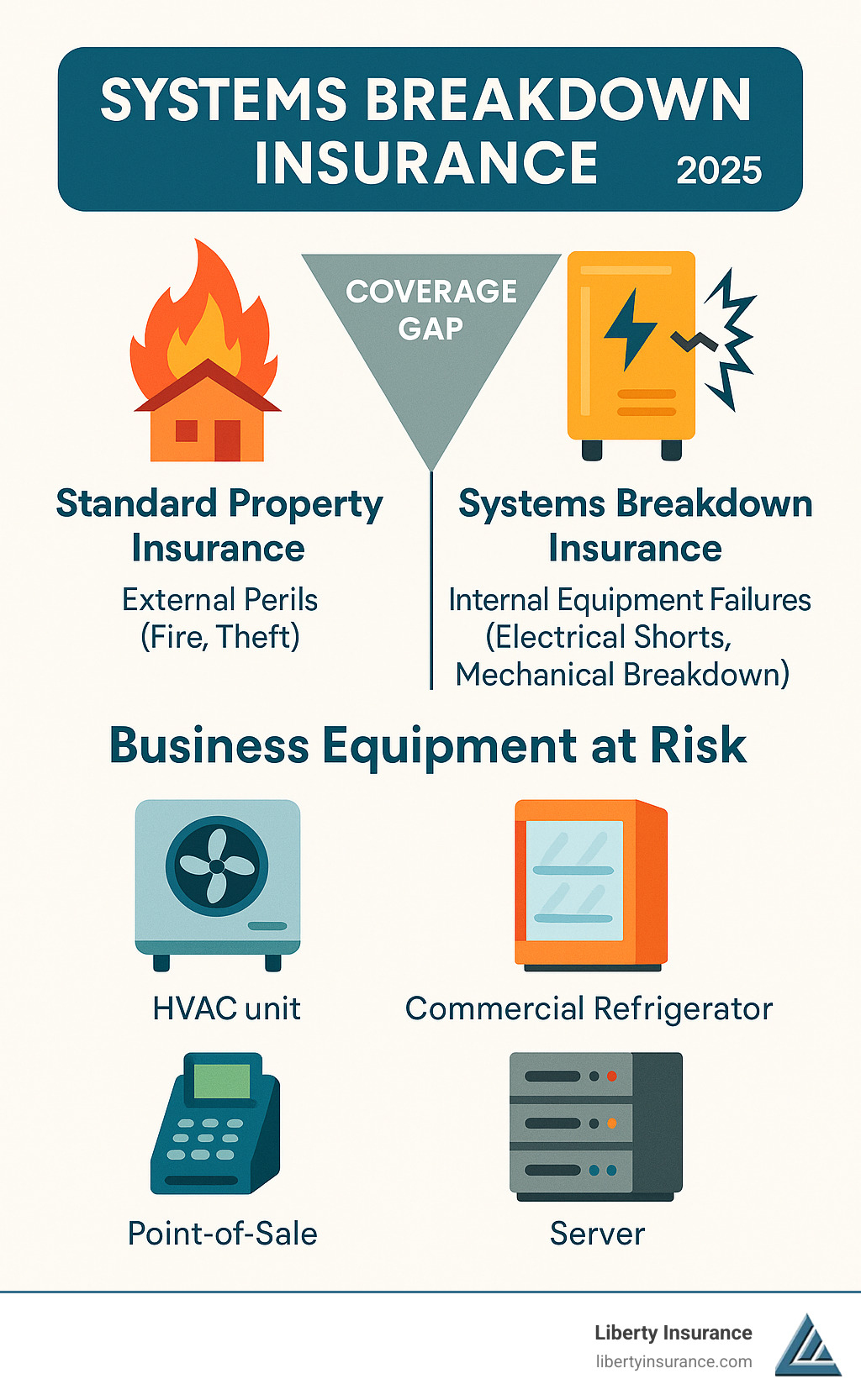
Systems Breakdown Insurance protects businesses when critical equipment fails due to internal mechanical or electrical problems. Unlike standard property insurance, which covers external threats like fire or theft, this specialized policy handles sudden equipment failures from power surges, mechanical breakdowns, and operator errors.
Quick Answer: What Systems Breakdown Insurance Covers:
- Equipment failures from internal causes (electrical shorts, mechanical breakdown, pressure vessel explosions)
- Business interruption losses when equipment failure stops operations
- Spoilage costs when refrigeration or climate control systems fail
- Data restoration after server or computer system breakdowns
- Extra expenses for temporary repairs and expedited replacements
Modern businesses, from restaurants to retail stores, rely on specialized equipment like refrigeration units, point-of-sale systems, and HVAC. When this equipment fails from an internal issue—not an external disaster—standard property insurance typically won’t help. Most property policies specifically exclude damage from electrical arcing, mechanical breakdown, and boiler explosions, leaving a dangerous coverage gap.
For example, a grocery store suffered a power surge that damaged its POS systems and refrigeration units, leading to over $44,000 in spoiled inventory and forced closure. These internal failures are common, with air conditioning and refrigeration being the top source of breakdown claims.
The financial impact goes beyond simple repair costs, including lost revenue, spoiled goods, and the expense of temporary equipment. These consequential losses can quickly dwarf the original equipment’s value.
As Andrew Harris of Liberty Insurance, I’ve helped many New Jersey businesses identify this critical coverage gap. My experience shows that most owners don’t realize their standard policy won’t cover these internal failures until it’s too late.
What is Systems Breakdown Insurance and How Does it Differ from Property Insurance?
Picture this: you arrive at your office, and the power is out. There was no storm, fire, or break-in. Your electrical system simply failed from the inside. This is a scenario where your standard property insurance won’t help, but Systems Breakdown Insurance is designed to.
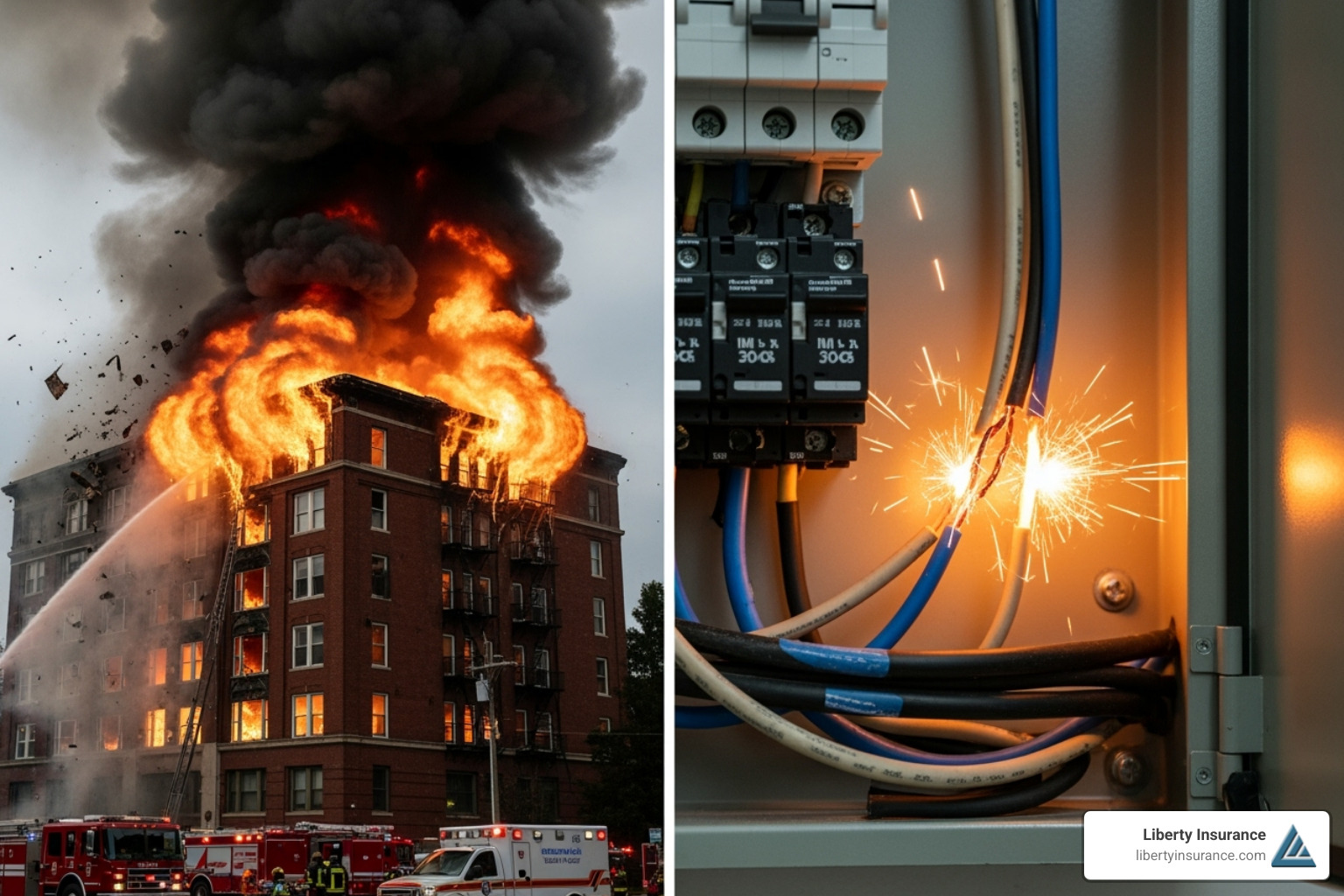
Also known as Boiler and Machinery (B&M) insurance, this coverage fills a critical gap. Think of it this way: standard property insurance protects you from external threats happening to your equipment. Systems Breakdown Insurance covers damage from internal forces that start inside your equipment.
The Critical Gap in Standard Property Policies
Your Commercial Property Insurance is excellent for major external risks like fire, storms, and theft. However, most policies contain crucial exclusions for damage caused by electrical arcing, mechanical breakdown, or boiler explosions. There’s also a broad wear and tear exclusion.
For example, if your restaurant’s walk-in freezer stops working due to an internal electrical short, your property policy will likely deny the claim based on these exclusions. This gap exists because property insurance was designed for external events, not the complex internal workings of modern machinery.
Defining a “Sudden and Accidental” Breakdown
So what qualifies as a “sudden and accidental” breakdown? The key is that the failure is unexpected and immediate, not the result of gradual wear over time.
- Internal mechanical failure: A motor’s bearings suddenly seize, or a shaft snaps under normal use.
- Electrical shorts and power surges: A voltage spike or internal short can cascade through electronic equipment, causing widespread damage.
- Motor burnout: Internal components fail under electrical or mechanical stress, causing the motor to die without warning.
- Operator error: An employee accidentally damages equipment through improper use, leading to an immediate failure.
- Centrifugal force: Rotating parts break apart or spin out of control, causing sudden damage.
The defining factor is that the equipment was working one moment and broken the next due to an internal cause. That’s precisely the situation Systems Breakdown Insurance is built to cover.
For businesses looking to understand their full range of protection options, you can find more info about business insurance to see how different coverages work together to protect your operations.
What Your Policy Covers: Equipment, Causes, and Components
Systems Breakdown Insurance is a comprehensive financial shield, going far beyond simply fixing a broken machine to cover the full ripple effect of equipment failure.
Types of Equipment Typically Covered
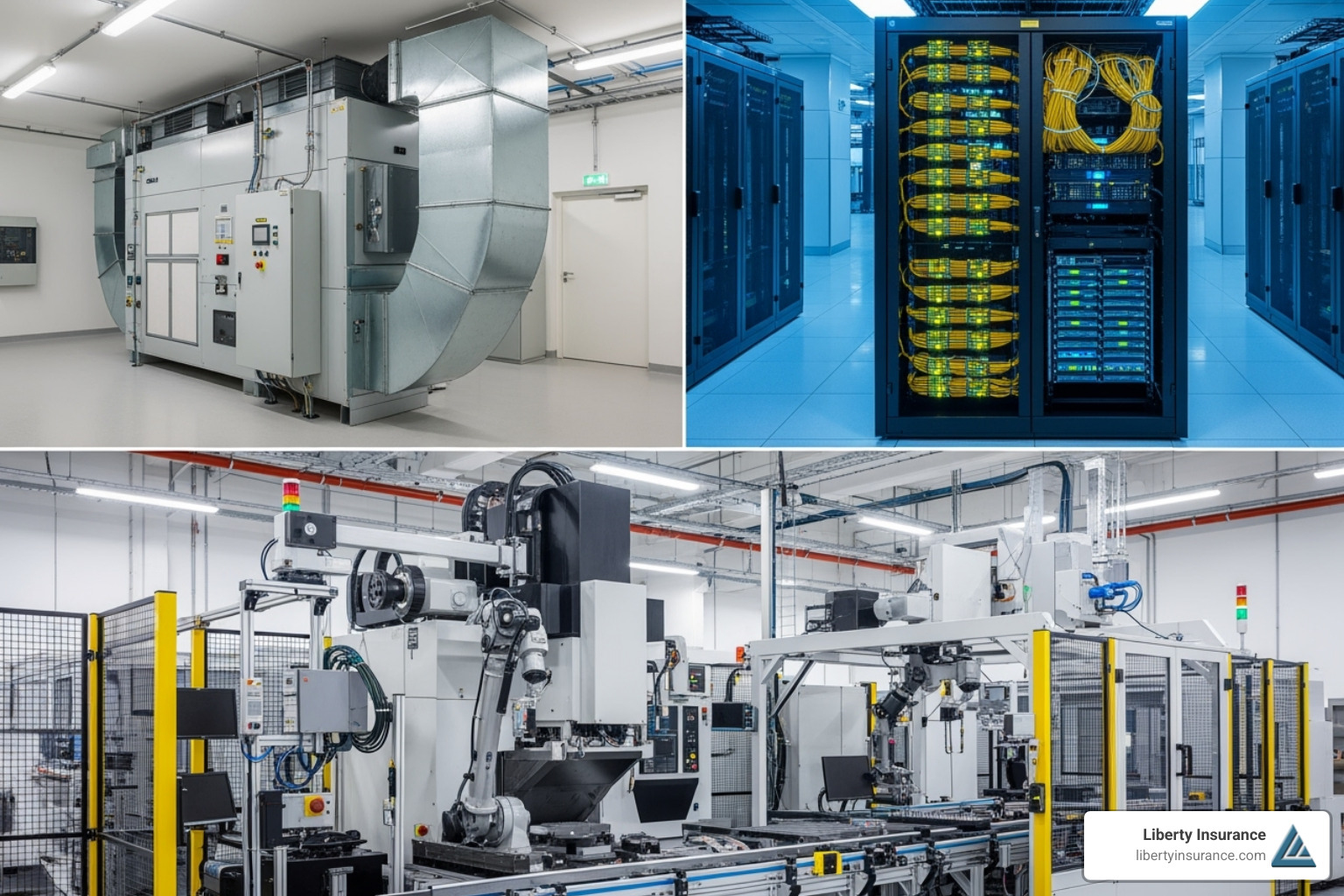
This policy casts a wide net, protecting most of the machinery and systems that keep your business running:
- Electrical systems: Transformers, generators, and electrical panels that power your entire operation.
- HVAC and refrigeration systems: Air conditioners, boilers, furnaces, and refrigeration units, which are a leading source of claims.
- Computer and communications equipment: Servers, data storage systems, and network equipment essential for digital operations.
- Production machinery: Presses, CNC machines, and other specialized equipment for manufacturing.
- Renewable energy systems: Solar panels, wind turbines, and their control systems.
- Point-of-sale (POS) systems: Critical for processing transactions in retail and hospitality.
Common Causes of Failure
Breakdowns often happen without warning due to internal forces:
- Mechanical issues: Vibration, metal fatigue, or misalignment can cause parts to seize, snap, or fail catastrophically.
- Electrical problems: Power surges, short circuits, and voltage spikes can instantly fry the delicate microelectronics in modern equipment.
- Human error: Even well-trained employees can make mistakes that lead to immediate equipment breakdowns.
Core Components of a Systems Breakdown Insurance Policy
A strong policy includes several interconnected coverages:
- Property Damage: Covers the cost to repair or replace the broken equipment itself.
- Business Interruption: Reimburses you for lost profits and ongoing expenses (like payroll and rent) when a breakdown halts your operations. For more on this, explore our Business Interruption Insurance options.
- Extra Expense: Pays for additional costs to get back online quickly, such as renting temporary equipment or paying for overtime labor.
- Spoilage: Critical for businesses with perishable goods, this covers the value of inventory lost due to a failure in refrigeration or climate control systems.
- Data Restoration: Helps pay for the expensive process of recovering critical business data from backups or professional services after a server or computer system crashes.
The Financial Shield: Benefits and Real-World Scenarios
The true value of Systems Breakdown Insurance is its power to shield your business from the financial devastation of unexpected equipment failures. It’s about mitigating loss, minimizing downtime, and ensuring business continuity.

Key Benefits for Your Business
Investing in this coverage provides stability across your operations:
- Mitigates financial loss: Covers direct property damage, business interruption, and extra expenses, preventing a single failure from draining your cash reserves.
- Minimizes downtime: Pays for expedited repairs and temporary equipment rentals to get you back to full operation faster.
- Protects cash flow: Prevents massive, unplanned repair bills from depleting your working capital.
- Ensures operational resilience: Gives you a solid plan to weather unexpected equipment failures.
- Supports reputation management: Some policies include public relations coverage to help manage your business image during a crisis.
How It Protects Against Downtime and Financial Loss
Systems Breakdown Insurance addresses the complex web of costs that follow a failure:
- Lost revenue: The business interruption component covers income you lose when operations stop.
- Expediting expenses: Pays premium costs for things like express shipping or overtime labor to speed up recovery.
- Temporary equipment rental: Covers the cost of renting backup generators, HVAC units, or other machinery to keep your business running.
Consider these scenarios:
Restaurant Freezer Failure: A restaurant’s walk-in freezer fails overnight due to a mechanical breakdown. Thousands of dollars in inventory spoil. The policy’s spoilage component covers the ruined food, property damage covers the freezer repair, and business interruption covers lost income during the closure.
Manufacturing Plant Motor Burnout: A critical production machine’s motor burns out, halting the entire line. The policy covers the motor replacement, installation, and lost income during downtime, preventing delayed orders and cash flow disruption.
Real-World Examples and Their Financial Impact
These examples show how quickly costs can escalate:
| Incident Type | Cause of Breakdown | Financial Impact |
|---|---|---|
| Shopping Mall Power Outage | Electrical arcing in distribution system | Over $230,000 in losses (5 days of downtime) |
| Online Retailer Website Crash | Server circuit board failure | Over $19,200 in lost sales |
| Grocery Store Emergency Closure | Power surge damaging POS systems and refrigeration | Over $44,000 in combined losses |
| Meat Store Inventory Loss | Pipe rupture in walk-in freezer | Over $23,000 in spoiled inventory |
| Furniture Manufacturer Shutdown | Electrical panel arcing | Over $35,600 in production losses |
| High-Speed Press Damage | Loose bolt causing internal damage | Over $136,000 in repair and downtime costs |
| Automated Saw Breakdown | Microprocessor damage | Over $20,000 in lost production |
| Solar Power System Failure | Transformer electrical breakdown | Over $140,000 in system losses |
| Circuit Board Testing Equipment | Electrical event destroying motherboard | Over $185,800 in equipment and business losses |
These incidents represent real crises that can threaten a business’s survival. Systems Breakdown Insurance transforms these potential disasters into manageable inconveniences, providing invaluable peace of mind.
Customizing Your Coverage and Making the Right Choice

Is Systems Breakdown Insurance Right for You?
If your business depends on critical equipment to operate, this insurance is likely essential. Consider these industries:
- Manufacturing: A single machine breakdown can halt production and delay customer orders.
- Hospitality: Restaurants need refrigeration, ovens, and POS systems. A failure during peak hours means significant losses.
- Healthcare: Equipment failures impact patient care, and climate control is critical for medications.
- Retail: HVAC and lighting create the shopping environment, while POS systems complete sales.
- IT Services: Data centers depend entirely on servers and network infrastructure.
Assess not just replacement costs but the ripple effects of downtime, including lost revenue and reputational damage. For more insights, explore our Insurance for Business Owners resources.
How to Assess Your Exposure
A structured assessment ensures adequate coverage:
Inventory your equipment: List all critical systems including HVAC, refrigeration, electrical distribution, production machinery, servers, POS, and specialty equipment. Note replacement values and service contracts.
Map operational dependencies: Identify which processes stop if each system fails. Document single points of failure versus redundant setups.
Estimate downtime: For your top 5 critical assets, estimate realistic repair times including parts availability and specialized labor.
Quantify financial impact: Calculate daily revenue loss plus unavoidable expenses like rent and payroll. Add consequential losses such as rush shipping and temporary rentals.
Document scenarios: Build “Most Probable Loss” and “Maximum Foreseeable Loss” scenarios for top risks.
Right-sizing Limits and Deductibles
- Limits: Start with replacement cost for your largest critical item, then add Business Interruption and Extra Expense based on worst-case downtime.
- Deductibles: Higher deductibles reduce premium but ensure they don’t exceed your cash tolerance. Some policies use time deductibles for BI (24-72 hours).
- Sublimits: Data restoration and spoilage often have sublimits. Increase these if your exposure is material.
What Drives Premium Cost
Premiums vary by industry and risk profile. Common pricing drivers include:
- Equipment age and complexity
- Claims history and power quality problems
- Documented preventive maintenance programs
- Power protection systems and redundancy
- 24/7 operations with low downtime tolerance
Prevention Best Practices
Insurers often include engineering support. Prevention steps that may improve terms:
- Electrical: IR thermography on switchgear, surge protection at panels
- Mechanical: Vibration monitoring, lubrication analysis, alignment checks
- Environmental: Regular coil cleaning, filter changes, seasonal HVAC commissioning
- Data/IT: Regular tested backups, redundant power for server rooms
- Spares: Keep critical spares on-hand with vendor service contracts
Optional Endorsements for Your Systems Breakdown Insurance
Specialized endorsements address modern business risks:
- Cloud Service Interruption: Covers lost income if your cloud provider has an equipment breakdown.
- Off-Premises Equipment Coverage: Protects portable equipment at job sites.
- Public Relations Coverage: Helps manage reputation after service interruptions.
- Green Coverage: Provides funds to replace damaged equipment with more energy-efficient alternatives.
- Data Compromise: Helps respond to data breaches and identity restoration.
Review built-in sublimits on these endorsements to ensure adequate coverage for your specific exposure.
Frequently Asked Questions about Systems Breakdown Insurance
Does this insurance cover normal wear and tear?
No. This policy covers sudden and accidental breakdowns, not gradual deterioration, corrosion, or failures from lack of maintenance. Proper equipment maintenance is essential, as claims could be denied if breakdown results from neglect.
Are software and data covered?
This insurance primarily covers physical hardware—servers, computers, and machinery. Data restoration costs from covered hardware failure are often included or available as an endorsement. The software itself is generally not covered. Consider separate cyber liability insurance for broader digital risks.
How is this different from an equipment warranty?
Warranties and insurance serve different purposes. Equipment warranties are limited to specific machines for set periods (1-5 years) and typically cover only manufacturing defects.
Systems Breakdown Insurance is broader, covering equipment against internal failures like power surges, operator error, and mechanical breakdown—not just defects. It protects equipment after warranties expire.
Most importantly, warranties won’t cover consequential losses. If a machine fails, a warranty might replace the part, but won’t pay for lost income, spoiled inventory, or extra expenses. Equipment Breakdown Insurance covers these critical financial impacts.
What are common exclusions?
While wording varies, common exclusions include:
- Gradual deterioration, wear and tear, corrosion, rust
- Defects known prior to loss or failure from lack of maintenance
- Flood, earthquake, and external perils (covered elsewhere in property policies)
- Intentional or criminal acts
- Foundation and structural damage unrelated to equipment breakdown
- Testing or commissioning losses for new equipment
How do deductibles work?
Property damage usually has dollar deductibles ($1,000-$10,000+). Business Interruption often uses time deductibles or waiting periods (24-72 hours). Income losses within the waiting period aren’t covered. Choose waiting periods matching realistic outage durations.
How do I pick Business Interruption limits?
Estimate downtime for critical equipment, multiply by average daily gross earnings, add unavoidable expenses (rent, salaries, utilities), and include Extra Expense for expedited shipping and temporary rentals. Consider peak seasonality and customer concentration.
Is spoilage covered if refrigeration fails?
Yes, if your policy includes spoilage coverage. This applies when internal breakdown, power surge, or contamination causes temperature changes. Verify sublimits and increase them if perishable inventory is significant.
Does this cover utility service interruptions?
Breakdown at your premises is covered. Off-premises utility failure may require a Utility Service Interruption endorsement. Check trigger language, distance limitations, and waiting periods.
What if a contractor causes the breakdown?
If covered breakdown occurs from operator error or negligent work, your policy can respond. The insurer may pursue recovery from the responsible party through subrogation.
Are microelectronics covered?
Modern forms address microelectronics including control boards, PLCs, and drives. Some policies have special conditions for microelectronics coverage. Ensure your policy doesn’t restrict coverage to “measurable physical damage” if you rely on electronics.
What does “sudden and accidental” mean?
It means an unexpected, immediate event internal to equipment—electrical arcing, short circuit, pressure rupture, seized bearing—causing equipment to stop functioning. Slow deterioration doesn’t qualify.
How are claims handled?
- Protect people and property; isolate equipment
- Mitigate damage: prevent further loss
- Notify your agent/insurer promptly
- Document everything: photos, service notes, invoices, downtime logs
- Keep damaged parts for inspection
- Track lost income and expenses daily for BI claims
Will insurance pay for greener equipment upgrades?
Standard policies replace with like kind and quality. Green or energy-efficiency endorsements provide additional funds for Energy Star-rated or higher-efficiency equipment.
Is rented equipment covered?
Many policies extend coverage to equipment you’re legally responsible for on your premises. Terms vary, so request clarification for on-hire assets.
What about off-site equipment?
Coverage for off-premises equipment is often limited unless endorsed. Mobile Equipment endorsements can address this—confirm territory limits.
Does this replace cyber insurance?
No. Systems breakdown covers physical equipment loss from internal causes. Cyber insurance addresses data breaches, ransomware, and malicious digital events. The policies complement each other.
Can I get coverage under a BOP?
Many BOPs include Equipment Breakdown with modest limits. If you have significant exposure, consider standalone coverage with higher limits for BI, spoilage, and data restoration.
How quickly are claims paid?
Timing varies with complexity. Straightforward property damage claims resolve quickly; BI claims take longer due to income documentation. Prompt notice and thorough records speed the process.
Bottom line: How do I tailor coverage?
- Identify your top five single points of failure
- Quantify plausible downtime and daily costs
- Buy limits reflecting worst credible scenarios
- Add relevant endorsements for your operations
- Document maintenance to support better terms and faster claims
Conclusion
In today’s business world, your success hinges on equipment that runs behind the scenes—HVAC systems, servers, and refrigeration units. When these critical systems fail from internal problems, standard property insurance often leaves you exposed. Systems Breakdown Insurance is the lifeline that fills this crucial gap.
While your property policy handles external disasters like fires, this specialized coverage steps in for internal failures like power surges, mechanical breakdowns, and server crashes. As we’ve seen, the financial impact of these events goes far beyond repair costs, leading to lost income, spoiled inventory, and operational chaos. A single failure can cost tens of thousands of dollars.
Systems Breakdown Insurance provides a comprehensive safety net, covering repair costs, lost income during downtime, spoilage, and data restoration. With optional endorsements for modern risks like cloud service interruptions, you can create a policy that evolves with your business.
This isn’t just another policy; it’s a strategic investment in your business’s resilience. By assessing your equipment dependencies and customizing your coverage, you build a foundation that can withstand the unexpected breakdowns that threaten every modern business.
Ready to close the gap in your coverage? The team at Liberty Insurance can help you evaluate your risks and design a Systems Breakdown Insurance policy that protects your ability to keep operating and growing, no matter what breaks down.

