
Why Your Business Needs Systems Breakdown Coverage
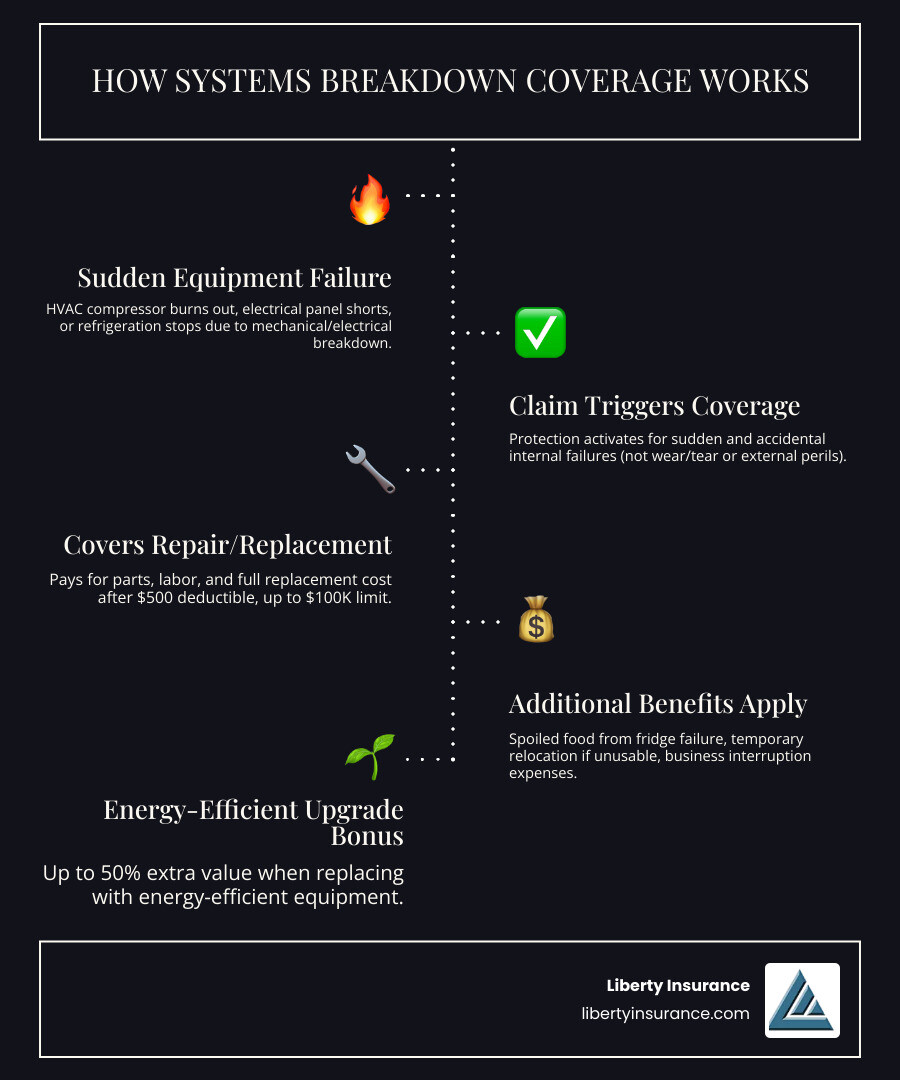
Systems breakdown coverage is an optional insurance endorsement that protects businesses and homeowners from the financial impact of sudden mechanical or electrical failures in essential equipment and systems. Unlike standard property insurance that covers damage from external events like fire or theft, this coverage specifically addresses internal breakdowns—when your HVAC system fails, your electrical panel shorts out, or your commercial refrigeration stops working without warning.
Quick Answer: What is Systems Breakdown Coverage?
- What it is: Optional add-on to commercial or homeowners insurance policies
- What it covers: Sudden mechanical or electrical failures in major systems and equipment (HVAC, electrical panels, boilers, refrigeration, computers, security systems)
- What it doesn’t cover: Normal wear and tear, lack of maintenance, or damage from external perils like fire or storms
- Typical cost: Around $50 per year for homeowners; varies for commercial properties
- Common deductible: $500
- Coverage limit: Often up to $100,000 per occurrence
- Bonus benefit: Up to 50% extra for energy-efficient replacements
The importance of this coverage became painfully clear during the 2003 Northeast blackout, which affected 50 million people and caused over 70,000 megawatts of electrical load loss. As investigators discovered, the cascading failure began with seemingly minor equipment issues—tree contact with transmission lines and a failed alarm system—that spiraled into one of the largest blackouts in North American history. For businesses, similar cascading failures can mean lost revenue, spoiled inventory, and unexpected repair costs that standard insurance won’t cover.
Why does this matter for your business? When your commercial refrigeration system fails, you’re not just facing repair costs—you’re dealing with thousands of dollars in spoiled inventory, potential health code violations, and lost business while systems are down. If your HVAC system breaks during a summer heatwave, you might need to close temporarily and relocate employees. Standard commercial property insurance typically won’t cover these scenarios because they’re not caused by covered perils like fire or vandalism.
Systems breakdown coverage fills this critical gap. It responds when equipment fails due to mechanical breakdown, electrical arcing, power surges, motor burnout, or operator error. For businesses with expensive machinery, climate-controlled inventory, or operations that depend on uninterrupted power and climate control, this coverage can mean the difference between a manageable expense and a business-threatening loss.
I’m Andrew Harris, and throughout my career in commercial insurance—including obtaining my CIC and AAI designations and serving clients through Liberty Insurance—I’ve seen how systems breakdown coverage has protected businesses from devastating equipment failures that would otherwise create serious financial hardship. Understanding the specific protections this endorsement offers is essential for any business owner evaluating their insurance portfolio.
Must-know systems breakdown coverage terms:
Understanding Systems Breakdown Coverage
When we talk about systems breakdown coverage, we are referring to a specialized form of protection designed to handle the “internal” disasters that standard policies ignore. Think of your property insurance as a shield against the outside world—falling trees, lightning strikes, or a fire. But what happens when the “enemy” is inside the machine?
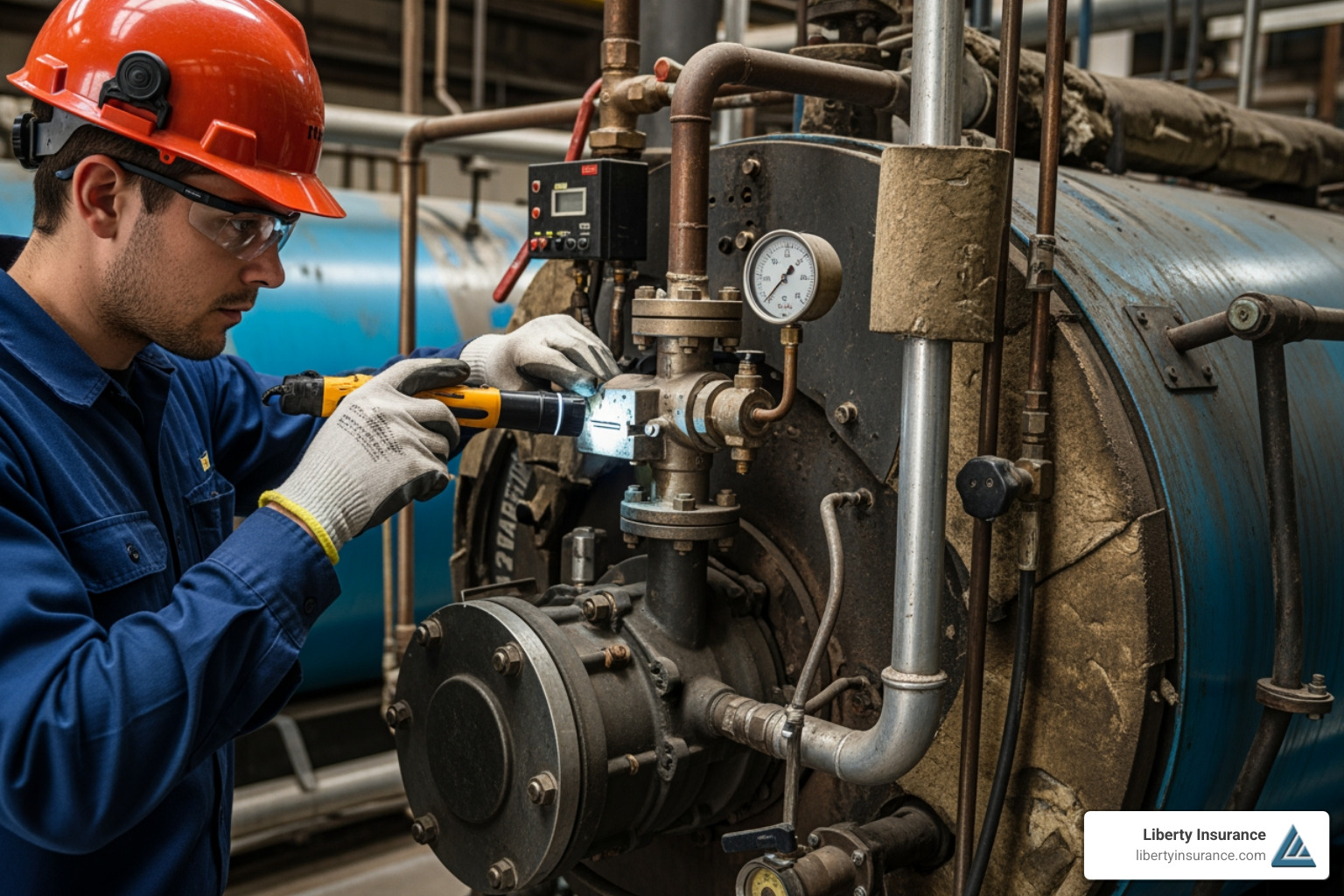
Equipment breakdown occurs when a machine or system suffers an accidental direct physical loss that necessitates repair or replacement. This isn’t about a lightbulb burning out; it’s about significant events like a boiler explosion, a mechanical failure in a production line, or an electrical short that fries a server room. Research into A New Accident Model for Engineering Safer Systems highlights that modern systems are increasingly complex and tightly coupled, meaning a single failure can lead to a total shutdown.
At Liberty Insurance, we see these incidents frequently in the New Jersey area, from Princeton to Toms River. Whether it’s a sudden motor burnout or a pressure system failure, the costs can be astronomical without the right endorsement. You can find more info about unexpected equipment failure to see how these events manifest in real-world scenarios.
How Systems Breakdown Coverage Works
The mechanics of this coverage are straightforward but vital. It applies to “covered property” located at your “residence premises” or commercial location. The trigger for a claim is typically an “equipment breakdown,” which includes:
- Mechanical Breakdown: Such as a seized motor or a snapped internal component.
- Electrical Failure: Including electrical arcing or power surges that damage internal circuitry.
- Pressure System Failure: Such as the rupture or bursting of a boiler or water heater.
This is fundamentally different from a system accident, which often involves a “cascade” of multiple failures. In the insurance world, we focus on the specific failure of the equipment itself. When a covered event occurs, the policy pays for the repair or replacement of the damaged unit, often using “replacement cost” valuation rather than “actual cash value” (which subtracts depreciation).
Who Benefits Most from This Protection
While every property owner can benefit, certain individuals and businesses in Trenton or New Brunswick find this coverage indispensable:
- Commercial Property Owners: If you lease space, your lease might require you to maintain the HVAC and electrical systems. A failure could put you in breach of contract or leave you with a massive repair bill.
- Owners of High-Value Machinery: Manufacturers in Millstone Township NJ rely on specialized equipment. If a CNC machine or a commercial oven fails, the replacement cost could exceed $50,000.
- Smart Technology Users: Modern “smart” homes and offices are filled with delicate sensors and automation systems. These are highly susceptible to electrical system failure, which can be covered under this endorsement.
- Owners of Aging Systems: While “wear and tear” isn’t covered, older systems are more prone to the sudden mechanical failures that are covered.
What Does Systems Breakdown Coverage Protect?
It is a common misconception that this coverage only applies to “heavy machinery.” In reality, it protects a vast array of equipment that keeps your daily life and business running.
From the elevators in a New Brunswick office building to the security systems in a Princeton retail store, systems breakdown coverage acts as a safety net. Here is a breakdown of what is typically included:
| Covered Systems | Commonly Excluded Items |
|---|---|
| Central HVAC (Heating & Cooling) | Septic Systems |
| Electrical Service Panels | Water Wells/Irrigation Lines |
| Commercial Kitchen Appliances | Small Gadgets (Toasters, Blenders) |
| Backup Generators & Boilers | Normal Wear and Deterioration |
| Computers & Server Equipment | Pre-existing Failures |
| Security & Alarm Systems | Intentional Damage or Neglect |
| Pool & Spa Equipment | Cosmetic Damage (Scratches/Dents) |
Essential Machinery and Appliances
For most our clients in New Jersey, the primary focus is on the “big-ticket” items.
- Central AC and Heat Pumps: These are complex mechanical systems. A failed compressor in July is more than an inconvenience; it’s a financial emergency.
- Water Heaters and Boilers: These are under constant pressure. A sudden rupture can cause significant damage.
- Electrical Panels: The heart of your building’s power. A surge can fry the entire board.
- Personal Electronics and Home Automation: We cover everything from smart thermostats to high-end stereos and home gym gear. If it plugs in and has a mechanical or electrical function, it’s likely eligible.
Additional Benefits: Food Spoilage and Living Expenses
One of the most overlooked aspects of systems breakdown coverage is the “consequential loss” protection.
Food Spoilage: If your refrigerator or freezer suffers a covered mechanical breakdown, we don’t just pay to fix the appliance. We also cover the cost of the spoiled food inside. For a restaurant or a homeowner with a stocked deep-freezer, this can save thousands of dollars.
Temporary Living/Business Expenses: If a covered breakdown makes your property uninhabitable—for instance, your heating system fails during a New Jersey blizzard—this coverage can help pay for temporary housing or relocation costs while repairs are made. Most policies offer a substantial limit for these occurrences, sometimes up to $100,000. For more on protecting against the surges that cause these issues, see more info about electrical surge protection.
Systems Breakdown Coverage vs. Standard Insurance
One of the most frequent questions we get at Liberty Insurance is: “Doesn’t my regular homeowners or commercial policy already cover this?”
The answer is almost always no. To understand why, you have to look at the “perils” (the causes of loss) listed in your policy. How homeowners insurance works is based on external events. If a lightning bolt hits your house and fries your TV, that is a covered peril. However, if your TV’s internal circuitry simply shorts out due to a mechanical defect or a minor power surge from the grid, standard insurance treats that as an “internal” issue and denies the claim.
You can find more info about systems breakdown insurance to see the specific language used to bridge this gap.
Key Differences from Homeowners Policies
The distinction lies in the origin of the damage.
- Standard Policy: Covers Fire, Wind, Hail, Theft, and Vandalism. These are “external” forces.
- Systems Breakdown Endorsement: Covers Mechanical Breakdown, Electrical Arcing, and Pressure Ruptures. These are “internal” forces.
Without this endorsement, you are essentially self-insuring the most expensive components of your property. If your $10,000 HVAC system simply stops working because the motor burned out, a standard policy offers $0 in assistance. With systems breakdown coverage, you pay your deductible (often $500) and the rest is taken care of.
Key Exclusions and Limitations
While this coverage is extensive, it is not a “maintenance contract.” It is still insurance, which means it is designed for sudden and accidental events, not the inevitable march of time.
The most common reason for a denied claim is wear and tear. If a pipe has been slowly rusting for ten years and finally starts to leak, that is a maintenance issue, not a “breakdown.” Insurance is not a replacement for regular servicing.
Other key exclusions include:
- Lack of Maintenance: If you never change your HVAC filters and the system chokes to death, that’s on the owner.
- Corrosion and Rust: Gradual deterioration is expected and must be managed by the property owner.
- Pre-existing Conditions: You cannot buy a policy today to fix a furnace that broke yesterday.
- Septic and Irrigation: Most policies exclude underground piping and septic systems unless you add a specific “Service Line” endorsement.
For a deeper dive into why systems fail, you can read scientific research on system failure anatomy, which explains the difference between a “disruption” and a “breakdown.”
The Financials: Costs, Deductibles, and Limits
One of the best arguments for systems breakdown coverage is the cost-to-benefit ratio. In many cases, adding this to your policy in New Jersey is incredibly affordable.
- Annual Premium: For many residential policies, the cost is as low as $50 per year. Even for commercial properties, the cost is often a fraction of the potential repair bills.
- Deductibles: The standard deductible is typically $500. This makes it much more accessible than your standard property deductible, which might be 1% of your home’s value or $1,000+.
- Coverage Limits: A common limit is $100,000 per occurrence. This is usually more than enough to replace even the most expensive residential HVAC or commercial kitchen setups.
The “Green” Upgrade Bonus
One of the most exciting features of modern systems breakdown coverage is the incentive for energy efficiency. If your old, inefficient boiler fails, many policies will pay up to 50% more than the standard replacement cost if you choose to replace it with a more environmentally friendly, safer, or energy-efficient model.
For example, if it costs $5,000 to replace your old AC with a similar model, but $7,500 to upgrade to a high-efficiency SEER-rated unit, the policy may cover the higher cost. This helps you lower your long-term utility bills while the insurance company helps foot the bill for the upgrade.
Frequently Asked Questions about Systems Breakdown
Can I add this to an existing policy?
Yes! You don’t have to wait for your policy to renew. It is an optional endorsement that can be added to your existing homeowners, condo, or commercial property policy at any time. It’s a seamless integration that provides immediate peace of mind.
Does it cover small appliances?
Generally, no. We focus on the “major” systems. Items like toasters, coffee makers, or blenders are considered “disposable” or small gadgets and are typically excluded. However, major kitchen appliances like ovens, dishwashers, and refrigerators are absolutely covered.
Is wear and tear included?
No. This is the most important distinction to make. Gradual deterioration, rust, and maintenance neglect are not covered. The failure must be sudden and accidental. If your dishwasher has been making a death-rattle for three years and finally dies, it might be hard to argue it was a “sudden” accident.
Conclusion
Our businesses and homes are only as reliable as the systems that power them. A single electrical surge or mechanical failure shouldn’t be enough to drain your savings or halt your business operations. Systems breakdown coverage is the “missing link” in most insurance portfolios, providing high-value protection for a very low annual cost.
At Liberty Insurance, we pride ourselves on offering customized protection that fits the unique needs of our neighbors in Millstone Township, Trenton, Toms River, and throughout New Jersey. We want to help you turn a potential catastrophe into a minor speed bump.
Don’t wait for the “death rattle” from your HVAC or the silence of a failed server. Secure your financial security and peace of mind today. Get started with systems breakdown insurance and let us help you protect what you’ve built.

