
Your Guide to Group Health Plan Management
Group health plan management is the process of establishing, administering, and overseeing employee health benefits. The goal is to provide employees with quality medical care while managing costs and complying with legal requirements.
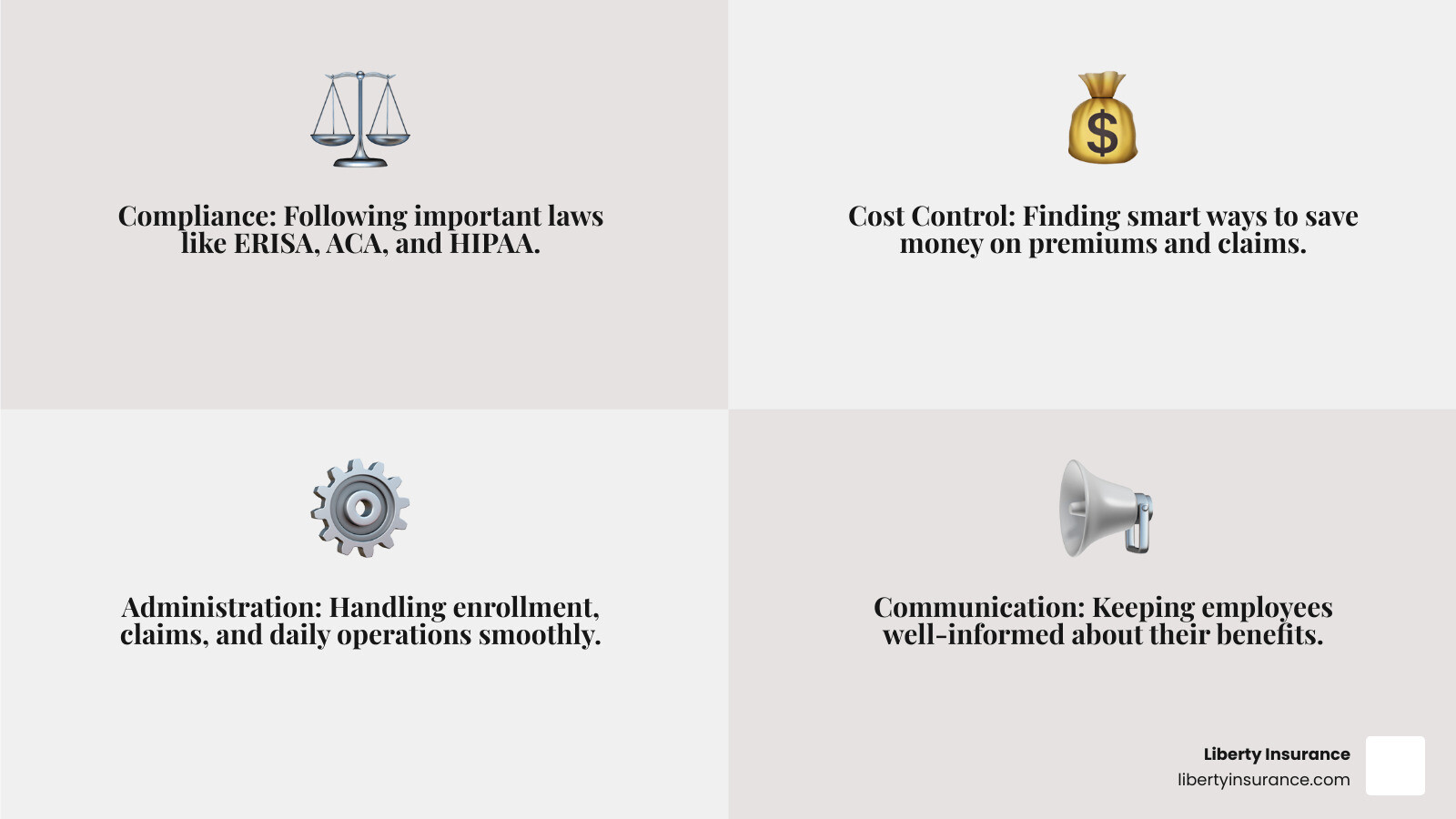
Successful group health plan management involves several key areas:
- Compliance: Following important laws like ERISA, ACA, and HIPAA.
- Cost Control: Finding smart ways to save money on premiums and claims.
- Administration: Handling enrollment, claims, and daily operations smoothly.
- Communication: Keeping employees well-informed about their benefits.
Offering a group health plan is a rewarding challenge. It helps attract and retain top talent and shows you care about your team’s well-being. However, managing these plans means dealing with complex rules, changing costs, and diverse employee needs.
This guide will walk you through everything you need to know, from basic concepts and plan selection to legal rules, cost-saving strategies, and new trends in health benefits.
As an insurance professional with designations like “Certified Insurance Counselor” (CIC) and “Accredited Advisor in Insurance” (AAI), and as Treasurer for the Professional Insurance Agents of New Jersey, I bring deep expertise to the complexities of Group health plan management.
Group health plan management word roundup:
The Foundations of Group Health Plans
This section explores the fundamental nature of group health plans, their advantages over individual policies, and their significant role in the modern workplace. Understanding these basics is the first step toward effective management.
What is a Group Health Plan?
A group health plan is an employee welfare benefit plan established by an employer or employee organization to provide medical care for participants and their dependents. This definition, provided by the Internal Revenue Service, highlights that these plans are tied to employment.
For businesses in Millstone Township, Trenton, and throughout New Jersey, offering a group health plan creates a structured way for your team to access healthcare. Key elements include:
- A Written Plan Document: The blueprint for how your plan works, outlining the benefit structure and operations.
- A Recordkeeping System: An efficient system for tracking contributions, benefit payments, and participant information.
- Information for Participants and Government: Materials like Summary Plan Descriptions (SPDs) for employees and various reports for federal agencies.
Understanding these foundational elements is key to effective group health plan management. For more comprehensive insights, explore our Business Health Insurance Complete Guide.
Group vs. Individual Insurance: Key Distinctions
While both group and individual health insurance provide medical coverage, they differ in cost, coverage, and eligibility.
The most significant distinction is risk pooling. In group plans, the insurer assesses the risk of the entire group, which often leads to more stable and lower premiums. Individual insurance is typically underwritten based on a single person’s health factors, which can result in higher costs outside of the Health Insurance Marketplace.
Here’s a quick breakdown of other key differences:
- Cost Sharing: Employers usually contribute a large portion of group plan premiums, making healthcare more affordable for employees. Individual plans require the person to pay 100% of the premium, though subsidies may be available.
- Premium Affordability: Due to risk pooling and employer contributions, group plans often have more competitive premiums.
- Plan Portability: Individual plans are portable, while group plans are tied to employment. COBRA offers temporary continuation of group coverage after leaving a job.
- Enrollment Periods: Both plan types have specific annual open enrollment periods and special enrollment for qualifying life events.
For those looking to understand personal coverage, our Individual Health Insurance guide offers valuable insights. Many New Jersey businesses appreciate the collective strength and affordability that group plans offer.
The Strategic Value in Recruitment and Retention
In today’s competitive job market, a robust group health plan is a strategic tool for attracting and retaining top talent across New Jersey.
Benefits for Employers:
- Attracting Top Talent: A quality health plan signals that you value employee well-being, making your company more appealing.
- Reducing Employee Turnover: Employees who feel secure in their health coverage are more likely to stay, reducing recruitment and training costs.
- Tax Advantages: Employer contributions are generally tax-deductible, and employee contributions can often be made pre-tax, saving both parties on payroll taxes.
- Increased Productivity: Healthier employees mean fewer sick days and a more engaged workforce.
- Positive Work Environment: Investing in employee health fosters a culture of care and improves morale.
Benefits for Employees:
- Lower Premiums: Employees benefit from the group’s collective bargaining power and employer contributions, making healthcare more accessible.
- Access to Better Care: Group plans often provide broader networks and more comprehensive benefits than many individual plans.
- Pre-Tax Contributions: Employees can often pay their share of premiums with pre-tax dollars, reducing their taxable income.
Strategic group health plan management turns a necessary expense into an investment in your company’s future. For a deeper dive, check out our insights on Employee Health Coverage.
Navigating the Landscape of Plan Options
Choosing the right plan structure is a pivotal decision for any business. It impacts not only the cost but also the accessibility and flexibility of care for your employees. This section breaks down the most common types of health plans and funding models to help us determine the best fit for your organization’s size, budget, and employee demographics.

Common Types of Group Health Insurance Plans
When considering group health plan management, understanding the different plan types is crucial. Each has its own structure for provider networks, referrals, and costs.
- Health Maintenance Organization (HMO): HMOs require employees to use a network of doctors and choose a primary care physician (PCP) to coordinate care. They typically have lower premiums but offer less flexibility.
- Preferred Provider Organization (PPO): PPOs offer more flexibility, allowing employees to see specialists without a referral and go out-of-network for care (at a higher cost). Premiums are usually higher than HMOs.
- High-Deductible Health Plan (HDHP): HDHPs feature lower premiums but higher deductibles, meaning employees pay more out-of-pocket before insurance kicks in. They are often paired with a Health Savings Account (HSA).
- Health Savings Account (HSA): Available only with an HDHP, an HSA is a tax-advantaged savings account for qualified medical expenses. Contributions are tax-deductible, and funds grow and can be withdrawn tax-free for medical costs.
- Point of Service (POS) Plans: A hybrid of HMOs and PPOs, POS plans require a PCP but allow out-of-network care at a higher cost.
Each plan type has unique pros and cons. For more details on business insurance, refer to our Types of Business Insurance guide.
Fully Insured vs. Self-Funded Plans: A Critical Decision
One of the most significant decisions in group health plan management is how your plan is funded. This choice impacts risk, cost, and control.
| Feature | Fully Insured Plans | Self-Funded Plans |
|---|---|---|
| Risk | Insurer assumes financial risk for claims. | Employer assumes financial risk for claims. |
| Cost | Predictable, fixed monthly premiums. | Variable costs based on actual claims; potential for savings or higher costs. |
| Control | Limited control over plan design and administration. | Greater control over plan design, benefits, and administration. |
| Compliance | Subject to state insurance laws and federal laws. | Primarily subject to federal ERISA laws, less state regulation. |
Fully Insured Model:
In this model, your company pays a fixed monthly premium to an insurance carrier, which assumes the financial risk for all employee claims. This offers predictable costs and is often preferred by smaller businesses in New Jersey seeking simplicity.
Self-Funded Model:
Here, the employer assumes the risk and pays for medical claims directly. This model offers greater control over plan design and transparency into claims data. While riskier, it can lead to significant savings if claims are lower than anticipated. Many employers mitigate this risk with stop-loss insurance, which caps the company’s financial exposure. According to the SHRM 2025 Benefits Survey, 27% of organizations offer a self-insured plan.
A hybrid approach, known as level-funded plans, is also popular. Employers pay a fixed monthly amount that covers estimated claims, administrative fees, and stop-loss insurance. If claims are lower than expected, the employer may receive a refund.
The decision between these models is complex. For more information on related business insurance, explore our Small Business Insurance Options guide.
The Core Pillars of Effective Group Health Plan Management
Strategic management is about actively controlling costs, leveraging technology, and ensuring your benefits package meets the evolving needs of your workforce. This is where proactive administration turns a simple benefit into a powerful business tool.
Strategic Cost Management in Group Health Plan Management
Controlling healthcare costs is a primary challenge in group health plan management. With strategic planning, we can implement measures that benefit both your bottom line and your employees.
- Plan Design Strategies: Adjusting deductibles, copays, and coinsurance can lower premiums, but it’s crucial to balance this with employee affordability.
- Tiered Networks: These networks encourage employees to use high-value (often lower-cost) providers by offering them lower out-of-pocket costs.
- Wellness Programs: Investing in employee wellness through fitness challenges or chronic disease management can lead to a healthier workforce and reduced claims over time.
- Health Risk Assessments (HRAs): HRAs help employers understand their team’s overall health risks, allowing for custom wellness programs that address specific needs and potentially reduce future claims.
- Dependent Eligibility Audits: Audits can uncover significant savings by ensuring only eligible dependents are covered. In the past, audits have found that over 12% of covered dependents were ineligible, preventing unnecessary claims costs.
For more detailed strategies, we recommend exploring the Toolkit: Essential Health Care Cost Management Strategies.
The Role of Technology in Group Health Plan Management
Technology has transformed group health plan management from a paper-heavy task into a streamlined process.

- Benefits Administration Platforms: These tools centralize benefits management, from enrollment to communication, reducing administrative work and errors.
- Online Enrollment Systems: Digital enrollment allows employees to easily select their benefits, saving HR time and reducing mistakes.
- Employee Self-Service Portals: These portals empower employees to access plan information and manage their benefits independently, improving satisfaction and reducing HR inquiries.
- Data Analytics for Cost Trends: Advanced platforms can analyze claims data to identify cost drivers and inform strategic decisions about plan design.
- Communication Tools: Technology enables multi-channel communication, allowing for targeted updates and reminders via email, mobile apps, or portals.
By embracing these solutions, we can improve the efficiency of group health plan management for both administrators and employees.
Tailoring Benefits for a Diverse Workforce
A one-size-fits-all approach rarely works for today’s diverse workforce. Effective group health plan management means responding to the varied needs of your employees across Trenton, Toms River, and Princeton.
- Surveying Employee Needs: Gathering feedback through surveys helps reveal what employees truly value in their health benefits.
- Offering a Range of Plan Choices: Providing a selection of plans—such as an HMO, PPO, or HDHP—allows employees to choose the option that best suits their needs and budget.
- Flexible Spending Accounts (FSAs): FSAs let employees set aside pre-tax money for eligible healthcare expenses like deductibles and copayments.
- Health Reimbursement Arrangements (HRAs): These are employer-funded accounts that reimburse employees for qualified medical expenses, offering a flexible way to help with out-of-pocket costs.
By offering a range of options, we can create a benefits package that meets diverse needs. Explore our Group Voluntary Benefits and Group Supplemental Benefits for more ways to improve your offerings.
Vendor Selection and Contract Negotiation
Navigating insurance carriers is a critical part of successful group health plan management. Our role is to help you secure the best solutions for your New Jersey business.
- Working with Brokers: An experienced broker acts as your advocate, using market knowledge to find plans that align with your needs and budget.
- Comparing Carriers: It’s essential to compare carriers on price, network quality, customer service, and innovation.
- Requesting Unbundled Services: We can request that services like administration and wellness programs be “unbundled,” allowing for more custom solutions and potentially better pricing.
- Reviewing Provider Network Adequacy: We review networks to ensure your employees have convenient access to doctors and hospitals in their areas.
- Negotiating Renewal Rates: We use data and market insights to negotiate effectively at renewal time, aiming to secure favorable rates.
- Service Level Agreements (SLAs): Clear SLAs define expectations for service quality and response times, ensuring vendor accountability.
Ensuring Compliance and Fulfilling Fiduciary Duties
Navigating the legal requirements of group health plans is non-negotiable. This section demystifies the complex web of laws like ERISA, ACA, and HIPAA, and clarifies your crucial role as a plan fiduciary.
Understanding Your Fiduciary Responsibilities Under ERISA
The Employee Retirement Income Security Act of 1974 (ERISA) is a federal law setting standards for most private-sector health plans. Understanding your fiduciary responsibilities under ERISA is paramount for effective group health plan management.
Who is a Fiduciary?
A person is a fiduciary if they exercise discretionary control over the plan’s management or assets. This includes selecting plan options or handling plan funds. According to the U.S. Department of Labor (DOL), fiduciary status is based on function, not title. As the employer, you often retain fiduciary responsibility even when hiring a third-party administrator.
Key Fiduciary Responsibilities:
- Prudent Person Rule: Fiduciaries must act with the care and diligence that a prudent person familiar with such matters would use.
- Acting in the Sole Interest of Participants: All decisions must be made for the exclusive purpose of providing benefits to participants and their beneficiaries.
- Avoiding Prohibited Transactions: ERISA prohibits transactions that create a conflict of interest, such as self-dealing or using plan assets for personal gain.
- Documenting Decisions: Maintaining thorough records of all decisions and their rationale is crucial to demonstrate that fiduciary duties were met.
For comprehensive guidance, the Department of Labor provides an excellent resource: Understanding Your Fiduciary Responsibilities Under A Group Health Plan.
A Guide to Key Regulatory Requirements
Beyond ERISA, several federal laws govern group health plan management. Compliance is essential for any New Jersey business offering health benefits.
Key Federal Laws Governing Group Health Plans:
- Affordable Care Act (ACA): The ACA requires employers with 50 or more employees to offer affordable, minimum-value health coverage or face penalties. It also extended dependent coverage to age 26 and prohibited limits on essential health benefits.
- Consolidated Omnibus Budget Reconciliation Act (COBRA): COBRA requires employers with 20 or more employees to offer temporary continuation of group health coverage after qualifying events like job loss.
- Health Insurance Portability and Accountability Act (HIPAA): HIPAA protects sensitive patient health information and prohibits discrimination based on health factors.
- Mental Health Parity and Addiction Equity Act (MHPAEA): This law requires that financial requirements and treatment limitations for mental health benefits be no more restrictive than those for medical benefits.
- Genetic Information Nondiscrimination Act (GINA): GINA prohibits health insurers and employers from discriminating based on genetic information.
Staying abreast of these regulations is critical. The U.S. Department of Labor provides valuable information on Health Plans and Benefits. For broader business coverage, you might find our insights on Employee Compensation Insurance helpful.
Plan Administration in Action: Communication, Claims, and Trends
Effective day-to-day administration ensures employees understand and use their benefits correctly, while staying ahead of industry trends keeps your offerings competitive and valuable.
Effective Communication with Plan Participants
Clear and consistent communication is a cornerstone of successful group health plan management. Employees can only value their benefits if they understand them.
- Summary Plan Description (SPD): This critical document explains the plan’s features, eligibility, and rights in plain language. ERISA requires administrators to provide SPDs to participants shortly after they enroll.
- Summary of Benefits and Coverage (SBC): Mandated by the ACA, the SBC is a standardized document that helps employees compare health plan options. You can find templates from the Centers for Medicare & Medicaid Services.
- Open Enrollment Communication: This annual period requires robust communication that clearly explains plan changes, new options, and deadlines.
- Multi-Channel Approach: Use various methods—email, employee portals, and meetings—to reach all employees effectively.
- Answering Employee Questions: Providing accessible resources ensures employees can get their questions answered promptly.
Prioritizing transparent communication empowers employees to make informed healthcare decisions.
Navigating the Claims and Appeals Process
Claims and appeals are an inevitable part of group health plan management. A clear, efficient process is vital for employee satisfaction and compliance.
When an employee receives care, the provider submits a claim. If a claim is denied, the plan must provide a clear notice explaining the reason and outlining the appeals process. Federal regulations set strict timelines for claim decisions and appeals to ensure fairness. Employees have the right to an internal appeal, where the plan reconsiders its decision. If the internal appeal is unsuccessful, employees in many plans have the right to an independent external review by a third party.
Having a well-defined process helps address issues efficiently, especially since errors can occur—up to three percent of U.S. medical claims are reportedly paid incorrectly.
Emerging Trends Shaping the Future of Health Benefits
The landscape of health benefits is constantly evolving. Staying informed about emerging trends is crucial for forward-thinking group health plan management.
- Telehealth and Virtual Care: Now a standard service, virtual visits offer convenient access to care and can reduce costs by minimizing ER visits. An increase in telehealth led to a reduction in emergency room visits that saved approximately $15.65 per member per month from 2018 to 2022.
- Focus on Mental Health Support: Employers are increasingly integrating robust mental health benefits, including virtual therapy and employee assistance programs (EAPs), to support a holistic view of employee well-being.
- Data-Driven Personalization: Leveraging data analytics provides insights into workforce health needs, informing more personalized benefits and effective cost-management strategies.
- Health and Wellness Incentives: Sophisticated incentive structures, such as premium reductions or HSA contributions, are being used to encourage healthy behaviors like participating in health screenings.
These trends represent opportunities to improve your benefits package and better support your employees. For more information on integrating these innovations, explore our insights on Life Health and Benefits Coverage.
Conclusion
Mastering group health plan management is an ongoing commitment that pays significant dividends in employee satisfaction, retention, and overall business health. By understanding plan fundamentals, making strategic choices, ensuring strict compliance, and embracing modern administrative practices, you can create a benefits program that is both cost-effective and highly valued. From navigating the intricacies of ERISA and ACA to leveraging technology for seamless administration, every step contributes to a more robust and responsive health plan.
A trusted insurance partner can provide the expertise needed to steer these complexities with confidence, helping your New Jersey business design and implement a plan that truly serves your employees and your strategic goals. For guidance on building the right benefits strategy for your business, the experts at Liberty Insurance are here to help.

