
Why Vessel Insurance Is the Foundation of Maritime Protection

Vessel insurance is the oldest form of insurance, born from the harsh realities of maritime trade when merchants realized they could lose everything if a single ship sank or fell prey to pirates. Today, it remains essential protection for anyone who operates, owns, or transports goods by water—covering everything from massive cargo ships to small fishing boats.
Here’s what you need to know about vessel insurance:
- Hull & Machinery Insurance protects your vessel’s physical structure and equipment against damage from storms, collisions, and other perils
- Marine Cargo Insurance covers merchandise being transported by water (and even during land portions of the journey)
- Protection & Indemnity (P&I) Insurance provides liability coverage for injuries to crew or passengers, damage to other property, environmental pollution, and cargo claims
- Specialized coverages address unique risks like passenger liability, war risks, and professional errors
The complexity of maritime insurance reflects the complexity of maritime operations themselves. Unlike a standard auto or property policy, vessel insurance must account for international waters, ancient maritime laws, specialized risks like “general average” (where all parties share extraordinary losses), and regulatory requirements that vary by country and vessel type.
Whether you’re operating a commercial fishing vessel, a passenger ferry, a cargo ship, or even a recreational yacht, understanding these three pillars of coverage—hull, cargo, and liability—is critical to protecting your investment and avoiding catastrophic financial losses.
I’m Andrew Harris, a Certified Insurance Counselor (CIC) and Accredited Advisor in Insurance (AAI). With years of experience in maritime risk management at Liberty Insurance and through organizations like the Professional Insurance Agents of New Jersey, I’ve seen how proper vessel insurance prevents financial disaster.
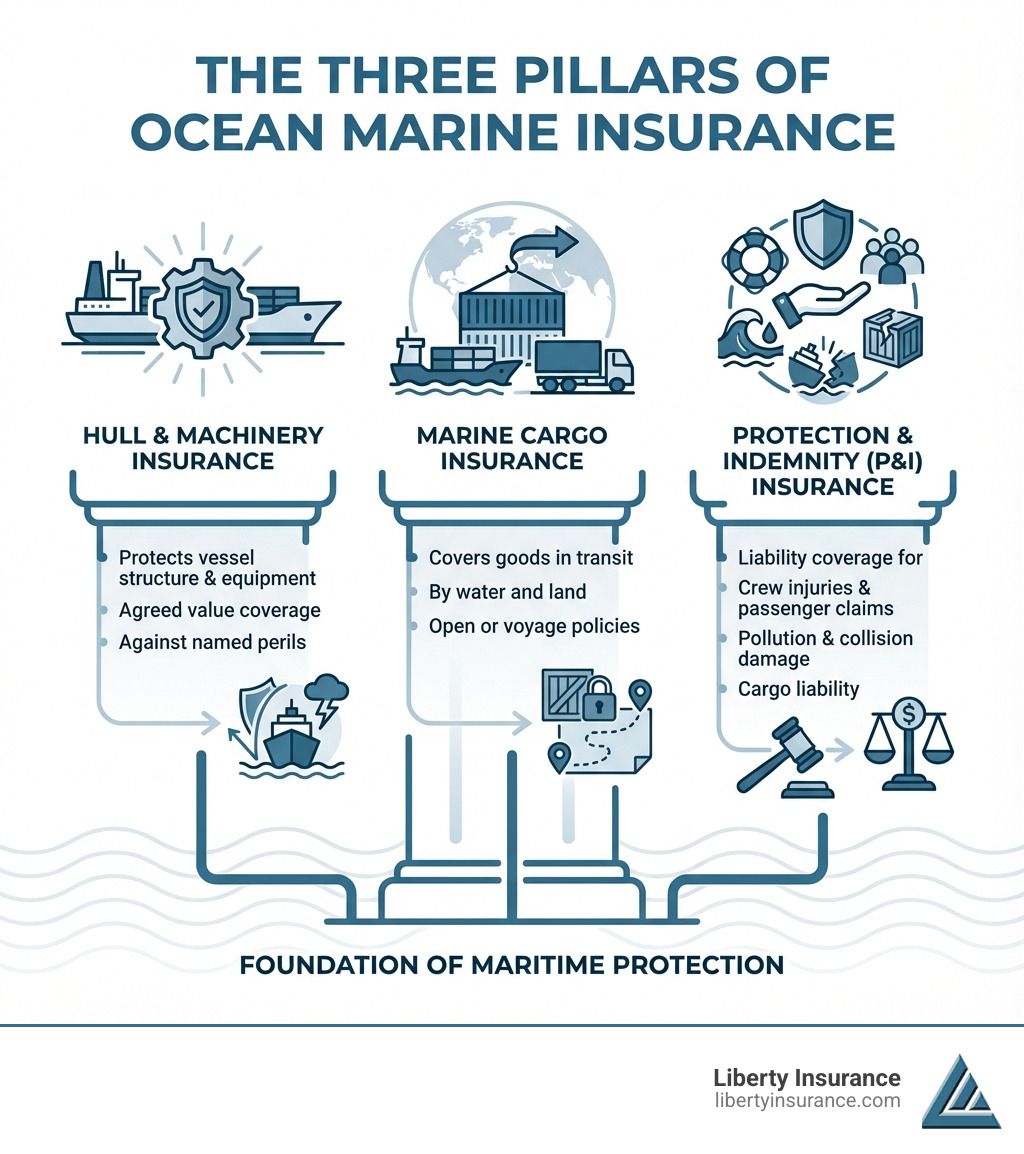
The Three Pillars of Ocean Marine Insurance
Just as a sturdy ship relies on its core structure, vessel insurance builds upon foundational coverages that address the most common and significant risks on the water. These are often referred to as the three pillars of ocean marine insurance: Hull & Machinery, Marine Cargo, and Protection & Indemnity (P&I). Each plays a distinct yet interconnected role in safeguarding your maritime interests.
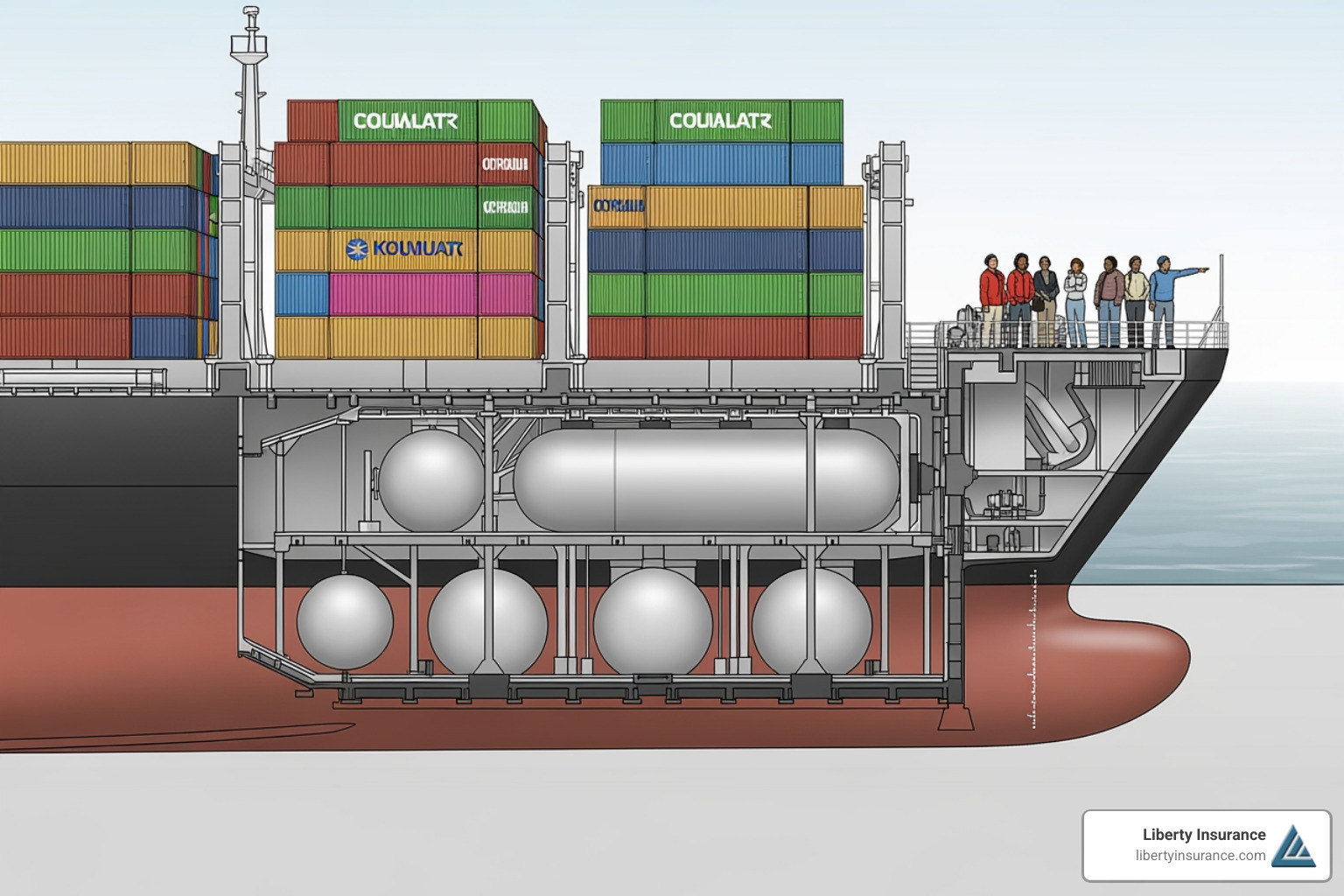
Hull & Machinery (H&M) Insurance: Protecting Your Core Asset
Hull & Machinery (H&M) insurance protects the physical integrity of your vessel. This coverage applies if your ship, boat, or floating machinery (like tugboats, barges, or oil rigs) suffers physical damage. It’s essentially the comprehensive and collision coverage for your maritime assets, protecting your investment in the vessel, its engines, and operational equipment.
Most H&M policies are based on internationally recognized standards, such as the Institute Time Clauses – Hulls. These clauses provide a framework for what is covered, typically on a “named perils” basis. This means the policy explicitly lists the risks it covers, which commonly include:
- Perils of the seas, rivers, lakes, or other navigable waters: This includes events like heavy weather, stranding, and collision.
- Fire and explosion.
- Violent theft by persons from outside the vessel.
- Jettison: The intentional throwing overboard of cargo or ship’s equipment to save the vessel.
- Piracy.
- Breakdown of or accident to nuclear installations or reactors.
A crucial component of H&M policies is the Inchmaree Clause. This clause extends coverage to include loss or damage caused by latent defects in machinery or the hull, and, importantly, negligence of the master, officers, crew, or pilots. This protects the owner from damage caused by human error on their own vessel.
A key feature of H&M policies is often “Agreed Value” coverage. This means that if your vessel is deemed a total loss, the insurer pays out a pre-agreed amount, saving you the headache of lengthy appraisals during a stressful time.
Several factors influence the cost of H&M coverage:
- Vessel Age and Construction: Older vessels or those with unique construction materials might pose higher risks.
- Vessel Size and Type: A small fishing vessel will have different risk profiles and costs than a large cargo ship.
- Trading Limits: Where your vessel operates – whether it’s coastal waters off New Jersey, inland rivers, or international routes – significantly impacts risk.
- Loss History: A track record of claims can increase premiums, while a clean history can lead to better rates.
One particularly important aspect of H&M is the Running Down Clause (RDC). This clause provides coverage for your legal liability if your vessel collides with another vessel and causes damage to its property or cargo. It’s a specific type of collision liability, ensuring that if you accidentally “run down” another ship, you’re covered for the damage you inflict upon it. Crucially, the RDC has limitations. It typically covers only three-fourths of the liability and excludes bodily injury, death, or damage to fixed objects like piers or docks. Those liabilities require P&I coverage, which we’ll cover next.
At Liberty Insurance, we specialize in helping you understand these nuances and secure the right protection for your maritime assets. Learn more about how we can protect your vessel with our Marine Vessel Insurance solutions.
Marine Cargo Insurance: Safeguarding Your Goods
Beyond the vessel itself, the cargo it carries represents immense value. That’s where Marine Cargo Insurance comes in, designed to protect the merchandise being transported by water. What’s fascinating about this coverage is that it often extends beyond just the waterborne leg of the journey, covering goods “warehouse to warehouse” – even when they are on dry land as part of the overall shipment. This means if your goods are damaged while being loaded onto a ship in Trenton, or while waiting in a port in New Brunswick, they could still be covered.
The responsibility for arranging cargo insurance is often determined by the terms of sale, commonly defined by Incoterms (International Commercial Terms). For example:
- CIF (Cost, Insurance, and Freight): The seller is responsible for purchasing insurance to cover the goods to the named destination port.
- FOB (Free on Board): The seller’s responsibility ends once the goods are loaded on board the vessel, at which point the buyer becomes responsible for insurance.
Marine Cargo Insurance can be structured in a few ways:
- Open Cargo Policies: These are very common for businesses with regular shipments. An Open Cargo policy provides continuous coverage for all shipments made during the policy period, offering efficiency and peace of mind.
- Voyage Policies: For single, one-off shipments, a Voyage policy offers coverage specifically for that particular journey.
Policies can be custom to be “all-risk” (covering all perils except those specifically excluded) or “named perils” (covering only those risks explicitly listed, such as fire, collision, or jettison). With customizable clauses, we can ensure the coverage matches the specific nature of your goods, the route, and any unique risks involved. For instance, if you’re shipping delicate electronics or temperature-sensitive goods, we can integrate specific protections.
Understanding Marine Cargo Insurance is vital for anyone involved in trade, from manufacturers to freight forwarders. It ensures that unforeseen events don’t wipe out the value of your goods in transit. Whether your cargo is moving across oceans or simply along the coast of New Jersey, protecting your goods is paramount. Find our comprehensive solutions for Marine Cargo Insurance and explore how it differs from Inland Cargo Insurance for land-based transit.
Understanding Maritime Liability: P&I Insurance and Comprehensive Liability Solutions
While H&M insurance protects your vessel and Marine Cargo protects your goods, maritime operations involve significant third-party liabilities. Protection & Indemnity (P&I) insurance is the indispensable safety net for accidents affecting people or property beyond your vessel. At Liberty Insurance, we understand that liability is a complex and financially devastating risk, and we’re here to help you steer it.
For a deeper dive into the broader scope of marine insurance, you can refer to our Ocean Marine Insurance Overview.
What is Protection & Indemnity (P&I) Insurance?
P&I insurance is arguably the most comprehensive form of maritime liability coverage. It covers a vast array of risks that are typically excluded from H&M policies. Think of P&I as covering your responsibilities to everyone else and the environment. Its scope is often described as covering liabilities that are not covered by a standard H&M policy with its Running Down Clause.
Here’s a more detailed look at what P&I typically covers:
- Crew Injury and Death: This is a primary exposure for any vessel owner. P&I covers claims arising from injuries, illness, or death of crew members, including medical expenses, disability payments, and repatriation costs.
- Passenger Liability: If you operate a passenger vessel, P&I is crucial. It covers liabilities for injury, illness, or death of passengers. For example, in Canada, regulations require operators carrying passengers by water to maintain insurance coverage of at least $250,000 per passenger. The International Maritime Organization’s Athens Convention, which many countries have adopted, can make vessel owners liable for death or personal injury up to around $314,700 per passenger. These principles of significant passenger liability are universal and apply to passenger vessels operating in New Jersey’s waters, such as ferries or tour boats.
- Stowaways and Refugees: P&I can help cover the significant costs associated with the care, repatriation, or fines related to stowaways or persons rescued at sea.
- Collision Liability Not Covered by H&M: Remember how the Running Down Clause in H&M is often limited (e.g., to 3/4ths of the liability and only for damage to the other vessel)? P&I covers the remaining portion (e.g., the other 1/4th) and, critically, covers liability for bodily injury or death to third parties and property damage to fixed or floating objects (FFO) like piers, jetties, buoys, or docks.
- Pollution Cleanup and Fines: Environmental damage, particularly oil spills, can incur astronomical cleanup costs and hefty fines under international conventions (like MARPOL and the CLC) and national laws (like the Oil Pollution Act of 1990 in the U.S.). P&I is designed to cover these critical liabilities.
- Wreck Removal Costs: If your vessel sinks and becomes a hazard to navigation, you are legally obligated to remove it. P&I can cover these substantial, often multi-million dollar, costs.
- Cargo Loss or Damage Liability: While Marine Cargo insurance protects the cargo owner, P&I covers the vessel owner’s legal liability for loss or damage to the cargo they are transporting, often arising from breach of the contract of carriage.
How P&I Clubs and Comprehensive Liability Coverage Work
P&I coverage is traditionally provided by P&I Clubs, which are non-profit, mutual insurance associations owned by their shipowner members. This mutual structure is fundamental to how they operate.
Instead of paying a fixed premium to a for-profit insurance company, members pay “calls” into a shared fund. This system typically involves:
- Advance Calls: An estimated premium paid at the beginning of the policy year.
- Supplementary Calls: If the claims for that year exceed the advance calls collected, the club will ask members for an additional contribution to cover the shortfall.
- Release Calls: A final call levied on a member who decides to leave the club, to cover their share of any future liabilities for the years they were a member.
This model prioritizes the collective protection of its members over profit. The world’s leading P&I Clubs are part of the International Group of P&I Clubs (IG). The IG operates a sophisticated risk-sharing (pooling) agreement. Each club retains a certain amount of risk for each claim, with larger claims being shared among all 13 IG clubs. For truly catastrophic claims, the IG collectively purchases high-limit reinsurance on the open market, allowing them to offer extremely high limits of coverage, sometimes in the billions of dollars.
For smaller vessels, fixed premium P&I options are also available, which function more like traditional insurance and eliminate the uncertainty of supplementary calls. These are common for workboats, fishing vessels, and yachts.
| Feature | Traditional Marine Insurance (Commercial) | P&I Club Coverage (Mutual) |
|---|---|---|
| Structure | For-profit, shareholder-driven | Non-profit, member-owned mutual association |
| Premium Model | Fixed premiums paid in advance | “Calls” (advance, supplementary) paid into a pooled fund, adjusted based on claims/surplus |
| Coverage Scope | Often narrower, focused on specific perils | Broader, covering open-ended liabilities (e.g., pollution, crew, wreck removal) |
| Liability Limits | Varies, can be high, but club limits are designed for catastrophic risk | Extremely high, often billions of dollars for major events, facilitated by the International Group pool |
At Liberty Insurance, we work to provide comprehensive liability coverage solutions, whether through a fixed premium facility or by facilitating entry into a P&I Club, ensuring the solution is custom to your specific needs.
Navigating Specialized Risks and Your Vessel Insurance Policy
Beyond the core pillars, the maritime world is rife with specialized risks that require unique insurance solutions. These coverages address niche challenges, from geopolitical tensions to professional responsibilities, ensuring that every facet of your operation is protected.
Mandatory Passenger Vessel Insurance Requirements
Operating any vessel that carries passengers comes with a significant responsibility and, consequently, mandatory insurance requirements. These regulations are in place to ensure passenger safety and provide financial compensation in the event of an accident. While specific laws vary by jurisdiction, the underlying principle is universal.
For example, in Canada, regulations require operators carrying passengers by water to maintain a minimum of $250,000 in liability insurance coverage per passenger, multiplied by the vessel’s passenger capacity. So, a vessel carrying 10 passengers would need at least $2,500,000 in coverage. These rules were influenced by the International Maritime Organization’s Athens Convention relating to the Carriage of Passengers and their Luggage by Sea, which sets a framework for owner liability in cases of death or personal injury.
These regulations also mandate proof of insurance, and enforcement can be strict, with potential fines up to $250,000 for non-compliance. While these are Canadian specifics, the spirit of these regulations applies to passenger vessel operations around New Jersey, such as sightseeing boats, ferries, or charter fishing vessels. We ensure our clients understand and meet all local and federal requirements for passenger liability. You can learn more about international standards like the Athens Convention relating to the Carriage of Passengers and their Luggage by Sea.
Understanding General Average in Maritime Law
“General Average” may sound like a term from a pirate movie, but it’s a crucial concept in maritime law and vessel insurance. This ancient principle dictates that all parties in a sea venture (shipowner, cargo owners, etc.) proportionally share in any voluntary and extraordinary sacrifices or expenditures made for the common safety of the venture.
Here is a more detailed example: A container ship sailing from Asia to New Jersey encounters a fire in its engine room. To save the ship and the vast majority of its cargo, the captain makes two critical decisions:
- Extraordinary Sacrifice: He orders several containers near the fire to be jettisoned (thrown overboard) to prevent the fire from spreading.
- Extraordinary Expenditure: He diverts the vessel to a nearby port of refuge and hires salvage tugs to help extinguish the fire, incurring significant costs.
In this scenario, the ship and most of the cargo are saved. The owner of the jettisoned containers and the shipowner (who paid for the tugs) have suffered a direct loss for the benefit of everyone. General Average is declared. An Average Adjuster is appointed to calculate the total value of the saved property (the ship and remaining cargo) and the total value of the losses. Each party whose property was saved must then contribute a pro-rata share to compensate those who suffered the loss. This ensures fairness and prevents any single party from bearing the full cost of an action that saved everyone.
The adjustment and contribution process for General Average is often governed by the York-Antwerp Rules, a set of internationally recognized principles. When cargo is released after a General Average event, the shipowner typically requires cargo interests to sign an “average bond” and their insurers to provide an “average guarantee” to ensure contributions are made. This ancient principle is a cornerstone of marine insurance and highlights the interconnectedness of all parties in a maritime venture.
Specialized Coverages for Unique Maritime Operations
The world’s oceans and waterways present a spectrum of risks far beyond standard navigation. For those operating in challenging environments or providing specialized services, custom vessel insurance coverages are essential.
- Marine War Risk: Standard marine policies explicitly exclude losses from war, strikes, riots, and terrorism. Marine War Risk insurance fills this critical gap. Coverage is often triggered when a vessel enters a high-risk area as defined by the Joint War Committee (JWC) in London. This insurance provides crucial protection for vessels and cargo against these perils. Some specialist providers can offer large capacities, such as USD 175 million, with additional capacity for War P&I.
- Kidnap & Ransom (K&R): In high-risk areas like the Gulf of Guinea or off the Horn of Africa, the threat of crew or passenger abduction for ransom is a grim reality. K&R insurance is a highly specialized product that covers expenses related to crisis response, negotiation, ransom payments, and other costs associated with such incidents.
- Increased Value & Disbursement: This coverage provides additional protection beyond the primary H&M policy. It allows a shipowner to insure their vessel for an amount higher than its basic H&M agreed value, covering additional economic interests like anticipated profits or costs laid out for a voyage (disbursements).
- Marine Professional Indemnity Insurance: Not every risk involves physical damage or direct liability. Professionals in the maritime industry—like shipbrokers, marine surveyors, consultants, or ship managers—can face claims arising from errors, omissions, or negligence in their professional duties. Marine Professional Indemnity insurance (often called Errors & Omissions) protects these firms and individuals against such claims for financial loss.
- Freight, Demurrage and Defence (FD&D): Often offered by P&I Clubs as a separate cover, FD&D is essentially legal expense insurance for shipowners and charterers. It covers the legal and other costs associated with disputes arising from charter parties, bills of lading, and other contracts of carriage. This ensures that vessel owners have expert legal support when faced with complex and costly commercial disagreements over issues like unpaid freight or hire.
The Unseen Hands: Key Players in Maritime Risk Management
While vessel insurance policies provide the financial safety net, several critical organizations and professionals work behind the scenes to assess, mitigate, and manage maritime risks. These “unseen hands” play a vital role in ensuring seaworthiness, setting standards, and providing expert assessments that directly impact insurance eligibility and claims.
The Role of Classification Societies
Classification Societies are independent, non-governmental organizations that establish and maintain technical standards for the construction and operation of ships. Their primary function is to ensure a vessel is structurally sound and mechanically fit for its intended service—in other words, that it is “in class.”
Think of them as the ultimate quality control for ships. They conduct surveys and inspections throughout a vessel’s life, from design approval and construction supervision to regular in-service inspections. While they don’t have governmental authority, their stamp of approval is a de facto requirement for commercial shipping. An unclassified vessel, or one that loses its classification status due to poor maintenance or damage, is often considered uninsurable and may be barred from entering certain ports. Insurers rely heavily on a vessel’s classification status when determining whether to provide H&M coverage and at what terms.
The Role of Marine Surveyors
Marine surveyors are the independent eyes and ears on the ground (or rather, at the dock and on the water) for vessel owners, charterers, and insurance underwriters. They are technical experts who provide objective assessments of vessels and their cargo.
Their roles typically fall into several categories:
- Pre-Risk Surveys: Before an insurer agrees to provide coverage, especially for an older vessel or one with a poor record, a marine surveyor will conduct a condition survey. This involves a thorough inspection of the vessel’s hull, equipment, and operational practices to assess potential hazards and verify its seaworthiness. This report helps underwriters accurately price the risk.
- Damage Surveys: In the unfortunate event of an incident or claim, marine surveyors are deployed to investigate the cause, nature, and extent of the damage. They provide an independent report that is crucial for claims validation and adjustment, helping to determine the appropriate payout under the vessel insurance policy.
- On-Hire/Off-Hire Surveys: When a vessel is chartered, surveyors inspect its condition at the beginning (on-hire) and end (off-hire) of the charter period to document any damage that may have occurred during that time.
Their expertise is invaluable in ensuring fairness and accuracy in the insurance process, from initial underwriting to final claims settlement.
The Role of Average Adjusters
Average Adjusters are highly specialized professionals with a unique role in maritime commerce, particularly when General Average is declared. They act as impartial experts to manage the complex process of adjusting the losses. When a General Average event occurs, the adjuster is appointed to collect all the necessary documentation, including the value of the sacrificed property (e.g., jettisoned cargo), the extraordinary expenses incurred (e.g., salvage costs), and the value of all the property that was saved.
Using the York-Antwerp Rules as their guide, they meticulously calculate the contribution each party (shipowner and all cargo owners) must pay to make good the losses. Their final statement of adjustment is a detailed legal and financial document that is generally accepted as binding by all parties and their insurers. Their independence and expertise are essential for a fair and orderly resolution of General Average claims.
Flag State and Port State Control
Every commercial vessel must be registered in a country, known as its “Flag State.” The Flag State is responsible for ensuring the vessel complies with international maritime laws and conventions, such as SOLAS (Safety of Life at Sea) and MARPOL (Marine Pollution). They enforce standards for safety, security, and environmental protection.
Port State Control (PSC) is the inspection of foreign ships in national ports to verify that the condition of the ship and its equipment comply with the requirements of international regulations and that the ship is manned and operated in compliance with these rules. If a PSC inspection finds serious deficiencies, the vessel can be detained until the problems are rectified. A poor PSC record can flag a vessel as high-risk, leading to higher insurance premiums or even the inability to obtain coverage.
Frequently Asked Questions about Vessel Insurance
We often encounter common questions from vessel owners and operators in New Jersey. Here are some of the most frequently asked, along with our expert insights.
What factors have the biggest impact on my vessel insurance premium?
The cost of your vessel insurance premium isn’t pulled from thin air; it’s a careful calculation based on a multitude of factors, all designed to assess the level of risk involved. Here are the key elements that influence your premium:
- Vessel Type and Value: A high-performance speedboat will have a different risk profile and premium than a pontoon boat or a commercial fishing vessel. The agreed value or actual cash value of your watercraft is a primary driver of the premium.
- Age, Construction, and Condition: Older vessels might require more maintenance and are often subject to condition surveys. The materials used in construction (e.g., steel, fiberglass, wood) also affect risk and repair costs.
- Navigational Territory: Where you plan to operate your vessel is critical. A policy for cruising the inland waters of New Jersey will be priced differently than one allowing voyages into the open Atlantic or international waters. Policies define specific navigational limits, and venturing outside them can void coverage.
- Operator Experience: Your experience, licensing, and training as an operator play a significant role. A seasoned captain with a clean record will generally receive more favorable rates than a novice. Completing boat safety courses and exams can often lead to additional training discounts.
- Claims History: A history of previous claims, whether for property damage or liability, can indicate a higher future risk and may result in higher premiums.
- Coverage Limits and Deductibles: Naturally, higher liability limits and lower deductibles will lead to higher premiums, as they represent greater potential exposure for the insurer.
- Vessel’s Classification Status: For commercial vessels, maintaining classification with a recognized Classification Society is often a prerequisite for obtaining insurance and directly impacts rates.
Can I get coverage for a pleasure craft like a yacht or a jet ski?
Absolutely! While much of our discussion has focused on commercial marine operations, we understand that many of our clients in New Jersey enjoy the waters for recreation. We offer specialized watercraft policies designed specifically for pleasure craft, including yachts, fishing boats, cruisers, pontoon boats, and even personal watercraft (PWC) like jet skis.
These policies combine the essential elements of hull (physical damage) and liability coverage (often called Protection & Indemnity for boats), but custom for recreational use. You can often choose between “agreed value” or “actual cash value” for your vessel. Many pleasure craft policies also offer valuable additional coverages such as:
- Emergency Towing and Assistance: Covering the costs if your vessel breaks down and needs to be towed.
- Medical Payments: Helping to cover medical expenses for you and your guests for injuries sustained on your vessel, regardless of fault.
- Personal Effects Coverage: Protecting your personal belongings on board, such as fishing gear, water skis, and clothing.
- Uninsured/Underinsured Boater Protection: Offering coverage if you’re involved in an accident with another boater who doesn’t have adequate insurance to cover your damages.
We can help you find comprehensive insurance available for all vessel types, ensuring your time on the water is worry-free.
Is my vessel covered when it’s out of the water for storage or transport?
This is an excellent question and one we hear often, especially with the seasonal nature of boating in New Jersey. The answer is: it depends on your specific policy, but most comprehensive vessel insurance policies do provide coverage.
Many policies include coverage for your boat while it’s out of the water for land transit, storage, or repairs. However, the scope can vary. For example, coverage during land transit might be limited to a certain distance or geographic area. Storage coverage should protect against perils like fire, theft, vandalism, or storm damage while the boat is on a trailer or in a marina’s dry-stack facility. It’s crucial to review your policy documents or speak with your Liberty Insurance agent to confirm the specifics. Never assume; always confirm to ensure seamless protection, regardless of whether your vessel is afloat or ashore.
What is the difference between a warranty and a condition in a marine policy?
This is a critical legal distinction in marine insurance. In general insurance, a breach of a policy condition might reduce a claim payout, but in marine insurance, warranties are much stricter. A warranty is a promise made by the insured that a certain state of affairs will continue to exist (e.g., a warranty that the vessel will remain in class). Under traditional maritime law, if you breach a warranty, the insurer is discharged from all liability from the date of the breach, even if the breach had nothing to do with the eventual loss. For example, if you breach a navigational warranty by sailing outside your permitted area, coverage could be voided for a subsequent fire that was completely unrelated to your location. While some modern regulations have softened this strict approach, it highlights the importance of adhering to all policy warranties.
How does the claims process work for a major marine incident?
While specifics vary, the process for a major claim generally follows these steps:
- Immediate Notification: As soon as it is safe to do so, you must notify your insurance agent or broker. The policy will have specific requirements for timely notification.
- Loss Mitigation: You have a duty to act as a “prudent uninsured,” meaning you must take reasonable steps to minimize the loss or damage. This could involve arranging for emergency repairs or salvage.
- Appointment of a Surveyor: The insurer will appoint an independent marine surveyor to investigate the cause, nature, and extent of the damage. The surveyor will inspect the vessel, review logs, and interview the crew.
- Documentation: You will need to gather and submit all relevant documents, such as the master’s report (protest), logbooks, repair quotes, and invoices for any expenses incurred.
- Adjustment and Settlement: Based on the surveyor’s report and the policy terms, the insurer’s claims adjuster will determine the covered amount. For complex claims like General Average or salvage, an Average Adjuster will be involved. Once the amount is agreed upon, the insurer will issue payment to settle the claim.
Conclusion: Charting a Course to Secure Coverage
Navigating the complex world of vessel insurance doesn’t have to feel like sailing through a storm without a compass. We’ve explored the three fundamental pillars of coverage: Hull & Machinery to protect your vessel, Marine Cargo to safeguard your goods, and Protection & Indemnity (P&I) to shield you from vast liabilities. We’ve also touched upon specialized risks, mandatory regulations, and the crucial roles played by Classification Societies and Marine Surveyors in maintaining maritime safety and insurability.
At Liberty Insurance, we believe that understanding these concepts is the first step toward securing peace of mind. Whether you operate a busy commercial vessel or enjoy the tranquility of a pleasure craft on the New Jersey coastline, a well-structured vessel insurance policy is your most reliable anchor. We pride ourselves on offering customizable coverage solutions that adapt to your unique operations and risk profile. Don’t let unforeseen circumstances leave you adrift; let us help you chart a course to secure and comprehensive protection.
Learn more about our comprehensive Marine Cargo Insurance solutions and how we can protect all your maritime interests.

