
So, you’re on Original Medicare, or about to be. You’ve got your red, white, and blue card, and you think you’re all set. But here’s the thing most people don’t realize until the first big medical bill arrives: Original Medicare was never designed to cover 100% of your costs.
That’s where a Medicare Supplement Plan, which most people just call Medigap, comes into play. It’s private insurance you can buy that works alongside your Original Medicare to pick up the tab for many of the costs Medicare itself leaves behind. Think of it as a financial backstop for your health coverage. It’s there to fill in the "gaps" like deductibles, coinsurance, and copayments, so you’re not blindsided by unpredictable expenses.
What Are These “Gaps” in Medicare Coverage?
Original Medicare is a fantastic foundation. Part A (Hospital Insurance) and Part B (Medical Insurance) provide a huge amount of protection. But they come with built-in cost-sharing that you’re responsible for. These are the gaps.
Let's use a simple analogy. Imagine Original Medicare is a high-quality raincoat. It’s going to keep you dry from the worst of a downpour, like a major surgery or hospital stay. But, it doesn't come with boots or an umbrella. You're still going to get your feet wet with deductibles and get soaked by coinsurance if you're not careful. A Medigap plan is like buying the matching boots and umbrella—it completes the outfit and keeps you truly protected from the financial storm.
Here's how this partnership works in the real world:
- You must have both Medicare Part A and Part B to buy a Medigap plan. You’ll continue to pay your Part B premium to the government.
- You also pay a separate monthly premium to a private insurance company for your Medigap policy.
- When you go to the doctor or hospital, you show both your Medicare card and your Medigap card. Medicare pays its share first.
- Then, your Medigap plan automatically steps in to pay its portion of the remaining bill, which can cover your deductibles and coinsurance, depending on which plan you choose.
A big part of understanding these gaps is knowing what Original Medicare does and doesn’t cover in specific situations, such as Medicare's coverage for home health care. Once you see the potential out-of-pocket costs, the value of a Medigap plan becomes crystal clear.
To better illustrate this, let's look at a side-by-side comparison.
Original Medicare vs. Medicare with a Supplement Plan
This table shows the difference in financial exposure you might face with just Original Medicare versus the protection you gain by adding a Medigap plan.
| Expense | Coverage with Original Medicare Only | Coverage with a Medigap Plan |
|---|---|---|
| Part A Deductible | You pay the full deductible (thousands per benefit period). | Typically covered 100% by most Medigap plans. |
| Part B Coinsurance | You pay 20% of most doctor services with no annual limit. | Typically covered 100% by most Medigap plans. |
| Hospital Costs | You pay significant daily coinsurance after day 60. | Most plans cover this, giving you up to 365 extra days. |
| Out-of-Pocket Max | No limit. Your financial risk is technically uncapped. | Your costs are predictable and capped, providing a financial safety net. |
As you can see, the Medigap column offers a level of predictability and security that Original Medicare alone simply cannot provide.
Medigap policies are standardized. This is a crucial point. A Plan G from one insurance company has to offer the exact same basic benefits as a Plan G from any other company. The only real differences are the monthly premium you’ll pay and the company’s reputation for customer service.
Why Supplemental Coverage Is So Common
The need for this extra protection isn't just theoretical; the numbers prove it. While total Medigap enrollment saw a slight dip in 2024 to 13.541 million people, the broader trend is clear. A stunning 87% of beneficiaries on Original Medicare had some form of supplemental coverage back in 2023. You can dig into the data on Medigap enrollment trends from Mark Farrah Associates.
People aren’t buying these plans for fun—they’re buying them for peace of mind and financial stability. Understanding this is the first step toward making a smart, confident decision as you get ready to enroll.
Decoding the Medigap Plan Letters from A to N
When you first start looking at Medicare Supplement plans, it can feel like you’ve stumbled into a bowl of alphabet soup. You’ll see plans with letters like A, B, C, D, F, G, K, L, M, and N. But what seems confusing at first is actually a brilliantly simple system designed to make your life easier.
The federal government standardized these plans. That means a Plan G from one insurance company in New Jersey has to offer the exact same core benefits as a Plan G from any other company. This is a huge advantage for you. It lets you shop for the best price and service without having to worry that the coverage itself is different.
A Medigap policy works hand-in-hand with Original Medicare, acting as a patch to fill in the financial gaps—like deductibles and coinsurance—that Medicare leaves behind.
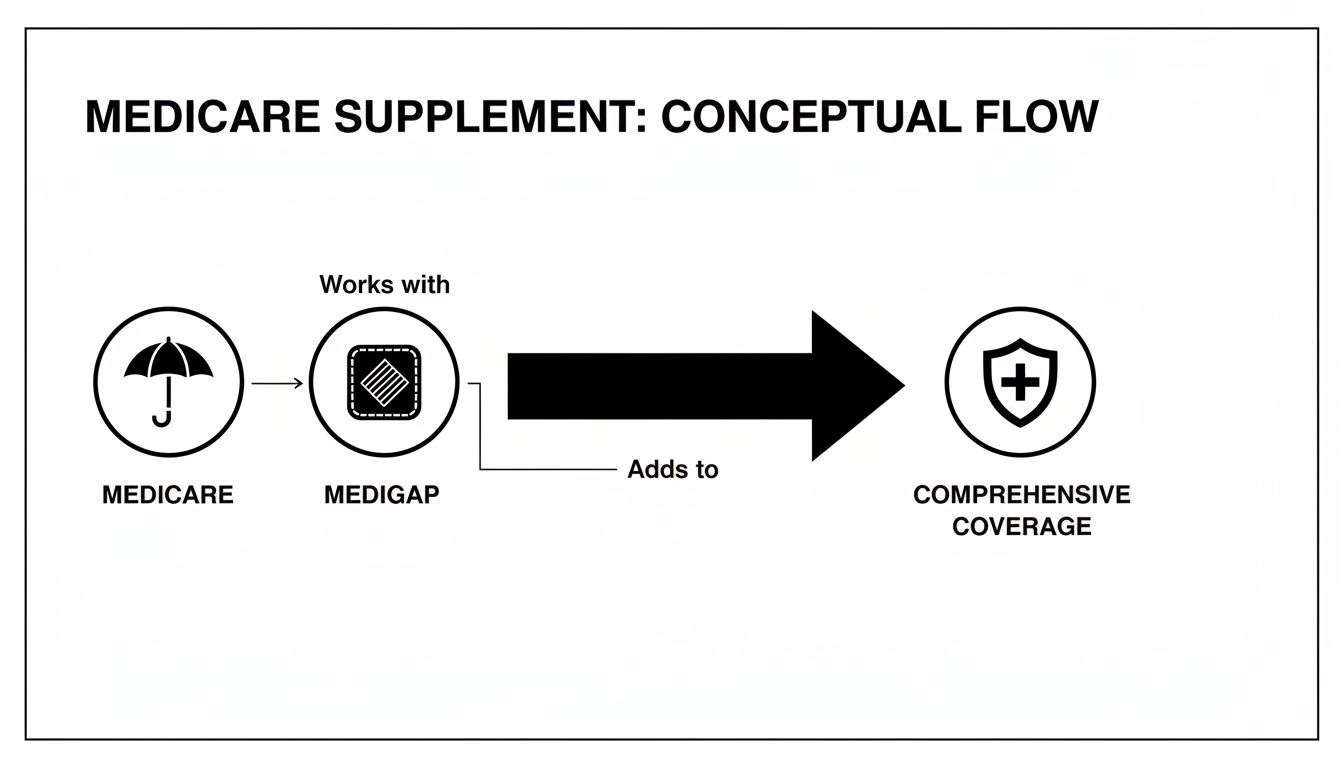
Think of it this way: Original Medicare provides the foundation, but a Medigap plan builds a strong financial shield around it, giving you predictable and comprehensive protection.
The Most Popular Medigap Plans Explained
While there are up to 10 different plans out there, most people new to Medicare quickly narrow their focus to a couple of key options that deliver the best all-around value. Today, the two front-runners are Plan G and Plan N.
Plan G: The New Gold Standard
Since 2020, Plan G has become the go-to choice for anyone newly eligible for Medicare. It's the most comprehensive plan available to new enrollees, covering nearly every out-of-pocket cost you'd otherwise face. This provides incredible predictability for your healthcare budget.
Here's a rundown of what Plan G covers:
- Part A Coinsurance and Hospital Costs: Takes care of the daily charges for long hospital stays.
- Part A Deductible: This is a big one. Plan G covers the entire hospital deductible for each benefit period.
- Part B Coinsurance or Copayment: Pays the 20% you'd normally owe for doctor visits, tests, and other outpatient services.
- Blood (First 3 Pints): Covers the cost of the first three pints of blood you might need for a transfusion.
- Foreign Travel Emergency: Pays for 80% of emergency care costs when you travel outside the U.S., up to the plan's limit.
The only thing Plan G doesn't cover is the annual Medicare Part B deductible. Once you meet that small, once-a-year deductible out-of-pocket, Plan G kicks in and pays 100% of all remaining Medicare-approved expenses for the rest of the year.
For many retirees, Plan G is the ultimate peace of mind. Knowing your only major medical expense for the year will be that one small Part B deductible makes budgeting simple and stress-free.
Plan N: A Cost-Effective Alternative
For those who want rock-solid protection but would rather have a lower monthly premium, Plan N is an excellent alternative. It offers benefits very similar to Plan G but asks you to share a small, predictable portion of the costs for routine care.
Like Plan G, Plan N covers your big-ticket items like the Part A hospital deductible and the 20% Part B coinsurance. The trade-off for a lower premium comes with a few cost-sharing details:
- You might have a small copayment of up to $20 for some office visits.
- An emergency room visit could have a $50 copayment if it doesn’t lead to you being admitted to the hospital.
These small, predictable copayments are exchanged for a lower monthly premium. If you’re in good health and don’t go to the doctor often, the savings from a Plan N premium can really add up over the course of a year, while still protecting you from catastrophic medical bills.
What Happened to Plan F?
If you’ve talked to friends or family who have been on Medicare for a while, you’ve probably heard about Plan F. For years, it was the king of Medigap plans because it offered "first-dollar" coverage—it paid for absolutely everything, including the Part B deductible.
However, a federal law changed the rules. As of January 1, 2020, Plan F (and Plan C) can no longer be sold to people who are new to Medicare. The idea behind the change was to give beneficiaries a little "skin in the game" by having them pay the Part B deductible, hopefully discouraging unnecessary doctor visits.
If you were eligible for Medicare before 2020, you might still be able to buy a Plan F. But for most people today, Plan G offers a much better financial value, often providing nearly identical protection for a lower overall cost.
Securing Your Medigap Enrollment Window
When it comes to Medicare Supplement plans, when you enroll is just as important as what plan you choose. Think of your initial enrollment as your one-time, non-negotiable "golden ticket" opportunity. This critical window is your Medigap Open Enrollment Period, and it is hands-down the single best time to buy a policy.
This is a six-month window that kicks off on the first day of the month you are both 65 or older and enrolled in Medicare Part B. During these six months, you have what are called “guaranteed issue rights.” It’s a powerful federal protection that puts you in the driver's seat.

Why This Six-Month Window Is So Important
During this unique period, insurance companies cannot use medical underwriting to evaluate your application. This is a massive advantage for you.
Here’s what they are prohibited from doing:
- Refusing to sell you a policy: If they offer a Medigap plan, they must sell it to you. Period.
- Charging you a higher premium: Your health status, pre-existing conditions, or past medical issues cannot be used to jack up your price.
- Imposing a waiting period: They can't force you to wait for your coverage to start, even if you have ongoing health problems.
Once this six-month window slams shut, you lose these federal protections. If you try to apply for a Medigap plan later, insurers can—and almost always will—put you through full medical underwriting. They can charge you much higher rates or even deny your application outright based on your health history.
This is the crucial takeaway: Missing your Medigap Open Enrollment Period can make it significantly more difficult and expensive to get the coverage you need. It is the one time you are in complete control.
Understanding Special Enrollment Periods
But what if your circumstances change outside of that initial six-month window? Life rarely sticks to a neat timeline. Thankfully, certain situations can trigger a Special Enrollment Period (SEP), giving you another chance to buy a Medigap plan with guaranteed issue rights.
These aren't arbitrary; they are specific, qualifying life events. Think of them as special exceptions that reopen the door to enrollment without medical underwriting, protecting you from being locked out of coverage.
Common triggers for a Medigap SEP include:
- Losing Employer Coverage: If you work past 65 and have group health insurance, you can delay Medigap. When that employer coverage ends, you will typically have a 63-day window to buy a Medigap plan with guaranteed issue rights.
- Moving Out of a Plan's Service Area: This often comes into play if you have a Medicare Advantage plan and move somewhere your current plan isn't offered. This event can give you the right to switch to Original Medicare and buy a Medigap policy.
- Your Insurer Goes Out of Business: If your Medigap or Medicare Advantage provider stops offering coverage or misled you, you may be granted an SEP to choose a new plan.
Planning Your Enrollment Strategy
Securing the right Medigap plan starts with knowing your dates. Your enrollment timeline is the foundation of your entire Medigap strategy.
First things first: identify your personal Medigap Open Enrollment Period. Mark the start and end dates on your calendar. If you plan to work past 65, make sure you understand the rules for your SEP when you eventually retire and lose that group coverage.
By getting ahead of these timelines, you guarantee you can choose from any available plan at the best possible price, without fear of being penalized for your health history. This proactive approach is the key to locking in predictable, long-term healthcare protection for years to come.
How Medigap Plan Premiums Are Actually Calculated
You’ve probably noticed something strange while shopping for Medigap: the exact same plan, say a Plan G, can have wildly different prices from one insurance company to the next. Since the benefits are standardized by the government, the only real moving part is that monthly premium. So how do carriers come up with these numbers?
It’s not random. They use specific pricing models that dictate not just what you pay on day one, but how that cost is likely to change as you get older. A low premium today might look tempting, but if it's built on a model that guarantees steep increases, it could become a financial burden down the road. It’s a bit like choosing a mortgage: do you go for the low introductory adjustable rate or the slightly higher, but predictable, fixed rate? The same logic applies here.
The Three Medigap Pricing Models
Insurance companies generally use one of three methods to set your Medigap premium. Each one treats your age differently, which has a massive impact on your long-term budget.
Community-Rated: This is the simplest approach. Everyone in a specific geographic area pays the same premium for the same plan, no matter how old they are when they sign up. Your rate won't climb just because you have another birthday.
Issue-Age-Rated: With this model, your premium is based on your age when you first buy the policy. Premiums are lower for younger buyers and higher for older ones, but the rate is "locked in" at your issue age. It won't increase simply because you get older.
Attained-Age-Rated: This is the most common model you'll see. Your premium starts low, based on your current age (your "attained age"), but it increases as you get older. These plans often look like the best deal at age 65, but they can become progressively more expensive with each passing year.
It's important to know that with any of these models, your premium can still go up due to inflation or rising healthcare costs. But the underlying pricing structure is what determines how your age factors into the equation.
Other Factors That Influence Your Premium
Beyond the core pricing model, several other details can move the needle on your monthly premium, especially for those of us here in New Jersey. Carriers use these factors to calculate their risk and set a price that reflects it.
Medigap plans are essential for shielding beneficiaries from the uncapped expenses of Original Medicare. The cost of this protection is significant, with premiums averaging $2,604 annually in 2023. However, prices vary widely, as popular Plan G premiums ranged from $1,968 per year in some areas to much higher in others. You can discover more insights about Medigap enrollment and premium data on kff.org.
This swing in costs is driven by a few key details:
- Your Location: Where you live in New Jersey matters. Premiums can differ by zip code based on local healthcare costs and the level of competition among insurers in your area.
- Tobacco Use: Insurers almost always charge higher premiums for people who use tobacco due to the well-documented health risks.
- When You Buy: Enrolling during your Medigap Open Enrollment Period is your golden ticket. It guarantees you can get any plan at the best rate without answering health questions. If you apply later, you could face medical underwriting and much higher premiums if you have pre-existing conditions.
- Household Discounts: Some companies offer a small break on the price, often a percentage discount, if you and your spouse both enroll in a plan from the same carrier.
By looking past the initial price tag and digging into how these premiums are actually built, you can make a financially sound decision that gives you stable, predictable coverage for years to come.
Medigap vs. Medicare Advantage: Which Path Is Right for You?
When you first step into the world of Medicare, one of the biggest forks in the road you'll face is deciding how to build out your coverage. Will you stick with Original Medicare and pair it with a Medigap plan, or go with an all-in-one Medicare Advantage plan?
This isn't just about picking a policy; it's about choosing a philosophy for how you want to manage your healthcare for years to come. Think of it as deciding between "Freedom and Predictability" versus "Simplicity and All-Inclusive Perks." Neither path is automatically better—the right one for you depends entirely on your health needs, your budget, and how you prefer to get your care.

Let’s walk through what each path looks like so you can make a confident choice.
The Medigap Path: Freedom and Predictability
Choosing Original Medicare plus a Medigap plan is the route for people who value maximum freedom and predictable, stable costs above all else. With this combination, you can see any doctor or visit any hospital in the entire United States that accepts Medicare. No networks, no restrictions.
This freedom is a massive benefit, especially if you travel often, live as a "snowbird" in another state for part of the year, or want to see a top specialist without getting a referral first. The financial side of this path is just as straightforward.
Here’s the basic trade-off:
- Higher Monthly Premiums: You'll pay a monthly premium for your Medigap plan on top of your standard Part B premium.
- Minimal Out-of-Pocket Costs: In exchange, your Medigap plan (like a Plan G) covers nearly all of your out-of-pocket costs for Medicare-approved services after you’ve paid the small annual Part B deductible.
This approach means you pay more upfront each month, but you’ll face very few, if any, surprise bills when you actually need medical care. It creates a powerful financial safety net.
The Medicare Advantage Path: Simplicity and Bundled Perks
Medicare Advantage plans, also known as Part C, are offered by private insurance companies that have been approved by Medicare. They work by bundling your Part A (hospital), Part B (medical), and usually Part D (prescription drug) coverage into a single, convenient plan.
Many people are drawn to their simplicity and the extra benefits they often include. These plans feel a lot like the employer-sponsored insurance you might have had during your working years, typically using provider networks like HMOs or PPOs to manage costs.
The trade-offs here are different:
- Lower Monthly Premiums: A huge draw for these plans is that many have very low or even $0 monthly premiums.
- Cost-Sharing for Services: You pay for care as you use it, with copayments and coinsurance for doctor visits, hospital stays, and other services, up to an annual out-of-pocket maximum.
- Extra Benefits: They often roll in coverage for things Original Medicare doesn’t, like routine dental, vision, and hearing care, or even gym memberships.
This path means your fixed monthly costs are lower, but your out-of-pocket expenses will fluctuate depending on how much care you need that year. Your choice of doctors and hospitals is also limited to the plan's network. Exploring different options for personal health insurance can give you a better feel for how these different coverage structures work in practice.
A Head-to-Head Comparison
To make the decision a bit clearer, let's put these two paths side-by-side and compare the features that matter most.
| Feature | Medigap with Original Medicare | Medicare Advantage (Part C) |
|---|---|---|
| Doctor Choice | Go to any doctor or hospital in the U.S. that accepts Medicare. No referrals are needed. | You must use doctors and hospitals in the plan's network. You may need referrals to see specialists. |
| Monthly Premiums | Higher premiums for the Medigap plan, plus your Part B premium. | Often low or $0 monthly premiums, but you still must pay your Part B premium. |
| Out-of-Pocket Costs | Predictable. After the Part B deductible, most plans cover all your remaining costs. | Variable. You pay copays and coinsurance for services until you hit your annual maximum. |
| Extra Benefits | None. You need to buy separate plans for prescription drugs (Part D), dental, and vision. | Often includes drug, dental, vision, hearing, and wellness benefits all in one plan. |
| Out-of-Pocket Max | No limit with Original Medicare, but Medigap pays most costs, creating a predictable budget. | Has a yearly out-of-pocket maximum that protects you from catastrophic medical costs. |
The Essential Question: Would you rather pay a higher, fixed premium each month for the freedom to see any doctor and have virtually no bills for care? Or would you prefer a lower monthly premium in exchange for using a network of doctors and paying for services as you go?
Your answer to this question is the key to figuring out which Medicare path is the right fit for you. There is no one-size-fits-all solution; the best choice is always the one that aligns with your personal health and financial situation.
How to Choose the Right Medigap Plan in New Jersey
Alright, you've done the homework. You know what a Medicare Supplement plan is, how the different plan letters work, and when you need to sign up. Now comes the most important part: turning all that information into the right plan for you, right here in New Jersey.
This is where the rubber meets the road. It’s less about memorizing rules and more about making smart, personal choices. You need to take an honest look at your health today and what it might look like down the road. You also need to figure out a monthly premium that fits your budget without causing financial stress.
For most folks, this process quickly zeros in on comparing Plan G and Plan N, the two most popular options for new Medicare beneficiaries.
The Advantage of an Expert Guide
Trying to navigate this final step by yourself can feel like a part-time job. You could spend days hopping between the websites of a dozen insurance carriers, trying to make sense of their quotes and marketing fluff. Naturally, every company claims their plan is the best, leaving you to cut through the noise.
This is exactly why working with an independent insurance agent is such a game-changer. Instead of you doing all that legwork, a licensed expert does it for you. They don't work for any single insurance company, so their only job is to find the absolute best fit for your specific needs and budget.
An independent agent is like your personal shopper in the massive Medigap marketplace. They give you one single point of contact to get quotes from multiple top-rated carriers, saving you a ton of time and making sure you see the whole picture of what’s available in New Jersey.
A Clear Roadmap to Your Best Plan
When you team up with an expert, the process becomes incredibly straightforward. You're no longer sifting through sales pitches; you're getting clear, unbiased advice that’s all about you. It turns a confusing task into a simple, stress-free one.
Here’s what that process looks like:
- A Personal Needs Review: An agent will talk with you about your health, your lifestyle, and your budget to figure out which plan letter makes the most sense.
- Side-by-Side Quote Comparison: They’ll pull the premium rates from all the different highly-rated insurance companies in New Jersey, showing you exactly how the price for the very same plan can vary from one carrier to the next.
- Help With Your Application: They guide you through the entire application, making sure everything is filled out correctly and submitted on time. This is especially crucial during your one-time Medigap Open Enrollment Period.
This partnership transforms what feels like an overwhelming project into a few manageable steps. If you’re ready to see what your options are, you can learn more about how we help New Jersey residents find the right Medicare supplement insurance. Taking this next step is the best way to make sure you end up with a plan that truly supports your health and financial goals.
Frequently Asked Questions About Medigap Plans
Even after you've done your homework, some practical questions always come up when you're zeroing in on the right Medigap plan. It’s one thing to understand the concepts, but another to see how they play out in the real world. Here are some quick, straightforward answers to the questions we hear most often from clients.
Do I Have to Renew My Medigap Plan Every Year?
No. This is one of the best features of a Medigap policy. Your plan is guaranteed renewable, which is a powerful protection for you.
As long as you keep paying your premiums on time, the insurance company can't cancel your policy for any reason. Your coverage won’t disappear just because you get older or your health changes.
Can I Switch Medigap Plans Later?
You can always apply to switch, but this is where timing is everything. Once your initial six-month Medigap Open Enrollment Period closes, your "guaranteed issue" rights are gone.
If you want to switch plans after that window, you'll almost certainly have to go through medical underwriting. The insurance company will review your health history and has the right to:
- Charge you a higher premium than a healthier person would pay.
- Deny your application for the new plan completely.
This is exactly why getting the right plan from the start is so critical. It’s your one chance to get any plan you want, with no health questions asked.
Do Medigap Plans Cover Long-Term Care?
This is a very common and important question. Medigap plans are built to fill the gaps in Original Medicare, but they do not cover long-term custodial care. This means help with daily activities like bathing, dressing, or eating, which is the type of care often provided in a nursing home or by a home health aide.
Medicare and Medigap are designed to cover skilled nursing care for a limited time after a hospital stay. They were never intended to pay for extended or permanent long-term care needs.
For those planning ahead for these possibilities, it's wise to look into specific solutions. You can learn more about how extended care insurance is designed to cover these exact types of services.
If I Have Medigap, Do I Need a Part D Plan?
Yes, almost certainly. Medigap plans sold to anyone new to Medicare after 2006 do not include prescription drug benefits.
Since Original Medicare offers very limited prescription coverage (mostly for drugs administered in a hospital), a separate Part D plan is essential. Without it, you'll be exposed to the full cost of your medications and could face late enrollment penalties down the road.
Making these choices is much easier when you have a trusted guide. The licensed agents at Liberty Insurance Associates provide one-on-one advice to help New Jersey residents find the right Medigap and Part D plans. If you’re ready for expert guidance tailored to your specific situation, visit us at https://libertyinsurance.com to get started.

