
Why Protecting Your Business Technology Matters
Electronic equipment coverage is specialized insurance protection that pays for repair or replacement of your business’s electronic devices and systems when they’re damaged by covered perils like power surges, mechanical breakdowns, accidents, or theft. Unlike standard commercial property insurance—which typically excludes many types of equipment failures—this coverage fills critical gaps that could otherwise leave your business facing thousands of dollars in unexpected repair bills.
In the modern digital economy, technology is no longer just a support tool; it is the foundation of almost every operation. From the servers that host your client data to the point-of-sale systems that process your revenue, your business is only as resilient as its hardware. This is why comprehensive risk management must include a specific focus on electronic assets. Standard policies often focus on “named perils” like fire or wind, but they frequently overlook the internal vulnerabilities of high-tech gear. As we move further into the era of the Internet of Things (IoT) and automated workflows, the complexity of these devices increases, making them more susceptible to minute electrical fluctuations that wouldn’t have affected the mechanical tools of the past.
What Electronic Equipment Coverage Protects:
- Devices: Computers, servers, smartphones, tablets, POS systems, networking equipment, and specialized machinery.
- Perils: Power surges, mechanical failures, accidental damage, theft, fire, and natural disasters.
- Locations: On-premises, off-site, during transit, and even internationally for mobile workforces.
- Costs: Repair expenses, replacement costs, data recovery, and sometimes spoiled inventory or lost income resulting from equipment failure.
Here’s the reality: most business owners don’t realize their standard commercial property policy won’t cover a power surge that fries their server, or a mechanical breakdown in their HVAC system that damages temperature-sensitive equipment. These aren’t considered “covered perils” under typical policies. Yet according to the U.S. Bureau of Labor Statistics, there were 2.6 million nonfatal workplace injuries and illnesses in 2023, and while that data focuses on personnel, equipment-related incidents contributed significantly to the business interruptions and financial losses associated with these workplace disruptions. The ripple effect of a single server failure can halt production for days, leading to missed deadlines and damaged client relationships.
Consider this real-world example from industry research: a business experienced an artificially generated power surge that damaged their boiler, water heater controls, security system, and media equipment. The total repair cost? $18,341. Without equipment breakdown coverage, that entire expense would have come directly out of the business owner’s pocket, potentially stalling growth or leading to debt. Furthermore, the time spent sourcing parts and finding qualified technicians can add thousands more in indirect costs.
The good news is that electronic equipment coverage is typically affordable—often added as an endorsement to your existing Business Owner’s Policy (BOP) for a modest additional premium. Industry data shows electronics-heavy businesses often pay an average of $160 per month for a comprehensive BOP that includes robust equipment protection. This small monthly investment acts as a safeguard against the high-volatility costs of tech replacement. For many small businesses, this is the difference between a manageable monthly expense and a catastrophic capital outlay.
I’m Andrew Harris, a Certified Insurance Counselor with Liberty Insurance who has spent years helping businesses protect their critical assets through comprehensive electronic equipment coverage solutions. Through my work with commercial clients and service on multiple insurance industry councils, I’ve seen how the right coverage prevents devastating financial losses when technology fails. My goal is to ensure that when a circuit board fries or a laptop is dropped, it’s a minor inconvenience rather than a major catastrophe. We focus on creating a safety net that allows you to innovate and grow without the constant fear of a technical glitch derailing your progress.
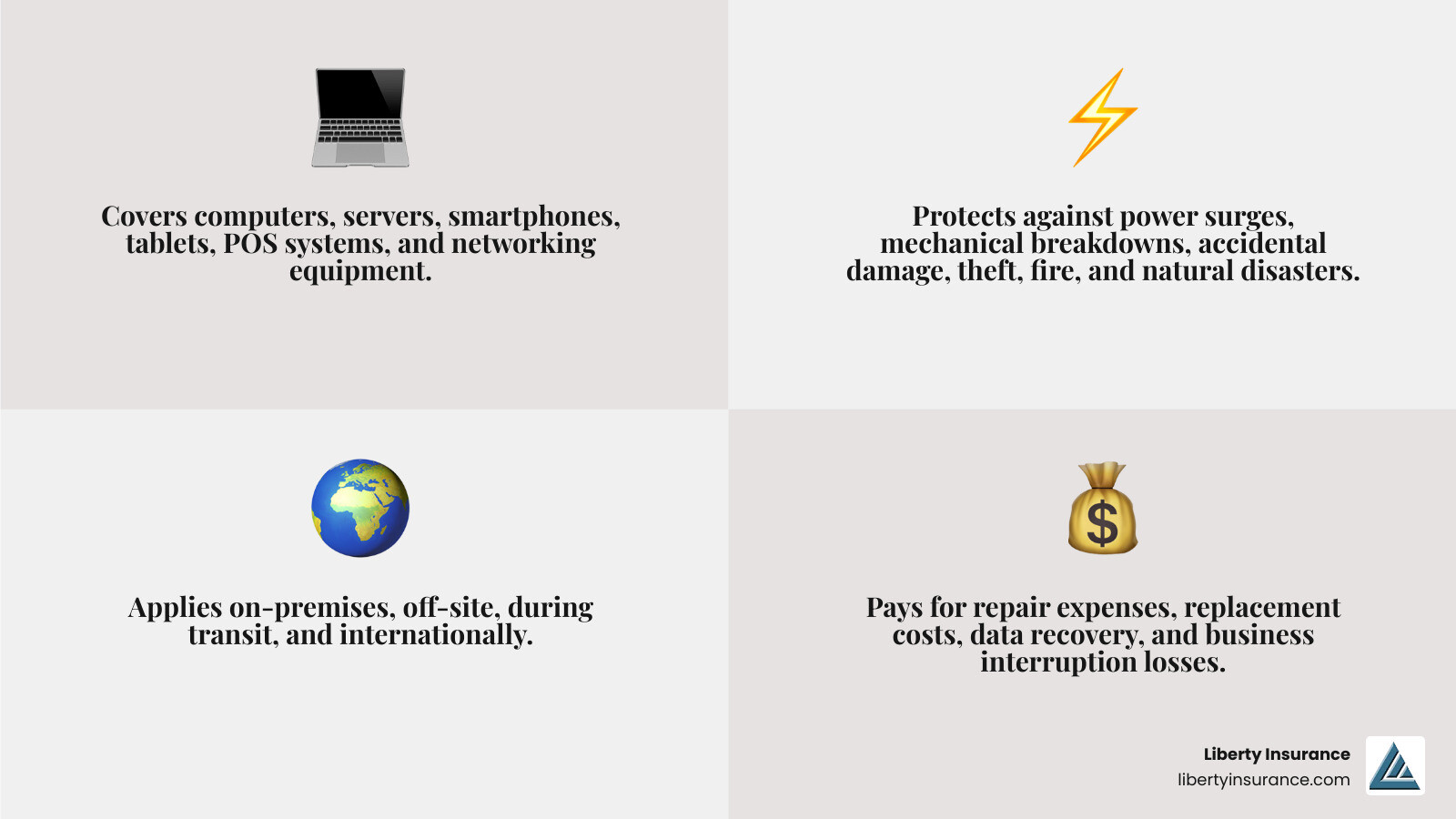
Simple guide to electronic equipment coverage:
Understanding Electronic Equipment Coverage

When we talk about electronic equipment coverage, we are looking at a specialized form of insurance designed to protect the “brains” of your business. In the modern New Jersey business landscape—whether you’re operating a tech startup in Princeton, a logistics hub in New Brunswick, or a retail storefront in Toms River—your computers, servers, and specialized tech are more than just tools; they are the lifeblood of your operations. If these systems fail, your ability to serve customers, process payments, and manage employees vanishes instantly. The interconnected nature of modern business means that a failure in one department, such as a shipping terminal, can quickly paralyze the entire supply chain.
Standard commercial property insurance is excellent for “named perils” like fire or windstorms. However, it often leaves a gaping hole when it comes to internal failures. If a circuit board simply fries itself due to an internal short or a server experiences a mechanical seizure, a standard policy might say “sorry, not covered” because there was no external force like a fire. That is where equipment breakdown insurance steps in. It functions as an asset protection layer that covers the sudden and accidental breakdown of technology, regardless of whether the cause was external or internal. This distinction is vital because, statistically, internal failures and power-related issues are far more common than catastrophic fires or floods.
At Liberty Insurance, we often help business owners add this as a policy endorsement. Think of it as an upgrade to your existing insurance that ensures that if your tech stops working, your business doesn’t. This is particularly important for businesses in Millstone Township and Trenton, where local infrastructure and weather patterns can sometimes lead to unexpected power fluctuations. You can even check out these comparison charts of Liberty Insurance coverage options to see how these endorsements fit into a larger risk management strategy. By integrating this coverage, you are essentially building a more resilient business model that can withstand the technical hiccups that are inevitable in a high-tech world.
Key Benefits of Electronic Equipment Coverage
The primary benefit is, of course, financial reimbursement. When a high-end server fails, you aren’t just out the cost of the hardware; you’re looking at labor costs for installation, software reconfiguration, and setup. Our coverage often includes:
- Repair Guarantees: Ensuring that repairs are done to professional standards by certified technicians, preventing further damage from shoddy workmanship. This is critical because modern electronics are highly sensitive; a poor repair job can lead to recurring issues or even fire hazards.
- Replacement Costs: If the device is totaled or the cost of repair exceeds its value, the policy helps cover the cost of a brand-new, modern equivalent. This is vital because technology moves fast; you don’t want to be reimbursed for the value of a 5-year-old laptop when you need a new one to run modern software. We focus on “like kind and quality,” ensuring your business doesn’t take a step backward in capability.
- Peace of Mind: Knowing that a $10,000 equipment failure won’t derail your monthly cash flow or force you to dip into your emergency reserves. This allows business owners to focus on growth and strategy rather than worrying about the “what ifs” of hardware failure.
- Expediting Expenses: In some cases, coverage can pay for the extra costs of rushing repairs or shipping replacement parts overnight to get you back in business faster. This can include overtime pay for technicians or air freight charges for critical components sourced from overseas.
- Business Income Protection: Some advanced policies can compensate you for the revenue lost while your critical systems were down. If your e-commerce server is offline for 48 hours, the lost sales can be more damaging than the cost of the server itself.
Covered Devices and Hardware
What exactly can you protect? The list is longer than you might think. We cover everything from the laptop on your desk to the specialized machinery in your Millstone Township facility. Common items include:
- Office Tech: Laptops, desktops, tablets, and even high-end monitors and docking stations.
- Infrastructure: Servers, networking gear, routers, switches, and mainframes that form the backbone of your local area network (LAN).
- Operations: POS systems, printers, copiers, scanners, and 3D printers used in prototyping or manufacturing.
- Specialized Gear: Medical electronics (like MRI or X-ray machines), telecommunications equipment, and laboratory devices used for research and development.
- Environmental Controls: Smart thermostats, security cameras, and HVAC control systems that protect other sensitive electronics by maintaining optimal operating conditions.
If it plugs into a wall or runs on a battery and is essential for your work, you should learn more about insuring business equipment to ensure nothing is left vulnerable. Protecting the hardware is the first step in a comprehensive business continuity plan that keeps your doors open regardless of technical setbacks.
What Does Electronic Equipment Coverage Protect Against?
The “what” is just as important as the “how.” Electronic equipment coverage is designed to handle the specific threats that electronics face—threats that don’t always involve a visible fire or a broken window. In fact, the most common causes of electronic failure are often invisible to the naked eye until the machine refuses to turn on. Understanding these risks allows you to better prepare your physical environment while ensuring your insurance policy is tailored to the most likely scenarios.
Protection Against Power Surges and Breakdowns
Power surges are the silent killers of modern business. Whether it’s a voltage spike from a utility company during a storm in Trenton or an internal short circuit caused by a faulty component in a New Brunswick office, these events can brick an entire office’s worth of gear in milliseconds. Standard surge protectors are often insufficient for the massive spikes that can occur during grid switching or lightning strikes. Furthermore, many business owners don’t realize that “micro-surges” occur dozens of times a day, slowly degrading the sensitive capacitors and processors inside high-end electronics until they eventually fail prematurely.
Internal failures are also a major concern. We often see unexpected equipment failure caused by mechanical breakdown or electrical disturbances. Remember the $18,341 repair example from the intro? That wasn’t just a random number; it was the real cost of a power surge affecting a boiler, security system, and media equipment simultaneously. With the right electrical surge protection and insurance, that bill becomes a manageable claim rather than a business-ending catastrophe. This coverage is essential because it addresses the “mechanical breakdown” exclusion found in almost every standard property policy, which assumes that if a machine stops working, it’s simply due to old age or poor maintenance—an assumption that is often incorrect in the world of high-tech circuitry.
Coverage for Accidental Damage and Theft
Accidents happen, especially in fast-paced work environments. Industry data indicates that average repair claims for minor electronic damage often hover around $430—often for things as simple as a cracked screen or a spilled coffee. While $430 might not seem like much, if five employees have accidents in a year, that’s over $2,000 in unbudgeted expenses. In a larger organization, these “minor” incidents can aggregate into a significant financial leak that drains the IT budget.
One of the most valuable aspects of this coverage is that it often follows you. If your sales team is traveling from Trenton to an international conference, or if you have remote workers in Toms River using company laptops, they are protected against:
- Accidental Drops: Shattered screens and internal impact damage that occurs during travel, site visits, or daily use in the field.
- Liquid Spills: The classic “coffee on the keyboard” scenario that can short out a motherboard instantly. This also includes damage from leaking pipes or overhead sprinklers.
- Theft: Stolen laptops from vehicles, hotel rooms, or co-working spaces (subject to policy limits). This is a critical component for the modern mobile workforce where equipment is frequently exposed to higher risks than it would be in a secured office.
- Natural Disasters: While standard property insurance covers fire, electronic equipment coverage can provide more specific valuations for tech damaged by smoke, heat, or the water used to extinguish a fire. It can also cover damage from earthquakes or floods if those specific endorsements are added.
- Vandalism: Protection against intentional damage caused by third parties, which can be particularly important for retail businesses with public-facing kiosks or POS terminals.
According to the U.S. Bureau of Labor Statistics, workplace environments are constantly evolving, and with that evolution comes new risks to the physical assets we use to perform our jobs. The rise of hybrid work models has significantly increased the “surface area” of risk, as equipment is now moved between homes, offices, and transit hubs daily. Ensuring your tech is covered against both the “big” disasters and the “small” accidents is the hallmark of a smart business owner who understands that operational continuity depends on hardware availability.
Comparing Coverage: Liberty Insurance Options and Service Contracts
Many business owners ask us: “Isn’t this just a service contract?” Not exactly. While manufacturer warranties and service contracts have their place, they are often limited to “defects in workmanship.” They won’t help you if a lightning strike fries your motherboard or if a pipe bursts and soaks your server rack. Furthermore, service contracts often have long wait times for repairs, whereas insurance allows you to choose your repair vendor to get back up and running faster. Service contracts also typically exclude any form of consequential loss, such as the data recovery costs or lost business income that often accompany a hardware failure.
| Feature | Manufacturer Warranty | Retail Service Contract | Liberty Insurance Coverage |
|---|---|---|---|
| Mechanical Breakdown | Yes (Limited time) | Yes | Yes |
| Power Surge | No | Sometimes | Yes |
| Accidental Damage | No | Often extra | Yes |
| Theft/Loss | No | No | Yes |
| Data Recovery | No | No | Optional Endorsement |
| Business Income Loss | No | No | Optional Endorsement |
| Choice of Repairer | No | No | Yes |
As you can see, our solutions provide a much broader safety net. For a deeper dive into how these systems interact, check out our systems breakdown insurance guide. We focus on the total impact on your business, not just the individual device. This holistic approach ensures that you aren’t just getting a check for a new computer, but you’re getting the support needed to restore your entire digital ecosystem to its pre-loss state.
Electronic Data Processing (EDP) and Specialized Coverage
For businesses that rely heavily on data—like tech firms in Princeton or medical offices in New Brunswick—standard coverage might not be enough. This is where Electronic Data Processing (EDP) insurance comes in. EDP is a specialized form of electronic equipment coverage that focuses not just on the hardware, but the “invisible” assets that make the hardware valuable. In many cases, the data stored on a $2,000 server is worth millions to the company, yet standard property insurance treats the data as having no physical value.
- Data Recovery: The cost to reconstruct lost research, customer databases, or financial records after a crash. This includes the labor costs for data entry professionals and IT specialists who must manually rebuild files from backups or forensic fragments.
- Software Protection: Coverage for proprietary programs, operating systems, and the labor required to reinstall and reconfigure them. Many modern software suites require complex licensing and setup that can take days to restore.
- Media Storage: Protection for external hard drives, network servers, and the physical media used to store backups. If your backup tapes are damaged in the same event that destroyed your primary server, EDP can be a lifesaver.
- Cyber-Physical Overlap: While not a replacement for Cyber Liability, EDP can cover physical damage to hardware caused by a cyber-attack (such as a hacker overclocking a processor until it melts).
With over 3,000 data breach incidents reported for small and midsize businesses annually in recent years, protecting the data side of your tech is just as critical as protecting the hardware. An electrical system failure can lead to corrupted data, and EDP helps bridge that financial gap by covering the specialized labor needed for data reconstruction. This is especially important for businesses subject to regulatory compliance (like HIPAA or GDPR), where data integrity is a legal requirement.
Choosing the Best Electronic Equipment Coverage for Your Business
Choosing the right plan depends on how you use your gear. At Liberty Insurance, we look at your specific workflow to recommend the best fit. We don’t believe in one-size-fits-all insurance; your coverage should reflect the unique way you generate value.
- Business Owner’s Policy (BOP): Best for small to mid-sized businesses needing a bundle of general liability and property insurance. We can add equipment breakdown as a cost-effective endorsement. This is the most common starting point for NJ businesses.
- Inland Marine: Essential if your equipment frequently leaves your main office (like laptops, cameras, or mobile diagnostic tools). This provides “floater” coverage that stays with the item wherever it goes, whether it’s in a car, a plane, or a client’s office.
- Commercial Property: The foundation for protecting your physical assets in New Jersey, covering the items that stay within your four walls. This is ideal for businesses with heavy stationary equipment like server farms or manufacturing tech.
We recommend a customizable equipment protection plan that allows you to set limits based on the actual value of your inventory, ensuring you aren’t overpaying for coverage you don’t need or under-insured for the tech you do have. Regular audits of your equipment list can help keep your premiums accurate and your coverage relevant as you upgrade your technology.
Costs, Limits, and Exclusions
How much will this set you back? The cost of electronic equipment coverage is surprisingly affordable when compared to the cost of replacement. When you consider that a single high-end MacBook or server can cost more than an entire year of premiums, the ROI is clear. For most businesses, the cost of insurance is a predictable line item that prevents unpredictable, budget-busting disasters.
- Average Premiums: A comprehensive Business Owner’s Policy (BOP) for an electronics-heavy business in New Jersey averages about $1,917 a year, or roughly $160 a month. This includes your general liability and property protection alongside equipment coverage. For very small startups, these costs can be even lower.
- General Liability: Stand-alone plans for very small operations can be as low as $76 a month, though these often lack the robust equipment protections of a BOP. We usually advise against these bare-bones plans for businesses that rely on technology.
- Deductibles: Most policies feature a deductible, often around $500 per occurrence. This helps keep your monthly premiums lower while ensuring you are covered for major losses. Some specialized policies for high-value medical equipment may have higher deductibles to further reduce premium costs.
- Claim Limits: While some basic retail protection plans have low limits like $2,000 per claim, commercial policies through Liberty Insurance can offer occurrence limits up to $100,000 or more depending on your needs. This is crucial for businesses with server rooms, specialized medical equipment, or high-end creative suites.
Common Policy Exclusions and Limitations
No insurance policy covers everything. It is important to be realistic about what is excluded so you can manage those risks through maintenance and security. Understanding exclusions is a key part of a professional risk management strategy:
- Wear and Tear: If a laptop simply gets old, slow, and the battery doesn’t hold a charge like it used to, that’s not a “breakdown.” That is expected depreciation. Insurance is designed for sudden and accidental events, not the inevitable march of time.
- Lack of Maintenance: If you don’t clean your cooling fans and the server overheats due to dust buildup, the claim might be denied. Insurance is for accidents, not neglect. We recommend keeping a maintenance log for high-value equipment.
- Cosmetic Defects: Scratches on a casing, dents, or minor screen blemishes that don’t affect the actual function of the device aren’t covered. If the device still works perfectly, the insurance company generally won’t pay for a replacement just because it looks used.
- Software Viruses: While EDP covers some data-related threats, standard equipment insurance usually excludes damage from viruses, malware, or “bugs.” These are typically handled under a separate Cyber Liability policy, which we also offer.
- Pre-existing Conditions: You can’t buy a policy today to cover a laptop that you dropped yesterday. Insurance must be in place before the loss occurs.
- Intentional Acts: Damage caused intentionally by the business owner or an authorized representative is never covered and can lead to policy cancellation and legal action.
How to File a Claim for Electronic Damage
If disaster strikes in Millstone Township or any of our service areas, the process for equipment damage insurance is straightforward. Following these steps carefully will help ensure your claim is processed quickly and accurately:
- Document the Damage: Take clear, high-resolution photos of the equipment and the surrounding area. If there was a power surge, note the time and any weather conditions. Keep the damaged item; do not throw it away until the adjuster has given you permission.
- Get an Estimate: Have a professional technician provide a written repair estimate. This should detail the cause of failure if possible, as this helps the insurance company determine if it was a covered peril like a surge or an excluded issue like wear and tear.
- Adjuster Assessment: An insurance adjuster may inspect the item to verify the cause of loss and ensure it falls under a covered peril. For smaller claims, this might be done virtually through photos and video.
- Valuation: Your payout will depend on whether you have Actual Cash Value (depreciated value) or Replacement Value (cost of a new item) coverage. We almost always recommend Replacement Value for electronics, as tech depreciates incredibly fast. A three-year-old computer might be worth very little on the open market, but replacing it with a functional equivalent will still cost you full price. Having the right valuation method is the difference between being back in business and being out of pocket.
Frequently Asked Questions about Electronic Equipment Coverage
Does coverage apply to used or older electronics?
Yes! Most electronic equipment coverage plans, including those we offer at Liberty Insurance, cover electronics regardless of age, provided they were in good functional condition when the policy started. This is a major advantage for businesses that use refurbished gear or legacy systems that are no longer under manufacturer warranty. However, keep in mind that if you have an “Actual Cash Value” policy, the payout for a 5-year-old laptop will be significantly lower than a new one. We recommend reviewing your inventory annually to ensure your limits match your current tech stack and that you have the right valuation type for older but essential gear.
Is my equipment covered while traveling or off-premises?
In many cases, yes, provided you have the right endorsements. This is a huge advantage over home warranties or standard office policies. Whether it’s a laptop used by a sales rep in a New Brunswick coffee shop or a business tablet used on a business trip to another country, “off-premises” endorsements provide global protection. This is vital for the modern mobile workforce in places like Toms River and Princeton. If your employees frequently work from home, ensure your policy specifically includes “off-premises” or “Inland Marine” coverage to bridge the gap between the office and the home workspace.
What is the difference between Actual Cash Value and Replacement Cost?
This is the most important distinction in your policy, and it can mean the difference between a $200 check and a $2,000 check. Understanding this can save your business from a major financial shortfall.
- Actual Cash Value (ACV): Reimburses you for what the item is worth today (original cost minus depreciation). Because electronics lose value so quickly, ACV often leaves business owners with a significant funding gap when they need to buy new gear. It’s essentially the “garage sale” value of your equipment.
- Replacement Cost: Pays for a brand-new version of the same or similar equipment. You’d get the full amount needed to buy a current model that performs the same functions. This is the gold standard for business insurance because it ensures you can return to full operational capacity without dipping into your own funds. While Replacement Cost has slightly higher premiums, it is the only way to ensure full financial recovery after a loss in the fast-moving world of technology.
Can I cover leased equipment?
Absolutely. In fact, most leasing agreements require you to carry insurance on the equipment as part of the contract. We can list the leasing company as an “additional insured” or “loss payee” on your policy to satisfy your contractual obligations while protecting your business from the liability of damaged leased gear. This ensures that if a leased copier or server is damaged, the insurance company pays the leasing firm directly, clearing your debt and allowing you to lease a replacement.
Does this cover damage from a cyber attack?
Standard electronic equipment coverage focuses on physical damage. If a hacker deletes your files but your server is physically fine, that is a Cyber Liability claim. However, if a cyber event causes physical damage—such as a virus that causes a machine to overheat and melt its components—some advanced EDP policies may provide coverage. For full protection, we recommend pairing equipment coverage with a robust Cyber Liability policy to cover both the hardware and the digital threats.
How often should I update my equipment list?
We recommend a formal review at least once a year, or whenever you make a significant capital investment in new technology. If you buy $20,000 worth of new workstations and don’t tell your agent, you might exceed your policy limits, leaving you under-insured if a major event like a fire or large power surge occurs. A quick email to your Liberty Insurance agent with a copy of your new equipment invoices is usually all it takes to keep your protection up to date.
Conclusion
In an era where business is conducted via the cloud and managed through high-powered servers, your technology is your most vulnerable asset. From power surges in Princeton to accidental spills in Millstone Township, the risks to your hardware are everywhere. A single voltage spike shouldn’t be the reason your business faces a financial setback or a permanent closure. The complexity of modern electronics means that when they fail, they fail completely, and the cost of restoration is often far higher than business owners anticipate.
At Liberty Insurance, we specialize in protecting New Jersey businesses from the unexpected. We understand that your technology is more than just a collection of circuits and screens; it is the engine of your productivity and the vault for your most valuable data. Whether you need to bundle your tech protection into a comprehensive Business Owner’s Policy or require specialized inland cargo insurance for equipment in transit, we have the local expertise to build a plan that fits your specific needs and budget. We pride ourselves on being more than just an insurance provider; we are your partners in risk management, helping you identify vulnerabilities before they become expensive problems.
We understand the unique challenges of the NJ business environment—from the coastal risks in Toms River to the urban infrastructure challenges in Trenton—and are here to help you mitigate risk effectively. Our goal is to provide you with the confidence to invest in the latest technology, knowing that your investment is shielded by a policy designed for the digital age.
Ready to protect your tech? Contact Liberty Insurance today to discuss electronic equipment coverage options and get a quote custom to your business. Let us help you ensure that your business remains resilient, responsive, and ready for whatever the future holds.

