
Understanding the High-Stakes Role of a Trustee
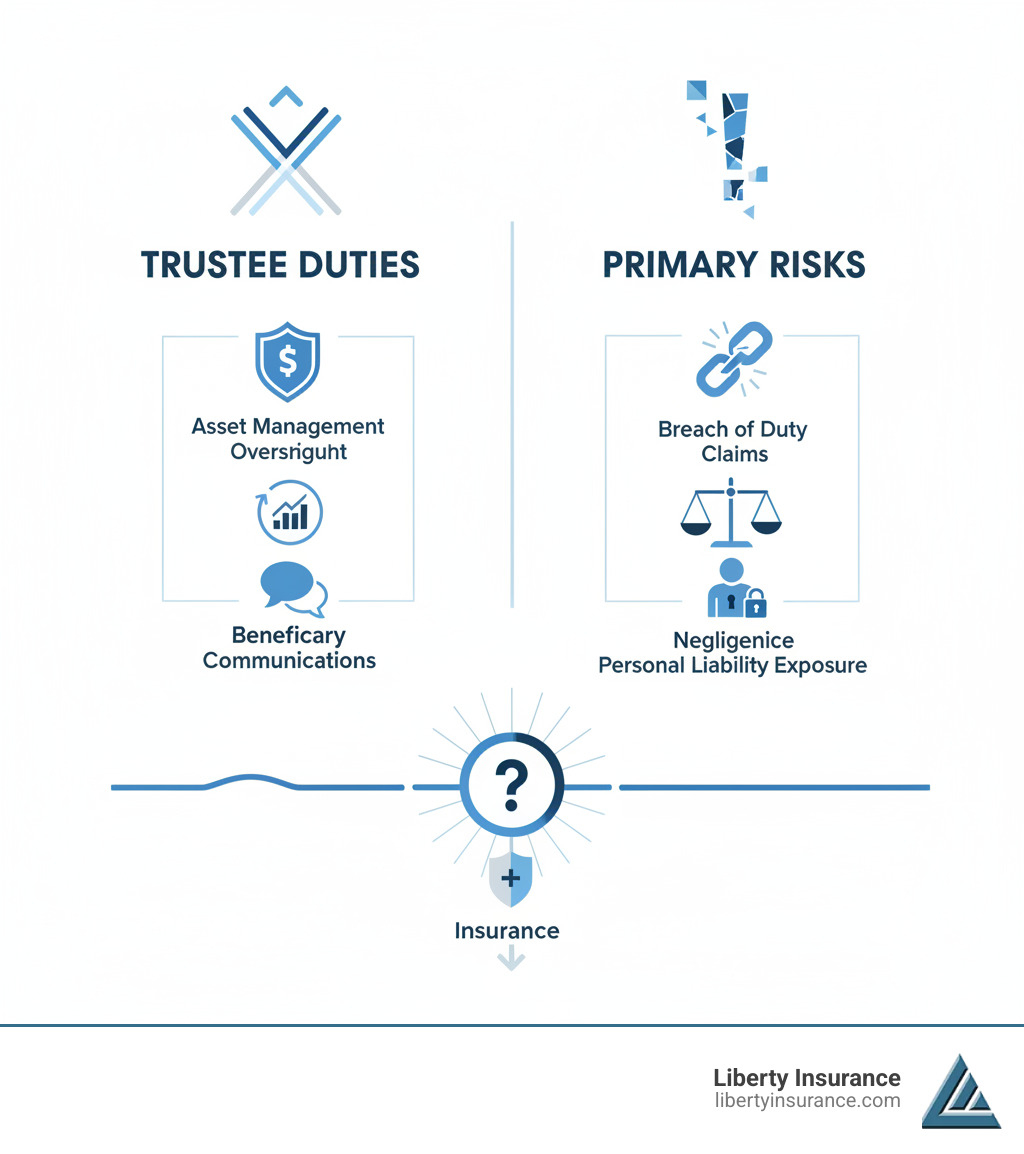
Accepting the role of a trustee means taking on a fiduciary duty to act in the best interests of beneficiaries. This high-stakes responsibility also comes with substantial personal liability. Trustees can be held personally responsible for mismanagement of assets, poor investment decisions, improper distributions, and conflicts of interest.
Without proper protection, your personal assets—home, savings, and investments—are at risk from beneficiary lawsuits. Trustee liability insurance is a specialized policy designed to shield you from this risk. It covers legal defense costs, settlements, and judgments for claims of negligence, breach of duty, or errors in managing trust assets.
This coverage is essential for individual and professional trustees, guardians, and conservators. As the 2021 lawsuit involving the Milton Hershey School Board shows, even trustees acting in good faith can face intense legal scrutiny. Proper insurance provides the peace of mind needed to fulfill your duties effectively.
I’m Andrew Harris, a Certified Insurance Counselor specializing in trustee liability insurance for over a decade. I’ve seen how this coverage is a critical tool for anyone managing a trust.
Why Every Trustee Faces Significant Personal Liability
When you become a trustee, you accept a fiduciary responsibility to act in the beneficiaries’ best interests. This legal standard is incredibly high, and it means your personal assets are directly on the line if something goes wrong. Unlike many professional roles, a mistake in managing a trust can put your home, savings, and retirement accounts at risk.

This risk is amplified by joint and several liability. If you serve as a co-trustee, you can be held responsible for the entire amount of damages, even if another trustee made the critical error. Without trustee liability insurance, you are personally backstopping the trust’s financial risks. Even if a lawsuit is unfounded, legal defense costs alone can be financially devastating, often running into hundreds of thousands of dollars.
Common Trustee Errors and Omissions
Even the most well-intentioned and diligent trustees can face allegations. Trust administration is a minefield of complex financial, legal, and interpersonal challenges. Mistakes, or even decisions that appear to be mistakes in hindsight, can lead to serious claims.
- Negligence: This is a broad category that includes failing to exercise the care an ordinarily prudent person would. Examples include not responding to beneficiary inquiries in a timely manner, failing to properly secure trust property (like real estate or valuable art), or not staying informed about changes in trust and tax law.
- Mismanagement of assets: This is one of the most common sources of litigation. It can involve making poor investment decisions that are not aligned with the trust’s stated goals, failing to diversify a portfolio (e.g., holding a large, concentrated stock position), or holding onto underperforming assets for too long out of sentiment or inaction.
- Improper accounting: Fiduciaries have a strict duty to account for their actions. This means keeping meticulous, accurate records of all income, expenses, and distributions. Commingling trust funds with personal or business accounts is a cardinal sin and can lead to immediate liability. Failing to provide regular, clear accountings to beneficiaries can also breed suspicion and lawsuits.
- Failure to follow trust documents: The trust document is your rulebook. Deviating from its specific instructions, even with what you believe are good intentions, is a breach of duty. This could mean making a distribution for a purpose not authorized by the trust or failing to make a required distribution on time.
- Conflicts of interest: A trustee must act with undivided loyalty to the beneficiaries. Engaging in self-dealing is strictly prohibited. This includes actions like hiring your own business to provide services to the trust, selling trust assets to yourself or a relative (even at what you think is a fair price), or making investment decisions that benefit you personally over the beneficiaries.
- Improper distributions: Many trusts give the trustee discretion to make distributions for a beneficiary’s “health, education, maintenance, and support” (HEMS). Misinterpreting these standards or making distributions that are seen as too lavish or too restrictive can lead to challenges from other beneficiaries who feel their interests are being harmed.
- Failure to gain favorable tax treatment: A trustee has a duty to manage the trust in a tax-efficient manner. This includes making timely tax filings, understanding the tax implications of investment decisions, and taking advantage of tax-saving opportunities, such as specific elections that can minimize estate or income taxes for the trust and its beneficiaries.
The lawsuit filed by a board member against the Milton Hershey School over its financial management highlights how even professional managers of massive trusts face intense litigation over their fiduciary decisions.
Who Can Sue a Trustee?
The list of potential plaintiffs is broader than many trustees realize, extending far beyond just the primary beneficiaries. Anyone with a financial stake in the trust’s performance can potentially bring a claim.
- Beneficiaries: This is the most common source of claims. Disputes often arise in family trusts where emotions, grief, and finances mix. Current income beneficiaries may sue for higher payouts, while remainder beneficiaries (those who inherit later) may sue to preserve the principal, creating an inherent conflict.
- Creditors: If the trust owes money to a third party, that creditor has a claim on trust assets. If you mismanage the trust and impair its ability to pay its debts, creditors can sue you personally to recover what they are owed.
- Charities: For charitable remainder trusts or private foundations, the designated charity is a beneficiary. If the charity believes you are not managing the assets prudently to maximize its future interest or are not following the charitable purpose, it may file suit.
- Government agencies: The IRS and state tax authorities can pursue trustees personally for unpaid trust-related taxes, along with substantial penalties and interest.
- Co-trustees: Disagreements over management strategy, investment choices, or distribution decisions can lead one co-trustee to sue another for an alleged breach of duty, either to compel action or to seek damages for mismanagement.
- Remainder beneficiaries: These individuals or entities have a vested interest in the long-term health of the trust. They will scrutinize your actions—especially investment strategies and principal distributions—to ensure their future inheritance is not being squandered by decisions that only benefit the current beneficiaries.
What is Trustee Liability Insurance and Who Needs It?
Trustee liability insurance is your financial safeguard in the complex world of trust management. Also known as Errors & Omissions (E&O) coverage, this policy protects your personal wealth—not the trust’s assets—if you are accused of a mistake in your fiduciary duties. It ensures that a lawsuit doesn’t jeopardize your home, savings, or investments.
Defining Trustee Liability Insurance
This insurance is essentially professional malpractice coverage designed specifically for trustees. It activates when a claim alleges a wrongful act, which can include honest mistakes, oversights, or decisions that resulted in financial harm.

Key coverage includes:
- Defense costs: Legal fees can be substantial, even for meritless claims.
- Settlements: Funds to resolve a claim out of court.
- Judgments: Payments ordered by a court if you are found liable.
The policy covers claims of breach of duty, negligence, and misleading statements. If your actions as a trustee are alleged to have cost someone money, this insurance is designed to protect you.
Who Is Covered by a Policy?
This coverage is vital for anyone in a fiduciary role, regardless of whether they are a professional or a family member. It typically protects:
- Individual and family trustees
- Professional trustees (attorneys, accountants, financial advisors)
- Co-trustees (protecting against joint and several liability)
- Uncompensated trustees (who face the same liability as paid trustees)
- Guardians and conservators
- Receivers managing businesses in financial distress
How Different Trust Types Affect Your Insurance Needs
The type of trust you manage directly impacts your liability risk and insurance needs. Some trusts carry higher intrinsic risks than others due to their complexity, purpose, or beneficiary structure.
- Irrevocable family trusts: These are often high-risk due to complex family dynamics and emotional disputes. The trustee is frequently caught between the needs of current income beneficiaries and the interests of future remainder beneficiaries, making investment and distribution decisions a tightrope walk.
- Testamentary trusts: Created upon someone’s death through their will, these trusts carry the risk of interpreting a deceased person’s wishes, which can be contentious among heirs. Ambiguous language in the will can lead to significant legal battles over the grantor’s intent.
- Living trusts: While the initial grantor often serves as trustee, liability shifts to the successor trustee upon the grantor’s death or incapacitation. This successor may face intense scrutiny for any changes in management or for how they handle the final distribution of assets.
- Charitable trusts: These involve a dual compliance duty: to the trust document and to the public benefit mission. Trustees must navigate complex tax regulations and may be subject to oversight by the state’s Attorney General, who acts on behalf of the public to ensure the charity’s purpose is fulfilled.
- Special needs trusts: These require extremely careful management to provide for a disabled beneficiary without jeopardizing their eligibility for crucial government benefits like SSI and Medicaid. A single improper distribution can have catastrophic consequences for the beneficiary’s care.
- Bankruptcy and liquidating trusts: These are high-pressure environments where the trustee’s primary duty is to liquidate assets and satisfy creditors under court oversight. Decisions are constantly scrutinized by creditors, bankruptcy courts, and other stakeholders, making litigation risk exceptionally high.
The size and complexity of trust assets—such as concentrated stock positions, commercial real estate, or private business interests—also play a major role in determining your risk and the appropriate level of coverage.
Decoding Your Policy: Coverage, Costs, and Key Considerations
Understanding your trustee liability insurance policy is critical to ensuring proper protection. While details can seem complex, an experienced insurance professional can help tailor a policy to your specific needs. For broader business protection, explore more info about Business Insurance.
How Trustee Liability Insurance Works in Practice
Trustee liability (also called Trustee E&O) is typically a claims-made policy. Coverage is triggered when a claim is first made against you during the policy period, regardless of when the act occurred, as long as it’s after the retroactive date.
Key terms to understand:
- Retroactive date: The earliest date for which coverage applies. Maintain continuous coverage to protect this date.
- Claim: Usually includes written demands, lawsuits, arbitration demands, and sometimes regulatory investigations.
- Wrongful act: Any actual or alleged error, omission, negligence, or breach of fiduciary duty as a trustee.
Claims-made vs. Claims-made-and-reported: The latter is more restrictive, requiring both the claim and report within the policy period. Missing the reporting deadline can void coverage.
Defense Provisions That Matter
The mechanics of your defense are as important as coverage limits:
- Duty to defend vs. reimbursement: Some policies obligate the insurer to defend you directly; others reimburse your costs.
- Choice of counsel: Many require pre-approved panel counsel. Negotiate if you have a preferred attorney.
- Consent to settle: Policies require your consent but include a “hammer clause” – refusing reasonable settlements may increase your liability.
- Defense inside vs. outside limits: If defense costs erode limits (inside), long cases can exhaust coverage for settlements.
- Allocation: How costs are split between covered and uncovered claims or parties.
- Severability: Protects innocent insureds if another insured misrepresents facts.
Common Exclusions You Should Understand
All policies include exclusions. Common ones include:
- Fraud or intentional misconduct: Often requires final court adjudication
- Personal profit: Illegal personal advantage claims
- Bodily injury and property damage: Covered by Commercial General Liability Insurance
- Insured vs. insured: Claims between co-insureds may be limited
- Prior acts/knowledge: Claims from before retroactive date or known circumstances
- ERISA/benefit plans: Requires separate Fiduciary Liability Insurance
- Cyber breaches: Consider Cyber Liability Insurance
- Contractual liability: Claims based solely on contract assumptions
Important Endorsements to Consider
- Additional insured scheduling: Ensures all co-trustees are covered
- Worldwide coverage: For international assets or beneficiaries
- Extended reporting period (tail): Essential when stepping down from trustee role
- Tax penalties sublimits: Limited coverage for tax-related losses
- Special needs trust endorsement: Custom for unique compliance requirements
How is the Cost of Trustee Liability Insurance Determined?
Premiums typically start at a few thousand dollars annually but vary based on:
- Trust size and value: Larger trusts mean greater potential liability
- Asset complexity: Real estate, private equity, or art collections are riskier than stocks and bonds
- Beneficiary structure: More beneficiaries and family conflicts increase risk
- Trustee experience: Proven track records can lower premiums
- Claims history: Previous lawsuits raise costs
- Policy limits and deductibles: Higher coverage and lower deductibles increase premiums
Factors you can influence:
- Governance and recordkeeping: Written investment policies and clear minutes demonstrate prudence
- Use of professionals: Documented reliance on qualified advisors reduces perceived risk
- Regular accountings: Frequent reporting to beneficiaries reduces surprises and lawsuits
Who Pays for the Insurance?
In most cases, the trust pays the premium as a reasonable administrative expense. Most trust documents explicitly allow this or contain broad language covering such expenses.
If the trust document is silent, get approval from the grantor or beneficiaries before using trust funds. If the trust cannot pay, factor the cost into your trustee fees. Learn more about Professional Liability Insurance.
Selecting the Right Limits and Deductible
Consider these factors when choosing coverage:
- Trust assets: Higher values and concentrated positions suggest higher limits
- Beneficiary profile: Contentious dynamics warrant more protection
- Defense costs: Complex litigation can consume hundreds of thousands in fees
- Court venue: Certain jurisdictions have higher costs
Practical approaches:
- Scenario testing: Estimate potential defense plus settlement costs
- Layered limits: Combine primary and excess policies for cost-effective higher limits
- Deductible calibration: Choose a retention you can absorb without stress
How to Apply: Underwriting and Documentation
Expect underwriters to request:
- Completed application with trust details
- Trust document and amendments
- Investment policy statement
- Financial statements and asset schedules
- Advisor roster
- Historical accountings
- Claims/loss history
Tips for smooth underwriting:
- Be organized: Present clear documentation
- Emphasize controls: Show calendars, policies, and approval workflows
- Highlight independence: Use of third-party professionals
- Address past issues: Explain lessons learned from any disputes
Claims and Notice: What to Do When Something Goes Wrong
Time is critical. Upon receiving any demand or complaint:
- Notify immediately: Contact your insurer and broker
- Preserve documents: Implement a litigation hold
- Follow notice provisions: Send to correct addresses per policy
- Provide facts, not admissions: Let counsel address liability
- Don’t settle prematurely: Consent typically rests with insurer
- Coordinate with co-trustees: Align communications while respecting conflicts
If stepping down, secure tail coverage for claims made later.
Coordinating With Other Policies
Avoid gaps by understanding policy interactions:
- Personal umbrella: Doesn’t cover professional fiduciary acts
- Professional malpractice: Often excludes trustee services unless endorsed
- D&O insurance: Protects corporate directors, not trust administration
- Fiduciary liability: Covers employee benefit plans, not personal trusts
- Cyber: Consider for electronic beneficiary records
Real-World Claim Examples
- Diversification dispute: Trustee retained concentrated position; beneficiaries alleged failure to diversify after market drop. Defense exceeded $450,000; settlement reached mid-trial.
- Distribution ambiguity: Discretionary distribution challenged as excessive. Defense costs were main exposure, resolved through mediation.
- Valuation error: Outdated appraisal led to over-distribution claim. Policy funded corrective settlement.
- Tax oversight: Missed election caused penalties. Some policies offer limited coverage for tax-related losses.
Key Considerations When Purchasing
Pay attention to these critical features:
- Policy limits: Standard $1 million may be insufficient for larger trusts
- Deductibles: Balance premium savings with out-of-pocket risk
- Claims-made vs. claims-made-and-reported: Former is generally broader
- Retroactive date: Maintain continuous coverage to avoid gaps
- Tail coverage: Essential protection after trustee duties end
- Policy exclusions: Understand what isn’t covered
Additional tips:
- Ask about defense provisions and severability
- Ensure all trustees are properly named
- Compare quotes on equal terms
- Plan for continuity and avoid coverage gaps
Trustee Liability vs. Other Management Policies
It’s easy to confuse trustee liability insurance with other management liability policies. Understanding the distinctions is crucial to avoid dangerous coverage gaps. Each policy is designed for a specific role and protects against unique risks.
| Policy Type | Who is Insured | What is Covered | Primary Purpose |
|---|---|---|---|
| Trustee Liability Insurance | Individual trustees, co-trustees, guardians, receivers | Errors, omissions, negligence, breach of duty in managing a trust’s assets. | Protects the personal assets of an individual trustee from lawsuits stemming from their fiduciary duties related to an individual trust. |
| D&O Insurance | Directors and Officers of a corporation/organization | Wrongful acts (breach of duty, misrepresentation, mismanagement) in their capacity as corporate leaders. | Protects the personal assets of corporate directors and officers from lawsuits related to their management of the company, often covering decisions that impact shareholders, employees, or regulators. |
| Fiduciary Liability Insurance | Fiduciaries of employee benefit plans (e.g., 401k) | Breach of fiduciary duty related to the administration and investment of employee benefit plans. | Protects fiduciaries and the plan assets from claims of mismanagement or imprudent investment decisions regarding employee benefit plans, ensuring compliance with ERISA and similar regulations. |
Trustee E&O vs. Fiduciary Liability Insurance
Though both policies involve fiduciary duties, their applications are entirely different. Trustee E&O insurance is for managing individual trusts—like family, charitable, or special needs trusts. It protects your personal assets from claims by beneficiaries regarding your management of their trust.
In contrast, Fiduciary Liability Insurance is for the corporate world, specifically for those who oversee employee benefit plans like 401(k)s or pension funds. This coverage addresses risks related to the Employee Retirement Income Security Act (ERISA) and protects plan fiduciaries from claims by plan participants. The core distinction is individual trusts vs. employee benefit plans.
Trustee Liability vs. Directors & Officers (D&O) Insurance
This distinction comes down to the entity being managed. As a trustee, you manage a trust’s assets for its beneficiaries according to a trust document. Trustee liability insurance protects you from claims related to these duties.
Directors and Officers (D&O) Liability Insurance, however, protects board members and officers of a corporation or nonprofit. They are accountable to shareholders, regulators, and other stakeholders for their business decisions. A D&O policy will not cover your duties as a trustee, and vice versa. The key difference is managing a trust vs. managing a company.
Frequently Asked Questions about Trustee Insurance
Many trustees have similar questions when first exploring trustee liability insurance. Here are answers to the most common concerns.
The trust document indemnifies me. Isn’t that enough protection?
An indemnification clause offers some protection, but it has significant gaps. It is not a substitute for insurance.
- It has limits: Most clauses do not cover allegations of gross negligence or intentional misconduct, leaving you to fund your own defense until proven innocent.
- The trust may lack funds: If trust assets are illiquid or depleted by a lawsuit, the promise to indemnify you is worthless.
- Reimbursement is often delayed: Indemnification may only apply after a court rules in your favor, meaning you must pay for your defense out-of-pocket for years.
- Conflicts can arise: Beneficiaries suing you may also challenge the trust’s duty to indemnify you.
Insurance provides an independent source of funds dedicated to your defense from day one.
I’m a co-trustee with a large bank. Won’t their insurance cover me?
This is a dangerous assumption. An institutional trustee’s policy typically only covers its own employees. As an independent co-trustee, you are likely not covered.
Under joint and several liability, you can be held 100% responsible for a mistake, even if the bank was at fault. In a lawsuit, the bank’s insurer will defend the bank, not you. This can lead to a bifurcation of defense, where you are left to hire and pay for your own attorney while the bank is fully represented. A personal policy is the only way to guarantee your own interests are protected.
What other insurance should a professional trustee consider?
For those operating a professional trustee practice, a comprehensive insurance program is essential. In addition to trustee liability, consider:
- Commercial General Liability Insurance: Covers basic business risks like slip-and-fall accidents or property damage.
- Cyber Liability Insurance: Protects against data breaches involving sensitive client financial and personal information.
- Business Crime Insurance: Covers losses from employee dishonesty, such as theft or embezzlement.
- Attorney Malpractice Coverage: If you are an attorney, ensure your policy doesn’t exclude your work as a trustee. A separate trustee liability policy is often necessary to cover this distinct professional service.
Conclusion: Protect Yourself While Protecting Others

Serving as a trustee is a profound act of trust, but it puts your personal assets on the line every day. A lawsuit, even a baseless one, can threaten your home, savings, and financial future. Legal defense costs alone can be financially crippling.
Trustee liability insurance is the solution. For a modest annual premium, it provides a powerful shield, covering legal fees, settlements, and judgments. This protection is far more reliable than trust indemnification clauses or assumptions about a co-trustee’s coverage.
This insurance isn’t just about protecting your wealth; it’s about giving you the confidence to manage the trust effectively without the constant fear of personal ruin. You can make sound decisions and act in the beneficiaries’ best interests, knowing you are secure.
Don’t wait until a claim is filed. These policies are “claims-made,” meaning coverage must be in place when a claim arises. Your willingness to serve as a trustee is commendable; ensure you have the protection you deserve. Learn more about Fiduciary Liability Insurance and let us help you secure the peace of mind to focus on what matters most.

