
Understanding Captive Insurance: The Basics
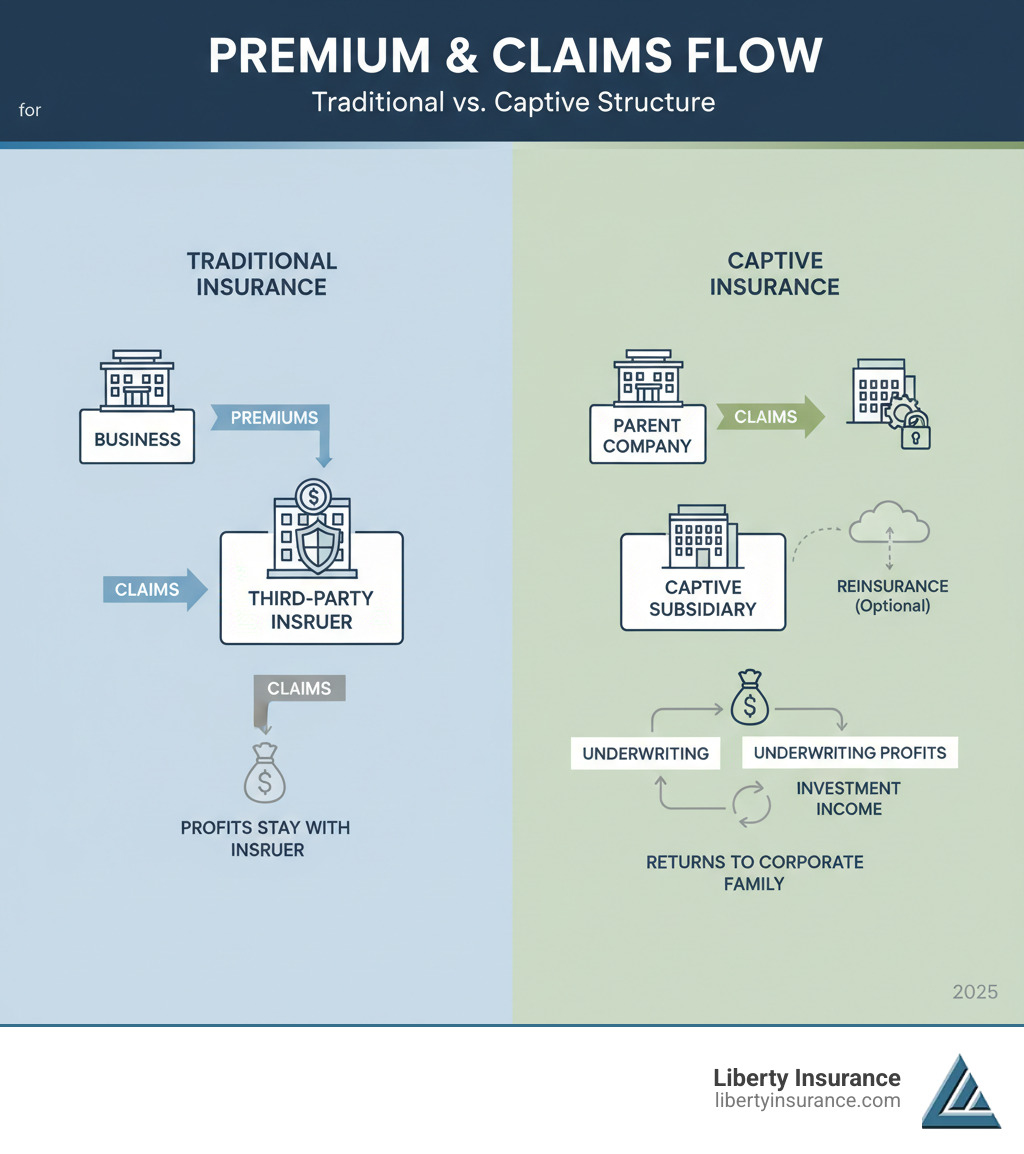
Captives insurance is a form of self-insurance where a company creates its own licensed insurance company to cover its own risks. Instead of paying premiums to a third-party insurer, a business forms a wholly-owned subsidiary that acts as its insurer. This structure allows the parent company to retain underwriting profits, customize coverage, and gain direct control over its risk management strategy.
This alternative risk transfer (ART) strategy has seen explosive growth. Today, over 7,000 captives operate globally, a significant increase from roughly 1,000 in 1980. The model is so effective that approximately 90% of Fortune 500 companies now have captive subsidiaries, and captives write over half of all property and casualty premiums.
The term “captive” was coined by Frederic M. Reiss in the 1950s to describe an insurance company that was “captive” to its parent company’s needs. While traditionally used by large corporations, modern captive structures are now accessible to smaller and mid-sized businesses looking to more efficiently protect their equipment, inventory, and operations.
I’m Andrew Harris, a Certified Insurance Counselor (CIC) and Accredited Advisor in Insurance (AAI) with Liberty Insurance. I’ve spent years helping businesses steer complex risk management strategies, including captives insurance solutions. My experience provides insight into when captives are a powerful tool and when traditional insurance remains the better option.
What is Captive Insurance and How Does It Differ from Traditional Insurance?
A captives insurance company is a licensed insurance subsidiary created by a parent company to insure its own risks. It flips the traditional insurance model on its head. Instead of paying premiums to an outside company that profits from your business, you create your own insurer. The premiums, underwriting profits, and investment income stay within your corporate family.

This isn’t an accounting trick; a captive is a legitimate, regulated insurance company. The key difference is that you are both the insured and the insurer, which changes the dynamics of control and cost.
- Control: With a captive, you design your own policies. If you have unique risks that traditional markets won’t cover or will only cover at a high price, you can create coverage custom to your specific needs.
- Cost: Traditional insurers have high overhead (marketing, executive salaries, shareholder profits) that can consume 40% or more of your premium. Captives operate much leaner, with expense ratios often between 15% and 30%. This efficiency translates into direct savings.
- Stability: Captives provide insulation from the volatility of the commercial insurance market. During “hard markets,” when premiums spike and coverage shrinks, a captive offers consistent pricing and availability.
- Profit: All underwriting profits and investment income generated by the captive belong to you, rewarding good risk management directly.
More info about Insurance for Business Owners
The Core Motivations for Forming a Captive
Businesses form captives for several strategic reasons that go beyond simple premium savings.
- Cost Reduction: Companies with strong safety records and low claims are often overpaying in the traditional market. A captive allows them to retain the underwriting profit and investment income that would otherwise go to an insurer.
- Customized Coverage: A captive can provide coverage for risks that are unavailable or prohibitively expensive in the commercial market, such as supply chain disruptions, intellectual property, or certain environmental liabilities.
- Risk Management Control: Captive owners direct their own claims process and loss control programs, leading to better outcomes and a culture of safety that aligns with their business philosophy.
- Direct Reinsurance Access: As a licensed insurer, a captive can access the global reinsurance market directly, often securing better pricing and broader capacity for catastrophic risks.
Forming a captive is a shift from viewing insurance as a mere expense to treating it as a strategic asset that generates value.
More info about Commercial Risk Insurance
Managing Emerging and Hard-to-Insure Risks
One of the most powerful uses of captives insurance is covering risks that traditional markets struggle with. Commercial insurers are often slow to adapt to new threats, leaving businesses exposed.
- Cyber Liability: As cyber threats evolve, a captive can provide custom coverage for ransomware, data breaches, and regulatory fines that may be excluded from standard policies.
- Supply Chain Disruptions: A captive can be structured to cover losses from specific supplier failures or transportation breakdowns that are often not covered by traditional business interruption policies.
- Intellectual Property & Reputational Damage: These intangible but highly valuable assets can be protected through a captive, covering risks like brand damage or IP infringement claims.
- Pandemic & Environmental Risks: Captives offer a framework to fund and formalize coverage for complex risks like future pandemics or specific pollution liabilities that commercial policies often exclude.
A captive provides the agility to address these risks proactively, rather than waiting for the traditional market to catch up.
A Spectrum of Solutions: Types of Captives Insurance Companies
There is no one-size-fits-all captives insurance solution. Captive structures vary based on ownership, how risks are shared, and the capital required. Choosing the right structure is critical for success.

Let’s review the main types of captives, from the most common to more specialized arrangements.
More info about Types of Business Insurance
Single-Parent (Pure) Captives
A single-parent captive (or pure captive) is the classic model: one company owns an insurance subsidiary to insure its own risks and those of its affiliates. This structure offers maximum control over coverage, claims, and investments. However, the parent company assumes all the risk and must provide all the capital, making it best suited for large corporations with significant premium volume and predictable losses.
Group and Association Captives
For businesses that lack the scale for a pure captive, a group captive is an excellent alternative. Multiple, often unrelated companies in a similar industry (e.g., construction, healthcare) pool their resources to form an insurance company they collectively own. This approach spreads risk and shares the costs of capital and administration. Governance is typically handled by a board of representatives from the member companies.
Cell Captives (PCCs and SCCs)
Cell captives, often called “rent-a-captives,” offer a lower-cost entry point into the captive world. A sponsor establishes a core insurance company and then “rents” out separate, legally protected cells to individual businesses. The assets and liabilities of each cell are ring-fenced, meaning one participant’s losses cannot affect another’s. The sponsor handles the capital and administrative burden, making this an ideal structure for smaller businesses or those wanting to test the captive concept.
Information on Protected Cell Captives
Other Specialized Captive Structures
Beyond the main types, several specialized structures exist:
- Risk Retention Groups (RRGs): Created by federal law, RRGs are member-owned insurance companies that can provide liability coverage nationwide after being licensed in a single state. They cannot write property insurance.
- Special Purpose Captives (SPCs): These are highly customized vehicles designed to insure a single, specific risk or facilitate a particular financial transaction.
- Branch Captives: A U.S.-based branch of an offshore captive, allowing it to write certain U.S. business, such as employee benefits under ERISA, that requires an onshore presence.
- Micro-Captives (Section 831(b)): These are small captives that, if they meet certain premium limits, receive favorable tax treatment on underwriting income. However, they have faced intense IRS scrutiny, and anyone considering this option must work with experienced advisors to ensure the structure is a legitimate insurance company, not a tax avoidance scheme.
Building Your Own Insurer: Establishment and Operations
Creating a captives insurance company is a deliberate, multi-step process, much like constructing a custom building. It requires a solid blueprint, a team of specialists, and a clear vision. While complex, the process is manageable with experienced partners and can fundamentally transform your company’s approach to risk.

The Formation Roadmap: Key Steps and Considerations
Forming a captive involves a series of carefully orchestrated steps:
- Feasibility Study: An independent consultant analyzes your risk profile, claims history, and financial capacity to determine if a captive is a viable and beneficial solution. This is the critical first step before committing significant resources.
- Business Plan & Actuarial Analysis: If the study is positive, a detailed business plan is created. This roadmap outlines the captive’s purpose, structure, and financial projections. Concurrently, an actuary analyzes historical data to determine appropriate premiums, reserves, and capital levels.
- Capitalization: Your captive must be funded with sufficient capital and surplus to meet regulatory requirements and pay claims. The amount varies by domicile and the risks insured.
- Assembling a Team: You will need a team of service providers, including a captive manager (for day-to-day operations), legal counsel, an accountant, an actuary, and an investment manager.
- Licensing: Finally, a formal application is submitted to the regulators in your chosen domicile. Once approved, your captive is officially a licensed insurance company.
More info about New Jersey Business Insurance
Choosing a Domicile for Your Captives Insurance
Your domicile—the jurisdiction where your captive is licensed and regulated—is a critical decision. It shapes capital requirements, tax obligations, and operational flexibility. Key factors include:
- Regulatory Environment: You want a domicile with experienced, practical regulators who understand the captive business model. Some are known for being more business-friendly, while others have more rigorous oversight.
- Tax Implications: Tax laws for premiums, investment income, and profits vary significantly between jurisdictions. These differences can have a substantial impact on your captive’s financial performance.
- Onshore vs. Offshore: Offshore domiciles like Bermuda, the Cayman Islands, and Guernsey are traditional leaders with deep expertise and sophisticated regulatory frameworks. However, onshore U.S. domiciles like Vermont, Delaware, Utah, and Tennessee have become highly competitive, offering the advantage of operating under U.S. law, which can simplify legal and financial oversight for U.S.-based parent companies. The choice often depends on the parent company’s global footprint and specific tax considerations.
The right domicile aligns with your captive’s structure, risk profile, and long-term strategy.
A Business Lawyer’s Guide to Captive Insurance
Regulatory Frameworks and Ongoing Management
Forming a captive is just the beginning. It must be managed as a fully licensed insurance company subject to continuous regulatory oversight. This is not a “set it and forget it” strategy.
Key management responsibilities include:
- Solvency and Compliance: Your captive must maintain minimum capital and surplus levels mandated by your domicile. It must also submit regular financial statements and actuarial opinions to regulators.
- Underwriting and Claims: A disciplined underwriting process is needed to assess risks and set actuarially sound premiums. Claims administration must be efficient and fair, whether handled internally or by a third-party administrator (TPA).
- Investment Management: The captive’s assets must be invested according to a clear policy that adheres to regulatory guidelines and generates returns while maintaining liquidity.
- Board Governance: A board of directors, typically comprising parent company executives, provides strategic oversight, reviews financial performance, and ensures regulatory compliance.
With the right team and systems, managing a captive becomes a routine part of corporate operations that delivers significant strategic value.
Navigating the Challenges and the Reinsurance Market
While captives insurance offers significant advantages, it’s a serious commitment. Understanding the potential challenges and the role of the reinsurance market is crucial for success.
More info about Corporate Coverage
Potential Risks and the Tax and Regulatory Maze
Forming a captive comes with real challenges that demand careful consideration.
- Capital Commitment: A captive requires substantial upfront capital and ongoing surplus to remain solvent. This is a significant financial commitment, even though the capital remains an asset of the parent company.
- Risk of Large Losses: Your captive directly assumes risk. An unexpectedly bad year of claims can strain its finances. Unlike with traditional insurance, where the insurer absorbs large losses, your captive’s losses are ultimately your own.
- Operational Complexity: Running an insurance company involves underwriting, claims management, regulatory compliance, and more. It is a long-term commitment that requires ongoing engagement from your management team.
- IRS Scrutiny: The IRS is highly vigilant, particularly with smaller captives. For a captive to qualify as “insurance” for tax purposes, it must demonstrate genuine risk transfer (the captive assumes real risk) and risk distribution (the risk is spread across a sufficient number of exposures). Risk distribution is critical because the law of large numbers is a fundamental principle of insurance; by pooling a large number of independent risks, the insurer can more accurately predict losses. Arrangements that fail these tests may be deemed self-funding masquerading as insurance, resulting in disallowed deductions and penalties. Micro-captives under I.R.C. § 831(b) have been a particular focus of IRS audits due to past abuses.
IRS Notice on Micro-Captive Transactions
How Captives Interact with the Reinsurance Market
A captive doesn’t have to bear all its risk alone. Most successful captives insurance programs use reinsurance, which is essentially insurance for insurance companies. This strategic partnership is fundamental to modern captive operations.
Reinsurance allows a captive to cede, or transfer, a portion of its risk to a large, professional reinsurer. This serves two key purposes:
- Managing Volatility: By transferring catastrophic risk to a reinsurer, a captive can cap its potential losses from a single large event or a bad claims year. This protects the captive’s capital and stabilizes its financial performance.
- Accessing Capacity: Reinsurers have vast capital reserves, allowing a captive to insure larger or more complex risks than it could handle on its own. This expands the captive’s capabilities.
Many captives also use a fronting arrangement, where a traditional insurer issues a policy and then transfers the risk back to the captive via a reinsurance agreement. This allows the captive to operate in jurisdictions where it isn’t licensed, using the fronting carrier’s licenses and network.
By strategically using reinsurance, a captive can improve its solvency, meet regulatory requirements, and operate with greater security and ambition.
The Evolving Landscape and Future of Captives Insurance
Captives insurance has evolved from a niche strategy into a mainstream risk management tool. The industry’s growth from around 1,000 captives in 1980 to over 7,000 today reflects a fundamental shift in how businesses view insurance—not as a sunk cost, but as a strategic asset to be controlled and optimized.

Market Evolution and Current Trends
Growth in the captive market often accelerates during “hard” commercial insurance markets, when high premiums and reduced coverage push businesses to seek alternatives. The recent hard market has sparked another wave of interest, but today’s captives are also expanding into new frontiers.
- New Lines of Coverage: Captives are increasingly used to cover employee benefits, providing multinational companies with greater control and cost savings. They are also being used to address emerging risks like climate change litigation and supply chain sustainability under the ESG (Environmental, Social, and Governance) umbrella.
- Innovative Products: Captives are ideal vehicles for parametric insurance, which pays a predetermined amount based on a specific trigger (e.g., earthquake magnitude) rather than a lengthy claims adjustment process.
- Data and Analytics: Advanced data analytics and AI are making captive operations more efficient and accurate, improving everything from underwriting and pricing to claims management.
More info about Business Asset Protection Ultimate Guide
The Future Outlook for Captives Insurance
The future of captives insurance appears bright, driven by several key forces.
- Middle Market Growth: The rise of accessible structures like cell captives is democratizing the concept, making it a viable option for mid-sized businesses, not just Fortune 500 giants.
- Insurtech Integration: Technology is streamlining captive administration, making it cheaper, faster, and more transparent. This will further lower the barrier to entry for a broader range of companies.
- Strategic Role in ERM: Captives are evolving from simple financing vehicles into central pillars of Enterprise Risk Management (ERM). They are being used to proactively identify, mitigate, and monitor risks across the entire organization.
- Increased Sophistication: The industry will continue to mature, with captives employing more complex reinsurance arrangements and investment strategies. Competition among domiciles will also drive innovation, benefiting captive owners.
The trajectory is clear: captives will continue to grow as businesses seek greater control over their risk management destiny.
Conclusion
We’ve explored captives insurance, from its basic definition as a self-owned insurance company to its strategic role in modern risk management. A captive transforms insurance from a mandatory expense into a powerful financial asset.
By forming a captive, your business gains unparalleled control to customize coverage, improves financial efficiency by retaining underwriting profits and investment income, and achieves stability against volatile market cycles. It’s a solution that allows you to address emerging and hard-to-insure risks that traditional markets often avoid.
However, this path is not for everyone. A captive demands a significant capital commitment, a long-term strategic vision, and meticulous attention to regulatory and tax compliance. The IRS is vigilant in ensuring these are legitimate insurance operations, not tax avoidance schemes. Getting it wrong can lead to serious financial consequences.
This is why expert guidance is non-negotiable. A successful captive requires a dedicated team of specialists—including captive managers, actuaries, attorneys, and accountants—to steer the complex landscape and ensure the structure is sound and compliant.
At Liberty Insurance, we understand that every business’s risk profile is unique. Whether you’re a large corporation or a growing mid-market company, captives insurance could offer the control and financial benefits you need to take charge of your risk destiny. For the right business with the right guidance, it can be a transformative strategy.

