
Why Property Damage Coverage Matters for Your Business
Property damage coverage is a crucial type of liability insurance that pays for damage you cause to someone else’s property when you’re at fault. For any business, from a solo contractor to a multi-vehicle fleet, the risk of causing property damage is a daily reality. Whether you’re driving a company vehicle, operating equipment on a job site, or running a business from a leased space, this coverage protects you from the staggering costs of repairs, replacements, and potential legal battles that can arise from a single accident.
This coverage is a form of third-party liability, meaning it protects others from damage you cause. It is designed to cover damage to other people’s vehicles, buildings, fences, equipment, and even intangible losses like business income. It does not, however, cover damage to your own property. For small business owners, property damage coverage is a fundamental component found in both commercial auto and general liability policies. These policies work in tandem to create a financial shield, protecting your business assets from being liquidated to cover a claim.
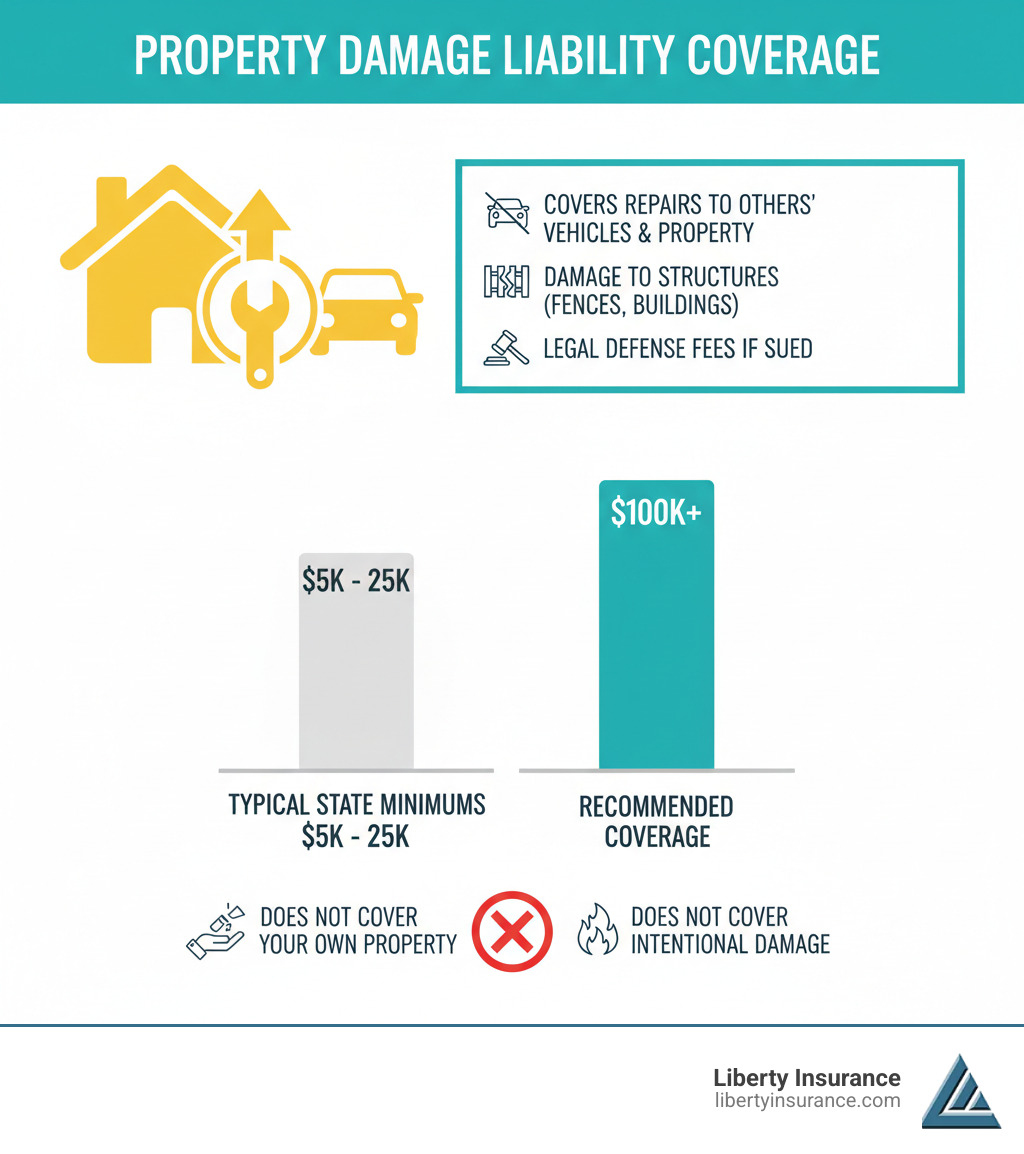
While nearly every state legally requires a minimum amount of property damage liability for vehicles, these limits are often dangerously low. For example, California requires just $5,000 and Florida mandates $10,000. Considering that the average new car price exceeds $48,000 and even minor collisions involving modern vehicles with advanced sensors can cost over $10,000 to repair, relying on state minimums is a high-stakes gamble that provides almost no meaningful protection for your business assets.
I’m Andrew Harris, a Certified Insurance Counselor with over 15 years of experience dedicated to helping business owners navigate the complexities of commercial insurance. I’ve seen firsthand how inadequate property damage coverage can cripple a thriving business after one unfortunate incident. In this comprehensive guide, I’ll break down what this essential liability coverage includes, how to determine the right coverage amount for your specific risks, how it compares to other policies, and how to confidently manage the claims process when accidents happen.
What is Property Damage Liability?
Property damage liability is a type of insurance that pays for the repair or replacement of someone else’s property that you damage in an at-fault incident. It is strictly third-party protection, meaning it covers financial losses incurred by other people or other businesses, not your own. If you are a contractor and you accidentally back your truck into a client’s garage door, this coverage pays to repair the door. To cover the dent in your own truck, you would need a separate first-party coverage like collision insurance. While most commonly associated with auto insurance, where it is legally required in most states, property damage liability is also a cornerstone of homeowners and commercial general liability policies.
- In auto insurance, it covers damage your insured vehicle causes to other cars, buildings, fences, mailboxes, guardrails, or any physical property that isn’t yours. This applies to both personal and commercial auto policies.
- In homeowners insurance, the personal liability section includes property damage protection for non-auto incidents. For example, if a tree from your yard falls and crushes your neighbor’s prized garden shed, or your teenager hits a baseball through their picture window, this coverage would apply.
- In business insurance, a Commercial General Liability (CGL) policy includes property damage coverage to protect your company if your operations, products, or services cause damage to a third party’s property. This is critical for a contractor in Edison, NJ, whose employee accidentally damages expensive flooring while working in a client’s home, or for a manufacturer whose faulty product causes a fire in a customer’s warehouse.
Without this coverage, you or your business would be personally and directly responsible for repair bills, legal fees, and other associated costs. These expenses can escalate into tens or even hundreds of thousands of dollars, posing a severe threat to your financial stability. You can learn more about the legal definition of property damage.
What Does Property Damage Coverage Include?
When you are found legally liable for an accident, property damage coverage pays for a wide and varied range of expenses up to your policy limit. It’s more than just fixing a dented bumper.
- Repair or replacement costs for another person’s vehicle and other tangible property, such as a stone mailbox, custom landscaping, or expensive decorative fencing.
- Damage to physical structures, including homes, storefronts, garages, sheds, lampposts, utility poles, and public infrastructure. The cost to repair a commercial building facade or replace a specialized utility pole can be substantial.
- Loss of Use costs. If you damage someone’s vehicle, your policy may cover the cost of a rental car for them while their vehicle is being repaired. If you damage a business’s property, it may cover their lost income while they are forced to close for repairs.
- Debris removal costs. After an accident, there are often costs associated with cleaning up the site, which can be covered.
- Legal defense fees if you’re sued for the damage. This is a critical benefit. Your policy typically covers attorney fees, court costs, and expert witness fees, protecting you from devastating legal expenses even if the lawsuit is ultimately found to be without merit.
What is Not Covered by Property Damage Liability?
Understanding the exclusions is just as important as knowing what’s covered. These are common areas of confusion that can lead to unexpected out-of-pocket costs.
- Your own vehicle or property. This is the most common misconception. Property damage liability only pays for the other party’s repairs. To protect your own vehicle, you need first-party coverages like Comprehensive Auto Coverage or collision insurance.
- Intentional acts. Insurance is designed to cover accidents (occurrences). If you deliberately damage someone’s property, it is considered a criminal act, not an insurable event.
- Damage from racing or illegal activities. If you cause damage while engaged in street racing, driving under the influence, or other illicit activities, your insurance carrier will almost certainly deny the claim.
- Business use of a personal vehicle. A standard personal auto policy often excludes coverage if you are using your vehicle for commercial purposes, such as making deliveries in Trenton, NJ, or driving for a rideshare service. You typically need a commercial policy or a special endorsement.
- Damage to your own work or product. A general liability policy will not pay to fix faulty workmanship you performed or replace a defective product you sold. It only covers the consequential damage your faulty work or product causes to other property.
- Electronic data. The loss, corruption, or restoration of electronic data is typically not considered “property damage” under standard policies, even if the physical device (like a server) is damaged. Cyber liability insurance is needed for this exposure.
- Property in your care, custody, or control (CCC). This is a critical exclusion for many businesses. If you are a mechanic in Millstone Township, NJ, and you damage a customer’s car while it’s in your shop, a standard general liability policy will not cover it because the car is in your CCC. You would need a special endorsement called garagekeepers liability. Similarly, a warehouse operator needs bailee coverage for customer goods.
Property Damage Liability vs. Other Key Coverages
Navigating insurance policies can feel like learning a new language, with many terms sounding frustratingly similar. Let’s clarify the distinct roles of property damage coverage, bodily injury liability, collision insurance, and comprehensive insurance. The simplest way to remember the difference is that liability coverages (property damage and bodily injury) protect other people from harm you cause, while physical damage coverages (collision and comprehensive) protect your own property.
| Feature | Property Damage Liability | Bodily Injury Liability | Collision Insurance | Comprehensive Insurance |
|---|---|---|---|---|
| Whose loss is covered? | Others’ vehicles and property | Other people’s medical bills and lost wages | Your own vehicle | Your own vehicle |
| What types of incidents are covered? | Damage you cause to others’ property in an at-fault accident | Injuries or death you cause to others in an at-fault accident | Damage to your car from a collision with another vehicle or object, or a rollover | Damage to your car from non-collision events (theft, fire, flood, hail, animal strikes) |
| Is it typically required? | Yes, by law in most states | Yes, by law in most states | No, but often required by lenders | No, but often required by lenders |
| Is there a deductible? | No | No | Yes | Yes |
The Role of Bodily Injury Liability
Often sold together with property damage liability as the core of any liability policy, bodily injury liability covers the costs associated with injuries or death that you or your business cause to another person. This includes medical expenses, rehabilitation costs, long-term nursing care, and lost wages. It also covers legal fees if you are sued for those injuries. Given the astronomical cost of medical care, carrying high limits for bodily injury liability is just as critical, if not more so, than for property damage.
The Role of Collision Insurance
Collision insurance is first-party coverage that pays for repairs or replacement for your vehicle when it’s damaged in a collision, regardless of who is at fault. This includes accidents with other cars, hitting a stationary object like a guardrail or pillar, or if your vehicle rolls over. For example, if you drive your work van in Millstone Township, NJ, and scrape it against a brick wall, your collision insurance pays to fix your van (after your deductible), while your property damage liability would cover the cost to repair the wall. While not legally required by the state, any lender or leasing company will insist on it for financed or leased vehicles. For businesses that depend on their vehicles to generate revenue, collision coverage is essential. We help business owners integrate this into their Business Auto Insurance plans.
Understanding Comprehensive Insurance
Comprehensive insurance, sometimes called “other than collision” coverage, protects your vehicle from damage caused by events that are not driving-related accidents. This includes a wide array of perils such as theft, vandalism, fire, floods, hail, falling objects, and hitting an animal. If your business vehicle is stolen from a job site in New Brunswick, damaged by a hailstorm, or its windshield is cracked by a flying rock on the highway, comprehensive insurance handles the repair or replacement costs (after your deductible). Like collision, it’s optional unless required by a lender, but it provides crucial protection against a wide range of unpredictable risks. For businesses in New Jersey’s coastal areas concerned about water damage, we also offer specialized Flood Insurance.
What About Uninsured/Underinsured Motorist (UM/UIM) Coverage?
This is a vital but often misunderstood coverage. What happens if someone else hits you and they either have no insurance (uninsured) or not enough insurance to cover your damages (underinsured)? That’s where Uninsured/Underinsured Motorist (UM/UIM) Coverage steps in. It is a first-party coverage that you buy to protect yourself from irresponsible drivers. It can cover both your medical bills (UM/UIM Bodily Injury) and, in some states, the damage to your vehicle (UM Property Damage or UMPD). Relying on others to be properly insured is a risky strategy; UM/UIM ensures you’re protected regardless of the other driver’s choices.
How Much Property Damage Coverage Do You Need?
Choosing the right amount of property damage coverage is one of the most critical financial decisions a business owner can make. It’s about protecting your business from a catastrophic loss, not just satisfying a legal checkbox. The uncomfortable truth is that state-mandated minimums are a safety net with massive holes, rarely sufficient to cover the real-world costs of a moderate accident, let alone a serious one.

State minimums for property damage liability vary widely and are often shockingly low:
- California: $5,000
- New Jersey: $25,000 (Basic Policy offers $5,000)
- Pennsylvania: $5,000
- Florida: $10,000
- Texas: $25,000
- Massachusetts: $5,000
A minor collision with a luxury vehicle or a modern car equipped with sophisticated sensors and cameras can easily result in a repair bill exceeding $15,000. If you cause a multi-car pileup, damage a commercial building, or strike municipal infrastructure like a traffic light system, these minimums won’t even make a dent in the total cost. For business owners in areas like Princeton, NJ, where property values are high, relying on minimums is a gamble with your company’s future. Commercial policies can offer limits of $1,000,000 or more, providing a much more realistic level of protection.
Factors to Consider When Choosing Your Limit
Determining your ideal coverage limit requires a thoughtful risk assessment. Consider these factors:
- Your Business Assets: The more you have to lose, the more you need to protect. Tally the value of your business assets (cash, equipment, property) and your personal assets. A lawsuit can target both.
- Your Industry: A construction company operating heavy machinery has a much higher risk profile than a home-based graphic designer. Your limit should reflect your daily operational risks.
- Vehicle & Equipment Use: Consider the size and weight of your vehicles. A heavy-duty truck can cause far more damage than a small sedan. Also, consider where and how often they are driven. High-mileage operations in dense urban areas require higher limits.
- Contractual Requirements: Many clients, especially larger corporations and government entities, will require you to carry specific liability limits (often $1,000,000 or more) before they will sign a contract with you.
- Financial Profile: Simply put, can your business absorb a $50,000, $100,000, or $500,000 judgment? If the answer is no, you need higher limits.
How to Find and Read Your Coverage Limits
Your policy’s declarations page is the summary of your coverage. For auto insurance, you’ll often see liability limits in a split-limit format like 100/300/100. Here’s how to decode it:
- $100,000: The maximum for bodily injury liability per person.
- $300,000: The maximum total for all bodily injuries per accident.
- $100,000: Your property damage coverage limit per accident.
This third number is your shield against property damage claims. If you cause $75,000 in damage, you’re covered. If the damage is $125,000, you’re personally on the hook for the extra $25,000. Some policies, particularly commercial ones, use a Combined Single Limit (CSL). A $500,000 CSL policy provides a single pool of money that can be used for all bodily injury and property damage claims from one accident, offering more flexibility. If you’re confused by your Insurance Policy, we’re here to help.
What Happens if Damage Exceeds Your Coverage?
When the damage you cause exceeds your policy limit, you are personally and legally responsible for the difference. If you have a $25,000 limit but cause $75,000 in damages, the claimant’s insurance company will pay their client and then their lawyers will come after you and your business for the remaining $50,000.
If you can’t pay, the damaged party can sue you, obtain a judgment, and legally compel you to pay. This can lead to courts ordering wage garnishment, placing liens on property, or seizing assets—including business accounts, equipment, personal savings, investments, and even your home. For a business, a large judgment could force liquidation or bankruptcy. This is why we consistently recommend coverage limits well above state minimums. For businesses and individuals with significant assets, an Umbrella Liability Insurance policy is essential. It provides an extra layer of protection, typically in increments of $1 million, that sits on top of your primary auto and general liability policies and kicks in when their limits are exhausted.
The Property Damage Claim Process
An accident is stressful, but knowing the claims process can help you navigate the aftermath with clarity and confidence. While procedures vary slightly between insurers, the fundamental steps for a property damage claim are consistent.
- Prioritize Safety and Call for Help. Your first priority is the well-being of everyone involved. Secure the area to prevent further harm. If it’s a car accident, move vehicles out of traffic if safe, turn on hazard lights, and call 911 if there are injuries or significant damage.
- Exchange Information. Calmly get the full name, address, phone number, and insurance information (company name and policy number) from all drivers and property owners involved. Note vehicle details like make, model, and license plate.
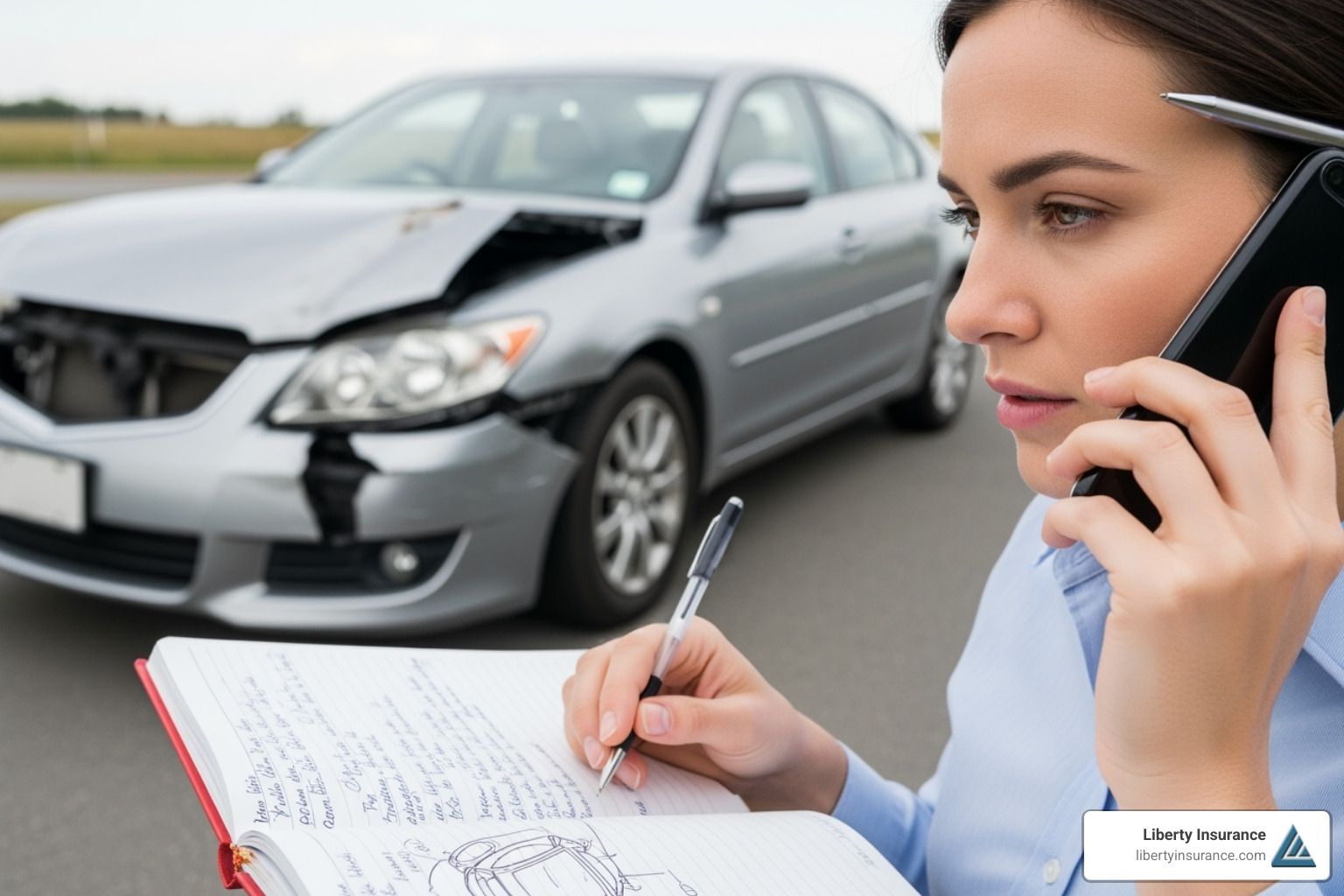
- Document Everything Meticulously. Use your phone to take extensive photos and videos. Capture the damage to all vehicles and property from multiple angles, the overall scene, skid marks, traffic signals, and any relevant factors like weather conditions. Write down the date, time, location, and a detailed, factual description of what happened while it’s fresh in your mind.
- Report the Claim Promptly. Contact your insurance company or agent as soon as possible, ideally within 24 hours. As Study.com advises, “You should contact your insurance company or agent as soon as possible after the damage occurs.” Prompt reporting is often a policy condition and helps expedite the entire process.
- Cooperate with the Adjuster. An insurance adjuster will be assigned to your claim. Their job is to investigate the facts, determine who was at fault (liability), and assess the monetary value of the damage. Be honest and responsive, but stick to the facts. Provide any requested documentation promptly.
- Review the Settlement. Once liability is determined, your insurer will present a settlement offer to the third party to cover their repair or replacement costs. If you are the claimant on someone else’s policy, review their offer carefully. You have the right to get your own estimates and negotiate if the offer seems too low.
Common Mistakes to Avoid During a Claim
- Admitting Fault: Even if you think you are to blame, do not admit fault at the scene or to the other party. State only the facts. Let the insurance professionals investigate and determine legal liability.
- Minimizing or Exaggerating Damage: Be truthful about the extent of the damage. Downplaying it can hurt your claim later, while exaggerating it constitutes insurance fraud.
- Accepting the First Offer Blindly: If you are the claimant, don’t feel pressured to accept the first settlement offer. Ensure it fully covers the cost of repairs with a reputable provider and any loss of use.
- Authorizing Repairs Prematurely: Do not authorize repairs until the insurance adjuster has inspected the damage and you have a clear understanding of what the policy will cover.
Property Damage in a Business Context
For businesses, property damage coverage is a cornerstone of a general liability policy, protecting you from the diverse risks inherent in your daily operations.
This protection is vital for contractors and service providers. A plumber in Princeton could accidentally cause a major water leak, damaging drywall, flooring, and furniture. An electrician in Trenton might drill into a wall and sever a critical data cable, causing business interruption for the client. Your property damage coverage is designed to handle the costs of repairing this third-party damage.
Event vendors also face unique risks. A fire on a food trailer could spread and damage a rented venue, or a tent company might improperly secure a tent that collapses and damages guest property. Without adequate coverage, the business owner would be personally responsible for the replacement costs and legal fees.
Businesses operating out of rented premises also need this protection. General liability policies typically include a sub-limit for “Damages to Premises Rented to You.” This addresses accidental damage you might cause to the space you lease, most commonly from fire. For a retail shop in Millstone Township, this coverage could be the difference between reopening after a small fire or going out of business. A significant claim can damage your reputation and threaten your company’s survival, which is why robust Commercial Property Insurance and general liability policies are so important.
Frequently Asked Questions about Property Damage Coverage
We often hear the same questions about property damage coverage from clients across New Jersey. Here are clear, straightforward answers to some of the most common inquiries.
Does property damage liability have a deductible?
No, property damage liability coverage does not have a deductible. A deductible is the amount you pay out-of-pocket on a claim for your own property. Since liability coverage is for damage you cause to a third party, your insurer pays the covered amount directly to them (or their insurer) up to your policy limit. You do not have to pay a deductible first. Deductibles apply to first-party coverages that protect your own property, like collision or comprehensive.
Can property damage liability cover legal fees?
Yes, and this is one of its most valuable and often overlooked features. If you are sued for property damage you allegedly caused, your policy covers your legal defense costs in addition to your liability limit in most standard policies. This includes attorney fees, court costs, and any settlement or judgment against you, up to your policy’s coverage limit. For a business owner in New Brunswick, NJ, this protection can prevent a lawsuit from turning into a financial catastrophe, even if the suit is frivolous.
Does my homeowners insurance include property damage liability?
Yes, your homeowners policy contains a personal liability section that provides property damage liability for non-vehicle incidents. This covers situations where you, a resident family member, or even a pet accidentally damages someone else’s property. For example, if a tree from your yard in Millstone Township, NJ, falls and damages a neighbor’s fence, or your dog digs up their prize-winning rose bushes, your homeowners liability coverage would typically respond. Vehicle-related damage always falls under your auto policy.
What is the difference between property damage liability and general liability?
This is a common point of confusion. Think of it this way: Commercial General Liability (CGL) is the name of the overall insurance policy. Property Damage Liability is one of the key coverages included within that CGL policy, alongside Bodily Injury Liability, Personal and Advertising Injury, and Medical Payments. So, property damage isn’t separate from general liability; it’s a fundamental component of it.
Will my insurance rates go up after a property damage claim?
It is highly likely that your premium will increase at your next renewal after an at-fault property damage claim. Insurance companies base rates on risk, and a claim indicates a higher risk profile. The amount of the increase depends on the severity of the claim, your previous claims history, your insurance carrier’s policies, and other factors. However, the premium increase is almost always far less than the cost of paying for the damages and legal fees out-of-pocket.
Does property damage liability cover the other party’s rental car?
Yes, this is typically covered under the “loss of use” portion of a property damage claim. If you are at fault in an accident and the other person’s car is undrivable and in the shop for repairs, your property damage liability coverage will pay for their reasonable rental car expenses during that time. This also applies to commercial property; if you damage a business’s essential equipment, your policy may cover the cost for them to rent a temporary replacement to avoid shutting down.
Conclusion: Your Business’s Financial Armor
Property damage coverage is more than just a line item on an insurance policy—it’s a fundamental safeguard for your financial security and your business’s longevity. Whether you’re an individual driver or a business owner in New Jersey, it protects you from the significant and often crippling out-of-pocket costs that follow an at-fault accident. An accident can happen in a split second, but the financial consequences can last for years.
Throughout this guide, we’ve seen that simply meeting state minimum requirements is a recipe for disaster, leaving you dangerously exposed to lawsuits and personal liability that could jeopardize your business assets, your personal savings, and everything you’ve worked to build. Relying on these inadequate minimums is a risk that’s simply not worth taking.
Building a robust insurance strategy requires a thoughtful approach. It means analyzing your specific risks, understanding the difference between first-party and third-party coverages, and selecting limits that truly protect your assets. It means considering essential additions like Uninsured/Underinsured Motorist coverage and, for those with substantial assets or higher risks, securing a Commercial Umbrella policy to provide an essential extra layer of protection.
We encourage you to review your current policy limits today. Don’t wait for a claim to discover a critical gap in your coverage. If you’re unsure whether your protection is adequate for the unique risks your business faces, our team at Liberty Insurance is here to help. We specialize in helping businesses across New Jersey—from the busy streets of Princeton to the coastal communities of Toms River—build insurance strategies that provide real, meaningful protection. Don’t wait for an accident to find out you’re underinsured.

