
Protecting Your Business Assets: What You Need to Know
Commercial property insurance is coverage that protects your business’s physical assets from perils like fire, theft, storm damage, and vandalism. It’s essential for any business that owns or leases property, equipment, or inventory.
What Commercial Property Insurance Covers:
– Buildings and structures
– Equipment and machinery
– Inventory and supplies
– Furniture and fixtures
– Outdoor signage
– Others’ property in your care
The average small business pays about $67 per month ($800 annually) for commercial property insurance, with 62% of businesses spending $100 or less monthly. Costs vary based on location, building construction, industry risk, and coverage limits.
Small business owners often face unexpected challenges—a burst pipe flooding your stockroom, a fire damaging your retail space, or theft of essential equipment. Without proper coverage, these events could devastate your business financially.
I’m Andrew Harris, a Certified Insurance Counselor with over a decade of experience helping businesses steer commercial property insurance options to protect their valuable assets. My work with the Professional Insurance Agents association and various insurance carriers has given me comprehensive insight into the coverage needs of businesses like yours.
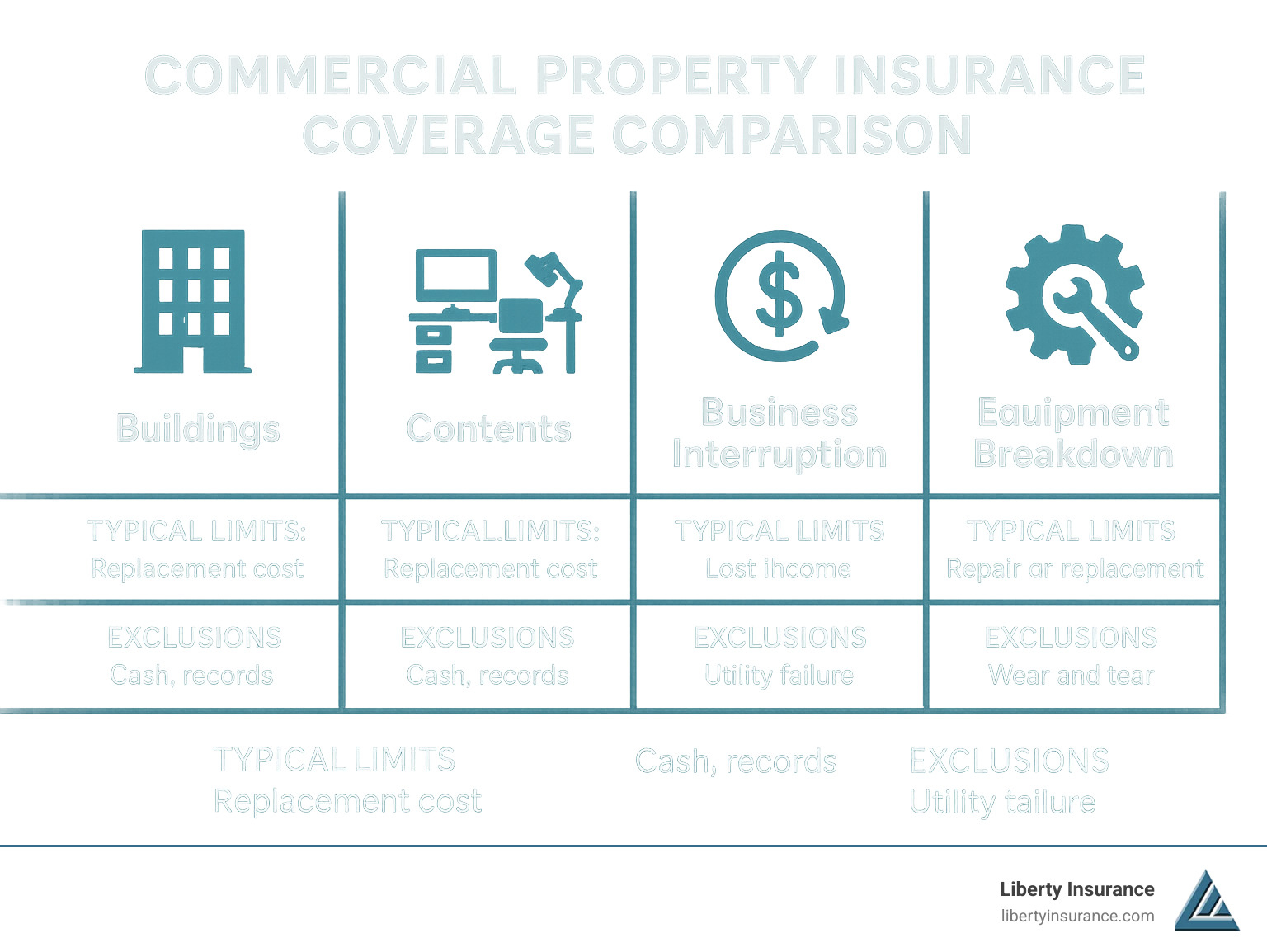
Commercial property insurance terms made easy:
– business personal property insurance
– general liability insurance small business
– types of business insurance
Commercial Property Insurance Explained
Think of commercial property insurance as your business’s safety net when disaster strikes. It’s the coverage that steps in to protect all those physical assets that keep your doors open—from your building itself to the equipment inside it.
Most policies are built on what insurance folks call the CP 00 10 form (that’s the Building and Personal Property Coverage Form). Don’t worry about memorizing that name—just know it’s the industry standard that sets the rules for what gets covered and how your claims get paid.
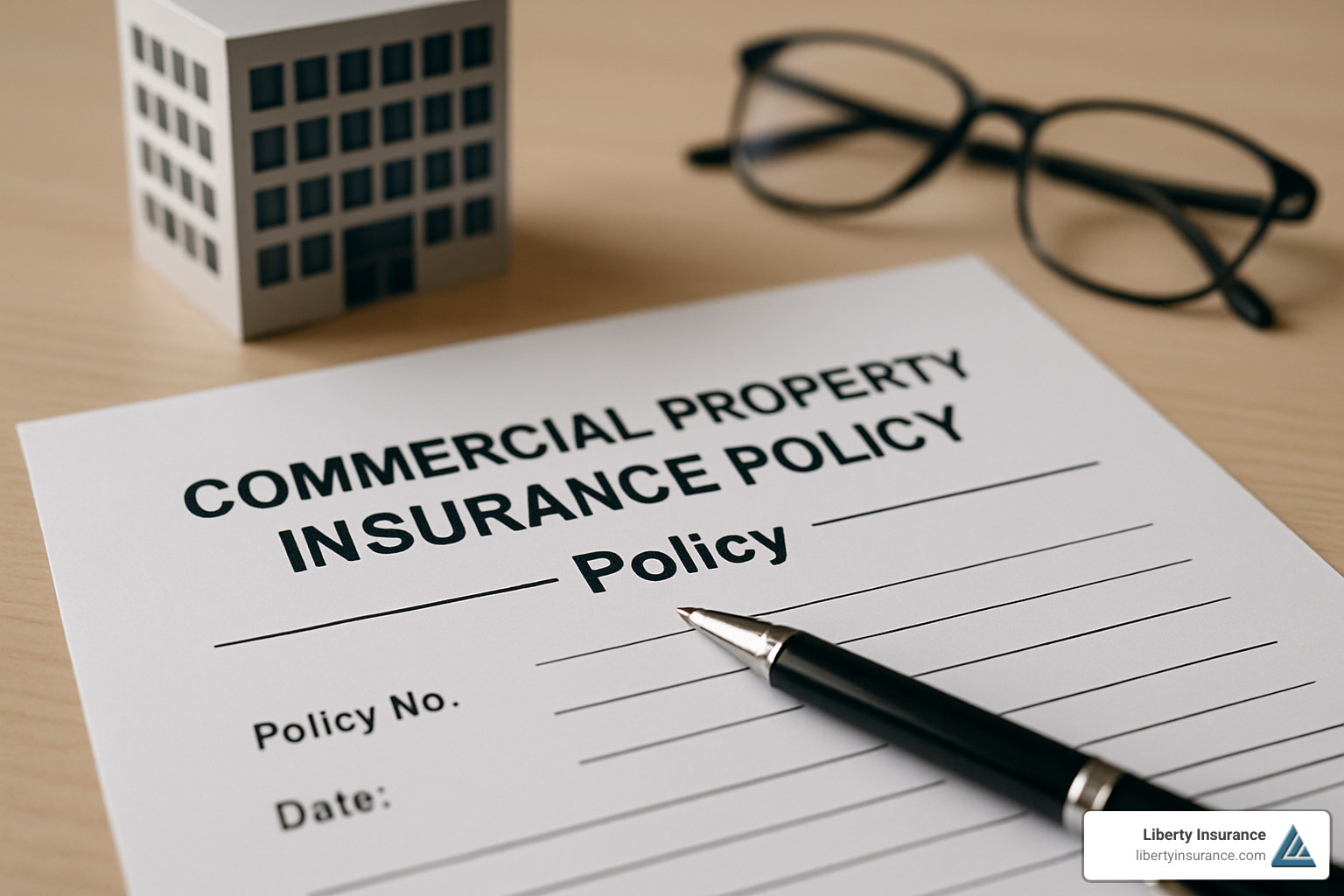
When you open your policy, you’ll find several key parts working together to protect your business:
Your declarations page is like the cover sheet—it shows your business details, how much coverage you have, your deductible, and what you’re paying. The coverage forms spell out exactly what property is protected, while the causes of loss forms list the specific dangers (like fire, theft, or windstorm) you’re insured against. The conditions section outlines what you and your insurer are responsible for, and any endorsements are special adjustments that customize your coverage.
One important concept to understand is coinsurance. This requires you to insure your property at a certain percentage of its value (usually 80-100%). Think of it as your commitment to being adequately insured—if you fall short, you might not get the full amount you’re expecting when you file a claim.
For a deeper dive into policy specifics, our Commercial Property Insurance Policy page has all the details.
How Commercial Property Insurance Works
When trouble finds your business, commercial property insurance springs into action. Here’s the process in real-world terms:
Something bad happens—maybe a fire breaks out in your stockroom or a storm damages your roof. You contact us right away and document everything (those photos on your phone will come in handy!). You’ll pay your deductible first—typically $500 or $1,000 with Liberty Insurance, though you can adjust this based on what works for your budget.
Our team assesses the damage and, once we have all your documentation, we typically make a decision within 48 hours. Then you receive payment to repair or replace what was damaged, based on your coverage limits and whether your policy pays replacement cost (the full cost to replace items new) or actual cash value (replacement cost minus depreciation).
Types of Businesses That Buy It
Almost every business needs commercial property insurance, but the protection looks different depending on what you do.
If you run a retail store, you’re protecting not just your space but all that inventory and those expensive checkout systems. Restaurant owners need coverage for specialized kitchen equipment and those perishable ingredients that could spoil during a power outage.
Contractors rely on their tools and equipment—imagine trying to finish a job if they were stolen overnight. Landlords need protection for their buildings and common areas, while home-based business owners often find (the hard way) that their homeowners policy doesn’t cover business equipment.
Even tech companies with minimal physical presence need coverage for those high-end computers and servers that keep their business running.
And here’s a common misconception: “I rent my space, so I don’t need property insurance.” Not true! Even if you don’t own the building, you still need to protect everything inside that belongs to your business—furniture, equipment, and any improvements you’ve made to the space.
What’s Covered—and What’s Not
Ever wonder what commercial property insurance actually protects? Let’s break it down in plain English so you know exactly what’s included—and just as importantly, what isn’t.
Your policy is designed to protect the physical assets that keep your business running day after day. Think of it as a safety net for all those things you’ve invested in that make your business… well, your business.
Standard Coverages:
When you invest in commercial property insurance, you’re protecting the backbone of your operation. Your building itself receives comprehensive coverage—from its foundation and completed additions to permanently installed fixtures and equipment. Even those outdoor fixtures within 100 feet of your premises fall under this protection.
But your building is just the beginning. All that stuff inside—what insurers call “business personal property”—is also covered. This includes your furniture, equipment, inventory, computers, and even those improvements you’ve made to a leased space.
Those eye-catching outdoor signs that bring customers through your door? They’re typically included too, though detached signs might need a bit of extra coverage. And if you’re temporarily looking after someone else’s property, you’ll have some protection there as well, though it’s usually limited.
When it comes to getting paid after a loss, how your property is valued makes all the difference:
| Valuation Method | How It Works | Best For | Drawbacks |
|---|---|---|---|
| Replacement Cost | Pays to replace property with new items of like kind and quality without deduction for depreciation | Businesses with newer equipment or those wanting maximum protection | Higher premiums |
| Actual Cash Value | Pays replacement cost minus depreciation based on age and condition | Businesses with older property seeking lower premiums | Lower claim payments that may not cover full replacement |
Covered Perils & Extensions
Most savvy business owners choose what’s called a “Special Causes of Loss” form (or “all-risk” coverage). This approach covers all direct physical losses except those specifically excluded—putting the burden of proof on the insurance company rather than on your shoulders.
Your commercial property insurance typically has your back when it comes to fire and smoke damage, lightning strikes, windstorms, hail, explosions, and even riots. It also covers damage from aircraft or vehicles, vandalism, theft (with some limitations), and water damage from burst pipes or leaky sprinklers.
Beyond these basics, many policies throw in some helpful extras. After a disaster, you’ll get help with debris removal, pollutant cleanup, and even fire department service charges. Many policies include limited coverage for valuable papers and records, and property in transit (though often with restrictions).
Common Exclusions & Limitations
Now for the reality check—what’s typically not covered by your commercial property insurance:
Flood damage requires separate coverage through the National Flood Insurance Program, while earthquake protection needs its own endorsement or policy. Normal wear and tear? That’s on you. And don’t even think about intentionally damaging your property—that’s never covered.
Other common gaps include increased costs to comply with current building codes after a loss (known as ordinance or law coverage), off-premises utility service interruptions, war and nuclear hazards, and terrorism (unless specifically added back). Cyber incidents causing physical damage are increasingly excluded from standard policies too.
It’s worth noting that your customers’ and employees’ personal belongings aren’t automatically covered under your policy unless you specifically add that protection. And remember—your commercial vehicles need their own commercial auto insurance.
Understanding these coverages and exclusions helps you spot potential gaps in your protection. After all, the best policy is one that actually covers what you need when disaster strikes.
Cost, Factors, and Ways to Save
Wondering what commercial property insurance might cost your business? You’re not alone. The price tag varies widely, but understanding what drives costs can help you find that sweet spot between protection and affordability.
Most small businesses pay around $67 monthly (about $800 yearly) for their commercial property insurance. That’s just the average, though—the majority (62%) actually spend $100 or less each month. Of course, if you’re running a larger operation or working in a higher-risk industry, your premium might look quite different.
Here at Liberty Insurance, we see premiums vary considerably among our New Jersey clients. A restaurant in Trenton might pay a different rate than an office building in Princeton or a retail shop in Toms River—each business has its own unique risk profile.
Factors That Drive Premiums
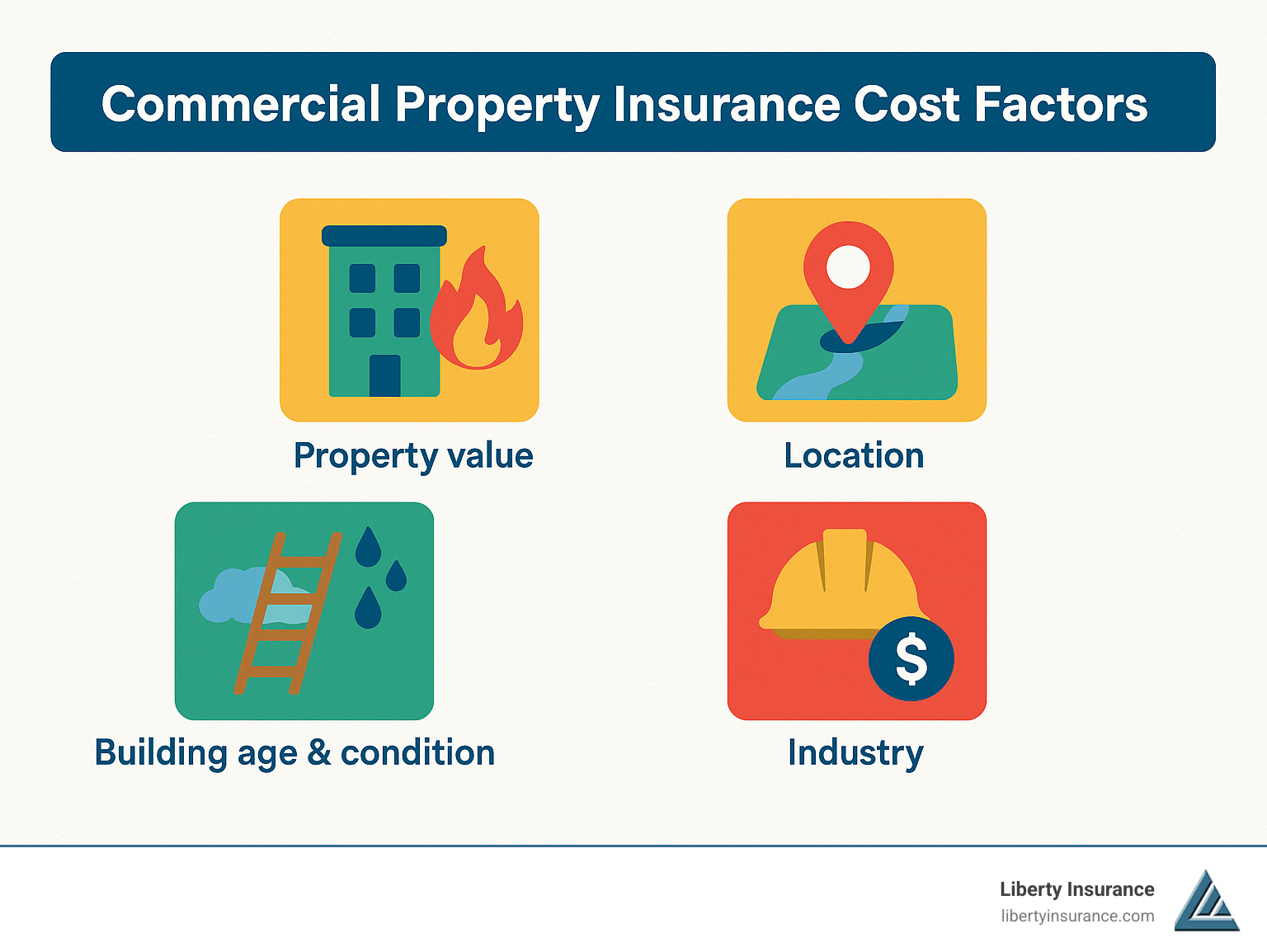
Your commercial property insurance cost isn’t pulled from thin air—it’s calculated based on specific factors about your business:
Where you’re located matters tremendously. If your building sits in hurricane-prone coastal New Jersey, you’ll likely pay more than someone in an inland area with fewer natural disasters. Being close to fire hydrants and fire stations can help lower your premium, though!
What your building is made of makes a big difference too. Fire-resistant materials like concrete and steel will earn you lower rates compared to wood-frame structures that burn more easily.
Newer buildings typically cost less to insure than older ones, especially if they have updated electrical, plumbing, and HVAC systems. And naturally, larger properties with more square footage generally mean higher premiums.
What you do in your building affects your rate as well. A restaurant kitchen with open flames presents higher fire risks than a quiet accounting office, and your premium will reflect that difference.
Good news: you can actively lower your rates by installing sprinklers, fire alarms, security systems, and surveillance cameras. Your claims history matters too—previous claims may bump up your premium, while a clean record works in your favor.
The rising costs of construction materials have pushed premiums higher in recent years, something we’ve seen affect many of our clients throughout New Jersey.
Money-Saving Strategies
While you never want to skimp on protecting your business, there are smart ways to manage your commercial property insurance costs:
Consider taking a slightly higher deductible. Jumping from a $1,000 to a $2,500 or even $5,000 deductible can significantly lower your premium—just make sure you could comfortably cover that amount if disaster strikes.
Bundle your policies for substantial savings. Combining commercial property with general liability in a Business Owner’s Policy (BOP) typically saves 10-15% compared to buying them separately. That’s real money back in your business account!
Invest in protection that pays for itself. Those fire sprinklers, security systems, and surveillance cameras don’t just protect your business—they can also qualify you for meaningful insurance discounts.
Pay annually instead of monthly if you can swing it. Many insurers (including us at Liberty Insurance) offer discounts of 5-10% for paying your premium in full.
Review your coverage values regularly to avoid overinsuring. As equipment depreciates or you upgrade to more efficient models, your coverage needs might change.
Document your safety procedures and train employees well. A solid risk management program sometimes qualifies for premium credits and certainly helps prevent claims in the first place.
For New Jersey business owners looking for flood protection, standard policies don’t cover flooding. You’ll need separate coverage through the National Flood Insurance Program, especially important in our coastal and low-lying areas.
Want to explore more about what drives costs? Our detailed guide on Commercial Property Insurance Cost breaks everything down even further.
Working with an experienced local agent who knows New Jersey’s unique risks can make all the difference. At Liberty Insurance, we pride ourselves on finding the most cost-effective coverage options custom to your specific situation—whether you’re in Millstone Township, New Brunswick, or anywhere in between.
Valuing Your Property, Policy Options & Limits
Getting the value of your business property right is like finding that perfect balance – too low and you’re left exposed after a disaster, too high and you’re throwing money away on premiums you don’t need. It’s perhaps the most crucial aspect of your commercial property insurance journey.
Determining Accurate Values
When it comes to valuing your business assets, you’ve got three main options to consider:
Replacement Cost Value (RCV) gives you the most complete protection. It pays to replace your damaged property with new items of similar kind and quality, without taking depreciation into account. Yes, the premiums are higher, but when disaster strikes, you’ll be glad you chose this option. Imagine replacing that five-year-old commercial kitchen equipment at today’s prices without any deduction for wear and tear!
Actual Cash Value (ACV) costs less up front but provides less protection when you need it. It calculates replacement cost minus depreciation based on age and condition. Your monthly premiums will be lighter on your budget, but that claim check might leave you digging into savings to fully replace what you lost.
Functional Replacement Cost can be a smart middle ground, especially for older buildings. It covers the cost to replace damaged property with less expensive but functionally equivalent property. If your 1950s building has ornate plaster ceilings that would cost a fortune to recreate exactly, this option lets you replace with modern materials that serve the same purpose.
For the most accurate valuation of your business property, we recommend:
Getting a professional third-party appraisal for your building rather than relying on those online calculators that might miss important details specific to your property. A few hundred dollars spent on an appraisal could save you thousands in the event of a claim.
Creating detailed inventory lists with purchase dates and values for all your business personal property. Take photos or videos of everything – from your computers and furniture to specialized equipment. Store these records in the cloud where a disaster can’t destroy them.
Don’t forget to account for seasonal inventory fluctuations if you’re in retail or another business where stock levels change throughout the year. A policy that adequately covers your holiday inventory peak will be overpriced during slower months if not structured properly.
Make updating your valuations a regular part of your business routine, especially after purchasing new equipment or making building improvements. At Liberty Insurance, we can help set up calendar reminders for these important reviews.
Policy Limits & Deductibles Impact
The limits and deductibles you choose significantly impact both what you pay now and what protection you’ll have when you need it.
When it comes to policy limits, you have options that fit different business situations:
Scheduled limits assign individual values to each building or category of property. This works well when you have a few distinct, valuable items that need specific coverage amounts.
Blanket limits provide a single coverage amount that applies across multiple buildings or types of property. This gives you flexibility in how your coverage is applied after a loss – particularly valuable if you have multiple locations or diverse property types.
Per-occurrence limits cap what will be paid for any single event, regardless of how many items are damaged. This is the maximum check you’ll receive after a covered disaster.
Most commercial property insurance policies include something called a coinsurance clause. This requires you to insure your property for at least a specified percentage (typically 80%) of its replacement value. If you don’t meet this requirement, you’ll face a penalty that reduces your claim payments.
Here’s a real-world example: If your building’s replacement value is $1,000,000 with an 80% coinsurance clause, you need at least $800,000 in coverage to avoid penalties. If you only insure for $600,000 and suffer a $100,000 loss, the math works against you: ($600,000 ÷ $800,000) × $100,000 = $75,000 (minus your deductible). That’s a $25,000 gap you’ll have to cover yourself!
When it comes to deductibles, most small businesses go with a $1,000 flat deductible, finding it strikes the right balance between manageable out-of-pocket costs and premium savings. But you have several options:
Flat deductibles are straightforward – a fixed dollar amount like $500, $1,000, or $2,500 that you’ll pay before insurance kicks in.
Percentage deductibles are calculated as a percentage of your insured value – often 1-5% for wind/hail coverage. On a $500,000 building with a 2% wind deductible, you’d be responsible for the first $10,000 in wind damage.
You’ll also want to understand if your deductible applies per-building or per-occurrence. The difference matters tremendously if multiple properties are damaged in the same event like a storm.
Understanding these valuation methods and policy structures is essential for creating the right Business Personal Property Insurance protection for your specific needs. At Liberty Insurance, we take the time to walk you through these options in plain English – no insurance jargon required.
Add-Ons, Bundled Policies, Risk Reduction & Claims
When it comes to protecting your business, standard commercial property insurance is just the beginning. Let’s explore how you can improve your coverage with valuable add-ons and smart bundling options.
Valuable Endorsements and Add-Ons
Think of endorsements as power-ups for your insurance policy. They fill important coverage gaps that could otherwise leave you exposed.
Equipment Breakdown Coverage does what standard policies don’t – it protects your vital machinery when it fails mechanically or electrically. If you’re a restaurant owner whose walk-in freezer suddenly stops working, or an office manager whose HVAC system crashes during summer, this coverage is a lifesaver.
Nothing hurts quite like watching your business sit idle after disaster strikes. Business Income Insurance (sometimes called interruption insurance) keeps money flowing while you’re closed for repairs by replacing lost income and covering ongoing expenses like rent and payroll. For many of our clients, this has been the difference between reopening and closing permanently.

Building codes change constantly, and if your property suffers damage, you might be required to rebuild to current standards – often at significant additional cost. Ordinance or Law Coverage handles these unexpected expenses that standard policies typically exclude.
For food-related businesses, Spoilage Coverage protects against loss of perishable products during power outages or equipment failures. Similarly, Utility Services Coverage extends protection when off-site service interruptions (like a neighborhood power outage) cause losses at your location.
If your equipment frequently travels between locations, Inland Marine Insurance fills an important gap by covering property in transit or at various locations – perfect for contractors, photographers, and businesses with mobile equipment.
Commercial Property Insurance vs Business Owner’s Policy
Small and medium-sized businesses often face a choice: standalone commercial property insurance or a bundled Business Owner’s Policy (BOP).
A BOP combines property coverage with general liability protection and typically includes business income coverage too. The beauty of bundling is the savings – typically 10-15% less than buying separate policies – plus the convenience of having essential coverages in one package.
BOPs work wonderfully for retail stores, small offices, service providers, apartment buildings, and small contractors. But if your business is larger or has unique risks, you might need a standalone commercial property policy with custom limits and endorsements custom to your specific situation.
We find many of our Liberty Insurance clients in New Jersey start with a BOP and then add specialized coverages as their businesses grow and evolve.
Filing a Claim & Proof of Insurance
When disaster strikes, a smooth claims process can dramatically speed your recovery. Here’s how to handle it effectively:
First, document everything thoroughly with photos and videos before cleanup begins. Report the incident promptly – most policies have specific timeframes for notification. Take reasonable steps to prevent additional damage (like covering broken windows), and gather documentation including inventory lists and receipts.
Working closely with your claims adjuster makes everything smoother. At Liberty Insurance, we strive to make claim decisions within 48 hours once we have complete documentation. Our online portal lets New Jersey clients submit and track claims 24/7, giving you peace of mind during stressful times.
When it comes to proving you’re insured, a Certificate of Insurance (COI) is your golden ticket. This document serves as evidence of coverage and is commonly requested by landlords, clients, and lenders. We can typically issue COIs the same day you request them, helping you meet business requirements without delays.
Reducing Risk to Lower Premiums
Smart business owners know that preventing losses is even better than having them covered. Plus, many risk reduction measures can directly lower your insurance costs.
Installing and maintaining fire protection systems like sprinklers and smoke detectors not only protects your business but often qualifies for premium discounts. The same goes for security improvements – surveillance cameras, alarm systems, and proper lighting deter criminals and impress insurers.
When building or renovating, consider using fire-resistant materials where possible. Implement regular maintenance for all building systems and equipment to prevent failures before they happen. Train your team on safety procedures and emergency protocols – well-prepared employees can prevent small incidents from becoming major disasters.
Many of our clients at Liberty Insurance have benefited from our risk assessment services, which identify specific improvements that could qualify for premium discounts. These assessments often reveal simple changes that dramatically reduce both risk and insurance costs.
Frequently Asked Questions
Is commercial property insurance required by law?
While commercial property insurance isn’t legally mandated by state or federal law, it’s effectively required in many business situations. If you have a mortgage or business loan, your lender will almost certainly require it. Similarly, commercial landlords typically make it a condition in lease agreements. Certain professional licenses and contracts may also demand proof of coverage.
Even when not explicitly required, this coverage provides essential protection most businesses simply can’t afford to go without. The cost of rebuilding and replacing business assets after a disaster would bankrupt many companies without proper insurance.
Do I need coverage if I lease my space?
Absolutely. Your landlord’s policy covers the building structure, but it doesn’t protect what matters most to your business – your stuff! This includes your furniture, equipment, inventory, and any improvements you’ve made to the space (like custom shelving, specialized lighting, or renovated interiors).
Just as importantly, your landlord’s policy won’t cover business income losses if you can’t operate due to property damage. Always review your lease carefully, as it will specify your insurance obligations. Some leases even require tenants to continue paying rent even if the space becomes unusable due to damage – making business income coverage especially important.
What documents prove I’m insured?
The primary proof of commercial property insurance is your Certificate of Insurance (COI). This document includes all the essential details about your coverage: your business name and location, insurance company, policy number, effective dates, coverage types and limits, deductible amounts, and any additional insureds.
At Liberty Insurance, we make it easy for our New Jersey clients to obtain COIs quickly – typically the same business day – either electronically or in hard copy. This allows you to promptly provide proof of insurance whenever it’s requested by landlords, clients, or regulatory authorities, keeping your business operations running smoothly.
Conclusion
Commercial property insurance truly serves as the foundation of your business protection plan. Think of it as the safety net that catches all those physical assets that keep your doors open and revenue flowing. Whether you run a cozy retail shop in Princeton or operate a busy manufacturing facility in Trenton, this coverage adapts to fit your specific needs.
Getting the right protection isn’t about buying the most expensive policy—it’s about understanding what makes your business unique and building coverage around those specific needs.
Start by taking a good look at what you own. How much would it really cost to replace your equipment if disaster struck tomorrow? Would you want brand-new replacements (replacement cost) or would you be okay with getting the depreciated value (actual cash value)? This honest assessment forms the backbone of effective coverage.
Next, consider the threats your business faces. A restaurant in coastal New Jersey might need different protection than a tech company in New Brunswick. Your policy should reflect these realities through the right coverage forms that address your specific risks.
Don’t forget to fill those coverage gaps! Standard policies might not cover everything you need. That’s where endorsements come in—adding protection for things like equipment breakdown or keeping income flowing when your business is temporarily closed after a disaster.
Smart business owners also know that preventing losses is just as important as insuring against them. Installing security systems, maintaining fire protection, and training employees on safety protocols not only protects your business but might earn you premium discounts too.
Finally, your business isn’t static—and neither should your insurance be. As you grow, acquire new equipment, or expand to new locations, your coverage needs to evolve too. We recommend reviewing your policy annually or whenever significant changes occur.
At Liberty Insurance, we pride ourselves on creating personalized commercial property insurance solutions for businesses across New Jersey. Our team intimately understands the challenges faced by business owners in Millstone Township, Trenton, Toms River, New Brunswick, Princeton, and surrounding areas.
The reality is that disasters rarely announce themselves—fires ignite, storms damage, and theft happens with little warning. With proper commercial property coverage in place, you can focus on what you do best—running your business—while knowing your assets stand protected.
Ready to secure your business with coverage that truly fits? Contact us today or request a quote. Our friendly, experienced agents are here to help you steer your options and find protection that gives you peace of mind without breaking the bank.

