
Why Understanding Inland Marine Insurance Examples Matters for Your Business
What is inland marine insurance examples? This question is critical for any business whose valuable assets don’t stay put. This specialized coverage protects your property when it’s most vulnerable: away from your primary business location. Common examples include:
- Construction Equipment: Essential tools, heavy machinery, and building materials located at a job site.
- Technology Assets: Company laptops, mobile servers, and diagnostic equipment used by employees off-premises.
- Fine Art & Collectibles: Valuable artwork and collections during transport, at exhibitions, or on loan.
- Customer Property: Items left in your care, custody, or control, such as electronics for repair or garments for cleaning.
- Mobile Equipment: The functional gear of a business on wheels, like food truck kitchens, mobile medical screening equipment, or a videographer’s production gear.
- Installation Materials: High-value items like custom cabinetry, HVAC units, or solar panels while in transit and during the installation process.
- Trade Show Exhibits: Booth structures, marketing materials, and product displays while traveling to and from conventions.
Don’t let the archaic name fool you—inland marine insurance has nothing to do with boats. It is a modern, flexible coverage that protects your business property when it’s on the move, stored off-site, or temporarily in someone else’s care.
Your standard business property insurance is designed to cover assets at a fixed address. The moment your equipment leaves, you create a dangerous and often costly coverage gap. A standard policy might offer a small sub-limit for off-premises property, perhaps $5,000, which is grossly inadequate if a trailer with $50,000 worth of tools is stolen. A stolen excavator doesn’t just represent the replacement cost of the machine; it means lost project time, expensive rental fees, and potential contract penalties. These are the real-world risks inland marine insurance is built to mitigate.
As Andrew Harris, a Certified Insurance Counselor with Liberty Insurance, I’ve helped hundreds of New Jersey businesses identify and close these gaps. My experience shows that most business owners are unaware of their mobile asset exposure until after a significant loss has occurred.
What is Inland Marine Insurance and Why the Confusing Name?
The name “inland marine insurance” is one of the most confusing in the industry, but its origins are rooted in the very history of commerce and insurance.
Think of it this way: your standard Commercial Property Insurance protects equipment at your fixed business address. But what happens when your contractor’s tools leave for a job site or your photography equipment travels to a wedding? That’s where inland marine insurance fills the gap, providing coverage that moves with your property.
The History Behind the Name
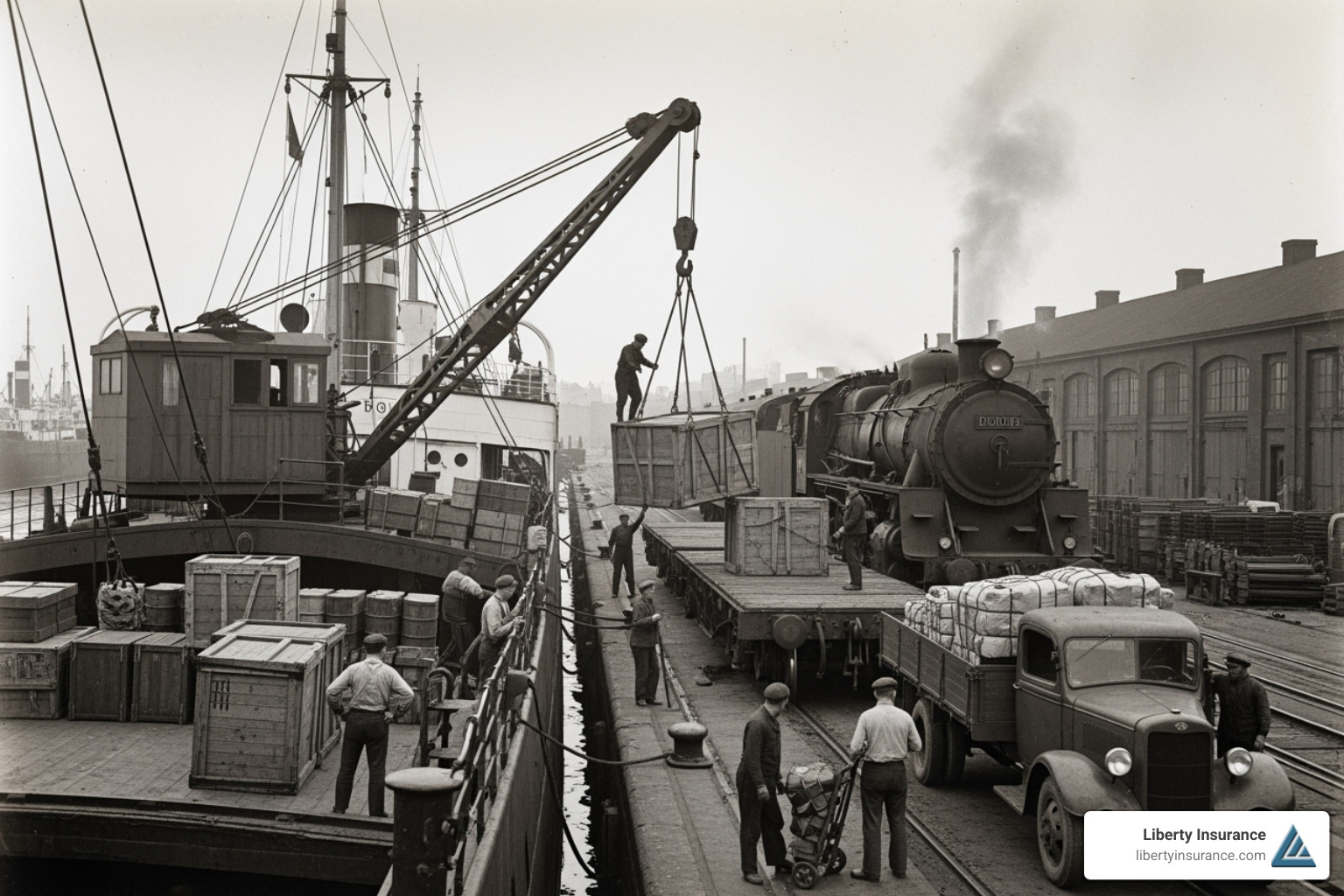
The story begins in the 17th and 18th centuries in the coffee houses of London, where merchants and ship owners gathered to underwrite voyages. This practice evolved into ocean marine insurance, which protected ships and cargo during dangerous sea journeys. However, once goods reached port, their journey was often far from over. They still needed to travel further inland by river barge, canal boat, train, or horse-drawn wagon to reach their final destination.
Ocean marine insurers saw an opportunity and expanded their business, offering policies to protect these goods as they moved away from the water. Because this new coverage wasn’t tied to a specific address but instead “floated” with the property, these policies were nicknamed “floaters.” Many inland marine policies are still called floaters today because they provide the same flexible, traveling protection. This historical context, as noted by the Insurance Information Institute, explains why we still use these seemingly odd terms.
The Modern Definition: Coverage That Moves With You
Today, inland marine insurance is an essential part of a comprehensive Business Insurance plan for any company whose valuable assets don’t stay in one place. It is broadly defined as coverage for property that is mobile in nature or involves transportation. This includes movable property like a contractor’s tools, specialized equipment like mobile medical devices, and even instrumentalities of communication and transportation like cell towers, bridges, pipelines, and fiber optic cables.
The beauty of this coverage is its flexibility and breadth. Unlike traditional property insurance that often covers only “named perils” (a specific list of risks like fire and theft), many inland marine policies provide “all-risk” (or open peril) coverage. This means the policy covers any loss unless the cause is specifically excluded, offering much broader protection. It typically protects against common risks like theft, fire, and accidental damage, no matter where your property is when a loss occurs. This makes it incredibly valuable for businesses that operate beyond the four walls of a single location.
What is Inland Marine Insurance? Examples for Different Industries

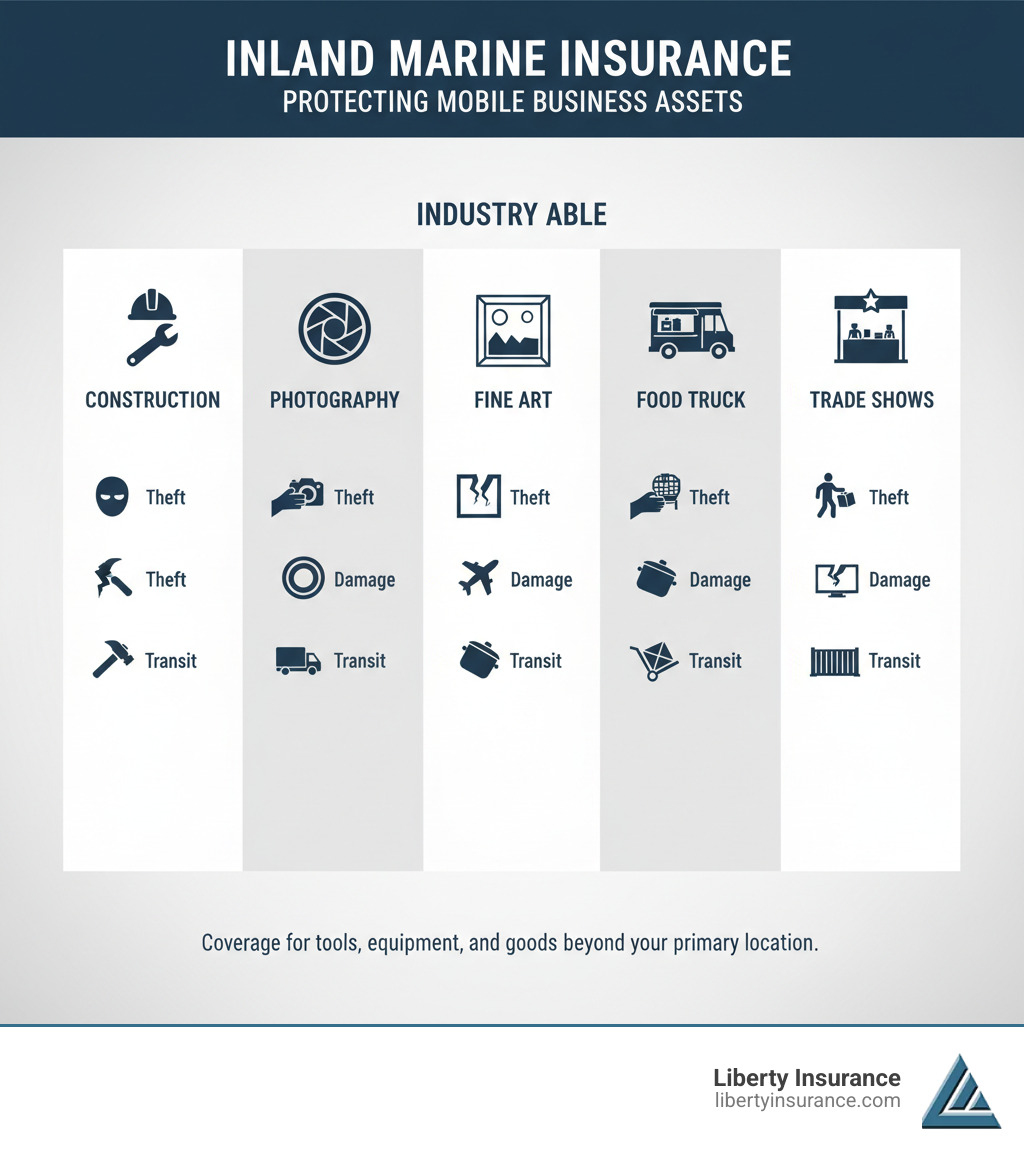
The true value of what is inland marine insurance examples lies in how the coverage adapts to meet each industry’s unique challenges. Unlike a one-size-fits-all business property policy, inland marine insurance follows your valuable assets wherever business takes them, providing tailored protection.
Inland Marine Insurance Examples for Contractors and Construction
Construction businesses operate in a world of constant motion, creating risks that standard property insurance can’t cover.
- Contractors’ Tools and Equipment Floaters: This is the cornerstone of inland marine for construction. It protects essential assets—from a blanket policy covering hand tools and power tools to a scheduled policy for high-value mobile machinery like bulldozers, cranes, and excavators. It covers them whether they are at a job site, in your truck, or temporarily stored elsewhere.
- Installation Floaters: This policy covers materials and equipment from the moment they leave your premises until they are successfully installed and accepted by the client. For example, if an HVAC contractor is lifting a $75,000 rooftop unit and it’s accidentally dropped and destroyed at the job site, this floater covers the loss, preventing a catastrophic financial hit.
- Builders Risk Insurance: This specialized inland marine coverage protects entire construction projects, from new builds to major renovations. It covers the structure and materials on-site against risks like fire, theft, vandalism, and weather damage. It’s important to note this covers the project itself, not the contractor’s own tools or equipment on site.
Inland Marine Insurance Examples for Technology, Arts, and Events
Valuable, mobile assets are not limited to construction sites. Creative, tech, and medical professionals also face unique risks.
- Electronic Data Processing (EDP) Equipment: This protects your hardware, software, and data. It covers losses from a power surge frying a server, a laptop stolen from an employee’s car, or damage during transit. Crucially, it can also cover the immense cost of data recovery, which often exceeds the hardware’s value.
- Fine Art and Collectibles: Galleries, museums, and collectors need specialized protection for valuable items being moved between exhibitions, transported for sale, or stored. It can cover risks specific to art, like damage from improper handling or changes in humidity.
- Medical and Scientific Equipment: This floater is vital for businesses with mobile diagnostic gear, such as portable X-ray machines, mobile MRI trailers, or environmental testing equipment used in the field.
- Photography and Musical Equipment: This coverage is essential for creative professionals who travel with expensive gear. It protects against theft of cameras from a wedding venue or damage to rare instruments during transport.
- Trade Show Exhibits: Companies invest thousands in booth displays and promotional materials. This coverage protects those assets from damage during shipping or theft at a conference venue.
Coverage for Businesses Handling Customer Property
If your business is responsible for other people’s property, you have a legal liability that requires special protection known as bailee’s coverage.
- Bailee’s Customer Coverage: This is for businesses that temporarily hold customer property, such as dry cleaners, computer repair shops, jewelers, or storage facilities. It covers your liability if a customer’s property is damaged, lost, or stolen while in your care.
- Motor Truck Cargo Coverage: This protects trucking and delivery services for their legal liability for the cargo they transport for others.
- Accounts Receivable Insurance: If your billing records are destroyed by a covered event like a fire, making it impossible to collect money owed to you, this coverage helps replace that lost income by helping to reconstruct records and covering uncollectible payments.
How Inland Marine Differs from Other Business Insurance
Understanding the unique role of inland marine insurance becomes clearer when you see how it fits with your other business policies. Each policy has a specialty, and they work together to create a comprehensive shield. What is inland marine insurance examples demonstrate how this coverage fills crucial gaps that other policies leave open.
| Insurance Type | What It Covers | Primary Purpose | Claim Example |
|---|---|---|---|
| Inland Marine | Your mobile property, goods in transit, off-premises equipment | Protects your own movable assets wherever they go | A contractor’s $75,000 of tools are stolen from a work van overnight. |
| Commercial Property | Buildings, fixtures, inventory at your fixed business location | Covers your assets at the address listed on the policy | A fire at your main office destroys computers and furniture. |
| General Liability | Third-party bodily injury and property damage you cause | Protects against lawsuits from others for your negligence | A client trips over your equipment at a job site and sues for their injuries. |
Inland Marine vs. Commercial Property Insurance
The biggest difference between inland marine and commercial property insurance is location. Your standard commercial property policy provides excellent protection, but only within the boundaries of your listed business address. While some policies include a small extension for “property off-premises,” this limit is often just $5,000 or $10,000 and may not cover all perils. If a trailer containing $80,000 of specialized equipment is stolen, that small extension is woefully inadequate.
Inland marine insurance, on the other hand, is designed to be mobile. It follows your valuable assets wherever they go. Another key difference is that inland marine policies often provide all-risk coverage (protecting against any loss unless specifically excluded), while many standard property policies are named-peril (covering only a list of specified risks). For more on this, our guide on Commercial Property Insurance can be a helpful resource.
Inland Marine vs. General Liability Insurance
This distinction is straightforward: general liability insurance protects you when your business operations accidentally damage someone else’s property or cause them injury. Inland marine insurance protects your own property from being damaged or lost.
For example, if your bulldozer operator accidentally damages a client’s underground pipes, your general liability policy would respond to the client’s claim. If that same bulldozer is stolen from the job site that night, your inland marine policy would respond to pay for your loss. General liability is third-party coverage; inland marine is first-party coverage.
Inland Marine vs. Commercial Auto Insurance
Many business owners get confused here. Commercial auto insurance covers your business vehicles—the trucks, vans, and cars themselves—and your liability if you cause an accident. However, it typically provides little to no coverage for the valuable contents inside those vehicles.
Inland marine insurance steps in to cover the tools, equipment, and inventory you transport. If a contractor’s van is stolen, commercial auto would cover the vehicle’s value, but a separate inland marine policy (like a tools and equipment floater) would be needed to cover the thousands of dollars of tools inside. Equipment that is permanently attached to the vehicle, like a welded ladder rack, is typically covered by the auto policy, but the ladders themselves require inland marine coverage.
Introduction
Picture this: You’re scrolling through insurance options and see “inland marine insurance.” Your first thought? Probably something about boats or harbors. Don’t let the name fool you—this essential business coverage has absolutely nothing to do with water.
So, what is inland marine insurance examples really all about? Think of it as your business’s traveling bodyguard. Inland marine insurance is a specialized type of property insurance that protects your valuable business assets when they’re on the move, stored somewhere else, or temporarily in someone else’s care.
Your standard Business Property Insurance works beautifully for protecting everything at your main business address. But the moment that equipment leaves your premises for a job site, you may have a significant coverage gap. This is the gap that inland marine insurance is designed to fill.
This guide will walk you through real-world examples, help you understand who needs this coverage, and show you how it protects your business’s mobile assets.
What is Inland Marine Insurance and Why the Confusing Name?
If you’re wondering what is inland marine insurance examples have to do with boats, you’re not alone. The name is genuinely confusing, but its history explains the term.
Inland marine insurance is property coverage for your business assets that don’t stay in one place. While your standard Commercial Property Insurance protects equipment at your business address, inland marine coverage follows your property wherever it goes—to job sites, trade shows, or client locations.
The History Behind the Name
Back in the 1700s and 1800s, ocean marine insurance protected valuable cargo during risky sea voyages. When ships reached port, the cargo still needed to get to its final destination by rail, wagon, or river barge. Insurers began offering coverage for these “inland” journeys as well.
These policies became known as “floater” policies because the coverage literally floated with the property as it moved. Unlike fire insurance of the day, which covered specific perils at fixed locations, marine insurers offered broader “all-risk” coverage.
The Modern Definition: Coverage That Moves With You
Today’s inland marine insurance is a crucial piece of any comprehensive Business Insurance plan. It protects business property that’s mobile, in transit, or temporarily stored away from your main business location. The coverage addresses several key scenarios, including movable property like construction equipment and specialized equipment such as medical devices. Its flexibility is what makes it so valuable for modern businesses.
What is Inland Marine Insurance? Examples for Different Industries
When exploring what is inland marine insurance examples look like, you’ll find this coverage adapts to fit the unique needs of different industries. A photographer’s camera equipment faces different threats than a contractor’s bulldozer, yet both need protection when they leave their home base.
Inland Marine Insurance Examples for Contractors and Construction
Contractors are constantly moving tools and equipment between job sites across New Jersey.
- Contractors’ Tools and Equipment Floater: This policy protects everything from hand tools to heavy machinery. It covers your assets whether they are stolen from a job site or damaged in transit.
- Installation Floater: This protection kicks in the moment you load materials onto your truck until they’re installed. It is critical for contractors transporting high-value items like commercial HVAC units or solar panels.
- Builders Risk Insurance: This policy protects entire construction projects from start to finish, covering the structure and materials against fire, theft, and weather damage.
Inland Marine Insurance Examples for Technology, Arts, and Events
Many other businesses depend on valuable, portable assets that need specialized protection.
- Electronic Data Processing (EDP) Insurance: This coverage protects hardware, software, and data when equipment leaves the office. It can cover not just hardware replacement but also the costly process of data recovery.
- Fine Art and Exhibition Coverage: Art galleries, museums, and private collectors use this to protect valuable pieces during transport for exhibitions, sales, or conservation work.
- Photography and Musical Equipment Floaters: This is essential for creative professionals who carry their livelihoods with them to different venues.
- Trade Show Exhibits Floater: This protects the substantial investments companies make in marketing displays and promotional materials that travel to conferences.
Coverage for Businesses Handling Customer Property
Some businesses are responsible for other people’s valuable property, which creates a special type of risk.
- Bailee’s Customer Coverage: This protects businesses that temporarily hold customer property, like dry cleaners or repair shops. If a customer’s item is damaged or stolen while in your care, this coverage helps pay for the replacement.
- Motor Truck Cargo Coverage: This is for businesses that transport goods for others, covering their legal liability for cargo damage or loss.
- Accounts Receivable Insurance: If a disaster destroys your billing records, you might not be able to collect money owed to you. This coverage helps replace that lost income.
How Inland Marine Differs from Other Business Insurance
Understanding the unique role of inland marine insurance becomes much clearer when you compare it to other common business policies. While all these policies work together, they each address fundamentally different types of risks.
| Insurance Type | What It Covers | Primary Purpose | Claim Example |
|---|---|---|---|
| Inland Marine | Your movable business property away from your premises | Protects your mobile assets wherever they go | A contractor’s $25,000 excavator stolen from a job site |
| Commercial Property | Your business property at a fixed location | Protects assets at your business premises | Fire damages inventory stored in your warehouse |
| General Liability | Claims others make against your business | Protects against lawsuits for injury or damage you cause | Customer slips and falls at your business location |
Inland Marine vs. Commercial Property Insurance
This distinction is the most important one to understand. Your standard Commercial Property Insurance is designed for stationary assets at your specified business address. The moment your valuable property leaves that location, your coverage may become limited or disappear entirely.
Inland marine insurance is designed for this exact scenario. It travels with your property, providing protection at job sites, during transport, or at temporary storage locations. Furthermore, inland marine policies are frequently written on an “all-risk” basis, covering everything unless it’s specifically excluded, which is broader than the “named perils” basis of many property policies.
Inland Marine vs. General Liability Insurance
These two policies serve completely different purposes in your Business Insurance portfolio.
- Inland marine insurance is first-party property coverage: It protects your own business assets from physical loss or damage.
- General liability insurance is third-party liability coverage: It protects your business when you are legally responsible for causing bodily injury or property damage to someone else.
Inland Marine vs. Commercial Auto Insurance
This comparison often causes confusion. Commercial auto insurance covers the vehicle itself and the liability that comes with operating it. Inland marine insurance covers the valuable contents you are transporting in that vehicle. Your commercial auto policy likely provides little to no coverage for the expensive tools or equipment inside your truck or van.
Understanding Your Inland Marine Policy

Once you’ve identified the need for inland marine coverage, the next step is understanding how these policies are structured and what they cover. While designed to be flexible, they have specific rules and limitations that are critical to grasp before a loss occurs.
How Policies are Structured
Inland marine insurance can be adapted to your business needs. It can be purchased as a standalone policy, which is ideal for businesses with extensive, high-value, or complex mobile property, as it allows for higher limits and more customized terms. More commonly for small to mid-sized businesses, it is added as an endorsement to an existing Businessowners Policy (BOP) or Commercial Package Policy. This is often a cost-effective route for businesses with more straightforward needs.
When listing your property, you have two main options:
- Scheduled Property: This approach lists each valuable item individually with its own declared value and, often, a serial number. This is best for high-value, unique items like a specific piece of heavy machinery, a high-end camera, or a rare musical instrument.
- Blanket Coverage: This provides a single, aggregate coverage limit for a group of similar items without needing to list each one. This is perfect for a contractor’s collection of power tools or a photographer’s bag of cables, batteries, and accessories. It offers more flexibility than scheduling every single item.
Common Exclusions and Valuation
It’s crucial to know what isn’t covered. While often written on an “all-risk” basis, every policy has exclusions. Common ones include:
- Normal wear and tear, rust, or gradual deterioration.
- Mechanical breakdown or electrical failure (unless it results in a covered peril like a fire).
- Inherent vice, where an item deteriorates due to its own nature (e.g., a sensitive chemical that degrades over time).
- Intentional damage by you or your employees.
- Mysterious disappearance, where property is missing with no evidence of theft (this is sometimes covered but may have a higher deductible).
- Catastrophic events like floods, earthquakes, and war, which often require separate coverage.
Valuation determines your payout in a claim. Actual Cash Value (ACV) pays the replacement cost minus depreciation. Replacement Cost Value (RCV) pays to replace your item with a new one of similar kind and quality, without deducting for depreciation. Many inland marine policies can be written on an RCV basis, which is a significant advantage for equipment that you would want to replace with a new model.
Frequently Asked Questions about Inland Marine Insurance
After helping hundreds of New Jersey businesses protect their mobile assets, we’ve noticed the same questions come up again and again. Let’s clear up the confusion with some straight answers.
Who typically needs inland marine insurance?
Any business that owns valuable property that doesn’t stay in one place needs to consider this coverage. Understanding what is inland marine insurance examples helps clarify if your business fits the profile.
- Contractors and construction companies who move expensive tools and machinery between job sites.
- Technology firms with employees who work remotely or install equipment at client locations.
- Creative professionals like photographers, musicians, and videographers who travel with their gear.
- Mobile service providers, such as food trucks, mobile pet groomers, or on-site repair services.
- Landscapers and arborists with valuable mowers, chippers, and other equipment.
- Businesses that handle customer property, like dry cleaners, electronics repair shops, and storage facilities, need bailee’s coverage.
If your business’s ability to generate revenue depends on equipment that regularly leaves your premises, you likely need inland marine coverage.
How much does inland marine insurance cost?
Pricing is highly individualized. While some industry data suggests an average annual premium is around $2,500 per year, this can vary dramatically. Your actual cost will depend on several factors:
- The value of the property: Higher values mean higher premiums.
- Your industry and risk level: A construction company faces higher theft and damage risks than a solo consultant, affecting the cost.
- Your business’s claims history: A clean record demonstrates good risk management and results in lower premiums.
- Your chosen coverage limits and deductibles: Higher limits and lower deductibles increase the cost.
- Security measures: Using GPS trackers on equipment or having a secured yard for overnight storage can sometimes lead to discounts.
Is inland marine the same as cargo insurance?
No, but they are related. Think of “cargo insurance” as a broad term for protecting goods in transit. Inland marine insurance is a category that includes specific types of cargo coverage, but it also covers much more.
For example, Motor Truck Cargo coverage is a type of inland marine policy that protects a trucking company for its liability for the cargo it’s hauling for others. However, an equipment floater is an inland marine policy that protects your own business property directly, whether it’s being shipped, sitting at a job site, or stored in your work van overnight. The key difference is that inland marine protects your mobile property wherever it goes, not just during active transportation.
Does inland marine insurance cover property worldwide?
Typically, no. A standard inland marine policy provides coverage within a defined territory, which is usually the United States, its territories and possessions, and Canada. If you or your employees travel with business property to Mexico or overseas for a project, you will likely have no coverage under a standard policy. For international protection, you would need to add a specific worldwide coverage endorsement or purchase a separate, specialized transit policy.
Protecting Your Mobile Assets for Peace of Mind
From a contractor’s tools at a New Jersey job site to a photographer’s camera gear on a shoot in Princeton, your business’s most valuable assets are often its most mobile. As the what is inland marine insurance examples in this guide show, your property is uniquely vulnerable the moment it leaves your primary location.
Many business owners mistakenly rely on standard property insurance, unknowingly creating a dangerous coverage gap that can threaten their financial stability. Inland marine insurance closes this gap with flexible, comprehensive protection that acts as a financial bodyguard for your assets. Unlike rigid, location-bound policies, this coverage is designed to be as mobile as your business. Whether your assets are on a truck traveling down Route 1, at a client’s location in Millstone Township, or temporarily stored in a warehouse in Toms River, your protection travels with them.
A proper insurance strategy involves more than just buying a policy; it’s about understanding how your business operates and where its unique risks lie. By reviewing your equipment floaters, bailee’s coverage needs, and installation risks, you can build a resilient business that can withstand the unexpected.
At Liberty Insurance, we’ve spent years helping New Jersey businesses navigate these complexities. Our experienced agents take the time to understand how your business operates, where your assets travel, and what unique risks you face. Whether you’re based in New Brunswick, Trenton, or anywhere across the Garden State, we can help you find the right protection.
Don’t wait for a theft or accident to reveal a costly gap in your coverage. The peace of mind that comes with proper inland marine protection is invaluable. Take the proactive step today to safeguard your mobile assets and secure your business’s financial future.
Learn more about Inland Marine Insurance and get the protection your business needs.

