
The Hidden Risk That Could Bankrupt Your Manufacturing Business
Manufacturing E&O insurance protects manufacturers from third-party financial losses caused by errors, omissions, or defective products—losses that aren’t covered by standard General Liability policies.
What Manufacturing E&O Insurance Covers:
- Financial damages from product defects or failures
- Errors in professional services (design, engineering, consulting)
- Breach of contract claims
- Legal defense costs
- Third-party economic losses without bodily injury or property damage
What It Doesn’t Cover:
- Bodily injury or property damage (covered by General Liability)
- Manufacturing delays
- Patent infringement
- Product recall expenses
Imagine this: A customer asks you to manufacture brake cables at 2.5 inches, but an error results in them being 2.25 inches. The cables are unusable, your customer misses their deadline, and they sue for $200,000 in lost income. Your General Liability policy won’t cover this—but Manufacturing E&O would.
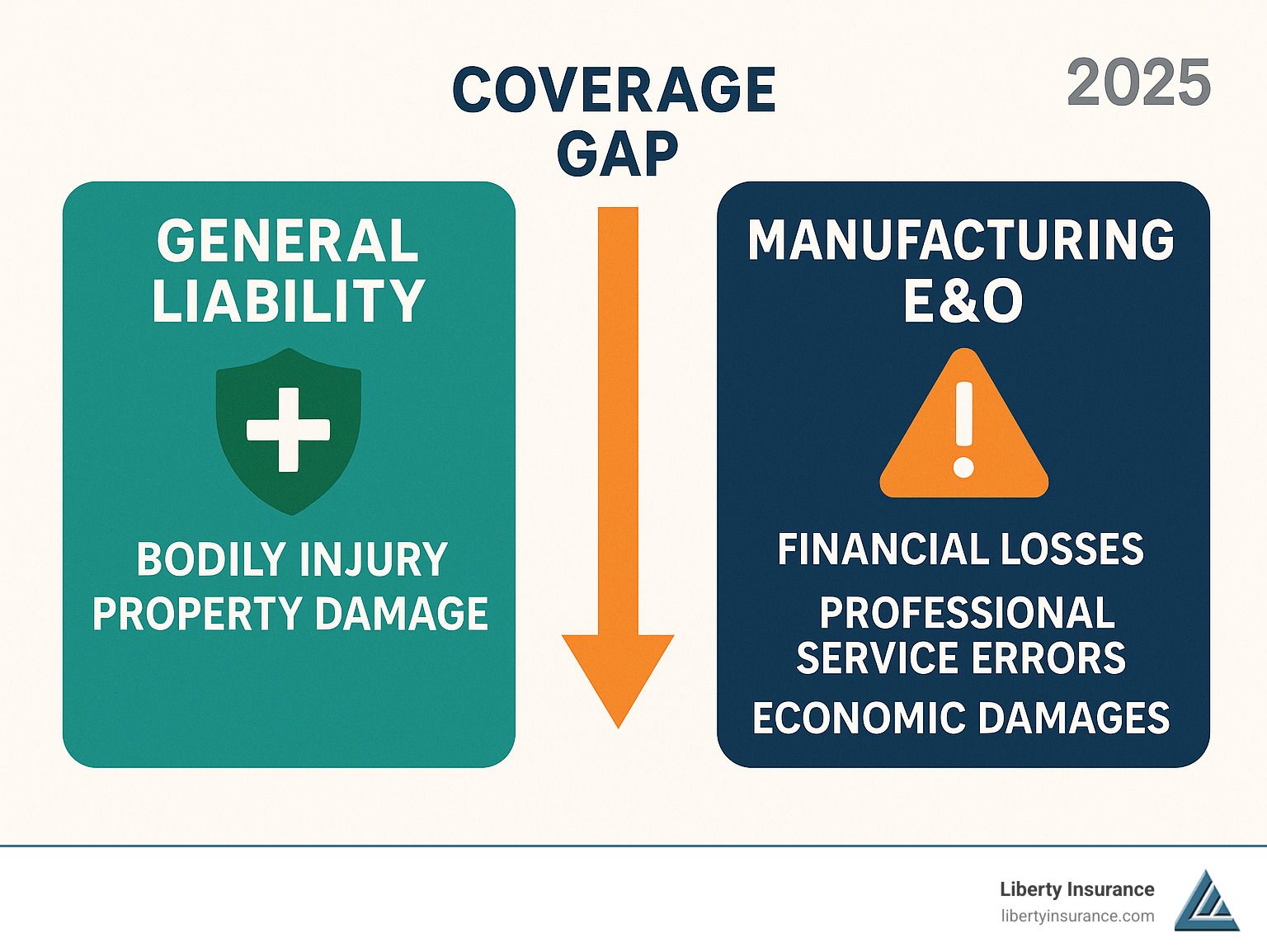
The manufacturing landscape is more complex than ever. Companies face increasing risks from longer supply chains, technology integration, and detailed contractual obligations. Traditional General Liability insurance covers bodily injury and property damage, but it typically excludes financial losses that don’t involve physical harm. This creates a dangerous coverage gap for manufacturers who provide professional services, design products, or whose errors could cause substantial economic damage to clients.
As an insurance counselor with over 15 years of experience, I’ve seen how manufacturing E&O insurance can be the difference between surviving a costly claim and going out of business. Most manufacturers don’t realize they need this specialized coverage until it’s too late.
For additional perspective on the evolving challenges the industry faces, the National Association of Manufacturers offers regularly updated research and insights into U.S. manufacturing trends.
Must-know manufacturing e&o insurance terms:
What is Manufacturers Errors & Omissions (E&O) Insurance?
Manufacturing E&O insurance, also known as professional liability for manufacturers, protects your business from financial losses a third party suffers because of your error. It’s a safety net for mistakes that don’t cause physical injury or property damage.
While often associated with doctors or lawyers, E&O is crucial in today’s complex manufacturing world. Your company may offer professional services like design, engineering, or technical advice. When an error occurs in these services, or your product fails to perform as promised, the result for your client can be purely financial.
This insurance covers claims of economic injury due to a defect or error on your part. It addresses claims that you were negligent in services, failed to perform as promised under a contract, or that your design flaws caused a client to lose money. It safeguards your business from claims related to your professional work and product quality, even when no one is physically harmed.
For example, if your company designs a custom part for a client’s assembly line and a design flaw halts their production, they could lose millions. Manufacturing E&O insurance would protect you against their claim for that lost income.
The Critical Difference: E&O vs. General Liability (GL)
Many manufacturers assume their General Liability (GL) insurance covers everything, but GL has a significant “coverage gap” concerning errors and omissions.
General Liability (GL) insurance primarily protects your business from claims of bodily injury or property damage. If a part from your factory breaks and injures someone or damages a customer’s equipment, your GL policy helps cover those costs.
However, GL policies usually exclude claims that are only about financial loss. They often contain exclusions for “damage to impaired property” or “property not physically injured.” This means if your product is faulty but causes no physical harm, or your service error leads to a client’s purely financial loss (like lost profits), your GL policy likely won’t respond.
This is where manufacturing E&O insurance fills the gap. It covers the financial loss claims that GL leaves behind, protecting against pure economic harm.
Here’s a quick look at how they compare:
| Feature | Manufacturers E&O Insurance | General Liability (GL) Insurance |
|---|---|---|
| Core Coverage | Financial loss, economic injury, professional service errors, design flaws, breach of contract. | Bodily injury, property damage. |
| Typical Claim Scenario | A client loses revenue because your manufactured component was slightly off-spec, causing production delays. | Your product malfunctions and causes a fire in a customer’s facility, leading to property damage. |
| Primary Purpose | Protects against financial damages from errors in professional services or product failures that don’t involve physical harm. | Protects against physical harm (bodily injury or property damage) caused by your business operations or products. |
Understanding this difference is vital for your business’s financial health. Without manufacturing E&O insurance, you leave your company exposed to a major type of claim that is increasingly common.
Why Manufacturing E&O Insurance is a Must-Have Today

The manufacturing world is growing and evolving. As of 2023, the U.S. had about 623,000 manufacturing businesses, a 0.7% increase from 2022. This growth brings new challenges: longer supply chains, smart factory technology, and complex contracts create risks that often lead to financial, rather than physical, damages.
Modern manufacturing risks are more detailed than ever. New technology boosts efficiency but also creates more opportunities for errors that cause financial harm. At the same time, attracting and retaining a quality workforce is a top priority for 83% of manufacturers, with talent shortages putting pressure on teams and potentially increasing errors.
In this environment, manufacturing E&O insurance is essential. It protects your business’s reputation from the damage a flawed product can cause and helps manage contractual obligations that demand specific performance standards. Many contracts now require E&O coverage, especially when professional services are involved. Considering the average manufacturer spends nearly $20,000 per employee on regulatory compliance alone, adding a major financial loss claim can be devastating. Manufacturing E&O insurance is a smart investment to ensure your business can handle modern challenges and continue to thrive.
Who Needs This Coverage Most?
While nearly any manufacturer can benefit from manufacturing E&O insurance, it is especially critical for certain businesses:
Component part manufacturers: A tiny error in a small part—say, 0.1mm too small—might not cause physical harm but could halt a client’s entire production line. They would look to you to cover their lost profits and other related expenses.
B2B manufacturers: If you sell to other businesses, you’re dealing with sophisticated clients who have tight schedules and complex supply chains. An error on your part can cause a significant ripple effect, leading to large financial claims.
Manufacturers providing value-added services: If you offer design, engineering, consulting, assembly, installation, or training, you have professional liability exposure. An error in these services that leads to a client’s financial loss is precisely what E&O insurance is designed to cover.
Companies with strict client contracts: If your agreements include performance clauses, penalties for delays, or specific design requirements, your risk is liftd. Some clients won’t even award a contract unless you have E&O insurance.
In short, if your product or service could put your customers at financial risk, manufacturing E&O insurance is a strategic necessity.
What Your Policy Covers: Inclusions, Exclusions, and Real-World Scenarios
Understanding what your manufacturing E&O insurance policy covers is key. A robust policy is designed to cover a third party’s financial damages resulting from your errors or omissions, a crucial distinction from General Liability.
Here’s what your policy generally includes:
- Financial Damages: This covers economic losses your client suffers due to your error, such as lost profits, business interruption, or increased operational expenses.
- Faulty Products and Material Defects: If your product is defective or doesn’t perform its intended function due to a manufacturing mistake, your E&O policy can cover the financial fallout for your client.
- Errors in Professional Services: If your company provides design, engineering, or consulting services, and an error leads to a client’s financial loss, your E&O policy steps in.
- Negligent Quality Control: If a lapse in your quality control leads to a defective product that causes a financial loss for your client, E&O can cover the claim.
- Legal Defense Costs: E&O policies typically cover legal fees, court costs, settlements, and judgments, even if a claim is baseless. This is a critical benefit, as defense costs alone can be crippling.
- Breach of Contract: If your error or omission leads to a breach of contract, causing financial harm to your client, many E&O policies can cover these claims.
- Coverage for Subcontractors: Your E&O policy can extend to cover errors made by a subcontractor if you are held legally responsible for their work.
Common Claims Scenarios for manufacturing e&o insurance
To understand the value of manufacturing E&O insurance, consider these common scenarios:
- Incorrect Product Specifications: A customer orders 5,000 cables at 2.5 inches, but a manufacturing error produces them at 2.25 inches. The unusable cables halt the customer’s assembly line, and they sue for lost production. Your E&O policy would cover this, while a GL policy would not.
- Design Error Causing a Client’s Recall: A subtle design flaw in a component you manufacture causes a client’s end product to malfunction, forcing a costly recall. They sue you for their lost profits and reputational damage.
- Faulty Component Halting Production: You supply a conveyor system that fails due to a defect, bringing your customer’s entire production line to a standstill. They hold you responsible for their significant financial losses.
- Improper Installation or Calibration: You manufacture and install specialized equipment. Your team improperly calibrates the machines, causing the client’s product to be defective. They sue you for reduced profit margins and business interruption.
These scenarios illustrate that the damage is purely financial, which is the sweet spot for manufacturing E&O insurance. For more examples, see our Manufacturing E&O Claim Scenarios.
Key Exclusions in a manufacturing e&o insurance Policy
While powerful, manufacturing E&O insurance doesn’t cover everything. It’s designed to fill the gap left by GL, not replace other essential coverages. Common exclusions include:
- Bodily Injury and Property Damage: These are covered by your General Liability policy.
- Product Recall Expenses: E&O may cover a client’s financial impact from a recall (e.g., lost profits), but not the direct costs of the recall itself (e.g., retrieving products). This requires a separate Product Recall Expense policy.
- Patent Infringement: Intellectual property disputes require specialized IP insurance.
- Manufacturing Delays: Financial harm resulting solely from a delay, without an underlying error in design or service, may be excluded.
- Intentional Fraud or Criminal Acts: E&O policies cover errors, not intentional wrongdoing.
- Pre-Policy Work: Most E&O policies are “claims-made,” meaning work performed before the policy’s retroactive date is typically excluded.
- Customer Communication Errors: If a mistake occurs because you followed a customer’s incorrect written specifications, your policy may not cover it. Clear documentation is crucial.
Always read your policy carefully and discuss any concerns with your insurance provider to ensure you don’t have any coverage gaps.
How to Choose the Right E&O Policy
Choosing the right manufacturing E&O insurance policy requires a custom approach to fit your unique business risks. At Liberty Insurance, we help clients select a policy that provides the right balance of coverage for their specific needs.
Key factors to consider include policy limits and deductibles. Your policy limit is the maximum your insurer will pay for a claim. We help you determine an adequate limit based on your contracts, client size, and services. Your deductible is what you pay before insurance kicks in; we’ll help you find a level that fits your budget.
Most manufacturing E&O insurance policies are “claims-made,” meaning the policy active when a claim is reported is the one that responds. The error must also have occurred within a specific time frame. Continuous coverage is therefore essential.
Other important considerations include:
- Coverage for subcontractors: Ensure your policy covers their work if you are held responsible for their mistakes.
- Affirmative coverage for design and engineering: If you offer these professional services, your policy must clearly state it covers them to avoid ambiguity in a claim.
- Defense cost allocation: We seek policies with 100% defense allocation, meaning legal defense costs don’t reduce your policy limits for settlements or judgments.
- “Hammer clause”: We prefer policies without this clause, which can force you to accept a settlement, giving you more control over your defense.
- Bundled coverage: Many modern policies offer options to bundle cyber event and pollution coverage, providing more comprehensive protection for today’s digital factories.
Choosing the right policy involves a careful review of your business operations and risks. To help you steer this, we’ve created A guide to comprehensive E&O policies.
Frequently Asked Questions about Manufacturing E&O
We get a lot of questions from manufacturers who are trying to wrap their heads around manufacturing E&O insurance. It’s totally understandable – this coverage fills a specific gap that many business owners didn’t even know existed. Let me walk you through the most common questions we hear, because chances are, you’re wondering about the same things.
Does E&O cover mistakes made by my subcontractors?
Here’s the good news: yes, it typically does. If you’re legally responsible for an error or omission made by your subcontractor that causes a financial loss for your client, your manufacturing E&O insurance policy should step in to protect you.
Think about it this way – when you hire a subcontractor to handle part of your manufacturing process, you’re still the one with the contract and relationship with your end client. If that subcontractor makes a mistake that costs your client money, they’re going to come after you, not the subcontractor.
For example, let’s say you outsource the heat treatment of metal components to a specialized facility. If they mess up the process and the parts don’t meet specifications, causing your client’s production line to shut down, you could be on the hook for their financial losses. Your E&O policy would cover this scenario.
We always make sure this coverage is explicitly included when we’re setting up a policy for our clients. It’s too important to leave to chance.
Are legal defense costs included in the coverage?
Absolutely! This might actually be one of the most valuable parts of your manufacturing E&O insurance policy. Legal defense costs – including attorney fees, court costs, expert witness fees, and all those other expenses that pile up during a lawsuit – are typically covered.
Here’s what makes this so important: even if a claim against you turns out to be completely bogus, you still have to defend yourself. And let me tell you, legal fees can add up faster than a teenager’s phone bill. We’re talking tens of thousands, sometimes hundreds of thousands of dollars, just to prove you did nothing wrong.
Many policies offer what we call “100% defense allocation,” which means these legal costs don’t eat into your policy limits. So if you have a $1 million policy and spend $200,000 defending a claim, you still have the full $1 million available for any settlement or judgment.
It’s like having a legal bodyguard who’s already paid for. Pretty reassuring, right?
What happens if a customer’s claim is due to their own error in the specifications they provided?
This is where things get interesting, and frankly, where good documentation becomes your best friend. Generally speaking, manufacturing E&O insurance is designed to cover your errors and omissions, not your customer’s mistakes.
If your customer provided you with incorrect specifications, and you followed those specifications exactly as written, then their claim typically wouldn’t be covered under your E&O policy. After all, you did exactly what they asked you to do.
But here’s the catch – and this is huge – you need to have written documentation that proves you followed their specifications to the letter. If it’s just a verbal agreement or if there’s any ambiguity about what was requested versus what was delivered, things can get murky fast.
This is why we always tell our clients to get everything in writing. Every specification, every change order, every conversation about requirements should be documented. It’s your paper trail that proves you held up your end of the bargain.
The bottom line? Your E&O policy protects you from your mistakes, but it can’t protect you from claims based on your customer’s errors – unless you can clearly prove that’s what happened.
Protect Your Business from Costly Errors
Wow, we’ve covered a lot, haven’t we? We’ve explored the ins and outs of manufacturing E&O insurance, from understanding its crucial role compared to General Liability to diving into real-world scenarios and what to look for in a policy. One thing should be crystal clear by now: in today’s , complex manufacturing world, this specialized coverage isn’t just a nice-to-have; it’s a genuine must-have.
Think about it. The manufacturing industry is constantly pushing boundaries, integrating new tech, and navigating increasingly long and intricate supply chains. Plus, finding and keeping skilled talent is a big challenge. All these factors create a fertile ground for errors and omissions that, while not causing physical harm, can lead to devastating financial losses for your business or your clients.
Your traditional General Liability policy is fantastic for covering bodily injuries and property damage – and you absolutely need it! But it leaves a significant “gap” when it comes to purely economic damages. This is where manufacturing E&O insurance steps in, acting as that essential safety net. It fills that critical GL coverage gap, protecting you from claims stemming from design flaws, manufacturing defects, mistakes in the professional services you offer, or even breaches of contract. It’s all about making sure a single misstep doesn’t send your entire operation spiraling.
At Liberty Insurance, we truly get the unique challenges and exposures manufacturers face. Whether you’re operating out of Millstone Township, Trenton, Toms River, New Brunswick, or Princeton, we understand the local landscape and the specific risks you encounter every day. Our customizable coverage solutions are designed precisely to shield your business from those often unseen and easily overlooked risks that can lead to major financial headaches.
Don’t wait for a costly error to hit your business before you realize you needed this vital protection. Take a proactive step today to secure your future. Let’s work together to develop a comprehensive business insurance strategy that includes the specialized peace of mind that manufacturing E&O insurance provides. We’re here to help you steer these complexities and ensure your business is adequately protected.

