
Why New Jersey Businesses Need Surety Bonds
Surety Bonds New Jersey are financial guarantees required for many businesses in the Garden State. Whether you’re a contractor, motor vehicle dealer, or licensed professional, understanding surety bonds is crucial for legal compliance and business success.
Quick Answer for Surety Bonds New Jersey:
- Definition: A three-party agreement between a principal (you), an obligee (the party requiring the bond), and a surety (the bond company).
- Cost: Typically 1% to 10% of the bond amount, paid annually.
- Purpose: To protect consumers and government agencies from financial loss.
- Common Types: License bonds, contract bonds, and court bonds.
- Requirements: Mandated by state regulations and vary by industry.
While the process may seem complex, obtaining a surety bond involves three straightforward steps. New Jersey requires these bonds across numerous industries, from construction companies needing performance bonds for projects over $850,000 to collection agencies needing consumer protection bonds.
As a Certified Insurance Counselor with extensive experience, I’ve guided countless New Jersey businesses through the Surety Bonds New Jersey process. My work has provided deep insight into the state’s specific bonding landscape and regulatory requirements.
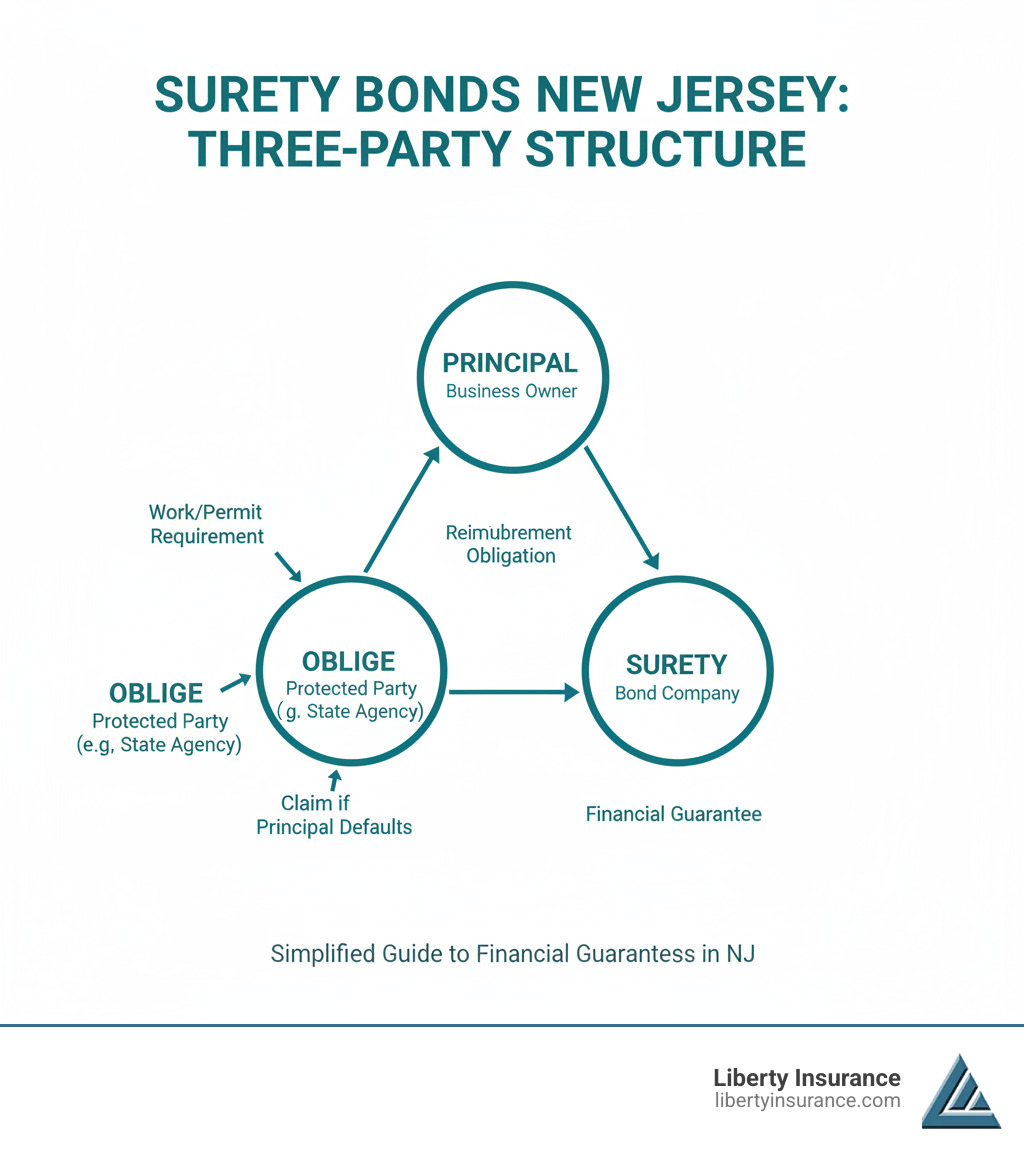
Simple guide to Surety Bonds New Jersey:
Understanding the Basics of Surety Bonds in New Jersey
Before applying, understand what a surety bond is and why it’s required. Unlike traditional insurance that protects you, a surety bond primarily protects your client or the public (the obligee) from financial loss if you (the principal) fail to fulfill your obligations. The surety company provides this financial guarantee.
What is a Surety Bond?
A surety bond is a legally binding, three-party agreement that functions as a financial safety net. The parties are:
- The Principal: You—the business owner or individual required to obtain the bond and fulfill an obligation.
- The Obligee: The entity requiring the bond, such as the State of New Jersey, a licensing board, or a client. The obligee is protected by the bond.
- The Surety: The surety company that backs your promise to the obligee. They guarantee that if you fail to meet your obligation, they will cover the resulting losses.
A surety bond is a financial guarantee, but it is not insurance. If the obligee files a valid claim against the bond, the surety will pay the obligee up to the bond’s full amount. However, under the indemnity agreement you sign, you are legally obligated to reimburse the surety for the entire claim amount plus any legal fees. This is a critical point: the indemnity agreement often extends to your personal assets, not just your business assets. It is a personal guarantee that you will make the surety whole. The ultimate financial responsibility always remains with you, the principal.
Why are Surety Bonds Required in New Jersey?
New Jersey mandates Surety Bonds New Jersey to ensure consumer protection, regulatory compliance, and public trust.
The primary goal is consumer protection. Bonds safeguard consumers from fraudulent or incomplete work. For example, if a contractor abandons a kitchen remodel after taking a large deposit, the homeowner can file a claim against the contractor’s bond to recover their financial losses and hire another professional to finish the job. The New Jersey Division of Consumer Affairs often outlines these requirements to protect the public from such predatory or negligent practices.
Regulatory compliance is another key reason. Government agencies use bonds to ensure businesses follow state laws and licensing requirements, maintaining high industry standards. The bond acts as a financial deterrent against violating regulations; if a business breaks the rules, a claim can be filed, resulting in a direct financial consequence. For many professions, such as motor vehicle dealers and collection agencies, a bond is a mandatory licensing requirement.
These bonds also build public trust by signaling that a business has met financial standards and is backed by a reputable surety. This gives consumers confidence in the services they receive, knowing there is a financial recourse available if things go wrong.
For public works projects, especially those over $850,000, New Jersey law (N.J.S.A. 2A:44-143) mandates payment and performance bonds. These contractor bids and bonds ensure projects are completed and that subcontractors are paid, protecting taxpayer funds.
Additionally, various government mandates require bonds for specific permits and activities. Upcoming changes to the Contractors’ Business Registration Act (CBRA) in 2025 will introduce new surety bond requirements for Home Improvement and Home Elevation Contractor Businesses, further strengthening consumer protection.
The 3 Simple Steps to Obtain Your New Jersey Surety Bond
Getting the right bond doesn’t have to be a headache. This straightforward three-step process will help you secure the Surety Bonds New Jersey you need efficiently.
Step 1: Identify Your Specific Bond Requirement
First, you must know exactly which bond you need. The entity requiring your bond, the obligee, will specify the exact bond type and the required coverage amount. This could be a state licensing board, a government agency like the New Jersey Motor Vehicle Commission, a court, or a private project owner.
For example, a contractor may need New Jersey Contractor Bonds for a project, while a motor vehicle dealer needs a different type of license bond. To avoid delays, contact your obligee directly to confirm the bond’s name, amount, and any specific forms required.
Step 2: Complete the Application and Get Your Quote
With your bond requirements in hand, you can apply with a reputable surety provider. The surety’s underwriters will review your application to assess risk and determine your premium. For many standard bonds, this process is fast, and you can receive a quote almost instantly online.

Information Needed to Apply for a Surety Bond
To speed up your application, have the following information ready:
- Business Information: Your business name, legal structure (LLC, corporation, etc.), address, and contact details.
- Owner’s Personal Information: Full name and social security number. Your personal credit history is a key factor in underwriting.
- Bond Details: The specific bond type and amount required by the obligee.
- Financial Statements: For larger or more complex bonds (like contract bonds), you may need to provide business financial statements.
- Professional Experience: Details about your years in business, past projects, and relevant licenses.
- Claims History: Information about any prior claims against your business or previous bonds.
Factors That Influence the Cost of a Surety Bonds New Jersey
The bond’s cost, or premium, is a percentage of the total bond amount, typically 1% to 10% annually. Several factors influence your rate:
- Personal Credit Score: This is often the most significant factor. A strong credit score usually results in a lower premium.
- Bond Type: Lower-risk bonds, like many license and permit bonds, are cheaper than higher-risk contract bonds.
- Business Financials: For larger bonds, the financial health of your business is closely examined.
- Professional Experience: A strong track record can positively impact your rate.
- Claims History: A history of claims will likely increase your premium.
Managing your financial health is key to securing favorable rates, much like it is for Insurance for Business Owners in New Jersey.
Step 3: Purchase, Sign, and File Your Bond
Once you accept your quote, you’ll pay the premium. After payment, the surety company issues the official bond document. Many standard bonds can be issued within minutes, which is helpful for tight deadlines.
Review the bond document carefully to ensure all information—your name, business details, bond amount, and obligee information—is correct. Then, sign the bond as the principal.
The final, critical step is to file the original, signed bond document with the obligee. Your bond is not active until it is officially filed. Once filed, you are compliant and can proceed with your license, permit, or project.
Common Types of Surety Bonds in New Jersey
New Jersey’s economy requires a wide variety of Surety Bonds New Jersey across different industries. Understanding the main categories can help simplify the process.

Each bond serves a specific purpose, but all are designed to protect consumers and ensure businesses meet their obligations.
Contract Surety Bonds
Essential for the construction industry, contract bonds provide financial assurance for building projects. They are especially critical for public works, with New Jersey law (N.J.S.A. 2A:44-143 & 144) requiring them for projects exceeding $850,000.
- Bid Bonds: Guarantee that if your bid is accepted, you will enter into the contract and provide the required performance and payment bonds.
- Performance Bond NJ: Guarantees you will complete the project according to the contract’s terms.
- Payment Bonds: Ensure that subcontractors, laborers, and material suppliers are paid for their work.
- Maintenance Bonds: Guarantee the quality of your work and materials for a specified period after project completion, typically one to two years.
Our Contract Surety Bonds page offers more detail on project-specific requirements.
Commercial License & Permit Bonds
Many professions in New Jersey require a license or permit bond to operate legally. These bonds ensure that businesses adhere to state laws and ethical standards, protecting consumers. Common examples include:
- Motor Vehicle Dealer Bonds: Protect car buyers from fraud or misrepresentation during a vehicle sale.
- Home Improvement Contractor Bonds: The upcoming 2025 CBRA changes will introduce new tiered bond requirements for home improvement (HICBs) and home elevation (HECBs) contractors. The bond amount will be based on the contractor’s annual gross sales, likely ranging from $10,000 to $50,000, enhancing homeowner protection. Our Home Improvement Contractor Insurance NJ resource can help you prepare.
- Public Adjuster Bonds: Ensure adjusters act ethically and in the best interest of policyholders when assisting with insurance claims.
- Collection Agency Bonds: Protect consumers from unlawful, harassing, or deceptive collection practices.
- HVACR Contractor Bonds: Guarantee that heating, ventilation, air conditioning, and refrigeration contractors meet licensing standards and perform work safely and correctly.
- Health Club Bonds: Required for fitness centers to protect members’ prepaid fees in case the club closes unexpectedly.
- Private Detective Bonds: Ensure private investigators operate within the law and handle sensitive information responsibly.
Court & Fiduciary Bonds
Courts require these bonds to ensure individuals appointed to manage sensitive financial or personal affairs do so honestly and responsibly. They guarantee that the appointed person will perform their duties according to the court’s orders.
- Probate Bonds: Required for individuals appointed to manage an estate. This category includes Executor Bonds (for those named in a will) and Administrator Bonds (for when there is no will).
- Guardianship Bonds: Protect the assets of minors or incapacitated adults by ensuring their appointed guardian acts responsibly and in the ward’s best interest.
- Trustee Bonds: Provide similar protection for assets held in a trust, ensuring the trustee manages the assets according to the trust’s terms.
- Appeal Bonds (Supersedeas Bonds): Required in litigation when a party wishes to appeal a court’s monetary judgment. The bond guarantees that the original judgment will be paid if the appeal is lost, while delaying payment during the appeal process.
Navigating the New Jersey Surety Bond Landscape
Understanding New Jersey’s specific rules is key to managing your bonding requirements. From costs to claims, being informed will help you operate successfully.
The Cost of Surety Bonds New Jersey
The cost of a Surety Bonds New Jersey, known as the bond premium, is a small fraction of the total bond amount. Most clients pay between 1% and 3% annually for standard license and permit bonds. For a $10,000 bond, your annual premium might be just $100 to $300. Some low-risk fixed-price bonds have a standard premium regardless of credit, often for a flat fee.
Surety companies use a tiered pricing model based on risk. Applicants with strong personal credit (e.g., 700+) and solid financials typically qualify for the lowest “standard market” rates, often around 1%. Those with moderate credit may fall into a mid-tier with slightly higher premiums, while applicants with significant credit challenges may be placed in a high-risk program with premiums ranging from 5% to 10% or more.
More complex contract bonds may range from 0.5% to 3%, depending on your qualifications. The underwriting process determines your premium based on risk. Your personal credit score is often the most significant factor; excellent credit typically secures the lowest rates.
For larger contract bonds, your business’s financial health—cash flow, working capital, and overall strength—is closely reviewed. Proactive financial management, similar to what’s needed for Small Business Insurance NJ, can lead to lower bonding costs.
Finding Approved Surety Companies and the Role of the DOBI
Not all surety companies are authorized to operate in New Jersey. The New Jersey Department of Banking and Insurance (DOBI) regulates these companies to ensure they are financially sound. The DOBI maintains an official New Jersey List of Approved Surety Companies that can provide bonds for public works projects over $850,000, as required by N.J.S.A. 2A:44-143 & 144.
Choosing a company from this list ensures you partner with a stable and compliant provider. These lists include NAIC codes and may note if a company is “Treasury Listed.” A Treasury-listed company is approved by the U.S. Department of the Treasury for federal projects, indicating exceptional financial strength.
Working with an experienced insurance partner means this research is already done for you. We work exclusively with approved, reliable sureties that meet New Jersey’s strict requirements.
What Happens if a Claim is Filed Against Your Bond?
A claim can be filed if the obligee suffers a financial loss because you failed to meet your bonded obligations, such as incomplete work or non-payment of suppliers.
The claim investigation begins when the obligee notifies the surety. The surety investigates the facts to determine if the claim is valid. If it is, and you cannot resolve the issue directly, the surety will make a surety payout to the claimant up to the bond amount.
However, you are not off the hook. The principal’s indemnity agreement requires you to reimburse the surety for the full claim payout, plus any legal fees. This is a key difference from traditional insurance—the ultimate financial responsibility is yours. If a claim is filed, you should immediately contact your surety agent, gather all relevant documentation (contracts, communication, proof of work), and cooperate fully with the investigation. A swift and transparent response can sometimes help mitigate the outcome.
Avoiding claims is crucial. A claim can make it harder and more expensive to get bonded in the future. Upholding professional standards and fulfilling all contractual obligations are your best defenses. Having proper General Liability Insurance NJ can also help protect against liabilities that could lead to bond claims.

Frequently Asked Questions about New Jersey Surety Bonds
Here are answers to some of the most common questions we receive about surety bonds in New Jersey.
Can I get a surety bond in New Jersey with bad credit?
Yes, it is often possible to get a Surety Bonds New Jersey with a less-than-perfect credit score. While good credit typically leads to lower premiums (often 1-3%), many surety providers have programs specifically for individuals with credit challenges. These are sometimes called “high-risk” or “subprime” bond programs.
You will likely face a higher premium, potentially in the 4% to 15% range, to offset the increased risk to the surety. In some cases, you might need to provide collateral or have a co-signer. However, bad credit should not stop you from getting the bond you need to operate legally. We work with our network of sureties to find the best available rates and terms for your specific situation.
How long is a surety bond valid for in New Jersey?
The validity period of a Surety Bonds New Jersey depends on the bond type.
License and Permit Bonds are typically valid for one year and must be renewed annually to keep your license active. The surety will send you a renewal notice before the expiration date. Missing a renewal can lead to a license suspension and potential fines.
Contract Bonds are tied to specific projects. A bid bond is valid until the contract is awarded, while performance and payment bonds last for the project’s duration, including any specified warranty period (often one or two years post-completion).
Court and Fiduciary Bonds remain in effect until your court-appointed duties are complete and the court formally releases you from the obligation. This could take months or even years, depending on the complexity of the case.
It’s crucial to track renewal dates to avoid a lapse in coverage. Our team can help streamline the renewal process.
How can I lower my surety bond premium over time?
Lowering your bond premium is an achievable goal that requires proactive effort. Since your premium is based on perceived risk, reducing that risk is key. Here are several strategies:
- Improve Your Personal Credit Score: This is the single most effective way to lower your premium for most bonds. Pay bills on time, reduce outstanding debt, and correct any errors on your credit report.
- Maintain Clean Business Financials: For larger contract bonds, strong business financial statements (balance sheet, income statement) demonstrate stability and reduce risk. Work with an accountant to keep your records in order.
- Avoid Bond Claims: A clean claims history is vital. Fulfilling all contractual and regulatory obligations shows the surety that you are a low-risk principal. A single claim can significantly increase future premiums.
- Build Experience: A longer, successful track record in your industry can lead to better rates over time as you prove your reliability.
By focusing on these areas, you can position yourself for the best possible rates at your next renewal.
What is the difference between a surety bond and business insurance?
This is a critical distinction. While both offer financial protection, they serve different purposes and protect different parties.
Business insurance is a two-party agreement between you and an insurer. It protects your business from financial loss. If a covered event occurs, like a fire, theft, or liability claim against you, the insurance company pays for the damages, and you are only responsible for your deductible. You can learn more about Business Insurance on our site.
A surety bond is a three-party agreement that protects the other party (the obligee), not you. The surety company guarantees your promise to the obligee. If you fail to fulfill that promise and a claim is paid, you are legally required to reimburse the surety for the full amount under the indemnity agreement.
Think of it this way: insurance is a risk transfer tool that protects your assets. A surety bond is a credit instrument, similar to a co-signed loan, where you are ultimately responsible for repayment. This is why fulfilling your contractual obligations is so important when you are bonded.
Conclusion
Securing Surety Bonds New Jersey is a vital step for compliance, building trust, and growing your business. Think of it as a passport that allows you to operate legally and compete for valuable contracts.
By following the three simple steps—identifying your requirement, completing an application, and filing your bond—you can steer the process with confidence. These bonds are more than a regulatory hurdle; they are a competitive advantage, signaling to clients that you meet high professional and financial standards.
While bonds protect your clients, it’s equally important to protect your own business. At Liberty Insurance, we understand that bonding is just one piece of your risk management puzzle. Our team helps Garden State businesses secure not only the right bonds but also robust commercial property insurance to safeguard physical assets and operations.
Our experts can help you build a comprehensive protection strategy custom to your business. To get started, explore our New Jersey Contractor Bonds page today. We look forward to partnering with you for a secure future in the Garden State.

